Group Members :
Satnam 25
Kabita 26
Aishwarya 27


                  1
 Copy data from a source
Scanners take paper and convert it into a bitmap
   Types of scanners
       Optical scanner
       Bar code readers
       Character and Mark recognition


                                                   2
   Convert text or drawings into machine
    readable format
   Can be displayed, printed, or stored
   Types of optical scanners
      Flatbed scanner
            Source placed on glass surface
            Image scanned from below
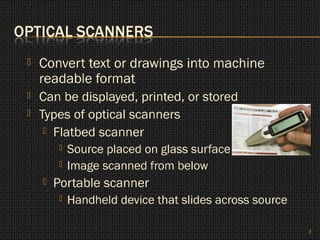
       Portable scanner
            Handheld device that slides across source

                                                         3
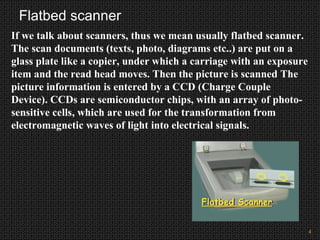
Flatbed scanner
If we talk about scanners, thus we mean usually flatbed scanner.
The scan documents (texts, photo, diagrams etc..) are put on a
glass plate like a copier, under which a carriage with an exposure
item and the read head moves. Then the picture is scanned The
picture information is entered by a CCD (Charge Couple
Device). CCDs are semiconductor chips, with an array of photo-
sensitive cells, which are used for the transformation from
electromagnetic waves of light into electrical signals.


                                                                     4
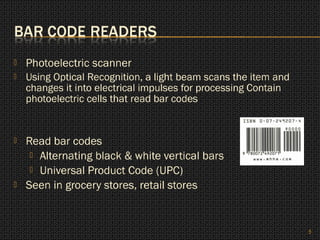
   Photoelectric scanner
   Using Optical Recognition, a light beam scans the item and
    changes it into electrical impulses for processing Contain
    photoelectric cells that read bar codes


   Read bar codes
      Alternating black & white vertical bars
      Universal Product Code (UPC)
   Seen in grocery stores, retail stores


                                                                 5
   Magnetic-ink character recognition (MICR)
      Reads magnetically encoded characters

   Optical-character recognition (OCR)
   Optical character recognition (OCR) converts
    bitmap back into text
       • different fonts create problems for simple
    “template matching”
                algorithms
       • more complex systems segment text,
    decompose it into lines and arcs, and decipher
    characters that way
   Optical-mark recognition (OMR)
      Senses presence or absence of marks


                                                       6
   A flatbed scanner scans one sheet at a time by laying
    the sheet face down on the bed of the scanner
   Sheetfed scanner use motorized rollers to feed the
    document across the scanning mechanism
   Handheld scanner-portable device that requires users
    to pass the scanning element over the item to be
    scanned


                                                            7
   Bar codes-each product has a unique product
    code (UPC) represented by a pattern of bars
   Bar code scanner scans the bars using
    reflected light which is then processed to
    retrieve product information assigned to that
    bar code
   Handwriting Recognition


                                                    8
   Scanners are typically envisioned as connected to a co-
    located host computer.
   Submitting “Jobs” to network scanners is unnatural
    since a walk-up user must be present to submit the
    originals anyway.
   Jobs may be most naturally started at the scanner and
    not at a workstation.
   Will be more prevalent as networked MFPs provide
    scanning capability.


                                                              9
   Archive-Communicate
             recording a facsimile of an image, such as a form or a
              signature for storage, transmission or reproduction.
              Parameters and area probably well defined, fidelity important.
              Includes Copying, Fax.
   Modify-Reproduce
             Capturing an image for inclusion in a document or display,
              often with modification, scaling, cropping, etc. Parameters
              may not be known and area to be scanned may be
              inconsistent, fidelity important.
   Extract-Analysis
             Processing an image for analysis or interpretation, such as
              OCR or feature analysis. Parameters and area probably well
              defined, fidelity not too important for extraction. Analysis
              required very high fidelity.

                                                                               10
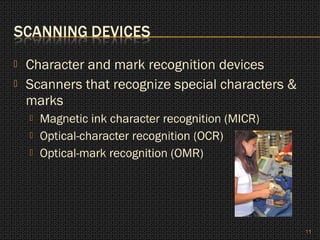
   Character and mark recognition devices
   Scanners that recognize special characters &
    marks
       Magnetic ink character recognition (MICR)
       Optical-character recognition (OCR)
       Optical-mark recognition (OMR)


                                                    11
   Scanners read and
    interpret information
    on printed matter
   The information is
    converted to a format
    for storage


                            12
   Grades test
   Checks survey
       The sense marks are
        compared on the test by
        the scanner
       Corrections are
        calculated


                                  13
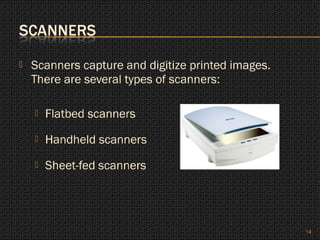
   Scanners capture and digitize printed images.
    There are several types of scanners:

       Flatbed scanners
       Handheld scanners
       Sheet-fed scanners


                                                    14
   Item to be scanned is to be pulled into a
    stationary scanning mechanism
   Smaller and less expensive than flatbed
    scanner


                                                15
   Item to be scanned rotates around stationary
    scanning mechanism
   Very large and expensive
   Used in the publishing industry.


                                                   16
Thank You


            17

Scanner presentation

  • 1.
    Group Members : Satnam25 Kabita 26 Aishwarya 27 1
  • 2.
     Copy datafrom a source Scanners take paper and convert it into a bitmap  Types of scanners  Optical scanner  Bar code readers  Character and Mark recognition 2
  • 3.
    Convert text or drawings into machine readable format  Can be displayed, printed, or stored  Types of optical scanners  Flatbed scanner  Source placed on glass surface  Image scanned from below  Portable scanner  Handheld device that slides across source 3
  • 4.
    Flatbed scanner If wetalk about scanners, thus we mean usually flatbed scanner. The scan documents (texts, photo, diagrams etc..) are put on a glass plate like a copier, under which a carriage with an exposure item and the read head moves. Then the picture is scanned The picture information is entered by a CCD (Charge Couple Device). CCDs are semiconductor chips, with an array of photo- sensitive cells, which are used for the transformation from electromagnetic waves of light into electrical signals. 4
  • 5.
    Photoelectric scanner  Using Optical Recognition, a light beam scans the item and changes it into electrical impulses for processing Contain photoelectric cells that read bar codes  Read bar codes  Alternating black & white vertical bars  Universal Product Code (UPC)  Seen in grocery stores, retail stores 5
  • 6.
    Magnetic-ink character recognition (MICR)  Reads magnetically encoded characters  Optical-character recognition (OCR)  Optical character recognition (OCR) converts bitmap back into text  • different fonts create problems for simple “template matching” algorithms  • more complex systems segment text, decompose it into lines and arcs, and decipher characters that way  Optical-mark recognition (OMR)  Senses presence or absence of marks 6
  • 7.
    A flatbed scanner scans one sheet at a time by laying the sheet face down on the bed of the scanner  Sheetfed scanner use motorized rollers to feed the document across the scanning mechanism  Handheld scanner-portable device that requires users to pass the scanning element over the item to be scanned 7
  • 8.
    Bar codes-each product has a unique product code (UPC) represented by a pattern of bars  Bar code scanner scans the bars using reflected light which is then processed to retrieve product information assigned to that bar code  Handwriting Recognition 8
  • 9.
    Scanners are typically envisioned as connected to a co- located host computer.  Submitting “Jobs” to network scanners is unnatural since a walk-up user must be present to submit the originals anyway.  Jobs may be most naturally started at the scanner and not at a workstation.  Will be more prevalent as networked MFPs provide scanning capability. 9
  • 10.
    Archive-Communicate  recording a facsimile of an image, such as a form or a signature for storage, transmission or reproduction. Parameters and area probably well defined, fidelity important. Includes Copying, Fax.  Modify-Reproduce  Capturing an image for inclusion in a document or display, often with modification, scaling, cropping, etc. Parameters may not be known and area to be scanned may be inconsistent, fidelity important.  Extract-Analysis  Processing an image for analysis or interpretation, such as OCR or feature analysis. Parameters and area probably well defined, fidelity not too important for extraction. Analysis required very high fidelity. 10
  • 11.
    Character and mark recognition devices  Scanners that recognize special characters & marks  Magnetic ink character recognition (MICR)  Optical-character recognition (OCR)  Optical-mark recognition (OMR) 11
  • 12.
    Scanners read and interpret information on printed matter  The information is converted to a format for storage 12
  • 13.
    Grades test  Checks survey  The sense marks are compared on the test by the scanner  Corrections are calculated 13
  • 14.
    Scanners capture and digitize printed images. There are several types of scanners:  Flatbed scanners  Handheld scanners  Sheet-fed scanners 14
  • 15.
    Item to be scanned is to be pulled into a stationary scanning mechanism  Smaller and less expensive than flatbed scanner 15
  • 16.
    Item to be scanned rotates around stationary scanning mechanism  Very large and expensive  Used in the publishing industry. 16
  • 17.

Editor's Notes

  • #3 Scanning devices read data or information from a physical source such as a written document, a price tag, or a picture. Three basic types: optical -- text and image; Barcode – wand readers and platform scanners; Character mark recognition – special characters
  • #4 The scanner record the light and dark areas as well as the color of the source document. Flatbed scanners are like a copy machine. The source is place on top of the device to scan. Portable scanners make direct contact with the source material and is dragged by hand across it.
  • #6 The photoelectric scanners are usually wand readers(portable handheld scanner) or platform scanners (mounted to a platform like a counter). UPC is a system by which every product is uniquely identified by manufacturer code and product code. Scanners read the UPC and lookup the item in a database to retrieve information, such as price.
  • #7 Character and mark recognition devices MICR - used by banks to read magnetically encoded characters on check. The ink is mixed with magnetic particles. OCR - specially preprinted characters are read by OCR devices such as wand scanners such as seen in retail stores. OMR - devices sense the presence or absence of marks, common for test scoring such as the SAT and GRE test.
  • #12 Character and mark recognition devices MICR - used by banks to read magnetically encoded characters OCR - specially preprinted characters are read by OCR devices such as wand scanners OMR - devices sense the presence or absence of marks, common for test scoring