Barcodes in the Retail
Industry
What is Barcode ?
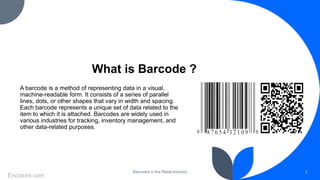
A barcode is a method of representing data in a visual,
machine-readable form. It consists of a series of parallel
lines, dots, or other shapes that vary in width and spacing.
Each barcode represents a unique set of data related to the
item to which it is attached. Barcodes are widely used in
various industries for tracking, inventory management, and
other data-related purposes.
Barcodes in the Retail Industry 2
Encstore.com
Types of Barcodes
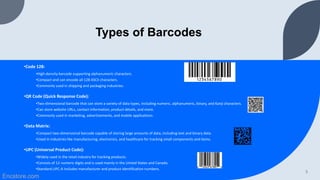
•Code 128:
•High-density barcode supporting alphanumeric characters.
•Compact and can encode all 128 ASCII characters.
•Commonly used in shipping and packaging industries.
•QR Code (Quick Response Code):
•Two-dimensional barcode that can store a variety of data types, including numeric, alphanumeric, binary, and Kanji characters.
•Can store website URLs, contact information, product details, and more.
•Commonly used in marketing, advertisements, and mobile applications.
•Data Matrix:
•Compact two-dimensional barcode capable of storing large amounts of data, including text and binary data.
•Used in industries like manufacturing, electronics, and healthcare for tracking small components and items.
•UPC (Universal Product Code):
•Widely used in the retail industry for tracking products.
•Consists of 12 numeric digits and is used mainly in the United States and Canada.
•Standard UPC-A includes manufacturer and product identification numbers.
Barcodes in the Retail Industry
3
Encstore.com
How Barcodes Work?
Barcode Creation: Barcodes are created by encoding information using specific patterns of lines and
spaces.
Printing the Barcode: Once encoded, the barcode is printed on labels or product packaging using
various printing technologies.
Barcode Scanner: A barcode scanner emits light to read the barcode, and the scanner detects the
changing patterns of light and dark areas.
Data Decoding: The scanner's decoder translates the patterns into numbers or characters, which are
then transmitted to a computer or system for further processing. PRESENTATION TITLE 4
Benefits of Barcodes in Retail
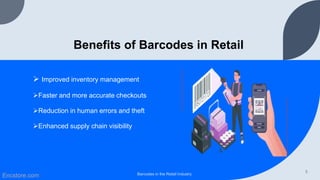
 Improved inventory management
Faster and more accurate checkouts
Reduction in human errors and theft
Enhanced supply chain visibility
Barcodes in the Retail Industry
5
Encstore.com
future trends of barcodes in the retail industry
Integration with IoT (Internet of Things): Barcodes will be integrated with IoT devices, allowing retailers to collect real-time data on
product movements, customer behaviors, and inventory levels. IoT-enabled sensors can provide valuable insights, leading to better decision-
making and improved customer experiences.
Blockchain and Supply Chain Transparency: Barcodes can be linked with blockchain technology to create transparent and
traceable supply chains. This ensures the authenticity of products, prevents counterfeiting, and enhances trust between retailers and
consumers.
Dynamic Barcodes: Future barcodes may include dynamic elements, such as changing patterns or colors. Dynamic barcodes can
enhance security and prevent unauthorized duplication, especially in high-value items and sensitive product categories.
AI-Powered Data Analysis: Advanced AI algorithms will process barcode data to generate actionable insights. Retailers can analyze
customer purchasing patterns, optimize inventory levels, and personalize marketing strategies based on the data collected from barcode
scans.
Contactless and Touchless Transactions: In response to health and safety concerns, touch less technologies, including barcodes,
will be further implemented. Contactless scanning and payment methods will minimize physical contact between customers and retail
employees.
Barcodes in the Retail Industry 6
Encstore.com
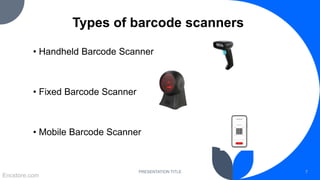
Types of barcode scanners
• Handheld Barcode Scanner
• Fixed Barcode Scanner
• Mobile Barcode Scanner
PRESENTATION TITLE 7
Encstore.com
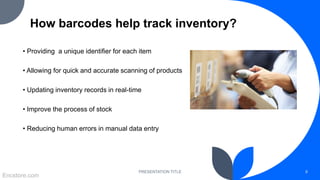
How barcodes help track inventory?
• Providing a unique identifier for each item
• Allowing for quick and accurate scanning of products
• Updating inventory records in real-time
• Improve the process of stock
• Reducing human errors in manual data entry
PRESENTATION TITLE 8
Encstore.com
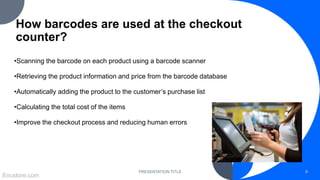
How barcodes are used at the checkout
counter?
•Scanning the barcode on each product using a barcode scanner
•Retrieving the product information and price from the barcode database
•Automatically adding the product to the customer’s purchase list
•Calculating the total cost of the items
•Improve the checkout process and reducing human errors
PRESENTATION TITLE 9
Encstore.com
Thank you
Encstore.com

barcode in the retail industry.pptx

  • 1.
    Barcodes in theRetail Industry
  • 2.
    What is Barcode? A barcode is a method of representing data in a visual, machine-readable form. It consists of a series of parallel lines, dots, or other shapes that vary in width and spacing. Each barcode represents a unique set of data related to the item to which it is attached. Barcodes are widely used in various industries for tracking, inventory management, and other data-related purposes. Barcodes in the Retail Industry 2 Encstore.com
  • 3.
    Types of Barcodes •Code128: •High-density barcode supporting alphanumeric characters. •Compact and can encode all 128 ASCII characters. •Commonly used in shipping and packaging industries. •QR Code (Quick Response Code): •Two-dimensional barcode that can store a variety of data types, including numeric, alphanumeric, binary, and Kanji characters. •Can store website URLs, contact information, product details, and more. •Commonly used in marketing, advertisements, and mobile applications. •Data Matrix: •Compact two-dimensional barcode capable of storing large amounts of data, including text and binary data. •Used in industries like manufacturing, electronics, and healthcare for tracking small components and items. •UPC (Universal Product Code): •Widely used in the retail industry for tracking products. •Consists of 12 numeric digits and is used mainly in the United States and Canada. •Standard UPC-A includes manufacturer and product identification numbers. Barcodes in the Retail Industry 3 Encstore.com
  • 4.
    How Barcodes Work? BarcodeCreation: Barcodes are created by encoding information using specific patterns of lines and spaces. Printing the Barcode: Once encoded, the barcode is printed on labels or product packaging using various printing technologies. Barcode Scanner: A barcode scanner emits light to read the barcode, and the scanner detects the changing patterns of light and dark areas. Data Decoding: The scanner's decoder translates the patterns into numbers or characters, which are then transmitted to a computer or system for further processing. PRESENTATION TITLE 4
  • 5.
    Benefits of Barcodesin Retail  Improved inventory management Faster and more accurate checkouts Reduction in human errors and theft Enhanced supply chain visibility Barcodes in the Retail Industry 5 Encstore.com
  • 6.
    future trends ofbarcodes in the retail industry Integration with IoT (Internet of Things): Barcodes will be integrated with IoT devices, allowing retailers to collect real-time data on product movements, customer behaviors, and inventory levels. IoT-enabled sensors can provide valuable insights, leading to better decision- making and improved customer experiences. Blockchain and Supply Chain Transparency: Barcodes can be linked with blockchain technology to create transparent and traceable supply chains. This ensures the authenticity of products, prevents counterfeiting, and enhances trust between retailers and consumers. Dynamic Barcodes: Future barcodes may include dynamic elements, such as changing patterns or colors. Dynamic barcodes can enhance security and prevent unauthorized duplication, especially in high-value items and sensitive product categories. AI-Powered Data Analysis: Advanced AI algorithms will process barcode data to generate actionable insights. Retailers can analyze customer purchasing patterns, optimize inventory levels, and personalize marketing strategies based on the data collected from barcode scans. Contactless and Touchless Transactions: In response to health and safety concerns, touch less technologies, including barcodes, will be further implemented. Contactless scanning and payment methods will minimize physical contact between customers and retail employees. Barcodes in the Retail Industry 6 Encstore.com
  • 7.
    Types of barcodescanners • Handheld Barcode Scanner • Fixed Barcode Scanner • Mobile Barcode Scanner PRESENTATION TITLE 7 Encstore.com
  • 8.
    How barcodes helptrack inventory? • Providing a unique identifier for each item • Allowing for quick and accurate scanning of products • Updating inventory records in real-time • Improve the process of stock • Reducing human errors in manual data entry PRESENTATION TITLE 8 Encstore.com
  • 9.
    How barcodes areused at the checkout counter? •Scanning the barcode on each product using a barcode scanner •Retrieving the product information and price from the barcode database •Automatically adding the product to the customer’s purchase list •Calculating the total cost of the items •Improve the checkout process and reducing human errors PRESENTATION TITLE 9 Encstore.com
  • 10.