What it is, what it’s for, and
how to make one
Annotated Bibliography
First, Review: The Works Cited
Page
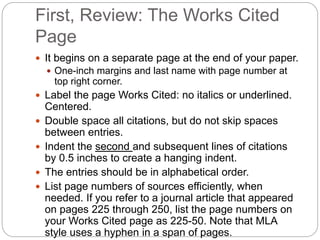
 It begins on a separate page at the end of your paper.
 One-inch margins and last name with page number at
top right corner.
 Label the page Works Cited: no italics or underlined.
Centered.
 Double space all citations, but do not skip spaces
between entries.
 Indent the second and subsequent lines of citations
by 0.5 inches to create a hanging indent.
 The entries should be in alphabetical order.
 List page numbers of sources efficiently, when
needed. If you refer to a journal article that appeared
on pages 225 through 250, list the page numbers on
your Works Cited page as 225-50. Note that MLA
style uses a hyphen in a span of pages.
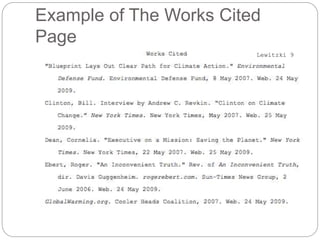
Example of The Works Cited
Page
Lewitzki 9
One Step Further:
The Annotated Bibliography
 The annotated bibliography is similar to the works
cited page in that it lists the sources used in a
paper.
 However, the annotated bibliography is
compiled before the paper is written.
 How can a list of works used be put together
before the paper is even written?
 The annotated bibliography is a list of potential
texts you will use in your paper.
 Each entry also includes a brief annotation of 1)
what the text is about and 2) why it will be useful
in your research.
Definition of an Annotated
Bibliography
 An annotated bibliography is a list of citations to
books, articles, and documents.
 Each citation is followed by a brief (usually about
150 words) descriptive and evaluative paragraph,
which is the annotation.
 The purpose of the annotation is to inform the
reader of the relevancy, accuracy, and quality of
the sources cited.
 It is also to get the writer to start identifying which
secondary sources he/she is going to consider
using.
Process: How to Write an Annotated
Bib
 Creating an annotated bibliography calls for the
application of a variety of intellectual skills:
concise explanation, succinct analysis, and
informed library research.
1. First, the hunting and gathering process:
 Consider your assignment and the topic you want
to research.
 Research using the library online databases.
 Record all the citations that may contain useful
information and ideas on your topic.
 Briefly examine and review the actual items.
 Only choose those specific works that provide a
variety of perspectives on your topic.
Process: How to Write an Annotated
Bib
2. After you have finished deciding which you
might use, cite each book, article, or document
as you would for a works cited page.
3. Then, write a concise annotation that
summarizes the central theme and scope of the
book or article. See the next slide for details!
For every annotation…
2. Each annotation should include one or more
sentences that
1. Evaluate the authority or background of the
author,
2. Comment on the intended audience,
3. Summarize the main point(s) of the work,
4. Explain how this work illuminates your
bibliography topic.
It is these four elements on
which you will be graded for
each annotation!
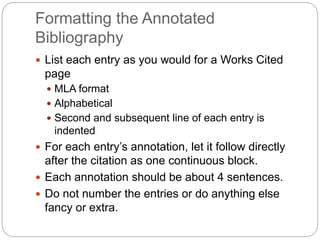
Formatting the Annotated
Bibliography
 List each entry as you would for a Works Cited
page
 MLA format
 Alphabetical
 Second and subsequent line of each entry is
indented
 For each entry’s annotation, let it follow directly
after the citation as one continuous block.
 Each annotation should be about 4 sentences.
 Do not number the entries or do anything else
fancy or extra.
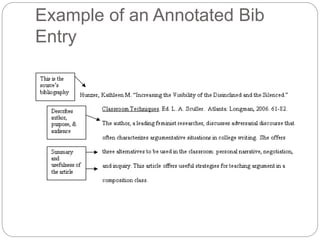
Example of an Annotated Bib
Entry
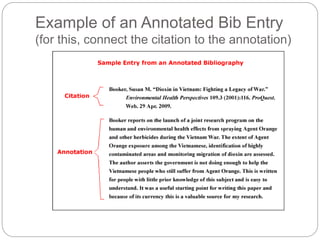
Example of an Annotated Bib Entry
(for this, connect the citation to the annotation)
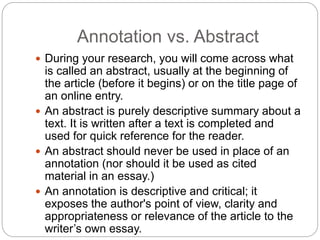
Annotation vs. Abstract
 During your research, you will come across what
is called an abstract, usually at the beginning of
the article (before it begins) or on the title page of
an online entry.
 An abstract is purely descriptive summary about a
text. It is written after a text is completed and
used for quick reference for the reader.
 An abstract should never be used in place of an
annotation (nor should it be used as cited
material in an essay.)
 An annotation is descriptive and critical; it
exposes the author's point of view, clarity and
appropriateness or relevance of the article to the
writer’s own essay.
Works Consulted
 With permission to reproduce from the
LibGuide: How to Prepare an Annotated
Bibliography: The Annotated Bibliography
 http://guides.library.cornell.edu/content.php?pid
=448160)
 OWL Purdue: Annotated Bibliography
 https://owl.english.purdue.edu/owl/resource/614/03/

The Annotated Bibliography

  • 1.
    What it is,what it’s for, and how to make one Annotated Bibliography
  • 2.
    First, Review: TheWorks Cited Page  It begins on a separate page at the end of your paper.  One-inch margins and last name with page number at top right corner.  Label the page Works Cited: no italics or underlined. Centered.  Double space all citations, but do not skip spaces between entries.  Indent the second and subsequent lines of citations by 0.5 inches to create a hanging indent.  The entries should be in alphabetical order.  List page numbers of sources efficiently, when needed. If you refer to a journal article that appeared on pages 225 through 250, list the page numbers on your Works Cited page as 225-50. Note that MLA style uses a hyphen in a span of pages.
  • 3.
    Example of TheWorks Cited Page Lewitzki 9
  • 4.
    One Step Further: TheAnnotated Bibliography  The annotated bibliography is similar to the works cited page in that it lists the sources used in a paper.  However, the annotated bibliography is compiled before the paper is written.  How can a list of works used be put together before the paper is even written?  The annotated bibliography is a list of potential texts you will use in your paper.  Each entry also includes a brief annotation of 1) what the text is about and 2) why it will be useful in your research.
  • 5.
    Definition of anAnnotated Bibliography  An annotated bibliography is a list of citations to books, articles, and documents.  Each citation is followed by a brief (usually about 150 words) descriptive and evaluative paragraph, which is the annotation.  The purpose of the annotation is to inform the reader of the relevancy, accuracy, and quality of the sources cited.  It is also to get the writer to start identifying which secondary sources he/she is going to consider using.
  • 6.
    Process: How toWrite an Annotated Bib  Creating an annotated bibliography calls for the application of a variety of intellectual skills: concise explanation, succinct analysis, and informed library research. 1. First, the hunting and gathering process:  Consider your assignment and the topic you want to research.  Research using the library online databases.  Record all the citations that may contain useful information and ideas on your topic.  Briefly examine and review the actual items.  Only choose those specific works that provide a variety of perspectives on your topic.
  • 7.
    Process: How toWrite an Annotated Bib 2. After you have finished deciding which you might use, cite each book, article, or document as you would for a works cited page. 3. Then, write a concise annotation that summarizes the central theme and scope of the book or article. See the next slide for details!
  • 8.
    For every annotation… 2.Each annotation should include one or more sentences that 1. Evaluate the authority or background of the author, 2. Comment on the intended audience, 3. Summarize the main point(s) of the work, 4. Explain how this work illuminates your bibliography topic. It is these four elements on which you will be graded for each annotation!
  • 9.
    Formatting the Annotated Bibliography List each entry as you would for a Works Cited page  MLA format  Alphabetical  Second and subsequent line of each entry is indented  For each entry’s annotation, let it follow directly after the citation as one continuous block.  Each annotation should be about 4 sentences.  Do not number the entries or do anything else fancy or extra.
  • 10.
    Example of anAnnotated Bib Entry
  • 11.
    Example of anAnnotated Bib Entry (for this, connect the citation to the annotation)
  • 12.
    Annotation vs. Abstract During your research, you will come across what is called an abstract, usually at the beginning of the article (before it begins) or on the title page of an online entry.  An abstract is purely descriptive summary about a text. It is written after a text is completed and used for quick reference for the reader.  An abstract should never be used in place of an annotation (nor should it be used as cited material in an essay.)  An annotation is descriptive and critical; it exposes the author's point of view, clarity and appropriateness or relevance of the article to the writer’s own essay.
  • 13.
    Works Consulted  Withpermission to reproduce from the LibGuide: How to Prepare an Annotated Bibliography: The Annotated Bibliography  http://guides.library.cornell.edu/content.php?pid =448160)  OWL Purdue: Annotated Bibliography  https://owl.english.purdue.edu/owl/resource/614/03/