Critical Reading: Restatement and Inference
What Is Critical Reading?   To non-critical readers, texts provide  facts .  Readers gain knowledge by  memorizing  the statements within a text. To the critical reader, any single text provides but one portrayal of the facts, one individual’s “take” on the subject matter. Critical readers thus recognize not only  what   a text says, but  also how  the author convey the message.
Goals of Critical Reading  to  recognize  an author’s purpose               to  understand tone and persuasive elements  to  recognize bias    
More specifically; recognizing  purpose  involves inferring a basis for choices of content and language  recognizing  tone and persuasive elements  involves classifying the nature of language choices  recognizing  bias  involves classifying the nature of patterns of choice of content and language
Restatement VS. Inference   What is the  difference   between these two words?
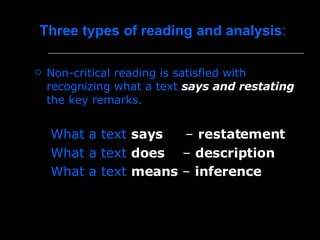
Three types of reading and analysis :  Non-critical reading is satisfied with recognizing what a text  says and restating  the key remarks.  What a text  says      –  restatement  What a text   does     –  description  What a text   means  –  inference
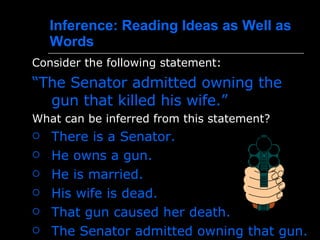
Inference :  Reading Ideas as Well as Words Consider the following statement:   “ The Senator admitted owning the gun that killed his wife.” What can be inferred from this statement? There is a Senator.  He owns a gun .  He is married.  His wife is dead .  That gun caused her death.  The Senator admitted owning that gun .
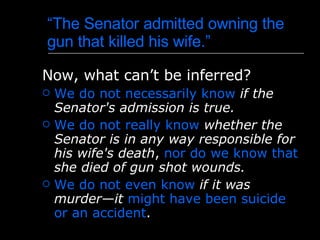
“ The Senator admitted owning the gun that killed his wife.” Now, what can’t be inferred? We do not necessarily know   if the Senator's admission is true .   We do not really know   whether the Senator is in any way responsible for his wife's death ,  nor do we know that   she died of gun shot wounds. We do not even know   if it was murder—it   might have been suicide or an accident .
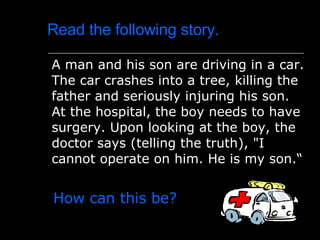
Read the following story. A man and his son are driving in a car .  The car crashes into a tree, killing the father and seriously injuring his son .  At the hospital, the boy needs to have surgery .  Upon looking at the boy, the doctor says  ( telling the truth ) ,  " I cannot operate on him .  He is my son .“ How can this b e?
Analysis and Inference :  The Tools of Critical Reading   A critical reader know what to look for  ( analysis )  and  how to think about what to find  ( inference )  . The first part — what to look for — involves  recognizing those aspects of a discussion  that control the meaning .  The second part — how to think about what you find — involves the processes of  inference , the  interpretation of data  from within the text .
Restatement VS. Inference   What is the  difference  between these two words?

A Critical Reading

  • 1.
  • 2.
    What Is CriticalReading? To non-critical readers, texts provide facts . Readers gain knowledge by memorizing the statements within a text. To the critical reader, any single text provides but one portrayal of the facts, one individual’s “take” on the subject matter. Critical readers thus recognize not only what a text says, but also how the author convey the message.
  • 3.
    Goals of CriticalReading to recognize an author’s purpose              to understand tone and persuasive elements to recognize bias  
  • 4.
    More specifically; recognizing purpose involves inferring a basis for choices of content and language recognizing tone and persuasive elements involves classifying the nature of language choices recognizing bias involves classifying the nature of patterns of choice of content and language
  • 5.
    Restatement VS. Inference What is the difference between these two words?
  • 6.
    Three types ofreading and analysis : Non-critical reading is satisfied with recognizing what a text says and restating the key remarks. What a text says     – restatement What a text does    – description What a text means – inference
  • 7.
    Inference : Reading Ideas as Well as Words Consider the following statement: “ The Senator admitted owning the gun that killed his wife.” What can be inferred from this statement? There is a Senator. He owns a gun . He is married. His wife is dead . That gun caused her death. The Senator admitted owning that gun .
  • 8.
    “ The Senatoradmitted owning the gun that killed his wife.” Now, what can’t be inferred? We do not necessarily know if the Senator's admission is true . We do not really know whether the Senator is in any way responsible for his wife's death , nor do we know that she died of gun shot wounds. We do not even know if it was murder—it might have been suicide or an accident .
  • 9.
    Read the followingstory. A man and his son are driving in a car . The car crashes into a tree, killing the father and seriously injuring his son . At the hospital, the boy needs to have surgery . Upon looking at the boy, the doctor says ( telling the truth ) , " I cannot operate on him . He is my son .“ How can this b e?
  • 10.
    Analysis and Inference: The Tools of Critical Reading A critical reader know what to look for ( analysis ) and how to think about what to find ( inference ) . The first part — what to look for — involves recognizing those aspects of a discussion that control the meaning . The second part — how to think about what you find — involves the processes of inference , the interpretation of data from within the text .
  • 11.
    Restatement VS. Inference What is the difference between these two words?