ANALYTICAL ESSAY
WILMER CONDA
ERIKA PAOLA ROSAS
What is it?
In this type of essay you analyze,
examine and interpret such things
as an event, book, poem, play or
other work of art.
Prewriting for Your Essay
 Understand the objective of an analytical essay.
 Generally, an analytical essay explores an issue, or presents an opinion
based on fact.
 Most often you will have to analyze another piece of writing or a film,
but you could also be asked to analyze an issue, or an idea.
 To do this, you must break the topic down into parts and provide
evidence, either from the text/film or from your own research, that
supports your claim.
Prewriting for Your Essay
 Decide what to write about.
 If you're writing an analytical essay
about a work of fiction, you could focus
your argument on what motivates a
specific character or group of
characters. Or, you could argue why a
certain line or paragraph is central to
the work as a
 If you're writing about a historical event,
try focusing on the forces that
contributed to what happened.
 If you're writing about scientific research
or findings, follow the scientific method
to analyze your results.
Prewriting for Your Essay
 Come up with a thesis
statement
The thesis statement
is a sentence or two
that summarizes the
claim you will make
in your paper. It tells
the reader what your
essay will be about
Prewriting for Your Essay
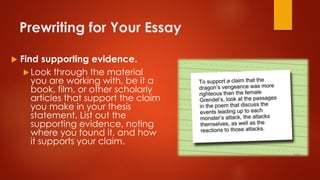
 Find supporting evidence.
 Look through the material
you are working with, be it a
book, film, or other scholarly
articles that support the claim
you make in your thesis
statement. List out the
supporting evidence, noting
where you found it, and how
it supports your claim.
Prewriting for Your Essay
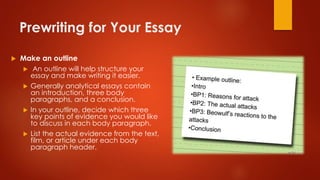
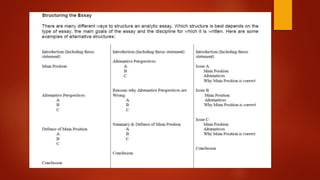
 Make an outline
 An outline will help structure your
essay and make writing it easier.
 Generally analytical essays contain
an introduction, three body
paragraphs, and a conclusion.
 In your outline, decide which three
key points of evidence you would like
to discuss in each body paragraph.
 List the actual evidence from the text,
film, or article under each body
paragraph header.
Writing Your Essay
 Write your introduction
 Your introduction should give your reader background information
about your topic.
 You should also state your thesis somewhere within the paragraph. Try
to make your introduction engaging but not too overzealous.
 Avoid summarizing the prompt--it’s best to simply state your argument
 Also avoid dramatic introductions (beginning an essay with a question
or exclamation is generally best to avoid). Do not use the first (I) or
second (you) person in your essay.
Writing Your Essay
 Write your body paragraphs
 Each body paragraph should have:
 a topic sentence,
 an analysis of some part of the text
 And evidence from the text that supports your analysis and your thesis statement.
 A topic sentence tells the reader what the body paragraph will be about. The
analysis of the text is where you make your argument. The evidence you provide
supports your argument. Remember that each claim you make should support
your thesis.
Writing Your Essay
 Example topic sentence: The key to
differentiating between the two attacks is
the notion of excessive retribution.
 Example analysis: The female Grendel does
not simply want vengeance, as per the
Medieval concept of ‘an eye for an eye.’
Instead, she wants to take a life for a life
while also throwing Hrothgar’s kingdom into
chaos.
 Example evidence: Instead of simply killing
Aeschere, and thus enacting just revenge,
she “quickly [snatches] up” that nobleman
and, with him “tight in her clutches,” she
leaves for the fen (1294). She does this to
lure Beowulf away from Heorot so she can
kill him as well.
Writing Your Essay
 Know when to quote or paraphrase
 Quoting means that you take the exact text and, placing it in
quotation marks, insert it into your essay
 Quoting is good when you are making a point and supporting
your argument. Make sure that you use the correct form of
quotation depending on if you are using APA
 Paraphrasing, on the other hand, is when you summarize the text.
Generally, paraphrasing is used when you are giving background
about the text so that your argument has some context.
Writing Your Essay
 Example of a quote: Instead of
simply killing Aeschere, and thus
enacting just revenge, she
“quickly [snatches] up” that
nobleman and, with him “tight in
her clutches,” she leaves for the
fen (1294).
 Example of a paraphrased
sentence: The female Grendel
enters Heorot, snatches up one of
the men sleeping inside it, and
runs away to the fen (1294).
Writing Your Essay
 Write your conclusion
 Your conclusion is where you remind your reader of how you proved your
argument
 You can also restate your thesis but reword it so that it is not just a repetition
of the thesis statement in your introduction
 If your teacher want you to make a broader connection in your conclusion
This means that he want you to make a ‘bigger world connection’.This could
mean stating how your argument affects other claims about the text, or how
your claim could change the view of someone reading the text you
analyzed.
Writing Your Essay
Example
conclusion
Writing Your Essay
 Example conclusion with a ‘bigger world connection’
The concept of an ‘eye for an eye’ was very present in
the early Medieval world. However, by comparing the
attacks of both the female Grendel and the dragon,
the medieval world’s perception of righteous
vengeance versus unjust revenge is made clear. While
the dragon acts out in the only way he knows how, the
female Grendel attacks with evil intent. This analysis
should make any reader more sympathetic to the
dragon’s plight, while portraying the female Grendel as
the immoral, evil creature she is.
Finalizing Your Essay
 Proofread your essay for
spelling or grammar mistakes
A paper that contains many
mistakes generally gets a
lower mark than one that has
been proofread and polished.
Run a spell check, look for run-
on sentences, and check for
punctuation errors.
Finalizing Your Essay
 Read your paper out loud
Reading out loud helps you
to find places in the essay
that might sound awkward.
This is also a great way to find
run-on sentences that you
might not have noticed
before.
Finalizing Your Essay
 Make sure that all characters,
titles, places, etc. are spelled
correctly
Go back to the text or article
and confirm that your spelling is
correct.
If you are analyzing a film, look
up the list of characters online.
Check two or three sources to
make sure that you have the
correct spelling.
Some tips …..
 Ask yourself "What am I trying to prove?" The answer should be in your thesis. If not, go back and
fix it.
 If you are writing a formal analysis or critique, then avoid using colloquial writing. Though informal
language may bring some color to a paper, you do not want to risk weakening your argument
by influencing it with verbal slang.
 Don't try to add useless sentences to make an analytical essay longer; it is better to leave it short
and to the point. Make each sentence count.
 Avoid being too vague. Vagueness leaves room for misinterpretation and in a coherent,
analytical essay, leaving room for misinterpretation decreases the effectiveness of your
argument.
 Avoid making your essay tacky by using quotations improperly. Remember that you want to
incorporate others' ideas, as support for your own point, but not so much that you have written
none of the essay yourself.
 Beginnings and endings of paragraphs and sentences are good places to use quotes,
metaphors, and repetition, for effect, because introductions and conclusions should not have
any details or in-depth analysis; that is what your body paragraphs are there for.

Analytical essay

  • 1.
  • 2.
    What is it? Inthis type of essay you analyze, examine and interpret such things as an event, book, poem, play or other work of art.
  • 3.
    Prewriting for YourEssay  Understand the objective of an analytical essay.  Generally, an analytical essay explores an issue, or presents an opinion based on fact.  Most often you will have to analyze another piece of writing or a film, but you could also be asked to analyze an issue, or an idea.  To do this, you must break the topic down into parts and provide evidence, either from the text/film or from your own research, that supports your claim.
  • 4.
    Prewriting for YourEssay  Decide what to write about.  If you're writing an analytical essay about a work of fiction, you could focus your argument on what motivates a specific character or group of characters. Or, you could argue why a certain line or paragraph is central to the work as a  If you're writing about a historical event, try focusing on the forces that contributed to what happened.  If you're writing about scientific research or findings, follow the scientific method to analyze your results.
  • 5.
    Prewriting for YourEssay  Come up with a thesis statement The thesis statement is a sentence or two that summarizes the claim you will make in your paper. It tells the reader what your essay will be about
  • 6.
    Prewriting for YourEssay  Find supporting evidence.  Look through the material you are working with, be it a book, film, or other scholarly articles that support the claim you make in your thesis statement. List out the supporting evidence, noting where you found it, and how it supports your claim.
  • 7.
    Prewriting for YourEssay  Make an outline  An outline will help structure your essay and make writing it easier.  Generally analytical essays contain an introduction, three body paragraphs, and a conclusion.  In your outline, decide which three key points of evidence you would like to discuss in each body paragraph.  List the actual evidence from the text, film, or article under each body paragraph header.
  • 8.
    Writing Your Essay Write your introduction  Your introduction should give your reader background information about your topic.  You should also state your thesis somewhere within the paragraph. Try to make your introduction engaging but not too overzealous.  Avoid summarizing the prompt--it’s best to simply state your argument  Also avoid dramatic introductions (beginning an essay with a question or exclamation is generally best to avoid). Do not use the first (I) or second (you) person in your essay.
  • 10.
    Writing Your Essay Write your body paragraphs  Each body paragraph should have:  a topic sentence,  an analysis of some part of the text  And evidence from the text that supports your analysis and your thesis statement.  A topic sentence tells the reader what the body paragraph will be about. The analysis of the text is where you make your argument. The evidence you provide supports your argument. Remember that each claim you make should support your thesis.
  • 11.
    Writing Your Essay Example topic sentence: The key to differentiating between the two attacks is the notion of excessive retribution.  Example analysis: The female Grendel does not simply want vengeance, as per the Medieval concept of ‘an eye for an eye.’ Instead, she wants to take a life for a life while also throwing Hrothgar’s kingdom into chaos.  Example evidence: Instead of simply killing Aeschere, and thus enacting just revenge, she “quickly [snatches] up” that nobleman and, with him “tight in her clutches,” she leaves for the fen (1294). She does this to lure Beowulf away from Heorot so she can kill him as well.
  • 12.
    Writing Your Essay Know when to quote or paraphrase  Quoting means that you take the exact text and, placing it in quotation marks, insert it into your essay  Quoting is good when you are making a point and supporting your argument. Make sure that you use the correct form of quotation depending on if you are using APA  Paraphrasing, on the other hand, is when you summarize the text. Generally, paraphrasing is used when you are giving background about the text so that your argument has some context.
  • 13.
    Writing Your Essay Example of a quote: Instead of simply killing Aeschere, and thus enacting just revenge, she “quickly [snatches] up” that nobleman and, with him “tight in her clutches,” she leaves for the fen (1294).  Example of a paraphrased sentence: The female Grendel enters Heorot, snatches up one of the men sleeping inside it, and runs away to the fen (1294).
  • 14.
    Writing Your Essay Write your conclusion  Your conclusion is where you remind your reader of how you proved your argument  You can also restate your thesis but reword it so that it is not just a repetition of the thesis statement in your introduction  If your teacher want you to make a broader connection in your conclusion This means that he want you to make a ‘bigger world connection’.This could mean stating how your argument affects other claims about the text, or how your claim could change the view of someone reading the text you analyzed.
  • 15.
  • 16.
    Writing Your Essay Example conclusion with a ‘bigger world connection’ The concept of an ‘eye for an eye’ was very present in the early Medieval world. However, by comparing the attacks of both the female Grendel and the dragon, the medieval world’s perception of righteous vengeance versus unjust revenge is made clear. While the dragon acts out in the only way he knows how, the female Grendel attacks with evil intent. This analysis should make any reader more sympathetic to the dragon’s plight, while portraying the female Grendel as the immoral, evil creature she is.
  • 17.
    Finalizing Your Essay Proofread your essay for spelling or grammar mistakes A paper that contains many mistakes generally gets a lower mark than one that has been proofread and polished. Run a spell check, look for run- on sentences, and check for punctuation errors.
  • 18.
    Finalizing Your Essay Read your paper out loud Reading out loud helps you to find places in the essay that might sound awkward. This is also a great way to find run-on sentences that you might not have noticed before.
  • 19.
    Finalizing Your Essay Make sure that all characters, titles, places, etc. are spelled correctly Go back to the text or article and confirm that your spelling is correct. If you are analyzing a film, look up the list of characters online. Check two or three sources to make sure that you have the correct spelling.
  • 21.
    Some tips ….. Ask yourself "What am I trying to prove?" The answer should be in your thesis. If not, go back and fix it.  If you are writing a formal analysis or critique, then avoid using colloquial writing. Though informal language may bring some color to a paper, you do not want to risk weakening your argument by influencing it with verbal slang.  Don't try to add useless sentences to make an analytical essay longer; it is better to leave it short and to the point. Make each sentence count.  Avoid being too vague. Vagueness leaves room for misinterpretation and in a coherent, analytical essay, leaving room for misinterpretation decreases the effectiveness of your argument.  Avoid making your essay tacky by using quotations improperly. Remember that you want to incorporate others' ideas, as support for your own point, but not so much that you have written none of the essay yourself.  Beginnings and endings of paragraphs and sentences are good places to use quotes, metaphors, and repetition, for effect, because introductions and conclusions should not have any details or in-depth analysis; that is what your body paragraphs are there for.