Annotated Bibliography
Sudipta Debnath
Asst Prof, SJCON
What is an annotated bibliography?
 A bibliography is a list of sources one has used in
researching a topic. They are also sometimes called
“works cited.”
 An annotation is a summary and/or an evaluation.
Thus. . .
An annotated bibliography is
 a list of sources that includes a summary and/or an
evaluation of each source.
What is an Annotated Bibliography?
“An annotated bibliography is a list of citations
to books, articles, and documents. Each citation is
followed by a brief descriptive and evaluative
paragraph, the annotation. The purpose of
the annotation is to inform the reader of the
relevance, accuracy, and quality of the sources
cited” (guides.library.cornell.edu).
Annotated Bibliography vs. Lit Review
 Annotated bibliography is basically a set of notes on
each reference
 Lit review flows in scientific/technical style
 Lit review compares/contrasts/links various
references and is far more analytical
Abstract vs. Annotated Bibliography
 The Abstract
 A summary of a work’s content
 Like all summaries, abstracts cover the main
points of a piece of writing
 Abstracts help you decide whether an article is
relevant for your purposes
 The Annotated Bibliography
 A list of sources that provides publication
information and a short description of each
source called an annotation
 Some annotations merely describe the content
and scope of the source
 Others evaluate the source’s authority, currency,
and relevance to a researcher’s purpose
Annotation Section
ONE paragraph includes the following 3 elements:
1. Summary
2. Assessment
3. Reflection
1: Summary
 Summarize: Some annotations merely summarize
the source. What are the main arguments? What
is the point of this book or article? What topics
are covered? If someone asked what this
article/book is about, what would you say? The
length of your annotations will determine how
detailed your summary is.
Sentence starters:
1. The main idea of this article is…….
2. The topics covered in this article are…….
3. The author’s point of view in this article is……
2: Assessment
 Assess: After summarizing a source, it may be
helpful to evaluate it. Is it a useful source?
How does it compare with other sources in
your bibliography? Is it credible? Is the
information reliable? Is this source biased or
objective? What is the goal of this source?
Sentence Starters:
1. The author of this piece is/is not credible because……
2. The author knows a lot about this topic because….
3. From this piece, the author wants you to………….
3: Reflection
 Reflect: Once you've summarized and assessed a
source, you need to ask how it fits into your
research. Was this source helpful to you? How does
it help you shape your argument? How can you use
this source in your research project? Has it changed
how you think about your topic?
Sentence Starters:
1. This article supports my ideas because…..
2. This article was helpful to me because….
3. This article added to my knowledge about this
topic because….
According to your assignment, an annotated
bibliography should do the following:
 Summarize
What is the main argument? What are the main points?
What topics are covered? In short, what is the source
about?
 Assess
Evaluate the source. Was it useful? Is it reliable? How does
it compare to your other sources?
 Reflect
How does the source fit into your research? Was it helpful?
How does it affect your argument?
Format
 The first entry should be one double-spaced line below the
title, which should be Annotated Bibliography. All other
entries should follow in alphabetical order.
 Each entry should follow the standard citation format
according to MLA / APA citation style.
Format of the annotation
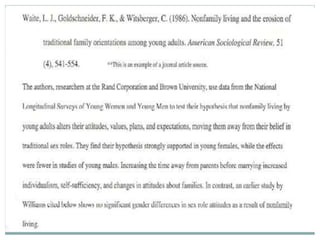
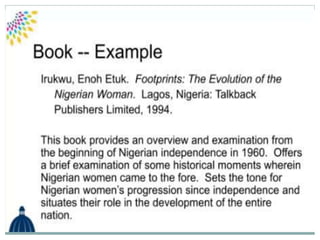
 Each annotation should begin one double spaced line
beneath each works cited entry.
 Each annotation should follow standard paragraph
format, beginning with an indention.
 Each annotation should be roughly the same length
so that each entry looks uniform.
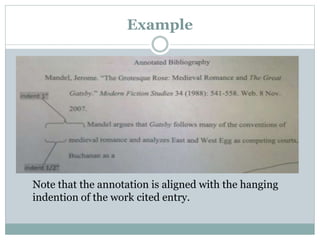
Example
Note that the annotation is aligned with the hanging
indention of the work cited entry.
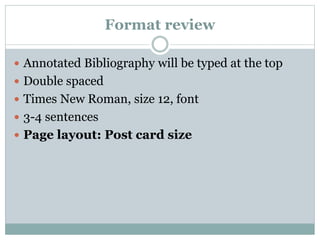
Format review
 Annotated Bibliography will be typed at the top
 Double spaced
 Times New Roman, size 12, font
 3-4 sentences
 Page layout: Post card size
Remember
 An annotated bibliography is more than just a works
cited page. The purpose of an annotated bibliography
is not only to list your sources, but also to explain
your research.
Helpful Sources
 APA Guidelines for annotated bibliography, 7th
edition
 MLA Handbook for Writers of Research Papers, 7th
edition, 2009.
 Purdue University’s Online Writing Lab

Annotated-Bibliography.pptx

  • 1.
  • 2.
    What is anannotated bibliography?  A bibliography is a list of sources one has used in researching a topic. They are also sometimes called “works cited.”  An annotation is a summary and/or an evaluation. Thus. . .
  • 3.
    An annotated bibliographyis  a list of sources that includes a summary and/or an evaluation of each source.
  • 4.
    What is anAnnotated Bibliography? “An annotated bibliography is a list of citations to books, articles, and documents. Each citation is followed by a brief descriptive and evaluative paragraph, the annotation. The purpose of the annotation is to inform the reader of the relevance, accuracy, and quality of the sources cited” (guides.library.cornell.edu).
  • 5.
    Annotated Bibliography vs.Lit Review  Annotated bibliography is basically a set of notes on each reference  Lit review flows in scientific/technical style  Lit review compares/contrasts/links various references and is far more analytical
  • 6.
    Abstract vs. AnnotatedBibliography  The Abstract  A summary of a work’s content  Like all summaries, abstracts cover the main points of a piece of writing  Abstracts help you decide whether an article is relevant for your purposes
  • 7.
     The AnnotatedBibliography  A list of sources that provides publication information and a short description of each source called an annotation  Some annotations merely describe the content and scope of the source  Others evaluate the source’s authority, currency, and relevance to a researcher’s purpose
  • 8.
    Annotation Section ONE paragraphincludes the following 3 elements: 1. Summary 2. Assessment 3. Reflection
  • 9.
    1: Summary  Summarize:Some annotations merely summarize the source. What are the main arguments? What is the point of this book or article? What topics are covered? If someone asked what this article/book is about, what would you say? The length of your annotations will determine how detailed your summary is. Sentence starters: 1. The main idea of this article is……. 2. The topics covered in this article are……. 3. The author’s point of view in this article is……
  • 10.
    2: Assessment  Assess:After summarizing a source, it may be helpful to evaluate it. Is it a useful source? How does it compare with other sources in your bibliography? Is it credible? Is the information reliable? Is this source biased or objective? What is the goal of this source? Sentence Starters: 1. The author of this piece is/is not credible because…… 2. The author knows a lot about this topic because…. 3. From this piece, the author wants you to………….
  • 11.
    3: Reflection  Reflect:Once you've summarized and assessed a source, you need to ask how it fits into your research. Was this source helpful to you? How does it help you shape your argument? How can you use this source in your research project? Has it changed how you think about your topic? Sentence Starters: 1. This article supports my ideas because….. 2. This article was helpful to me because…. 3. This article added to my knowledge about this topic because….
  • 12.
    According to yourassignment, an annotated bibliography should do the following:  Summarize What is the main argument? What are the main points? What topics are covered? In short, what is the source about?  Assess Evaluate the source. Was it useful? Is it reliable? How does it compare to your other sources?  Reflect How does the source fit into your research? Was it helpful? How does it affect your argument?
  • 13.
    Format  The firstentry should be one double-spaced line below the title, which should be Annotated Bibliography. All other entries should follow in alphabetical order.  Each entry should follow the standard citation format according to MLA / APA citation style.
  • 14.
    Format of theannotation  Each annotation should begin one double spaced line beneath each works cited entry.  Each annotation should follow standard paragraph format, beginning with an indention.  Each annotation should be roughly the same length so that each entry looks uniform.
  • 15.
    Example Note that theannotation is aligned with the hanging indention of the work cited entry.
  • 16.
    Format review  AnnotatedBibliography will be typed at the top  Double spaced  Times New Roman, size 12, font  3-4 sentences  Page layout: Post card size
  • 19.
    Remember  An annotatedbibliography is more than just a works cited page. The purpose of an annotated bibliography is not only to list your sources, but also to explain your research.
  • 20.
    Helpful Sources  APAGuidelines for annotated bibliography, 7th edition  MLA Handbook for Writers of Research Papers, 7th edition, 2009.  Purdue University’s Online Writing Lab

Editor's Notes

  • #9 May be modified for special needs students