ITECH PREP
2014
WRITING AN ANNOTATED
BIBLIOGRAPHY
WHAT IS AN ANNOTATED
BIBLIOGRAPHY?
• Go to: http://tinyurl.com/kos2n9o
• Answer the following question:
What is an annotated bibliography?
WHAT IS AN ANNOTATED
BIBLIOGRAPHY?
 A list of citations to books, articles, and documents.
 Followed by a brief (usually about 150 words)
descriptive and evaluative paragraph, the annotation.
 Informing the reader of the relevance, accuracy, and
quality of the sources cited.
 Each entry includes all the information included in a list
of works cited.
 The citations have the appropriate bibliographic
format (e.g., MLA, APA)
ANNOTATIONS VERSUS
ABSTRACTS
 Abstracts -
are descriptive summaries found at the beginning of
scholarly journal articles or in periodical indexes.
 Annotations -
are descriptive and critical; exposing the author's point of
view, clarity and authority.
WHAT IS THE PURPOSEPURPOSE OF AN
ANNOTATED BIBLIOGRAPHY?
 THINK-PAIR-SHARE
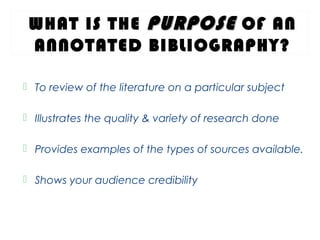
WHAT IS THE PURPOSEPURPOSE OF AN
ANNOTATED BIBLIOGRAPHY?
 To review of the literature on a particular subject
 Illustrates the quality & variety of research done
 Provides examples of the types of sources available.
 Shows your audience credibility
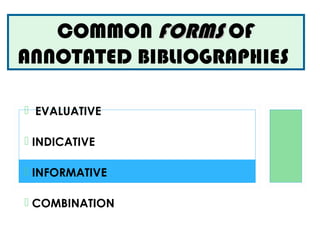
 EVALUATIVE
 INDICATIVE
 INFORMATIVE
 COMBINATION
COMMON FORMSFORMS OF
ANNOTATED BIBLIOGRAPHIES
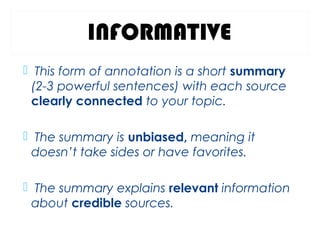
INFORMATIVE
 This form of annotation is a short summary
(2-3 powerful sentences) with each source
clearly connected to your topic.
 The summary is unbiased, meaning it
doesn’t take sides or have favorites.
 The summary explains relevant information
about credible sources.
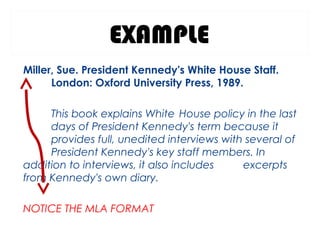
EXAMPLE
Miller, Sue. President Kennedy's White House Staff.
London: Oxford University Press, 1989.
This book explains White House policy in the last
days of President Kennedy's term because it
provides full, unedited interviews with several of
President Kennedy's key staff members. In
addition to interviews, it also includes excerpts
from Kennedy's own diary.
NOTICE THE MLA FORMAT
YOU BE THE JUDGE!
• Go to the iTech Library Website
• Click on “HS Resources” (at bottom)
• Open the “Annotated Bibliography Rubric”
• Work in pairs to assess bibliographies that I will display
on the screen using the 1-4 scale on the rubric
• We will do the first one together! 
EXAMPLE #1
Ehrenreich, B. (2001). Calcutta: Pollution and Health.
(2009) [Television broadcast]. CBS. Retrieved
from www.cbsnews.com
This was an informative site about air pollution in
Calcutta, because it contained a multitude of
resources for my topic. It has more specific
information than print resources on the subject.
It is authoritative because it is up to date and all
rights are reserved.
Bias
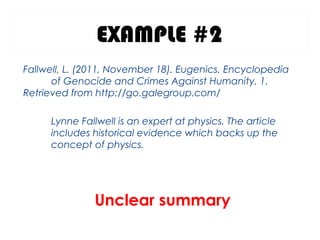
EXAMPLE #2
Fallwell, L. (2011, November 18). Eugenics. Encyclopedia
of Genocide and Crimes Against Humanity, 1.
Retrieved from http://go.galegroup.com/ 
Lynne Fallwell is an expert at physics. The article
includes historical evidence which backs up the
concept of physics.
Unclear summary
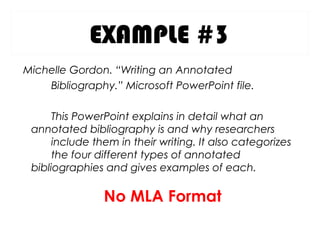
EXAMPLE #3
Michelle Gordon. “Writing an Annotated
Bibliography.” Microsoft PowerPoint file.
This PowerPoint explains in detail what an
annotated bibliography is and why researchers
include them in their writing. It also categorizes
the four different types of annotated
bibliographies and gives examples of each.
No MLA Format
LOOK AT EXAMPLES:
University of North Carolina-Chapel Hill
http://www.unc.edu/depts/wcweb/handouts/annotated_bibliographies.html
University of California-Santa Cruz
http://library.ucsc.edu/ref/howto/annotated.html
The OWL at Purdue
http://owl.english.purdue.edu/owl/resource/614/01/
The Writing Center @ University of Wisconsin, Madison
http://writing.wisc.edu/Handbook/AnnBib_content.html
FORMATS FOR CITING SOURCES
MLA (Modern Language Association) Generally used for disciplines in
the literature, arts, and humanities, such as English, languages, film,
and cultural studies or other theoretical studies.
APA (American Psychological Association) Natural and social sciences,
such as psychology, nursing, sociology, education and social work. It
is also used in economics, business, and criminology.
CBE (Council of Biology Editors)/CSE (Council of Science Editors) Used
by the plant sciences, zoology, microbiology, and many of the
medical sciences.
Turabian: Designed for college students to use with all subjects.
Chicago: Used with all subjects in the "real world" by books, magazines,
newspapers, and other non-scholarly publications.
Gordon, Asa H. “Writing an Annotated Bibliography.”
Savannah State University Library. File last
modified 15 Mar. 2013. Microsoft Powerpoint file.
Annotated Bibliography

Annotated Bibliography HS

  • 1.
    ITECH PREP 2014 WRITING ANANNOTATED BIBLIOGRAPHY
  • 2.
    WHAT IS ANANNOTATED BIBLIOGRAPHY? • Go to: http://tinyurl.com/kos2n9o • Answer the following question: What is an annotated bibliography?
  • 3.
    WHAT IS ANANNOTATED BIBLIOGRAPHY?  A list of citations to books, articles, and documents.  Followed by a brief (usually about 150 words) descriptive and evaluative paragraph, the annotation.  Informing the reader of the relevance, accuracy, and quality of the sources cited.  Each entry includes all the information included in a list of works cited.  The citations have the appropriate bibliographic format (e.g., MLA, APA)
  • 4.
    ANNOTATIONS VERSUS ABSTRACTS  Abstracts- are descriptive summaries found at the beginning of scholarly journal articles or in periodical indexes.  Annotations - are descriptive and critical; exposing the author's point of view, clarity and authority.
  • 5.
    WHAT IS THEPURPOSEPURPOSE OF AN ANNOTATED BIBLIOGRAPHY?  THINK-PAIR-SHARE
  • 6.
    WHAT IS THEPURPOSEPURPOSE OF AN ANNOTATED BIBLIOGRAPHY?  To review of the literature on a particular subject  Illustrates the quality & variety of research done  Provides examples of the types of sources available.  Shows your audience credibility
  • 7.
     EVALUATIVE  INDICATIVE INFORMATIVE  COMBINATION COMMON FORMSFORMS OF ANNOTATED BIBLIOGRAPHIES
  • 8.
    INFORMATIVE  This formof annotation is a short summary (2-3 powerful sentences) with each source clearly connected to your topic.  The summary is unbiased, meaning it doesn’t take sides or have favorites.  The summary explains relevant information about credible sources.
  • 9.
    EXAMPLE Miller, Sue. PresidentKennedy's White House Staff. London: Oxford University Press, 1989. This book explains White House policy in the last days of President Kennedy's term because it provides full, unedited interviews with several of President Kennedy's key staff members. In addition to interviews, it also includes excerpts from Kennedy's own diary. NOTICE THE MLA FORMAT
  • 10.
    YOU BE THEJUDGE! • Go to the iTech Library Website • Click on “HS Resources” (at bottom) • Open the “Annotated Bibliography Rubric” • Work in pairs to assess bibliographies that I will display on the screen using the 1-4 scale on the rubric • We will do the first one together! 
  • 11.
    EXAMPLE #1 Ehrenreich, B.(2001). Calcutta: Pollution and Health. (2009) [Television broadcast]. CBS. Retrieved from www.cbsnews.com This was an informative site about air pollution in Calcutta, because it contained a multitude of resources for my topic. It has more specific information than print resources on the subject. It is authoritative because it is up to date and all rights are reserved. Bias
  • 12.
    EXAMPLE #2 Fallwell, L.(2011, November 18). Eugenics. Encyclopedia of Genocide and Crimes Against Humanity, 1. Retrieved from http://go.galegroup.com/  Lynne Fallwell is an expert at physics. The article includes historical evidence which backs up the concept of physics. Unclear summary
  • 13.
    EXAMPLE #3 Michelle Gordon.“Writing an Annotated Bibliography.” Microsoft PowerPoint file. This PowerPoint explains in detail what an annotated bibliography is and why researchers include them in their writing. It also categorizes the four different types of annotated bibliographies and gives examples of each. No MLA Format
  • 14.
    LOOK AT EXAMPLES: Universityof North Carolina-Chapel Hill http://www.unc.edu/depts/wcweb/handouts/annotated_bibliographies.html University of California-Santa Cruz http://library.ucsc.edu/ref/howto/annotated.html The OWL at Purdue http://owl.english.purdue.edu/owl/resource/614/01/ The Writing Center @ University of Wisconsin, Madison http://writing.wisc.edu/Handbook/AnnBib_content.html
  • 15.
    FORMATS FOR CITINGSOURCES MLA (Modern Language Association) Generally used for disciplines in the literature, arts, and humanities, such as English, languages, film, and cultural studies or other theoretical studies. APA (American Psychological Association) Natural and social sciences, such as psychology, nursing, sociology, education and social work. It is also used in economics, business, and criminology. CBE (Council of Biology Editors)/CSE (Council of Science Editors) Used by the plant sciences, zoology, microbiology, and many of the medical sciences. Turabian: Designed for college students to use with all subjects. Chicago: Used with all subjects in the "real world" by books, magazines, newspapers, and other non-scholarly publications.
  • 16.
    Gordon, Asa H.“Writing an Annotated Bibliography.” Savannah State University Library. File last modified 15 Mar. 2013. Microsoft Powerpoint file. Annotated Bibliography