How to Write an Annotated
Bibliography - APA Style (7th
Edition)
What is an annotation?
• An annotation is more than just a brief summary of an article, book,
web site, or other type of publication. An annotation should give
enough information to make a reader decide whether to read the
complete work. In other words, if the reader were exploring the same
topic as you, is this material useful and if so, why?
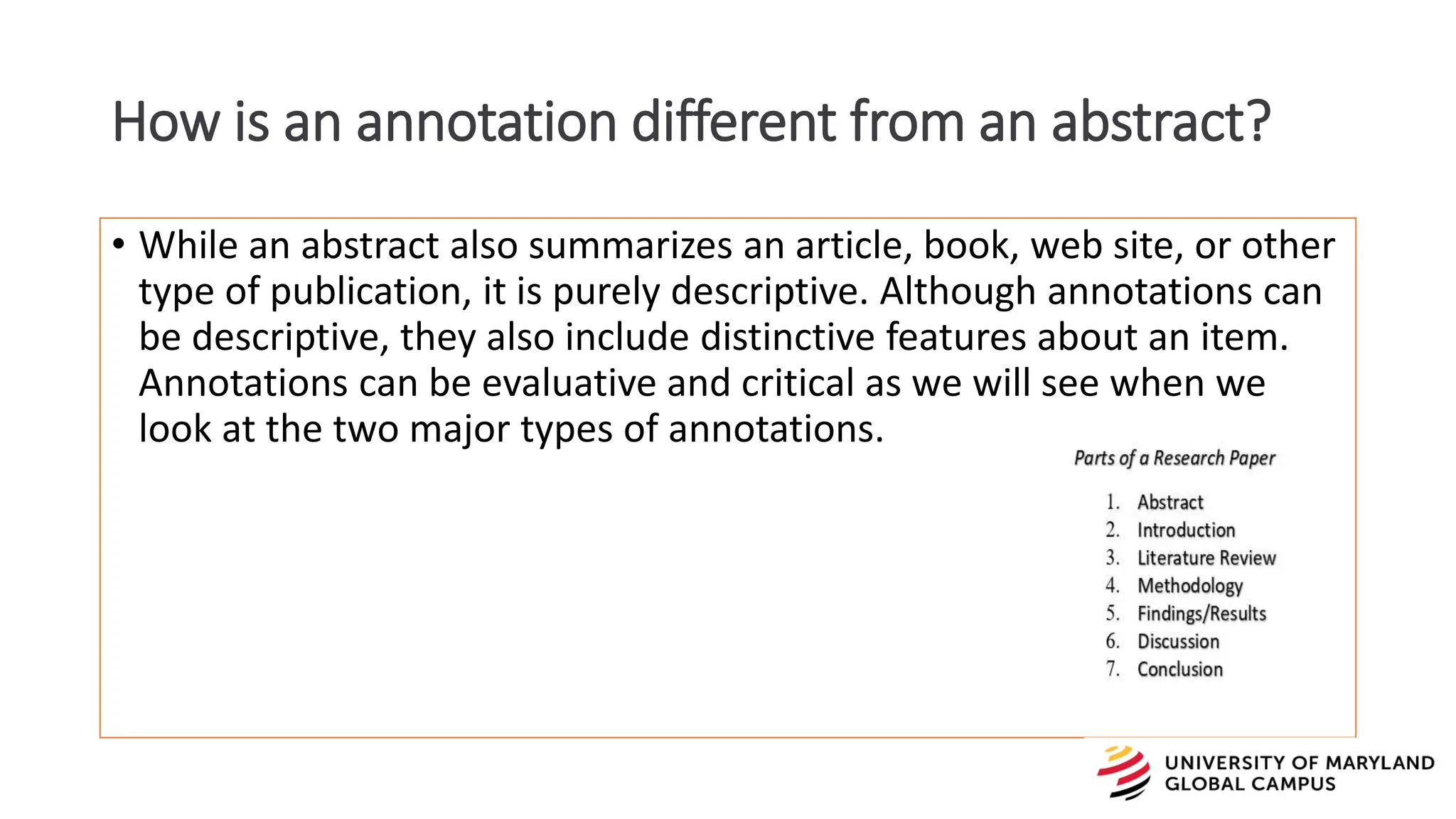
• While an abstract also summarizes an article, book, web site, or other
type of publication, it is purely descriptive. Although annotations can
be descriptive, they also include distinctive features about an item.
Annotations can be evaluative and critical as we will see when we
look at the two major types of annotations.
How is an annotation different from an abstract?
What is an annotated bibliography?
• An annotated bibliography is an organized list of sources (like a reference
list). It differs from a straightforward bibliography in that each reference is
followed by a paragraph length annotation, usually 100–200 words in
length.
• Depending on the assignment, an annotated bibliography might have
different purposes:
• Provide help with a literature review on a particular subject
• Help to formulate a thesis on a subject
• Demonstrate the research you have performed on a particular subject
• Provide examples of major sources of information available on a topic
• Describe items that other researchers may find of interest on a topic
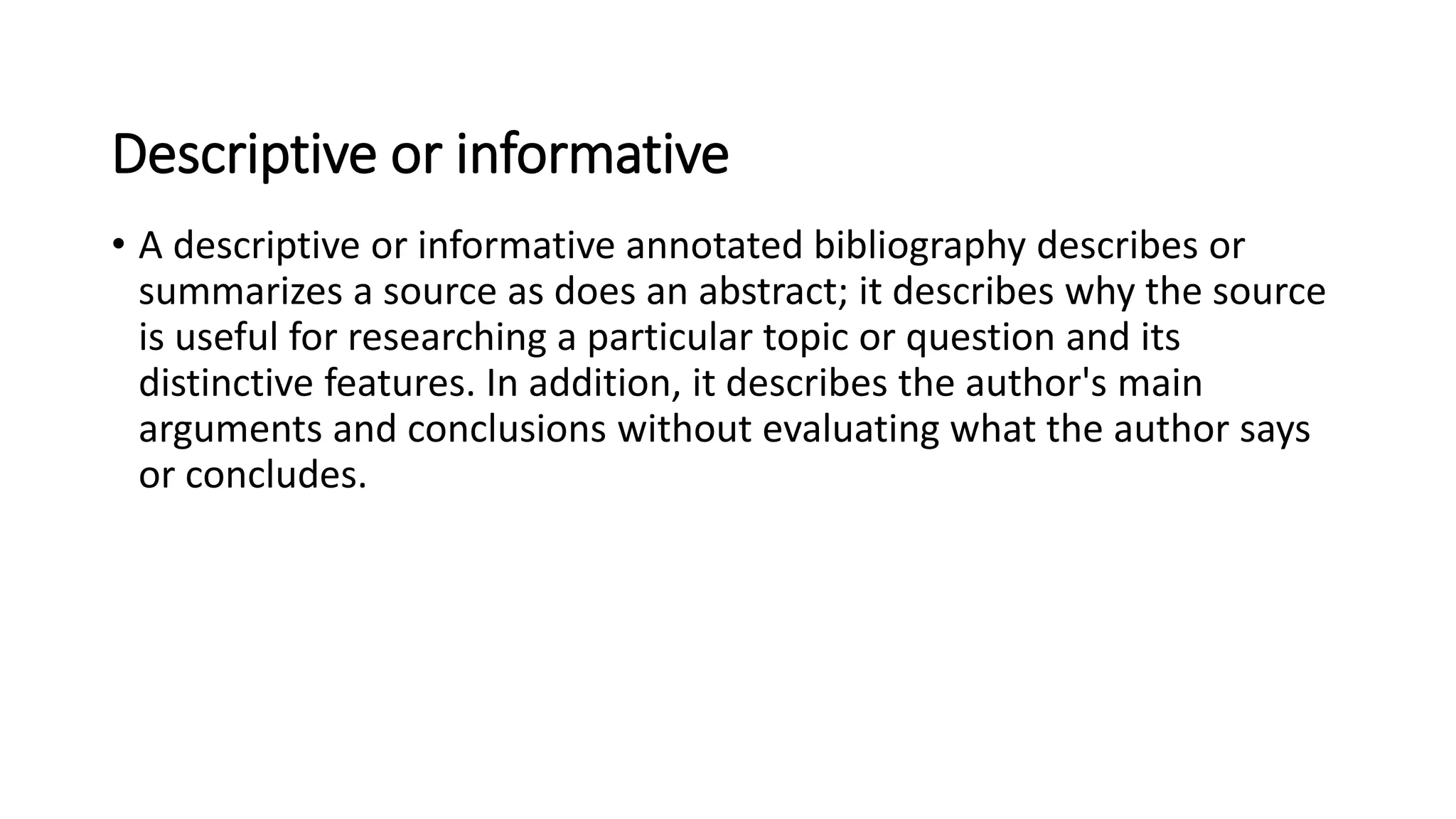
Types of annotated bibliographies
There are two major types of annotated bibliographies:
1.Descriptive or informative
2. Analytical or critical
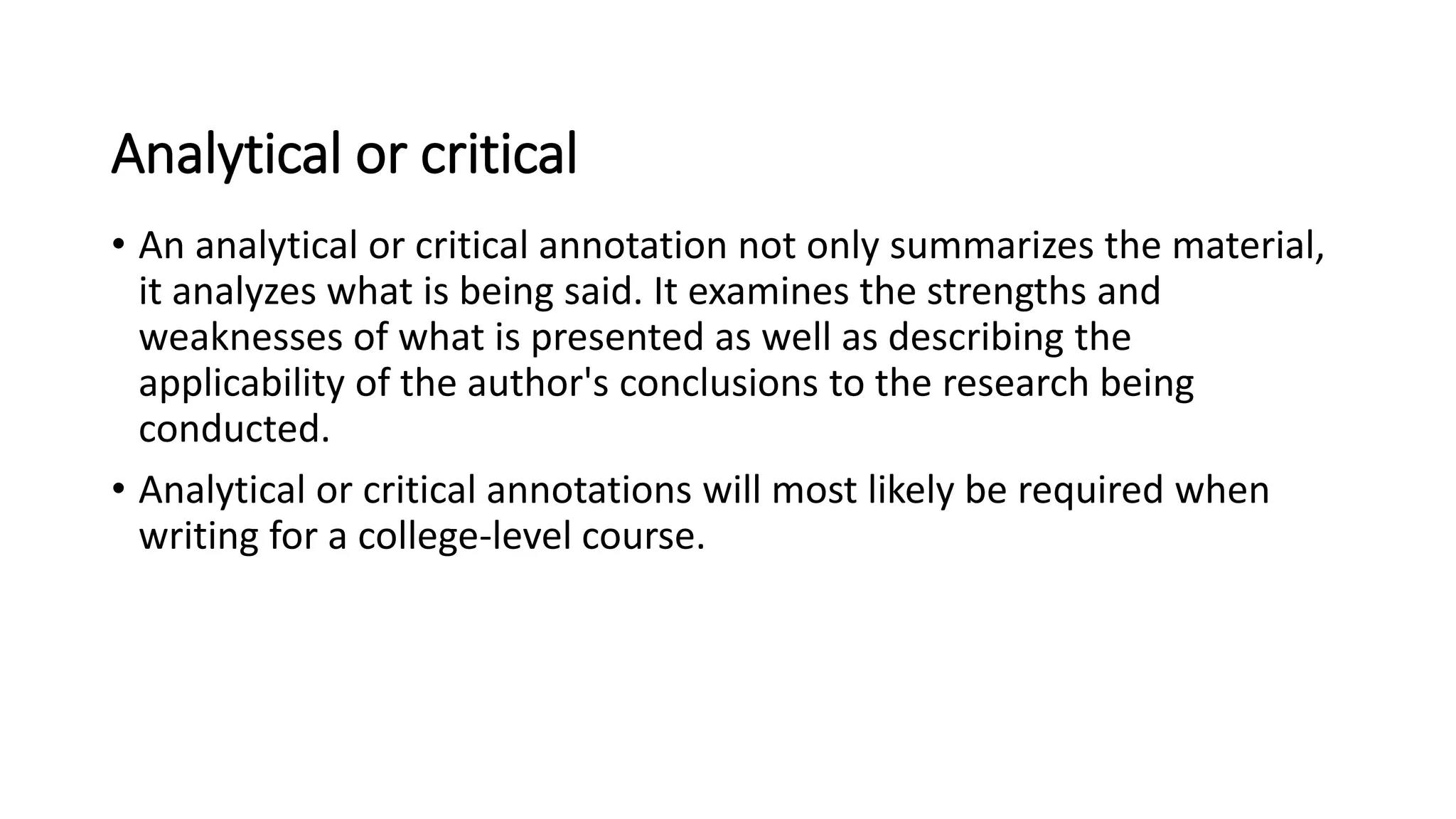
Descriptive or informative
• A descriptive or informative annotated bibliography describes or
summarizes a source as does an abstract; it describes why the source
is useful for researching a particular topic or question and its
distinctive features. In addition, it describes the author's main
arguments and conclusions without evaluating what the author says
or concludes.
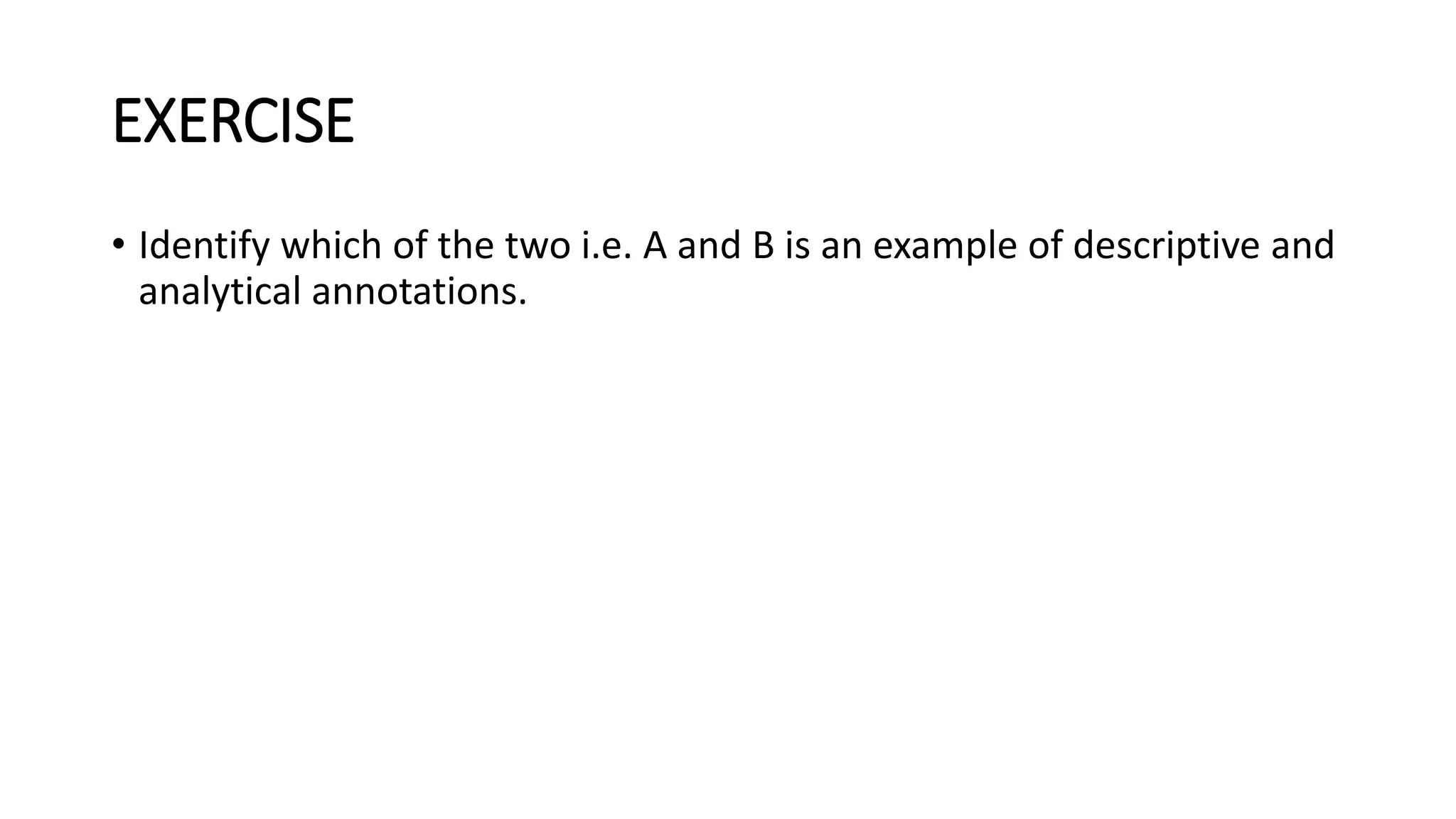
Analytical or critical
• An analytical or critical annotation not only summarizes the material,
it analyzes what is being said. It examines the strengths and
weaknesses of what is presented as well as describing the
applicability of the author's conclusions to the research being
conducted.
• Analytical or critical annotations will most likely be required when
writing for a college-level course.
EXERCISE
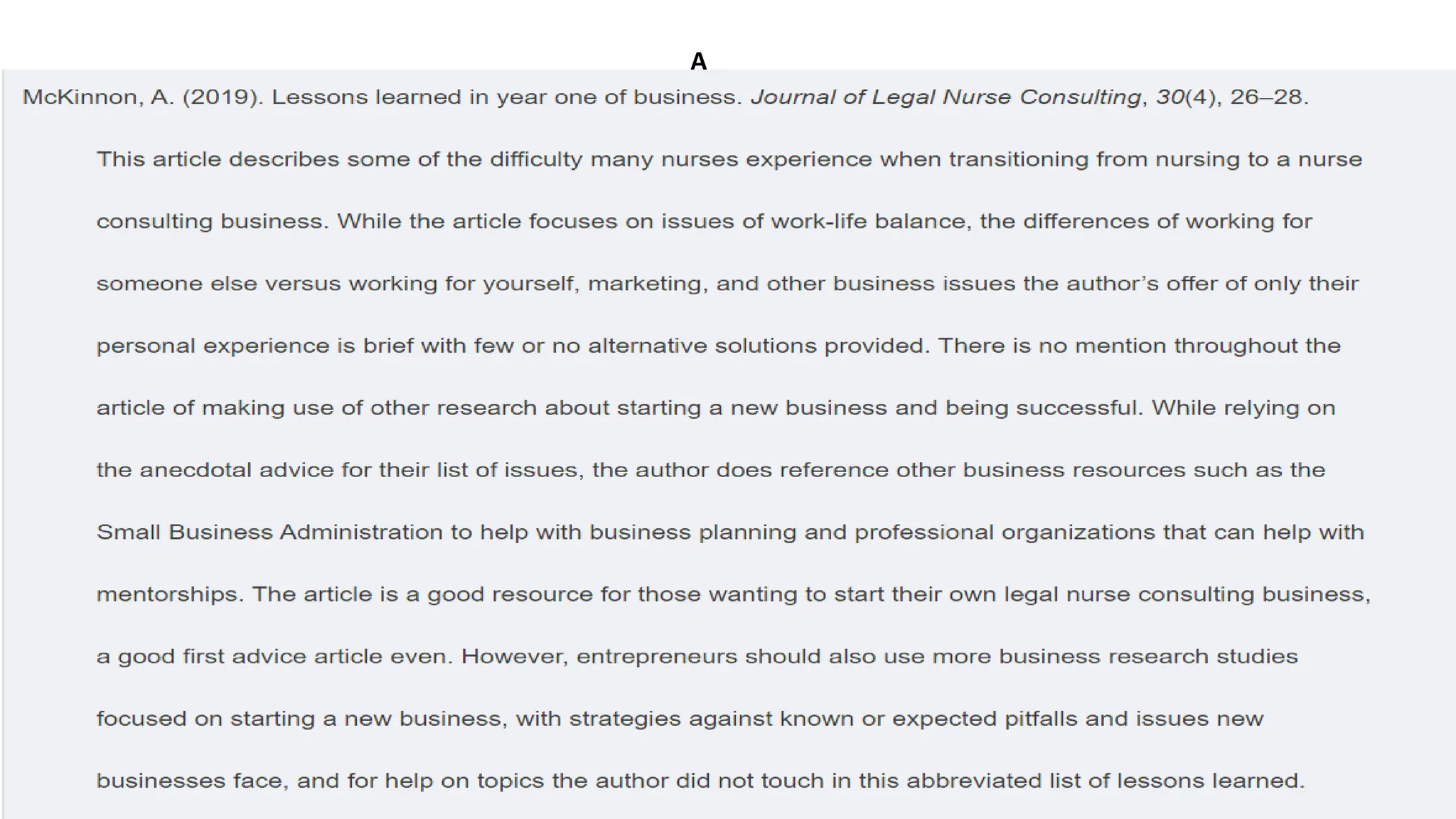
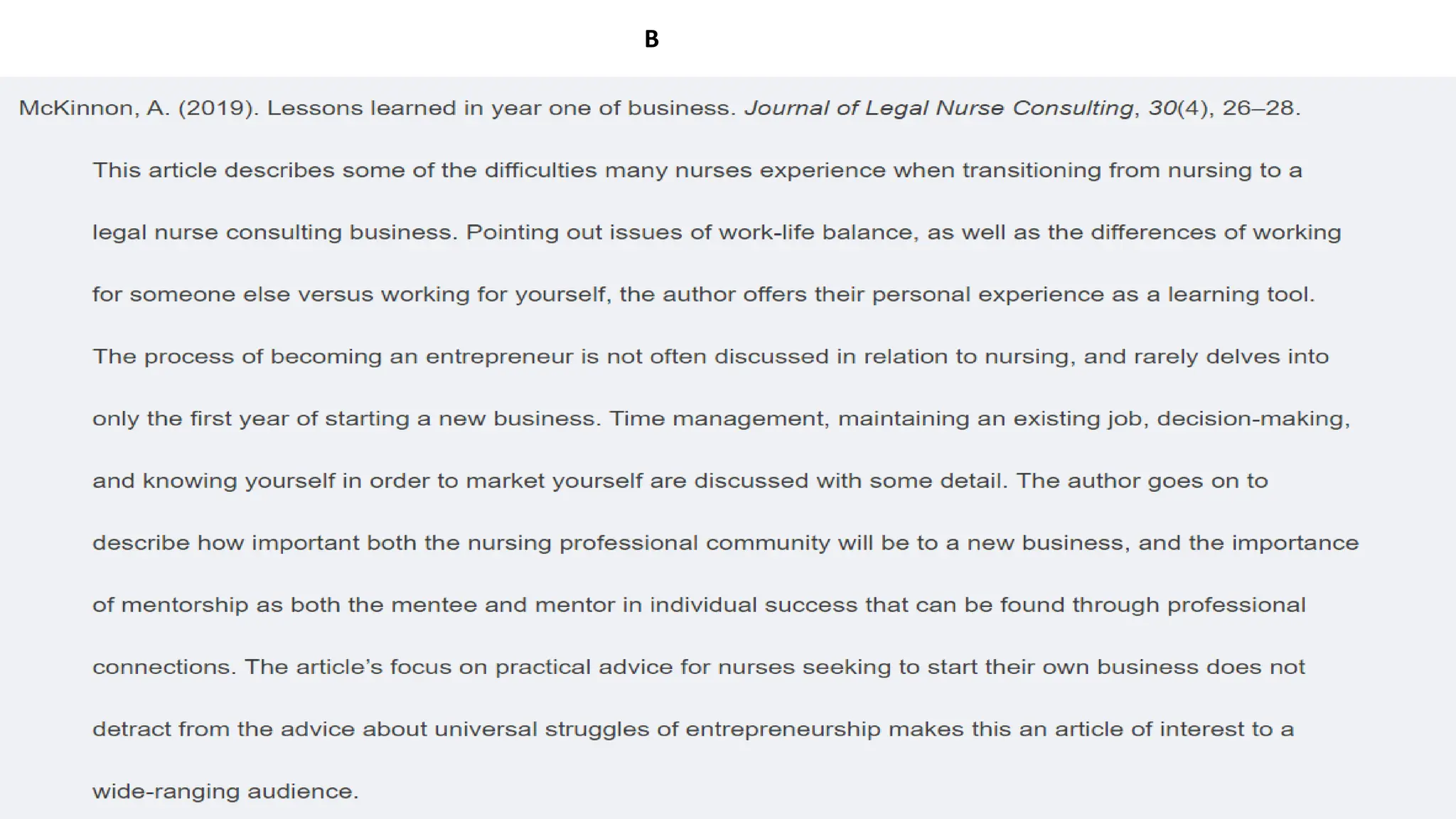
• Identify which of the two i.e. A and B is an example of descriptive and
analytical annotations.
A
B
To get started
Now you are ready to begin writing your own annotated bibliography.
• Choose your sources - Before writing your annotated bibliography, you must
choose your sources. This involves doing research much like for any other
project. Locate records to materials that may apply to your topic.
• Review the items - Then review the actual items and choose those that
provide a wide variety of perspectives on your topic. Article abstracts are
helpful in this process.
• Write the citation and annotation - When writing your annotation, the
complete citation should always come first and the annotation follows.
Depending on the type of annotated bibliography you are writing, you will
want to include some or all of the following:
• The purpose of the work
• A summary of its content
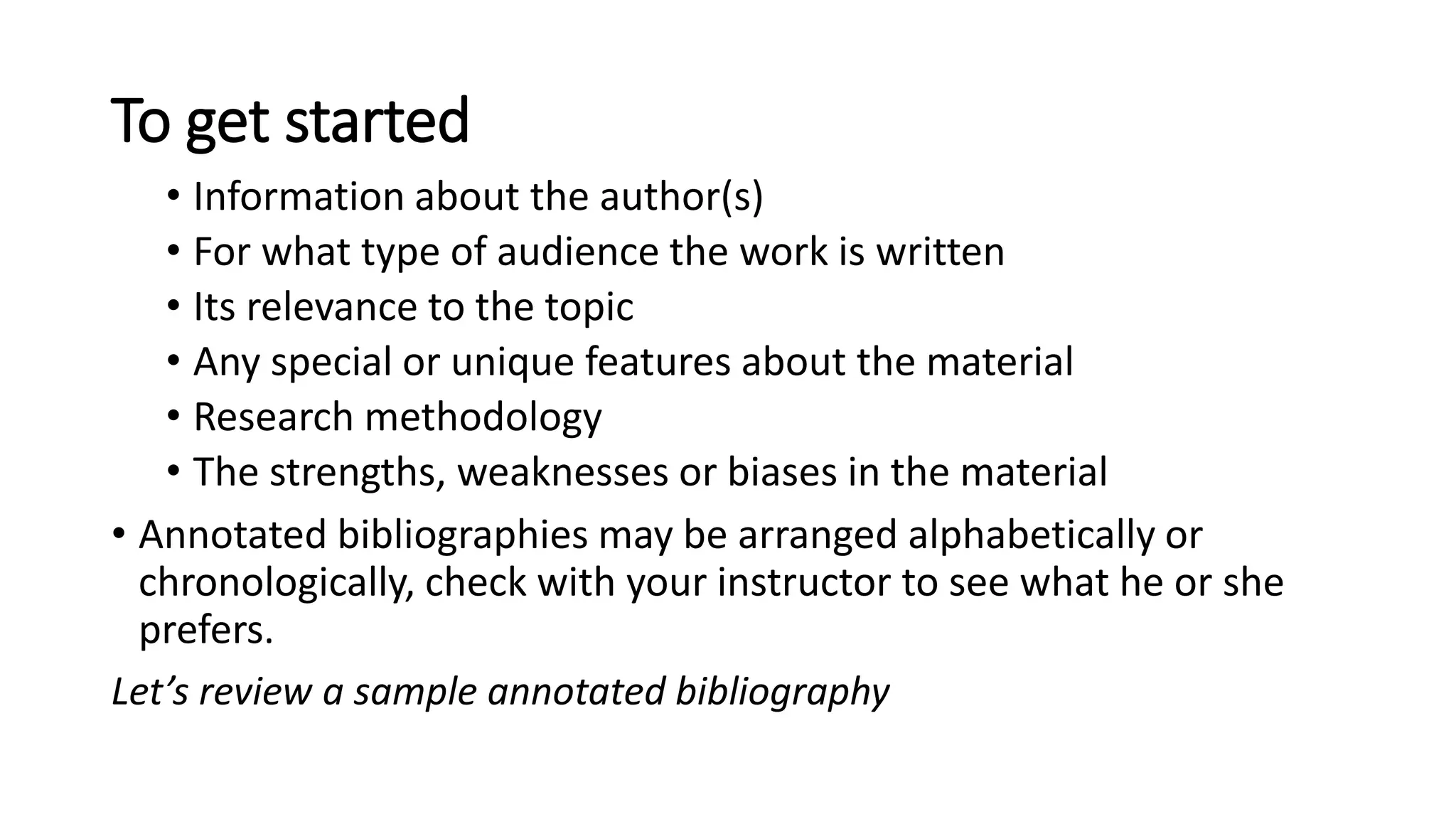
To get started
• Information about the author(s)
• For what type of audience the work is written
• Its relevance to the topic
• Any special or unique features about the material
• Research methodology
• The strengths, weaknesses or biases in the material
• Annotated bibliographies may be arranged alphabetically or
chronologically, check with your instructor to see what he or she
prefers.
Let’s review a sample annotated bibliography

What is an Annotated Bibliography? An Introductionpptx

  • 1.
    How to Writean Annotated Bibliography - APA Style (7th Edition)
  • 2.
    What is anannotation? • An annotation is more than just a brief summary of an article, book, web site, or other type of publication. An annotation should give enough information to make a reader decide whether to read the complete work. In other words, if the reader were exploring the same topic as you, is this material useful and if so, why?
  • 3.
    • While anabstract also summarizes an article, book, web site, or other type of publication, it is purely descriptive. Although annotations can be descriptive, they also include distinctive features about an item. Annotations can be evaluative and critical as we will see when we look at the two major types of annotations. How is an annotation different from an abstract?
  • 4.
    What is anannotated bibliography? • An annotated bibliography is an organized list of sources (like a reference list). It differs from a straightforward bibliography in that each reference is followed by a paragraph length annotation, usually 100–200 words in length. • Depending on the assignment, an annotated bibliography might have different purposes: • Provide help with a literature review on a particular subject • Help to formulate a thesis on a subject • Demonstrate the research you have performed on a particular subject • Provide examples of major sources of information available on a topic • Describe items that other researchers may find of interest on a topic
  • 5.
    Types of annotatedbibliographies There are two major types of annotated bibliographies: 1.Descriptive or informative 2. Analytical or critical
  • 6.
    Descriptive or informative •A descriptive or informative annotated bibliography describes or summarizes a source as does an abstract; it describes why the source is useful for researching a particular topic or question and its distinctive features. In addition, it describes the author's main arguments and conclusions without evaluating what the author says or concludes.
  • 7.
    Analytical or critical •An analytical or critical annotation not only summarizes the material, it analyzes what is being said. It examines the strengths and weaknesses of what is presented as well as describing the applicability of the author's conclusions to the research being conducted. • Analytical or critical annotations will most likely be required when writing for a college-level course.
  • 8.
    EXERCISE • Identify whichof the two i.e. A and B is an example of descriptive and analytical annotations.
  • 9.
  • 10.
  • 11.
    To get started Nowyou are ready to begin writing your own annotated bibliography. • Choose your sources - Before writing your annotated bibliography, you must choose your sources. This involves doing research much like for any other project. Locate records to materials that may apply to your topic. • Review the items - Then review the actual items and choose those that provide a wide variety of perspectives on your topic. Article abstracts are helpful in this process. • Write the citation and annotation - When writing your annotation, the complete citation should always come first and the annotation follows. Depending on the type of annotated bibliography you are writing, you will want to include some or all of the following: • The purpose of the work • A summary of its content
  • 12.
    To get started •Information about the author(s) • For what type of audience the work is written • Its relevance to the topic • Any special or unique features about the material • Research methodology • The strengths, weaknesses or biases in the material • Annotated bibliographies may be arranged alphabetically or chronologically, check with your instructor to see what he or she prefers. Let’s review a sample annotated bibliography