ANNOTATED
BIBLIOGRAPHY
A Preliminary Research Requirement
WHAT IS AN ANNOTATED BIBLIOGRAPHY?
1. An annotated bibliography is a list of citations to
books, articles, and documents.
2. Each citation is followed by a brief (usually about
150 words) descriptive and evaluative paragraph,
the annotation.
3. The purpose of the annotation is to inform the
reader of the relevance, accuracy, and quality of
the sources cited.
ANNOTATIONS VS. ABSTRACTS
1. Abstracts are the purely descriptive summaries
often found at the beginning of scholarly journal
articles or in periodical indexes.
2. Annotations are descriptive and critical; they may
describe the author's point of view, authority, or
clarity and appropriateness of expression.
THE PROCESS
1. Creating an annotated bibliography calls for the application of a
variety of intellectual skills: concise exposition, succinct analysis,
and informed library research.
2. First, locate and record citations to books, periodicals, and
documents that may contain useful information and ideas on your
topic. Briefly examine and review the actual items. Then choose
those works that provide a variety of perspectives on your topic.
3. Cite the book, article, or document using the appropriate style.
4. Write a concise annotation that summarizes the central theme
and scope of the book or article. Include one or more sentences
that (a) evaluate the authority or background of the author, (b)
comment on the intended audience, (c) compare or contrast this
work with another you have cited, or (d) explain how this work
illuminates your bibliography topic.
THE PROCESS
1. Creating an annotated bibliography calls for the application of a
variety of intellectual skills: concise exposition, succinct analysis,
and informed library research.
2. First, locate and record citations to books, periodicals, and
documents that may contain useful information and ideas on your
topic. Briefly examine and review the actual items. Then choose
those works that provide a variety of perspectives on your topic.
3. Cite the book, article, or document using the appropriate style.
4. Write a concise annotation that summarizes the central theme
and scope of the book or article. Include one or more sentences
that (a) evaluate the authority or background of the author, (b)
comment on the intended audience, (c) compare or contrast this
work with another you have cited, or (d) explain how this work
illuminates your bibliography topic.
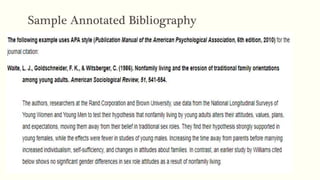
Sample Annotated Bibliography
Good Luck
and
Happy Researching!
In a piece of paper, submit the
names of your final members
including the working
title/problem you will, most
likely, explore.

Annotated-bibliography.pdf

  • 1.
  • 2.
    WHAT IS ANANNOTATED BIBLIOGRAPHY? 1. An annotated bibliography is a list of citations to books, articles, and documents. 2. Each citation is followed by a brief (usually about 150 words) descriptive and evaluative paragraph, the annotation. 3. The purpose of the annotation is to inform the reader of the relevance, accuracy, and quality of the sources cited.
  • 3.
    ANNOTATIONS VS. ABSTRACTS 1.Abstracts are the purely descriptive summaries often found at the beginning of scholarly journal articles or in periodical indexes. 2. Annotations are descriptive and critical; they may describe the author's point of view, authority, or clarity and appropriateness of expression.
  • 4.
    THE PROCESS 1. Creatingan annotated bibliography calls for the application of a variety of intellectual skills: concise exposition, succinct analysis, and informed library research. 2. First, locate and record citations to books, periodicals, and documents that may contain useful information and ideas on your topic. Briefly examine and review the actual items. Then choose those works that provide a variety of perspectives on your topic. 3. Cite the book, article, or document using the appropriate style. 4. Write a concise annotation that summarizes the central theme and scope of the book or article. Include one or more sentences that (a) evaluate the authority or background of the author, (b) comment on the intended audience, (c) compare or contrast this work with another you have cited, or (d) explain how this work illuminates your bibliography topic.
  • 5.
    THE PROCESS 1. Creatingan annotated bibliography calls for the application of a variety of intellectual skills: concise exposition, succinct analysis, and informed library research. 2. First, locate and record citations to books, periodicals, and documents that may contain useful information and ideas on your topic. Briefly examine and review the actual items. Then choose those works that provide a variety of perspectives on your topic. 3. Cite the book, article, or document using the appropriate style. 4. Write a concise annotation that summarizes the central theme and scope of the book or article. Include one or more sentences that (a) evaluate the authority or background of the author, (b) comment on the intended audience, (c) compare or contrast this work with another you have cited, or (d) explain how this work illuminates your bibliography topic.
  • 6.
  • 7.
  • 8.
    In a pieceof paper, submit the names of your final members including the working title/problem you will, most likely, explore.