THE ANNOTATED
BIBLIOGRAPHY
What is a Bibliography?
What is an Annotation?
A Bibliography is a list of citations put together
on a topic of interest.
An Annotation is a commentary a reader makes
after critically reading an information source.
It includes a summary of the reading and the
reader’s response to the reading.
What is an
Annotated Bibliography?
An Annotated Bibliography is a list of
bibliographic citations that includes a
descriptive and evaluative paragraph of each
citation.
Its overall purpose is to support your study of a
particular subject by providing a collection of
succinct article summaries that will negate the
need for rereading of an article.
Where do I start?
 Begin by critically reading the article. View the
reading as an interactive process in which
your interpretation of author’s words is
influenced by your own knowledge and
experiences.
 Critical readers attempt to dialogue with the
text by asking tough questions on the article’s
purpose, audience, language and content.
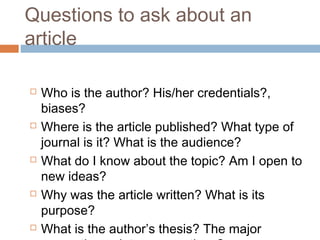
Questions to ask about an
article
 Who is the author? His/her credentials?,
biases?
 Where is the article published? What type of
journal is it? What is the audience?
 What do I know about the topic? Am I open to
new ideas?
 Why was the article written? What is its
purpose?
 What is the author’s thesis? The major
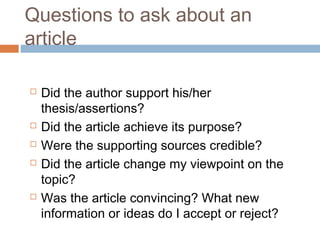
Questions to ask about an
article
 Did the author support his/her
thesis/assertions?
 Did the article achieve its purpose?
 Were the supporting sources credible?
 Did the article change my viewpoint on the
topic?
 Was the article convincing? What new
information or ideas do I accept or reject?
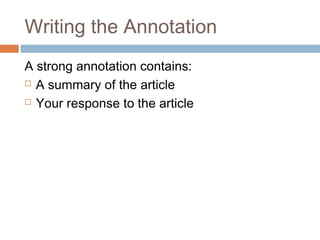
Writing the Annotation
A strong annotation contains:
 A summary of the article
 Your response to the article
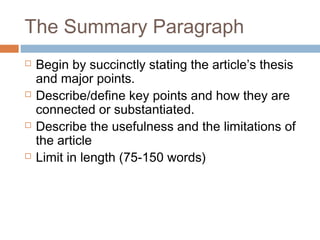
The Summary Paragraph
 Begin by succinctly stating the article’s thesis
and major points.
 Describe/define key points and how they are
connected or substantiated.
 Describe the usefulness and the limitations of
the article
 Limit in length (75-150 words)
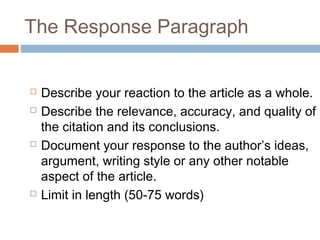
The Response Paragraph
 Describe your reaction to the article as a whole.
 Describe the relevance, accuracy, and quality of
the citation and its conclusions.
 Document your response to the author’s ideas,
argument, writing style or any other notable
aspect of the article.
 Limit in length (50-75 words)
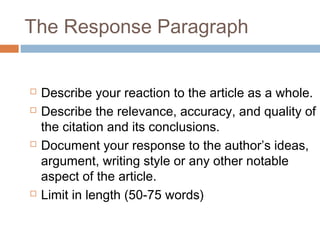
The Response Paragraph
 Describe your reaction to the article as a whole.
 Describe the relevance, accuracy, and quality of
the citation and its conclusions.
 Document your response to the author’s ideas,
argument, writing style or any other notable
aspect of the article.
 Limit in length (50-75 words)

Annotated bibliography

  • 1.
  • 2.
    What is aBibliography? What is an Annotation? A Bibliography is a list of citations put together on a topic of interest. An Annotation is a commentary a reader makes after critically reading an information source. It includes a summary of the reading and the reader’s response to the reading.
  • 3.
    What is an AnnotatedBibliography? An Annotated Bibliography is a list of bibliographic citations that includes a descriptive and evaluative paragraph of each citation. Its overall purpose is to support your study of a particular subject by providing a collection of succinct article summaries that will negate the need for rereading of an article.
  • 4.
    Where do Istart?  Begin by critically reading the article. View the reading as an interactive process in which your interpretation of author’s words is influenced by your own knowledge and experiences.  Critical readers attempt to dialogue with the text by asking tough questions on the article’s purpose, audience, language and content.
  • 5.
    Questions to askabout an article  Who is the author? His/her credentials?, biases?  Where is the article published? What type of journal is it? What is the audience?  What do I know about the topic? Am I open to new ideas?  Why was the article written? What is its purpose?  What is the author’s thesis? The major
  • 6.
    Questions to askabout an article  Did the author support his/her thesis/assertions?  Did the article achieve its purpose?  Were the supporting sources credible?  Did the article change my viewpoint on the topic?  Was the article convincing? What new information or ideas do I accept or reject?
  • 7.
    Writing the Annotation Astrong annotation contains:  A summary of the article  Your response to the article
  • 8.
    The Summary Paragraph Begin by succinctly stating the article’s thesis and major points.  Describe/define key points and how they are connected or substantiated.  Describe the usefulness and the limitations of the article  Limit in length (75-150 words)
  • 9.
    The Response Paragraph Describe your reaction to the article as a whole.  Describe the relevance, accuracy, and quality of the citation and its conclusions.  Document your response to the author’s ideas, argument, writing style or any other notable aspect of the article.  Limit in length (50-75 words)
  • 10.
    The Response Paragraph Describe your reaction to the article as a whole.  Describe the relevance, accuracy, and quality of the citation and its conclusions.  Document your response to the author’s ideas, argument, writing style or any other notable aspect of the article.  Limit in length (50-75 words)