Let’s Review:
The Main Idea…
1. Answers the question: “What is the main point the
author is trying to make about the topic?
1. Functions as the umbrella of the paragraph/text
2. May be anywhere in the paragraph, but typically it is
the beginning
3. Is supported by “pillars” or supporting points
Let’s Review:
Supporting Details…
Are the reasons, examples, facts, steps of other
kinds of evidence that explain and support the main
idea
Appear as two types: major and minor details
Can be identified by transitions like list words and
transition words
STOP: Make an outline
Take out a half sheet of paper
Recall what you learned in the last chapter about outlines
Draw out an outline that includes the main idea, the major
details, and minor details
Include transition words
See what it would look like on the next page!
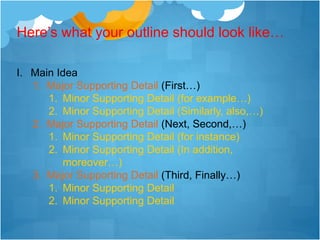
Here’s what your outline should look like…
I. Main Idea
1. Major Supporting Detail (First…)
1. Minor Supporting Detail (for example…)
2. Minor Supporting Detail (Similarly, also,…)
2. Major Supporting Detail (Next, Second,…)
1. Minor Supporting Detail (for instance)
2. Minor Supporting Detail (In addition,
moreover…)
3. Major Supporting Detail (Third, Finally…)
1. Minor Supporting Detail
2. Minor Supporting Detail
The Main Idea: Sneaky
Business
As you learned in Chapter 2, the main
idea is stated, usually at the beginning
of your reading right?
News flash: it can also be “hidden” or
what we call implied
Implied Main Ideas
When something is not said outright or stated, it is
suggested or implied.
An implied main idea is the overall point the author is
trying to make, but it is only suggested by the
supporting details and not clearly stated in one
sentence.
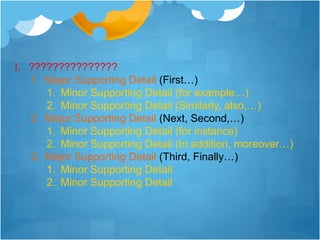
I. ???????????????
1. Major Supporting Detail (First…)
1. Minor Supporting Detail (for example…)
2. Minor Supporting Detail (Similarly, also,…)
2. Major Supporting Detail (Next, Second,…)
1. Minor Supporting Detail (for instance)
2. Minor Supporting Detail (In addition, moreover…)
3. Major Supporting Detail (Third, Finally…)
1. Minor Supporting Detail
2. Minor Supporting Detail
Your Biggest Helper: ASK
YOURSELF THIS:
What is the main point the
author is trying to make
about the topic?
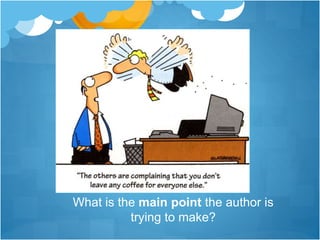
What is the main point the author is
trying to make?
You can figure out the implied main idea asking
yourself the question and then by looking at the
supporting details:
The man’s coworkers are complaining that he
doesn’t leave coffee for anyone else.
He has such a caffeine high that he is flying!
What is the main point the author is trying to
make about that topic?
That he is drinking too much coffee.
All people are concerned about a few great questions: the existence
of God, the purpose of life, the existence of an afterlife, and morality.
About the first, science has nothing to say: no test tube has either
proved or disproved God’s existence. As to the purpose of life,
although science can provide a definition of life and describe the
characteristics of living organisms, it has nothing to say about
ultimate purpose. Regarding an afterlife, science can offer no
information, for it has no tests that it can use to detect a “hereafter.”
As for the question of morality, science can demonstrate the
consequences of behavior but not the moral superiority of one action
compared with another. Science cannot even prove that loving your
family and neighbor is superior to hurting and killing them.
Read the following paragraph on page
146 and see if you can figure out its main
idea.
Now ask yourself…
Who or what is this paragraph about?
What is the main point the author is trying to
make about that topic?
Does all or most of the material in the
paragraph support this main idea?
Who or what is this paragraph about?
In the paragraph, all the details are about science
and great human concerns, so that must be the
topic.
What is the main point the author is trying to make
about that topic?
Science alone cannot tell us about the four main
concerns that all people have.
Does all or most of the material in the paragraph
support this main idea? Yes. Every sentence is about the
“great questions” people are concerned about and the lack of
information science provides about them.
Stop: What’s the hint to help
find the implied main idea?
What is the main point the
author is trying to make about
the topic?
Review
One way to find the implied main idea is to ask what?
What is the main point the
author is trying to make about
the topic?
Put it in your own words
Many times when we read, we have to infer or make
a conclusion
To infer is to figure it out on your own based on
evidence
Take a look at page 152 in your book
Inferring in a longer passage
In longer works, you will have to find the inferred main
idea
This is known as the thesis or central point
You must make sure that most or all of the material must
support that point
Read the longer passage on 155 and then ask yourself
the 3 hint questions to find the implied main idea
3 questions
Who or what is the passage about?
What is the point the author is trying to make about
the topic?
Does all or most of the material in the passage
support this idea?
TEST YOURSELF
1. What is the difference between a stated main idea
and an implied main idea?
2. What question can you ask yourself when trying to
find the main idea?
3. What does it mean to infer?
4. What should you look for in longer works when the
author gives you an implied main idea?

Chapter 4

  • 2.
    Let’s Review: The MainIdea… 1. Answers the question: “What is the main point the author is trying to make about the topic? 1. Functions as the umbrella of the paragraph/text 2. May be anywhere in the paragraph, but typically it is the beginning 3. Is supported by “pillars” or supporting points
  • 3.
    Let’s Review: Supporting Details… Arethe reasons, examples, facts, steps of other kinds of evidence that explain and support the main idea Appear as two types: major and minor details Can be identified by transitions like list words and transition words
  • 4.
    STOP: Make anoutline Take out a half sheet of paper Recall what you learned in the last chapter about outlines Draw out an outline that includes the main idea, the major details, and minor details Include transition words See what it would look like on the next page!
  • 5.
    Here’s what youroutline should look like… I. Main Idea 1. Major Supporting Detail (First…) 1. Minor Supporting Detail (for example…) 2. Minor Supporting Detail (Similarly, also,…) 2. Major Supporting Detail (Next, Second,…) 1. Minor Supporting Detail (for instance) 2. Minor Supporting Detail (In addition, moreover…) 3. Major Supporting Detail (Third, Finally…) 1. Minor Supporting Detail 2. Minor Supporting Detail
  • 6.
    The Main Idea:Sneaky Business As you learned in Chapter 2, the main idea is stated, usually at the beginning of your reading right? News flash: it can also be “hidden” or what we call implied
  • 7.
    Implied Main Ideas Whensomething is not said outright or stated, it is suggested or implied. An implied main idea is the overall point the author is trying to make, but it is only suggested by the supporting details and not clearly stated in one sentence.
  • 8.
    I. ??????????????? 1. MajorSupporting Detail (First…) 1. Minor Supporting Detail (for example…) 2. Minor Supporting Detail (Similarly, also,…) 2. Major Supporting Detail (Next, Second,…) 1. Minor Supporting Detail (for instance) 2. Minor Supporting Detail (In addition, moreover…) 3. Major Supporting Detail (Third, Finally…) 1. Minor Supporting Detail 2. Minor Supporting Detail
  • 9.
    Your Biggest Helper:ASK YOURSELF THIS: What is the main point the author is trying to make about the topic?
  • 10.
    What is themain point the author is trying to make?
  • 11.
    You can figureout the implied main idea asking yourself the question and then by looking at the supporting details: The man’s coworkers are complaining that he doesn’t leave coffee for anyone else. He has such a caffeine high that he is flying! What is the main point the author is trying to make about that topic? That he is drinking too much coffee.
  • 12.
    All people areconcerned about a few great questions: the existence of God, the purpose of life, the existence of an afterlife, and morality. About the first, science has nothing to say: no test tube has either proved or disproved God’s existence. As to the purpose of life, although science can provide a definition of life and describe the characteristics of living organisms, it has nothing to say about ultimate purpose. Regarding an afterlife, science can offer no information, for it has no tests that it can use to detect a “hereafter.” As for the question of morality, science can demonstrate the consequences of behavior but not the moral superiority of one action compared with another. Science cannot even prove that loving your family and neighbor is superior to hurting and killing them. Read the following paragraph on page 146 and see if you can figure out its main idea.
  • 13.
    Now ask yourself… Whoor what is this paragraph about? What is the main point the author is trying to make about that topic? Does all or most of the material in the paragraph support this main idea?
  • 14.
    Who or whatis this paragraph about? In the paragraph, all the details are about science and great human concerns, so that must be the topic. What is the main point the author is trying to make about that topic? Science alone cannot tell us about the four main concerns that all people have. Does all or most of the material in the paragraph support this main idea? Yes. Every sentence is about the “great questions” people are concerned about and the lack of information science provides about them.
  • 15.
    Stop: What’s thehint to help find the implied main idea? What is the main point the author is trying to make about the topic?
  • 16.
    Review One way tofind the implied main idea is to ask what? What is the main point the author is trying to make about the topic?
  • 17.
    Put it inyour own words Many times when we read, we have to infer or make a conclusion To infer is to figure it out on your own based on evidence Take a look at page 152 in your book
  • 18.
    Inferring in alonger passage In longer works, you will have to find the inferred main idea This is known as the thesis or central point You must make sure that most or all of the material must support that point Read the longer passage on 155 and then ask yourself the 3 hint questions to find the implied main idea
  • 19.
    3 questions Who orwhat is the passage about? What is the point the author is trying to make about the topic? Does all or most of the material in the passage support this idea?
  • 20.
    TEST YOURSELF 1. Whatis the difference between a stated main idea and an implied main idea? 2. What question can you ask yourself when trying to find the main idea? 3. What does it mean to infer? 4. What should you look for in longer works when the author gives you an implied main idea?