ARTICLE CRITIQUE
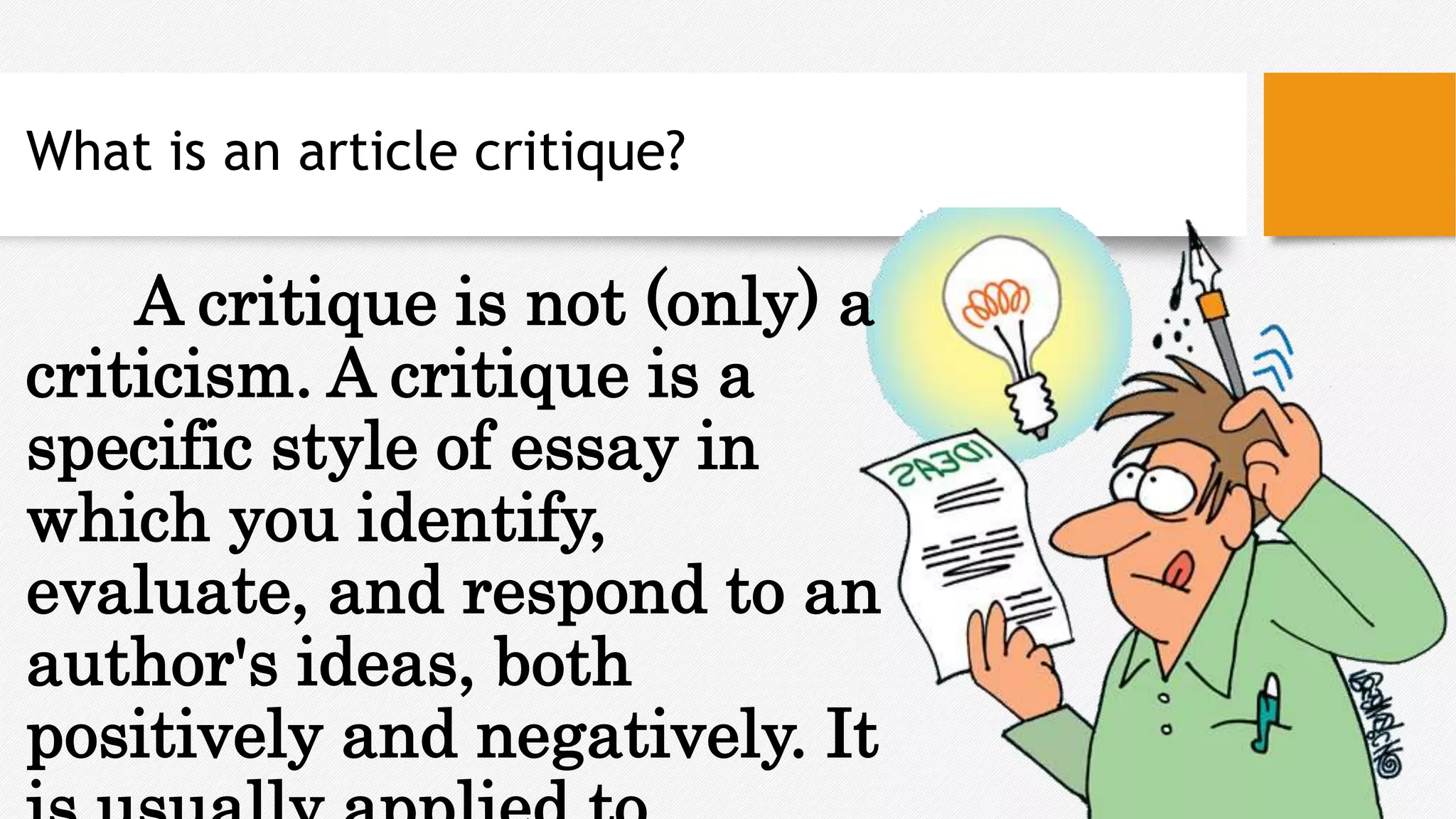
What is an article critique?
A critique is not (only) a
criticism. A critique is a
specific style of essay in
which you identify,
evaluate, and respond to an
author's ideas, both
positively and negatively. It
•A review (or “critique”) of a
book or article is not
primarily a summary.
Rather, it analyses,
comments on and
evaluates the work.
•An article critique is similar to
book review, but it analyzes
and comments on an article or
text, instead of an entire book.
Although the word "critique" is
usually associated with fault
finding or criticism in a
negative sense, it actually
•You are expected to engage
with the article rather than
just summarize it, by
considering its content
carefully, and from different
angles. Your critique must
be objective, so support it
with evidence rather than
When you engage in a critique you are demonstrating
to your marker that:
• You have read extensively
• You can identify the particular strengths
and weaknesses of those readings
• You can identify different positions and
perspectives in the readings
• You are developing the skills and
knowledge to engage with the experts
• You are joining in a broader academic
debate about an article's merits
What do we do when we critique?
Identify:
•What is the article's
background and purpose?
•What is the main idea (the
main argument) that the
article is communicating?
Evaluate:
•How convincing is the
argument?
•What does the argument
assume?
•How useful or applicable is
the article?
Respond:
•What is your
assessment of the
article?
•What issues does it
raise?
STRUCTURE
Structure #1
•Introduction
•Summary
•Content (your review)
•Conclusion
INTRODUCTION
•Include a few opening
sentences that announce
the author(s) and the
title, and briefly explain
the topic of the text.
Present the aim of the
SUMMARY
•Present a summary of the key
points along with a limited
number of examples.
•You can also briefly explain the
author’s purpose/intentions
throughout the text and you
may briefly describe how the
text is organized.
REVIEW
•The REVIEW should be a balanced
discussion and evaluation of the
strengths, weakness and notable
features of the text.
•Remember to base your discussion
on specific criteria.
•Good reviews also include other
sources to support your evaluation
•If your critique is more positive
than negative, then present the
negative points first and the
positive last.
•You could begin by stating what is
good about the idea and then
concede and explain how it is
limited in some way. While this
example shows a mixed evaluation,
Structure #2
Introduction
Body
Conclusion
How to make an ARTICLE CRITIQUE?
•Read the article.
•Re-read the article. Underline
important ideas. Circle key terms.
Find the main point of the article.
Divide the article into sections or
stages of thought.
•Note the main idea of each
•Scan the text. Look for
information that can be
deduced from the
introduction, conclusion and
the title and headings.
What do these tell you
about the main points of the
•Locate the topic sentences
and highlight the main
points as you read.
•Reread the text and make
separate notes of the main points.
Examples and evidence do not
need to be included at this stage.
Usually they are used selectively
in your critique.
•Rewrite them in your own words
and in complete sentences
•Use reporting verbs and
phrases (eg; The author
describes…, Smith argues
that …).
•If you include unique or
specialist phrases from the
text, use quotation marks.
QUIZ TIME!
ARTICLE CRITIQUE.pptx

ARTICLE CRITIQUE.pptx

  • 1.
  • 2.
    What is anarticle critique? A critique is not (only) a criticism. A critique is a specific style of essay in which you identify, evaluate, and respond to an author's ideas, both positively and negatively. It
  • 3.
    •A review (or“critique”) of a book or article is not primarily a summary. Rather, it analyses, comments on and evaluates the work.
  • 4.
    •An article critiqueis similar to book review, but it analyzes and comments on an article or text, instead of an entire book. Although the word "critique" is usually associated with fault finding or criticism in a negative sense, it actually
  • 5.
    •You are expectedto engage with the article rather than just summarize it, by considering its content carefully, and from different angles. Your critique must be objective, so support it with evidence rather than
  • 6.
    When you engagein a critique you are demonstrating to your marker that: • You have read extensively • You can identify the particular strengths and weaknesses of those readings • You can identify different positions and perspectives in the readings • You are developing the skills and knowledge to engage with the experts • You are joining in a broader academic debate about an article's merits
  • 7.
    What do wedo when we critique? Identify: •What is the article's background and purpose? •What is the main idea (the main argument) that the article is communicating?
  • 8.
    Evaluate: •How convincing isthe argument? •What does the argument assume? •How useful or applicable is the article?
  • 9.
    Respond: •What is your assessmentof the article? •What issues does it raise?
  • 10.
  • 11.
  • 12.
    INTRODUCTION •Include a fewopening sentences that announce the author(s) and the title, and briefly explain the topic of the text. Present the aim of the
  • 13.
    SUMMARY •Present a summaryof the key points along with a limited number of examples. •You can also briefly explain the author’s purpose/intentions throughout the text and you may briefly describe how the text is organized.
  • 14.
    REVIEW •The REVIEW shouldbe a balanced discussion and evaluation of the strengths, weakness and notable features of the text. •Remember to base your discussion on specific criteria. •Good reviews also include other sources to support your evaluation
  • 15.
    •If your critiqueis more positive than negative, then present the negative points first and the positive last. •You could begin by stating what is good about the idea and then concede and explain how it is limited in some way. While this example shows a mixed evaluation,
  • 16.
  • 17.
  • 18.
  • 19.
  • 20.
    How to makean ARTICLE CRITIQUE?
  • 21.
    •Read the article. •Re-readthe article. Underline important ideas. Circle key terms. Find the main point of the article. Divide the article into sections or stages of thought. •Note the main idea of each
  • 22.
    •Scan the text.Look for information that can be deduced from the introduction, conclusion and the title and headings. What do these tell you about the main points of the
  • 23.
    •Locate the topicsentences and highlight the main points as you read.
  • 24.
    •Reread the textand make separate notes of the main points. Examples and evidence do not need to be included at this stage. Usually they are used selectively in your critique. •Rewrite them in your own words and in complete sentences
  • 25.
    •Use reporting verbsand phrases (eg; The author describes…, Smith argues that …). •If you include unique or specialist phrases from the text, use quotation marks.
  • 26.