DIAGNOSTIC TEST
Dr. R. Sasipriya
Assistant Professor in Physical Science
V.O.C. College of Education
Thoothukudi
CONTENT
 Introduction
 Diagnostic test
 Functions
 Characteristic of diagnostic test
 Preparation
 Diagnostic Assessment Ideas
 Types of diagnostic test
 Construction of diagnostic test
 preparation of the scoring and marking scheme
 Strategies for remedial teaching
 Advantage
 Disadvantage
 Conclusion
INTRODUCTION
A diagnostic test is a test designed
to locate specific learning deficiencies
in case of specific individuals at a
specific stage of learning so that
specific efforts could be made to
overcome those deficiencies.
DIAGNOSTIC TEST
Diagnostic test is a type of
assessment given at the beginning of
the instruction. It aims to identify
the strengths and weaknesses of the
students regarding the topic to be
discussed.
FUNCTIONS
 To direct curriculum emphasis
 To provide for educational guidance of
pupil
 To simulate the learning activities of
pupils
 To direct and motivate administrative
and supervisory efforts.
CHARACTERISTIC
The sub test used to access each of
these skills must represent a valid
measure.
Each subject must have high
reliability.
The correlation among subject
must be low.
PREPARATION
Planning
Writing items
Assembling test
Reviewing the test
Providing
directions and
preparing scoring
key
DIAGNOSTIC ASSESSMENT IDEAS
 Test/Quiz
Criteria for success
Achievement of curriculum
expectations
May use standardized testing
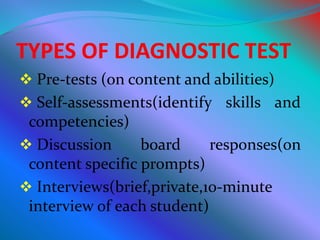
TYPES OF DIAGNOSTIC TEST
 Pre-tests (on content and abilities)
 Self-assessments(identify skills and
competencies)
 Discussion board responses(on
content specific prompts)
 Interviews(brief,private,10-minute
interview of each student)
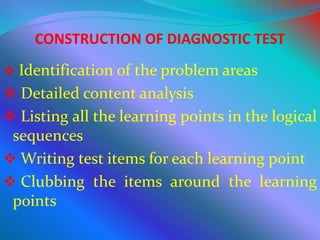
CONSTRUCTION OF DIAGNOSTIC TEST
 Identification of the problem areas
 Detailed content analysis
 Listing all the learning points in the logical
sequences
 Writing test items for each learning point
 Clubbing the items around the learning
points
 Providing clear instructions
 Preparing a scoring key and a
marking key
 Providing the time limit as
required by individual students
 Administration of the test
PREPARING THE SCORING KEY AND
MARKING SCHEME
Scoring key is prepared the
objective type questions and marking
schemes made for the essay and short
answers.
SCORING KEY
Q .No Answer Marks
1 A 1
2 C 1
3 D 1
4 B 1
MARKING SCHEME
Q. No Value points Marks Total marks
1
Value point-1
Value point-2
Value point-3
Value point-4
1
1
1
1
4
2
Value point-1
Value point-2
Value point-3
Value point-4
1
1
1
1
4
STRATEGIES FOR REMEDIAL
TEACHING
 Individual tutorial
 Auto instructional learning
 Group tutorial teaching
 Class teaching
 Informal teachings
ADVANDAGE
Analysis of a
learner’s performance in writing
and speaking in terms of
grammatical accuracy or linguistic
appropriacy.
DISADVANTAGE
Difficulty in
identifying whether a learner
masters the present perfect/past
tense distinction.
CONCLUSION
A useful test not only provides
information about students
achievement but also reveals the
instructional effectiveness as well. If
we examine individual performance,
we should able to determine each
student degree of proficiency on each
objective.
Thank you

Diagnostic test

  • 1.
    DIAGNOSTIC TEST Dr. R.Sasipriya Assistant Professor in Physical Science V.O.C. College of Education Thoothukudi
  • 2.
    CONTENT  Introduction  Diagnostictest  Functions  Characteristic of diagnostic test  Preparation  Diagnostic Assessment Ideas  Types of diagnostic test  Construction of diagnostic test  preparation of the scoring and marking scheme  Strategies for remedial teaching  Advantage  Disadvantage  Conclusion
  • 3.
    INTRODUCTION A diagnostic testis a test designed to locate specific learning deficiencies in case of specific individuals at a specific stage of learning so that specific efforts could be made to overcome those deficiencies.
  • 4.
    DIAGNOSTIC TEST Diagnostic testis a type of assessment given at the beginning of the instruction. It aims to identify the strengths and weaknesses of the students regarding the topic to be discussed.
  • 5.
    FUNCTIONS  To directcurriculum emphasis  To provide for educational guidance of pupil  To simulate the learning activities of pupils  To direct and motivate administrative and supervisory efforts.
  • 6.
    CHARACTERISTIC The sub testused to access each of these skills must represent a valid measure. Each subject must have high reliability. The correlation among subject must be low.
  • 7.
    PREPARATION Planning Writing items Assembling test Reviewingthe test Providing directions and preparing scoring key
  • 8.
    DIAGNOSTIC ASSESSMENT IDEAS Test/Quiz Criteria for success Achievement of curriculum expectations May use standardized testing
  • 9.
    TYPES OF DIAGNOSTICTEST  Pre-tests (on content and abilities)  Self-assessments(identify skills and competencies)  Discussion board responses(on content specific prompts)  Interviews(brief,private,10-minute interview of each student)
  • 10.
    CONSTRUCTION OF DIAGNOSTICTEST  Identification of the problem areas  Detailed content analysis  Listing all the learning points in the logical sequences  Writing test items for each learning point  Clubbing the items around the learning points
  • 11.
     Providing clearinstructions  Preparing a scoring key and a marking key  Providing the time limit as required by individual students  Administration of the test
  • 12.
    PREPARING THE SCORINGKEY AND MARKING SCHEME Scoring key is prepared the objective type questions and marking schemes made for the essay and short answers.
  • 13.
    SCORING KEY Q .NoAnswer Marks 1 A 1 2 C 1 3 D 1 4 B 1
  • 14.
    MARKING SCHEME Q. NoValue points Marks Total marks 1 Value point-1 Value point-2 Value point-3 Value point-4 1 1 1 1 4 2 Value point-1 Value point-2 Value point-3 Value point-4 1 1 1 1 4
  • 15.
    STRATEGIES FOR REMEDIAL TEACHING Individual tutorial  Auto instructional learning  Group tutorial teaching  Class teaching  Informal teachings
  • 16.
    ADVANDAGE Analysis of a learner’sperformance in writing and speaking in terms of grammatical accuracy or linguistic appropriacy.
  • 17.
    DISADVANTAGE Difficulty in identifying whethera learner masters the present perfect/past tense distinction.
  • 18.
    CONCLUSION A useful testnot only provides information about students achievement but also reveals the instructional effectiveness as well. If we examine individual performance, we should able to determine each student degree of proficiency on each objective.
  • 19.