Professor: Dr.Hadi Salehi
Presented by: Imaneh Amini
What is Classroom Research?
The formal study of teaching and learning. It
attempts to answer two fundamental questions:
• how well are students learning ?
• how effectively are teachers teaching?
Through close observation, the collection of
feedback on student learning and the careful
design of experiments, classroom teachers can
learn more about:
• how students learn
• how students respond to particular teaching
approaches.
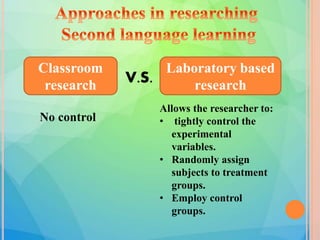
Classroom
research
Laboratory based
research
V.S.
Allows the researcher to:
• tightly control the
experimental
variables.
• Randomly assign
subjects to treatment
groups.
• Employ control
groups.
No control
Combined approaches to
classroom research
Studies must be carried out in different
contexts and a range of different
approaches must be used to gain a deeper
understanding of the complexity of
second language learning.

• Observational data are common in second language
research.
• Useful for gathering in-depth information about some
phenomena occurring in L2/FL classrooms.
 Types of language
 Activities
 Interactions
 Instructions
 Events
• Can allow the study of a behavior at close range with many
important contextual variables present.
Contextual variables are environmental
factors
e.g.
Location of the school
Size of school/ classroom
1. Obtrusive observer.
2. The Hawthorne effect.
3. Objectivity and subjectivity
4. Obtaining permission & requesting the
instructor’s help.
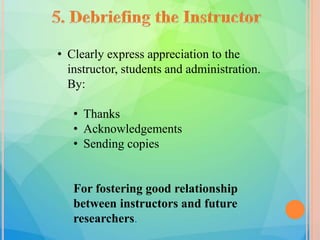
5. Debriefing the instructor.
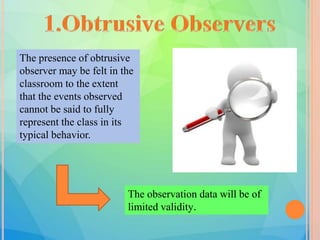
The presence of obtrusive
observer may be felt in the
classroom to the extent
that the events observed
cannot be said to fully
represent the class in its
typical behavior.
The observation data will be of
limited validity.
Young learners get
distracted by observers.
Prevent instructors from
delivering the lesson to the best
of their ability.
+
Prevent students from learning
to the best of theirs.
Compromise the quality
of the lesson.
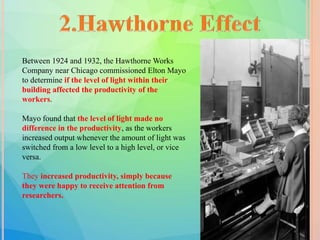
Between 1924 and 1932, the Hawthorne Works
Company near Chicago commissioned Elton Mayo
to determine if the level of light within their
building affected the productivity of the
workers.
Mayo found that the level of light made no
difference in the productivity, as the workers
increased output whenever the amount of light was
switched from a low level to a high level, or vice
versa.
They increased productivity, simply because
they were happy to receive attention from
researchers.
Accordingly,
• In observational research it may be
difficult to be sure that the observed
classes are the same without
observation.
• In controlled research it may be
difficult to separate the Hawthorne
effects from experimental variables.
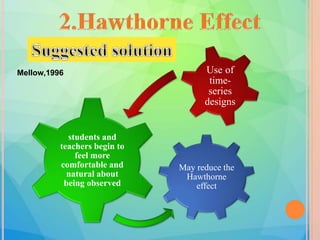
May reduce the
Hawthorne
effect
students and
teachers begin to
feel more
comfortable and
natural about
being observed
Use of
time-
series
designs
Mellow,1996
• Instructors often observe each others classes for
professional development / may carry out
observations of their own classes.
• The level of objectivity and subjectivity may be
questionable.
• Therefore it is necessary for researchers to strive for
objectivity and be aware of the subjective elements in
that effort.
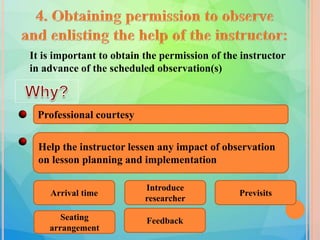
It is important to obtain the permission of the instructor
in advance of the scheduled observation(s)
Professional courtesy
Seating
arrangement
Arrival time
Help the instructor lessen any impact of observation
on lesson planning and implementation
Introduce
researcher
Previsits
Feedback
• Debrief the instructor about the
research findings or the content of
the observation notes of scheme.
Establish a more trusting and
cooperative relationship with
instructors.
• Clearly express appreciation to the
instructor, students and administration.
By:
• Thanks
• Acknowledgements
• Sending copies
For fostering good relationship
between instructors and future
researchers.
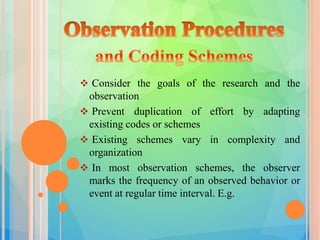
 Consider the goals of the research and the
observation
 Prevent duplication of effort by adapting
existing codes or schemes
 Existing schemes vary in complexity and
organization
 In most observation schemes, the observer
marks the frequency of an observed behavior or
event at regular time interval. E.g.
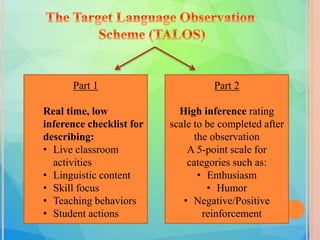
Part 1
Real time, low
inference checklist for
describing:
• Live classroom
activities
• Linguistic content
• Skill focus
• Teaching behaviors
• Student actions
Part 2
High inference rating
scale to be completed after
the observation
A 5-point scale for
categories such as:
• Enthusiasm
• Humor
• Negative/Positive
reinforcement
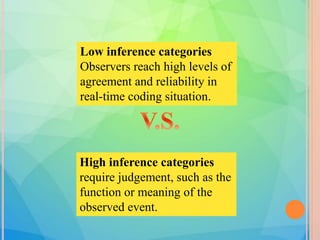
High inference categories
require judgement, such as the
function or meaning of the
observed event.
Low inference categories
Observers reach high levels of
agreement and reliability in
real-time coding situation.
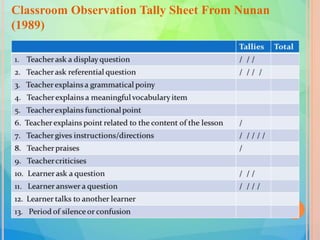
Classroom Observation Tally Sheet From Nunan
(1989)
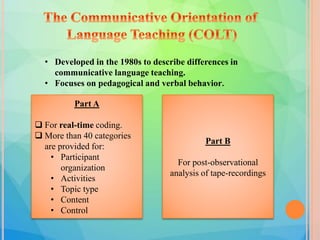
• Developed in the 1980s to describe differences in
communicative language teaching.
• Focuses on pedagogical and verbal behavior.
Part A
 For real-time coding.
 More than 40 categories
are provided for:
• Participant
organization
• Activities
• Topic type
• Content
• Control
Part B
For post-observational
analysis of tape-recordings
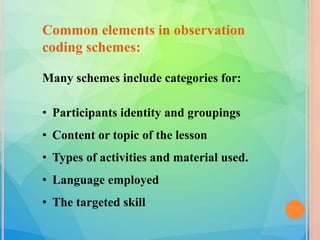
Common elements in observation
coding schemes:
Many schemes include categories for:
• Participants identity and groupings
• Content or topic of the lesson
• Types of activities and material used.
• Language employed
• The targeted skill
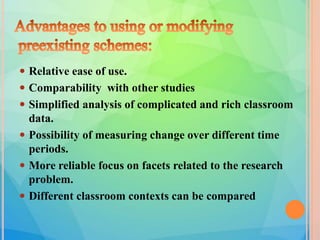
 Relative ease of use.
 Comparability with other studies
 Simplified analysis of complicated and rich classroom
data.
 Possibility of measuring change over different time
periods.
 More reliable focus on facets related to the research
problem.
 Different classroom contexts can be compared
CAVEAT TO USING OR MODIFYING
EXISTING OBSERVATION SCHEMES
 Determine if the scheme is appropriate for the
research goals.
 To be valid the finding must be the result of
appropriate and applicable schemes.
 Consider the type of findings that are likely to emerge
from an observation scheme.
 With most coding schemes only one rater observes
the data.
 The use of predetermined categories limit and restrict
the observer’s perceptions, important patterns could
be missed.
Data elicitation techniques that encourage
learners to communicate their internal
processing and perspectives about language
learning experience which cannot be detected by
observation approaches.
Definition
Methods
1. Uptake Sheets
2. Stimulated Recalls
3. Diary Research
Uptake:
Whatever is that
the learners get
from all the
language learning
opportunities
provided by
language lessons.
• Allow researchers to investigate learners’
perceptions about what they are learning.
• Often distributed at the beginning of the
lesson.
• Learners are asked to mark or note things
on which the researcher or teacher is
focusing.
• Helps creating a more detailed picture of
classroom events in the process.
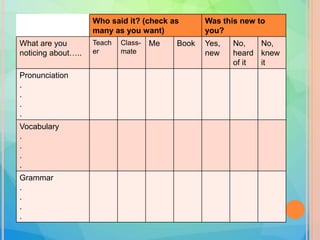
Who said it? (check as
many as you want)
Was this new to
you?
What are you
noticing about…..
Teach
er
Class-
mate
Me Book Yes,
new
No,
heard
of it
No,
knew
it
Pronunciation
.
.
.
.
Vocabulary
.
.
.
.
Grammar
.
.
.
.
• The observer makes an audio or video
recording and plays it to the participant,
stopping to ask what they think in a
particular point.
• Provide researcher with access to the learners’
interpretations of the events that were observed.
• A valuable source of information for researchers
interested in viewing a finely detailed picture of the
classroom.
• A first person account of a language
learning or a teaching experience.
• Documented through regular candid entries
in a personal journal and then analyzed for
recurrent patterns and salient events.
(Bailey, 1990)
Definition
THANK YOU

Classroomresearch

  • 1.
  • 2.
    What is ClassroomResearch? The formal study of teaching and learning. It attempts to answer two fundamental questions: • how well are students learning ? • how effectively are teachers teaching? Through close observation, the collection of feedback on student learning and the careful design of experiments, classroom teachers can learn more about: • how students learn • how students respond to particular teaching approaches.
  • 3.
    Classroom research Laboratory based research V.S. Allows theresearcher to: • tightly control the experimental variables. • Randomly assign subjects to treatment groups. • Employ control groups. No control
  • 4.
    Combined approaches to classroomresearch Studies must be carried out in different contexts and a range of different approaches must be used to gain a deeper understanding of the complexity of second language learning.
  • 5.
    • Observational dataare common in second language research. • Useful for gathering in-depth information about some phenomena occurring in L2/FL classrooms.  Types of language  Activities  Interactions  Instructions  Events
  • 6.
    • Can allowthe study of a behavior at close range with many important contextual variables present. Contextual variables are environmental factors e.g. Location of the school Size of school/ classroom
  • 7.
    1. Obtrusive observer. 2.The Hawthorne effect. 3. Objectivity and subjectivity 4. Obtaining permission & requesting the instructor’s help. 5. Debriefing the instructor.
  • 8.
    The presence ofobtrusive observer may be felt in the classroom to the extent that the events observed cannot be said to fully represent the class in its typical behavior. The observation data will be of limited validity.
  • 9.
    Young learners get distractedby observers. Prevent instructors from delivering the lesson to the best of their ability. + Prevent students from learning to the best of theirs. Compromise the quality of the lesson.
  • 10.
    Between 1924 and1932, the Hawthorne Works Company near Chicago commissioned Elton Mayo to determine if the level of light within their building affected the productivity of the workers. Mayo found that the level of light made no difference in the productivity, as the workers increased output whenever the amount of light was switched from a low level to a high level, or vice versa. They increased productivity, simply because they were happy to receive attention from researchers.
  • 11.
    Accordingly, • In observationalresearch it may be difficult to be sure that the observed classes are the same without observation. • In controlled research it may be difficult to separate the Hawthorne effects from experimental variables.
  • 12.
    May reduce the Hawthorne effect studentsand teachers begin to feel more comfortable and natural about being observed Use of time- series designs Mellow,1996
  • 13.
    • Instructors oftenobserve each others classes for professional development / may carry out observations of their own classes. • The level of objectivity and subjectivity may be questionable. • Therefore it is necessary for researchers to strive for objectivity and be aware of the subjective elements in that effort.
  • 14.
    It is importantto obtain the permission of the instructor in advance of the scheduled observation(s) Professional courtesy Seating arrangement Arrival time Help the instructor lessen any impact of observation on lesson planning and implementation Introduce researcher Previsits Feedback
  • 15.
    • Debrief theinstructor about the research findings or the content of the observation notes of scheme. Establish a more trusting and cooperative relationship with instructors.
  • 16.
    • Clearly expressappreciation to the instructor, students and administration. By: • Thanks • Acknowledgements • Sending copies For fostering good relationship between instructors and future researchers.
  • 17.
     Consider thegoals of the research and the observation  Prevent duplication of effort by adapting existing codes or schemes  Existing schemes vary in complexity and organization  In most observation schemes, the observer marks the frequency of an observed behavior or event at regular time interval. E.g.
  • 18.
    Part 1 Real time,low inference checklist for describing: • Live classroom activities • Linguistic content • Skill focus • Teaching behaviors • Student actions Part 2 High inference rating scale to be completed after the observation A 5-point scale for categories such as: • Enthusiasm • Humor • Negative/Positive reinforcement
  • 19.
    High inference categories requirejudgement, such as the function or meaning of the observed event. Low inference categories Observers reach high levels of agreement and reliability in real-time coding situation.
  • 20.
    Classroom Observation TallySheet From Nunan (1989)
  • 21.
    • Developed inthe 1980s to describe differences in communicative language teaching. • Focuses on pedagogical and verbal behavior. Part A  For real-time coding.  More than 40 categories are provided for: • Participant organization • Activities • Topic type • Content • Control Part B For post-observational analysis of tape-recordings
  • 22.
    Common elements inobservation coding schemes: Many schemes include categories for: • Participants identity and groupings • Content or topic of the lesson • Types of activities and material used. • Language employed • The targeted skill
  • 23.
     Relative easeof use.  Comparability with other studies  Simplified analysis of complicated and rich classroom data.  Possibility of measuring change over different time periods.  More reliable focus on facets related to the research problem.  Different classroom contexts can be compared
  • 24.
    CAVEAT TO USINGOR MODIFYING EXISTING OBSERVATION SCHEMES  Determine if the scheme is appropriate for the research goals.  To be valid the finding must be the result of appropriate and applicable schemes.  Consider the type of findings that are likely to emerge from an observation scheme.  With most coding schemes only one rater observes the data.  The use of predetermined categories limit and restrict the observer’s perceptions, important patterns could be missed.
  • 25.
    Data elicitation techniquesthat encourage learners to communicate their internal processing and perspectives about language learning experience which cannot be detected by observation approaches. Definition Methods 1. Uptake Sheets 2. Stimulated Recalls 3. Diary Research
  • 26.
    Uptake: Whatever is that thelearners get from all the language learning opportunities provided by language lessons. • Allow researchers to investigate learners’ perceptions about what they are learning. • Often distributed at the beginning of the lesson. • Learners are asked to mark or note things on which the researcher or teacher is focusing. • Helps creating a more detailed picture of classroom events in the process.

  • 27.
    Who said it?(check as many as you want) Was this new to you? What are you noticing about….. Teach er Class- mate Me Book Yes, new No, heard of it No, knew it Pronunciation . . . . Vocabulary . . . . Grammar . . . .
  • 28.
    • The observermakes an audio or video recording and plays it to the participant, stopping to ask what they think in a particular point. • Provide researcher with access to the learners’ interpretations of the events that were observed. • A valuable source of information for researchers interested in viewing a finely detailed picture of the classroom.
  • 29.
    • A firstperson account of a language learning or a teaching experience. • Documented through regular candid entries in a personal journal and then analyzed for recurrent patterns and salient events. (Bailey, 1990) Definition
  • 30.