PSY101 Social Psychology
Week 11
Dr. Russell Rodrigo
How do we respond to the real, implied or
imagined presence of other people?
Gordan Allport
Overview
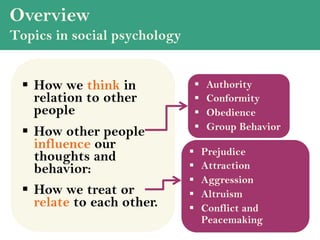
Topics in social psychology
§ How we think in
relation to other
people
§ How other people
influence our
thoughts and
behavior:
§ How we treat or
relate to each other.
§ Authority
§ Conformity
§ Obedience
§ Group Behavior
§ Prejudice
§ Attraction
§ Aggression
§ Altruism
§ Conflict and
Peacemaking
Social factors, Dimensions and
Explanations
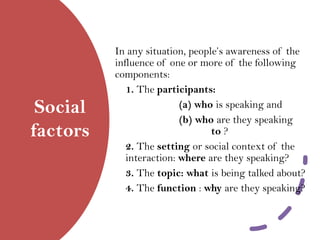
Social
factors
In any situation, people’s awareness of the
influence of one or more of the following
components:
1. The participants:
(a) who is speaking and
(b) who are they speaking
to ?
2. The setting or social context of the
interaction: where are they speaking?
3. The topic: what is being talked about?
4. The function : why are they speaking?
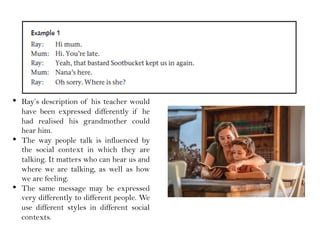
• Ray’s description of his teacher would
have been expressed differently if he
had realised his grandmother could
hear him.
• The way people talk is influenced by
the social context in which they are
talking. It matters who can hear us and
where we are talking, as well as how
we are feeling.
• The same message may be expressed
very differently to different people. We
use different styles in different social
contexts.
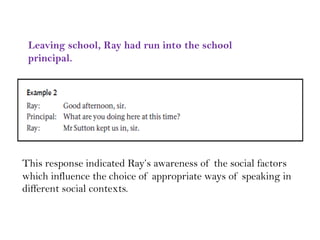
This response indicated Ray’s awareness of the social factors
which influence the choice of appropriate ways of speaking in
different social contexts.
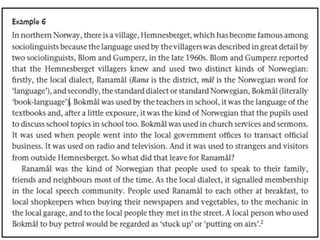
Leaving school, Ray had run into the school
principal.
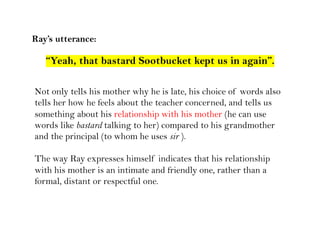
Ray’s utterance:
“Yeah, that bastard Sootbucket kept us in again”.
Not only tells his mother why he is late, his choice of words also
tells her how he feels about the teacher concerned, and tells us
something about his relationship with his mother (he can use
words like bastard talking to her) compared to his grandmother
and the principal (to whom he uses sir ).
The way Ray expresses himself indicates that his relationship
with his mother is an intimate and friendly one, rather than a
formal, distant or respectful one.
Social
dimensions
In addition to these components, it is useful to take
account of four different dimensions for analysis which
relate to the factors above and which have been only
implicit in the discussion so far. These are:
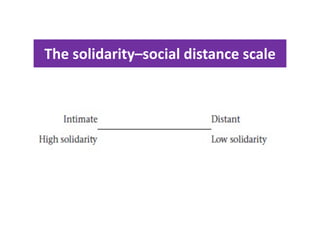
1. A social distance scale concerned with
participant relationships
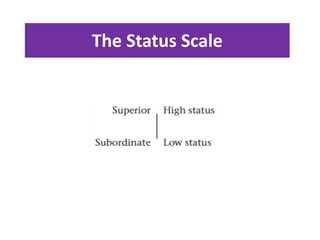
2. A status scale concerned with participant
relationships
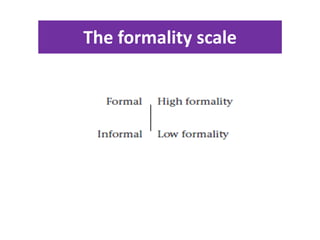
3. A formality scale relating to the setting or type
of interaction
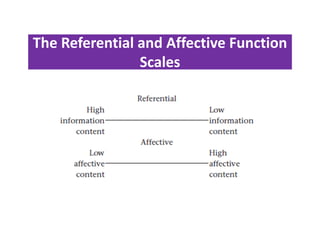
4. Two functional scales relating to the purposes or
topic of interaction.
The solidarity–social distance scale
The Status Scale
The formality scale
The Referential and Affective Function
Scales
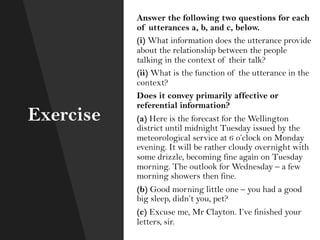
Exercise
Answer the following two questions for each
of utterances a, b, and c, below.
(i) What information does the utterance provide
about the relationship between the people
talking in the context of their talk?
(ii) What is the function of the utterance in the
context?
Does it convey primarily affective or
referential information?
(a) Here is the forecast for the Wellington
district until midnight Tuesday issued by the
meteorological service at 6 o’clock on Monday
evening. It will be rather cloudy overnight with
some drizzle, becoming fine again on Tuesday
morning. The outlook for Wednesday – a few
morning showers then fine.
(b) Good morning little one – you had a good
big sleep, didn’t you, pet?
(c) Excuse me, Mr Clayton. I’ve finished your
letters, sir.
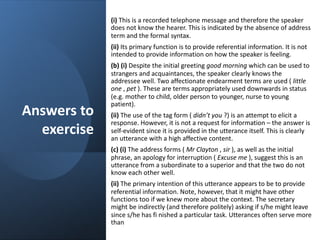
Answers to
exercise
(i) This is a recorded telephone message and therefore the speaker
does not know the hearer. This is indicated by the absence of address
term and the formal syntax.
(ii) Its primary function is to provide referential information. It is not
intended to provide information on how the speaker is feeling.
(b) (i) Despite the initial greeting good morning which can be used to
strangers and acquaintances, the speaker clearly knows the
addressee well. Two affectionate endearment terms are used ( little
one , pet ). These are terms appropriately used downwards in status
(e.g. mother to child, older person to younger, nurse to young
patient).
(ii) The use of the tag form ( didn’t you ?) is an attempt to elicit a
response. However, it is not a request for information – the answer is
self-evident since it is provided in the utterance itself. This is clearly
an utterance with a high affective content.
(c) (i) The address forms ( Mr Clayton , sir ), as well as the initial
phrase, an apology for interruption ( Excuse me ), suggest this is an
utterance from a subordinate to a superior and that the two do not
know each other well.
(ii) The primary intention of this utterance appears to be to provide
referential information. Note, however, that it might have other
functions too if we knew more about the context. The secretary
might be indirectly (and therefore politely) asking if s/he might leave
since s/he has fi nished a particular task. Utterances often serve more
than
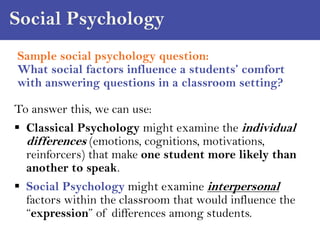
Social Psychology
Sample social psychology question:
What social factors influence a students’ comfort
with answering questions in a classroom setting?
To answer this, we can use:
§ Classical Psychology might examine the individual
differences (emotions, cognitions, motivations,
reinforcers) that make one student more likely than
another to speak.
§ Social Psychology might examine interpersonal
factors within the classroom that would influence the
“expression” of differences among students.
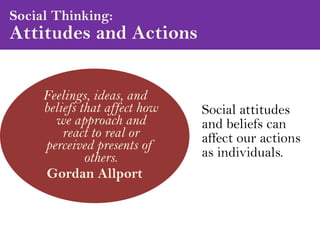
Social attitudes
and beliefs can
affect our actions
as individuals.
Social Thinking:
Attitudes and Actions
Feelings, ideas, and
beliefs that affect how
we approach and
react to real or
perceived presents of
others.
Gordan Allport
How we explain the behaviour of others is
often different than how we explain our own
behaviour.
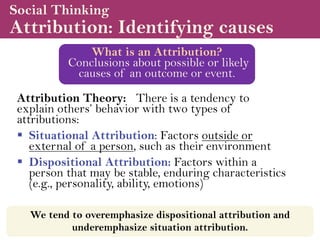
Social Thinking
Attribution: Identifying causes
Attribution Theory: There is a tendency to
explain others’ behavior with two types of
attributions:
§ Situational Attribution: Factors outside or
external of a person, such as their environment
§ Dispositional Attribution: Factors within a
person that may be stable, enduring characteristics
(e.g., personality, ability, emotions)
What is an Attribution?
Conclusions about possible or likely
causes of an outcome or event.
We tend to overemphasize dispositional attribution and
underemphasize situation attribution.
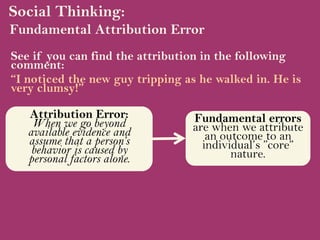
Fundamental Attribution Error
See if you can find the attribution in the following
comment:
“I noticed the new guy tripping as he walked in. He is
very clumsy!”
Social Thinking:
Attribution Error:
When we go beyond
available evidence and
assume that a person’s
behavior is caused by
personal factors alone.
Fundamental errors
are when we attribute
an outcome to an
individual’s ”core”
nature.
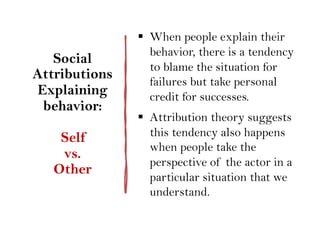
Social
Attributions
Explaining
behavior:
Self
vs.
Other
§ When people explain their
behavior, there is a tendency
to blame the situation for
failures but take personal
credit for successes.
§ Attribution theory suggests
this tendency also happens
when people take the
perspective of the actor in a
particular situation that we
understand.
Judging a Book by Its Cover?
• Halo Effect – Positive Attribution on
Surface Observation
– Edward Thorndike
– Name given to the phenomenon
whereby evaluators tend to be influenced
by their previous judgments of
performance or personality.
– Perceptions of attractiveness or wealth
may lead to judgments about personal
characteristics (hard working, smart, etc).
• Horn Effect – Negative Attribution on
Surface Observation
– Unattractive people are judged to have
negative personal characteristics (lazy,
stupid, careless, etc)
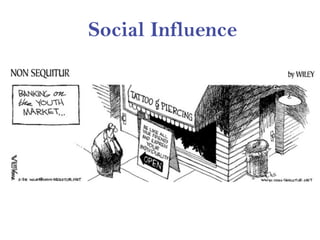
Social Influence
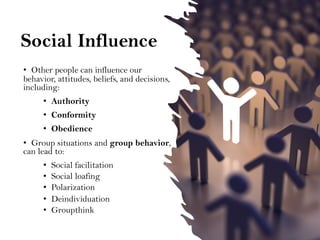
Social Influence
• Other people can influence our
behavior, attitudes, beliefs, and decisions,
including:
• Authority
• Conformity
• Obedience
• Group situations and group behavior,
can lead to:
• Social facilitation
• Social loafing
• Polarization
• Deindividuation
• Groupthink
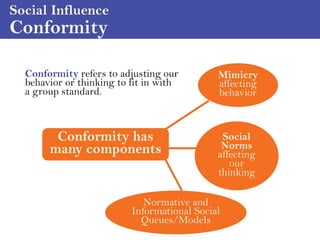
Conformity has
many components
Mimicry
affecting
behavior
Social
Norms
affecting
our
thinking
Normative and
Informational Social
Queues/Models
Social Influence
Conformity
Conformity refers to adjusting our
behavior or thinking to fit in with
a group standard.
Social Influence: Conformity
Responding to Social Norms
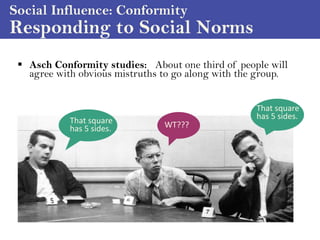
§ Asch Conformity studies: About one third of people will
agree with obvious mistruths to go along with the group.
That square
has 5 sides.
That square
has 5 sides.
WT???
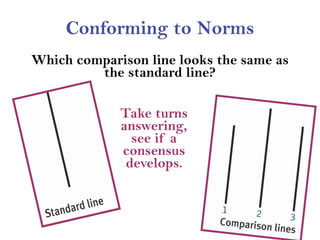
Conforming to Norms
Which comparison line looks the same as
the standard line?
Take turns
answering,
see if a
consensus
develops.
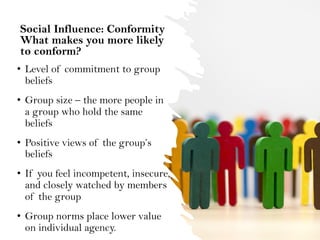
Social Influence: Conformity
What makes you more likely
to conform?
• Level of commitment to group
beliefs
• Group size – the more people in
a group who hold the same
beliefs
• Positive views of the group’s
beliefs
• If you feel incompetent, insecure,
and closely watched by members
of the group
• Group norms place lower value
on individual agency.
Milgram wanted to study the influence of direct
commands on behavior.
Question: Under what social conditions are
people more likely to obey commands?
Experiment: Authority figure tells
participants to administer shocks when
someone gives wrong answers.
Obedience: Response to Commands
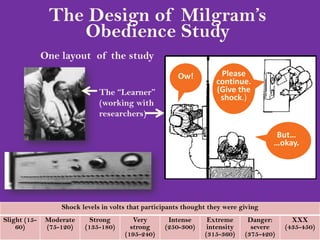
Voltages increased; how high
would people go?
The Design of Milgram’s
Obedience Study
One layout of the study
The “Learner”
(working with
researchers)
Ow! Please
continue.
(Give the
shock.)
But…
…okay.
Shock levels in volts that participants thought they were giving
Slight (15-
60)
Moderate
(75-120)
Strong
(135-180)
Very
strong
(195-240)
Intense
(250-300)
Extreme
intensity
(315-360)
Danger:
severe
(375-420)
XXX
(435-450)
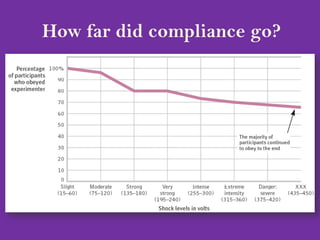
How far did compliance go?
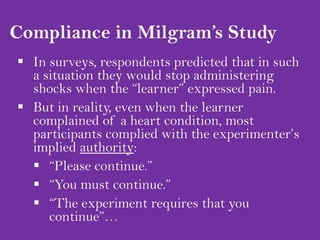
§ In surveys, respondents predicted that in such
a situation they would stop administering
shocks when the “learner” expressed pain.
§ But in reality, even when the learner
complained of a heart condition, most
participants complied with the experimenter’s
implied authority:
§ “Please continue.”
§ “You must continue.”
§ “The experiment requires that you
continue”…
Compliance in Milgram’s Study
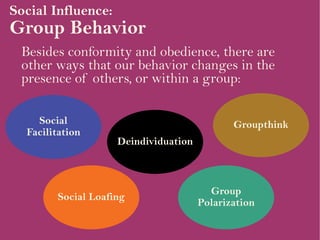
Social Influence:
Group Behavior
Besides conformity and obedience, there are
other ways that our behavior changes in the
presence of others, or within a group:
Social
Facilitation
Social Loafing
Deindividuation
Group
Polarization
Groupthink
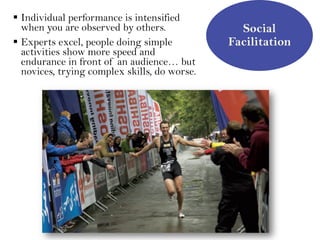
§ Individual performance is intensified
when you are observed by others.
§ Experts excel, people doing simple
activities show more speed and
endurance in front of an audience… but
novices, trying complex skills, do worse.
Social
Facilitation
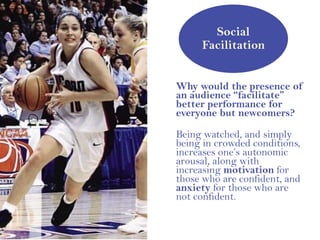
Social
Facilitation
Being watched, and simply
being in crowded conditions,
increases one’s autonomic
arousal, along with
increasing motivation for
those who are confident, and
anxiety for those who are
not confident.
Why would the presence of
an audience “facilitate”
better performance for
everyone but newcomers?
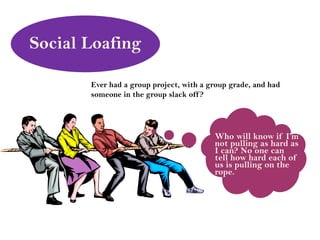
Social Loafing
Who will know if I’m
not pulling as hard as
I can? No one can
tell how hard each of
us is pulling on the
rope.
Ever had a group project, with a group grade, and had
someone in the group slack off ?
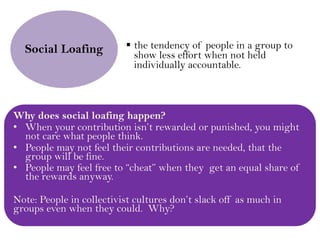
Social Loafing § the tendency of people in a group to
show less effort when not held
individually accountable.
Who will know if
I’m not pulling as
hard as I can? No
one can tell how
hard each of us is
pulling on the rope.
Why does social loafing happen?
• When your contribution isn’t rewarded or punished, you might
not care what people think.
• People may not feel their contributions are needed, that the
group will be fine.
• People may feel free to “cheat” when they get an equal share of
the rewards anyway.
Note: People in collectivist cultures don’t slack off as much in
groups even when they could. Why?
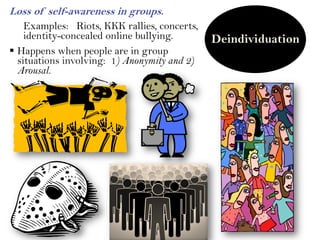
Loss of self-awareness in groups.
Examples: Riots, KKK rallies, concerts,
identity-concealed online bullying.
§ Happens when people are in group
situations involving: 1) Anonymity and 2)
Arousal.
Deindividuation
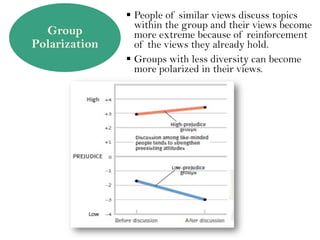
§ People of similar views discuss topics
within the group and their views become
more extreme because of reinforcement
of the views they already hold.
§ Groups with less diversity can become
more polarized in their views.
Group
Polarization
§ When a group of individuals
reaches a consensus without
critical reasoning or
evaluation of alternative
ideas.
§ Groups may make decisions
without an open exchange of ideas.
§ May limit original thinking within
groups
Groupthink
Social Framing
Framing is a key component of sociology, the
study of social interaction among humans. In
social theory, framing is a schema of
interpretation, a collection of anecdotes and
stereotypes, that individuals rely on to understand
and respond to events.
What are frames successful social movements
use?
– Diagnostic framing - states the social
movement problem in a clear, easily
understood way. There is not "grey" area
of framing - its what is wrong and how to
fix it.
– Prognostic framing - offers a solution and
states how it'll be implemented. ...
– Motivational framing - is the call to
action.
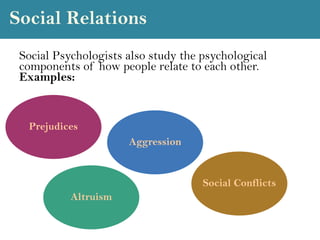
Social Psychologists also study the psychological
components of how people relate to each other.
Examples:
Social Relations
Prejudices
Altruism
Aggression
Social Conflicts
Social Relations
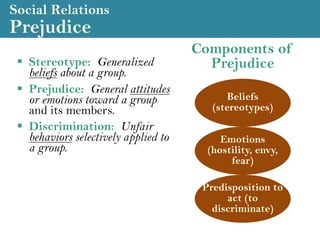
Prejudice
§ Stereotype: Generalized
beliefs about a group.
§ Prejudice: General attitudes
or emotions toward a group
and its members.
§ Discrimination: Unfair
behaviors selectively applied to
a group.
Components of
Prejudice
Beliefs
(stereotypes)
Predisposition to
act (to
discriminate)
Emotions
(hostility, envy,
fear)
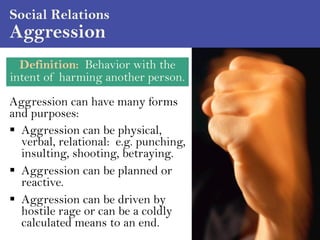
Aggression can have many forms
and purposes:
§ Aggression can be physical,
verbal, relational: e.g. punching,
insulting, shooting, betraying.
§ Aggression can be planned or
reactive.
§ Aggression can be driven by
hostile rage or can be a coldly
calculated means to an end.
Social Relations
Aggression
Definition: Behavior with the
intent of harming another person.
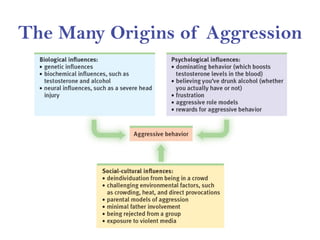
The Many Origins of Aggression
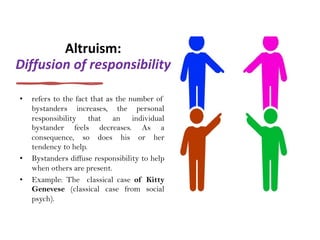
Altruism:
Diffusion of responsibility
• refers to the fact that as the number of
bystanders increases, the personal
responsibility that an individual
bystander feels decreases. As a
consequence, so does his or her
tendency to help.
• Bystanders diffuse responsibility to help
when others are present.
• Example: The classical case of Kitty
Genevese (classical case from social
psych).
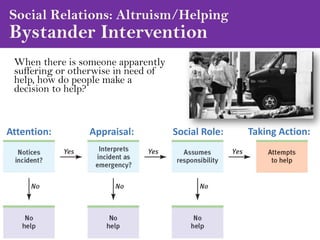
Social Relations: Altruism/Helping
Bystander Intervention
When there is someone apparently
suffering or otherwise in need of
help, how do people make a
decision to help?
Attention: Appraisal: Social Role: Taking Action:
Social Relations: Altruism/Helping
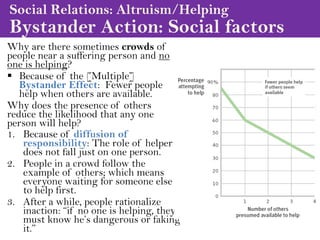
Bystander Action: Social factors
Why are there sometimes crowds of
people near a suffering person and no
one is helping?
§ Because of the [Multiple]
Bystander Effect: Fewer people
help when others are available.
Why does the presence of others
reduce the likelihood that any one
person will help?
1. Because of diffusion of
responsibility: The role of helper
does not fall just on one person.
2. People in a crowd follow the
example of others; which means
everyone waiting for someone else
to help first.
3. After a while, people rationalize
inaction: “if no one is helping, they
must know he’s dangerous or faking
it.”
Social Relations: Altruism/Helping
Other Factors promoting helping
Bystanders are most likely to help when:
The person we might help:
§ appears to be in need, deserving of assistance.
§ is a woman, and/or is similar to us in some way.
§ is in a small town or rural area.
Meanwhile, upon encountering this person:
§ We are feeling some guilt, and/or just saw
someone else trying to help.
§ We are not in a hurry, and/or not preoccupied.
§ Strongest predictor: We are in a good mood.
When our preferences are
incompatible - Conflict
Conflict and Peacemaking
Conflict: A perceived incompatibility in goals,
ideas, and actions between people or groups.
What factors worsen or reduce conflict?
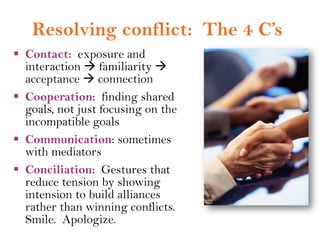
Resolving conflict: The 4 C’s
§ Contact: exposure and
interaction à familiarity à
acceptance à connection
§ Cooperation: finding shared
goals, not just focusing on the
incompatible goals
§ Communication: sometimes
with mediators
§ Conciliation: Gestures that
reduce tension by showing
intension to build alliances
rather than winning conflicts.
Smile. Apologize.
Discussion
1. Reflect on your own socialization in regard to gender. Give an example of
how you were socialized in regard to gender as a child and as an adult.
Describe what impact these examples might have had on your attitudes,
behaviors, or preferences.
2. Explain what a social norm is and give an example of a social norm in your
friend group. How do you know it is a social norm? Why do you think your
friend group has made it a norm? What would happen if a friend were to
break this norm?
3. Discuss and offer examples of both the positive and negative implications of
group conformity. Discuss the potential for political use of the power of the
group for social control.
4. If you’ve ever participated in a protest or demonstration, describe your
experience. Why did you participate? Draw on the frameworks (social
framing, social networks, collective identity) social psychologists use to
understand why people participate in social movements..
Thank you for listening.