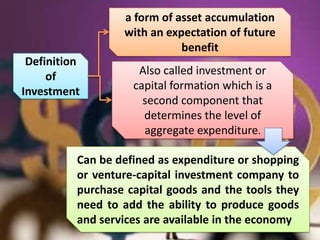
a form of asset accumulation
                  with an expectation of future
                             benefit
 Definition
     of              Also called investment or
Investment          capital formation which is a
                      second component that
                      determines the level of
                      aggregate expenditure.

          Can be defined as expenditure or shopping
          or venture-capital investment company to
          purchase capital goods and the tools they
          need to add the ability to produce goods
          and services are available in the economy
Investment
                       Securities
 Products

               an instrument of ownership
             form that can be transferred in
             the form of securities, stocks /
                 bonds, evidence of debt
             (Promissory Notes), interest or
                participation in a collective
             agreement (mutual funds), the
               right to buy a stock (Rights),
             guarantees to buy the stock at
              future or that the instrument
                       can be traded.
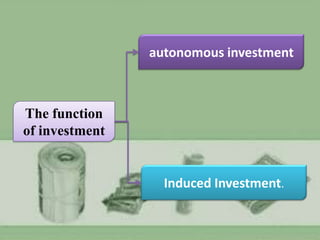
autonomous investment


The function
of investment


                  Induced Investment.
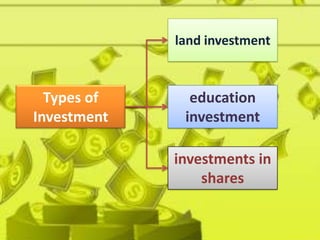
land investment


  Types of     education
Investment    investment

             investments in
                 shares
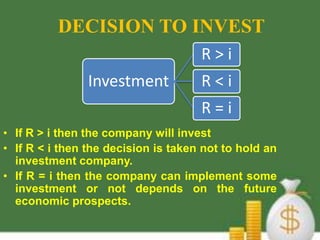
DECISION TO INVEST
                                     R>i
                Investment           R<i
                                     R=i
• If R > i then the company will invest
• If R < i then the decision is taken not to hold an
  investment company.
• If R = i then the company can implement some
  investment or not depends on the future
  economic prospects.
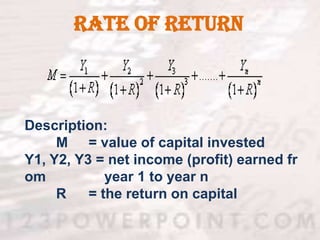
Rate of Return


Description:
     M = value of capital invested
Y1, Y2, Y3 = net income (profit) earned fr
om           year 1 to year n
     R    = the return on capital
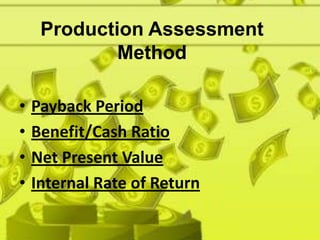
Production Assessment
             Method

•   Payback Period
•   Benefit/Cash Ratio
•   Net Present Value
•   Internal Rate of Return
Benefit Method and cost rasio
  This method is used to evaluate the feasibility
  project by comparing the total benefits
  of the total costs have been discounted to the year
  basis by using the discount rate
  (discount rate) during the plan year. This method
  there are two
  formula is:
• Net Benefit Cost Ratio (Net B/C) Net B/C
• Gross Benefit Cost Ratio (Gross B/C) Gross B/C
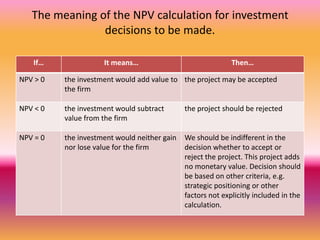
The meaning of the NPV calculation for investment
                decisions to be made​​.

   If…               It means…                               Then…

NPV > 0   the investment would add value to the project may be accepted
          the firm

NPV < 0   the investment would subtract       the project should be rejected
          value from the firm

NPV = 0   the investment would neither gain   We should be indifferent in the
          nor lose value for the firm         decision whether to accept or
                                              reject the project. This project adds
                                              no monetary value. Decision should
                                              be based on other criteria, e.g.
                                              strategic positioning or other
                                              factors not explicitly included in the
                                              calculation.
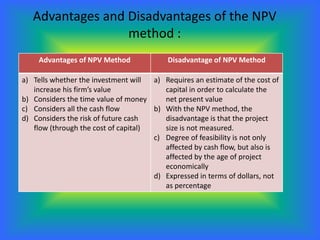
Advantages and Disadvantages of the NPV
                  method :
     Advantages of NPV Method              Disadvantage of NPV Method

a) Tells whether the investment will  a) Requires an estimate of the cost of
   increase his firm’s value             capital in order to calculate the
b) Considers the time value of money     net present value
c) Considers all the cash flow        b) With the NPV method, the
d) Considers the risk of future cash     disadvantage is that the project
   flow (through the cost of capital)    size is not measured.
                                      c) Degree of feasibility is not only
                                         affected by cash flow, but also is
                                         affected by the age of project
                                         economically
                                      d) Expressed in terms of dollars, not
                                         as percentage
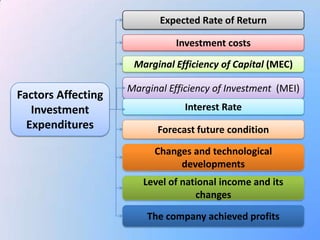
Expected Rate of Return

                               Investment costs

                     Marginal Efficiency of Capital (MEC)

                    Marginal Efficiency of Investment (MEI)
Factors Affecting
   Investment                    Interest Rate
  Expenditures            Forecast future condition

                          Changes and technological
                               developments
                       Level of national income and its
                                   changes

                        The company achieved profits
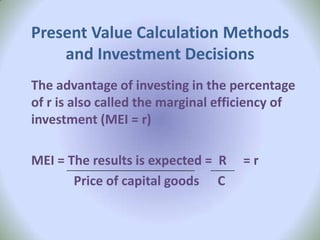
Present Value Calculation Methods
    and Investment Decisions
The advantage of investing in the percentage
of r is also called the marginal efficiency of
investment (MEI = r)

MEI = The results is expected = R   =r
       Price of capital goods C
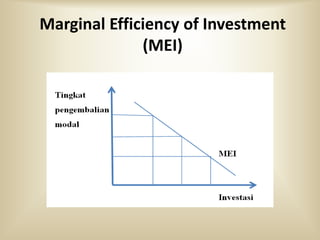
Marginal Efficiency of Investment
              (MEI)
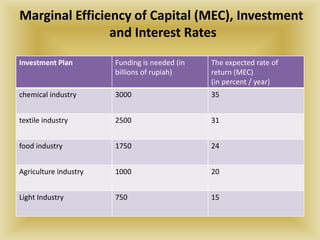
Marginal Efficiency of Capital (MEC), Investment
                and Interest Rates
Investment Plan        Funding is needed (in   The expected rate of
                       billions of rupiah)     return (MEC)
                                               (in percent / year)
chemical industry      3000                    35


textile industry       2500                    31


food industry          1750                    24


Agriculture industry   1000                    20


Light Industry         750                     15
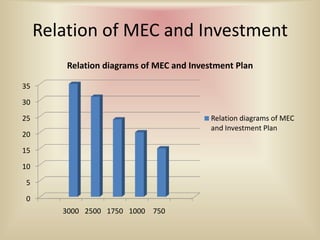
Relation of MEC and Investment
         Relation diagrams of MEC and Investment Plan

35

30

25                                         Relation diagrams of MEC
                                           and Investment Plan
20

15

10

5

0
        3000 2500 1750 1000 750
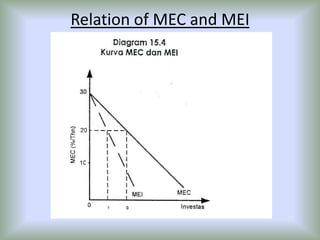
Relation of MEC and MEI
Thank you for your
   attention 

TEORI INVESTASI

  • 2.
    a form ofasset accumulation with an expectation of future benefit Definition of Also called investment or Investment capital formation which is a second component that determines the level of aggregate expenditure. Can be defined as expenditure or shopping or venture-capital investment company to purchase capital goods and the tools they need to add the ability to produce goods and services are available in the economy
  • 3.
    Investment Securities Products an instrument of ownership form that can be transferred in the form of securities, stocks / bonds, evidence of debt (Promissory Notes), interest or participation in a collective agreement (mutual funds), the right to buy a stock (Rights), guarantees to buy the stock at future or that the instrument can be traded.
  • 4.
    autonomous investment The function ofinvestment Induced Investment.
  • 5.
    land investment Types of education Investment investment investments in shares
  • 6.
    DECISION TO INVEST R>i Investment R<i R=i • If R > i then the company will invest • If R < i then the decision is taken not to hold an investment company. • If R = i then the company can implement some investment or not depends on the future economic prospects.
  • 7.
    Rate of Return Description: M = value of capital invested Y1, Y2, Y3 = net income (profit) earned fr om year 1 to year n R = the return on capital
  • 8.
    Production Assessment Method • Payback Period • Benefit/Cash Ratio • Net Present Value • Internal Rate of Return
  • 9.
    Benefit Method andcost rasio This method is used to evaluate the feasibility project by comparing the total benefits of the total costs have been discounted to the year basis by using the discount rate (discount rate) during the plan year. This method there are two formula is: • Net Benefit Cost Ratio (Net B/C) Net B/C • Gross Benefit Cost Ratio (Gross B/C) Gross B/C
  • 10.
    The meaning ofthe NPV calculation for investment decisions to be made​​. If… It means… Then… NPV > 0 the investment would add value to the project may be accepted the firm NPV < 0 the investment would subtract the project should be rejected value from the firm NPV = 0 the investment would neither gain We should be indifferent in the nor lose value for the firm decision whether to accept or reject the project. This project adds no monetary value. Decision should be based on other criteria, e.g. strategic positioning or other factors not explicitly included in the calculation.
  • 11.
    Advantages and Disadvantagesof the NPV method : Advantages of NPV Method Disadvantage of NPV Method a) Tells whether the investment will a) Requires an estimate of the cost of increase his firm’s value capital in order to calculate the b) Considers the time value of money net present value c) Considers all the cash flow b) With the NPV method, the d) Considers the risk of future cash disadvantage is that the project flow (through the cost of capital) size is not measured. c) Degree of feasibility is not only affected by cash flow, but also is affected by the age of project economically d) Expressed in terms of dollars, not as percentage
  • 12.
    Expected Rate ofReturn Investment costs Marginal Efficiency of Capital (MEC) Marginal Efficiency of Investment (MEI) Factors Affecting Investment Interest Rate Expenditures Forecast future condition Changes and technological developments Level of national income and its changes The company achieved profits
  • 13.
    Present Value CalculationMethods and Investment Decisions The advantage of investing in the percentage of r is also called the marginal efficiency of investment (MEI = r) MEI = The results is expected = R =r Price of capital goods C
  • 14.
    Marginal Efficiency ofInvestment (MEI)
  • 15.
    Marginal Efficiency ofCapital (MEC), Investment and Interest Rates Investment Plan Funding is needed (in The expected rate of billions of rupiah) return (MEC) (in percent / year) chemical industry 3000 35 textile industry 2500 31 food industry 1750 24 Agriculture industry 1000 20 Light Industry 750 15
  • 16.
    Relation of MECand Investment Relation diagrams of MEC and Investment Plan 35 30 25 Relation diagrams of MEC and Investment Plan 20 15 10 5 0 3000 2500 1750 1000 750
  • 17.
  • 18.
    Thank you foryour attention 