Instructional
Design
Teaching and Learning
Process
Teaching and Learning Interactions
Teaching and Learning is a term that implies the
interaction activities between teachers and
students to achieve the goals set.
The term learning and teaching or learning is
often encountered in the learning of foreign
literature or instruction
Learning and Instruction
Fontana (1981)
Learning : process changes that are relatively
fixed in the behavior of individuals as a result
of experience. This implies that: learning
should enable individual behavioral
change, the change must be the fruit of
experience.
Learning and Instruction
Romiszwoski (1981)
Instruction : refers to the process of teaching
that is centered on the purpose or goal direct
teaching process which in many cases can be
planned in advance (preplanned).
Interactions that occur in a teaching situation
called interaction teaching / instructional
interaction, which is a process that was
pursued by the bond teaching purposes
(intended purpose / set and have sistematized
directionally)
Interaction teaching is / are bound by the
situation and the purpose of education is
called educational or teaching interaction
called "instructive interaction".
Interactions are also commonly referred
educative teaching and learning
interactions, because these interactions occur
in the process of learning and teaching
processes
In the interaction that happens students learn
and teachers teach, both in order to achieve
educational goals.
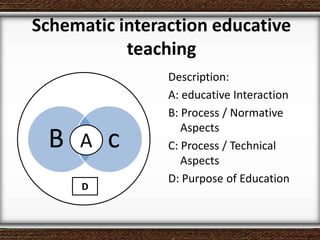
In each educative interaction will always contain
two main elements, namely: the normative
elements and technical elements.
Schematic interaction educative
teaching
B cA
D
Description:
A: educative Interaction
B: Process / Normative
Aspects
C: Process / Technical
Aspects
D: Purpose of Education
Communication between teachers and students
called the learning interaction.
In a narrow sense:
Teaching and learning interactions called
interaction learning, for teaching done with the
intention of helping students to learn the
circumstances provide the right conditions for
students to learn.
Fundamentals of learning interactions
Interaction is instructive
Interactions that take place in order to
achieve educational goals
In the teaching-learning interactions are
expected to occur for behavioral changes
in students as a result of learning
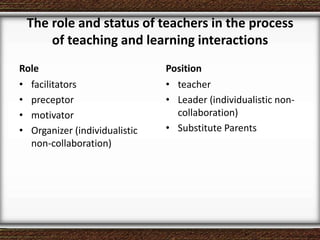
The role and status of teachers in the process
of teaching and learning interactions
Role
• facilitators
• preceptor
• motivator
• Organizer (individualistic
non-collaboration)
Position
• teacher
• Leader (individualistic non-
collaboration)
• Substitute Parents
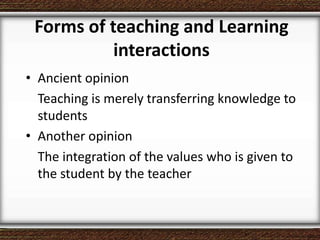
Forms of teaching and Learning
interactions
• Ancient opinion
Teaching is merely transferring knowledge to
students
• Another opinion
The integration of the values ​​who is given to
the student by the teacher
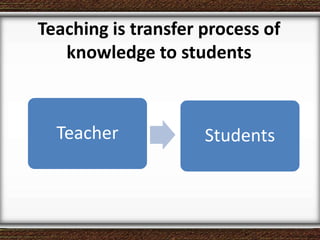
Teaching is transfer process of
knowledge to students
Teacher Students
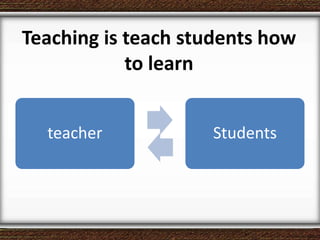
Teaching is teach students how
to learn
teacher Students
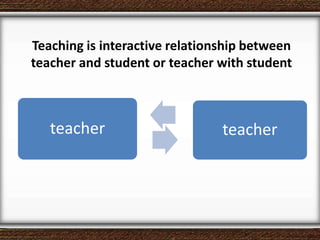
Teaching is interactive relationship between
teacher and student or teacher with student
teacher teacher
Student
Student Student
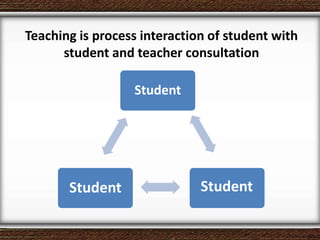
Teaching is process interaction of student with
student and teacher consultation
The factors that base on teaching and
learning interactions
• There is a goal to be achieved
• There is material in the teaching learning process
• There are teachers who teach
• There are students who are teaching and learning
process
• There are certain methods to achieve goals
• The process takes place in the bonding
interaction situational
1. Factors of goals
The general’s and special’s goal of education
or teaching must be based on three
objectives (Bloom's Taxonomy):
a. Cognitive objective
b. Affective objective
c. Psychomotor objective
The Functions and the purposes of
teaching
• Being the central point of attention and guidance
in carrying out activities / teaching interaction
• Determines the direction of the activities /
teaching interaction
• Being the central point of attention and guidance
in formulating the design of teaching
• Become a subject matter that will be developed
in deepening and expanding the scope of
teaching
• A guideline to prevent / avoid the deviation of
teaching.
2. Factors instructional materials
The determination must be based on teaching
materials to fullfill the purpose of teaching
3. Factors teachers and learners
Things that must the learners consider:
• Learners must put the sanctity of life
• Students must be willing to seek knowledge.
• Do not brag about the knowledge that they
have, especially against the teacher.
• Learners must know the position of the
knowledge that they’ve been learned.
4. Factors Methods
The method is a way to achieve the goals.
5. Factors situations
The situation is a learning environment or
the classroom.
Studying process in student
oriented
In studying process, students aren’t just use teacher
as one of study source, but maybe use with all of
source for get the point of study.
teachers are a model, because teacers behaviours
affect to students’s study activity. Student look the
teachers as a model who they can follow for good
attitude or good advice
Studying process in teacher oriented
Profesional teacher task can measure how
teacher can create studying process will
efective and efficient
Because teacher has role as school’s mediator
to student’s parent. Teacher mus concern to
stundet’s peformance, achievment, progress
in studying process
– Emotion & character
– interest
– Dream
– hobby
– Society
– environment
– Problem
Teacher must sensitive about their student
Learning System
Enquiry Discovery Learning
searching and get by self. Student must active
Expository Learning
Teacher give all of thing about student’s study
subject
Mastery Learning
Teachet direct help student for get the point of
study
Studying Strategy
1. Indentification and create a specification and
qualification about change student’s behaviors.
2. Choose the studying system by aspiration and
people oriented.
3. Choose the best procedur, method, and technic for
studying process.
4. Create a standard for studying goal or studying
criteria for give feed back to student
Drafting of The
Educational Unit Basic and
Secondary Level
Curriculum
1. Explaining the content standards
2. Outlining competency
3. Describing self-development and local
content
4. Describing the development of Graduates
Competency Standard and Standard
content
5. Explaining the Education Unit Level
Curriculum (KTSP)
COMPETENCE
• Standard content is the scope and level of
matter competency requirements as
outlined in the graduate competencies,
competency assessment materials, subjects
and competencies that must be met learners
learning syllabus
• Standard content includes the basic
framework and structure of the curriculum,
the burden of learning, curriculum unit level
of education, and the education calendar
1. Content standards
• CURRICULUM STRUCTURE an array of patterns
and the subjects to be taken by learners in
learning activities
• CURRICULUM SRUCTURE compiled based
competency standards and competency
standards courses
• Graduation Competency standards (SKL) is
used as a guideline in determining the
assessment of students' graduation
attendees unit educator.
• Competency is the ability of a graduate
qualification that includes the
attitudes, knowledge and national skill
standards that have been agreed upon.
2. Graduation Competency
Standard
• LOCAL CONTENT is an extra activities to
develop competencies that are tailored to
the characteristics and potential of the
region, including areas of excellence
• Local content subjects, making education
units must develop competency standards
and competency base for any kind of local
content organized
3. Development and Implementation of
Local Self Content
• DEVELOPMENT OF SELF is an activity that aims
not give the opportunity to students to
develop and express themselves according to
the needs, talents, and interests of each
learner according
• Self-development is not a subject. Assessment
of self-development activities conducted in a
qualitative, not quantitative as in subjects
The Development of Graduates Competency
Standards, Content Standards on Education Unit
– Act No. 20 of 2003 about National Education System
Section 36 up to Section 38
– Government Regulation no.19/2005 concerning
National Education Standards section 5 up to section
18 and section 25 up to section 27
– The regulation of national education minister
no.22/2006 concerning the content standards for
elementary and secondary education unit.
– The Regulation of the National Education Minister
no.23/2006 concerning Graduates Competency
Standards for primary and secondary education unit.
National Education Standards
1. Content Standards
2. Graduates Competency Standards
3. Standards of process
4. Teachers and Education Personnel Standards
5. Infrastructure Standards
6. Management standards
7. Educational Assessment Standards
8. Financing standards
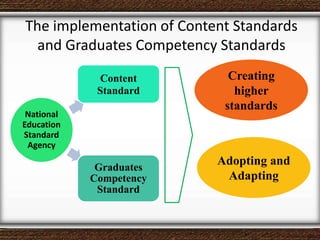
The implementation of Content Standards
and Graduates Competency Standards
National
Education
Standard
Agency
Content
Standard
Graduates
Competency
Standard
Creating
higher
standards
Adopting and
Adapting
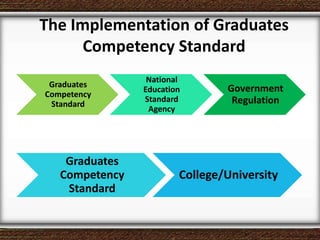
The Implementation of Graduates
Competency Standard
Graduates
Competency
Standard
National
Education
Standard
Agency
Government
Regulation
Graduates
Competency
Standard
College/University
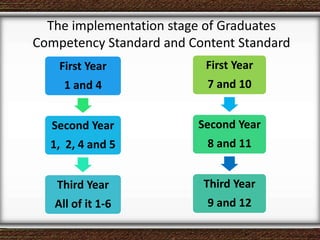
The implementation stage of Graduates
Competency Standard and Content Standard
First Year
1 and 4
Second Year
1, 2, 4 and 5
Third Year
All of it 1-6
First Year
7 and 10
Second Year
8 and 11
Third Year
9 and 12
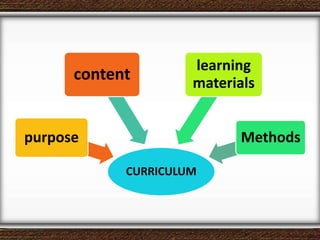
CURRICULUM
purpose
content
learning
materials
Methods
The Educational Unit Level Curriculum
The Educational Unit Level Curriculum is the
operational curriculum developed and
implemented by each educational unit.
The Educational Unit Level Curriculum consists
of the goals each unit education
level, curriculum structure and load of unit
education level, education calendar and
syllabus.
The development principles of The
Educational Unit Level Curriculum
1. Focused on the potential, progress, needs and
interests of students and their environment.
2. Diverse and integrated.
3. Responsive to the development of
science, technology and art.
4. Relevant to the needs of life.
5. Comprehensive and continuous
6. Lifelong learning
7. Balance between national interests and regional
interests.
Operational guidelines for The Educational Unit Level Curriculum
1. The increase of faith and piety and a noble character.
2. The increase in potential, intelligence, and interest in accordance
with the level of development and abilities of learners.
3. The diversity of potential and characteristics of the area and the
environment.
4. The demands of regional and national development
5. The demands of the working world
6. Developments in science, technology, and art.
7. Religion
8. The dynamics of global development
9. National unity and national values
10. The condition of social and cultural
11. Gender equality
12. Characteristics the educational units
The Components of The Educational
Unit Level Curriculum
A. The Purpose of Educational Unit Level
B. Structure and Content of Educational Unit
Level Curriculum
C. Education Calendar
The Purpose of Educational Unit Level
1. The purpose of basic education is laying the
foundation of
intelligence, knowledge, personality, noble
character, and the skills to live independently and
follow further education.
2. The purpose of secondary education is to increase the
intelligence, knowledge, personality, noble
character, and the skills to live independently and
follow further education.
3. The purpose of vocational secondary education is
increasing intelligence, knowledge, personality, noble
character, and the skills to live independently and
follow further education according to the vocational.
Structure and Content of Education
Unit Level Curriculum
The Structure of The Educational Unit Level
Curriculum in elementary and secondary level
contained in content standards, which are
developed from a group of subjects as follows :
– Religion and moral values
– Citizenship and personality
– Science and technology
– aesthetics
– physical, sports, and health
The Contents of The Educational Unit Level
Curriculum covers a number of subjects that the
breadth and depth are a burden for students
studying in the educational unit. Besides local
substance and self development activities
included in the curriculum.
1. The subjects
2. The local content
3. Self-development activities
4. Setting the load learning
5. The increase in grade, placement of, and graduation
6. Life skills education
7. Education based on local and global excellence
1. Subjects, and the allocation of time for each
level of educational units are listed on the
structures listed in the curriculum content
standards
2. The Local Content
– is a subject, so that educational unit should
develop competencies standard and basic
competencies for each type of local content
organized.
– The educational unit can organize a local content
subjects each semester. This means that in one
year, the educational unit can hold two local
content subjects.
3. Self-development activities
– Self-development activities are activities that are
aimed at providing opportunities for learners to
develop and express themselves according to the
needs, talents, interests, each learner according
to the conditions of the school.
– self-development activities facilitated or guided
by a counselor, teacher, or educational staff to do
in the form of extracurricular activities.
Self-development activities can be done through
counseling service activities with respect to
individual and social life, learning, and career
development of students and scouting
activities, leadership, and youth academic
groups.
Self-development is not a subject. Assessment
of self-development activities conducted in a
qualitative, not quantitative as the subjects.
4. Setting the load of learning
– The load learning the system package is used by
both the unit level basic education standard or
independent categories, and the level of
secondary education unit standard category.
– The load learning in semester credit system (SKS)
can be used by junior high school (SMP) with
independent category, and by senior high school
(SMA) with standard category.
The load of learning in Semester Credit System
(SKS) is used by the high school category
independently.
Learning hours for each subject on the system
on package system allocated as indicated in
the structure of the curriculum. Education
units maximum possible to add four hours of
lessons per week as a whole
Utilization of additional learning time
to consider the needs of learners in
achieving competence, as well as be
used for other subjects that are
considered important and not on the
structure of the curriculum listed in
the content standards
• Allocation of time for self-mastery structured and
unstructured activities in the system package for basic
education 0% -40%
• Allocation of time for self-mastery structured and
unstructured activities in the system package for
secondary education (junior high school) 0%-50%
• Allocation of time for self-mastery structured and
unstructured activities in the system package for senior
secondary education (senior high school) 0%-60%
• Allocation of time to practice, two hours of practical
activities in school the equivalent of one hour face to
face. Four hours of practice outside the school the
equivalent of one hour face to face.
- The credits at the junior high school consisted
of : a 40-minute face-to-face, 20-minute self-
structured activities and unstructured
activities
- The credits at the high school consists of: 45
minutes face-to-face, 25-minute structured
activities and unstructured independent
activity
Completeness Learning
Mastery learning each indicator set out
in the basic competencies range from 0-
100%
Ideal criteria of completeness for each
indicator is 75%
Education units must determine the
minimum completeness criteria
Education units are expected to
increase mastery learning criteria
Reporting the results of learning
(report cards) learners
The increase in class, and
Graduation
In accordance with the provisions of
Regulation 19/2005 Article 72 paragraph
(1), learners passed from unit after primary
and secondary education:
Completing the entire program of learning
Obtain a minimum value based on the minimum
graduation criteria (KKM)
Graduate school (MA) for the science and
technology subjects
Pass the National Exam
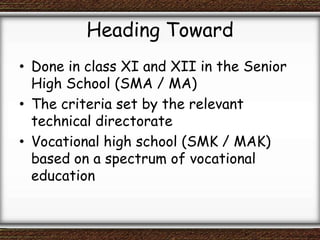
Heading Toward
• Done in class XI and XII in the Senior
High School (SMA / MA)
• The criteria set by the relevant
technical directorate
• Vocational high school (SMK / MAK)
based on a spectrum of vocational
education
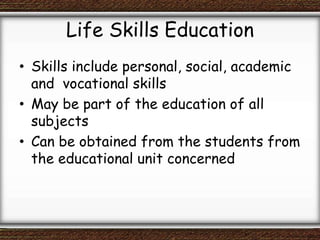
Life Skills Education
• Skills include personal, social, academic
and vocational skills
• May be part of the education of all
subjects
• Can be obtained from the students from
the educational unit concerned
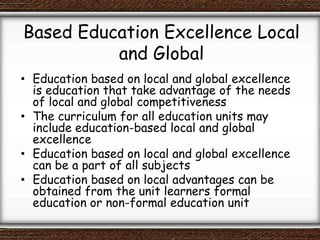
Based Education Excellence Local
and Global
• Education based on local and global excellence
is education that take advantage of the needs
of local and global competitiveness
• The curriculum for all education units may
include education-based local and global
excellence
• Education based on local and global excellence
can be a part of all subjects
• Education based on local advantages can be
obtained from the unit learners formal
education or non-formal education unit
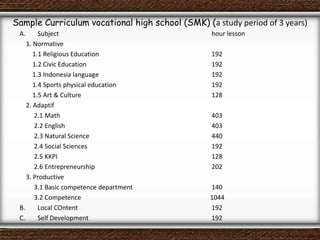
Sample Curriculum vocational high school (SMK) (a study period of 3 years)
A. Subject hour lesson
1. Normative
1.1 Religious Education 192
1.2 Civic Education 192
1.3 Indonesia language 192
1.4 Sports physical education 192
1.5 Art & Culture 128
2. Adaptif
2.1 Math 403
2.2 English 403
2.3 Natural Science 440
2.4 Social Sciences 192
2.5 KKPI 128
2.6 Entrepreneurship 202
3. Productive
3.1 Basic competence department 140
3.2 Competence 1044
B. Local COntent 192
C. Self Development 192
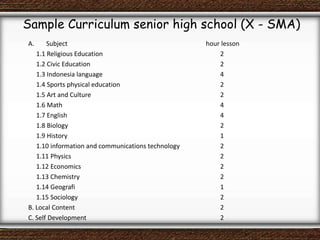
Sample Curriculum senior high school (X - SMA)
A. Subject hour lesson
1.1 Religious Education 2
1.2 Civic Education 2
1.3 Indonesia language 4
1.4 Sports physical education 2
1.5 Art and Culture 2
1.6 Math 4
1.7 English 4
1.8 Biology 2
1.9 History 1
1.10 information and communications technology 2
1.11 Physics 2
1.12 Economics 2
1.13 Chemistry 2
1.14 Geografi 1
1.15 Sociology 2
B. Local Content 2
C. Self Development 2
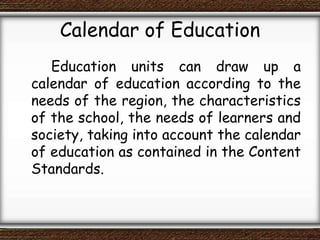
Calendar of Education
Education units can draw up a
calendar of education according to the
needs of the region, the characteristics
of the school, the needs of learners and
society, taking into account the calendar
of education as contained in the Content
Standards.
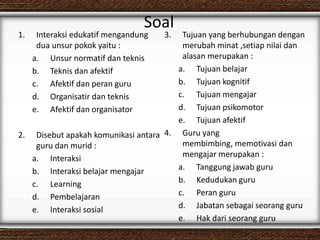
Soal
1. Interaksi edukatif mengandung
dua unsur pokok yaitu :
a. Unsur normatif dan teknis
b. Teknis dan afektif
c. Afektif dan peran guru
d. Organisatir dan teknis
e. Afektif dan organisator
2. Disebut apakah komunikasi antara
guru dan murid :
a. Interaksi
b. Interaksi belajar mengajar
c. Learning
d. Pembelajaran
e. Interaksi sosial
3. Tujuan yang berhubungan dengan
merubah minat ,setiap nilai dan
alasan merupakan :
a. Tujuan belajar
b. Tujuan kognitif
c. Tujuan mengajar
d. Tujuan psikomotor
e. Tujuan afektif
4. Guru yang
membimbing, memotivasi dan
mengajar merupakan :
a. Tanggung jawab guru
b. Kedudukan guru
c. Peran guru
d. Jabatan sebagai seorang guru
e. Hak dari seorang guru
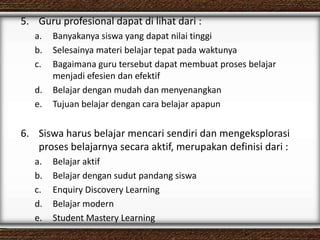
5. Guru profesional dapat di lihat dari :
a. Banyakanya siswa yang dapat nilai tinggi
b. Selesainya materi belajar tepat pada waktunya
c. Bagaimana guru tersebut dapat membuat proses belajar
menjadi efesien dan efektif
d. Belajar dengan mudah dan menyenangkan
e. Tujuan belajar dengan cara belajar apapun
6. Siswa harus belajar mencari sendiri dan mengeksplorasi
proses belajarnya secara aktif, merupakan definisi dari :
a. Belajar aktif
b. Belajar dengan sudut pandang siswa
c. Enquiry Discovery Learning
d. Belajar modern
e. Student Mastery Learning
7. Dari pernyataan di bawah ini hal yang harus di perhatikan oleh guru saat
mengajar adalah :
a. Nilai yang di dapat pada saat ujian
b. Kelengkapan belajar siswa
c. Masalah yang di hadapi oleh siswa, di lingkungan, emosi dll
d. Cara belajar siswa di kelas
e. Keaktifan siswa saat belajar
8. Di bawah ini merupakan landasan hukum pengembangan kurikulum
tingkat satuan pendidikan (KTSP), kecuali :
a. UU no 20 tahun 2003
b. PP no 19 tahun 2005
c. Permendiknas no 22 tahun 2006
d. Permendiknas no 23 tahun 2006
e. Permendiknas no 24 tahun 2006
9. Permendiknas no 23 tahun 2006 mengatur tentang :
a. Standar Isi
b. Standar Kompetensi Lulusan
c. Standar Proses
d. Standar Pendidik
e. Standar Pembiayaan
10. Standar Isi dan Standar Kompetensi Lulusan pada KTSP
ditentukan oleh :
a. Badan Standar Nasional Pendidikan
b. Pemerintah Pusat
c. Menteri Pendidikan Nasional
d. Departemen Pendidikan
e. Departemen Agama
11. Standar Kompetensi dan Kompetensi Dasar termasuk
ke dalam :
a. Standar Kompetensi Lulusan
b. Standar Proses
c. Standar Tenaga Kependidikan
d. Standar Isi
e. Standar Operasional
12. Pendidikan kecakapan hidup meliputi hal hal di bawah
ini kecuali :
a. Kecakapan pribadi
b. Kecakapan sosial
c. Kecapakan akdemik
d. Kecakapan vokasional
e. Kecakapan berbicara
13. Pendidikan yang memanfaatkan pengembangan
kompetensi peserta dalam aspek budaya , bahasa
teknologi dan informasi adalah :
a. Pendidikan berbasis keunngulan lokal
b. Pendidikan berbasis keunggulan global
c. Pendidikan berbasis keunggulan lokal dan global
d. Pendidikan berbasik keunggulan kompetensi
e. Pendidikan berbasis keunggulan karakteristik
14. Kriteria penjurusan diatur oleh :
a. Direktorat teknis terkait
b. Guru terkait
c. Kepala sekolah
d. Siswa
e. Tenaga kerja tata usaha
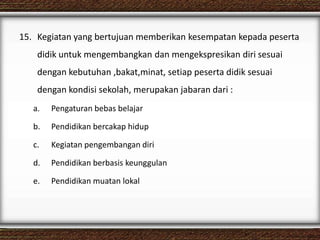
15. Kegiatan yang bertujuan memberikan kesempatan kepada peserta
didik untuk mengembangkan dan mengekspresikan diri sesuai
dengan kebutuhan ,bakat,minat, setiap peserta didik sesuai
dengan kondisi sekolah, merupakan jabaran dari :
a. Pengaturan bebas belajar
b. Pendidikan bercakap hidup
c. Kegiatan pengembangan diri
d. Pendidikan berbasis keunggulan
e. Pendidikan muatan lokal
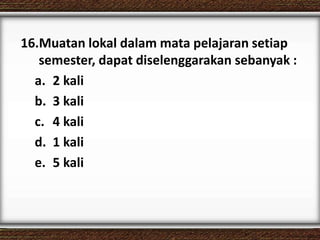
16.Muatan lokal dalam mata pelajaran setiap
semester, dapat diselenggarakan sebanyak :
a. 2 kali
b. 3 kali
c. 4 kali
d. 1 kali
e. 5 kali
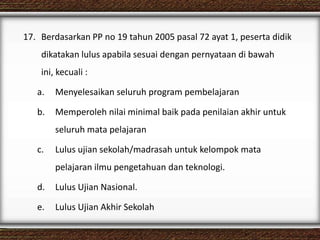
17. Berdasarkan PP no 19 tahun 2005 pasal 72 ayat 1, peserta didik
dikatakan lulus apabila sesuai dengan pernyataan di bawah
ini, kecuali :
a. Menyelesaikan seluruh program pembelajaran
b. Memperoleh nilai minimal baik pada penilaian akhir untuk
seluruh mata pelajaran
c. Lulus ujian sekolah/madrasah untuk kelompok mata
pelajaran ilmu pengetahuan dan teknologi.
d. Lulus Ujian Nasional.
e. Lulus Ujian Akhir Sekolah
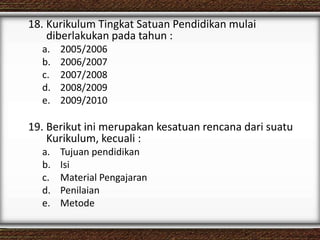
18. Kurikulum Tingkat Satuan Pendidikan mulai
diberlakukan pada tahun :
a. 2005/2006
b. 2006/2007
c. 2007/2008
d. 2008/2009
e. 2009/2010
19. Berikut ini merupakan kesatuan rencana dari suatu
Kurikulum, kecuali :
a. Tujuan pendidikan
b. Isi
c. Material Pengajaran
d. Penilaian
e. Metode
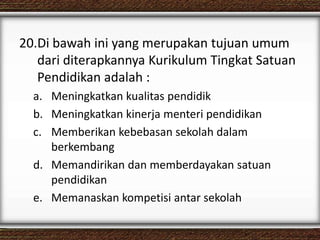
20.Di bawah ini yang merupakan tujuan umum
dari diterapkannya Kurikulum Tingkat Satuan
Pendidikan adalah :
a. Meningkatkan kualitas pendidik
b. Meningkatkan kinerja menteri pendidikan
c. Memberikan kebebasan sekolah dalam
berkembang
d. Memandirikan dan memberdayakan satuan
pendidikan
e. Memanaskan kompetisi antar sekolah

Perencanaan Pengajaran

  • 1.
  • 2.
  • 3.
    Teaching and LearningInteractions Teaching and Learning is a term that implies the interaction activities between teachers and students to achieve the goals set. The term learning and teaching or learning is often encountered in the learning of foreign literature or instruction
  • 4.
    Learning and Instruction Fontana(1981) Learning : process changes that are relatively fixed in the behavior of individuals as a result of experience. This implies that: learning should enable individual behavioral change, the change must be the fruit of experience.
  • 5.
    Learning and Instruction Romiszwoski(1981) Instruction : refers to the process of teaching that is centered on the purpose or goal direct teaching process which in many cases can be planned in advance (preplanned).
  • 6.
    Interactions that occurin a teaching situation called interaction teaching / instructional interaction, which is a process that was pursued by the bond teaching purposes (intended purpose / set and have sistematized directionally) Interaction teaching is / are bound by the situation and the purpose of education is called educational or teaching interaction called "instructive interaction".
  • 7.
    Interactions are alsocommonly referred educative teaching and learning interactions, because these interactions occur in the process of learning and teaching processes In the interaction that happens students learn and teachers teach, both in order to achieve educational goals. In each educative interaction will always contain two main elements, namely: the normative elements and technical elements.
  • 8.
    Schematic interaction educative teaching BcA D Description: A: educative Interaction B: Process / Normative Aspects C: Process / Technical Aspects D: Purpose of Education
  • 9.
    Communication between teachersand students called the learning interaction. In a narrow sense: Teaching and learning interactions called interaction learning, for teaching done with the intention of helping students to learn the circumstances provide the right conditions for students to learn.
  • 10.
    Fundamentals of learninginteractions Interaction is instructive Interactions that take place in order to achieve educational goals In the teaching-learning interactions are expected to occur for behavioral changes in students as a result of learning
  • 11.
    The role andstatus of teachers in the process of teaching and learning interactions Role • facilitators • preceptor • motivator • Organizer (individualistic non-collaboration) Position • teacher • Leader (individualistic non- collaboration) • Substitute Parents
  • 12.
    Forms of teachingand Learning interactions • Ancient opinion Teaching is merely transferring knowledge to students • Another opinion The integration of the values ​​who is given to the student by the teacher
  • 13.
    Teaching is transferprocess of knowledge to students Teacher Students
  • 14.
    Teaching is teachstudents how to learn teacher Students
  • 15.
    Teaching is interactiverelationship between teacher and student or teacher with student teacher teacher
  • 16.
    Student Student Student Teaching isprocess interaction of student with student and teacher consultation
  • 17.
    The factors thatbase on teaching and learning interactions • There is a goal to be achieved • There is material in the teaching learning process • There are teachers who teach • There are students who are teaching and learning process • There are certain methods to achieve goals • The process takes place in the bonding interaction situational
  • 18.
    1. Factors ofgoals The general’s and special’s goal of education or teaching must be based on three objectives (Bloom's Taxonomy): a. Cognitive objective b. Affective objective c. Psychomotor objective
  • 19.
    The Functions andthe purposes of teaching • Being the central point of attention and guidance in carrying out activities / teaching interaction • Determines the direction of the activities / teaching interaction • Being the central point of attention and guidance in formulating the design of teaching • Become a subject matter that will be developed in deepening and expanding the scope of teaching • A guideline to prevent / avoid the deviation of teaching.
  • 20.
    2. Factors instructionalmaterials The determination must be based on teaching materials to fullfill the purpose of teaching 3. Factors teachers and learners Things that must the learners consider: • Learners must put the sanctity of life • Students must be willing to seek knowledge. • Do not brag about the knowledge that they have, especially against the teacher. • Learners must know the position of the knowledge that they’ve been learned.
  • 21.
    4. Factors Methods Themethod is a way to achieve the goals. 5. Factors situations The situation is a learning environment or the classroom.
  • 22.
    Studying process instudent oriented In studying process, students aren’t just use teacher as one of study source, but maybe use with all of source for get the point of study. teachers are a model, because teacers behaviours affect to students’s study activity. Student look the teachers as a model who they can follow for good attitude or good advice
  • 23.
    Studying process inteacher oriented Profesional teacher task can measure how teacher can create studying process will efective and efficient Because teacher has role as school’s mediator to student’s parent. Teacher mus concern to stundet’s peformance, achievment, progress in studying process
  • 24.
    – Emotion &character – interest – Dream – hobby – Society – environment – Problem Teacher must sensitive about their student
  • 25.
    Learning System Enquiry DiscoveryLearning searching and get by self. Student must active Expository Learning Teacher give all of thing about student’s study subject Mastery Learning Teachet direct help student for get the point of study
  • 26.
    Studying Strategy 1. Indentificationand create a specification and qualification about change student’s behaviors. 2. Choose the studying system by aspiration and people oriented. 3. Choose the best procedur, method, and technic for studying process. 4. Create a standard for studying goal or studying criteria for give feed back to student
  • 27.
    Drafting of The EducationalUnit Basic and Secondary Level Curriculum
  • 28.
    1. Explaining thecontent standards 2. Outlining competency 3. Describing self-development and local content 4. Describing the development of Graduates Competency Standard and Standard content 5. Explaining the Education Unit Level Curriculum (KTSP) COMPETENCE
  • 29.
    • Standard contentis the scope and level of matter competency requirements as outlined in the graduate competencies, competency assessment materials, subjects and competencies that must be met learners learning syllabus • Standard content includes the basic framework and structure of the curriculum, the burden of learning, curriculum unit level of education, and the education calendar 1. Content standards
  • 30.
    • CURRICULUM STRUCTUREan array of patterns and the subjects to be taken by learners in learning activities • CURRICULUM SRUCTURE compiled based competency standards and competency standards courses
  • 31.
    • Graduation Competencystandards (SKL) is used as a guideline in determining the assessment of students' graduation attendees unit educator. • Competency is the ability of a graduate qualification that includes the attitudes, knowledge and national skill standards that have been agreed upon. 2. Graduation Competency Standard
  • 32.
    • LOCAL CONTENTis an extra activities to develop competencies that are tailored to the characteristics and potential of the region, including areas of excellence • Local content subjects, making education units must develop competency standards and competency base for any kind of local content organized 3. Development and Implementation of Local Self Content
  • 33.
    • DEVELOPMENT OFSELF is an activity that aims not give the opportunity to students to develop and express themselves according to the needs, talents, and interests of each learner according • Self-development is not a subject. Assessment of self-development activities conducted in a qualitative, not quantitative as in subjects
  • 34.
    The Development ofGraduates Competency Standards, Content Standards on Education Unit – Act No. 20 of 2003 about National Education System Section 36 up to Section 38 – Government Regulation no.19/2005 concerning National Education Standards section 5 up to section 18 and section 25 up to section 27 – The regulation of national education minister no.22/2006 concerning the content standards for elementary and secondary education unit. – The Regulation of the National Education Minister no.23/2006 concerning Graduates Competency Standards for primary and secondary education unit.
  • 35.
    National Education Standards 1.Content Standards 2. Graduates Competency Standards 3. Standards of process 4. Teachers and Education Personnel Standards 5. Infrastructure Standards 6. Management standards 7. Educational Assessment Standards 8. Financing standards
  • 36.
    The implementation ofContent Standards and Graduates Competency Standards National Education Standard Agency Content Standard Graduates Competency Standard Creating higher standards Adopting and Adapting
  • 37.
    The Implementation ofGraduates Competency Standard Graduates Competency Standard National Education Standard Agency Government Regulation Graduates Competency Standard College/University
  • 38.
    The implementation stageof Graduates Competency Standard and Content Standard First Year 1 and 4 Second Year 1, 2, 4 and 5 Third Year All of it 1-6 First Year 7 and 10 Second Year 8 and 11 Third Year 9 and 12
  • 39.
  • 40.
    The Educational UnitLevel Curriculum The Educational Unit Level Curriculum is the operational curriculum developed and implemented by each educational unit. The Educational Unit Level Curriculum consists of the goals each unit education level, curriculum structure and load of unit education level, education calendar and syllabus.
  • 41.
    The development principlesof The Educational Unit Level Curriculum 1. Focused on the potential, progress, needs and interests of students and their environment. 2. Diverse and integrated. 3. Responsive to the development of science, technology and art. 4. Relevant to the needs of life. 5. Comprehensive and continuous 6. Lifelong learning 7. Balance between national interests and regional interests.
  • 42.
    Operational guidelines forThe Educational Unit Level Curriculum 1. The increase of faith and piety and a noble character. 2. The increase in potential, intelligence, and interest in accordance with the level of development and abilities of learners. 3. The diversity of potential and characteristics of the area and the environment. 4. The demands of regional and national development 5. The demands of the working world 6. Developments in science, technology, and art. 7. Religion 8. The dynamics of global development 9. National unity and national values 10. The condition of social and cultural 11. Gender equality 12. Characteristics the educational units
  • 43.
    The Components ofThe Educational Unit Level Curriculum A. The Purpose of Educational Unit Level B. Structure and Content of Educational Unit Level Curriculum C. Education Calendar
  • 44.
    The Purpose ofEducational Unit Level 1. The purpose of basic education is laying the foundation of intelligence, knowledge, personality, noble character, and the skills to live independently and follow further education. 2. The purpose of secondary education is to increase the intelligence, knowledge, personality, noble character, and the skills to live independently and follow further education. 3. The purpose of vocational secondary education is increasing intelligence, knowledge, personality, noble character, and the skills to live independently and follow further education according to the vocational.
  • 45.
    Structure and Contentof Education Unit Level Curriculum The Structure of The Educational Unit Level Curriculum in elementary and secondary level contained in content standards, which are developed from a group of subjects as follows : – Religion and moral values – Citizenship and personality – Science and technology – aesthetics – physical, sports, and health
  • 46.
    The Contents ofThe Educational Unit Level Curriculum covers a number of subjects that the breadth and depth are a burden for students studying in the educational unit. Besides local substance and self development activities included in the curriculum. 1. The subjects 2. The local content 3. Self-development activities 4. Setting the load learning 5. The increase in grade, placement of, and graduation 6. Life skills education 7. Education based on local and global excellence
  • 47.
    1. Subjects, andthe allocation of time for each level of educational units are listed on the structures listed in the curriculum content standards 2. The Local Content – is a subject, so that educational unit should develop competencies standard and basic competencies for each type of local content organized. – The educational unit can organize a local content subjects each semester. This means that in one year, the educational unit can hold two local content subjects.
  • 48.
    3. Self-development activities –Self-development activities are activities that are aimed at providing opportunities for learners to develop and express themselves according to the needs, talents, interests, each learner according to the conditions of the school. – self-development activities facilitated or guided by a counselor, teacher, or educational staff to do in the form of extracurricular activities.
  • 49.
    Self-development activities canbe done through counseling service activities with respect to individual and social life, learning, and career development of students and scouting activities, leadership, and youth academic groups. Self-development is not a subject. Assessment of self-development activities conducted in a qualitative, not quantitative as the subjects.
  • 50.
    4. Setting theload of learning – The load learning the system package is used by both the unit level basic education standard or independent categories, and the level of secondary education unit standard category. – The load learning in semester credit system (SKS) can be used by junior high school (SMP) with independent category, and by senior high school (SMA) with standard category.
  • 51.
    The load oflearning in Semester Credit System (SKS) is used by the high school category independently. Learning hours for each subject on the system on package system allocated as indicated in the structure of the curriculum. Education units maximum possible to add four hours of lessons per week as a whole
  • 52.
    Utilization of additionallearning time to consider the needs of learners in achieving competence, as well as be used for other subjects that are considered important and not on the structure of the curriculum listed in the content standards
  • 53.
    • Allocation oftime for self-mastery structured and unstructured activities in the system package for basic education 0% -40% • Allocation of time for self-mastery structured and unstructured activities in the system package for secondary education (junior high school) 0%-50% • Allocation of time for self-mastery structured and unstructured activities in the system package for senior secondary education (senior high school) 0%-60% • Allocation of time to practice, two hours of practical activities in school the equivalent of one hour face to face. Four hours of practice outside the school the equivalent of one hour face to face.
  • 54.
    - The creditsat the junior high school consisted of : a 40-minute face-to-face, 20-minute self- structured activities and unstructured activities - The credits at the high school consists of: 45 minutes face-to-face, 25-minute structured activities and unstructured independent activity
  • 55.
    Completeness Learning Mastery learningeach indicator set out in the basic competencies range from 0- 100% Ideal criteria of completeness for each indicator is 75% Education units must determine the minimum completeness criteria Education units are expected to increase mastery learning criteria
  • 56.
    Reporting the resultsof learning (report cards) learners The increase in class, and Graduation
  • 57.
    In accordance withthe provisions of Regulation 19/2005 Article 72 paragraph (1), learners passed from unit after primary and secondary education: Completing the entire program of learning Obtain a minimum value based on the minimum graduation criteria (KKM) Graduate school (MA) for the science and technology subjects Pass the National Exam
  • 58.
    Heading Toward • Donein class XI and XII in the Senior High School (SMA / MA) • The criteria set by the relevant technical directorate • Vocational high school (SMK / MAK) based on a spectrum of vocational education
  • 59.
    Life Skills Education •Skills include personal, social, academic and vocational skills • May be part of the education of all subjects • Can be obtained from the students from the educational unit concerned
  • 60.
    Based Education ExcellenceLocal and Global • Education based on local and global excellence is education that take advantage of the needs of local and global competitiveness • The curriculum for all education units may include education-based local and global excellence • Education based on local and global excellence can be a part of all subjects • Education based on local advantages can be obtained from the unit learners formal education or non-formal education unit
  • 61.
    Sample Curriculum vocationalhigh school (SMK) (a study period of 3 years) A. Subject hour lesson 1. Normative 1.1 Religious Education 192 1.2 Civic Education 192 1.3 Indonesia language 192 1.4 Sports physical education 192 1.5 Art & Culture 128 2. Adaptif 2.1 Math 403 2.2 English 403 2.3 Natural Science 440 2.4 Social Sciences 192 2.5 KKPI 128 2.6 Entrepreneurship 202 3. Productive 3.1 Basic competence department 140 3.2 Competence 1044 B. Local COntent 192 C. Self Development 192
  • 62.
    Sample Curriculum seniorhigh school (X - SMA) A. Subject hour lesson 1.1 Religious Education 2 1.2 Civic Education 2 1.3 Indonesia language 4 1.4 Sports physical education 2 1.5 Art and Culture 2 1.6 Math 4 1.7 English 4 1.8 Biology 2 1.9 History 1 1.10 information and communications technology 2 1.11 Physics 2 1.12 Economics 2 1.13 Chemistry 2 1.14 Geografi 1 1.15 Sociology 2 B. Local Content 2 C. Self Development 2
  • 63.
    Calendar of Education Educationunits can draw up a calendar of education according to the needs of the region, the characteristics of the school, the needs of learners and society, taking into account the calendar of education as contained in the Content Standards.
  • 64.
    Soal 1. Interaksi edukatifmengandung dua unsur pokok yaitu : a. Unsur normatif dan teknis b. Teknis dan afektif c. Afektif dan peran guru d. Organisatir dan teknis e. Afektif dan organisator 2. Disebut apakah komunikasi antara guru dan murid : a. Interaksi b. Interaksi belajar mengajar c. Learning d. Pembelajaran e. Interaksi sosial 3. Tujuan yang berhubungan dengan merubah minat ,setiap nilai dan alasan merupakan : a. Tujuan belajar b. Tujuan kognitif c. Tujuan mengajar d. Tujuan psikomotor e. Tujuan afektif 4. Guru yang membimbing, memotivasi dan mengajar merupakan : a. Tanggung jawab guru b. Kedudukan guru c. Peran guru d. Jabatan sebagai seorang guru e. Hak dari seorang guru
  • 65.
    5. Guru profesionaldapat di lihat dari : a. Banyakanya siswa yang dapat nilai tinggi b. Selesainya materi belajar tepat pada waktunya c. Bagaimana guru tersebut dapat membuat proses belajar menjadi efesien dan efektif d. Belajar dengan mudah dan menyenangkan e. Tujuan belajar dengan cara belajar apapun 6. Siswa harus belajar mencari sendiri dan mengeksplorasi proses belajarnya secara aktif, merupakan definisi dari : a. Belajar aktif b. Belajar dengan sudut pandang siswa c. Enquiry Discovery Learning d. Belajar modern e. Student Mastery Learning
  • 66.
    7. Dari pernyataandi bawah ini hal yang harus di perhatikan oleh guru saat mengajar adalah : a. Nilai yang di dapat pada saat ujian b. Kelengkapan belajar siswa c. Masalah yang di hadapi oleh siswa, di lingkungan, emosi dll d. Cara belajar siswa di kelas e. Keaktifan siswa saat belajar 8. Di bawah ini merupakan landasan hukum pengembangan kurikulum tingkat satuan pendidikan (KTSP), kecuali : a. UU no 20 tahun 2003 b. PP no 19 tahun 2005 c. Permendiknas no 22 tahun 2006 d. Permendiknas no 23 tahun 2006 e. Permendiknas no 24 tahun 2006
  • 67.
    9. Permendiknas no23 tahun 2006 mengatur tentang : a. Standar Isi b. Standar Kompetensi Lulusan c. Standar Proses d. Standar Pendidik e. Standar Pembiayaan 10. Standar Isi dan Standar Kompetensi Lulusan pada KTSP ditentukan oleh : a. Badan Standar Nasional Pendidikan b. Pemerintah Pusat c. Menteri Pendidikan Nasional d. Departemen Pendidikan e. Departemen Agama
  • 68.
    11. Standar Kompetensidan Kompetensi Dasar termasuk ke dalam : a. Standar Kompetensi Lulusan b. Standar Proses c. Standar Tenaga Kependidikan d. Standar Isi e. Standar Operasional 12. Pendidikan kecakapan hidup meliputi hal hal di bawah ini kecuali : a. Kecakapan pribadi b. Kecakapan sosial c. Kecapakan akdemik d. Kecakapan vokasional e. Kecakapan berbicara
  • 69.
    13. Pendidikan yangmemanfaatkan pengembangan kompetensi peserta dalam aspek budaya , bahasa teknologi dan informasi adalah : a. Pendidikan berbasis keunngulan lokal b. Pendidikan berbasis keunggulan global c. Pendidikan berbasis keunggulan lokal dan global d. Pendidikan berbasik keunggulan kompetensi e. Pendidikan berbasis keunggulan karakteristik 14. Kriteria penjurusan diatur oleh : a. Direktorat teknis terkait b. Guru terkait c. Kepala sekolah d. Siswa e. Tenaga kerja tata usaha
  • 70.
    15. Kegiatan yangbertujuan memberikan kesempatan kepada peserta didik untuk mengembangkan dan mengekspresikan diri sesuai dengan kebutuhan ,bakat,minat, setiap peserta didik sesuai dengan kondisi sekolah, merupakan jabaran dari : a. Pengaturan bebas belajar b. Pendidikan bercakap hidup c. Kegiatan pengembangan diri d. Pendidikan berbasis keunggulan e. Pendidikan muatan lokal
  • 71.
    16.Muatan lokal dalammata pelajaran setiap semester, dapat diselenggarakan sebanyak : a. 2 kali b. 3 kali c. 4 kali d. 1 kali e. 5 kali
  • 72.
    17. Berdasarkan PPno 19 tahun 2005 pasal 72 ayat 1, peserta didik dikatakan lulus apabila sesuai dengan pernyataan di bawah ini, kecuali : a. Menyelesaikan seluruh program pembelajaran b. Memperoleh nilai minimal baik pada penilaian akhir untuk seluruh mata pelajaran c. Lulus ujian sekolah/madrasah untuk kelompok mata pelajaran ilmu pengetahuan dan teknologi. d. Lulus Ujian Nasional. e. Lulus Ujian Akhir Sekolah
  • 73.
    18. Kurikulum TingkatSatuan Pendidikan mulai diberlakukan pada tahun : a. 2005/2006 b. 2006/2007 c. 2007/2008 d. 2008/2009 e. 2009/2010 19. Berikut ini merupakan kesatuan rencana dari suatu Kurikulum, kecuali : a. Tujuan pendidikan b. Isi c. Material Pengajaran d. Penilaian e. Metode
  • 74.
    20.Di bawah iniyang merupakan tujuan umum dari diterapkannya Kurikulum Tingkat Satuan Pendidikan adalah : a. Meningkatkan kualitas pendidik b. Meningkatkan kinerja menteri pendidikan c. Memberikan kebebasan sekolah dalam berkembang d. Memandirikan dan memberdayakan satuan pendidikan e. Memanaskan kompetisi antar sekolah

Editor's Notes