Managerial Economics &
   Business Strategy
                                 Chapter 1
The Fundamentals of Managerial
         Economics


 Michael R. Baye, Managerial Economics and Business Strategy, 5e. ©The McGraw-Hill Companies, Inc., 2006
Overview
I. Introduction
II. The Economics of Effective Management
    Identify Goals and Constraints
    Recognize the Role of Profits
    Understand Incentives
    Five Forces Model
    Understand Markets
    Recognize the Time Value of Money
    Use Marginal Analysis


     Michael R. Baye, Managerial Economics and Business Strategy, 5e. ©The McGraw-Hill Companies, Inc., 2006
Managerial Economics
• Manager
   A person who directs resources to achieve a stated goal.
• Economics
   The science of making decisions in the presence of
   scare resources.
• Managerial Economics
   The study of how to direct scarce resources in the way
   that most efficiently achieves a managerial goal.


    Michael R. Baye, Managerial Economics and Business Strategy, 5e. ©The McGraw-Hill Companies, Inc., 2006
Economic vs. Accounting
           Profits
• Accounting Profits
    Total revenue (sales) minus dollar cost of producing
    goods or services.
    Reported on the firm’s income statement.
• Economic Profits
    Total revenue minus total opportunity cost.


     Michael R. Baye, Managerial Economics and Business Strategy, 5e. ©The McGraw-Hill Companies, Inc., 2006
Opportunity Cost
• Accounting Costs
    The explicit costs of the resources needed to produce
    produce goods or services.
    Reported on the firm’s income statement.
• Opportunity Cost
    The cost of the explicit and implicit resources that are
    foregone when a decision is made.
• Economic Profits
    Total revenue minus total opportunity cost.


     Michael R. Baye, Managerial Economics and Business Strategy, 5e. ©The McGraw-Hill Companies, Inc., 2006
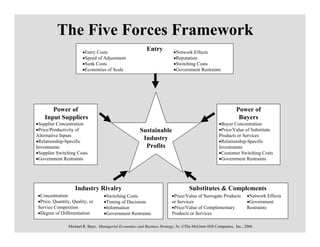
The Five Forces Framework
                       •Entry Costs
                                                          Entry          •Network Effects
                       •Speed of Adjustment                              •Reputation
                       •Sunk Costs                                       •Switching Costs
                       •Economies of Scale                               •Government Restraints


       Power of                                                                                             Power of
    Input Suppliers                                                                                          Buyers
•Supplier Concentration                                                                            •Buyer Concentration
•Price/Productivity of                                 Sustainable                                 •Price/Value of Substitute
Alternative Inputs                                                                                 Products or Services
•Relationship-Specific
                                                        Industry                                   •Relationship-Specific
Investments                                              Profits                                   Investments
•Supplier Switching Costs                                                                          •Customer Switching Costs
•Government Restraints                                                                             •Government Restraints


                   Industry Rivalry                                               Substitutes & Complements
•Concentration                    •Switching Costs                      •Price/Value of Surrogate Products         •Network Effects
•Price, Quantity, Quality, or     •Timing of Decisions                  or Services                                •Government
Service Competition               •Information                          •Price/Value of Complementary              Restraints
•Degree of Differentiation        •Government Restraints                Products or Services

               Michael R. Baye, Managerial Economics and Business Strategy, 5e. ©The McGraw-Hill Companies, Inc., 2006
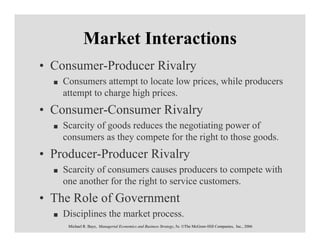
Market Interactions
• Consumer-Producer Rivalry
    Consumers attempt to locate low prices, while producers
    attempt to charge high prices.
• Consumer-Consumer Rivalry
    Scarcity of goods reduces the negotiating power of
    consumers as they compete for the right to those goods.
• Producer-Producer Rivalry
    Scarcity of consumers causes producers to compete with
    one another for the right to service customers.
• The Role of Government
    Disciplines the market process.
     Michael R. Baye, Managerial Economics and Business Strategy, 5e. ©The McGraw-Hill Companies, Inc., 2006
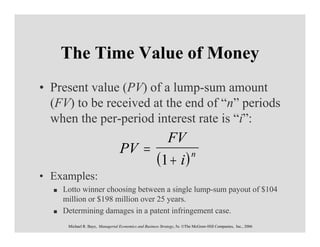
The Time Value of Money
• Present value (PV) of a lump-sum amount
  (FV) to be received at the end of “n” periods
  when the per-period interest rate is “i”:
                                                            FV
                                 PV =
                                                      (1 + i )           n

• Examples:
    Lotto winner choosing between a single lump-sum payout of $104
    million or $198 million over 25 years.
    Determining damages in a patent infringement case.
     Michael R. Baye, Managerial Economics and Business Strategy, 5e. ©The McGraw-Hill Companies, Inc., 2006
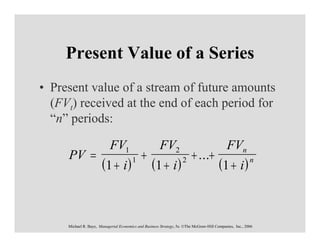
Present Value of a Series
• Present value of a stream of future amounts
  (FVt) received at the end of each period for
  “n” periods:

                            FV1                         FV2                                  FVn
     PV =                                    +                           + ...+
                       (1 + i )         1
                                                   (1 + i )         2
                                                                                         (1 + i )         n


     Michael R. Baye, Managerial Economics and Business Strategy, 5e. ©The McGraw-Hill Companies, Inc., 2006
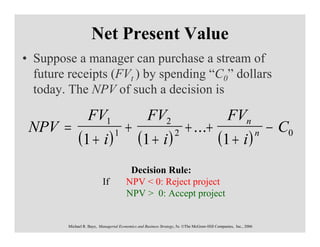
Net Present Value
• Suppose a manager can purchase a stream of
  future receipts (FVt ) by spending “C0” dollars
  today. The NPV of such a decision is

                   FV1                               FV2                                          FVn
 NPV =                                  +                                 + ...+                                       − C0
              (1 + i )            1
                                               (1 + i )             2
                                                                                            (1 + i )               n


                                          Decision Rule:
                            If           NPV < 0: Reject project
                                         NPV > 0: Accept project


         Michael R. Baye, Managerial Economics and Business Strategy, 5e. ©The McGraw-Hill Companies, Inc., 2006
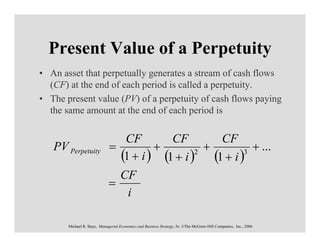
Present Value of a Perpetuity
• An asset that perpetually generates a stream of cash flows
  (CF) at the end of each period is called a perpetuity.
• The present value (PV) of a perpetuity of cash flows paying
  the same amount at the end of each period is


                                CF        CF        CF
   PV Perpetuity             =         +          +        + ...
                               (1 + i ) (1 + i ) (1 + i )
                                                2        3


                               CF
                             =
                                 i

       Michael R. Baye, Managerial Economics and Business Strategy, 5e. ©The McGraw-Hill Companies, Inc., 2006
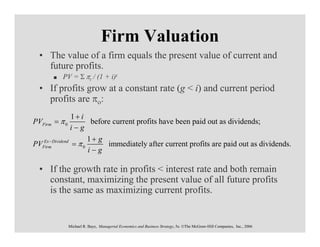
Firm Valuation
  • The value of a firm equals the present value of current and
    future profits.
          PV = Σ πt / (1 + i)t
  • If profits grow at a constant rate (g < i) and current period
    profits are πο:
                1+ i
PVFirm = π 0           before current profits have been paid out as dividends;
               i−g
                      1+ g
PVFirm Dividend = π 0
   Ex −
                            immediately after current profits are paid out as dividends.
                      i−g

  • If the growth rate in profits < interest rate and both remain
    constant, maximizing the present value of all future profits
    is the same as maximizing current profits.


               Michael R. Baye, Managerial Economics and Business Strategy, 5e. ©The McGraw-Hill Companies, Inc., 2006
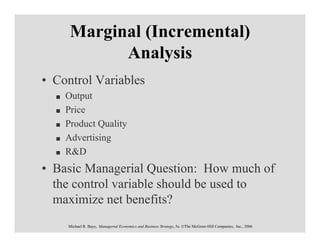
Marginal (Incremental)
           Analysis
• Control Variables
    Output
    Price
    Product Quality
    Advertising
    R&D
• Basic Managerial Question: How much of
  the control variable should be used to
  maximize net benefits?
    Michael R. Baye, Managerial Economics and Business Strategy, 5e. ©The McGraw-Hill Companies, Inc., 2006
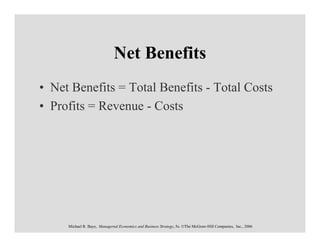
Net Benefits
• Net Benefits = Total Benefits - Total Costs
• Profits = Revenue - Costs


     Michael R. Baye, Managerial Economics and Business Strategy, 5e. ©The McGraw-Hill Companies, Inc., 2006
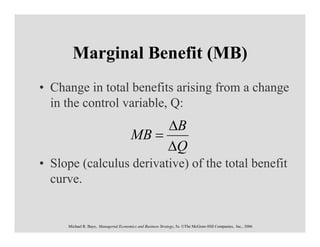
Marginal Benefit (MB)
• Change in total benefits arising from a change
  in the control variable, Q:
                                             ∆B
                                        MB =
                                             ∆Q
• Slope (calculus derivative) of the total benefit
  curve.


     Michael R. Baye, Managerial Economics and Business Strategy, 5e. ©The McGraw-Hill Companies, Inc., 2006
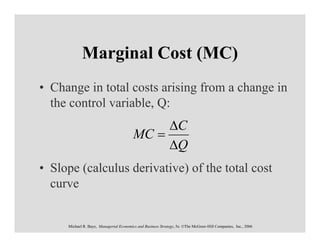
Marginal Cost (MC)
• Change in total costs arising from a change in
  the control variable, Q:
                                              ∆C
                                         MC =
                                              ∆Q
• Slope (calculus derivative) of the total cost
  curve


     Michael R. Baye, Managerial Economics and Business Strategy, 5e. ©The McGraw-Hill Companies, Inc., 2006
Marginal Principle
• To maximize net benefits, the managerial
  control variable should be increased up to
  the point where MB = MC.
• MB > MC means the last unit of the control
  variable increased benefits more than it
  increased costs.
• MB < MC means the last unit of the control
  variable increased costs more than it
  increased benefits.
     Michael R. Baye, Managerial Economics and Business Strategy, 5e. ©The McGraw-Hill Companies, Inc., 2006
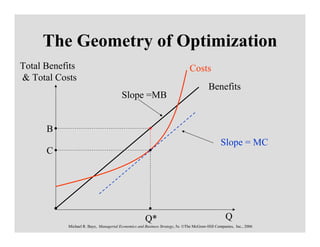
The Geometry of Optimization
Total Benefits                                                                Costs
& Total Costs
                                                                                         Benefits
                                        Slope =MB


      B
                                                                                                Slope = MC
      C


                                                      Q*                                          Q
           Michael R. Baye, Managerial Economics and Business Strategy, 5e. ©The McGraw-Hill Companies, Inc., 2006
Conclusion
• Make sure you include all costs and benefits
  when making decisions (opportunity cost).
• When decisions span time, make sure you
  are comparing apples to apples (PV
  analysis).
• Optimal economic decisions are made at the
  margin (marginal analysis).


     Michael R. Baye, Managerial Economics and Business Strategy, 5e. ©The McGraw-Hill Companies, Inc., 2006

Chapter1

  • 1.
    Managerial Economics & Business Strategy Chapter 1 The Fundamentals of Managerial Economics Michael R. Baye, Managerial Economics and Business Strategy, 5e. ©The McGraw-Hill Companies, Inc., 2006
  • 2.
    Overview I. Introduction II. TheEconomics of Effective Management Identify Goals and Constraints Recognize the Role of Profits Understand Incentives Five Forces Model Understand Markets Recognize the Time Value of Money Use Marginal Analysis Michael R. Baye, Managerial Economics and Business Strategy, 5e. ©The McGraw-Hill Companies, Inc., 2006
  • 3.
    Managerial Economics • Manager A person who directs resources to achieve a stated goal. • Economics The science of making decisions in the presence of scare resources. • Managerial Economics The study of how to direct scarce resources in the way that most efficiently achieves a managerial goal. Michael R. Baye, Managerial Economics and Business Strategy, 5e. ©The McGraw-Hill Companies, Inc., 2006
  • 4.
    Economic vs. Accounting Profits • Accounting Profits Total revenue (sales) minus dollar cost of producing goods or services. Reported on the firm’s income statement. • Economic Profits Total revenue minus total opportunity cost. Michael R. Baye, Managerial Economics and Business Strategy, 5e. ©The McGraw-Hill Companies, Inc., 2006
  • 5.
    Opportunity Cost • AccountingCosts The explicit costs of the resources needed to produce produce goods or services. Reported on the firm’s income statement. • Opportunity Cost The cost of the explicit and implicit resources that are foregone when a decision is made. • Economic Profits Total revenue minus total opportunity cost. Michael R. Baye, Managerial Economics and Business Strategy, 5e. ©The McGraw-Hill Companies, Inc., 2006
  • 6.
    The Five ForcesFramework •Entry Costs Entry •Network Effects •Speed of Adjustment •Reputation •Sunk Costs •Switching Costs •Economies of Scale •Government Restraints Power of Power of Input Suppliers Buyers •Supplier Concentration •Buyer Concentration •Price/Productivity of Sustainable •Price/Value of Substitute Alternative Inputs Products or Services •Relationship-Specific Industry •Relationship-Specific Investments Profits Investments •Supplier Switching Costs •Customer Switching Costs •Government Restraints •Government Restraints Industry Rivalry Substitutes & Complements •Concentration •Switching Costs •Price/Value of Surrogate Products •Network Effects •Price, Quantity, Quality, or •Timing of Decisions or Services •Government Service Competition •Information •Price/Value of Complementary Restraints •Degree of Differentiation •Government Restraints Products or Services Michael R. Baye, Managerial Economics and Business Strategy, 5e. ©The McGraw-Hill Companies, Inc., 2006
  • 7.
    Market Interactions • Consumer-ProducerRivalry Consumers attempt to locate low prices, while producers attempt to charge high prices. • Consumer-Consumer Rivalry Scarcity of goods reduces the negotiating power of consumers as they compete for the right to those goods. • Producer-Producer Rivalry Scarcity of consumers causes producers to compete with one another for the right to service customers. • The Role of Government Disciplines the market process. Michael R. Baye, Managerial Economics and Business Strategy, 5e. ©The McGraw-Hill Companies, Inc., 2006
  • 8.
    The Time Valueof Money • Present value (PV) of a lump-sum amount (FV) to be received at the end of “n” periods when the per-period interest rate is “i”: FV PV = (1 + i ) n • Examples: Lotto winner choosing between a single lump-sum payout of $104 million or $198 million over 25 years. Determining damages in a patent infringement case. Michael R. Baye, Managerial Economics and Business Strategy, 5e. ©The McGraw-Hill Companies, Inc., 2006
  • 9.
    Present Value ofa Series • Present value of a stream of future amounts (FVt) received at the end of each period for “n” periods: FV1 FV2 FVn PV = + + ...+ (1 + i ) 1 (1 + i ) 2 (1 + i ) n Michael R. Baye, Managerial Economics and Business Strategy, 5e. ©The McGraw-Hill Companies, Inc., 2006
  • 10.
    Net Present Value •Suppose a manager can purchase a stream of future receipts (FVt ) by spending “C0” dollars today. The NPV of such a decision is FV1 FV2 FVn NPV = + + ...+ − C0 (1 + i ) 1 (1 + i ) 2 (1 + i ) n Decision Rule: If NPV < 0: Reject project NPV > 0: Accept project Michael R. Baye, Managerial Economics and Business Strategy, 5e. ©The McGraw-Hill Companies, Inc., 2006
  • 11.
    Present Value ofa Perpetuity • An asset that perpetually generates a stream of cash flows (CF) at the end of each period is called a perpetuity. • The present value (PV) of a perpetuity of cash flows paying the same amount at the end of each period is CF CF CF PV Perpetuity = + + + ... (1 + i ) (1 + i ) (1 + i ) 2 3 CF = i Michael R. Baye, Managerial Economics and Business Strategy, 5e. ©The McGraw-Hill Companies, Inc., 2006
  • 12.
    Firm Valuation • The value of a firm equals the present value of current and future profits. PV = Σ πt / (1 + i)t • If profits grow at a constant rate (g < i) and current period profits are πο: 1+ i PVFirm = π 0 before current profits have been paid out as dividends; i−g 1+ g PVFirm Dividend = π 0 Ex − immediately after current profits are paid out as dividends. i−g • If the growth rate in profits < interest rate and both remain constant, maximizing the present value of all future profits is the same as maximizing current profits. Michael R. Baye, Managerial Economics and Business Strategy, 5e. ©The McGraw-Hill Companies, Inc., 2006
  • 13.
    Marginal (Incremental) Analysis • Control Variables Output Price Product Quality Advertising R&D • Basic Managerial Question: How much of the control variable should be used to maximize net benefits? Michael R. Baye, Managerial Economics and Business Strategy, 5e. ©The McGraw-Hill Companies, Inc., 2006
  • 14.
    Net Benefits • NetBenefits = Total Benefits - Total Costs • Profits = Revenue - Costs Michael R. Baye, Managerial Economics and Business Strategy, 5e. ©The McGraw-Hill Companies, Inc., 2006
  • 15.
    Marginal Benefit (MB) •Change in total benefits arising from a change in the control variable, Q: ∆B MB = ∆Q • Slope (calculus derivative) of the total benefit curve. Michael R. Baye, Managerial Economics and Business Strategy, 5e. ©The McGraw-Hill Companies, Inc., 2006
  • 16.
    Marginal Cost (MC) •Change in total costs arising from a change in the control variable, Q: ∆C MC = ∆Q • Slope (calculus derivative) of the total cost curve Michael R. Baye, Managerial Economics and Business Strategy, 5e. ©The McGraw-Hill Companies, Inc., 2006
  • 17.
    Marginal Principle • Tomaximize net benefits, the managerial control variable should be increased up to the point where MB = MC. • MB > MC means the last unit of the control variable increased benefits more than it increased costs. • MB < MC means the last unit of the control variable increased costs more than it increased benefits. Michael R. Baye, Managerial Economics and Business Strategy, 5e. ©The McGraw-Hill Companies, Inc., 2006
  • 18.
    The Geometry ofOptimization Total Benefits Costs & Total Costs Benefits Slope =MB B Slope = MC C Q* Q Michael R. Baye, Managerial Economics and Business Strategy, 5e. ©The McGraw-Hill Companies, Inc., 2006
  • 19.
    Conclusion • Make sureyou include all costs and benefits when making decisions (opportunity cost). • When decisions span time, make sure you are comparing apples to apples (PV analysis). • Optimal economic decisions are made at the margin (marginal analysis). Michael R. Baye, Managerial Economics and Business Strategy, 5e. ©The McGraw-Hill Companies, Inc., 2006