In-Datacenter Performance Analysis
of Tensor Processing Unit
Draft Paper Overview
Overview
• Motivation
• Purpose of the paper
• Summary of neural networks
• Overview of the proposed architecture
• Results and comparison between TPU, CPU &
GPU
Motivation
• 2006: only a few applications could run on custom
H/W (ASIC, FPGA, GPUs) —> thus you could easily find
those resources in a datacenter (due to under-utilization)
• 2013: predictions on the wide applicability of another
computational paradigm called Neural Networks (NN),
could double the computation demands on datacenters.
• It would be very expensive to increase the
GPUs in order to satisfy those needs
Tensor Processing Unit
(TPU)
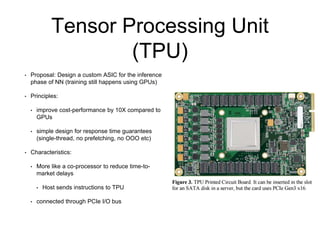
• Proposal: Design a custom ASIC for the inference
phase of NN (training still happens using GPUs)
• Principles:
• improve cost-performance by 10X compared to
GPUs
• simple design for response time guarantees
(single-thread, no prefetching, no OOO etc)
• Characteristics:
• More like a co-processor to reduce time-to-
market delays
• Host sends instructions to TPU
• connected through PCIe I/O bus
Neural Network
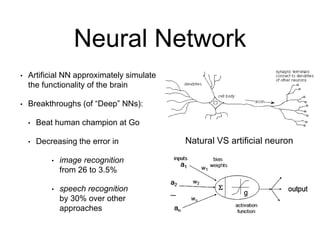
• Artificial NN approximately simulate
the functionality of the brain
• Breakthroughs (of “Deep” NNs):
• Beat human champion at Go
• Decreasing the error in
• image recognition
from 26 to 3.5%
• speech recognition
by 30% over other
approaches
Natural VS artificial neuron
Neural Networks Structure
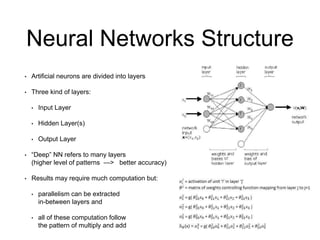
• Artificial neurons are divided into layers
• Three kind of layers:
• Input Layer
• Hidden Layer(s)
• Output Layer
• “Deep” NN refers to many layers
(higher level of patterns —> better accuracy)
• Results may require much computation but:
• parallelism can be extracted
in-between layers and
• all of these computation follow
the pattern of multiply and add
Neural Network Phases
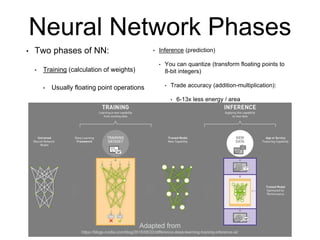
Adapted from
https://blogs.nvidia.com/blog/2016/08/22/difference-deep-learning-training-inference-ai/
• Inference (prediction)
• You can quantize (transform floating points to
8-bit integers)
• Trade accuracy (addition-multiplication):
• 6-13x less energy / area
• Two phases of NN:
• Training (calculation of weights)
• Usually floating point operations
Popular NN Architectures
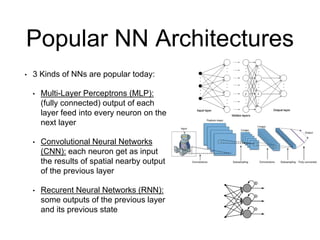
• 3 Kinds of NNs are popular today:
• Multi-Layer Perceptrons (MLP):
(fully connected) output of each
layer feed into every neuron on the
next layer
• Convolutional Neural Networks
(CNN): each neuron get as input
the results of spatial nearby output
of the previous layer
• Recurent Neural Networks (RNN):
some outputs of the previous layer
and its previous state
Paper Synopsis
• Description and Evaluation of the Tensor Processing Unit (TPU)
• By comparing power and performance between the TPU, a GPU
and a CPU
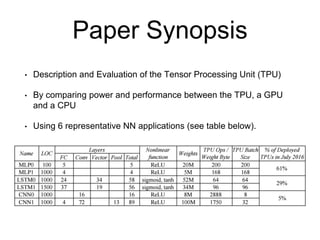
• Using 6 representative NN applications (see table below).
TPU Block Diagram
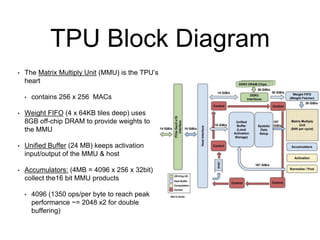
• The Matrix Multiply Unit (MMU) is the TPU’s
heart
• contains 256 x 256 MACs
• Weight FIFO (4 x 64KB tiles deep) uses
8GB off-chip DRAM to provide weights to
the MMU
• Unified Buffer (24 MB) keeps activation
input/output of the MMU & host
• Accumulators: (4MB = 4096 x 256 x 32bit)
collect the16 bit MMU products
• 4096 (1350 ops/per byte to reach peak
performance ~= 2048 x2 for double
buffering)
Matrix Multiply Unit
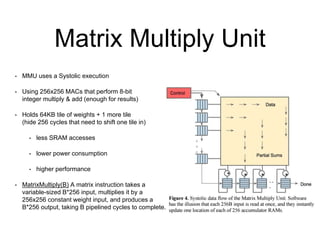
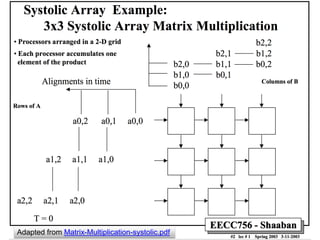
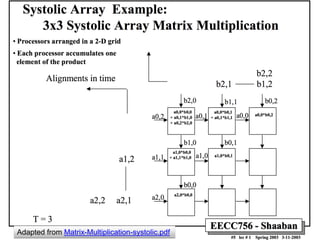
• MMU uses a Systolic execution
• Using 256x256 MACs that perform 8-bit
integer multiply & add (enough for results)
• Holds 64KB tile of weights + 1 more tile
(hide 256 cycles that need to shift one tile in)
• less SRAM accesses
• lower power consumption
• higher performance
• MatrixMultiply(B) A matrix instruction takes a
variable-sized B*256 input, multiplies it by a
256x256 constant weight input, and produces a
B*256 output, taking B pipelined cycles to complete.
Adapted from Matrix-Multiplication-systolic.pdf
Evaluation
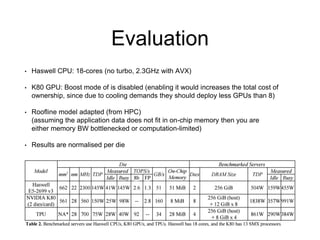
• Haswell CPU: 18-cores (no turbo, 2.3GHz with AVX)
• K80 GPU: Boost mode of is disabled (enabling it would increases the total cost of
ownership, since due to cooling demands they should deploy less GPUs than 8)
• Roofline model adapted (from HPC)
(assuming the application data does not fit in on-chip memory then you are
either memory BW bottlenecked or computation-limited)
• Results are normalised per die
TPU micro-bench results
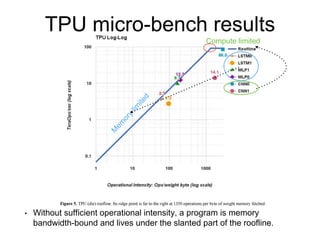
• Without sufficient operational intensity, a program is memory
bandwidth-bound and lives under the slanted part of the roofline.
Compute limited
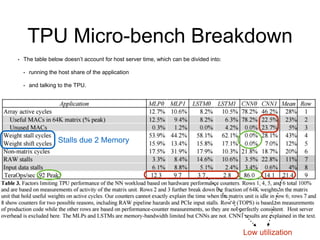
TPU Micro-bench Breakdown
Stalls due 2 Memory
Low utilization
• The table below doesn’t account for host server time, which can be divided into:
• running the host share of the application
• and talking to the TPU.
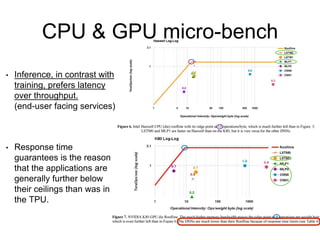
CPU & GPU micro-bench
• Inference, in contrast with
training, prefers latency
over throughput.
(end-user facing services)
• Response time
guarantees is the reason
that the applications are
generally further below
their ceilings than was in
the TPU.
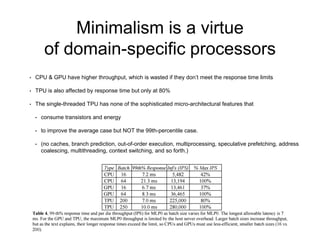
Minimalism is a virtue
of domain-specific processors
• CPU & GPU have higher throughput, which is wasted if they don’t meet the response time limits
• TPU is also affected by response time but only at 80%
• The single-threaded TPU has none of the sophisticated micro-architectural features that
• consume transistors and energy
• to improve the average case but NOT the 99th-percentile case.
• (no caches, branch prediction, out-of-order execution, multiprocessing, speculative prefetching, address
coalescing, multithreading, context switching, and so forth.)
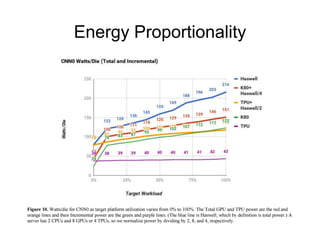
Energy Proportionality
Evaluation of Alternative TPU
Design
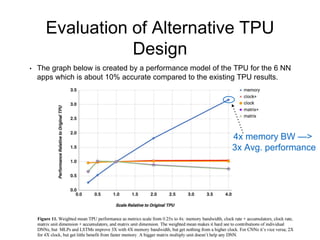
• The graph below is created by a performance model of the TPU for the 6 NN
apps which is about 10% accurate compared to the existing TPU results.
4x memory BW —>
3x Avg. performance
Cost-Performance Results
Conclusion
• Although most researchers are optimizing CNNs, they represent just 5% of google’s
datacenter workload.
• Since Inference apps are user-facing, they emphasize response-time over throughput
• Due to latency limits, the K80 GPU is just a little faster than the CPU, for inference.
• Despite having a much smaller and lower power chip, the TPU has 25 times as many
MACs and 3.5 times as much on-chip memory as the K80 GPU.
• The TPU is about 15X - 30X faster at inference than the K80 GPU and the Haswell CPU.
• Four of the six NN apps are memory-bandwidth limited on the TPU; if the TPU were
revised to have the same memory system as the K80 GPU, it would be about 30X - 50X
faster than the GPU and CPU.
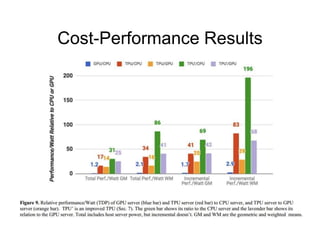
• The performance/Watt of the TPU is 30X - 80X that of contemporary products; the
revised TPU with K80 memory would be 70X - 200X better.
TPU vs FPGA
• Jouppi says, that the hardware engineering team
did look to FPGAs to solve the problem of cheap,
efficient, and high performance inference early on
before shifting to a custom ASIC.
• FPGA vs ASIC: there ends up being a big
difference in performance and performance per watt
• However, the TPU is programmable like a CPU or
GPU, it is not for just one neural network.
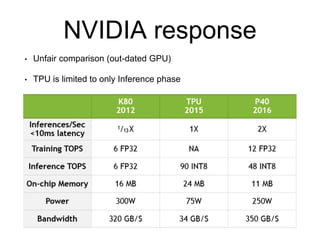
NVIDIA response
• Unfair comparison (out-dated GPU)
• TPU is limited to only Inference phase
References
• http://www.cs.iusb.edu/~danav/teach/c463/12_nn.html
• https://blogs.nvidia.com/blog/2017/04/10/ai-drives-rise-accelerated-
computing-datacenter/
• https://cloudplatform.googleblog.com/2017/04/quantifying-the-performance-
of-the-TPU-our-first-machine-learning-chip.html
• Draft Paper:
https://drive.google.com/file/d/0Bx4hafXDDq2EMzRNcy1vSUxtcEk/view
• https://www.nextplatform.com/2017/04/05/first-depth-look-googles-tpu-
architecture/
• Systolic Execution:
http://web.cecs.pdx.edu/~mperkows/temp/May22/0020.Matrix-multiplication-
systolic.pdf

Tensor Processing Unit (TPU)

  • 1.
    In-Datacenter Performance Analysis ofTensor Processing Unit Draft Paper Overview
  • 2.
    Overview • Motivation • Purposeof the paper • Summary of neural networks • Overview of the proposed architecture • Results and comparison between TPU, CPU & GPU
  • 3.
    Motivation • 2006: onlya few applications could run on custom H/W (ASIC, FPGA, GPUs) —> thus you could easily find those resources in a datacenter (due to under-utilization) • 2013: predictions on the wide applicability of another computational paradigm called Neural Networks (NN), could double the computation demands on datacenters. • It would be very expensive to increase the GPUs in order to satisfy those needs
  • 4.
    Tensor Processing Unit (TPU) •Proposal: Design a custom ASIC for the inference phase of NN (training still happens using GPUs) • Principles: • improve cost-performance by 10X compared to GPUs • simple design for response time guarantees (single-thread, no prefetching, no OOO etc) • Characteristics: • More like a co-processor to reduce time-to- market delays • Host sends instructions to TPU • connected through PCIe I/O bus
  • 5.
    Neural Network • ArtificialNN approximately simulate the functionality of the brain • Breakthroughs (of “Deep” NNs): • Beat human champion at Go • Decreasing the error in • image recognition from 26 to 3.5% • speech recognition by 30% over other approaches Natural VS artificial neuron
  • 6.
    Neural Networks Structure •Artificial neurons are divided into layers • Three kind of layers: • Input Layer • Hidden Layer(s) • Output Layer • “Deep” NN refers to many layers (higher level of patterns —> better accuracy) • Results may require much computation but: • parallelism can be extracted in-between layers and • all of these computation follow the pattern of multiply and add
  • 7.
    Neural Network Phases Adaptedfrom https://blogs.nvidia.com/blog/2016/08/22/difference-deep-learning-training-inference-ai/ • Inference (prediction) • You can quantize (transform floating points to 8-bit integers) • Trade accuracy (addition-multiplication): • 6-13x less energy / area • Two phases of NN: • Training (calculation of weights) • Usually floating point operations
  • 8.
    Popular NN Architectures •3 Kinds of NNs are popular today: • Multi-Layer Perceptrons (MLP): (fully connected) output of each layer feed into every neuron on the next layer • Convolutional Neural Networks (CNN): each neuron get as input the results of spatial nearby output of the previous layer • Recurent Neural Networks (RNN): some outputs of the previous layer and its previous state
  • 9.
    Paper Synopsis • Descriptionand Evaluation of the Tensor Processing Unit (TPU) • By comparing power and performance between the TPU, a GPU and a CPU • Using 6 representative NN applications (see table below).
  • 10.
    TPU Block Diagram •The Matrix Multiply Unit (MMU) is the TPU’s heart • contains 256 x 256 MACs • Weight FIFO (4 x 64KB tiles deep) uses 8GB off-chip DRAM to provide weights to the MMU • Unified Buffer (24 MB) keeps activation input/output of the MMU & host • Accumulators: (4MB = 4096 x 256 x 32bit) collect the16 bit MMU products • 4096 (1350 ops/per byte to reach peak performance ~= 2048 x2 for double buffering)
  • 11.
    Matrix Multiply Unit •MMU uses a Systolic execution • Using 256x256 MACs that perform 8-bit integer multiply & add (enough for results) • Holds 64KB tile of weights + 1 more tile (hide 256 cycles that need to shift one tile in) • less SRAM accesses • lower power consumption • higher performance • MatrixMultiply(B) A matrix instruction takes a variable-sized B*256 input, multiplies it by a 256x256 constant weight input, and produces a B*256 output, taking B pipelined cycles to complete.
  • 12.
  • 13.
  • 14.
    Evaluation • Haswell CPU:18-cores (no turbo, 2.3GHz with AVX) • K80 GPU: Boost mode of is disabled (enabling it would increases the total cost of ownership, since due to cooling demands they should deploy less GPUs than 8) • Roofline model adapted (from HPC) (assuming the application data does not fit in on-chip memory then you are either memory BW bottlenecked or computation-limited) • Results are normalised per die
  • 15.
    TPU micro-bench results •Without sufficient operational intensity, a program is memory bandwidth-bound and lives under the slanted part of the roofline. Compute limited
  • 16.
    TPU Micro-bench Breakdown Stallsdue 2 Memory Low utilization • The table below doesn’t account for host server time, which can be divided into: • running the host share of the application • and talking to the TPU.
  • 17.
    CPU & GPUmicro-bench • Inference, in contrast with training, prefers latency over throughput. (end-user facing services) • Response time guarantees is the reason that the applications are generally further below their ceilings than was in the TPU.
  • 18.
    Minimalism is avirtue of domain-specific processors • CPU & GPU have higher throughput, which is wasted if they don’t meet the response time limits • TPU is also affected by response time but only at 80% • The single-threaded TPU has none of the sophisticated micro-architectural features that • consume transistors and energy • to improve the average case but NOT the 99th-percentile case. • (no caches, branch prediction, out-of-order execution, multiprocessing, speculative prefetching, address coalescing, multithreading, context switching, and so forth.)
  • 19.
  • 20.
    Evaluation of AlternativeTPU Design • The graph below is created by a performance model of the TPU for the 6 NN apps which is about 10% accurate compared to the existing TPU results. 4x memory BW —> 3x Avg. performance
  • 21.
  • 22.
    Conclusion • Although mostresearchers are optimizing CNNs, they represent just 5% of google’s datacenter workload. • Since Inference apps are user-facing, they emphasize response-time over throughput • Due to latency limits, the K80 GPU is just a little faster than the CPU, for inference. • Despite having a much smaller and lower power chip, the TPU has 25 times as many MACs and 3.5 times as much on-chip memory as the K80 GPU. • The TPU is about 15X - 30X faster at inference than the K80 GPU and the Haswell CPU. • Four of the six NN apps are memory-bandwidth limited on the TPU; if the TPU were revised to have the same memory system as the K80 GPU, it would be about 30X - 50X faster than the GPU and CPU. • The performance/Watt of the TPU is 30X - 80X that of contemporary products; the revised TPU with K80 memory would be 70X - 200X better.
  • 23.
    TPU vs FPGA •Jouppi says, that the hardware engineering team did look to FPGAs to solve the problem of cheap, efficient, and high performance inference early on before shifting to a custom ASIC. • FPGA vs ASIC: there ends up being a big difference in performance and performance per watt • However, the TPU is programmable like a CPU or GPU, it is not for just one neural network.
  • 24.
    NVIDIA response • Unfaircomparison (out-dated GPU) • TPU is limited to only Inference phase
  • 25.
    References • http://www.cs.iusb.edu/~danav/teach/c463/12_nn.html • https://blogs.nvidia.com/blog/2017/04/10/ai-drives-rise-accelerated- computing-datacenter/ •https://cloudplatform.googleblog.com/2017/04/quantifying-the-performance- of-the-TPU-our-first-machine-learning-chip.html • Draft Paper: https://drive.google.com/file/d/0Bx4hafXDDq2EMzRNcy1vSUxtcEk/view • https://www.nextplatform.com/2017/04/05/first-depth-look-googles-tpu- architecture/ • Systolic Execution: http://web.cecs.pdx.edu/~mperkows/temp/May22/0020.Matrix-multiplication- systolic.pdf