Scale-Out ccNUMA:
Exploiting Skew with Strongly Consistent Caching
Antonios Katsarakis*, Vasilis Gavrielatos*, 

A. Joshi, N. Oswald, B. Grot, V. Nagarajan
The University of Edinburgh
This work was supported by EPSRC, ARM and Microsoft through their PhD Fellowship Programs
*The first two authors equally contribute to this work
Large-scale online services
2
Backed by Key-Value Stores (KVS)
Characteristics:
• Numerous users
• Read-mostly workloads
( e.g. Facebook 0.2% writes [ATC’13] )

Distributed KVS
KVS Performance 101
3
…
KVS Performance 101
4
In-memory storage:

Avoid slow disk access
… … …
…
KVS Performance 101
5
In-memory storage:

Avoid slow disk access
Partitioning:

• Shard the dataset across multiple nodes
• Enables high capacity in-memory storage

… … …
…
KVS Performance 101
6
In-memory storage:

Avoid slow disk access
Partitioning:

• Shard the dataset across multiple nodes
• Enables high capacity in-memory storage

Remote Direct Memory Access (RDMA):
Avoid costly TCP/IP processing via
• Kernel bypass
• H/w network stack processing
… … …
…
KVS Performance 101
7
In-memory storage:

Avoid slow disk access
Partitioning:

• Shard the dataset across multiple nodes
• Enables high capacity in-memory storage

Remote Direct Memory Access (RDMA):
Avoid costly TCP/IP processing via
• Kernel bypass
• H/w network stack processing
Good start, but there is a problem…
Skewed Access Distribution
8
Real-world datasets → mixed popularity
• Popularity follows a power-law distribution
• Small number of objects hot; most are not
Mixed popularity → load imbalance
• Node(s) storing hottest objects
get highly loaded
• Majority of nodes are under-utilized
128 Servers
… … …
Overloaded
YCSB, skew exponent = 0.99
Skewed Access Distribution
9
Real-world datasets → mixed popularity
• Popularity follows a power-law distribution
• Small number of objects hot; most are not
Mixed popularity → load imbalance
• Node(s) storing hottest objects
get highly loaded
• Majority of nodes are under-utilized
128 Servers
… … …
Overloaded
YCSB, skew exponent = 0.99
Skew-induced load imbalance limits system throughput
Centralized cache [SOCC’11, SOSP’17]
• Dedicated node resides in front of the KVS
caching hot objects.
◦ Filters the skew with a small cache
◦ Throughput is limited by the single cache
Existing Skew Mitigation Techniques
10
… … …
← Cache
Centralized cache [SOCC’11, SOSP’17]
• Dedicated node resides in front of the KVS
caching hot objects.
◦ Filters the skew with a small cache
◦ Throughput is limited by the single cache
NUMA abstraction [NSDI’14, SOCC’16]
• Uniformly distribute requests to all servers
• Remote objects RDMA’ed from home node
◦ Load balance the client requests
◦ No locality → excessive network b/w
Most requests require remote access
Existing Skew Mitigation Techniques
11
… … …
… … …
← Cache
Centralized cache [SOCC’11, SOSP’17]
• Dedicated node resides in front of the KVS
caching hot objects.
◦ Filters the skew with a small cache
◦ Throughput is limited by the single cache
NUMA abstraction [NSDI’14, SOCC’16]
• Uniformly distribute requests to all servers
• Remote objects RDMA’ed from home node
◦ Load balance the client requests
◦ No locality → excessive network b/w
Most requests require remote access
Existing Skew Mitigation Techniques
12
… … …
… … …
Can we get the best of both worlds?
← Cache
13
Caching + NUMA
… … …
+
Scale-Out ccNUMA!
… … …
via distributed caching
14
Caching + NUMA
… … …
+
Scale-Out ccNUMA!
What are the challenges?
… … …
via distributed caching
Scale-Out ccNUMA Challenges
15
Challenge 1: Distributed cache architecture design
• Which items to cache and where?
• How to steer traffic for maximum load balance & hit rate?
Challenge 2: Keeping the caches consistent 

(i.e. what happens on a write)
• How to locate replicas?
• How to execute writes efficiently?
Scale-Out ccNUMA Challenges
16
Challenge 1: Distributed cache architecture design
• Which items to cache and where?
• How to steer traffic for maximum load balance & hit rate?
Challenge 2: Keeping the caches consistent 

(i.e. what happens on a write)
• How to locate replicas?
• How to execute writes efficiently?
Solving Challenge 1 with Symmetric Caching
17
Which items to cache and where?
• Insight: hottest objects see most hits
• Idea: all nodes cache hottest objects →
Implication: all caches have same content
• Symmetric caching:
small cache with hottest objects at each node
How to steer traffic for maximum load balance and hit rate?
• Insight: symmetric caching → all caches equal (highest) hit rate
• Idea: uniformly spread requests
• Requests for hottest objects → served locally on any node
• Cache misses served as in NUMA Abstraction
Benefits:
• Load balances and filters the skew
• Throughput scales with number of servers
• Less network b/w: most requests are served locally
Symmetric Caching
… … …
18
Which items to cache and where?
• Insight: hottest objects see most hits
• Idea: all nodes cache hottest objects →
Implication: all caches have same content
• Symmetric caching:
small cache with hottest objects at each node
How to steer traffic for maximum load balance and hit rate?
• Insight: symmetric caching → all caches equal (highest) hit rate
• Idea: uniformly spread requests
• Requests for hottest objects → served locally on any node
• Cache misses served as in NUMA abstraction
Benefits:
• Load balances and filters the skew
• Throughput scales with number of servers
• Less network b/w: most requests are served locally
Symmetric Caching
… … …
19
Which items to cache and where?
• Insight: hottest objects see most hits
• Idea: all nodes cache hottest objects →
Implication: all caches have same content
• Symmetric caching:
small cache with hottest objects at each node
How to steer traffic for maximum load balance and hit rate?
• Insight: symmetric caching → all caches equal (highest) hit rate
• Idea: uniformly spread requests
• Requests for hottest objects → served locally on any node
• Cache misses served as in NUMA abstraction
Benefits:
• Load balances and filters the skew
• Throughput scales with number of servers
• Less network b/w: most requests are served locally
Symmetric Caching
… … …
20
Which items to cache and where?
• Insight: hottest objects see most hits
• Idea: all nodes cache hottest objects →
Implication: all caches have same content
• Symmetric caching:
small cache with hottest objects at each node
How to steer traffic for maximum load balance and hit rate?
• Insight: symmetric caching → all caches equal (highest) hit rate
• Idea: uniformly spread requests
• Requests for hottest objects → served locally on any node
• Cache misses served as in NUMA abstraction
Benefits:
• Load balances and filters the skew
• Throughput scales with number of servers
• Less network b/w: most requests are served locally
Symmetric Caching
… … …
Challenge 2: How to keep the caches consistent?
Keeping the caches consistent
21
Requirement:
On a write, inform all replicas of the new value
How to locate replicas?
- Easy with Symmetric Caching!
If object in local cache → all nodes cache it
Keeping the caches consistent
22
Requirement:
On a write, inform all replicas of the new value
How to locate replicas?
- Easy with Symmetric Caching!
If object in local cache → all nodes cache it
Keeping the caches consistent
23
Requirement:
On a write, inform all replicas of the new value
How to locate replicas?
- Easy with Symmetric Caching!
If object in local cache → all nodes cache it
How to execute writes efficiently?
• Typical protocols:
◦ Ensure global write ordering via a primary
◦ Primary executes all writes → hot-spot Primary executes all writes
Write( )Write( )
Primary
Keeping the caches consistent
24
Requirement:
On a write, inform all replicas of the new value
How to locate replicas?
- Easy with Symmetric Caching!
If object in local cache → all nodes cache it
How to execute writes efficiently?
• Typical protocols:
◦ Ensure global write ordering via a primary
◦ Primary executes all writes → hot-spot
• Fully distributed writes
Can guarantee ordering via logical clocks
Avoid hot-spots
Evenly spread write propagation costs
Primary executes all writes
Write( )Write( )
Primary
Fully distributed writes
Write( ) Write( )
Protocols in Scale-out ccNUMA
25
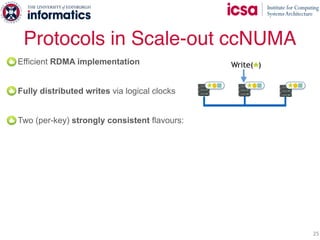
Efficient RDMA implementation
Fully distributed writes via logical clocks
Two (per-key) strongly consistent flavours:
Write( )
Protocols in Scale-out ccNUMA
26
Efficient RDMA implementation
Fully distributed writes via logical clocks
Two (per-key) strongly consistent flavours:
◦ Linearizability (Lin): 2 RTTs
Write( )
Protocols in Scale-out ccNUMA
27
Efficient RDMA implementation
Fully distributed writes via logical clocks
Two (per-key) strongly consistent flavours:
◦ Linearizability (Lin): 2 RTTs
Broadcast Invalidations*
* along with logical (Lamport) clocks
Lin
Invalidate all caches
Write( )
Protocols in Scale-out ccNUMA
28
Efficient RDMA implementation
Fully distributed writes via logical clocks
Two (per-key) strongly consistent flavours:
◦ Linearizability (Lin): 2 RTTs
Broadcast Invalidations*
Broadcast Updates*
* along with logical (Lamport) clocks
Lin
Invalidate all caches
Write( )
Broadcast Updates
Protocols in Scale-out ccNUMA
29
Efficient RDMA implementation
Fully distributed writes via logical clocks
Two (per-key) strongly consistent flavours:
◦ Linearizability (Lin): 2 RTTs
Broadcast Invalidations*
Broadcast Updates*
◦ Sequential Consistency (SC): 1 RTT
Broadcast Updates*

* along with logical (Lamport) clocks
Lin
SC
Invalidate all caches
Write( )
Broadcast Updates
Evaluation
30
Hardware setup: 9 nodes
• 56Gb/s FDR InfiniBand NIC
• 64GB DRAM
• 2x 10 core CPUs - 25MB L3
KVS Workload:
• Skew exponent: α = 0.99 (YCSB)
• 250 M key-value pairs - (Key = 8B, Value = 40B)
Evaluated systems:
• Baseline: NUMA abstraction (state-of-the-art)
• Scale-out ccNUMA
• Per-node symmetric cache size: 0.1% of dataset
Performance
31
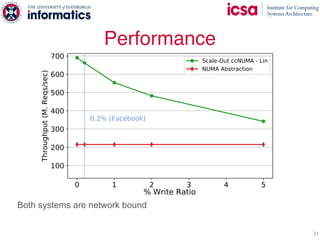
Both systems are network bound
Performance
32
>3χ
Both systems are network bound
Lin: >3x throughput at low write ratio
Performance
33
>3χ
1.6χ
Both systems are network bound
Lin: >3x throughput at low write ratio, 1.6x at 5% writes
2.2χ
Performance
34
Both systems are network bound
Lin: >3x throughput at low write ratio, 1.6x at 5% writes
SC: higher throughput at higher write ratios: 2.2x at 5% writes
>3χ
1.6χ
Conclusion
35
Scale-Out ccNUMA:
Distributed cache → best of Caching + NUMA
• Symmetric Caching:
◦ Load balances and filters skew
◦ Throughput scales with number of servers
◦ Less network b/w: most requests are local
• Fully distributed protocols:
◦ Efficient RDMA Implementation
◦ Fully distributed writes
◦ Two strong consistency guarantees
Up to 3x performance of state-of-the-art
while guaranteeing per-key Linearizability
Symmetric Caching
Fully distributed protocols
Write( ) Write( )
… … …
Questions?
36
Backup Slides
37
Effectiveness of caching
38
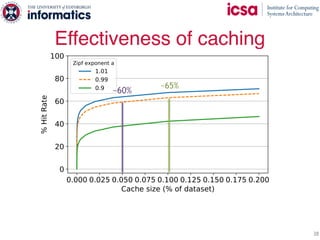
~65%
~60%
Read-only (varying skew)
39
Request breakdown
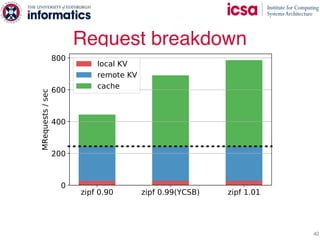
40
Network traffic
41
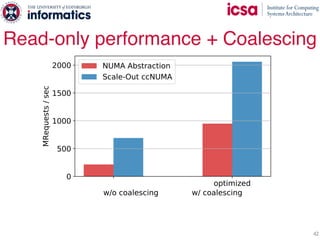
Read-only performance + Coalescing
42
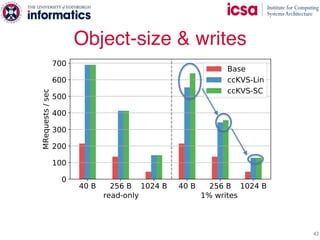
Object-size & writes
43
Object-size & coalescing
44
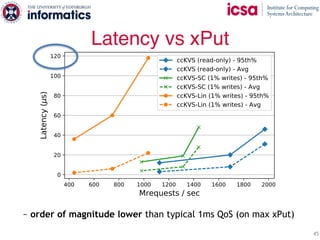
Latency vs xPut
45
~ order of magnitude lower than typical 1ms QoS (on max xPut)
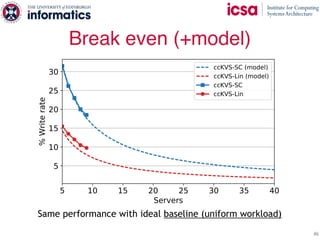
Break even (+model)
46
Same performance with ideal baseline (uniform workload)
Scalability (+model)
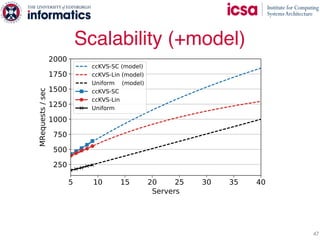
47

Scale-out ccNUMA - Eurosys'18

  • 1.
    Scale-Out ccNUMA: Exploiting Skewwith Strongly Consistent Caching Antonios Katsarakis*, Vasilis Gavrielatos*, 
 A. Joshi, N. Oswald, B. Grot, V. Nagarajan The University of Edinburgh This work was supported by EPSRC, ARM and Microsoft through their PhD Fellowship Programs *The first two authors equally contribute to this work
  • 2.
    Large-scale online services 2 Backedby Key-Value Stores (KVS) Characteristics: • Numerous users • Read-mostly workloads ( e.g. Facebook 0.2% writes [ATC’13] )
 Distributed KVS
  • 3.
  • 4.
    … KVS Performance 101 4 In-memorystorage:
 Avoid slow disk access
  • 5.
    … … … … KVSPerformance 101 5 In-memory storage:
 Avoid slow disk access Partitioning:
 • Shard the dataset across multiple nodes • Enables high capacity in-memory storage

  • 6.
    … … … … KVSPerformance 101 6 In-memory storage:
 Avoid slow disk access Partitioning:
 • Shard the dataset across multiple nodes • Enables high capacity in-memory storage
 Remote Direct Memory Access (RDMA): Avoid costly TCP/IP processing via • Kernel bypass • H/w network stack processing
  • 7.
    … … … … KVSPerformance 101 7 In-memory storage:
 Avoid slow disk access Partitioning:
 • Shard the dataset across multiple nodes • Enables high capacity in-memory storage
 Remote Direct Memory Access (RDMA): Avoid costly TCP/IP processing via • Kernel bypass • H/w network stack processing Good start, but there is a problem…
  • 8.
    Skewed Access Distribution 8 Real-worlddatasets → mixed popularity • Popularity follows a power-law distribution • Small number of objects hot; most are not Mixed popularity → load imbalance • Node(s) storing hottest objects get highly loaded • Majority of nodes are under-utilized 128 Servers … … … Overloaded YCSB, skew exponent = 0.99
  • 9.
    Skewed Access Distribution 9 Real-worlddatasets → mixed popularity • Popularity follows a power-law distribution • Small number of objects hot; most are not Mixed popularity → load imbalance • Node(s) storing hottest objects get highly loaded • Majority of nodes are under-utilized 128 Servers … … … Overloaded YCSB, skew exponent = 0.99 Skew-induced load imbalance limits system throughput
  • 10.
    Centralized cache [SOCC’11,SOSP’17] • Dedicated node resides in front of the KVS caching hot objects. ◦ Filters the skew with a small cache ◦ Throughput is limited by the single cache Existing Skew Mitigation Techniques 10 … … … ← Cache
  • 11.
    Centralized cache [SOCC’11,SOSP’17] • Dedicated node resides in front of the KVS caching hot objects. ◦ Filters the skew with a small cache ◦ Throughput is limited by the single cache NUMA abstraction [NSDI’14, SOCC’16] • Uniformly distribute requests to all servers • Remote objects RDMA’ed from home node ◦ Load balance the client requests ◦ No locality → excessive network b/w Most requests require remote access Existing Skew Mitigation Techniques 11 … … … … … … ← Cache
  • 12.
    Centralized cache [SOCC’11,SOSP’17] • Dedicated node resides in front of the KVS caching hot objects. ◦ Filters the skew with a small cache ◦ Throughput is limited by the single cache NUMA abstraction [NSDI’14, SOCC’16] • Uniformly distribute requests to all servers • Remote objects RDMA’ed from home node ◦ Load balance the client requests ◦ No locality → excessive network b/w Most requests require remote access Existing Skew Mitigation Techniques 12 … … … … … … Can we get the best of both worlds? ← Cache
  • 13.
    13 Caching + NUMA …… … + Scale-Out ccNUMA! … … … via distributed caching
  • 14.
    14 Caching + NUMA …… … + Scale-Out ccNUMA! What are the challenges? … … … via distributed caching
  • 15.
    Scale-Out ccNUMA Challenges 15 Challenge1: Distributed cache architecture design • Which items to cache and where? • How to steer traffic for maximum load balance & hit rate? Challenge 2: Keeping the caches consistent 
 (i.e. what happens on a write) • How to locate replicas? • How to execute writes efficiently?
  • 16.
    Scale-Out ccNUMA Challenges 16 Challenge1: Distributed cache architecture design • Which items to cache and where? • How to steer traffic for maximum load balance & hit rate? Challenge 2: Keeping the caches consistent 
 (i.e. what happens on a write) • How to locate replicas? • How to execute writes efficiently? Solving Challenge 1 with Symmetric Caching
  • 17.
    17 Which items tocache and where? • Insight: hottest objects see most hits • Idea: all nodes cache hottest objects → Implication: all caches have same content • Symmetric caching: small cache with hottest objects at each node How to steer traffic for maximum load balance and hit rate? • Insight: symmetric caching → all caches equal (highest) hit rate • Idea: uniformly spread requests • Requests for hottest objects → served locally on any node • Cache misses served as in NUMA Abstraction Benefits: • Load balances and filters the skew • Throughput scales with number of servers • Less network b/w: most requests are served locally Symmetric Caching … … …
  • 18.
    18 Which items tocache and where? • Insight: hottest objects see most hits • Idea: all nodes cache hottest objects → Implication: all caches have same content • Symmetric caching: small cache with hottest objects at each node How to steer traffic for maximum load balance and hit rate? • Insight: symmetric caching → all caches equal (highest) hit rate • Idea: uniformly spread requests • Requests for hottest objects → served locally on any node • Cache misses served as in NUMA abstraction Benefits: • Load balances and filters the skew • Throughput scales with number of servers • Less network b/w: most requests are served locally Symmetric Caching … … …
  • 19.
    19 Which items tocache and where? • Insight: hottest objects see most hits • Idea: all nodes cache hottest objects → Implication: all caches have same content • Symmetric caching: small cache with hottest objects at each node How to steer traffic for maximum load balance and hit rate? • Insight: symmetric caching → all caches equal (highest) hit rate • Idea: uniformly spread requests • Requests for hottest objects → served locally on any node • Cache misses served as in NUMA abstraction Benefits: • Load balances and filters the skew • Throughput scales with number of servers • Less network b/w: most requests are served locally Symmetric Caching … … …
  • 20.
    20 Which items tocache and where? • Insight: hottest objects see most hits • Idea: all nodes cache hottest objects → Implication: all caches have same content • Symmetric caching: small cache with hottest objects at each node How to steer traffic for maximum load balance and hit rate? • Insight: symmetric caching → all caches equal (highest) hit rate • Idea: uniformly spread requests • Requests for hottest objects → served locally on any node • Cache misses served as in NUMA abstraction Benefits: • Load balances and filters the skew • Throughput scales with number of servers • Less network b/w: most requests are served locally Symmetric Caching … … … Challenge 2: How to keep the caches consistent?
  • 21.
    Keeping the cachesconsistent 21 Requirement: On a write, inform all replicas of the new value How to locate replicas? - Easy with Symmetric Caching! If object in local cache → all nodes cache it
  • 22.
    Keeping the cachesconsistent 22 Requirement: On a write, inform all replicas of the new value How to locate replicas? - Easy with Symmetric Caching! If object in local cache → all nodes cache it
  • 23.
    Keeping the cachesconsistent 23 Requirement: On a write, inform all replicas of the new value How to locate replicas? - Easy with Symmetric Caching! If object in local cache → all nodes cache it How to execute writes efficiently? • Typical protocols: ◦ Ensure global write ordering via a primary ◦ Primary executes all writes → hot-spot Primary executes all writes Write( )Write( ) Primary
  • 24.
    Keeping the cachesconsistent 24 Requirement: On a write, inform all replicas of the new value How to locate replicas? - Easy with Symmetric Caching! If object in local cache → all nodes cache it How to execute writes efficiently? • Typical protocols: ◦ Ensure global write ordering via a primary ◦ Primary executes all writes → hot-spot • Fully distributed writes Can guarantee ordering via logical clocks Avoid hot-spots Evenly spread write propagation costs Primary executes all writes Write( )Write( ) Primary Fully distributed writes Write( ) Write( )
  • 25.
    Protocols in Scale-outccNUMA 25 Efficient RDMA implementation Fully distributed writes via logical clocks Two (per-key) strongly consistent flavours: Write( )
  • 26.
    Protocols in Scale-outccNUMA 26 Efficient RDMA implementation Fully distributed writes via logical clocks Two (per-key) strongly consistent flavours: ◦ Linearizability (Lin): 2 RTTs Write( )
  • 27.
    Protocols in Scale-outccNUMA 27 Efficient RDMA implementation Fully distributed writes via logical clocks Two (per-key) strongly consistent flavours: ◦ Linearizability (Lin): 2 RTTs Broadcast Invalidations* * along with logical (Lamport) clocks Lin Invalidate all caches Write( )
  • 28.
    Protocols in Scale-outccNUMA 28 Efficient RDMA implementation Fully distributed writes via logical clocks Two (per-key) strongly consistent flavours: ◦ Linearizability (Lin): 2 RTTs Broadcast Invalidations* Broadcast Updates* * along with logical (Lamport) clocks Lin Invalidate all caches Write( ) Broadcast Updates
  • 29.
    Protocols in Scale-outccNUMA 29 Efficient RDMA implementation Fully distributed writes via logical clocks Two (per-key) strongly consistent flavours: ◦ Linearizability (Lin): 2 RTTs Broadcast Invalidations* Broadcast Updates* ◦ Sequential Consistency (SC): 1 RTT Broadcast Updates*
 * along with logical (Lamport) clocks Lin SC Invalidate all caches Write( ) Broadcast Updates
  • 30.
    Evaluation 30 Hardware setup: 9nodes • 56Gb/s FDR InfiniBand NIC • 64GB DRAM • 2x 10 core CPUs - 25MB L3 KVS Workload: • Skew exponent: α = 0.99 (YCSB) • 250 M key-value pairs - (Key = 8B, Value = 40B) Evaluated systems: • Baseline: NUMA abstraction (state-of-the-art) • Scale-out ccNUMA • Per-node symmetric cache size: 0.1% of dataset
  • 31.
  • 32.
    Performance 32 >3χ Both systems arenetwork bound Lin: >3x throughput at low write ratio
  • 33.
    Performance 33 >3χ 1.6χ Both systems arenetwork bound Lin: >3x throughput at low write ratio, 1.6x at 5% writes
  • 34.
    2.2χ Performance 34 Both systems arenetwork bound Lin: >3x throughput at low write ratio, 1.6x at 5% writes SC: higher throughput at higher write ratios: 2.2x at 5% writes >3χ 1.6χ
  • 35.
    Conclusion 35 Scale-Out ccNUMA: Distributed cache→ best of Caching + NUMA • Symmetric Caching: ◦ Load balances and filters skew ◦ Throughput scales with number of servers ◦ Less network b/w: most requests are local • Fully distributed protocols: ◦ Efficient RDMA Implementation ◦ Fully distributed writes ◦ Two strong consistency guarantees Up to 3x performance of state-of-the-art while guaranteeing per-key Linearizability Symmetric Caching Fully distributed protocols Write( ) Write( ) … … …
  • 36.
  • 37.
  • 38.
  • 39.
  • 40.
  • 41.
  • 42.
  • 43.
  • 44.
  • 45.
    Latency vs xPut 45 ~order of magnitude lower than typical 1ms QoS (on max xPut)
  • 46.
    Break even (+model) 46 Sameperformance with ideal baseline (uniform workload)
  • 47.