In-DatacenterPerformance Analysisof A Tensor
Processing Unit​
DONG-HYUN HWANG
Preview of Highlights
Inference apps usually emphasize response-time over throughput since they are often user-facing.
Due to latency limits, the K80 GPU is underutilized for inference, and is just a little faster than a
Haswell CPU.
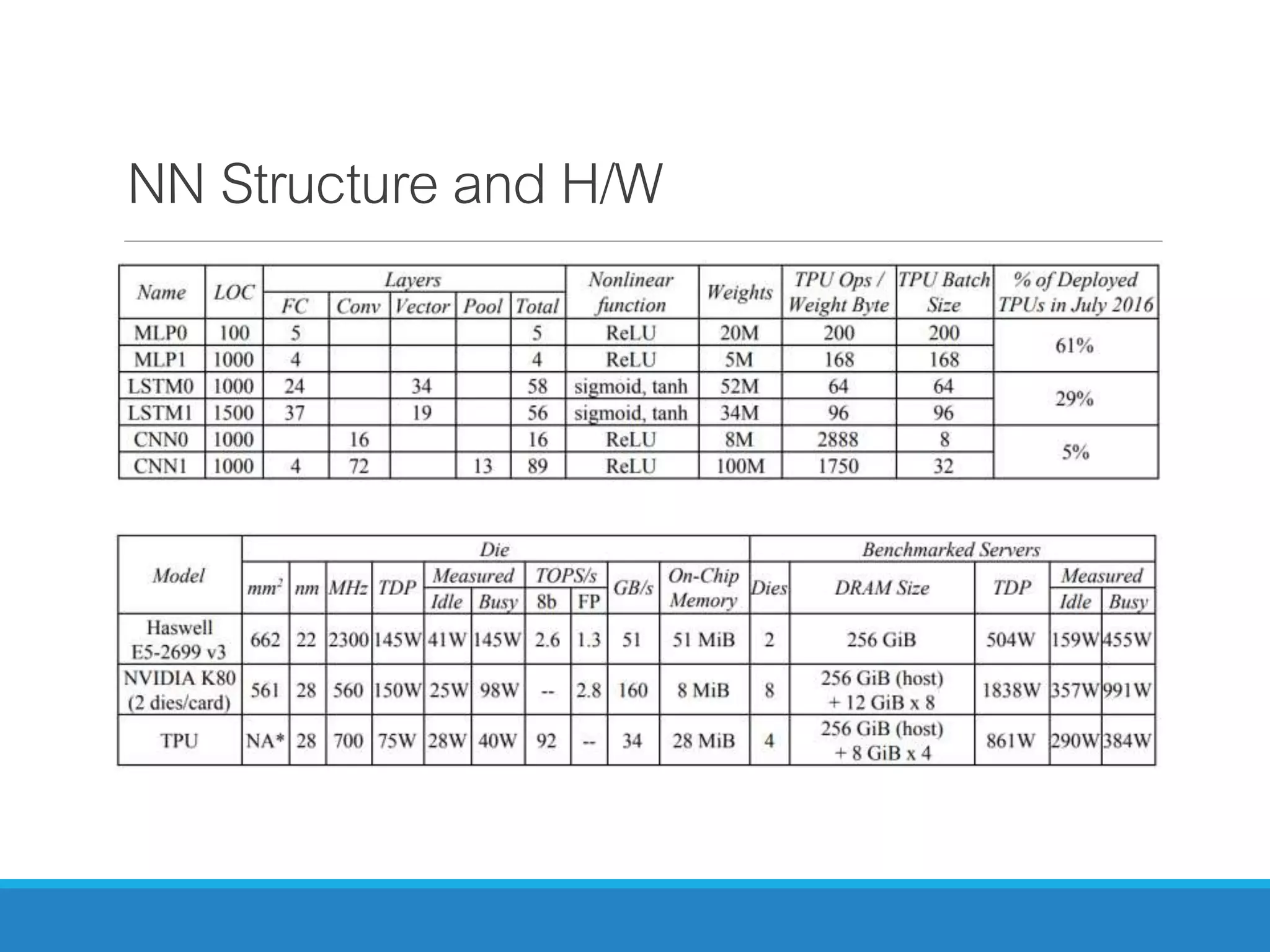
Despite having a much smaller and lower power chip, the TPU has 25 times as many MACs and 3.5
times as much on-chip memory as the K80 GPU.
The TPU is about 15X - 30X faster at inference than the K80 GPU and the Haswell CPU.
Preview of Highlights(cont.)
Four of the six NN apps are memory-bandwidth limited on the TPU; if the TPU were revised to have
the same memory system as the K80 GPU, it would be about 30X - 50X faster than the GPU and
CPU.
The performance/Watt of the TPU is 30X - 80X that of contemporary products; the revised TPU with
K80 memory would be 70X - 200X better.
While most architects have been accelerating CNNs, they represent just 5% of our datacenter
workload
Introduction
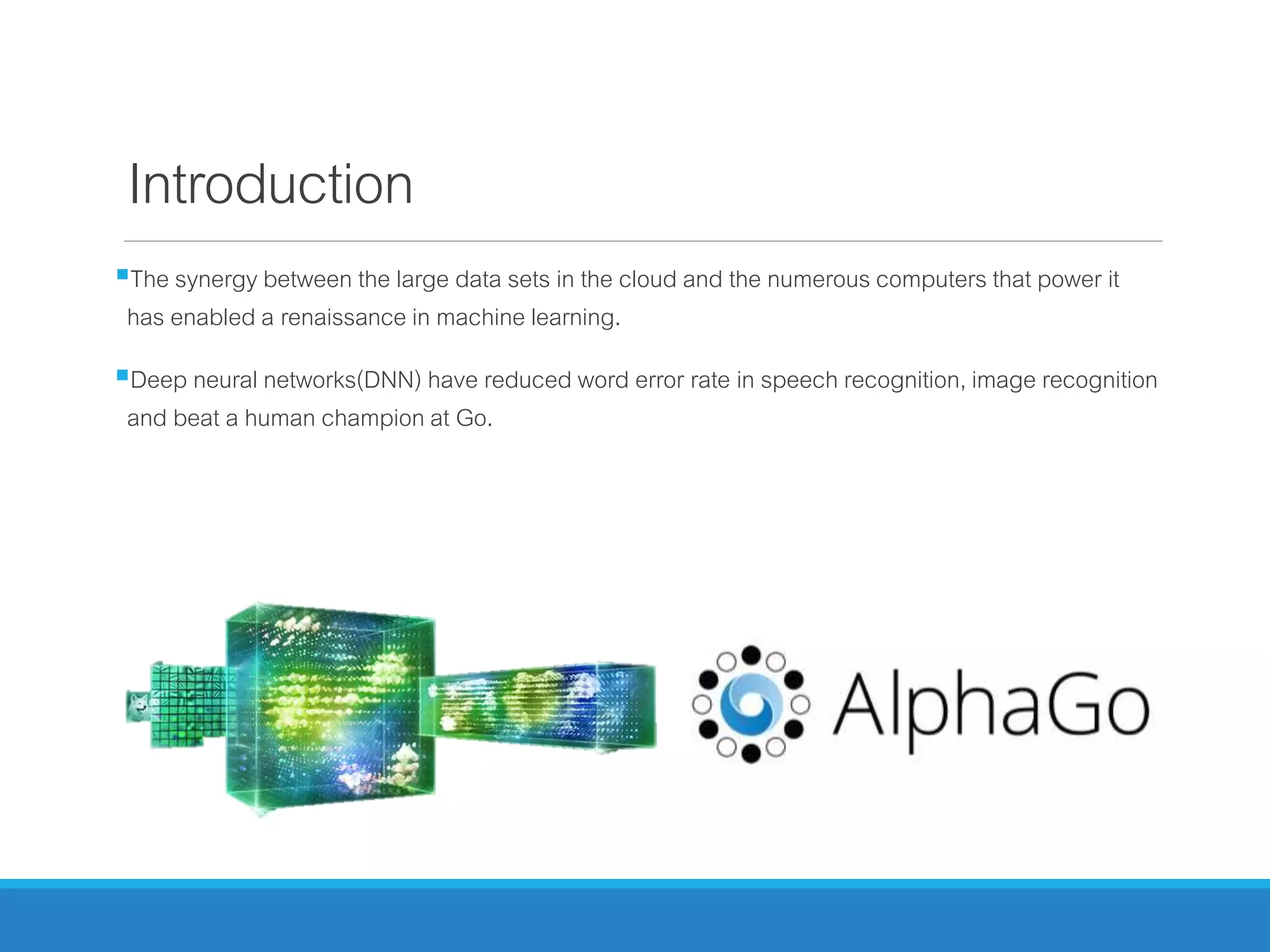
The synergy between the large data sets in the cloud and the numerous computers that power it
has enabled a renaissance in machine learning.
Deep neural networks(DNN) have reduced word error rate in speech recognition, image recognition
and beat a human champion at Go.
Introduction
The “deep” part of DNN comes from going beyond a few layers and virtually all training today is in
floating point, which is one reason GPUs have been so popular.
Quantization transforms FP numbers into integers (often 8-bit) which are usually good enough for
prediction (inference).
8-bit integer multiplies can be 6X less energy and area than 16-bit FP multiplies.
Integer addition can be 13X less energy and 38X less area than 16-bit FP additions.
TPU in this paper doesn’t support training.
 TPU2 supports it.
NNsAre PopularToday
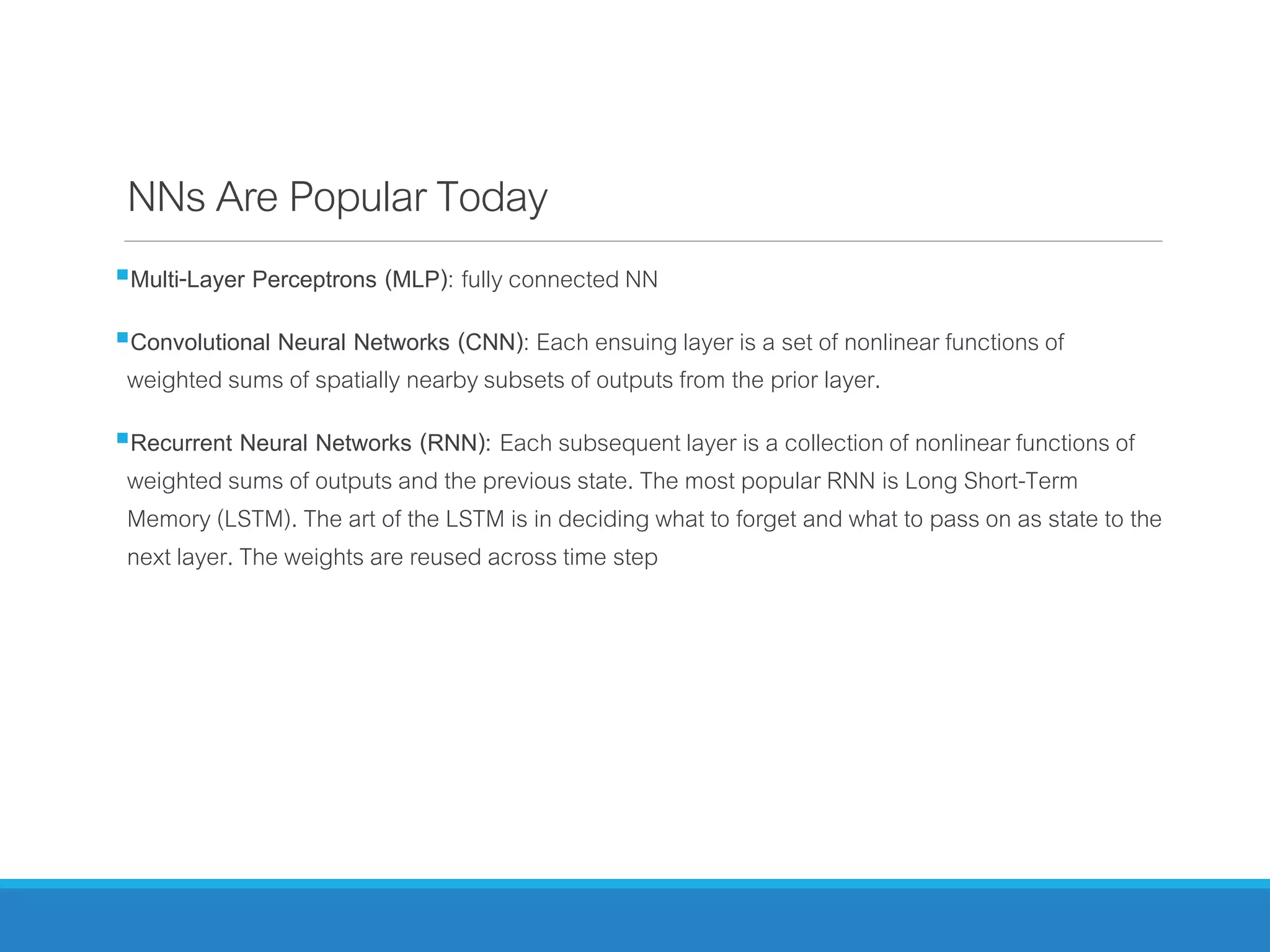
Multi-Layer Perceptrons (MLP): fully connected NN
Convolutional Neural Networks (CNN): Each ensuing layer is a set of nonlinear functions of
weighted sums of spatially nearby subsets of outputs from the prior layer.
Recurrent Neural Networks (RNN): Each subsequent layer is a collection of nonlinear functions of
weighted sums of outputs and the previous state. The most popular RNN is Long Short-Term
Memory (LSTM). The art of the LSTM is in deciding what to forget and what to pass on as state to the
next layer. The weights are reused across time step
Main Purpose
Training
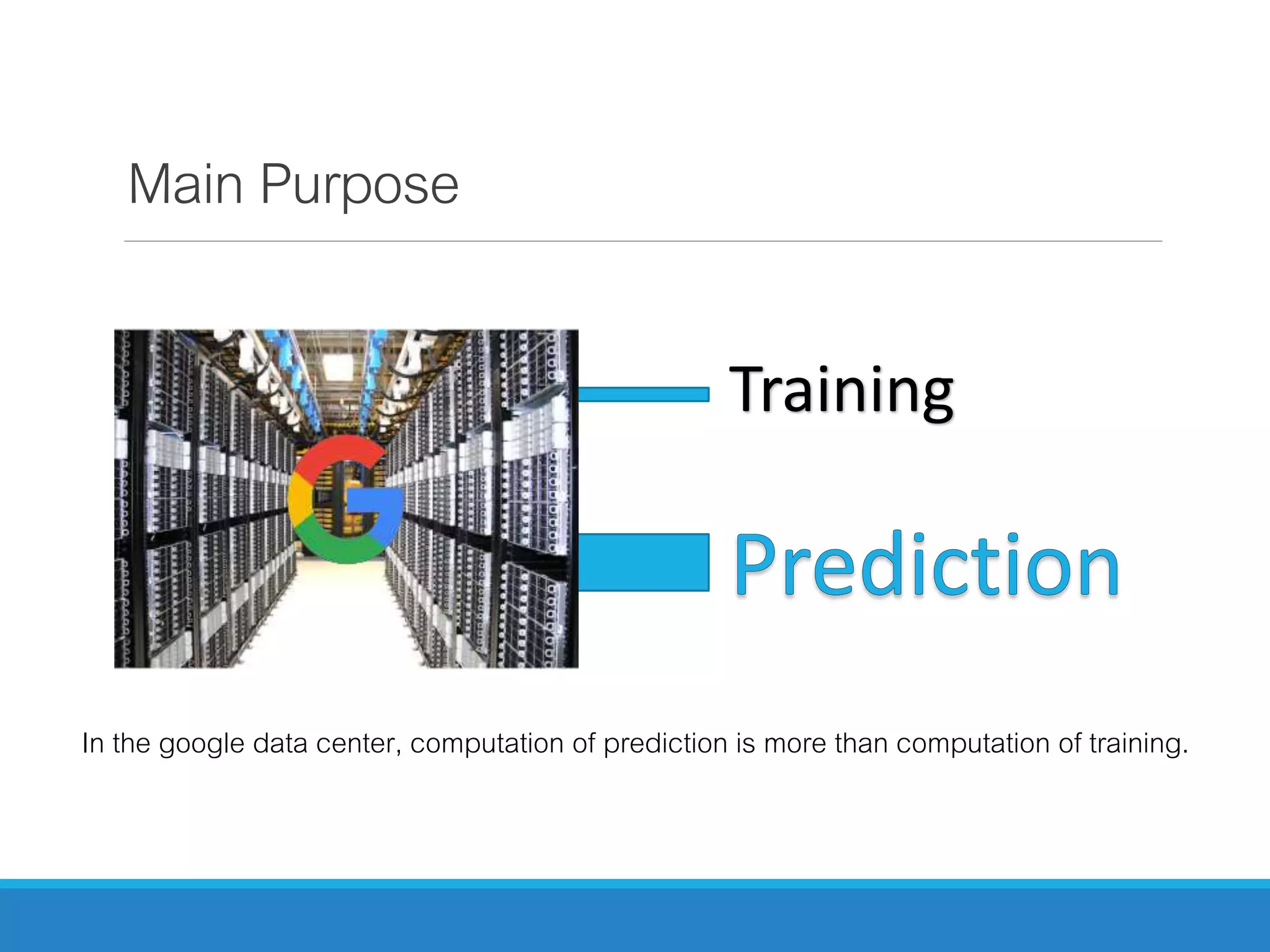
In the google data center, computation of prediction is more than computation of training.
Prediction
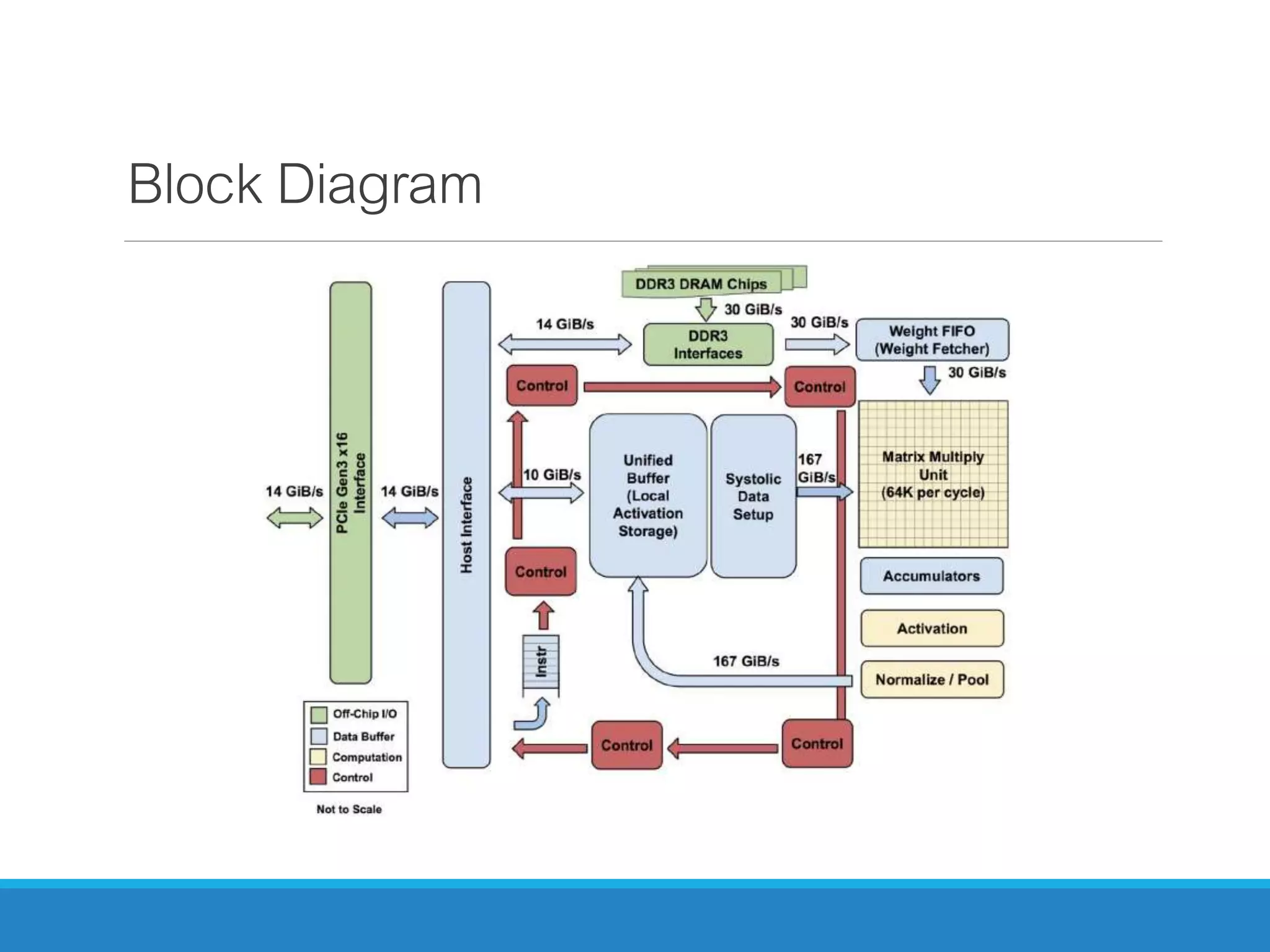
Block Diagram
Architecture
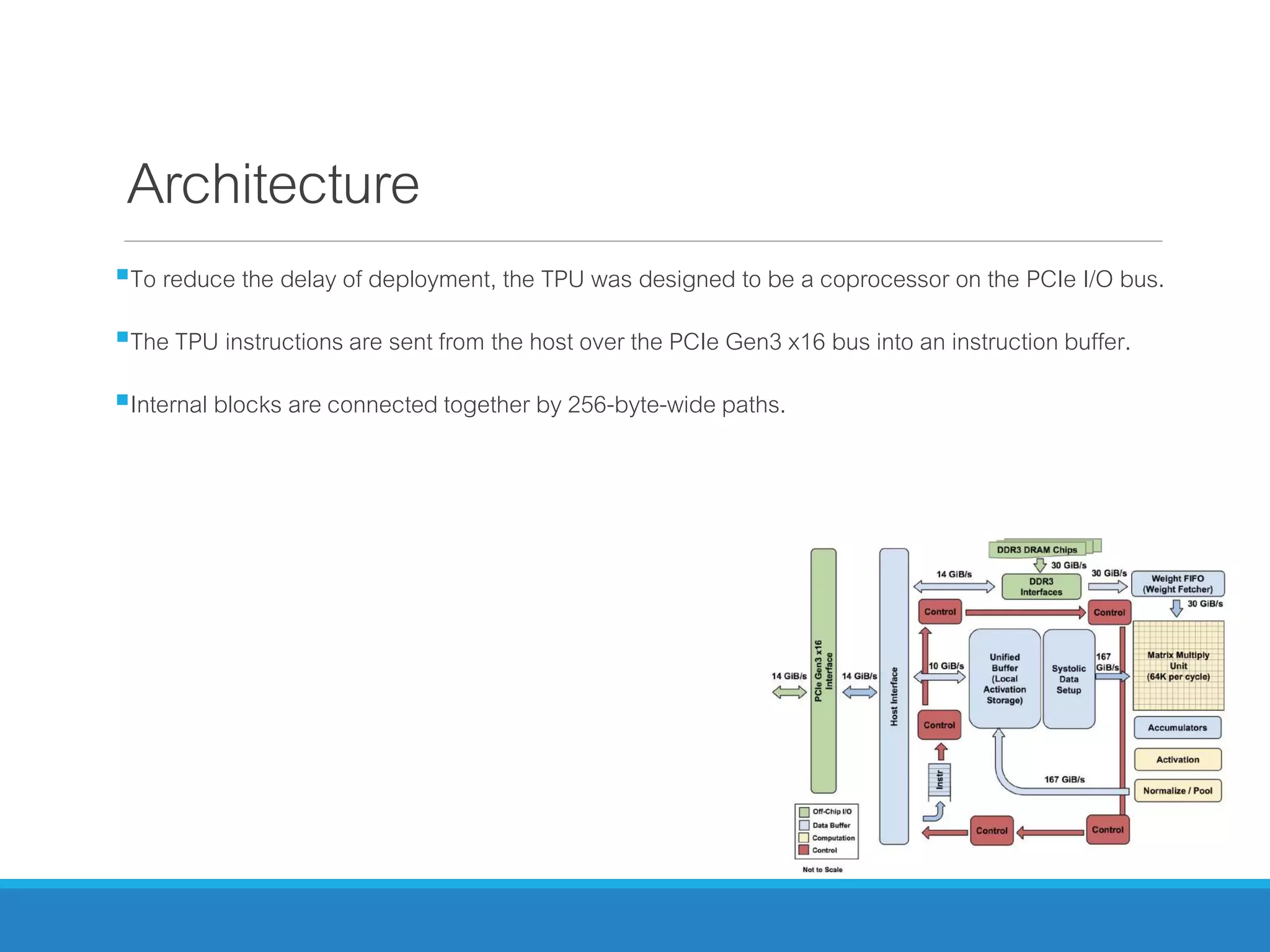
To reduce the delay of deployment, the TPU was designed to be a coprocessor on the PCIe I/O bus.
The TPU instructions are sent from the host over the PCIe Gen3 x16 bus into an instruction buffer.
Internal blocks are connected together by 256-byte-wide paths.
MMU
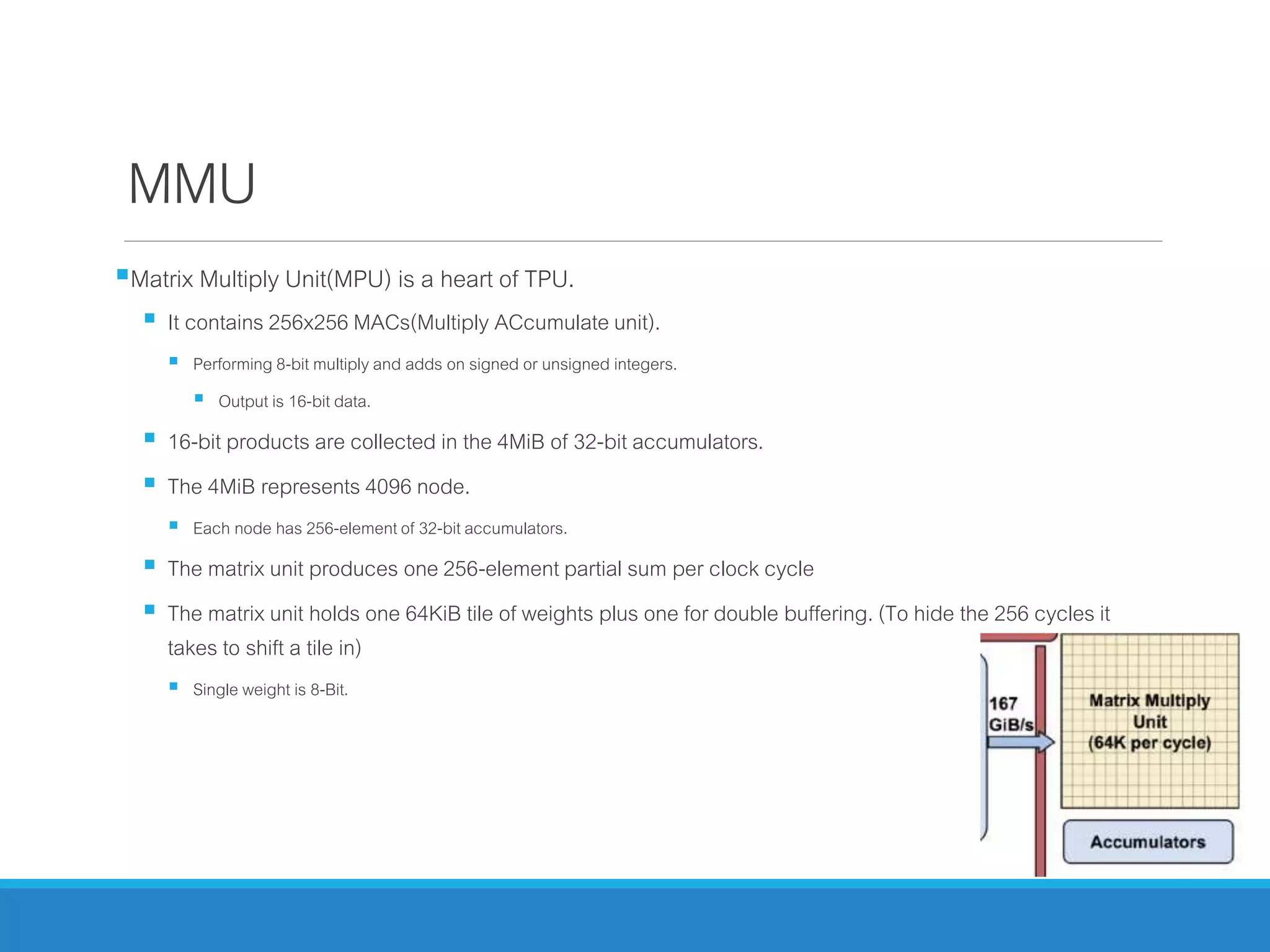
Matrix Multiply Unit(MPU) is a heart of TPU.
 It contains 256x256 MACs(Multiply ACcumulate unit).
 Performing 8-bit multiply and adds on signed or unsigned integers.
 Output is 16-bit data.
 16-bit products are collected in the 4MiB of 32-bit accumulators.
 The 4MiB represents 4096 node.
 Each node has 256-elementof 32-bit accumulators.
 The matrix unit produces one 256-element partial sum per clock cycle
 The matrix unit holds one 64KiB tile of weights plus one for double buffering. (To hide the 256 cycles it
takes to shift a tile in)
 Single weight is 8-Bit.
Memory and Buffer
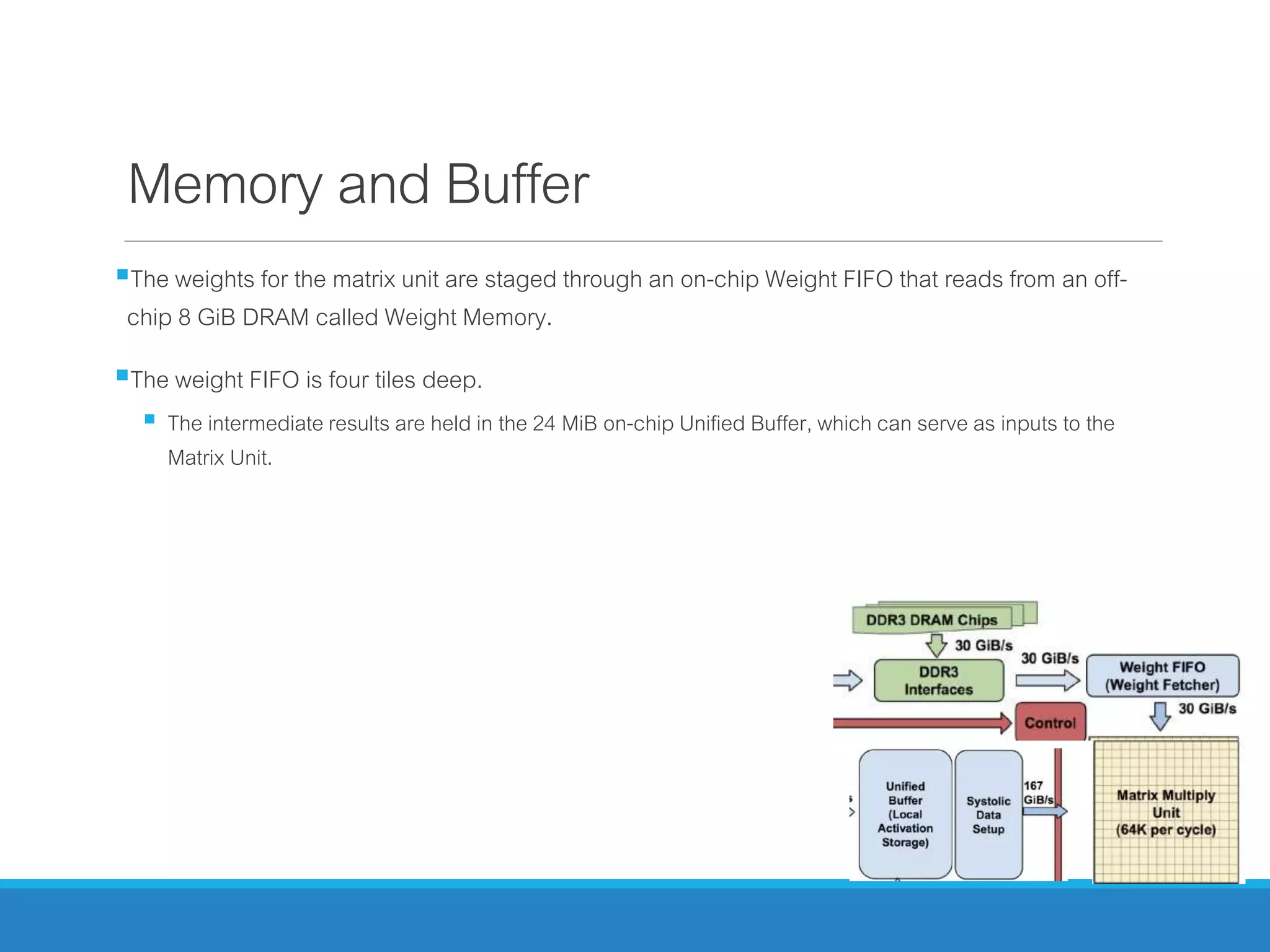
The weights for the matrix unit are staged through an on-chip Weight FIFO that reads from an off-
chip 8 GiB DRAM called Weight Memory.
The weight FIFO is four tiles deep.
 The intermediate results are held in the 24 MiB on-chip Unified Buffer, which can serve as inputs to the
Matrix Unit.
Architecture (cont.)
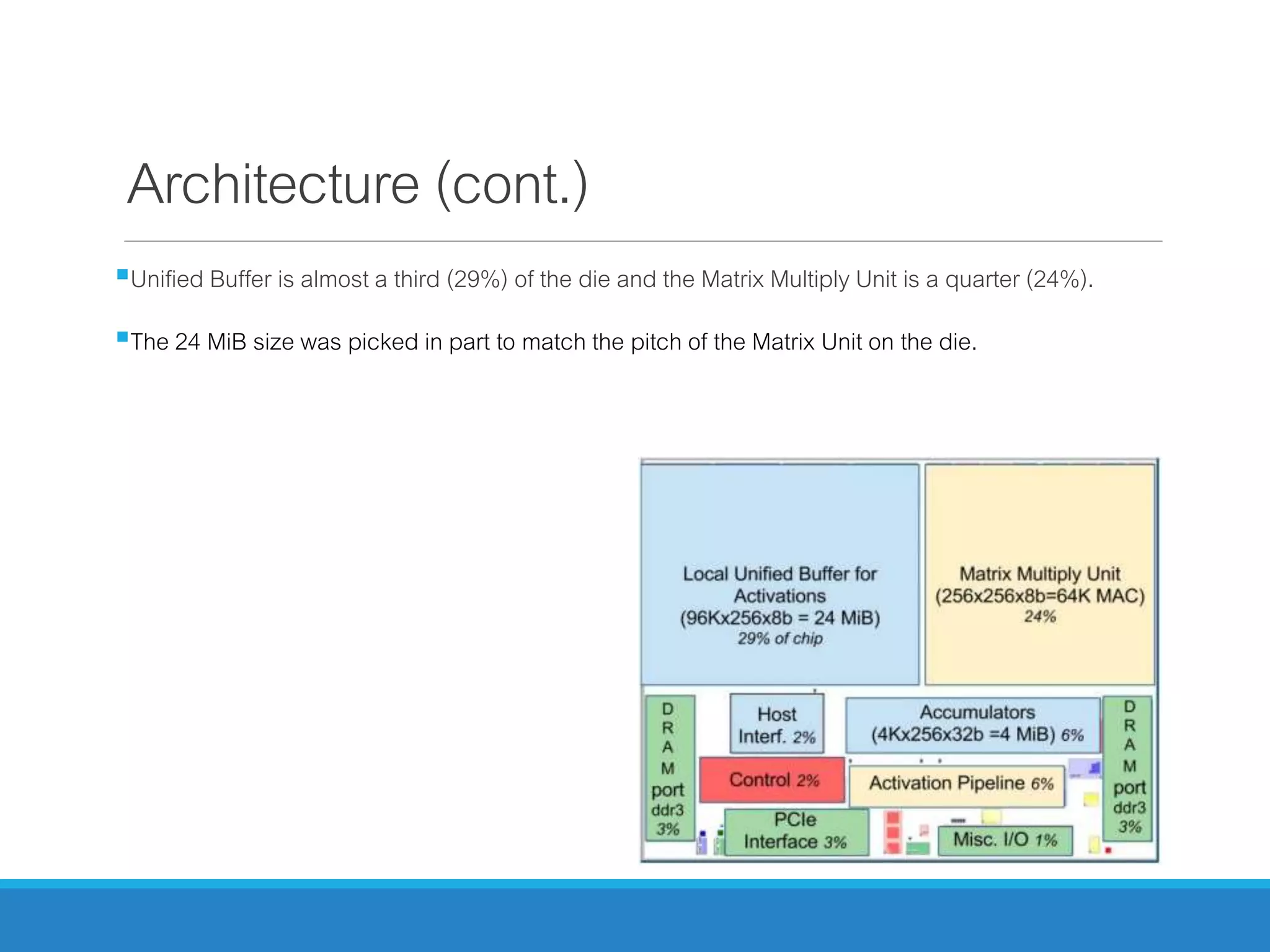
Unified Buffer is almost a third (29%) of the die and the Matrix Multiply Unit is a quarter (24%).
The 24 MiB size was picked in part to match the pitch of the Matrix Unit on the die.
Architecture (cont.)
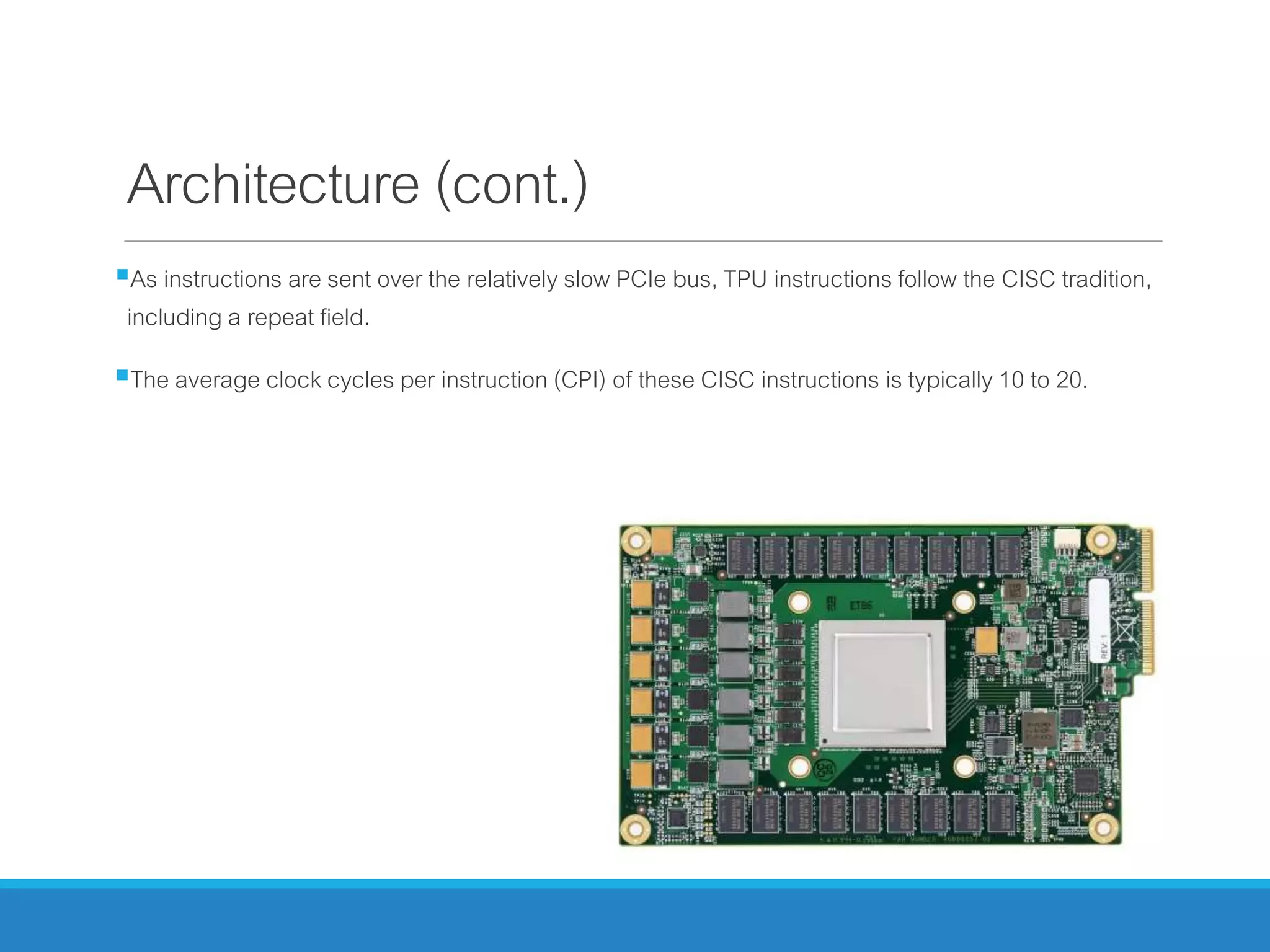
As instructions are sent over the relatively slow PCIe bus, TPU instructions follow the CISC tradition,
including a repeat field.
The average clock cycles per instruction (CPI) of these CISC instructions is typically 10 to 20.
TPU Execution Stage
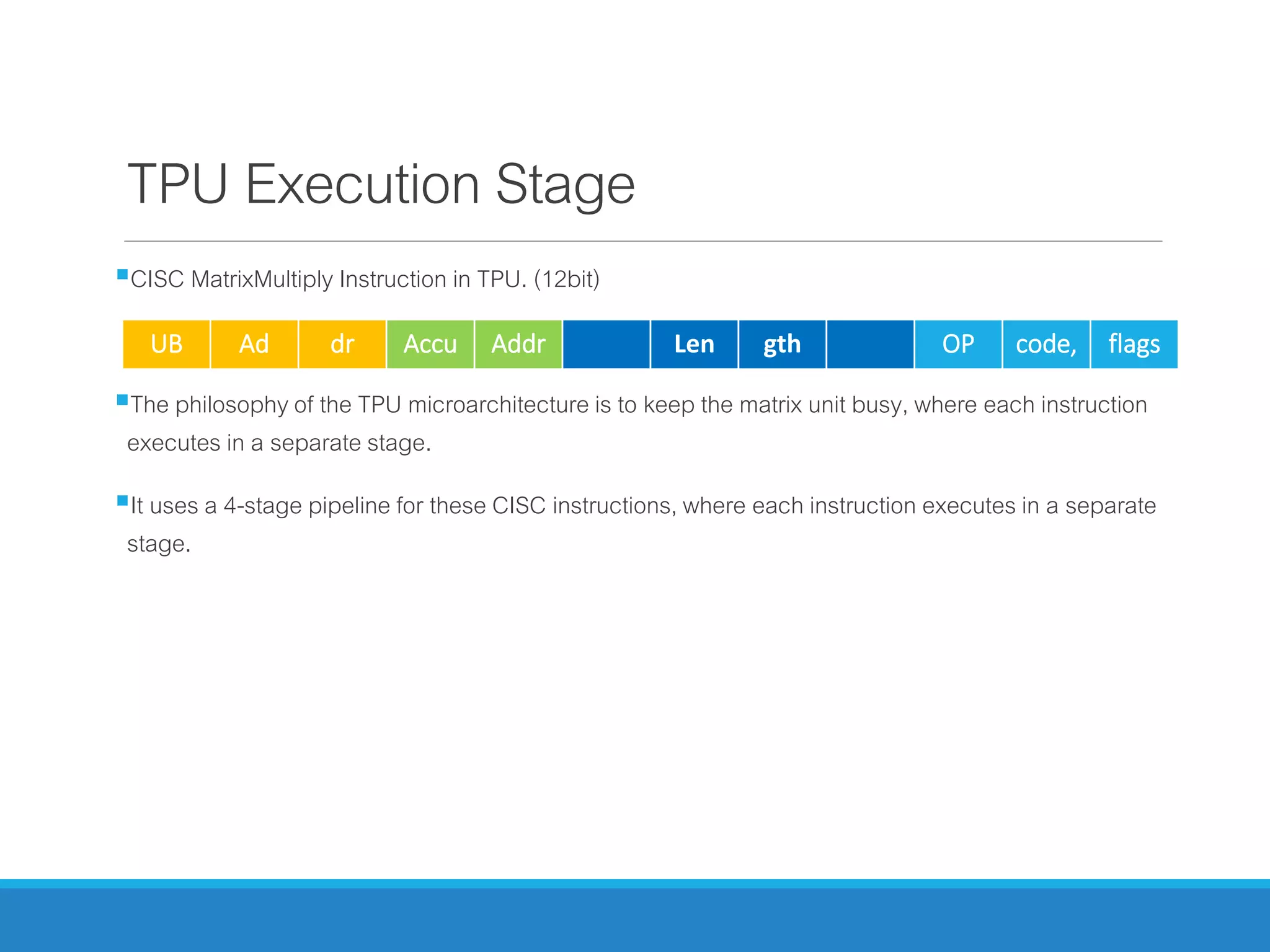
CISC MatrixMultiply Instruction in TPU. (12bit)
The philosophy of the TPU microarchitecture is to keep the matrix unit busy, where each instruction
executes in a separate stage.
It uses a 4-stage pipeline for these CISC instructions, where each instruction executes in a separate
stage.
UB Ad dr Accu Addr Len gth OP code, flags
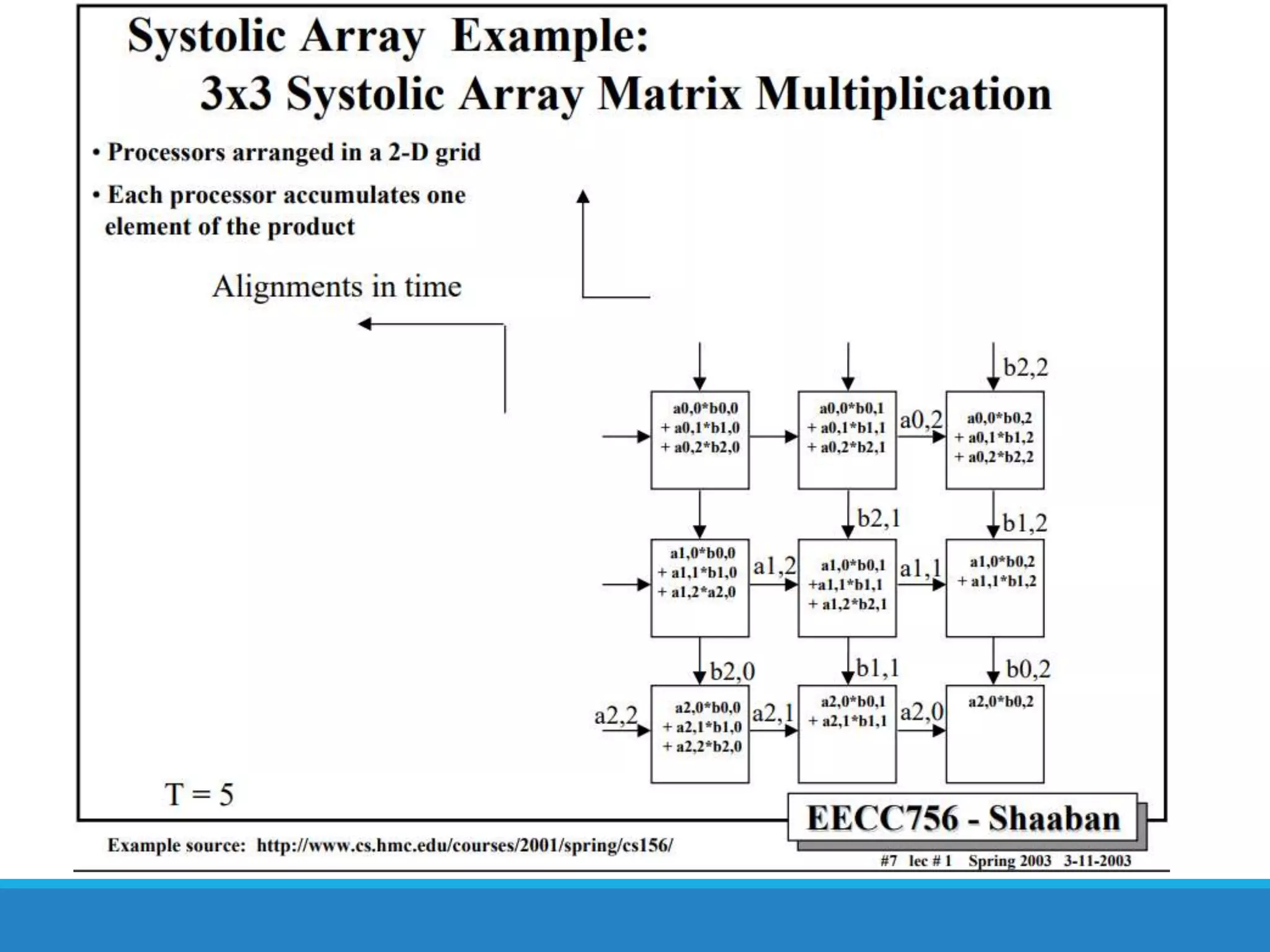
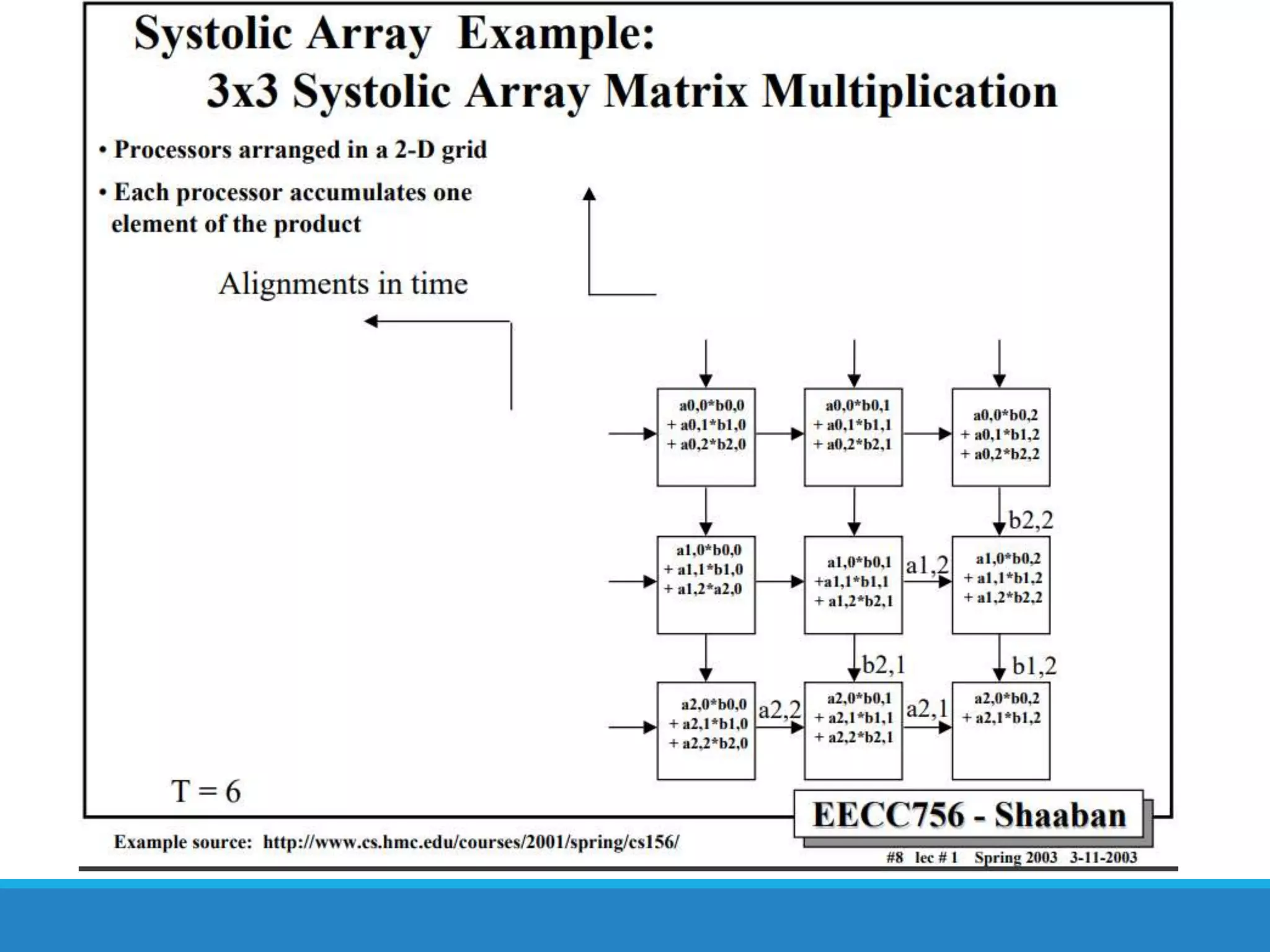
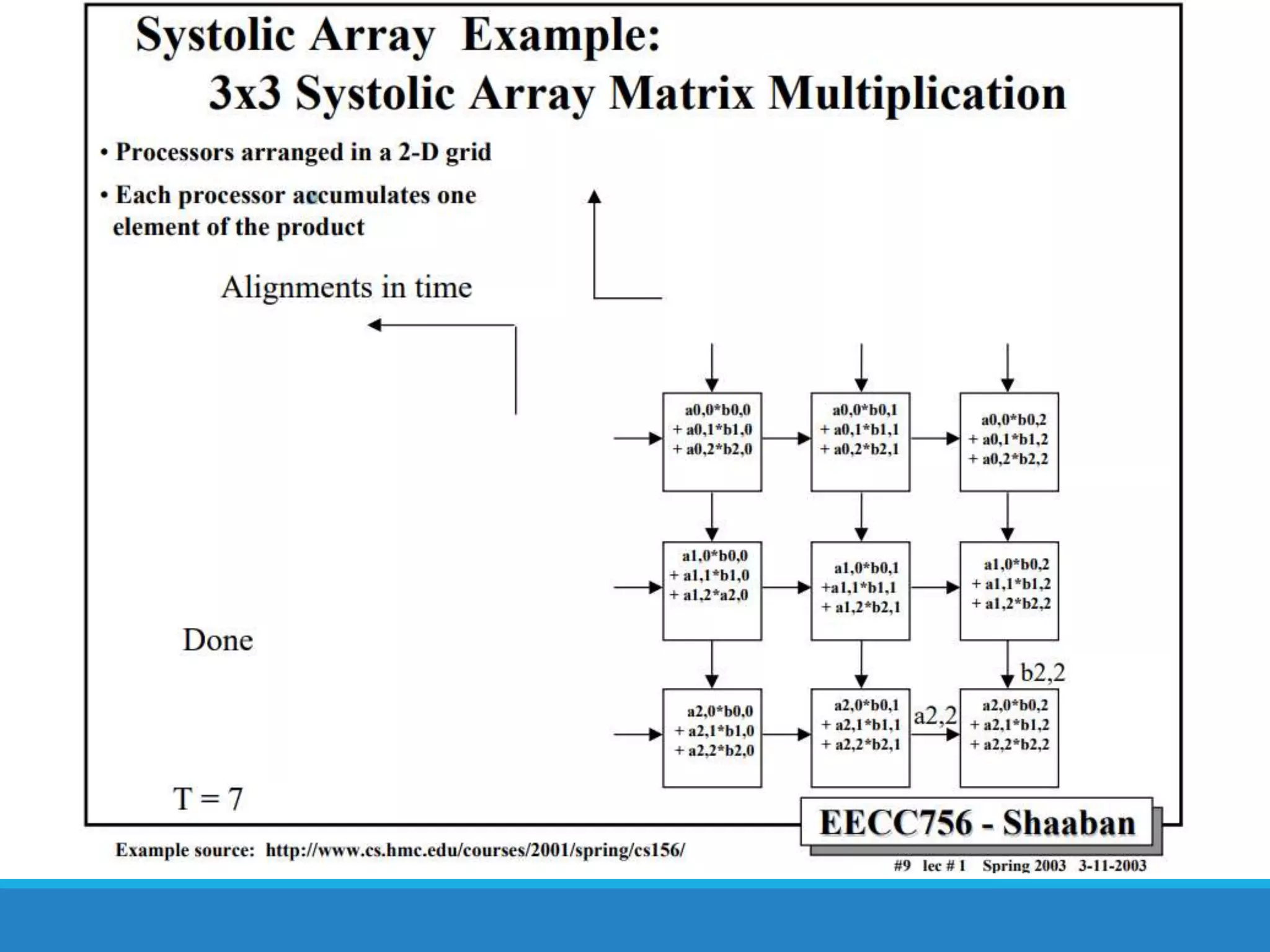
Systolic Array (Fundamental)
Systolic Array
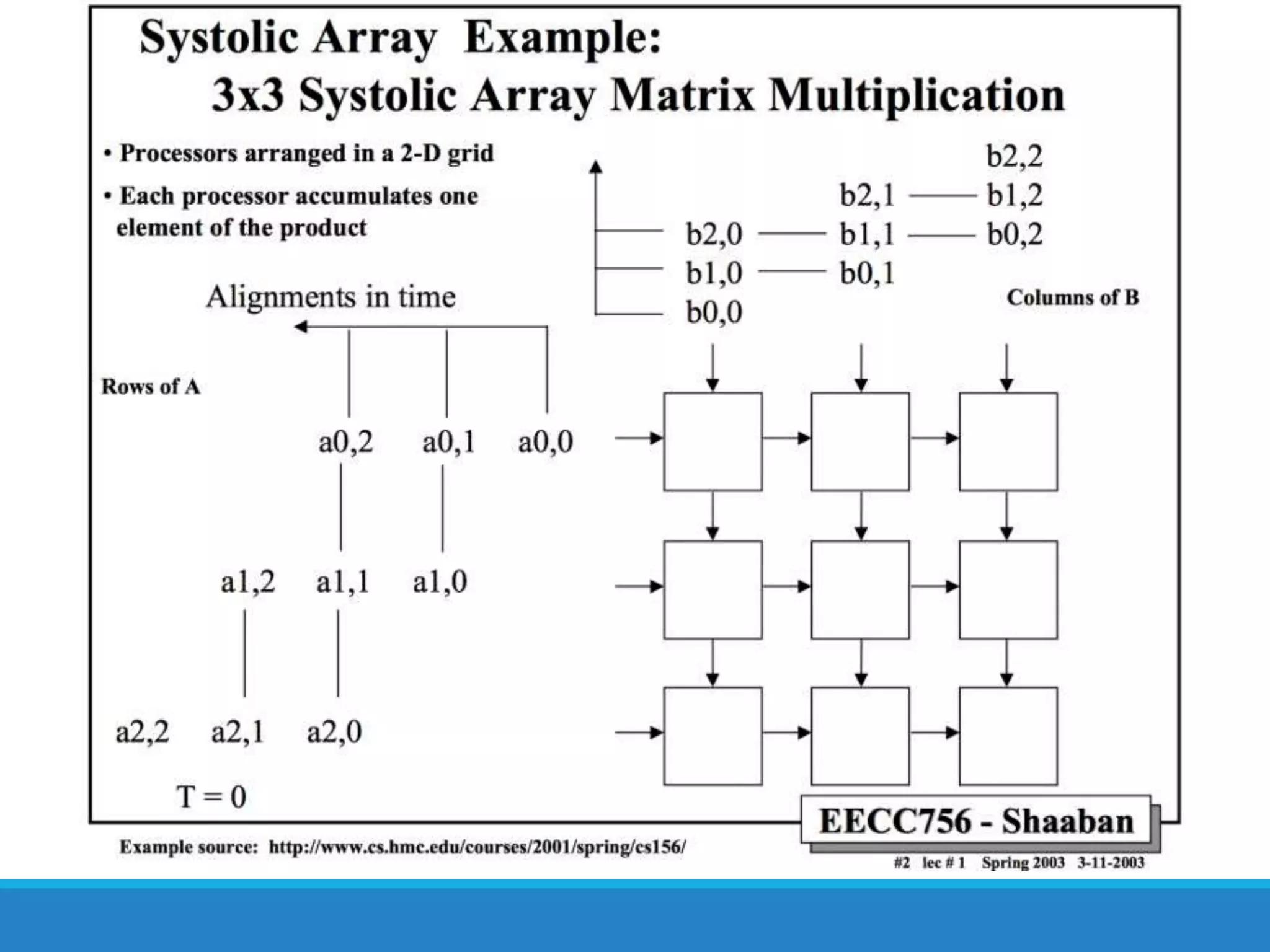
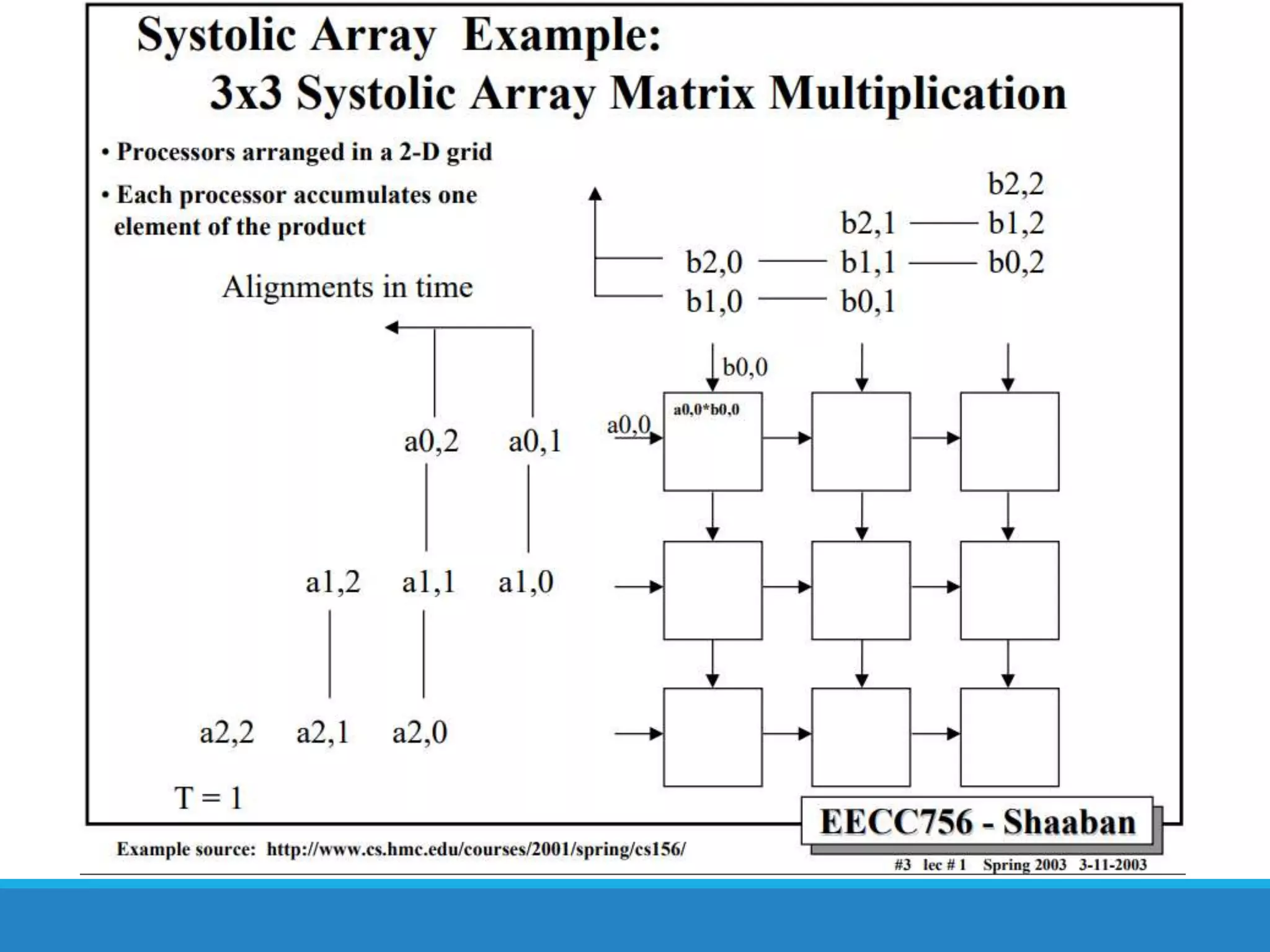
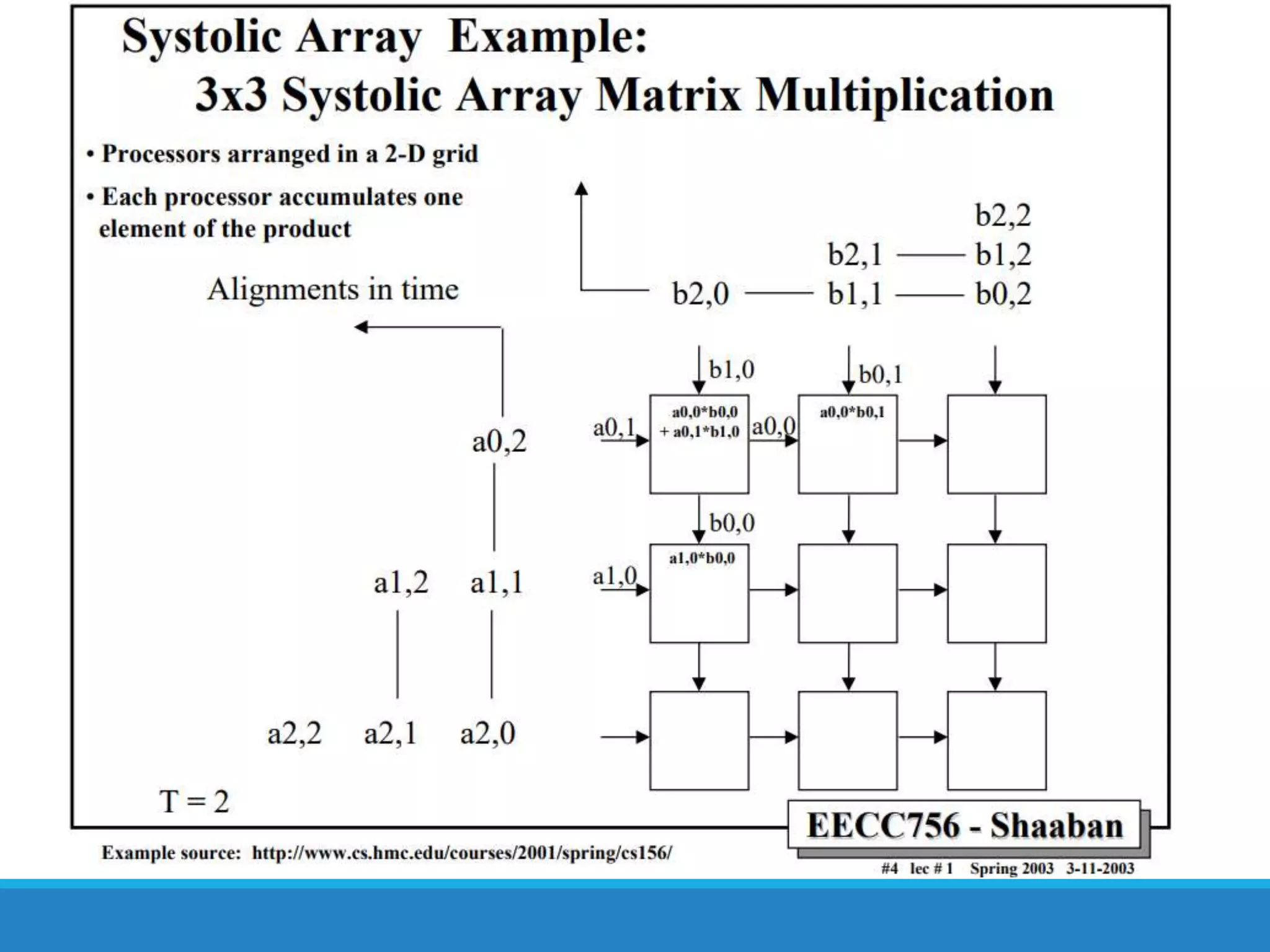
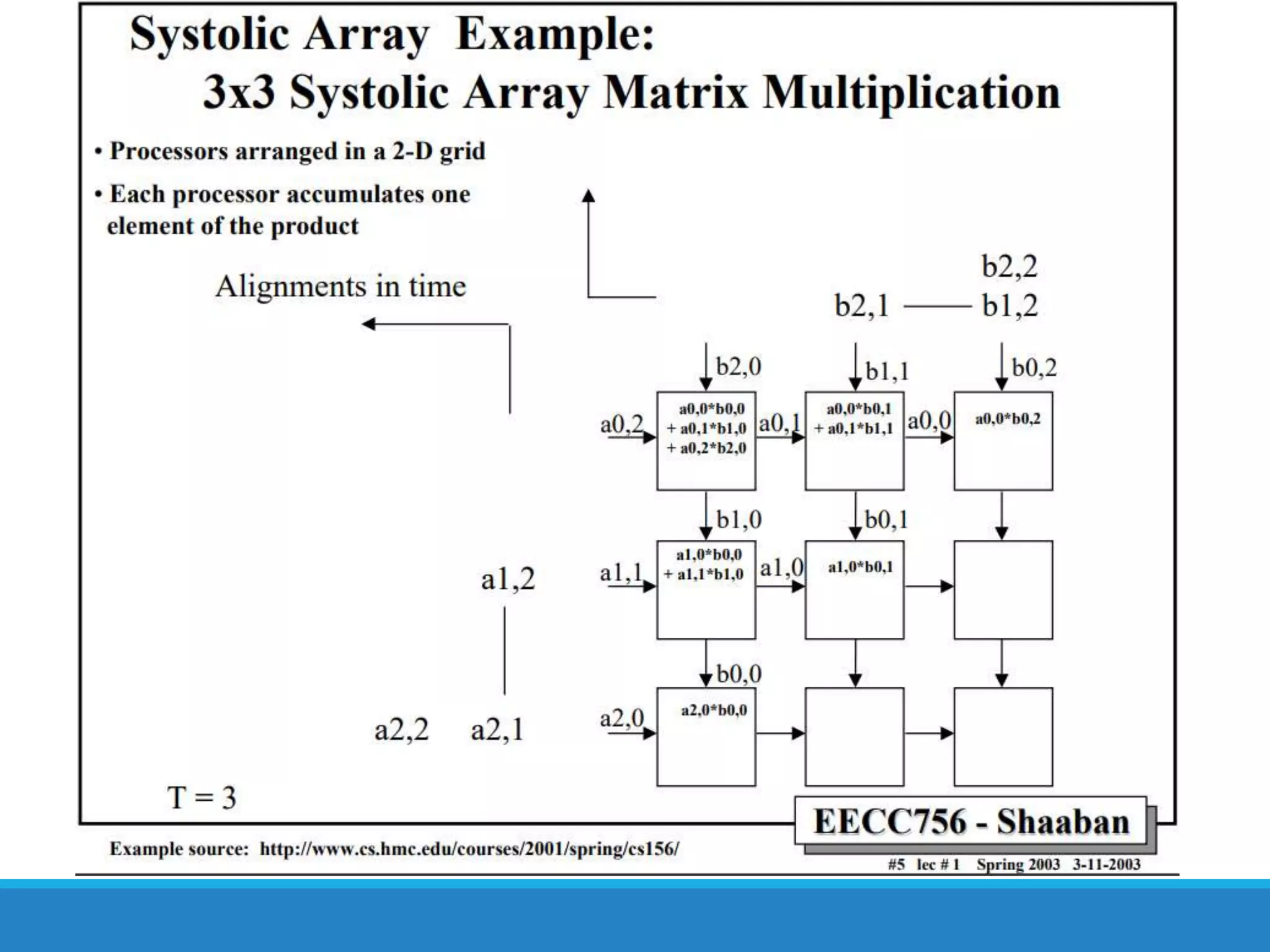
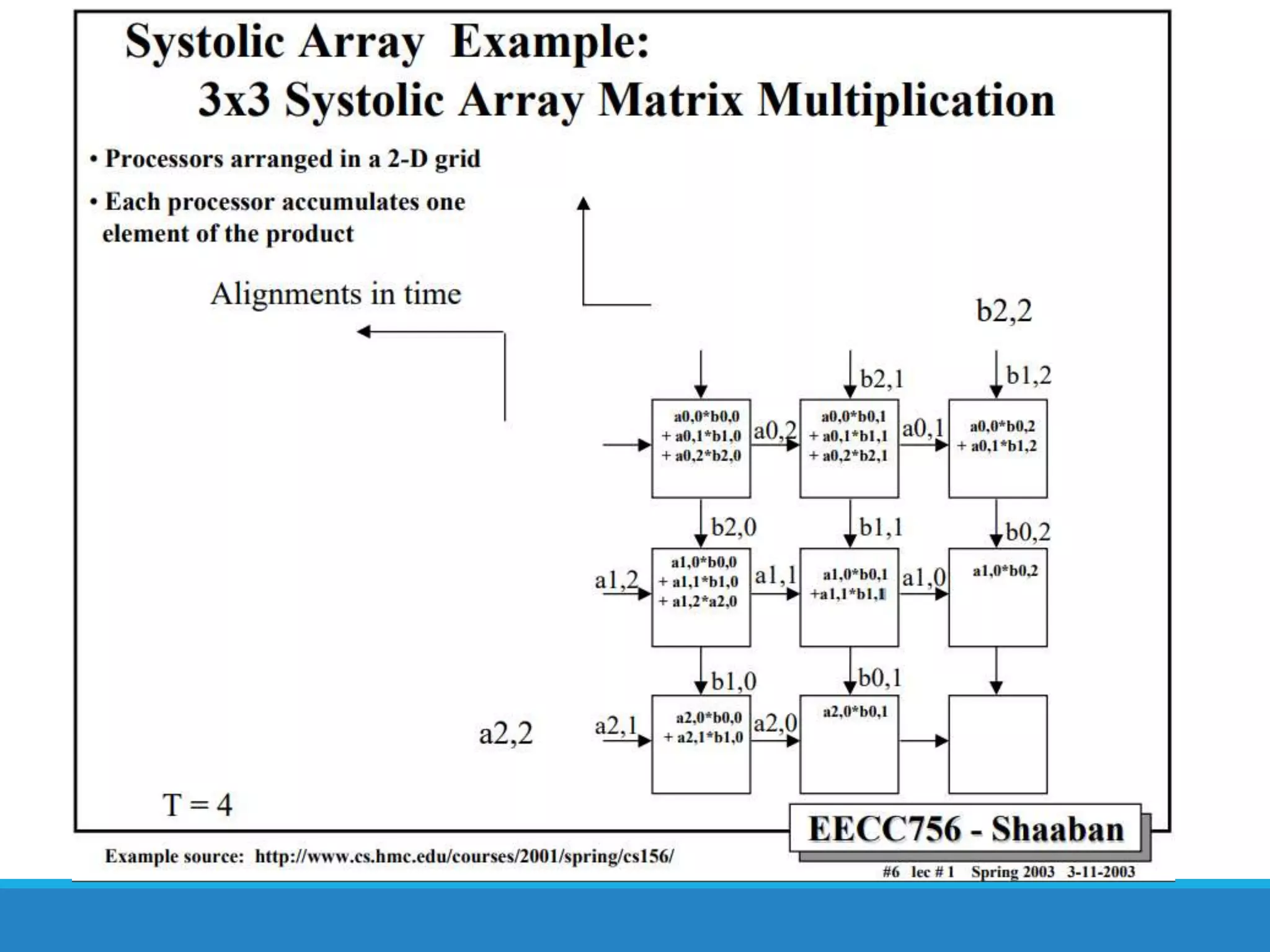
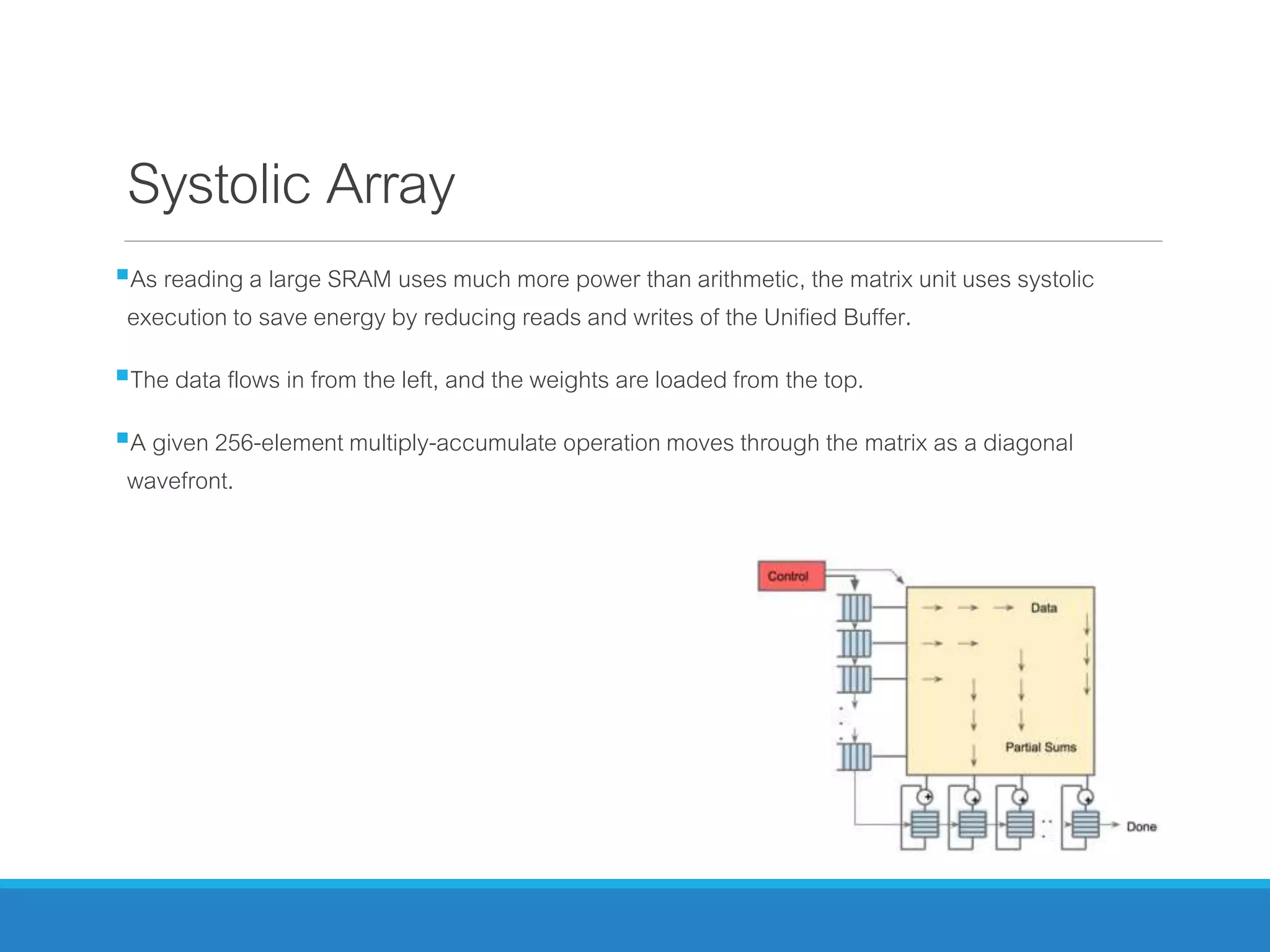
As reading a large SRAM uses much more power than arithmetic, the matrix unit uses systolic
execution to save energy by reducing reads and writes of the Unified Buffer.
The data flows in from the left, and the weights are loaded from the top.
A given 256-element multiply-accumulate operation moves through the matrix as a diagonal
wavefront.
Software
The TPU software stack had to be compatible with those developed for CPUs and GPUs so that
applications could be ported quickly to the TPU.
The portion of the application run on the TPU is typically written in TensorFlow and is compiled into
an API that can run on GPUs or TPUs.
In TensorFlow 1.3, operations and bindings for the cloud TPU are included.
Key Instruction Set
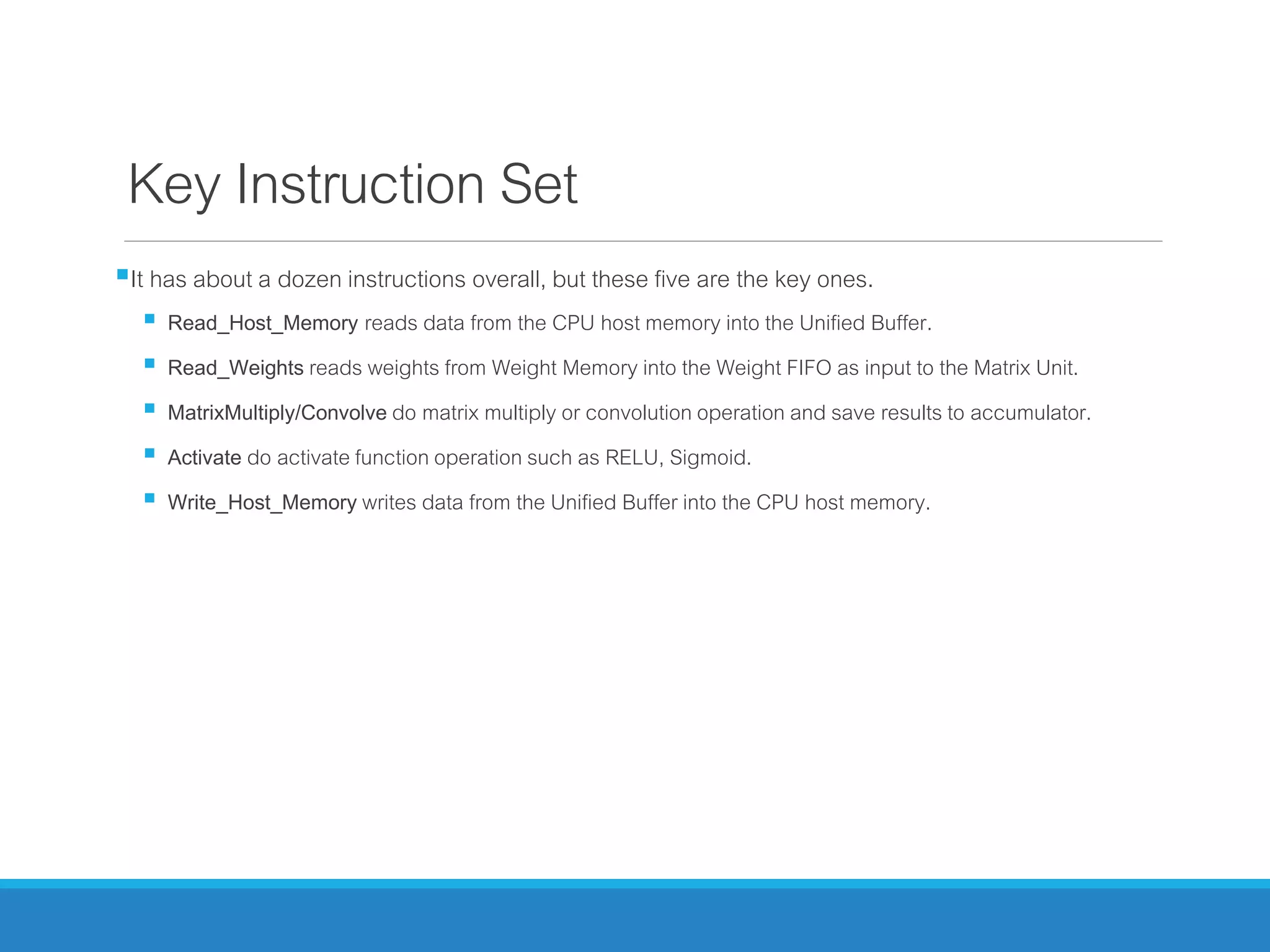
It has about a dozen instructions overall, but these five are the key ones.
 Read_Host_Memory reads data from the CPU host memory into the Unified Buffer.
 Read_Weights reads weights from Weight Memory into the Weight FIFO as input to the Matrix Unit.
 MatrixMultiply/Convolve do matrix multiply or convolution operation and save results to accumulator.
 Activate do activate function operation such as RELU, Sigmoid.
 Write_Host_Memory writes data from the Unified Buffer into the CPU host memory.
NN Structure and H/W
Performance
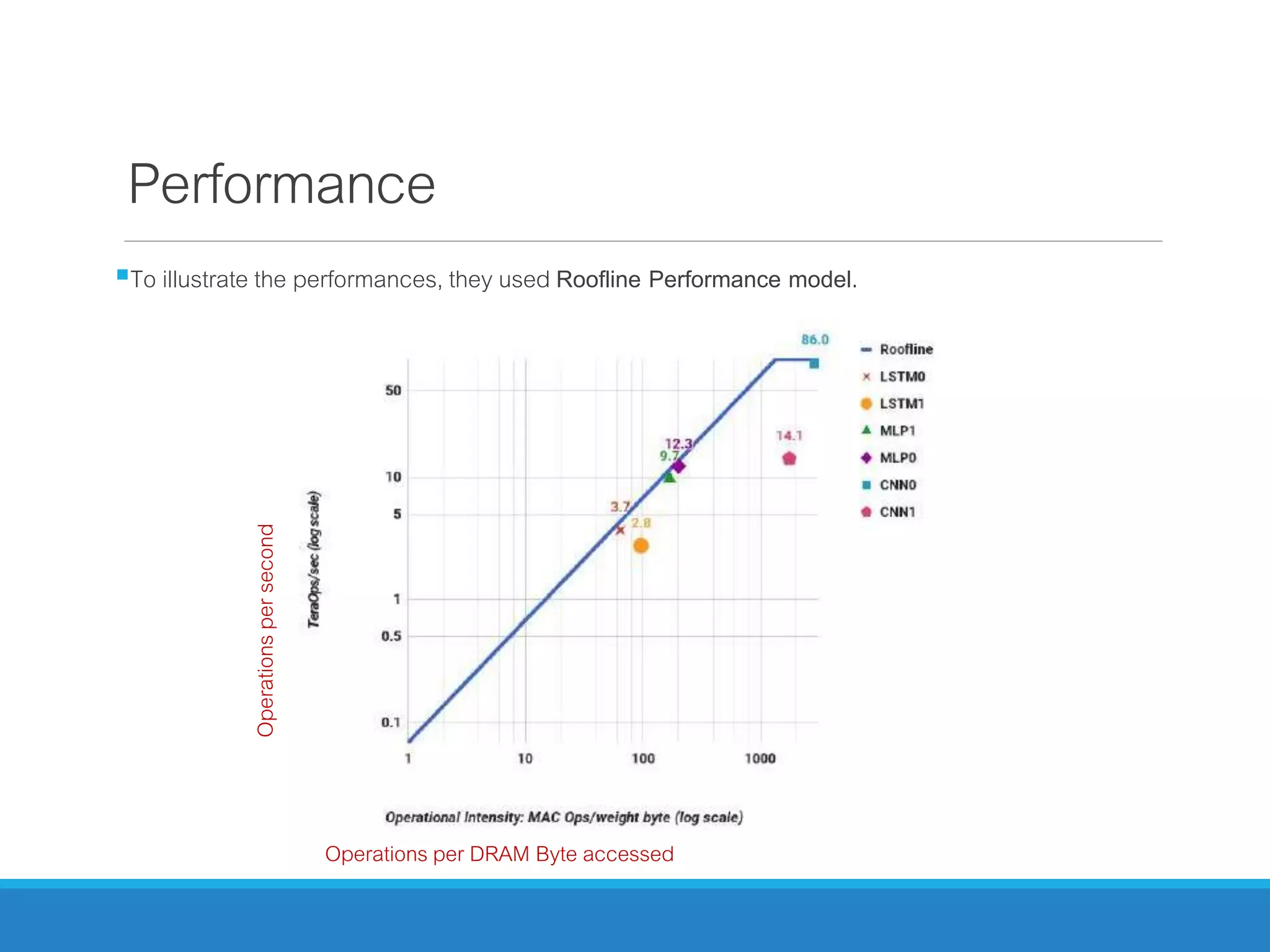
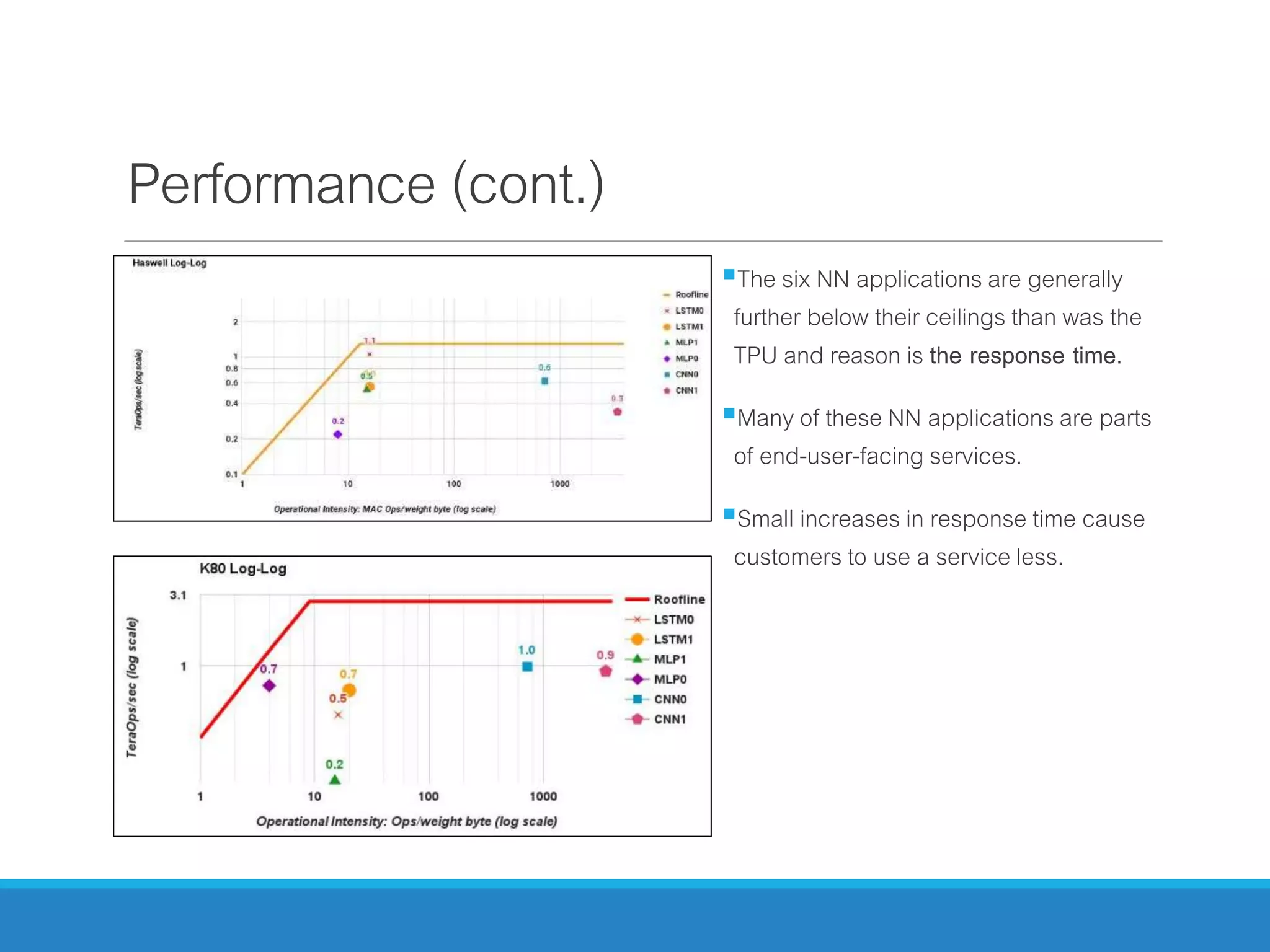
To illustrate the performances, they used Roofline Performance model.Operationspersecond
Operations per DRAM Byte accessed
Performance (cont.)
The six NN applications are generally
further below their ceilings than was the
TPU and reason is the response time.
Many of these NN applications are parts
of end-user-facing services.
Small increases in response time cause
customers to use a service less.
Performance (cont.)
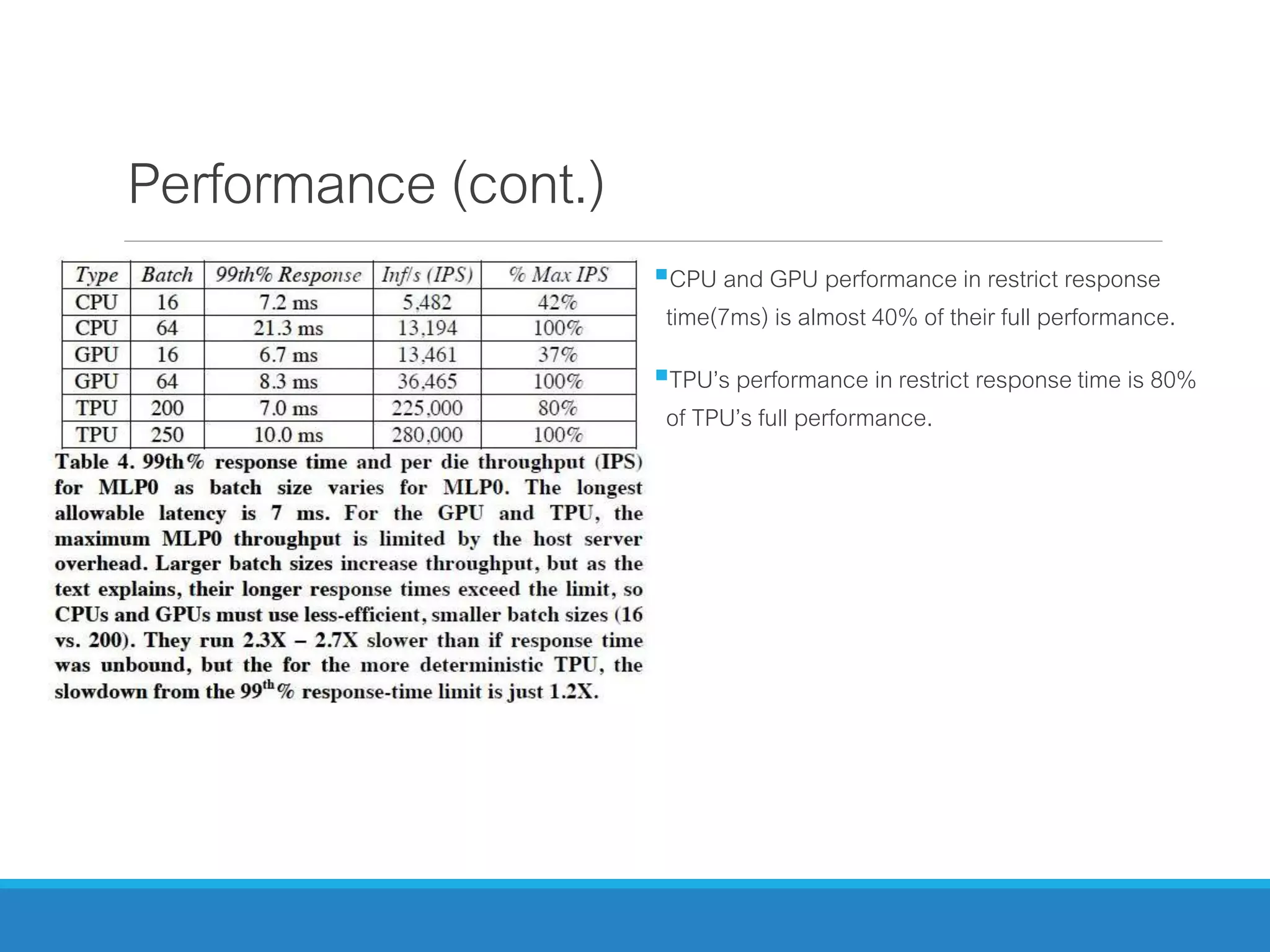
CPU and GPU performance in restrict response
time(7ms) is almost 40% of their full performance.
TPU’s performance in restrict response time is 80%
of TPU’s full performance.
Performance (cont.)
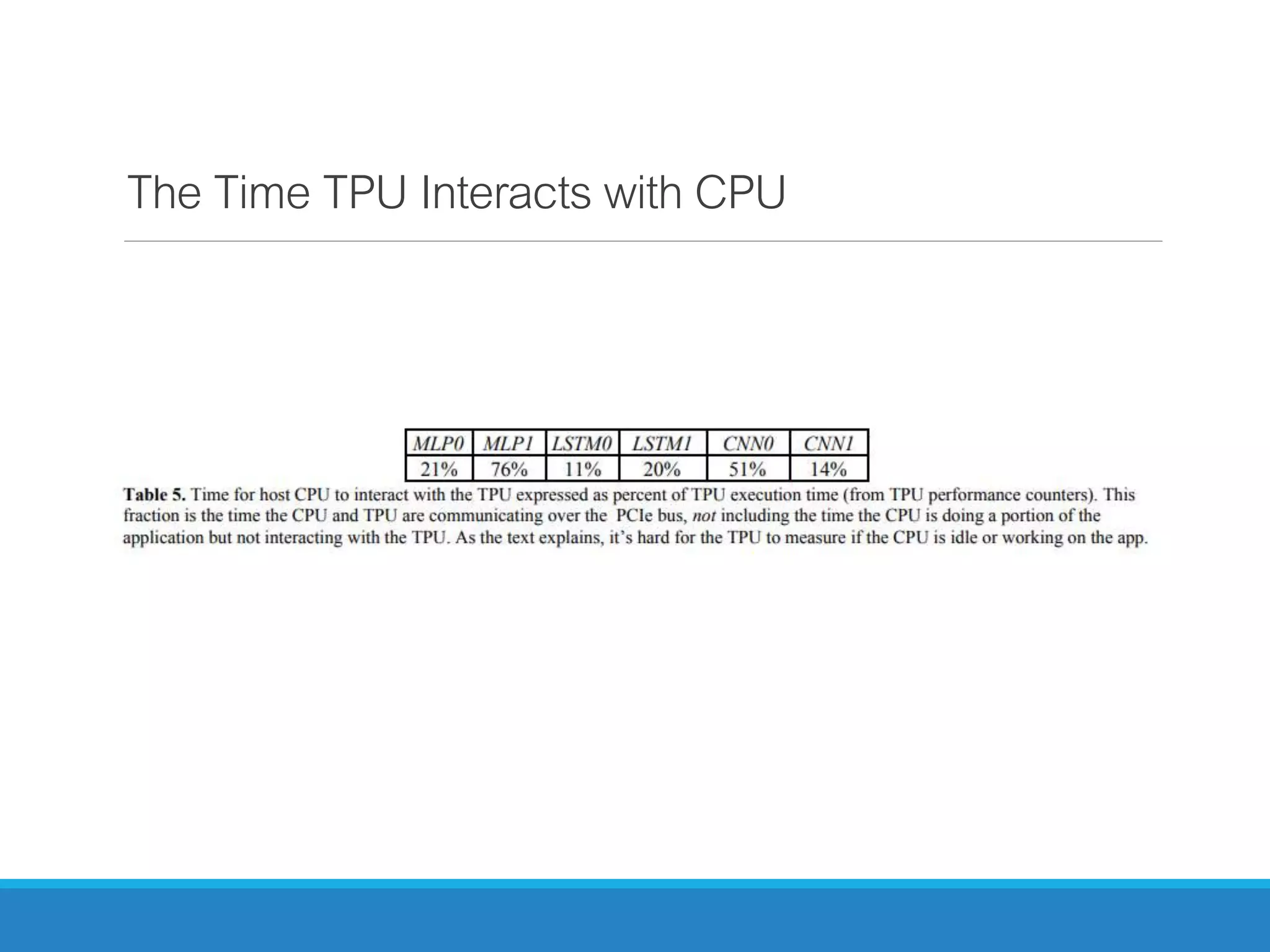
The Time TPU Interacts with CPU
Performance (cont.)
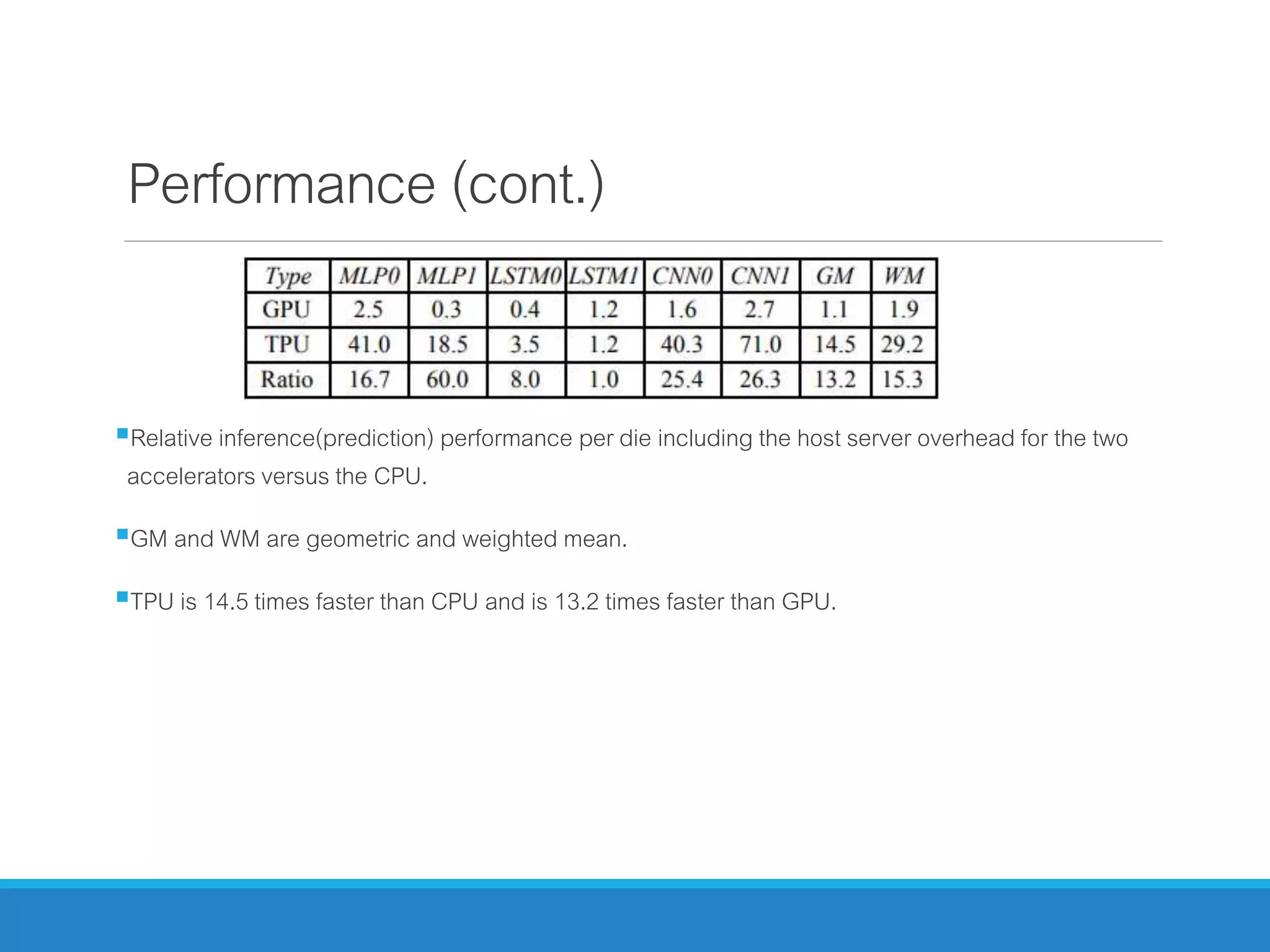
Relative inference(prediction) performance per die including the host server overhead for the two
accelerators versus the CPU.
GM and WM are geometric and weighted mean.
TPU is 14.5 times faster than CPU and is 13.2 times faster than GPU.
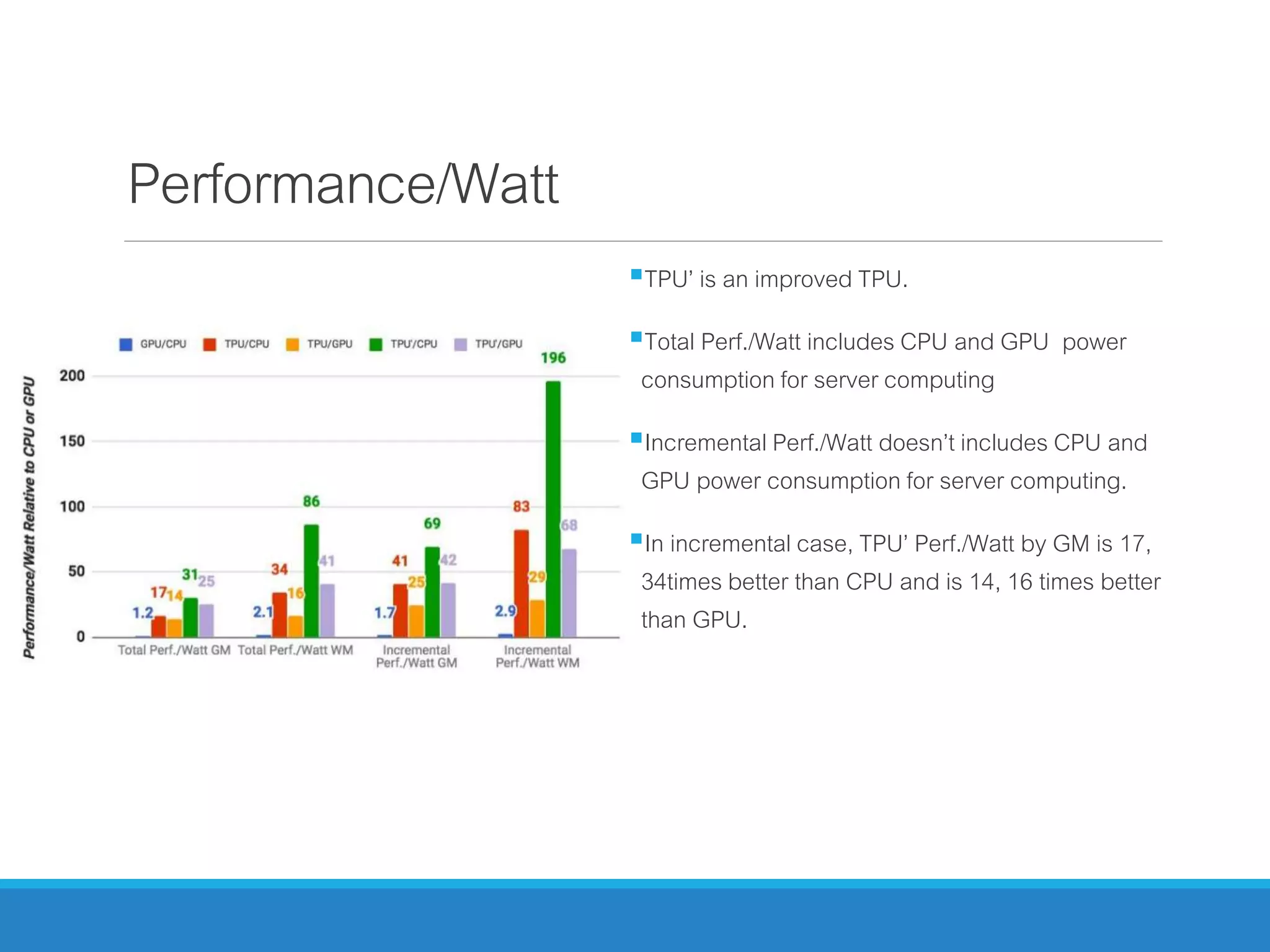
Performance/Watt
TPU’ is an improved TPU.
Total Perf./Watt includes CPU and GPU power
consumption for server computing
Incremental Perf./Watt doesn’t includes CPU and
GPU power consumption for server computing.
In incremental case, TPU’ Perf./Watt by GM is 17,
34times better than CPU and is 14, 16 times better
than GPU.
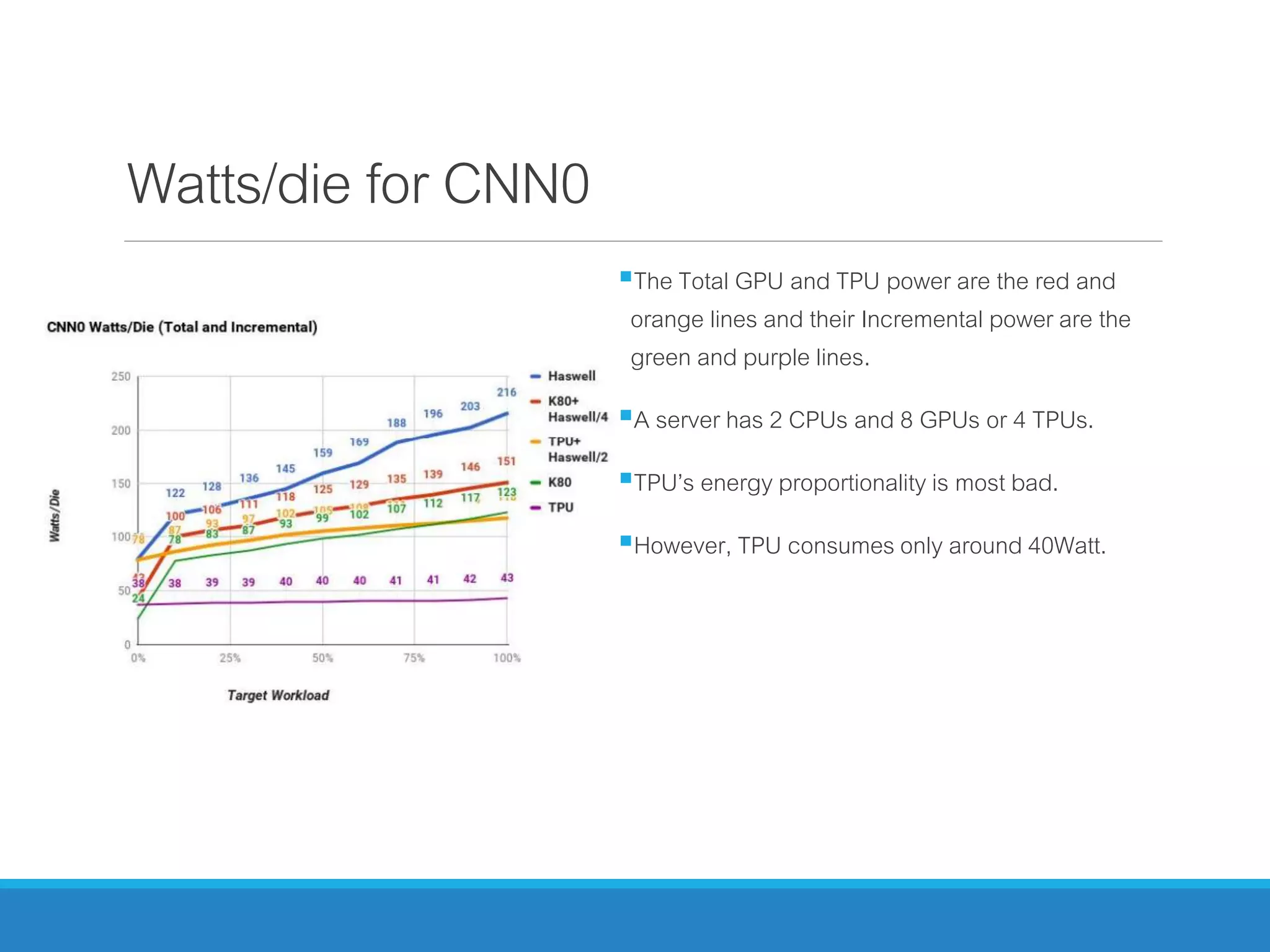
Watts/die for CNN0
The Total GPU and TPU power are the red and
orange lines and their Incremental power are the
green and purple lines.
A server has 2 CPUs and 8 GPUs or 4 TPUs.
TPU’s energy proportionality is most bad.
However, TPU consumes only around 40Watt.
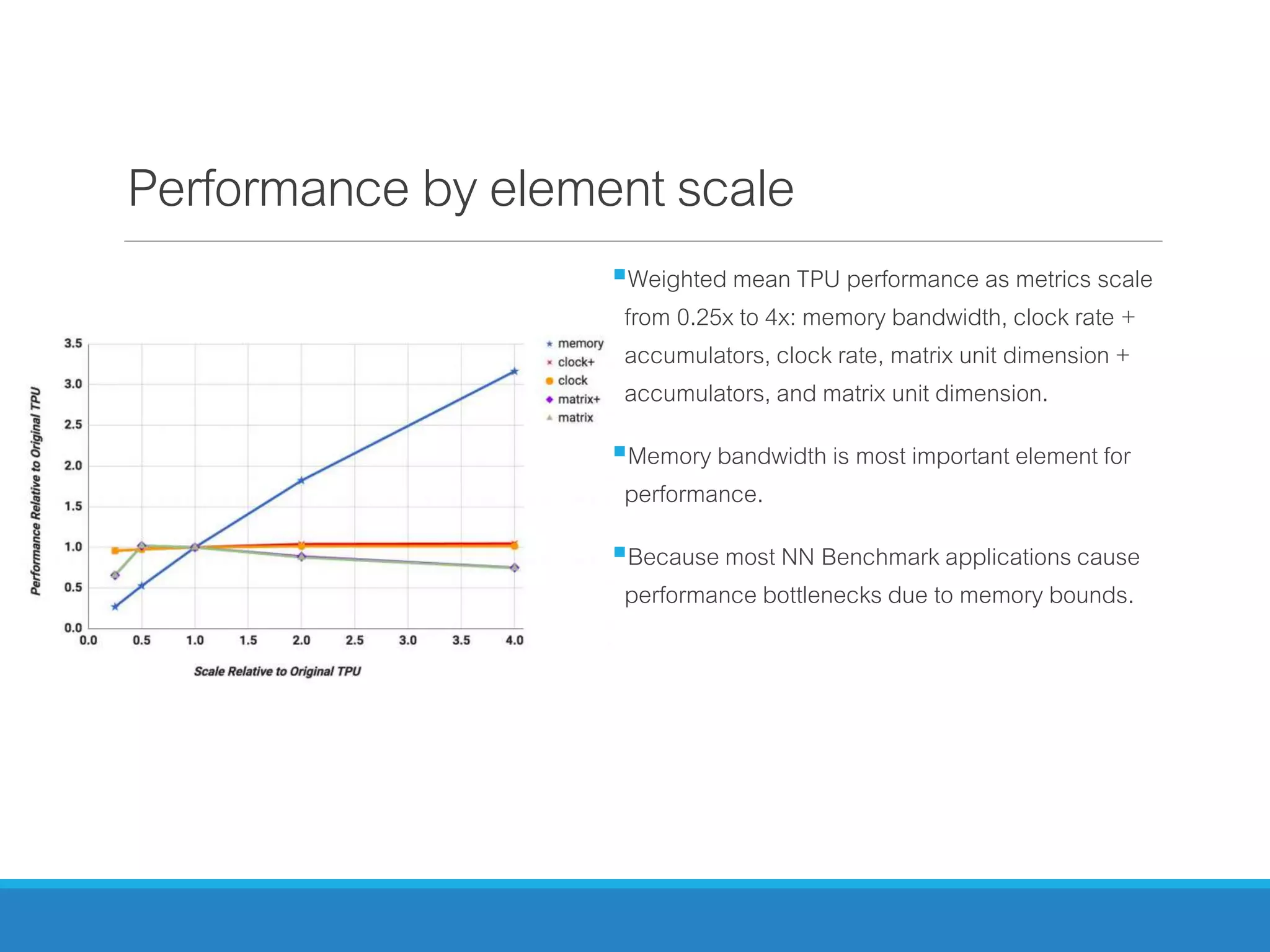
Performanceby elementscale
Weighted mean TPU performance as metrics scale
from 0.25x to 4x: memory bandwidth, clock rate +
accumulators, clock rate, matrix unit dimension +
accumulators, and matrix unit dimension.
Memory bandwidth is most important element for
performance.
Because most NN Benchmark applications cause
performance bottlenecks due to memory bounds.
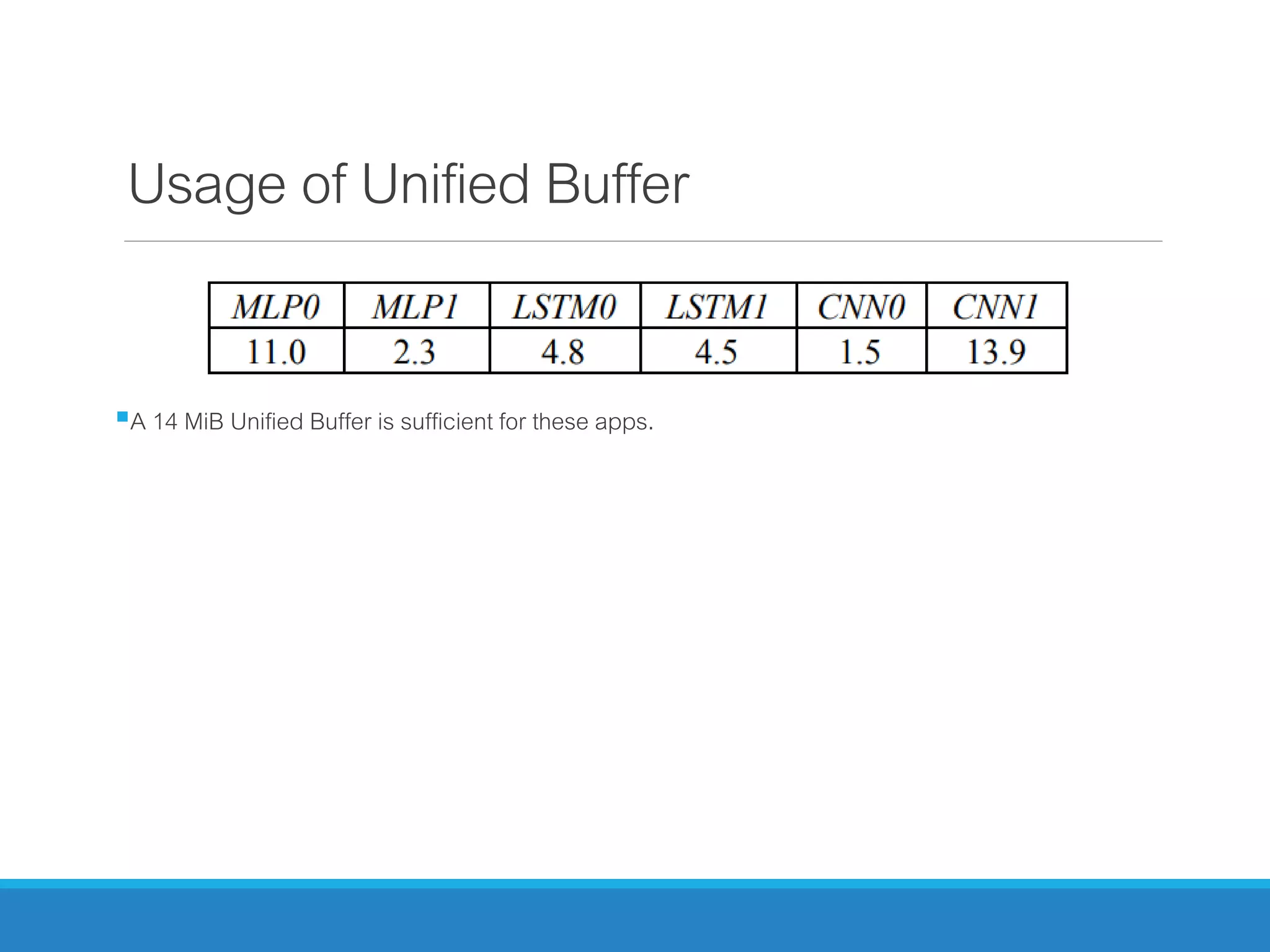
Usage of Unified Buffer
A 14 MiB Unified Buffer is sufficient for these apps.
Discussion
In this paper, they organize the authors' ideas by dividing various topics (author thoughts) into
Fallacy (false thinking) and Pitfall (danger).
Discussion(cont.)
Fallacy: NN inference applications in datacenters value throughput as much as response time.
Answer: Developers had strong response-time demands.
Even the developers of one application in 2014 that cared about response time (LSTM1) said the
limit was 10 ms in 2014, but shrank it to 7 ms when they actually ported it to the TPU.
Fallacy: The K80 GPU architecture is a good match to NN inference.
Answer: K80 is only a little faster at inference than Haswell and much slower than the TPU.
Throughput-oriented architectural approach, it may be more challenging for GPUs to meet the strict
latency limits
Discussion(cont.)
Pitfall: Architects have neglected important NN tasks
Answer: 15% of the papers at ISCA 2016 were on hardware accelerators for NN. All nine papers
looked at CNNs, and only two mentioned other NNs. CNN is only about 5% of our datacenter NN
workload.
Pitfall: For NN hardware, Inferences Per Second (IPS) is an inaccurate summary performance metric
Answer: Results show that IPS is a poor overall performance summary for NN hardware. For
example, the TPU runs the 4-layer MLP1 at 360,000 IPS but the 89-layer CNN1 at only 4,700 IPS, so
TPU IPS vary by 75X!. To compare NN machines better, we need a benchmark suite written at a
high-level to port it to the wide variety of NN architectures.
Discussion(cont.)
Fallacy: The K80 GPU results would be much better if Boost mode were enabled.
Answer: Setting aside the negative impact of K80 Boost mode on TCO (Section 3), we measured it
on LSTM1. Boost mode increased the clock rate by a factor of up to 1.6—from 560 to 875 MHz—
which increased performance by 1.4X, but it also raised power by 1.3X. The net gain in
performance/Watt is 1.1X, and thus for LSTM1, boost mode would have a minor impact on our
energy-speed analysis.
Discussion(cont.)
Fallacy: CPU and GPU results would be comparable to the TPU if we used them more efficiently or
compared to newer versions.
Answer: In 8-bit results for just one DNN on the CPU, the benefit was ~3.5X. It was less confusing
(and less space) to present all CPU results in floating point, rather than having one exception, with
its own roofline. DNNs had similar speedup, performance/Watt ratio would drop from 41-83X to 12-
24X.
Pitfall: Performance counters added as an afterthought for NN hardware.
Answer: The TPU has 106 performance counters, and if anything we would like a few more. The
raison d'etre for NN accelerators is performance, and it is way too early in their evolution to have
good intuition about what is going on.
Discussion(cont.)
Fallacy: After two years of software tuning, the only path left to increase TPU performance is
hardware upgrades.
Answer: The performance of CNN1 on the TPU could improve if developers and compiler writers did
more work to match CNN1 to the TPU hardware.
Related Work
Fathom: reference workloads for modern deep learning methods
The Handbook of Brain Theory and Neural Networks
Training Neural Networks with Spert-II. Chapter 11 in Parallel Architectures for Artificial Networks: Paradigms and
Implementations
Eyeriss: A Spatial Architecture for Energy-Efficient Dataflow for Convolutional Neural Networks
High Performance Hardware for Machine Learning
A VLSI architecture for highperformance, low-cost, on-chip learning
Special-purpose digital hardware for neural networks: An architectural survey
If I could only design one circuit…: technical perspective
Toward accelerating deep learning at scale using specialized hardware in the datacenter
A Reconfigurable Fabric for Accelerating Large-Scale Datacenter Services
Convolution engine: balancing efficiency & flexibility in specialized computing
Design of a 1st Generation Neurocomputer
Conclusion
Despite living on an I/O bus and having relatively little memory bandwidth that limits utilization of the
TPU. four of the six NN applications are memory-bound.
The TPU leverages the order-of-magnitude reduction in energy and area of 8-bit integer systolic
matrix multipliers over 32-bit floating-point datapaths of a K80 GPU to pack 25 times as many MACs
and 3.5 times the on-chip memory (28 MiB vs. 8 MiB) while using less than half the power of the K80
in a relatively small die.
Inference applications have serious response-time bounds because they are often part of user
facing applications, thus NN architectures need to perform well when coping with 99th-percentile
latency deadlines.
Conclusion(cont.)
The TPU die leverages its advantage in MACs and on-chip memory to run short programs written using
the domain specific TensorFlow framework 15 times as fast as the K80 GPU die, resulting in a
performance/Watt advantage of 29 times, which is correlated with performance/total cost of ownership.
Compared to the Haswell CPU die, the corresponding ratios are 29 and 83.
The TPU succeeded because of
 the large—but not too large—matrix multiply unit
 reduce dependence on host CPU
 a single-threaded, deterministic execution model that proved to be a good match to 99th-percentile response
time limits
 enough flexibility to match the NNs of 2017 as well as of 2013
 the omission of general-purpose features that enabled a small and low power die despite the larger data path
and memory
 the use of 8-bit integers by the quantized applications
 applications were written using TensorFlow, which made it easy to port them to the TPU at high-performance
rather than them having to be rewritten to run well on the very different TPU hardware.

TPU paper slide

  • 1.
    In-DatacenterPerformance Analysisof ATensor Processing Unit​ DONG-HYUN HWANG
  • 2.
    Preview of Highlights Inferenceapps usually emphasize response-time over throughput since they are often user-facing. Due to latency limits, the K80 GPU is underutilized for inference, and is just a little faster than a Haswell CPU. Despite having a much smaller and lower power chip, the TPU has 25 times as many MACs and 3.5 times as much on-chip memory as the K80 GPU. The TPU is about 15X - 30X faster at inference than the K80 GPU and the Haswell CPU.
  • 3.
    Preview of Highlights(cont.) Fourof the six NN apps are memory-bandwidth limited on the TPU; if the TPU were revised to have the same memory system as the K80 GPU, it would be about 30X - 50X faster than the GPU and CPU. The performance/Watt of the TPU is 30X - 80X that of contemporary products; the revised TPU with K80 memory would be 70X - 200X better. While most architects have been accelerating CNNs, they represent just 5% of our datacenter workload
  • 4.
    Introduction The synergy betweenthe large data sets in the cloud and the numerous computers that power it has enabled a renaissance in machine learning. Deep neural networks(DNN) have reduced word error rate in speech recognition, image recognition and beat a human champion at Go.
  • 5.
    Introduction The “deep” partof DNN comes from going beyond a few layers and virtually all training today is in floating point, which is one reason GPUs have been so popular. Quantization transforms FP numbers into integers (often 8-bit) which are usually good enough for prediction (inference). 8-bit integer multiplies can be 6X less energy and area than 16-bit FP multiplies. Integer addition can be 13X less energy and 38X less area than 16-bit FP additions. TPU in this paper doesn’t support training.  TPU2 supports it.
  • 6.
    NNsAre PopularToday Multi-Layer Perceptrons(MLP): fully connected NN Convolutional Neural Networks (CNN): Each ensuing layer is a set of nonlinear functions of weighted sums of spatially nearby subsets of outputs from the prior layer. Recurrent Neural Networks (RNN): Each subsequent layer is a collection of nonlinear functions of weighted sums of outputs and the previous state. The most popular RNN is Long Short-Term Memory (LSTM). The art of the LSTM is in deciding what to forget and what to pass on as state to the next layer. The weights are reused across time step
  • 7.
    Main Purpose Training In thegoogle data center, computation of prediction is more than computation of training.
  • 8.
  • 9.
  • 10.
    Architecture To reduce thedelay of deployment, the TPU was designed to be a coprocessor on the PCIe I/O bus. The TPU instructions are sent from the host over the PCIe Gen3 x16 bus into an instruction buffer. Internal blocks are connected together by 256-byte-wide paths.
  • 11.
    MMU Matrix Multiply Unit(MPU)is a heart of TPU.  It contains 256x256 MACs(Multiply ACcumulate unit).  Performing 8-bit multiply and adds on signed or unsigned integers.  Output is 16-bit data.  16-bit products are collected in the 4MiB of 32-bit accumulators.  The 4MiB represents 4096 node.  Each node has 256-elementof 32-bit accumulators.  The matrix unit produces one 256-element partial sum per clock cycle  The matrix unit holds one 64KiB tile of weights plus one for double buffering. (To hide the 256 cycles it takes to shift a tile in)  Single weight is 8-Bit.
  • 12.
    Memory and Buffer Theweights for the matrix unit are staged through an on-chip Weight FIFO that reads from an off- chip 8 GiB DRAM called Weight Memory. The weight FIFO is four tiles deep.  The intermediate results are held in the 24 MiB on-chip Unified Buffer, which can serve as inputs to the Matrix Unit.
  • 13.
    Architecture (cont.) Unified Bufferis almost a third (29%) of the die and the Matrix Multiply Unit is a quarter (24%). The 24 MiB size was picked in part to match the pitch of the Matrix Unit on the die.
  • 14.
    Architecture (cont.) As instructionsare sent over the relatively slow PCIe bus, TPU instructions follow the CISC tradition, including a repeat field. The average clock cycles per instruction (CPI) of these CISC instructions is typically 10 to 20.
  • 15.
    TPU Execution Stage CISCMatrixMultiply Instruction in TPU. (12bit) The philosophy of the TPU microarchitecture is to keep the matrix unit busy, where each instruction executes in a separate stage. It uses a 4-stage pipeline for these CISC instructions, where each instruction executes in a separate stage. UB Ad dr Accu Addr Len gth OP code, flags
  • 16.
  • 24.
    Systolic Array As readinga large SRAM uses much more power than arithmetic, the matrix unit uses systolic execution to save energy by reducing reads and writes of the Unified Buffer. The data flows in from the left, and the weights are loaded from the top. A given 256-element multiply-accumulate operation moves through the matrix as a diagonal wavefront.
  • 25.
    Software The TPU softwarestack had to be compatible with those developed for CPUs and GPUs so that applications could be ported quickly to the TPU. The portion of the application run on the TPU is typically written in TensorFlow and is compiled into an API that can run on GPUs or TPUs. In TensorFlow 1.3, operations and bindings for the cloud TPU are included.
  • 26.
    Key Instruction Set Ithas about a dozen instructions overall, but these five are the key ones.  Read_Host_Memory reads data from the CPU host memory into the Unified Buffer.  Read_Weights reads weights from Weight Memory into the Weight FIFO as input to the Matrix Unit.  MatrixMultiply/Convolve do matrix multiply or convolution operation and save results to accumulator.  Activate do activate function operation such as RELU, Sigmoid.  Write_Host_Memory writes data from the Unified Buffer into the CPU host memory.
  • 27.
  • 28.
    Performance To illustrate theperformances, they used Roofline Performance model.Operationspersecond Operations per DRAM Byte accessed
  • 29.
    Performance (cont.) The sixNN applications are generally further below their ceilings than was the TPU and reason is the response time. Many of these NN applications are parts of end-user-facing services. Small increases in response time cause customers to use a service less.
  • 30.
    Performance (cont.) CPU andGPU performance in restrict response time(7ms) is almost 40% of their full performance. TPU’s performance in restrict response time is 80% of TPU’s full performance.
  • 31.
  • 32.
    The Time TPUInteracts with CPU
  • 33.
    Performance (cont.) Relative inference(prediction)performance per die including the host server overhead for the two accelerators versus the CPU. GM and WM are geometric and weighted mean. TPU is 14.5 times faster than CPU and is 13.2 times faster than GPU.
  • 34.
    Performance/Watt TPU’ is animproved TPU. Total Perf./Watt includes CPU and GPU power consumption for server computing Incremental Perf./Watt doesn’t includes CPU and GPU power consumption for server computing. In incremental case, TPU’ Perf./Watt by GM is 17, 34times better than CPU and is 14, 16 times better than GPU.
  • 35.
    Watts/die for CNN0 TheTotal GPU and TPU power are the red and orange lines and their Incremental power are the green and purple lines. A server has 2 CPUs and 8 GPUs or 4 TPUs. TPU’s energy proportionality is most bad. However, TPU consumes only around 40Watt.
  • 36.
    Performanceby elementscale Weighted meanTPU performance as metrics scale from 0.25x to 4x: memory bandwidth, clock rate + accumulators, clock rate, matrix unit dimension + accumulators, and matrix unit dimension. Memory bandwidth is most important element for performance. Because most NN Benchmark applications cause performance bottlenecks due to memory bounds.
  • 37.
    Usage of UnifiedBuffer A 14 MiB Unified Buffer is sufficient for these apps.
  • 38.
    Discussion In this paper,they organize the authors' ideas by dividing various topics (author thoughts) into Fallacy (false thinking) and Pitfall (danger).
  • 39.
    Discussion(cont.) Fallacy: NN inferenceapplications in datacenters value throughput as much as response time. Answer: Developers had strong response-time demands. Even the developers of one application in 2014 that cared about response time (LSTM1) said the limit was 10 ms in 2014, but shrank it to 7 ms when they actually ported it to the TPU. Fallacy: The K80 GPU architecture is a good match to NN inference. Answer: K80 is only a little faster at inference than Haswell and much slower than the TPU. Throughput-oriented architectural approach, it may be more challenging for GPUs to meet the strict latency limits
  • 40.
    Discussion(cont.) Pitfall: Architects haveneglected important NN tasks Answer: 15% of the papers at ISCA 2016 were on hardware accelerators for NN. All nine papers looked at CNNs, and only two mentioned other NNs. CNN is only about 5% of our datacenter NN workload. Pitfall: For NN hardware, Inferences Per Second (IPS) is an inaccurate summary performance metric Answer: Results show that IPS is a poor overall performance summary for NN hardware. For example, the TPU runs the 4-layer MLP1 at 360,000 IPS but the 89-layer CNN1 at only 4,700 IPS, so TPU IPS vary by 75X!. To compare NN machines better, we need a benchmark suite written at a high-level to port it to the wide variety of NN architectures.
  • 41.
    Discussion(cont.) Fallacy: The K80GPU results would be much better if Boost mode were enabled. Answer: Setting aside the negative impact of K80 Boost mode on TCO (Section 3), we measured it on LSTM1. Boost mode increased the clock rate by a factor of up to 1.6—from 560 to 875 MHz— which increased performance by 1.4X, but it also raised power by 1.3X. The net gain in performance/Watt is 1.1X, and thus for LSTM1, boost mode would have a minor impact on our energy-speed analysis.
  • 42.
    Discussion(cont.) Fallacy: CPU andGPU results would be comparable to the TPU if we used them more efficiently or compared to newer versions. Answer: In 8-bit results for just one DNN on the CPU, the benefit was ~3.5X. It was less confusing (and less space) to present all CPU results in floating point, rather than having one exception, with its own roofline. DNNs had similar speedup, performance/Watt ratio would drop from 41-83X to 12- 24X. Pitfall: Performance counters added as an afterthought for NN hardware. Answer: The TPU has 106 performance counters, and if anything we would like a few more. The raison d'etre for NN accelerators is performance, and it is way too early in their evolution to have good intuition about what is going on.
  • 43.
    Discussion(cont.) Fallacy: After twoyears of software tuning, the only path left to increase TPU performance is hardware upgrades. Answer: The performance of CNN1 on the TPU could improve if developers and compiler writers did more work to match CNN1 to the TPU hardware.

  • 44.
    Related Work Fathom: referenceworkloads for modern deep learning methods The Handbook of Brain Theory and Neural Networks Training Neural Networks with Spert-II. Chapter 11 in Parallel Architectures for Artificial Networks: Paradigms and Implementations Eyeriss: A Spatial Architecture for Energy-Efficient Dataflow for Convolutional Neural Networks High Performance Hardware for Machine Learning A VLSI architecture for highperformance, low-cost, on-chip learning Special-purpose digital hardware for neural networks: An architectural survey If I could only design one circuit…: technical perspective Toward accelerating deep learning at scale using specialized hardware in the datacenter A Reconfigurable Fabric for Accelerating Large-Scale Datacenter Services Convolution engine: balancing efficiency & flexibility in specialized computing Design of a 1st Generation Neurocomputer
  • 45.
    Conclusion Despite living onan I/O bus and having relatively little memory bandwidth that limits utilization of the TPU. four of the six NN applications are memory-bound. The TPU leverages the order-of-magnitude reduction in energy and area of 8-bit integer systolic matrix multipliers over 32-bit floating-point datapaths of a K80 GPU to pack 25 times as many MACs and 3.5 times the on-chip memory (28 MiB vs. 8 MiB) while using less than half the power of the K80 in a relatively small die. Inference applications have serious response-time bounds because they are often part of user facing applications, thus NN architectures need to perform well when coping with 99th-percentile latency deadlines.
  • 46.
    Conclusion(cont.) The TPU dieleverages its advantage in MACs and on-chip memory to run short programs written using the domain specific TensorFlow framework 15 times as fast as the K80 GPU die, resulting in a performance/Watt advantage of 29 times, which is correlated with performance/total cost of ownership. Compared to the Haswell CPU die, the corresponding ratios are 29 and 83. The TPU succeeded because of  the large—but not too large—matrix multiply unit  reduce dependence on host CPU  a single-threaded, deterministic execution model that proved to be a good match to 99th-percentile response time limits  enough flexibility to match the NNs of 2017 as well as of 2013  the omission of general-purpose features that enabled a small and low power die despite the larger data path and memory  the use of 8-bit integers by the quantized applications  applications were written using TensorFlow, which made it easy to port them to the TPU at high-performance rather than them having to be rewritten to run well on the very different TPU hardware.

Editor's Notes

  • #3 -this latency limits is described in the paper as 7ms.
  • #4 TPU used DDR3 but K80 used GDDR5 (GDDR5 is much faster than DDR3) contemporary products mean Haswell and K80
  • #6 Area writen in this paper means a die size :)
  • #8 대부분의 구글 유저는 트레이닝을 요청하는게 아니라 트레이닝된 것을 쓴다.
  • #9 This activate function is RELU.
  • #10 TPU의 블록다이어그램은 다음과 같다. 초록색은 TPU 보드 외부와 통신하는 인터페이스. 파란색은 내부 데이터 버퍼 노란색은 실제 계산이 일어나는 곳. 빨간색은 컨트롤관련을 의미한다. The block diagram of the TPU is as follows. Green is the interface that communicates with the outside of the TPU board. Blue is an internal data buffer Yellow is where the calculation takes place. Red means control.
  • #12 256X256 행렬 이외에 여유를 두고자 한것같기도 하다.
  • #13 (64KB (1BYTE * 256 * 256) X 4)
  • #14 24MiB is the peak, but I could not confirm why the peak is based on 24 MiB.
  • #15 RISC를 쓰면 CPU랑 인터랙션 타임이 늘어나잖어 (!!!!) CISC is more complex than RISC, but has the advantage of reducing the time to interact with the CPU.
  • #16 However, it is not clear what is done for each stage.
  • #17 Evenif SRAM is faster than DRAM, They applied the Systolic Array to the TPU to minimize access to the SRAM for matrix computation.
  • #29 The larger the X axis value is, the more the computation is increased compared to the same memory access count. The linear increase of the graph is due to the memory bandwidth bottleneck, which makes it impossible to perform by full-performance. The closer each shape is to the loop line means the more efficient the use of hardware.
  • #30 Ceiling 천장 메모리 밴드위스가 쌉딸림. The poor performance of the CPU and GPU is due to slow computation and frequent access to memory + amount of memory is poor. TPU는 시스톨릭 어레이도 씀
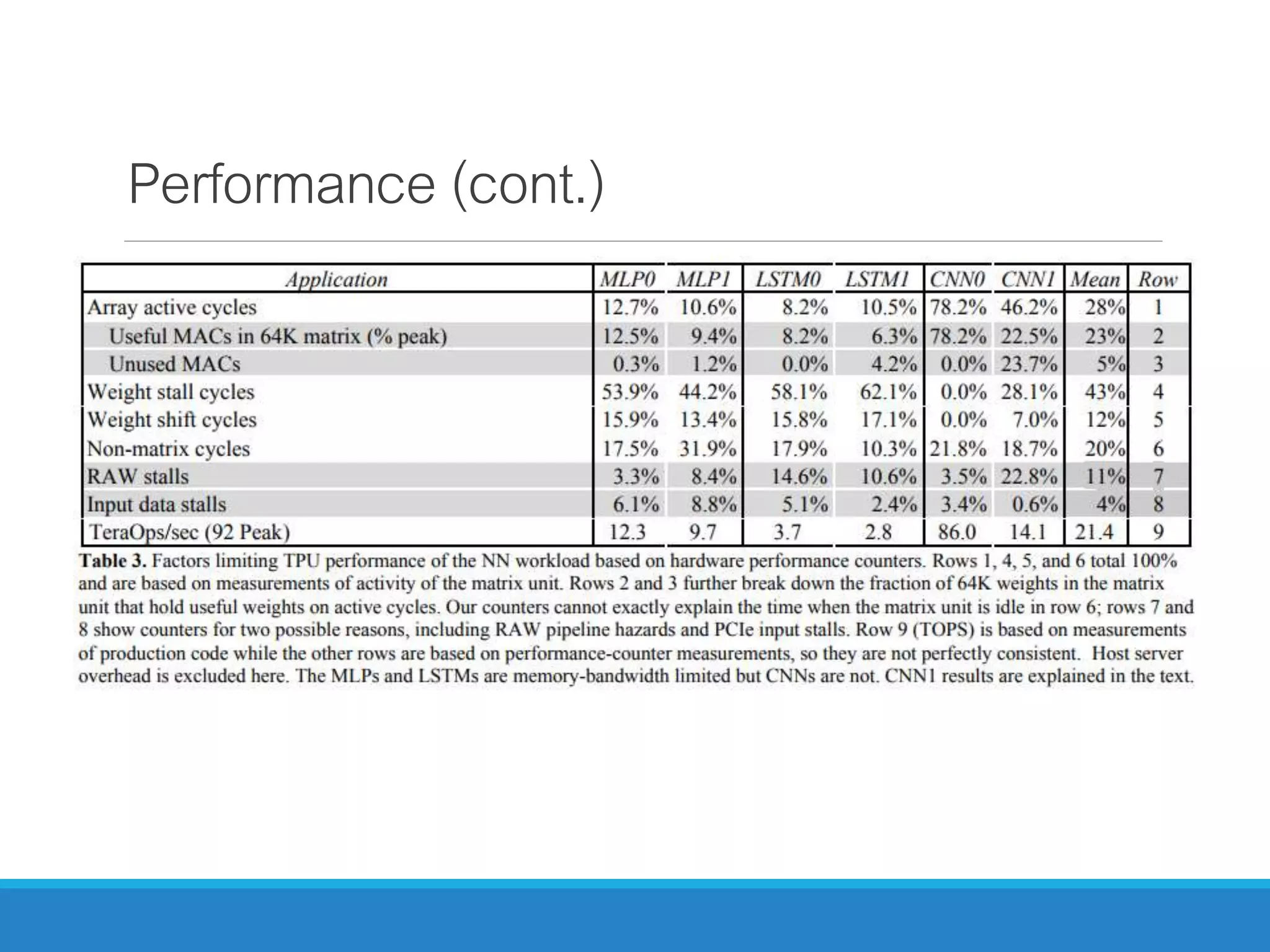
  • #32 NN작업부하가 TPU의 성능을 제안하는 요인들 -Weight stall은 여전히 짱짱해… 마지막 TeraOPS는 정확하지 않어. MLP, LSTM은 메모리 밴드위스 조짐 (보시면 웨이트 스톨 이나 쉬프트가 CNN보다 쩔어).
  • #33 The TPU interacts with the CPU only for a small amount of time, because the use of relatively slow PCIe results in a performance penalty when Interact is increased.
  • #36 TPU’s power management is not good but it is okay because TPU’s power consumtion is already low.