1
GPU
• Presentation Prepared by
• SAATWIK KUMAR
• 1101219423
• ETC, ET-2
2
– What is GPU?
– When was GPU discovered?
• High Performance Computing
– Current Top Ten List
– GPU ARCHITECTURE
– What is GPU Pipeline?
– Where Is GPU Data Stored?
– Applications
Presentation Overview
3
A Graphics Processing Unit or GPU (also occasionally
called Visual Processing Unit or VPU) is a dedicated
processor efficient at manipulating and displaying
computer graphics .
 Like the CPU (Central Processing Unit), it is a single-
chip processor.
• A graphics processing unit or GPU is a specialized
microprocessor that discharge and accelerates 3D or
2D graphics. It is used in embedded systems, mobile
phones, personal computers, workstations, and game
consoles.
What is GPU ?
4
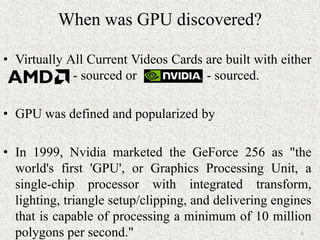
• Virtually All Current Videos Cards are built with either
- - sourced or - sourced.
• GPU was defined and popularized by
• In 1999, Nvidia marketed the GeForce 256 as "the
world's first 'GPU', or Graphics Processing Unit, a
single-chip processor with integrated transform,
lighting, triangle setup/clipping, and delivering engines
that is capable of processing a minimum of 10 million
polygons per second."
When was GPU discovered?
Historically, Video cards developed from
the need to display Graphics with
growing higher resolutions and color
depths on IBM PC Compatible
Computers.
• Standards such as CGA, MDA
• (monochrome display adapter), HGC etc
were introduced from1982 to 1990 and
supported by a variety of Hardware
Maunfactures.
7/27/2015 5
Current Top Ten List
• #1 GeForce GTX 580
#2 GeForce GTX 480
#3 Quadro 6000
#4 GeForce GTX 570
#5 GeForce GTX 470
#6 Radeon HD 6870
#7 Radeon HD 6850
#8 Radeon HD 5870
#9 WinFast GTX 460
#10 Radeon HD 5970
29/10/2104 10
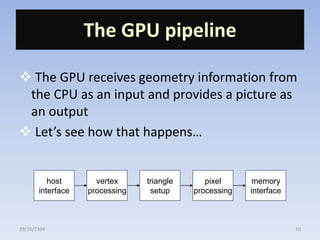
The GPU pipeline
 The GPU receives geometry information from
the CPU as an input and provides a picture as
an output
 Let’s see how that happens…
host
interface
vertex
processing
triangle
setup
pixel
processing
memory
interface
7/27/2015 8
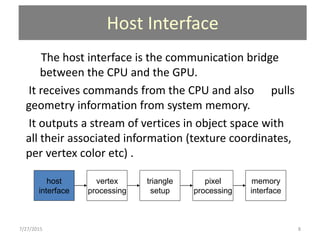
Host Interface
The host interface is the communication bridge
between the CPU and the GPU.
 It receives commands from the CPU and also pulls
geometry information from system memory.
 It outputs a stream of vertices in object space with
all their associated information (texture coordinates,
per vertex color etc) .
host
interface
vertex
processing
triangle
setup
pixel
processing
memory
interface
9
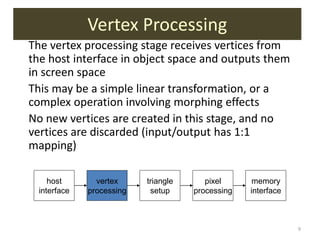
Vertex Processing
The vertex processing stage receives vertices from
the host interface in object space and outputs them
in screen space
This may be a simple linear transformation, or a
complex operation involving morphing effects
No new vertices are created in this stage, and no
vertices are discarded (input/output has 1:1
mapping)
host
interface
vertex
processing
triangle
setup
pixel
processing
memory
interface
7/27/2015 10
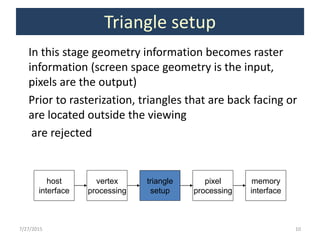
Triangle setup
In this stage geometry information becomes raster
information (screen space geometry is the input,
pixels are the output)
Prior to rasterization, triangles that are back facing or
are located outside the viewing
 are rejected
host
interface
vertex
processing
triangle
setup
pixel
processing
memory
interface
12
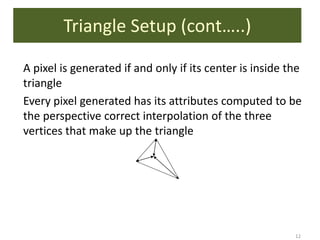
Triangle Setup (cont…..)
A pixel is generated if and only if its center is inside the
triangle
Every pixel generated has its attributes computed to be
the perspective correct interpolation of the three
vertices that make up the triangle
13
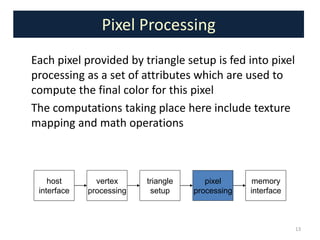
Pixel Processing
Each pixel provided by triangle setup is fed into pixel
processing as a set of attributes which are used to
compute the final color for this pixel
The computations taking place here include texture
mapping and math operations
host
interface
vertex
processing
triangle
setup
pixel
processing
memory
interface
14
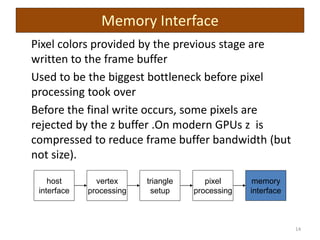
Memory Interface
Pixel colors provided by the previous stage are
written to the frame buffer
Used to be the biggest bottleneck before pixel
processing took over
Before the final write occurs, some pixels are
rejected by the z buffer .On modern GPUs z is
compressed to reduce frame buffer bandwidth (but
not size).
host
interface
vertex
processing
triangle
setup
pixel
processing
memory
interface
7/27/2015 15
Where is GPU Data Stored?
– Vertex buffer
– Frame buffer
– Texture
Vertex Buffer
Vertex
Processor
Rasterizer
Fragment
Processor
Frame
Buffer(s)
Texture
7/27/2015 15
Some applications…..
Computer generated holography using a
graphics processing unit
Improve the performance of CAD tools.
Computer graphics in games
7/27/2015 16
THANK
YOU
GRAPHICS PROCESSING UNIT (GPU)

GRAPHICS PROCESSING UNIT (GPU)

  • 1.
    1 GPU • Presentation Preparedby • SAATWIK KUMAR • 1101219423 • ETC, ET-2
  • 2.
    2 – What isGPU? – When was GPU discovered? • High Performance Computing – Current Top Ten List – GPU ARCHITECTURE – What is GPU Pipeline? – Where Is GPU Data Stored? – Applications Presentation Overview
  • 3.
    3 A Graphics ProcessingUnit or GPU (also occasionally called Visual Processing Unit or VPU) is a dedicated processor efficient at manipulating and displaying computer graphics .  Like the CPU (Central Processing Unit), it is a single- chip processor. • A graphics processing unit or GPU is a specialized microprocessor that discharge and accelerates 3D or 2D graphics. It is used in embedded systems, mobile phones, personal computers, workstations, and game consoles. What is GPU ?
  • 4.
    4 • Virtually AllCurrent Videos Cards are built with either - - sourced or - sourced. • GPU was defined and popularized by • In 1999, Nvidia marketed the GeForce 256 as "the world's first 'GPU', or Graphics Processing Unit, a single-chip processor with integrated transform, lighting, triangle setup/clipping, and delivering engines that is capable of processing a minimum of 10 million polygons per second." When was GPU discovered?
  • 5.
    Historically, Video cardsdeveloped from the need to display Graphics with growing higher resolutions and color depths on IBM PC Compatible Computers. • Standards such as CGA, MDA • (monochrome display adapter), HGC etc were introduced from1982 to 1990 and supported by a variety of Hardware Maunfactures. 7/27/2015 5
  • 6.
    Current Top TenList • #1 GeForce GTX 580 #2 GeForce GTX 480 #3 Quadro 6000 #4 GeForce GTX 570 #5 GeForce GTX 470 #6 Radeon HD 6870 #7 Radeon HD 6850 #8 Radeon HD 5870 #9 WinFast GTX 460 #10 Radeon HD 5970
  • 7.
    29/10/2104 10 The GPUpipeline  The GPU receives geometry information from the CPU as an input and provides a picture as an output  Let’s see how that happens… host interface vertex processing triangle setup pixel processing memory interface
  • 8.
    7/27/2015 8 Host Interface Thehost interface is the communication bridge between the CPU and the GPU.  It receives commands from the CPU and also pulls geometry information from system memory.  It outputs a stream of vertices in object space with all their associated information (texture coordinates, per vertex color etc) . host interface vertex processing triangle setup pixel processing memory interface
  • 9.
    9 Vertex Processing The vertexprocessing stage receives vertices from the host interface in object space and outputs them in screen space This may be a simple linear transformation, or a complex operation involving morphing effects No new vertices are created in this stage, and no vertices are discarded (input/output has 1:1 mapping) host interface vertex processing triangle setup pixel processing memory interface
  • 10.
    7/27/2015 10 Triangle setup Inthis stage geometry information becomes raster information (screen space geometry is the input, pixels are the output) Prior to rasterization, triangles that are back facing or are located outside the viewing  are rejected host interface vertex processing triangle setup pixel processing memory interface
  • 11.
    12 Triangle Setup (cont…..) Apixel is generated if and only if its center is inside the triangle Every pixel generated has its attributes computed to be the perspective correct interpolation of the three vertices that make up the triangle
  • 12.
    13 Pixel Processing Each pixelprovided by triangle setup is fed into pixel processing as a set of attributes which are used to compute the final color for this pixel The computations taking place here include texture mapping and math operations host interface vertex processing triangle setup pixel processing memory interface
  • 13.
    14 Memory Interface Pixel colorsprovided by the previous stage are written to the frame buffer Used to be the biggest bottleneck before pixel processing took over Before the final write occurs, some pixels are rejected by the z buffer .On modern GPUs z is compressed to reduce frame buffer bandwidth (but not size). host interface vertex processing triangle setup pixel processing memory interface
  • 14.
    7/27/2015 15 Where isGPU Data Stored? – Vertex buffer – Frame buffer – Texture Vertex Buffer Vertex Processor Rasterizer Fragment Processor Frame Buffer(s) Texture
  • 15.
    7/27/2015 15 Some applications….. Computergenerated holography using a graphics processing unit Improve the performance of CAD tools. Computer graphics in games
  • 16.