State-of-the-art
• Keep data in-memory
• Ensure strong consistency
• Exploit concurrency to cope with
high throughput needs of modern services
Deficiencies of Existing Work
Strongly consistent but cannot maximize
throughput in memory-resident workloads
1. Block excessively
2. Handle memory accesses inefficiently
Concurrent Growing Hashtables
• Ubiquitous in todays cloud
• Offer Get, Put, Insert, Delete and index
Resizes to store and access KV pairs
Dandelion Hashtable: Beyond Billion Memory Requests Per Second on a Commodity Server
Antonios Katsarakis Vasilis Gavrielatos Nikos Ntarmos
Huawei Research
In High-Performance Parallel and Distributed Computing (HPDC'24)
In-memory but not memory aware
1. Multiple memory accesses even for small (16B) KVs, no collision/resizes
2. No overlapped memory accesses: stall each Get,Insert,Delete waiting for data from memory
3. Bad occupancy: few index slots filled before resize → harms memory/performance
Concurrent but practically blocking
Prior art may offer non-blocking Gets but compromise Deletes/Inserts/Resizes
1. Inserts leading to Resize block every request until all objects copied to larger index
2. Open-addressing designs: slow Deletes that block all requests to free index slots
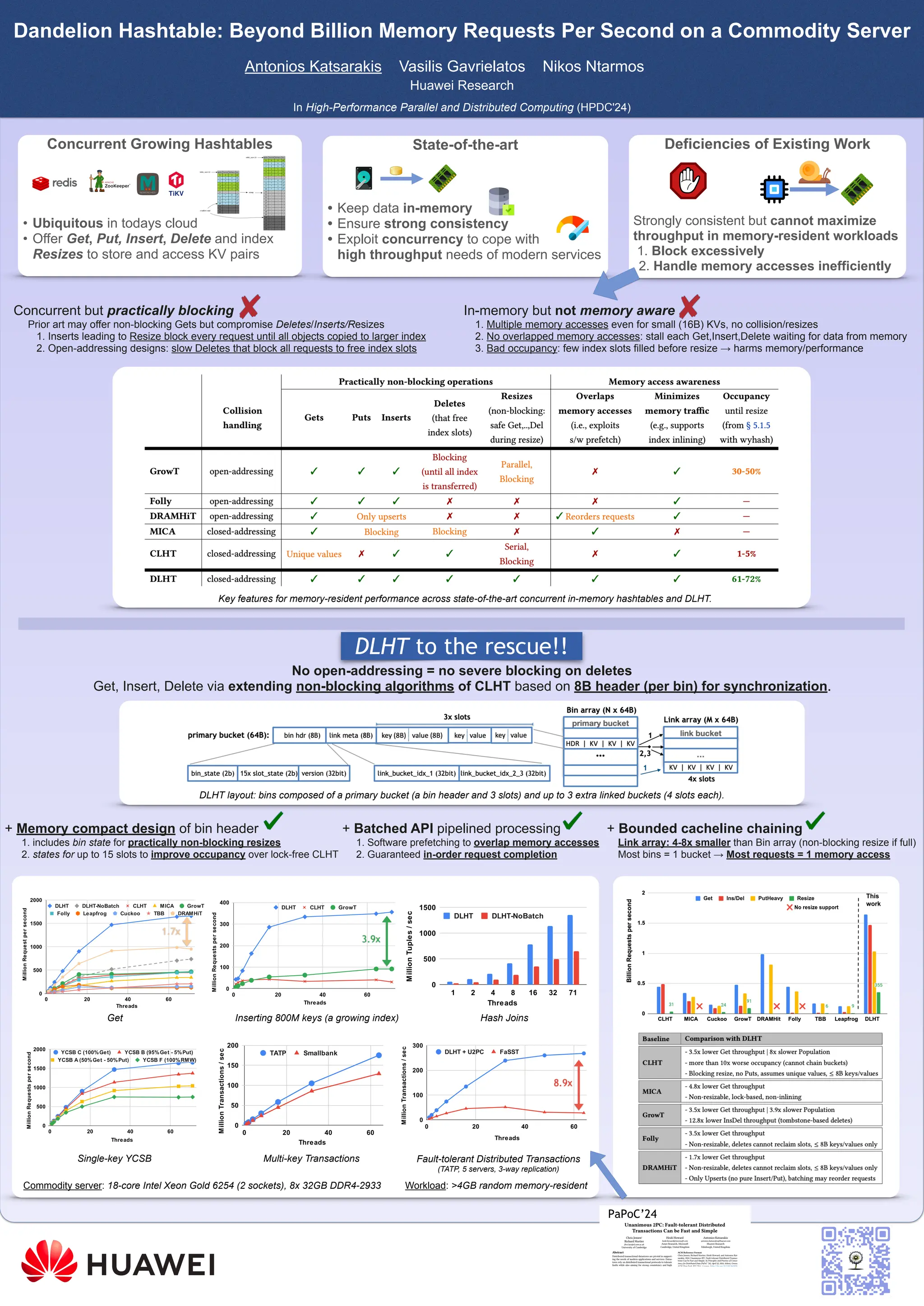
No open-addressing = no severe blocking on deletes
Get, Insert, Delete via extending non-blocking algorithms of CLHT based on 8B header (per bin) for synchronization.
+ Memory compact design of bin header
1. includes bin state for practically non-blocking resizes
2. states for up to 15 slots to improve occupancy over lock-free CLHT
+ Batched API pipelined processing
1. Software prefetching to overlap memory accesses
2. Guaranteed in-order request completion
+ Bounded cacheline chaining
Link array: 4-8x smaller than Bin array (non-blocking resize if full)
Most bins = 1 bucket → Most requests = 1 memory access
DLHT to the rescue!!
Get Inserting 800M keys (a growing index) Hash Joins
Single-key YCSB Multi-key Transactions Fault-tolerant Distributed Transactions
(TATP, 5 servers, 3-way replication)
Commodity server: 18-core Intel Xeon Gold 6254 (2 sockets), 8x 32GB DDR4-2933 Workload: >4GB random memory-resident
DLHT layout: bins composed of a primary bucket (a bin header and 3 slots) and up to 3 extra linked buckets (4 slots each).
Key features for memory-resident performance across state-of-the-art concurrent in-memory hashtables and DLHT.
PaPoC’24
1.7x
3.9x
8.9x

Dandelion Hashtable: beyond billion requests per second on a commodity server [poster - Eurosys'24]

  • 1.
    State-of-the-art • Keep datain-memory • Ensure strong consistency • Exploit concurrency to cope with high throughput needs of modern services Deficiencies of Existing Work Strongly consistent but cannot maximize throughput in memory-resident workloads 1. Block excessively 2. Handle memory accesses inefficiently Concurrent Growing Hashtables • Ubiquitous in todays cloud • Offer Get, Put, Insert, Delete and index Resizes to store and access KV pairs Dandelion Hashtable: Beyond Billion Memory Requests Per Second on a Commodity Server Antonios Katsarakis Vasilis Gavrielatos Nikos Ntarmos Huawei Research In High-Performance Parallel and Distributed Computing (HPDC'24) In-memory but not memory aware 1. Multiple memory accesses even for small (16B) KVs, no collision/resizes 2. No overlapped memory accesses: stall each Get,Insert,Delete waiting for data from memory 3. Bad occupancy: few index slots filled before resize → harms memory/performance Concurrent but practically blocking Prior art may offer non-blocking Gets but compromise Deletes/Inserts/Resizes 1. Inserts leading to Resize block every request until all objects copied to larger index 2. Open-addressing designs: slow Deletes that block all requests to free index slots No open-addressing = no severe blocking on deletes Get, Insert, Delete via extending non-blocking algorithms of CLHT based on 8B header (per bin) for synchronization. + Memory compact design of bin header 1. includes bin state for practically non-blocking resizes 2. states for up to 15 slots to improve occupancy over lock-free CLHT + Batched API pipelined processing 1. Software prefetching to overlap memory accesses 2. Guaranteed in-order request completion + Bounded cacheline chaining Link array: 4-8x smaller than Bin array (non-blocking resize if full) Most bins = 1 bucket → Most requests = 1 memory access DLHT to the rescue!! Get Inserting 800M keys (a growing index) Hash Joins Single-key YCSB Multi-key Transactions Fault-tolerant Distributed Transactions (TATP, 5 servers, 3-way replication) Commodity server: 18-core Intel Xeon Gold 6254 (2 sockets), 8x 32GB DDR4-2933 Workload: >4GB random memory-resident DLHT layout: bins composed of a primary bucket (a bin header and 3 slots) and up to 3 extra linked buckets (4 slots each). Key features for memory-resident performance across state-of-the-art concurrent in-memory hashtables and DLHT. PaPoC’24 1.7x 3.9x 8.9x