PRESENTED BY,
Dr.SHARI.S.R
JUNIOR RESIDENT
DEPT.OF PROSTHODONTICS
GDC ,TVM
CONTENTS
TMD-Definition
Functional anatomy
Epidemiology
Etiology
Diagnosis
Treatment
Discussion
Classification
Review of literature
Conclusion
Functional anatomy
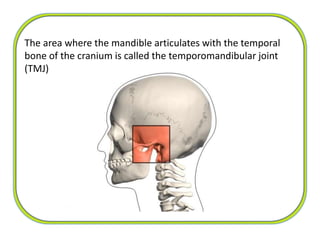
The area where the mandible articulates with the temporal
bone of the cranium is called the temporomandibular joint
(TMJ)
TYPE OF JOINT
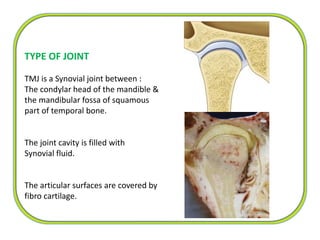
TMJ is a Synovial joint between :
The condylar head of the mandible &
the mandibular fossa of squamous
part of temporal bone.
The joint cavity is filled with
Synovial fluid.
The articular surfaces are covered by
fibro cartilage.
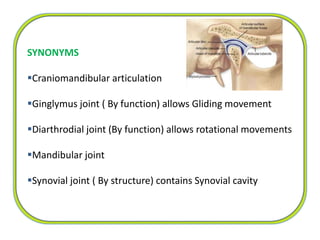
SYNONYMS
Craniomandibular articulation
Ginglymus joint ( By function) allows Gliding movement
Diarthrodial joint (By function) allows rotational movements
Mandibular joint
Synovial joint ( By structure) contains Synovial cavity
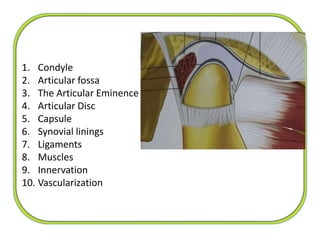
1. Condyle
2. Articular fossa
3. The Articular Eminence
4. Articular Disc
5. Capsule
6. Synovial linings
7. Ligaments
8. Muscles
9. Innervation
10. Vascularization
Trigeminal nerve
Auriculotemporal nerve
Deep temporal and masseteric nerves.
Innervation
Vascularization
The predominant vessels are :
The superficial temporal artery from the posterior,
The middle meningeal artery from the anterior and
The internal maxillary artery from the inferior
Other important arteries are :
the deep auricular,
anterior tympanic, and
ascending pharyngeal arteries.
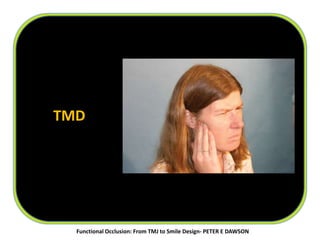
TMD
Functional Occlusion: From TMJ to Smile Design- PETER E DAWSON
DEFINITION:“Temporomandibular disorders are
conditions producing abnormal, incomplete, or
impaired function of the temporomandibular
joint(s) and/or the muscles of mastication.”(GPT-9)
GPT 9
The dental profession generally was first drawn into the area of TM
disorders (TMDs) by Costen’s 1934 article. Costen was an otolaryngologist
who, based on 11 cases, first suggested that changes in dental condition
were responsible for various ear symptoms.
History of Temporomandibular Disorders
Management of temporomandibular disorders and occlusion / Jeffrey P. Okeson. -- 7th ed.
The most common therapies provided at that time were bite-raising
appliances first suggested and described by Costen.
CONTENTS
Epidemiology
57 various epidemiological studies report :
• An average of 40% to 60% of the population as having at least one
detectable sign associated with TMD.
EPIDEMIOLOGICAL STUDIES
• Studies reveal that the most TMD symptoms are reported by people in the
20- to 40-year age group
Management of temporomandibular disorders and occlusion / Jeffrey P. Okeson. -- 7th ed.
• It is documented that occlusal contact patterns influence the function of
the masticatory system the occlusal contact pattern may also
influence functional disturbances.
CONTENTS
Definition
Functional anatomy
Epidemiology
Etiology
Treatment
Discussion
Diagnosis
Classification
Literature review
Conclusion
Classification
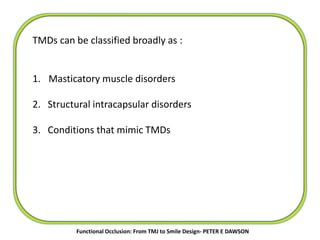
TMDs can be classified broadly as :
1. Masticatory muscle disorders
2. Structural intracapsular disorders
3. Conditions that mimic TMDs
Functional Occlusion: From TMJ to Smile Design- PETER E DAWSON
More specific classification [PETER E DAWSON ]
Category 1: Occluso-muscle disorders with no intracapsular defects.
Category 2 :Intracapsular disorders that are directly related to occlusal
disharmony and are reversible in re-establishing comfortable function
if the occlusion is corrected.
Category 3 :Intracapsular disorders that are not reversible, but because
of adaptive changes, can function comfortably if occluso-muscle
harmony is re-established.
Category 4 :Nonadapted intracapsular disorders that may be either
primary or secondary to occlusal disharmony or may be unrelated.
Functional Occlusion: From TMJ to Smile Design- PETER E DAWSON
Masticatory muscle disorders
Temporomandibular joint
(TMJ) disorders
Chronic mandibular hypomobility
Growth disorders
• Protective co-contraction
• Local muscle soreness
• Myofascial pain
• Myospasm
• Centrally mediated myalgia
• Derangement of the condyle-disc complex
• Structural incompatibility of the articular surfaces
• Inflammatory disorders of the TMJ
• Ankylosis
• Muscle contracture
• Coronoid impedance
• Congenital and developmental bone disorders
• Congenital and developmental muscle disorders
Classification System for Diagnosing Temporomandibular Disorders
[ OKESON JP ]
Management of temporomandibular disorders and occlusion / Jeffrey P. Okeson. -- 7th ed.
CLASSIFICATION
[American Academy of Orofacial Pain] – McNeil
Articular
•Developmental
Deviation of form.
•Disc displacement
With reduction.
Without reduction.
•Hypermobility.
•Dislocation.
•Inflammatory
Synovitis.
Capsulitis.
•Arthritides
Osteoarthrosis.
Osteoarthritis.
Polyarthritides.
•Ankylosis
Fibrous / bony
Non-Articular OR Masticatory muscle disorders.
•Myofascial pain.
•Myositis.
•Spasm.
•Protective splinting.
•Contracture.
•Neoplasia.
McNeill Charles : Management of temporomandibular disorders. J Prosthet Dent 1997; 77: 510-22.
CONTENTS
Definition
Functional anatomy
Epidemiology
Etiology
Treatment
Discussion
Diagnosis
Classification
Literature review
Conclusion
CONTENTS
Etiology
TMD
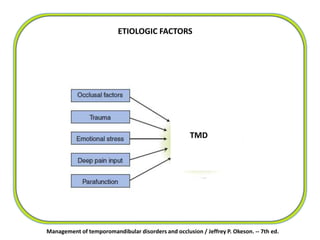
ETIOLOGIC FACTORS
TMD
Management of temporomandibular disorders and occlusion / Jeffrey P. Okeson. -- 7th ed.
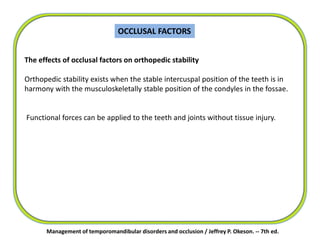
OCCLUSAL FACTORS
Management of temporomandibular disorders and occlusion / Jeffrey P. Okeson. -- 7th ed.
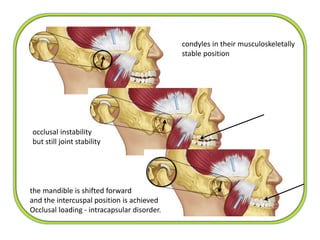
The effects of occlusal factors on orthopedic stability
Orthopedic stability exists when the stable intercuspal position of the teeth is in
harmony with the musculoskeletally stable position of the condyles in the fossae.
Functional forces can be applied to the teeth and joints without tissue injury.
occlusal instability
but still joint stability
the mandible is shifted forward
and the intercuspal position is achieved
Occlusal loading - intracapsular disorder.
condyles in their musculoskeletally
stable position
The
THE EFFECTS OF ACCUTE CHANGES IN THE OCCLUSAL CONDITION AND TMJ
• Accute change produce protective co-contraction.
• Inhibitory effect on parafunctional activity
TRAUMA
Greater impact on intracapsular disorders than on muscular disorders.
Macrotrauma [ eg :-Direct blow to the face ]
Trauma
Microtrauma. [ eg :-Clenching, Bruxism ]
Management of temporomandibular disorders and occlusion / Jeffrey P. Okeson. -- 7th ed.
Stress affects the body by activating the
hypothalamic-pituitary-adrenal (HPA) axis
The HPA axis
[ through complex neural pathways]
Increases the activity of the gamma efferents
Intrafusal fibers of the muscle spindles to contract
sensitized spindles
Any slight stretching of the muscle will cause a
reflex contraction
Increase in the muscle’s tonicity.
EMOTIONAL STRESS
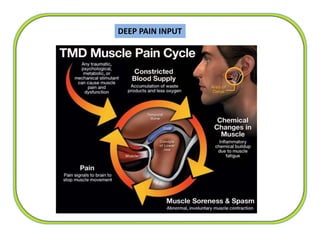
DEEP PAIN INPUT
PARAFUNCTION
Diurnal activity - Parafunctional activity during the day
Clenching
Grinding
Other oral habits often performed without the individual’s awareness
Nocturnal activity
Form of single episodes - Clenching
Rhythmic contractions - Bruxing
Bruxing events
Management of temporomandibular disorders and occlusion / Jeffrey P. Okeson. -- 7th ed.
TMDs can be classified broadly as :
1. Masticatory muscle disorders
2. Structural intracapsular disorders.
Functional Occlusion: From TMJ to Smile Design- PETER E DAWSON
Occluso-Muscle Disorders
Functional Occlusion: From TMJ to Smile Design- PETER E DAWSON
Masticatory muscle Disorders
• Protective co-contraction
• Local muscle soreness
• Myofascial pain
• Myospasm
• Centrally mediated myalgia
Management of temporomandibular disorders and occlusion / Jeffrey P. Okeson. -- 7th ed.
Protective co-contraction [ protective muscle splinting ]
Deep pain input or an increase in emotional stress
Sudden change in sensory or proprioceptive input from associated
structures
CNS response to injury or threat of injury
First response of the masticatory muscles
Management of temporomandibular disorders and occlusion / Jeffrey P. Okeson. -- 7th ed.
Key to identify Protective splinting immediately follows an event
If continues for several hours or days, the muscle tissue can
become compromised and a local muscle problem may develop
Management of temporomandibular disorders and occlusion / Jeffrey P. Okeson. -- 7th ed.
Local muscle soreness (Noninflammatory Myalgia)
The first response of the muscle tissue to prolonged co-contraction
The most common type of acute muscle pain seen in dental practice
Inflammatory changes in the local environment of the muscle tissues.
release of certain algogenic substances (i.e., bradykinin,
substance P, histamine)
produce pain
Muscles - tender to palpation
- increased pain with function
- actual muscle weakness
Eg :- If elevator muscles are involved -- limited mouth opening
Management of temporomandibular disorders and occlusion / Jeffrey P. Okeson. -- 7th ed.
Myospasm(Tonic Contraction Myalgia)
Etiology :-
Muscle fatigue & changes in local electrolyte balances.
Deep pain input
Results in –
• Structural dysfunction - major positional changes in the jaw -
acute malocclusions.
• Firm muscle on palpation
Myospasms are short-lived, lasting for only minutes
Uncontrolled muscle contractions repeated over time = Dystonia
Management of temporomandibular disorders and occlusion / Jeffrey P. Okeson. -- 7th ed.
Myofascial pain ( Trigger point myalgia)
Deep pain input
+
Increased levels of emotional stress
[ upregulation of the autonomic nervous system ]
excite peripheral sensory neurons
(primary afferents)
antidromic release of algogenic substances into the peripheral tissues
(neurogenic inflammation)
muscle pain
Management of temporomandibular disorders and occlusion / Jeffrey P. Okeson. -- 7th ed.
Centrally mediated myalgia
Chronic, continuous muscle pain disorder originating predominantly from CNS
effects that are felt peripherally in the muscle tissues.
Prolonged nociceptive input
Can result in an antidromic effect on afferent peripheral neurons.
Neurons that normally only carry information from the periphery into the CNS can
now be reversed to carry information from the CNS out to the peripheral tissues
The afferent neurons in the periphery can release nociceptive
neurotransmitters (e.g., substance P, bradykinin)
Peripheral tissue pain.
Neurogenic inflammation
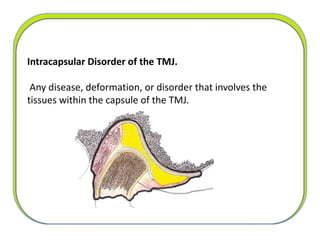
Intracapsular Disorder of the TMJ.
Any disease, deformation, or disorder that involves the
tissues within the capsule of the TMJ.
Intracapsular Disorder of the TMJ.
 Derangement of the condyle-disc complex
• Displacement of the disc.
• Dislocation with reduction
• Dislocation without reduction
 Structural incompatibility of articular surfaces
• Deviation of form
• Adhesions
• Subluxations
• Spontaneous dislocation
 Inflammatory disorders
• Synovitis
• Capsulitis
• Retrodiscitis
• Arthitides.
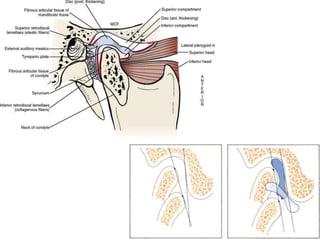
Functioning of normal healthy joint.
• Inferior joint cavity
• Superior joint cavity
• Absence of intra articular pressure-----joint dislocate.
• Superior retrodiscal lamina
• During opening----superior retrodiscal lamina rotates disc
posteriorly & condyle moves anteriorly
• During closing---- superior lateral pterygoid rotates
condyle forward & condyle moves posteriorly.
Functioning of normal healthy joint.
• The disc maintains its position on the condyle during
movement because of its morphology and interarticular
pressure.
• If morphology is altered discal ligaments elongate,disc is
permitted to translate across articular surface of condyle.
BIOMECHANICS OF JOINT ALTERED
Progressive events in condyle – disc dysfunction
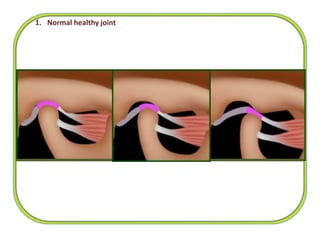
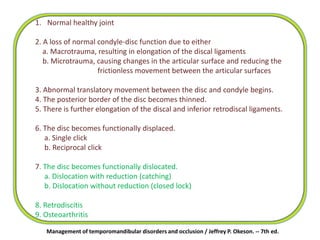
1. Normal healthy joint
2. A loss of normal condyle-disc function due to either
a. Macrotrauma, resulting in elongation of the discal ligaments
b. Microtrauma, causing changes in the articular surface and reducing the
frictionless movement between the articular surfaces
3. Abnormal translatory movement between the disc and condyle begins.
4. The posterior border of the disc becomes thinned.
5. There is further elongation of the discal and inferior retrodiscal ligaments.
6. The disc becomes functionally displaced.
a. Single click
b. Reciprocal click
7. The disc becomes functionally dislocated.
a. Dislocation with reduction (catching)
b. Dislocation without reduction (closed lock)
8. Retrodiscitis
9. Osteoarthritis
Management of temporomandibular disorders and occlusion / Jeffrey P. Okeson. -- 7th ed.
1. Normal healthy joint
2. A loss of normal condyle-disc function due to either
a. Macrotrauma, resulting in elongation of the discal ligaments
b. Microtrauma, causing changes in the articular surface and reducing the
frictionless movement between the articular surfaces
3. Abnormal translatory movement between the disc and condyle begins.
4. The posterior border of the disc becomes thinned.
5. There is further elongation of the discal and inferior retrodiscal ligaments.
6. The disc becomes functionally displaced.
a. Single click
b. Reciprocal click
7. The disc becomes functionally dislocated.
a. Dislocation with reduction (catching)
b. Dislocation without reduction (closed lock)
8. Retrodiscitis
9. Osteoarthritis
Management of temporomandibular disorders and occlusion / Jeffrey P. Okeson. -- 7th ed.
2. A loss of normal condyle-disc function due to either
a. Macrotrauma, resulting in elongation of the discal ligaments
b. Microtrauma, causing changes in the articular surface and reducing the
frictionless movement between the articular surfaces
Macrotrauma
Any sudden force to the joint that can result in structural alterations.
Direct - blow to the chin,
Indirect trauma - injury that may occur to the TMJ secondary to a sudden force but
not one that occurs directly to the mandible. Eg :- cervical extension-flexion injury
Management of temporomandibular disorders and occlusion / Jeffrey P. Okeson. -- 7th ed.
Microtrauma
Any small force that is repeatedly applied to the joint structures over a long period
of time. Eg :- bruxism or clenching
Mechanism : 1
1. Functional limitation of load exceeded
2. Collagen fibrils become fragmented( ARTICULAR SURFACE)
3. Decrease in the stiffness of the collagen network
4. Allows proteoglycan-water gel to swell and flow out into the joint space
5. Softening of the articular surface
6. Chondromalacia .
7. Loading continues to exceed the capacity of the articular tissues
8. Irreversible changes
9. Regions of fibrillation begin to develop
10. Focal roughening of the articular surfaces
11. This alters the frictional characteristics
12. Lead to sticking of the articular surfaces
13. changes in the mechanics of condyle-disc movement
14. Continued sticking and/ or roughening
15. Leads to strains on the discal ligaments during movements
16. Disc displacements.
Management of temporomandibular disorders and occlusion / Jeffrey P. Okeson. -- 7th ed.
Mechanism : 2
Hypoxic/reperfusion theory
1. The forces applied to the articular surfaces can exceed the capillary
pressure of the supplying vessels
2. Hypoxia
3. When the interarticular pressure returns to normal, the blood is
reperfused into the capillaries supplying the joint structures.
4. Free radicals are released.
5. It cause breakdown of hyaluronic acid that protects phospholipids
that line the joint surfaces and joint moves with friction.
6. Friction between articular surfaces leading to breakdown.
7. The resulting sticking can lead to disc displacement.
1. Normal healthy joint
2. A loss of normal condyle-disc function due to either
a. Macrotrauma, resulting in elongation of the discal ligaments
b. Microtrauma, causing changes in the articular surface and reducing the
frictionless movement between the articular surfaces
3. Abnormal translatory movement between the disc and condyle begins.
4. The posterior border of the disc becomes thinned.
5. There is further elongation of the discal and inferior retrodiscal ligaments.
6. The disc becomes functionally displaced.
a. Single click
b. Reciprocal click
7. The disc becomes functionally dislocated.
a. Dislocation with reduction (catching)
b. Dislocation without reduction (closed lock)
8. Retrodiscitis
9. Osteoarthritis
Management of temporomandibular disorders and occlusion / Jeffrey P. Okeson. -- 7th ed.
3.Abnormal translatory movement between the disc and
condyle begins.
4. The posterior border of the disc becomes thinned.
5. There is further elongation of the discal and inferior
retrodiscal ligaments
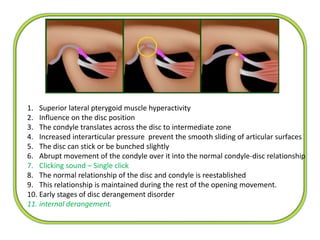
1. Superior lateral pterygoid muscle hyperactivity
2. Influence on the disc position
3. The condyle translates across the disc to intermediate zone
4. Increased interarticular pressure prevent the smooth sliding of articular surfaces
5. The disc can stick or be bunched slightly
6. Abrupt movement of the condyle over it into the normal condyle-disc relationship
7. Clicking sound – Single click
8. The normal relationship of the disc and condyle is reestablished
9. This relationship is maintained during the rest of the opening movement.
10. Early stages of disc derangement disorder
11. internal derangement.
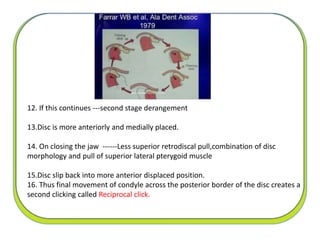
12. If this continues ---second stage derangement
13.Disc is more anteriorly and medially placed.
14. On closing the jaw ------Less superior retrodiscal pull,combination of disc
morphology and pull of superior lateral pterygoid muscle
15.Disc slip back into more anterior displaced position.
16. Thus final movement of condyle across the posterior border of the disc creates a
second clicking called Reciprocal click.
1. Normal healthy joint
2. A loss of normal condyle-disc function due to either
a. Macrotrauma, resulting in elongation of the discal ligaments
b. Microtrauma, causing changes in the articular surface and reducing the
frictionless movement between the articular surfaces
3. Abnormal translatory movement between the disc and condyle begins.
4. The posterior border of the disc becomes thinned.
5. There is further elongation of the discal and inferior retrodiscal ligaments.
6. The disc becomes functionally displaced.
a. Single click
b. Reciprocal click
7. The disc becomes functionally dislocated.
a. Dislocation with reduction (catching)
b. Dislocation without reduction (closed lock)
8. Retrodiscitis
9. Osteoarthritis
Management of temporomandibular disorders and occlusion / Jeffrey P. Okeson. -- 7th ed.
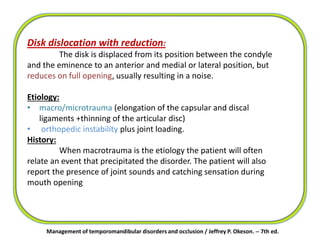
Disk dislocation with reduction:
The disk is displaced from its position between the condyle
and the eminence to an anterior and medial or lateral position, but
reduces on full opening, usually resulting in a noise.
Etiology:
• macro/microtrauma (elongation of the capsular and discal
ligaments +thinning of the articular disc)
• orthopedic instability plus joint loading.
History:
When macrotrauma is the etiology the patient will often
relate an event that precipitated the disorder. The patient will also
report the presence of joint sounds and catching sensation during
mouth opening
Clinical characteristics:
• Normal range of movement is present after the disc is recaptured
during opening of mouth.
• Discal movement can be felt by palpation of the joints during opening
and closing.
• Deviations in the opening pathway are common.
• Presence of catching sensation present.
Disk displacement without reduction (closed lock)
A condition in which the disk is displaced from normal position
between the condyle and the fossa to an anterior and medial or lateral
position, associated with limited mandibular opening
Etiology:
Macrotrauma and microtrauma are the most common cause.
History:
• Patients most often report the exact onset of this disorder.
• The history may reveal a gradual increase in intracapsular symptoms
(clicking and catching) prior to the dislocation.
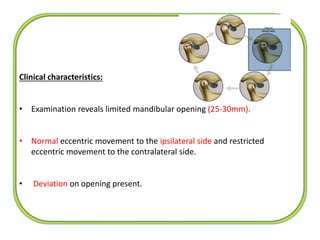
Clinical characteristics:
• Examination reveals limited mandibular opening (25-30mm).
• Normal eccentric movement to the ipsilateral side and restricted
eccentric movement to the contralateral side.
• Deviation on opening present.
Factors that predispose to disc derangement disorders
1. Steepness of the articular eminence
2. Morphology of the condyle and fossa
3. Joint laxity.
4. Hormonal factors.
5. Attachment of the superior lateral pterygoid muscle
Management of temporomandibular disorders and occlusion / Jeffrey P. Okeson. -- 7th ed.
Structural in compatibility of articular surfaces.
• Deviation in form.
• Adhesion.
• Subluxation (Hypermobility).
• Spontaneous dislocation (open lock).
Deviation in form:
Change in the shape of the articular surfaces
• Flattening of condyle/fossa.
• Bony protuberance on the condyle.
• Thinning of the borders of the disc.
• Perforations of the disc.
Adherence/Adhesion:
Adherence: Temporary sticking of articular surfaces.
Adhesion: Permanent sticking of articular surfaces.
.
Adherence :
• Due to static loading( as clenching during sleep)
• Single click then back to normal
• Boundary and Weeping lubrication
Subluxation / Hypermobility
Sudden forward movement of the condyle during latter
phase of mouth opening.
During maximal opening ---Lateral poles will jump forward
causing a noticeable preauricular depression.
Deviation on opening present
Management of temporomandibular disorders and occlusion / Jeffrey P. Okeson. -- 7th ed.
• Due to steep posterior slope of articular eminence.
• Rotational movement of disc is fully utilized before
complete translation of condyle
• So bodily shift occurs ------THUD SOUND.
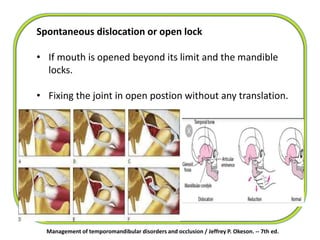
Spontaneous dislocation or open lock
• If mouth is opened beyond its limit and the mandible
locks.
• Fixing the joint in open postion without any translation.
Management of temporomandibular disorders and occlusion / Jeffrey P. Okeson. -- 7th ed.
Inflammatory joint disorders
• Synovitis
• Capsulitis
• Retrodiscitis
• Arthritides.
Management of temporomandibular disorders and occlusion / Jeffrey P. Okeson. -- 7th ed.
Synovitis
The synovial tissues that line the recess areas of the joint become inflamed
Caused by any irritating condition within the joint( microtrauma)
Constant intracapsular pain that is enhanced by joint movement
Tenderness on lateral aspect of condyle is palpated.
Management of temporomandibular disorders and occlusion / Jeffrey P. Okeson. -- 7th ed.
The capsular ligament becomes inflamed
Capsulitis
• Etiology - macrotrauma (especially an open-mouth injury ).
• SAME clinical features of synovitis.
• Differential diagnosis by arthroscopy.
Management of temporomandibular disorders and occlusion / Jeffrey P. Okeson. -- 7th ed.
Retrodiscitis
Etiology –
• Macrotrauma (especially an open-mouth injury ),
• Microtrauma.(As the disc is thinned and the ligaments become
elongated, the condyle begins to encroach on the retrodiscal tissues).
Clinical feature:-
 Constant dull, aching pain that is often increased by clenching.
 Severe inflammation leads to swelling and force the condyle slightly
forward down the posterior slope of the articular eminence. This shift
can cause an acute malocclusion. Ie, DISOCCLUSION
Inflammation of retrodiscal tissues are highly vascularized and innervated
Management of temporomandibular disorders and occlusion / Jeffrey P. Okeson. -- 7th ed.
Inflammation of articular surfaces of the joint.
Group of disorders in which destructive bony changes are seen
Arthritidis
Most common - TMJ osteoarthritis (degenerative joint disease)
1. Loading forces continue
2. Articular surface becomes softened (chondromalacia)
3. Subarticular bone begins to resorb
4. Progressive degeneration results in loss of the subchondral cortical layer
5. bone erosion & osteoarthritis.
once loading is decreased, the arthritic condition can become adaptive. The
adaptive stage is known as osteoarthrosis
Pain
Crepitus
REMAINING TOPICS WILL BE COVERED IN THE NEXT SECTION.
THANKYOU

TEMPOROMANDIBULAR JOINT DISORDERS first part

  • 1.
  • 2.
  • 3.
  • 4.
    The area wherethe mandible articulates with the temporal bone of the cranium is called the temporomandibular joint (TMJ)
  • 5.
    TYPE OF JOINT TMJis a Synovial joint between : The condylar head of the mandible & the mandibular fossa of squamous part of temporal bone. The joint cavity is filled with Synovial fluid. The articular surfaces are covered by fibro cartilage.
  • 6.
    SYNONYMS Craniomandibular articulation Ginglymus joint( By function) allows Gliding movement Diarthrodial joint (By function) allows rotational movements Mandibular joint Synovial joint ( By structure) contains Synovial cavity
  • 7.
    1. Condyle 2. Articularfossa 3. The Articular Eminence 4. Articular Disc 5. Capsule 6. Synovial linings 7. Ligaments 8. Muscles 9. Innervation 10. Vascularization
  • 8.
    Trigeminal nerve Auriculotemporal nerve Deeptemporal and masseteric nerves. Innervation
  • 9.
    Vascularization The predominant vesselsare : The superficial temporal artery from the posterior, The middle meningeal artery from the anterior and The internal maxillary artery from the inferior Other important arteries are : the deep auricular, anterior tympanic, and ascending pharyngeal arteries.
  • 10.
    TMD Functional Occlusion: FromTMJ to Smile Design- PETER E DAWSON
  • 11.
    DEFINITION:“Temporomandibular disorders are conditionsproducing abnormal, incomplete, or impaired function of the temporomandibular joint(s) and/or the muscles of mastication.”(GPT-9) GPT 9
  • 12.
    The dental professiongenerally was first drawn into the area of TM disorders (TMDs) by Costen’s 1934 article. Costen was an otolaryngologist who, based on 11 cases, first suggested that changes in dental condition were responsible for various ear symptoms. History of Temporomandibular Disorders Management of temporomandibular disorders and occlusion / Jeffrey P. Okeson. -- 7th ed. The most common therapies provided at that time were bite-raising appliances first suggested and described by Costen.
  • 13.
  • 14.
    57 various epidemiologicalstudies report : • An average of 40% to 60% of the population as having at least one detectable sign associated with TMD. EPIDEMIOLOGICAL STUDIES • Studies reveal that the most TMD symptoms are reported by people in the 20- to 40-year age group Management of temporomandibular disorders and occlusion / Jeffrey P. Okeson. -- 7th ed. • It is documented that occlusal contact patterns influence the function of the masticatory system the occlusal contact pattern may also influence functional disturbances.
  • 15.
  • 16.
  • 17.
    TMDs can beclassified broadly as : 1. Masticatory muscle disorders 2. Structural intracapsular disorders 3. Conditions that mimic TMDs Functional Occlusion: From TMJ to Smile Design- PETER E DAWSON
  • 18.
    More specific classification[PETER E DAWSON ] Category 1: Occluso-muscle disorders with no intracapsular defects. Category 2 :Intracapsular disorders that are directly related to occlusal disharmony and are reversible in re-establishing comfortable function if the occlusion is corrected. Category 3 :Intracapsular disorders that are not reversible, but because of adaptive changes, can function comfortably if occluso-muscle harmony is re-established. Category 4 :Nonadapted intracapsular disorders that may be either primary or secondary to occlusal disharmony or may be unrelated. Functional Occlusion: From TMJ to Smile Design- PETER E DAWSON
  • 19.
    Masticatory muscle disorders Temporomandibularjoint (TMJ) disorders Chronic mandibular hypomobility Growth disorders • Protective co-contraction • Local muscle soreness • Myofascial pain • Myospasm • Centrally mediated myalgia • Derangement of the condyle-disc complex • Structural incompatibility of the articular surfaces • Inflammatory disorders of the TMJ • Ankylosis • Muscle contracture • Coronoid impedance • Congenital and developmental bone disorders • Congenital and developmental muscle disorders Classification System for Diagnosing Temporomandibular Disorders [ OKESON JP ] Management of temporomandibular disorders and occlusion / Jeffrey P. Okeson. -- 7th ed.
  • 20.
    CLASSIFICATION [American Academy ofOrofacial Pain] – McNeil Articular •Developmental Deviation of form. •Disc displacement With reduction. Without reduction. •Hypermobility. •Dislocation. •Inflammatory Synovitis. Capsulitis. •Arthritides Osteoarthrosis. Osteoarthritis. Polyarthritides. •Ankylosis Fibrous / bony Non-Articular OR Masticatory muscle disorders. •Myofascial pain. •Myositis. •Spasm. •Protective splinting. •Contracture. •Neoplasia. McNeill Charles : Management of temporomandibular disorders. J Prosthet Dent 1997; 77: 510-22.
  • 21.
  • 22.
  • 23.
    TMD ETIOLOGIC FACTORS TMD Management oftemporomandibular disorders and occlusion / Jeffrey P. Okeson. -- 7th ed.
  • 24.
    OCCLUSAL FACTORS Management oftemporomandibular disorders and occlusion / Jeffrey P. Okeson. -- 7th ed. The effects of occlusal factors on orthopedic stability Orthopedic stability exists when the stable intercuspal position of the teeth is in harmony with the musculoskeletally stable position of the condyles in the fossae. Functional forces can be applied to the teeth and joints without tissue injury.
  • 25.
    occlusal instability but stilljoint stability the mandible is shifted forward and the intercuspal position is achieved Occlusal loading - intracapsular disorder. condyles in their musculoskeletally stable position
  • 26.
    The THE EFFECTS OFACCUTE CHANGES IN THE OCCLUSAL CONDITION AND TMJ • Accute change produce protective co-contraction. • Inhibitory effect on parafunctional activity
  • 27.
    TRAUMA Greater impact onintracapsular disorders than on muscular disorders. Macrotrauma [ eg :-Direct blow to the face ] Trauma Microtrauma. [ eg :-Clenching, Bruxism ] Management of temporomandibular disorders and occlusion / Jeffrey P. Okeson. -- 7th ed.
  • 28.
    Management of temporomandibulardisorders and occlusion / Jeffrey P. Okeson. -- 7th ed. Stress affects the body by activating the hypothalamic-pituitary-adrenal (HPA) axis The HPA axis [ through complex neural pathways] Increases the activity of the gamma efferents Intrafusal fibers of the muscle spindles to contract sensitized spindles Any slight stretching of the muscle will cause a reflex contraction Increase in the muscle’s tonicity. EMOTIONAL STRESS
  • 29.
  • 30.
    PARAFUNCTION Diurnal activity -Parafunctional activity during the day Clenching Grinding Other oral habits often performed without the individual’s awareness Nocturnal activity Form of single episodes - Clenching Rhythmic contractions - Bruxing Bruxing events Management of temporomandibular disorders and occlusion / Jeffrey P. Okeson. -- 7th ed.
  • 31.
    TMDs can beclassified broadly as : 1. Masticatory muscle disorders 2. Structural intracapsular disorders. Functional Occlusion: From TMJ to Smile Design- PETER E DAWSON
  • 32.
    Occluso-Muscle Disorders Functional Occlusion:From TMJ to Smile Design- PETER E DAWSON
  • 33.
    Masticatory muscle Disorders •Protective co-contraction • Local muscle soreness • Myofascial pain • Myospasm • Centrally mediated myalgia Management of temporomandibular disorders and occlusion / Jeffrey P. Okeson. -- 7th ed.
  • 34.
    Protective co-contraction [protective muscle splinting ] Deep pain input or an increase in emotional stress Sudden change in sensory or proprioceptive input from associated structures CNS response to injury or threat of injury First response of the masticatory muscles Management of temporomandibular disorders and occlusion / Jeffrey P. Okeson. -- 7th ed. Key to identify Protective splinting immediately follows an event If continues for several hours or days, the muscle tissue can become compromised and a local muscle problem may develop
  • 35.
    Management of temporomandibulardisorders and occlusion / Jeffrey P. Okeson. -- 7th ed. Local muscle soreness (Noninflammatory Myalgia) The first response of the muscle tissue to prolonged co-contraction The most common type of acute muscle pain seen in dental practice Inflammatory changes in the local environment of the muscle tissues. release of certain algogenic substances (i.e., bradykinin, substance P, histamine) produce pain Muscles - tender to palpation - increased pain with function - actual muscle weakness Eg :- If elevator muscles are involved -- limited mouth opening
  • 36.
    Management of temporomandibulardisorders and occlusion / Jeffrey P. Okeson. -- 7th ed. Myospasm(Tonic Contraction Myalgia) Etiology :- Muscle fatigue & changes in local electrolyte balances. Deep pain input Results in – • Structural dysfunction - major positional changes in the jaw - acute malocclusions. • Firm muscle on palpation Myospasms are short-lived, lasting for only minutes Uncontrolled muscle contractions repeated over time = Dystonia
  • 37.
    Management of temporomandibulardisorders and occlusion / Jeffrey P. Okeson. -- 7th ed. Myofascial pain ( Trigger point myalgia) Deep pain input + Increased levels of emotional stress [ upregulation of the autonomic nervous system ] excite peripheral sensory neurons (primary afferents) antidromic release of algogenic substances into the peripheral tissues (neurogenic inflammation) muscle pain
  • 38.
    Management of temporomandibulardisorders and occlusion / Jeffrey P. Okeson. -- 7th ed. Centrally mediated myalgia Chronic, continuous muscle pain disorder originating predominantly from CNS effects that are felt peripherally in the muscle tissues. Prolonged nociceptive input Can result in an antidromic effect on afferent peripheral neurons. Neurons that normally only carry information from the periphery into the CNS can now be reversed to carry information from the CNS out to the peripheral tissues The afferent neurons in the periphery can release nociceptive neurotransmitters (e.g., substance P, bradykinin) Peripheral tissue pain. Neurogenic inflammation
  • 39.
    Intracapsular Disorder ofthe TMJ. Any disease, deformation, or disorder that involves the tissues within the capsule of the TMJ.
  • 40.
    Intracapsular Disorder ofthe TMJ.  Derangement of the condyle-disc complex • Displacement of the disc. • Dislocation with reduction • Dislocation without reduction  Structural incompatibility of articular surfaces • Deviation of form • Adhesions • Subluxations • Spontaneous dislocation  Inflammatory disorders • Synovitis • Capsulitis • Retrodiscitis • Arthitides.
  • 41.
    Functioning of normalhealthy joint. • Inferior joint cavity • Superior joint cavity • Absence of intra articular pressure-----joint dislocate. • Superior retrodiscal lamina • During opening----superior retrodiscal lamina rotates disc posteriorly & condyle moves anteriorly • During closing---- superior lateral pterygoid rotates condyle forward & condyle moves posteriorly.
  • 43.
    Functioning of normalhealthy joint. • The disc maintains its position on the condyle during movement because of its morphology and interarticular pressure. • If morphology is altered discal ligaments elongate,disc is permitted to translate across articular surface of condyle. BIOMECHANICS OF JOINT ALTERED
  • 44.
    Progressive events incondyle – disc dysfunction
  • 45.
    1. Normal healthyjoint 2. A loss of normal condyle-disc function due to either a. Macrotrauma, resulting in elongation of the discal ligaments b. Microtrauma, causing changes in the articular surface and reducing the frictionless movement between the articular surfaces 3. Abnormal translatory movement between the disc and condyle begins. 4. The posterior border of the disc becomes thinned. 5. There is further elongation of the discal and inferior retrodiscal ligaments. 6. The disc becomes functionally displaced. a. Single click b. Reciprocal click 7. The disc becomes functionally dislocated. a. Dislocation with reduction (catching) b. Dislocation without reduction (closed lock) 8. Retrodiscitis 9. Osteoarthritis Management of temporomandibular disorders and occlusion / Jeffrey P. Okeson. -- 7th ed.
  • 46.
  • 47.
    1. Normal healthyjoint 2. A loss of normal condyle-disc function due to either a. Macrotrauma, resulting in elongation of the discal ligaments b. Microtrauma, causing changes in the articular surface and reducing the frictionless movement between the articular surfaces 3. Abnormal translatory movement between the disc and condyle begins. 4. The posterior border of the disc becomes thinned. 5. There is further elongation of the discal and inferior retrodiscal ligaments. 6. The disc becomes functionally displaced. a. Single click b. Reciprocal click 7. The disc becomes functionally dislocated. a. Dislocation with reduction (catching) b. Dislocation without reduction (closed lock) 8. Retrodiscitis 9. Osteoarthritis Management of temporomandibular disorders and occlusion / Jeffrey P. Okeson. -- 7th ed.
  • 48.
    2. A lossof normal condyle-disc function due to either a. Macrotrauma, resulting in elongation of the discal ligaments b. Microtrauma, causing changes in the articular surface and reducing the frictionless movement between the articular surfaces Macrotrauma Any sudden force to the joint that can result in structural alterations. Direct - blow to the chin, Indirect trauma - injury that may occur to the TMJ secondary to a sudden force but not one that occurs directly to the mandible. Eg :- cervical extension-flexion injury Management of temporomandibular disorders and occlusion / Jeffrey P. Okeson. -- 7th ed. Microtrauma Any small force that is repeatedly applied to the joint structures over a long period of time. Eg :- bruxism or clenching
  • 49.
    Mechanism : 1 1.Functional limitation of load exceeded 2. Collagen fibrils become fragmented( ARTICULAR SURFACE) 3. Decrease in the stiffness of the collagen network 4. Allows proteoglycan-water gel to swell and flow out into the joint space 5. Softening of the articular surface 6. Chondromalacia . 7. Loading continues to exceed the capacity of the articular tissues 8. Irreversible changes 9. Regions of fibrillation begin to develop 10. Focal roughening of the articular surfaces 11. This alters the frictional characteristics 12. Lead to sticking of the articular surfaces 13. changes in the mechanics of condyle-disc movement 14. Continued sticking and/ or roughening 15. Leads to strains on the discal ligaments during movements 16. Disc displacements. Management of temporomandibular disorders and occlusion / Jeffrey P. Okeson. -- 7th ed.
  • 50.
    Management of temporomandibulardisorders and occlusion / Jeffrey P. Okeson. -- 7th ed. Mechanism : 2 Hypoxic/reperfusion theory 1. The forces applied to the articular surfaces can exceed the capillary pressure of the supplying vessels 2. Hypoxia 3. When the interarticular pressure returns to normal, the blood is reperfused into the capillaries supplying the joint structures. 4. Free radicals are released. 5. It cause breakdown of hyaluronic acid that protects phospholipids that line the joint surfaces and joint moves with friction. 6. Friction between articular surfaces leading to breakdown. 7. The resulting sticking can lead to disc displacement.
  • 51.
    1. Normal healthyjoint 2. A loss of normal condyle-disc function due to either a. Macrotrauma, resulting in elongation of the discal ligaments b. Microtrauma, causing changes in the articular surface and reducing the frictionless movement between the articular surfaces 3. Abnormal translatory movement between the disc and condyle begins. 4. The posterior border of the disc becomes thinned. 5. There is further elongation of the discal and inferior retrodiscal ligaments. 6. The disc becomes functionally displaced. a. Single click b. Reciprocal click 7. The disc becomes functionally dislocated. a. Dislocation with reduction (catching) b. Dislocation without reduction (closed lock) 8. Retrodiscitis 9. Osteoarthritis Management of temporomandibular disorders and occlusion / Jeffrey P. Okeson. -- 7th ed.
  • 52.
    Management of temporomandibulardisorders and occlusion / Jeffrey P. Okeson. -- 7th ed. 3.Abnormal translatory movement between the disc and condyle begins. 4. The posterior border of the disc becomes thinned. 5. There is further elongation of the discal and inferior retrodiscal ligaments
  • 53.
    1. Superior lateralpterygoid muscle hyperactivity 2. Influence on the disc position 3. The condyle translates across the disc to intermediate zone 4. Increased interarticular pressure prevent the smooth sliding of articular surfaces 5. The disc can stick or be bunched slightly 6. Abrupt movement of the condyle over it into the normal condyle-disc relationship 7. Clicking sound – Single click 8. The normal relationship of the disc and condyle is reestablished 9. This relationship is maintained during the rest of the opening movement. 10. Early stages of disc derangement disorder 11. internal derangement.
  • 54.
    12. If thiscontinues ---second stage derangement 13.Disc is more anteriorly and medially placed. 14. On closing the jaw ------Less superior retrodiscal pull,combination of disc morphology and pull of superior lateral pterygoid muscle 15.Disc slip back into more anterior displaced position. 16. Thus final movement of condyle across the posterior border of the disc creates a second clicking called Reciprocal click.
  • 55.
    1. Normal healthyjoint 2. A loss of normal condyle-disc function due to either a. Macrotrauma, resulting in elongation of the discal ligaments b. Microtrauma, causing changes in the articular surface and reducing the frictionless movement between the articular surfaces 3. Abnormal translatory movement between the disc and condyle begins. 4. The posterior border of the disc becomes thinned. 5. There is further elongation of the discal and inferior retrodiscal ligaments. 6. The disc becomes functionally displaced. a. Single click b. Reciprocal click 7. The disc becomes functionally dislocated. a. Dislocation with reduction (catching) b. Dislocation without reduction (closed lock) 8. Retrodiscitis 9. Osteoarthritis Management of temporomandibular disorders and occlusion / Jeffrey P. Okeson. -- 7th ed.
  • 56.
    Management of temporomandibulardisorders and occlusion / Jeffrey P. Okeson. -- 7th ed. Disk dislocation with reduction: The disk is displaced from its position between the condyle and the eminence to an anterior and medial or lateral position, but reduces on full opening, usually resulting in a noise. Etiology: • macro/microtrauma (elongation of the capsular and discal ligaments +thinning of the articular disc) • orthopedic instability plus joint loading. History: When macrotrauma is the etiology the patient will often relate an event that precipitated the disorder. The patient will also report the presence of joint sounds and catching sensation during mouth opening
  • 57.
    Clinical characteristics: • Normalrange of movement is present after the disc is recaptured during opening of mouth. • Discal movement can be felt by palpation of the joints during opening and closing. • Deviations in the opening pathway are common. • Presence of catching sensation present.
  • 58.
    Disk displacement withoutreduction (closed lock) A condition in which the disk is displaced from normal position between the condyle and the fossa to an anterior and medial or lateral position, associated with limited mandibular opening Etiology: Macrotrauma and microtrauma are the most common cause. History: • Patients most often report the exact onset of this disorder. • The history may reveal a gradual increase in intracapsular symptoms (clicking and catching) prior to the dislocation.
  • 59.
    Clinical characteristics: • Examinationreveals limited mandibular opening (25-30mm). • Normal eccentric movement to the ipsilateral side and restricted eccentric movement to the contralateral side. • Deviation on opening present.
  • 60.
    Factors that predisposeto disc derangement disorders 1. Steepness of the articular eminence 2. Morphology of the condyle and fossa 3. Joint laxity. 4. Hormonal factors. 5. Attachment of the superior lateral pterygoid muscle Management of temporomandibular disorders and occlusion / Jeffrey P. Okeson. -- 7th ed.
  • 61.
    Structural in compatibilityof articular surfaces. • Deviation in form. • Adhesion. • Subluxation (Hypermobility). • Spontaneous dislocation (open lock).
  • 62.
    Deviation in form: Changein the shape of the articular surfaces • Flattening of condyle/fossa. • Bony protuberance on the condyle. • Thinning of the borders of the disc. • Perforations of the disc.
  • 63.
    Adherence/Adhesion: Adherence: Temporary stickingof articular surfaces. Adhesion: Permanent sticking of articular surfaces. . Adherence : • Due to static loading( as clenching during sleep) • Single click then back to normal • Boundary and Weeping lubrication
  • 64.
    Subluxation / Hypermobility Suddenforward movement of the condyle during latter phase of mouth opening. During maximal opening ---Lateral poles will jump forward causing a noticeable preauricular depression. Deviation on opening present Management of temporomandibular disorders and occlusion / Jeffrey P. Okeson. -- 7th ed. • Due to steep posterior slope of articular eminence. • Rotational movement of disc is fully utilized before complete translation of condyle • So bodily shift occurs ------THUD SOUND.
  • 65.
    Spontaneous dislocation oropen lock • If mouth is opened beyond its limit and the mandible locks. • Fixing the joint in open postion without any translation. Management of temporomandibular disorders and occlusion / Jeffrey P. Okeson. -- 7th ed.
  • 66.
    Inflammatory joint disorders •Synovitis • Capsulitis • Retrodiscitis • Arthritides. Management of temporomandibular disorders and occlusion / Jeffrey P. Okeson. -- 7th ed.
  • 67.
    Synovitis The synovial tissuesthat line the recess areas of the joint become inflamed Caused by any irritating condition within the joint( microtrauma) Constant intracapsular pain that is enhanced by joint movement Tenderness on lateral aspect of condyle is palpated. Management of temporomandibular disorders and occlusion / Jeffrey P. Okeson. -- 7th ed.
  • 68.
    The capsular ligamentbecomes inflamed Capsulitis • Etiology - macrotrauma (especially an open-mouth injury ). • SAME clinical features of synovitis. • Differential diagnosis by arthroscopy. Management of temporomandibular disorders and occlusion / Jeffrey P. Okeson. -- 7th ed.
  • 69.
    Management of temporomandibulardisorders and occlusion / Jeffrey P. Okeson. -- 7th ed. Retrodiscitis Etiology – • Macrotrauma (especially an open-mouth injury ), • Microtrauma.(As the disc is thinned and the ligaments become elongated, the condyle begins to encroach on the retrodiscal tissues). Clinical feature:-  Constant dull, aching pain that is often increased by clenching.  Severe inflammation leads to swelling and force the condyle slightly forward down the posterior slope of the articular eminence. This shift can cause an acute malocclusion. Ie, DISOCCLUSION Inflammation of retrodiscal tissues are highly vascularized and innervated
  • 70.
    Management of temporomandibulardisorders and occlusion / Jeffrey P. Okeson. -- 7th ed. Inflammation of articular surfaces of the joint. Group of disorders in which destructive bony changes are seen Arthritidis Most common - TMJ osteoarthritis (degenerative joint disease) 1. Loading forces continue 2. Articular surface becomes softened (chondromalacia) 3. Subarticular bone begins to resorb 4. Progressive degeneration results in loss of the subchondral cortical layer 5. bone erosion & osteoarthritis. once loading is decreased, the arthritic condition can become adaptive. The adaptive stage is known as osteoarthrosis Pain Crepitus
  • 71.
    REMAINING TOPICS WILLBE COVERED IN THE NEXT SECTION. THANKYOU

Editor's Notes

  • #6 The fibro cartilage is considered as a growth center, which contributes to the over all growth of the mandible
  • #9 Branches of the mandibular nerve provide the afferent innervation. Most innervation is provided by the auriculotemporal nerve. Additional innervation is provided by the deep temporal and masseteric nerves.
  • #15 Signs that are present but unknown to the patient are called subclinical. a logical assumption would be that the occlusal contact pattern may also influence functional disturbances. it makes the study of occlusion a significant and important part of dentistry
  • #18 Combinations of two of all three problems can and do occur
  • #19 The most common source of orofacial pain and dysfunction that can be associated with TMDs is occluso-muscle pain/dysfunction. There is hardly an aspect of dentistry that is not related in some way to the cause or correction of occluso-muscle disorders.
  • #24 ETIOLOGIC FACTORS UNDERLYING TEMPOROMANDIBULAR DISORDERS
  • #25 Orthopedic stability exists when the stable intercuspal position of the teeth is in harmony with the musculoskeletally stable position of the condyles in the fossae. When this condition exists, functional forces can be applied to the teeth and joints without tissue injury.
  • #26 A, With the teeth apart, the elevator muscles maintain the condyles in their musculoskeletally stable positions (superior-anterior positions resting against the posterior slopes of the articular eminences). In this situation there is joint stability. B, As the mouth is closed, a single tooth contact does not allow the entire dental arch to gain full intercuspation. At this point there is occlusal instability but still joint stability. Since the condyles and teeth do not fit in a stable relationship at the same time, this is orthopedic instability (Chapter 5). C, In order to gain the occlusal stability necessary for functional activities, the mandible is shifted forward and the intercuspal position is achieved. At this point the patient achieves occlusal stability but the condyles may no longer be orthopedically stable. This orthopedic instability may not pose a problem unless unusual loading occurs. If loading begins, the condyles will seek out stability and the unusual movement can lead to strains on the condyle/disc complex, resulting in an intracapsular disorder
  • #27 A, With the teeth apart, the elevator muscles maintain the condyles in their musculoskeletally stable positions (superior-anterior positions resting against the posterior slopes of the articular eminences). In this situation there is joint stability. B, As the mouth is closed, a single tooth contact does not allow the entire dental arch to gain full intercuspation. At this point there is occlusal instability but still joint stability. Since the condyles and teeth do not fit in a stable relationship at the same time, this is orthopedic instability (Chapter 5). C, In order to gain the occlusal stability necessary for functional activities, the mandible is shifted forward and the intercuspal position is achieved. At this point the patient achieves occlusal stability but the condyles may no longer be orthopedically stable. This orthopedic instability may not pose a problem unless unusual loading occurs. If loading begins, the condyles will seek out stability and the unusual movement can lead to strains on the condyle/disc complex, resulting in an intracapsular disorder
  • #28 Macrotrauma is any sudden force that can result in structural alterations, such as a direct blow to the face. Microtrauma is any small force that is repeatedly applied to the structures over a long period of time. Activities such as bruxism or clenching can produce microtrauma to the tissues that are being loaded (i.e., teeth, joints, or muscles)
  • #29 The overall effect is an increase in the muscle’s tonicity. HPA axis prepares the body to respond (through the autonomic nervous system).
  • #31 other oral habits often performed without the individual’s awareness, such as cheek and tongue biting, finger and thumb sucking, unusual postural habits, and many occupation-related activities such as biting on pencils, pins, or nails or holding objects under the chin. once the clinician makes the patient aware of the possibility of these diurnal activities, he or she will recognize them and can than decrease them. In many patients both activities occur and are sometimes difficult to separate. For that reason clenching and bruxism are often referred as bruxing events
  • #32 Combinations of two of all three problems can and do occur
  • #33 Most temporomandibular disorder (TMD) pain is not temporomandibular joint (TMJ) pain. Most TMD pain is masticatory muscle pain triggered by deflective occlusal interferences.
  • #34 Most temporomandibular disorder (TMD) pain is not temporomandibular joint (TMJ) pain. Most TMD pain is masticatory muscle pain triggered by deflective occlusal interferences.
  • #35 Most temporomandibular disorder (TMD) pain is not temporomandibular joint (TMJ) pain. Most TMD pain is masticatory muscle pain triggered by deflective occlusal interferences.
  • #36 Most temporomandibular disorder (TMD) pain is not temporomandibular joint (TMJ) pain. Most TMD pain is masticatory muscle pain triggered by deflective occlusal interferences.
  • #38 The muscle pain conditions described to this point are relatively simple, having their origins predominantly in the local muscle tissues. Therefore these conditions can be managed successfully by treatment of the local structures (muscles, joints, or teeth).
  • #39 when the CNS becomes exposed to prolonged nociceptive input, brainstem pathways can functionally change. This can result in an antidromic effect on afferent peripheral neurons. Inother words, neurons that normally only carry information from the periphery into the CNS can now be reversed to carry information from the CNS out to the peripheral tissues. This is likely to occur through the axon transport system.23 When this occurs, the afferent neurons in the periphery can release nociceptive neurotransmitters (e.g., substance P, bradykinin), which in turn causes peripheral tissue pain. This process is called neurogenic inflammation.
  • #47 A, Normal position of the disc on the condyle in the closed-joint position. B, Functional displacement of the disc. Its posterior border has been thinned and the discal and inferior retrodiscal ligaments are elongated, allowing activity of the superior lateral pterygoid to displace the disc anteriorly (and medially. The forward movement of the disc will be limited by the length of the discal ligaments and the thickness of the posterior border of the disc. Actually the attachment of the superolateral pterygoid pulls the disc not only forward but also medially on the condyle (Figure 8-6). If the pull of this muscle is prolonged, over time the posterior border of the disc can become more thinned. As this area is thinned, the disc may be displaced more in the anteromedial direction. Since the superior retrodiscal lamina provides little resistance in the closed joint position, the medial and anterior position of the disc is maintained. As the posterior border of the disc becomes more thinned, it can be displaced further into the discal space so that the condyle becomes positioned on the posterior border of the disc. This condition is known as functional disc displacement
  • #49 If this trauma occurs when the teeth are separated (open-mouth trauma) the condyle can be suddenly displaced from the fossa. This sudden movement of the condyle is resisted by the ligaments. If the force is great, the ligaments can become elongated, which may compromise normal condyle-disc mechanics. The resulting increased looseness can lead to discal displacement and to the symptoms of clicking and catching. With open-mouth trauma, the joint opposite to the site of the trauma often receives the most injury. For example, if an individual receives a blow to the right side of the mandible, the mandible is quickly shifted to the left. The right condyle is well supported by the medial wall of the fossae. Therefore this condyle is not displaced and ligaments are not injured. However, when a blow comes to the right side, the left condyle can be quickly forced laterally where there is no bony support, only ligaments. These ligaments can be suddenly elongated, resulting in a left TMJ disc displacement. Macrotrauma can also occur when the teeth are together (closed-mouth trauma). If trauma occurs to the mandible when the teeth are together, the intercuspation of the teeth maintains the jaw position, resisting joint displacement. Closed-mouth trauma is therefore less injurious to the condyle-disc complex . Closed-mouth trauma is not likely to be without some consequence. Although ligaments may not be elongated, articular surfaces can certainly receive sudden traumatic loading.149 This type of loading may disrupt the articular surface of the condyle, fossa, or disc, which may lead to alterations in the smooth sliding surfaces of the joint, causing roughness and even sticking during movement. This type of trauma therefore may result in Adhesions. Microtrauma - the dense fibrous connective tissues that cover the articular surfaces of the joints can well tolerate loading forces. In fact, these tissues need a certain amount of loading to survive, since loading forces drive synovial fluid in and out of the articular surfaces, delivering nutrients with it and removing waste products. When the functional limitation has been exceeded, the collagen fibrils become fragmented, resulting in a decrease in the stiffness of the collagen network. This allows the proteoglycan-water gel to swell and flow out into the joint space, leading to a softening of the articular surface. This softening is called chondromalacia.168 This early stage of chondromalacia is reversible if the excessive loading is reduced. If, however, the loading continues to exceed the capacity of the articular tissues, irreversible changes can occur. Regions of fibrillation can begin to develop, resulting in focal roughening of the articular surfaces.169 This alters the frictional characteristics and may lead to sticking of the articular surfaces, causing changes in the mechanics of condyle-disc movement. Continued sticking and/ or roughening leads to strains on the discal ligaments during movements and eventually disc displacements. Hypoxic/reperfusion theory -the forces applied to the articular surfaces can exceed the capillary pressure of the supplying vessels. If this pressure is maintained, hypoxia can develop in the structures supplied by the vessels. When the interarticular pressure returns to normal, the blood is reperfused into the capillaries supplying the joint structures. It is thought that free radicals are released into the synovial fluid during this reperfusion phase. These free radicals can rapidly break down the hyaluronic acid protecting the phospholipids that line the joint surfaces and provide important lubrication.170-176 When the phospholipids are lost,177 the articular surfaces no longer slide frictionlessly, leading to breakdown. The resulting sticking can also lead to disc displacement.
  • #54 If muscle hyperactivity were present, the superior lateral pterygoid muscle would have an even greater influence on the disc position. The important feature of this functional relationship is that the condyle translates across the disc to some degree when movement begins. This type of movement does not occur in the normal joint. During such movement the increased interarticular pressure may prevent the articular surfaces from sliding across each other smoothly. The disc can stick or be bunched slightly, causing an abrupt movement of the condyle over it into the normal condyledisc relationship. A clicking sound often accompanies this abrupt movement. Once the joint has clicked, the normal relationship of the disc and condyle is reestablished, and this relationship is maintained during the rest of the opening movement. During closing of the mouth, the normal relationship of the disc and condyle is maintained because of interarticular pressure. However, once the mouth is closed and the interarticular pressure is lower, the disc can once again be displaced forward by tonicity of the superior lateral pterygoid muscle. In many instances, if the displacement is slight and the interarticular pressure is low, no click is noted during this redisplacement (Figure 8-8). This single click observed during opening movement represents the very early stages of disc derangement disorder or what is also called internal derangement.
  • #55 If muscle hyperactivity were present, the superior lateral pterygoid muscle would have an even greater influence on the disc position. The important feature of this functional relationship is that the condyle translates across the disc to some degree when movement begins. This type of movement does not occur in the normal joint. During such movement the increased interarticular pressure may prevent the articular surfaces from sliding across each other smoothly. The disc can stick or be bunched slightly, causing an abrupt movement of the condyle over it into the normal condyledisc relationship. A clicking sound often accompanies this abrupt movement. Once the joint has clicked, the normal relationship of the disc and condyle is reestablished, and this relationship is maintained during the rest of the opening movement. During closing of the mouth, the normal relationship of the disc and condyle is maintained because of interarticular pressure. However, once the mouth is closed and the interarticular pressure is lower, the disc can once again be displaced forward by tonicity of the superior lateral pterygoid muscle. In many instances, if the displacement is slight and the interarticular pressure is low, no click is noted during this redisplacement (Figure 8-8). This single click observed during opening movement represents the very early stages of disc derangement disorder or what is also called internal derangement.
  • #61 Steepness -As the steepness increases, more rotational movement is required between the disc and condyle during forward translation of the condyle (Figure 8-23).244 Therefore patients with steep eminences are more likely to demonstrate greater condyle-disc movement during function. This exaggerated condyle-disc movement may increase the risk of ligament elongation, which leads to disc derangement disorders. Morphology - Flat or gablelike condyles that articulate against inverted V-shaped temporal components seem to be more vulnerable to disc derangement disorders and degenerative joint disease. Joint laxity - generalized laxity may be due to increased levels of estrogen.252-254 For example, women’s joints are generally more flexible and lax than men’s. may help explain the higher incidence of TMDs in females. Hormones - premenstrual phase, oral contraceptives Superior lateral pterygoid muscle - if the attachment of the muscle is greater to the neck of the condyle (and less to the disc), muscle function will have correspondingly less influence on disc position.