Ahmed Elborae
How to ?
series
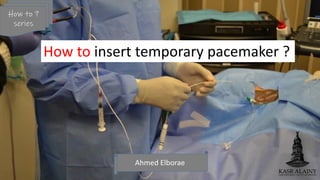
How to insert temporary pacemaker ?
21th of July, 1969
11 years before we step on the moon…
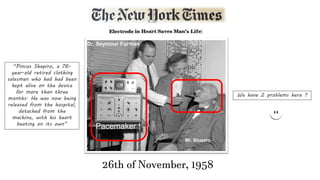
“Pincus Shapiro, a 76-
year-old retired clothing
salesman who had had been
kept alive on the device
for more than three
months. He was now being
released from the hospital,
detached from the
machine, with his heart
beating on its own”
Mr. Shapiro
Dr. Seymour Furman
Pacemaker !
26th of November, 1958
We have 2 problems here ?
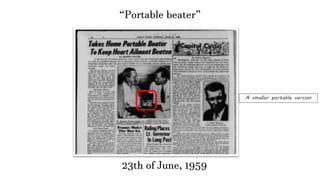
23th of June, 1959
“Portable beater”
A smaller portable version
Indications?
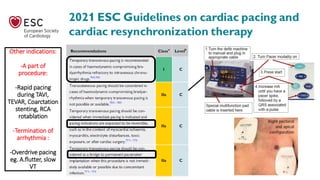
Other indications:
-A part of
procedure:
-Rapid pacing
during TAVI,
TEVAR, Coarctation
stenting, RCA
rotablation
-Termination of
arrhythmia :
-Overdrive pacing
eg. A.flutter, slow
VT
How?
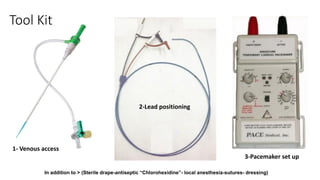
Tool Kit
In addition to > (Sterile drape-antiseptic “Chlorohexidine”- local anesthesia-sutures- dressing)
1- Venous access
2-Lead positioning
3-Pacemaker set up
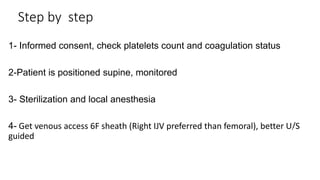
Step by step
1- Informed consent, check platelets count and coagulation status
2-Patient is positioned supine, monitored
3- Sterilization and local anesthesia
4- Get venous access 6F sheath (Right IJV preferred than femoral), better U/S
guided
Skin
Liver
*
5- Introduce the pacing lead under fluoroscopy guidance
The most critical step
Andrei D Margulescu, et al.Accuracy of fluoroscopic and electrocardiographic criteria for pacemaker lead implantation by comparison with three-dimensional echocardiography. ASE journal 2012.
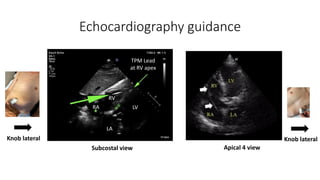
Echocardiography guidance
RA
RV
TPM Lead
at RV apex
LA
LV
Subcostal view Apical 4 view
Knob lateral Knob lateral
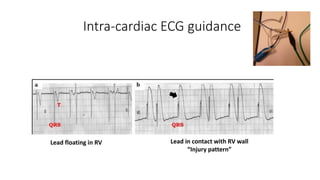
Intra-cardiac ECG guidance
Lead floating in RV Lead in contact with RV wall
“Injury pattern”
Sensitivity (mV):
Lower than least
sensed R (mV)
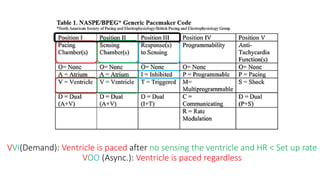
> Demand= VVI
>Async.= V00 (Risk R on T )
Heart rate:
Then usually set 70-80/min.
Higher might be allowed in
HF, shock
Output (mA):
Start high and go ↓
Usually set (x2) least
capture (mA)
6- pacemaker set up
↓ mA till Loss of capture
4 mA 3 mA 2 mA 1mA
↑ mV threshold till Loss of sensing, then set it below
Pacemaker language?
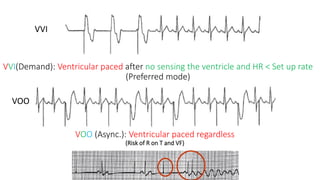
VVI
VOO
VVI(Demand): Ventricle is paced after no sensing the ventricle and HR < Set up rate
VOO (Async.): Ventricle is paced regardless
VOO (Async.): Ventricular paced regardless
(Risk of R on T and VF)
VVI(Demand): Ventricular paced after no sensing the ventricle and HR < Set up rate
(Preferred mode)
VVI
VOO
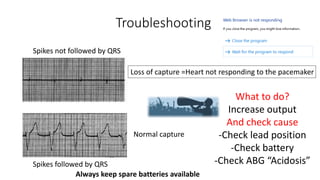
Troubleshooting
Spikes not followed by QRS
Spikes followed by QRS
Loss of capture =Heart not responding to the pacemaker
Normal capture
What to do?
Increase output
And check cause
-Check lead position
-Check battery
-Check ABG “Acidosis”
Always keep spare batteries available
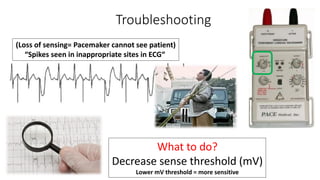
Troubleshooting
(Loss of sensing= Pacemaker cannot see patient)
“Spikes seen in inappropriate sites in ECG“
What to do?
Decrease sense threshold (mV)
Lower mV threshold = more sensitive
Post procedure
• Fix sheath by suture, and cover lead with sterile dressing
• Do ECG post procedure (LBBB)
• Do CXR post procedure to exclude lung complications
• Consider prophylactic antibiotics “preferred anti-staph”
• Consider prophylactic anticoagulation especially femoral approach
• Shorten duration as possible to limit complications
• Echo FU before and after removal of lead (Pericardial effusion)
Complications?
“If you didn’t have complications, then you did not perform the number needed to get one”
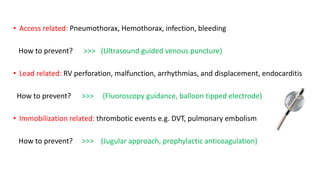
• Access related: Pneumothorax, Hemothorax, infection, bleeding
How to prevent? >>> (Ultrasound guided venous puncture)
• Lead related: RV perforation, malfunction, arrhythmias, and displacement, endocarditis
How to prevent? >>> (Fluoroscopy guidance, balloon tipped electrode)
• Immobilization related: thrombotic events e.g. DVT, pulmonary embolism
How to prevent? >>> (Jugular approach, prophylactic anticoagulation)
Special situations?
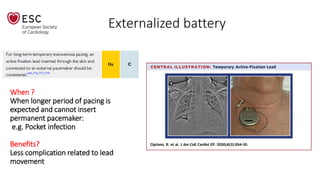
Externalized battery
When ?
When longer period of pacing is
expected and cannot insert
permanent pacemaker:
e.g. Pocket infection
Benefits?
Less complication related to lead
movement
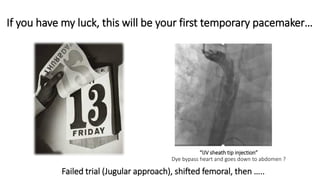
If you have my luck, this will be your first temporary pacemaker…
Failed trial (Jugular approach), shifted femoral, then …..
“IJV sheath tip injection”
Dye bypass heart and goes down to abdomen ?
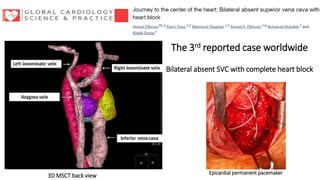
3D MSCT back view
The 3rd reported case worldwide
Bilateral absent SVC with complete heart block
Epicardial permanent pacemaker
Thank You

Temporary pacemaker

  • 1.
    Ahmed Elborae How to? series How to insert temporary pacemaker ?
  • 2.
  • 3.
    11 years beforewe step on the moon…
  • 4.
    “Pincus Shapiro, a76- year-old retired clothing salesman who had had been kept alive on the device for more than three months. He was now being released from the hospital, detached from the machine, with his heart beating on its own” Mr. Shapiro Dr. Seymour Furman Pacemaker ! 26th of November, 1958 We have 2 problems here ?
  • 5.
    23th of June,1959 “Portable beater” A smaller portable version
  • 6.
  • 7.
    Other indications: -A partof procedure: -Rapid pacing during TAVI, TEVAR, Coarctation stenting, RCA rotablation -Termination of arrhythmia : -Overdrive pacing eg. A.flutter, slow VT
  • 8.
  • 9.
    Tool Kit In additionto > (Sterile drape-antiseptic “Chlorohexidine”- local anesthesia-sutures- dressing) 1- Venous access 2-Lead positioning 3-Pacemaker set up
  • 10.
    Step by step 1-Informed consent, check platelets count and coagulation status 2-Patient is positioned supine, monitored 3- Sterilization and local anesthesia 4- Get venous access 6F sheath (Right IJV preferred than femoral), better U/S guided Skin Liver *
  • 11.
    5- Introduce thepacing lead under fluoroscopy guidance The most critical step Andrei D Margulescu, et al.Accuracy of fluoroscopic and electrocardiographic criteria for pacemaker lead implantation by comparison with three-dimensional echocardiography. ASE journal 2012.
  • 12.
    Echocardiography guidance RA RV TPM Lead atRV apex LA LV Subcostal view Apical 4 view Knob lateral Knob lateral
  • 13.
    Intra-cardiac ECG guidance Leadfloating in RV Lead in contact with RV wall “Injury pattern”
  • 14.
    Sensitivity (mV): Lower thanleast sensed R (mV) > Demand= VVI >Async.= V00 (Risk R on T ) Heart rate: Then usually set 70-80/min. Higher might be allowed in HF, shock Output (mA): Start high and go ↓ Usually set (x2) least capture (mA) 6- pacemaker set up ↓ mA till Loss of capture 4 mA 3 mA 2 mA 1mA ↑ mV threshold till Loss of sensing, then set it below
  • 15.
  • 16.
    VVI(Demand): Ventricle ispaced after no sensing the ventricle and HR < Set up rate VOO (Async.): Ventricle is paced regardless
  • 17.
    VOO (Async.): Ventricularpaced regardless (Risk of R on T and VF) VVI(Demand): Ventricular paced after no sensing the ventricle and HR < Set up rate (Preferred mode) VVI VOO
  • 18.
    Troubleshooting Spikes not followedby QRS Spikes followed by QRS Loss of capture =Heart not responding to the pacemaker Normal capture What to do? Increase output And check cause -Check lead position -Check battery -Check ABG “Acidosis” Always keep spare batteries available
  • 19.
    Troubleshooting (Loss of sensing=Pacemaker cannot see patient) “Spikes seen in inappropriate sites in ECG“ What to do? Decrease sense threshold (mV) Lower mV threshold = more sensitive
  • 20.
    Post procedure • Fixsheath by suture, and cover lead with sterile dressing • Do ECG post procedure (LBBB) • Do CXR post procedure to exclude lung complications • Consider prophylactic antibiotics “preferred anti-staph” • Consider prophylactic anticoagulation especially femoral approach • Shorten duration as possible to limit complications • Echo FU before and after removal of lead (Pericardial effusion)
  • 21.
    Complications? “If you didn’thave complications, then you did not perform the number needed to get one”
  • 22.
    • Access related:Pneumothorax, Hemothorax, infection, bleeding How to prevent? >>> (Ultrasound guided venous puncture) • Lead related: RV perforation, malfunction, arrhythmias, and displacement, endocarditis How to prevent? >>> (Fluoroscopy guidance, balloon tipped electrode) • Immobilization related: thrombotic events e.g. DVT, pulmonary embolism How to prevent? >>> (Jugular approach, prophylactic anticoagulation)
  • 23.
  • 24.
    Externalized battery When ? Whenlonger period of pacing is expected and cannot insert permanent pacemaker: e.g. Pocket infection Benefits? Less complication related to lead movement
  • 25.
    If you havemy luck, this will be your first temporary pacemaker… Failed trial (Jugular approach), shifted femoral, then ….. “IJV sheath tip injection” Dye bypass heart and goes down to abdomen ?
  • 26.
    3D MSCT backview The 3rd reported case worldwide Bilateral absent SVC with complete heart block Epicardial permanent pacemaker
  • 27.