Head	and	Neck		
									Temporal	and	Infratemporal	regions	
																																		part	III	
Maxillary	Nerves	and		Pterygo-pala<ne	Ganglion	
							Dr.	Mohamed	El	Fiky	
Professor	of	Anatomy	and	embryology
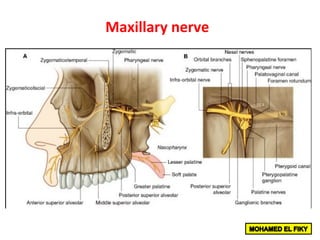
Maxillary	nerve
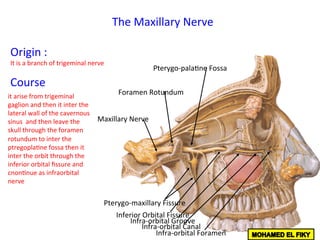
Maxillary	Nerve	
Foramen	Rotundum	
Pterygo-pala<ne	Fossa	
Pterygo-maxillary	Fissure	
Inferior	Orbital	Fissure	
Infra-orbital	Groove	
Infra-orbital	Canal	
Infra-orbital	Foramen	
The	Maxillary	Nerve	
Origin	:	
It	is	a	branch	of	trigeminal	nerve		
Course		
it	arise	from	trigeminal	
gaglion	and	then	it	inter	the	
lateral	wall	of	the	cavernous	
sinus		and	then	leave	the	
skull	through	the	foramen	
rotundum	to	inter	the	
ptregopla<ne	fossa	then	it	
inter	the	orbit	through	the	
inferior	orbital	fissure	and	
cnon<nue	as	infraorbital	
nerve
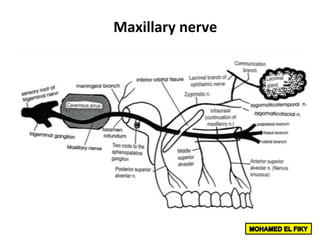
Maxillary	nerve
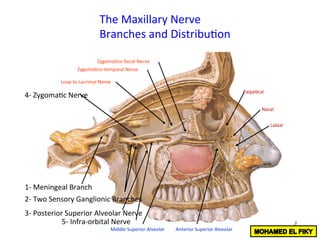
1-	Meningeal	Branch	
2-	Two	Sensory	Ganglionic	Branches	
3-	Posterior	Superior	Alveolar	Nerve	
4-	Zygoma<c	Nerve	
Loop	to	Lacrimal	Nerve	
Zygoma<co-temporal	Nerve	
Zygoma<co-facial	Nerve	
5-	Infra-orbital	Nerve	
Middle	Superior	Alveolar	 Anterior	Superior	Alveolar	
Palpebral	
Nasal	
Labial	
The	Maxillary	Nerve	
Branches	and	Distribu<on
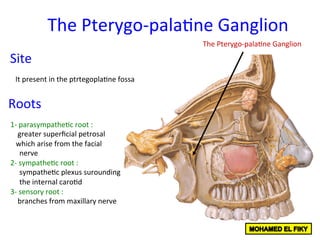
The	Pterygo-pala<ne	Ganglion	
Site	
It	present	in	the	ptrtegopla<ne	fossa		
The	Pterygo-pala<ne	Ganglion	
Roots		
1-	parasympathe<c	root	:	
				greater	superficial	petrosal	
			which	arise	from	the	facial	
					nerve		
2-	sympathe<c	root	:		
					sympathe<c	plexus	surounding	
					the	internal	caro<d	
3-	sensory	root	:	
				branches	from	maxillary	nerve
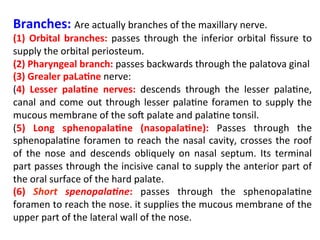
Branches:	Are	actually	branches	of	the	maxillary	nerve.	
(1)	 Orbital	 branches:	 passes	 through	 the	 inferior	 orbital	 fissure	 to	
supply	the	orbital	periosteum.	
(2)	Pharyngeal	branch:	passes	backwards	through	the	palatova	ginal	
(3)	Grealer	paLa>ne	nerve:	
(4)	 Lesser	 pala>ne	 nerves:	 descends	 through	 the	 lesser	 pala<ne,	
canal	and	come	out	through	lesser	pala<ne	foramen	to	supply	the	
mucous	membrane	of	the	soW	palate	and	pala<ne	tonsil.	
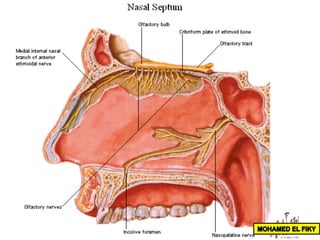
(5)	 Long	 sphenopala>ne	 (nasopala>ne):	 Passes	 through	 the	
sphenopala<ne	foramen	to	reach	the	nasal	cavity,	crosses	the	roof	
of	 the	 nose	 and	 descends	 obliquely	 on	 nasal	 septum.	 Its	 terminal	
part	passes	through	the	incisive	canal	to	supply	the	anterior	part	of	
the	oral	surface	of	the	hard	palate.		
(6)	 Short	 spenopala-ne:	 passes	 through	 the	 sphenopala<ne	
foramen	to	reach	the	nose.	it	supplies	the	mucous	membrane	of	the	
upper	part	of	the	lateral	wall	of	the	nose.
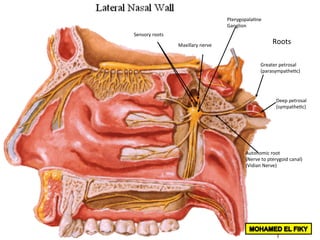
Pterygopala<ne		
Ganglion	
Autonomic	root	
(Nerve	to	pterygoid	canal)	
(Vidian	Nerve)	
Greater	petrosal	
(parasympathe<c)	
Deep	petrosal	
(sympathe<c)	
Sensory	roots	
Maxillary	nerve	
Roots
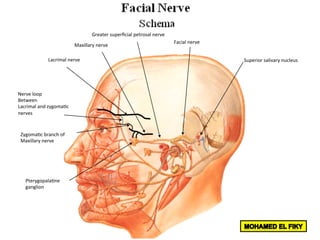
Superior	salivary	nucleus	
Facial	nerve	
Greater	superficial	petrosal	nerve	
Pterygopala<ne		
ganglion	
Maxillary	nerve	
Lacrimal	nerve	
Zygoma<c	branch	of	
Maxillary	nerve	
Nerve	loop	
Between	
Lacrimal	and	zygoma<c	
nerves
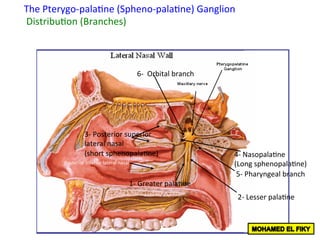
1-	Greater	pala<ne	
Posterior	inferior	lateral	nasal	
2-	Lesser	pala<ne	
3-	Posterior	superior	
lateral	nasal	
(short	sphenopala<ne)	 4-	Nasopala<ne	
(Long	sphenopala<ne)	
5-	Pharyngeal	branch	
6-		Orbital	branch	
The	Pterygo-pala<ne	(Spheno-pala<ne)	Ganglion		
	Distribu<on	(Branches)
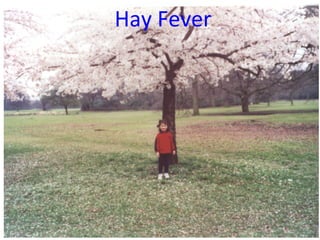
Hay	Fever
Hay	Fever	Conjunc<vi<s	
Hay	Fever	It	is	allergic	rhini<s		
Symptoms	:	
• Nasal	conges<on		
• Runny	nose		
• Sneezing		
• Nose	&	eye	itching		with	excess	tears	and	allergic	conjunc<vi<s

Temporal and infratemporal region part 3