CHAPTER 1 
INTRODUCTION 
1.1 Project Background 
Sometimes electric fan usage is wasting power because of human attitude. 
Human also mostly demands something that easily to be used without wasting 
energy. To minimize or reduce the power usage, this project developed an 
automatic fan system where speed is controlled by the room temperature. 
1.2 Problem Statement 
Most human feels the inconvenient about changing the fan speed level 
manually when the room temperature changes. So, the automatic fan system 
that automatically changes the speed level according to temperature changes is 
recommended to be built for solving this problem. 
1.3 Project Objectives 
The objectives of this project are to: 
i. Enable the electric fan to automatically change the speed level according to 
temperature changes. 
ii. Develop an automatic fan system that can change the speed level due to the 
environment temperature changes. 
iii. Develop an automatic fan system that can preview the status of the 
temperature and the speed level by using Liquid Crystal Display(LCD).
1.4 Project Scopes 
The system is built using: 
i. Temperature sensor LM35 
ii. IC 3914 
iii. Voltage regulator 
iv. The DC motor as the output for the system.
CHAPTER 2 
WORKING PRINCIPLE 
2.1 Circuit Diagram 
2.2 PCB Layout 
2.3 Components List
2.4 Working 
This temperature dependent controller fan speed uses an LM35 temperature 
sensor IC for precision sensing of the temperature. The output voltage of LM35 varies 
linearly with the temperature changes in degree Celsius. Low output impedence, 
linear output variation with input changes and precise inherent calibration of LM35 
make interfacing of this device to read out or control circuitry easy. LM35 exhibits 
extremely low self heating, as it draws only 60UA from the power supply and 
operates over a wide temperature range of -50 to +150 C. 
The output of LM35 is fed to LM3914 IC, which sense the analogue voltage 
levels and drives five relay. Suddenly changes the fan speed corresponding to the rise 
in temperature. The output pins of IC LM3914 are pulled high to Vcc. LM3914 
contains its own adjustable reference and an accurate 10 step voltage divider network. 
The buffer drives ten individual camparators referenced to the precision potential 
divider. 
When the power supply is applied to circuit, Its goes to bridge regtifier which 
convert the ac cruuect into dc current. A voltage regulator is also connected across the 
rectifier which regulate the voltage at 5 volt. Now we can heat the LM35 temperature 
sensor, the output pin of the sensor is connected to the 5th pin of LM3914 IC. Finally 
when the sensor temperature reaches 39 degree Celsius, pin 10 goes low to energies 
relay RL5. As result the fan starts moving at the maximum speed because in this 
position all the relays are energized. When the temperature decreases below 39 degree 
Celsius the speed of fan is also decreases.
CHAPTER 3 
INTEGRATED CIRCUIT 
3.1 INTRODUCTION 
An integrated circuit or monolithic integrated circuit (also referred to as 
an IC, a chip, or a microchip) is a set of electronic circuits on one small plate ("chip") 
of semiconductor material, normally silicon. This can be made much smaller than 
a discrete circuit made from independent components. ICs can be made very compact, 
having up to several billion transistors and other electronic components in an area the 
size of a fingernail. The width of each conducting line in a circuit can be made smaller 
and smaller as the technology advances; in 2008 it dropped below 100 nanometer, and 
now is tens of nanometers. 
ICs were made possible by experimental discoveries showing that semiconductor 
devices could perform the functions of vacuum tubesand by mid-20th-century 
technology advancements in semiconductor device fabrication. The integration of large 
numbers of tinytransistors into a small chip was an enormous improvement over the 
manual assembly of circuits using discrete electronic components. The integrated 
circuit's mass production capability, reliability and building-block approach to circuit 
design ensured the rapid adoption of standardized integrated circuits in place of designs 
using discrete transistors. 
ICs have two main advantages over discrete circuits: cost and performance. Cost is low 
because the chips, with all their components, are printed as a unit 
by photolithography rather than being constructed one transistor at a time. 
Furthermore, packaged ICs use much less material than discrete circuits. Performance 
is high because the IC's components switch quickly and consume little power 
(compared to their discrete counterparts) as a result of the small size and close 
proximity of the components. As of 2012, typical chip areas range from a few square 
millimeters to around 450 mm2, with up to 9 million transistors per mm2. 
Integrated circuits are used in virtually all electronic equipment today and have 
revolutionized the world of electronics. Computers, mobile phones, and other 
digital home appliances are now inextricable parts of the structure of modern societies, 
made possible by the low cost of integrated circuits.
3.2 LM3914 IC 
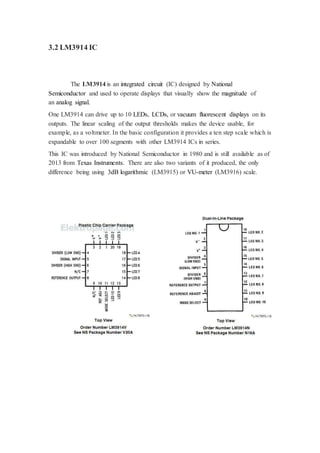
The LM3914 is an integrated circuit (IC) designed by National 
Semiconductor and used to operate displays that visually show the magnitude of 
an analog signal. 
One LM3914 can drive up to 10 LEDs, LCDs, or vacuum fluorescent displays on its 
outputs. The linear scaling of the output thresholds makes the device usable, for 
example, as a voltmeter. In the basic configuration it provides a ten step scale which is 
expandable to over 100 segments with other LM3914 ICs in series. 
This IC was introduced by National Semiconductor in 1980 and is still available as of 
2013 from Texas Instruments. There are also two variants of it produced, the only 
difference being using 3dB logarithmic (LM3915) or VU-meter (LM3916) scale.
3.2.1 FEATURES 
All the devices in this group operate with a range of voltages from 3-35 V, can 
drive LED and VFD displays. They can provide a regulated output current between 
2-30 mA to directly drive displays. 
Internally, each device contains ten comparators and a resistor scaling network, as well 
as a 1.25 volt reference source. As the input voltage increases, each comparator turns 
on. The device can be configured for either a bar-graph mode, where all lower-output 
terminals switch on, or "dot" mode in which only one output goes on. The device is 
packaged in an 18 pin dual in-line package or in a surface mount leadless chip carrier. 
3.3 ADVANTAGES OF IC’S 
1. Very small size. 
2. Low Cost. 
3. Reduced Power Consumption. 
4. Higher reliable. 
5. Higher operating speed. 
6. Reduced external wiring connections.
CHAPTER 4 
TEMPERATURE SENSOR 
4.1 INTRODUCTION 
Temperature sensors are vital to a variety of everyday products. For example, 
household ovens, refrigerators, and thermostats all rely on temperature maintenance 
and control in order to function properly. Temperature control also has applications in 
chemical engineering. Examples of this include maintaining the temperature of a 
chemical reactor at the ideal set-point, monitoring the temperature of a possible 
runaway reaction to ensure the safety of employees, and maintaining the temperature of 
streams released to the environment to minimize harmful environmental impact. 
While temperature is generally sensed by humans as “hot”, “neutral”, or “cold”, 
chemical engineering requires precise, quantitative measurements of temperature in 
order to accurately control a process. This is achieved through the use of temperature 
sensors, and temperature regulators which process the signals they receive from 
sensors. 
From a thermodynamics perspective, temperature changes as a function of the average 
energy of molecular movement. As heat is added to a system, molecular motion 
increases and the system experiences an increase in temperature. It is difficult, 
however, to directly measure the energy of molecular movement, so temperature 
sensors are generally designed to measure a property which changes in response to 
temperature. The devices are then calibrated to traditional temperature scales using a 
standard (i.e. the boiling point of water at known pressure). The following sections 
discuss the various types of sensors and regulators. 
Temperature sensors are devices used to measure the temperature of a medium. 
There are 2 kinds on temperature sensors: 1) contact sensors and 2) noncontact sensors. 
However, the 3 main types are thermometers, resistance temperature detectors, and 
thermocouples. All three of these sensors measure a physical property (i.e. volume of a 
liquid, current through a wire), which changes as a function of temperature. In addition 
to the 3 main types of temperature sensors, there are numerous other temperature 
sensors available for use.
Contact Sensors 
Contact temperature sensors measure the temperature of the object to which the sensor 
is in contact by assuming or knowing that the two (sensor and the object) are in thermal 
equilibrium, in other words, there is no heat flow between them. 
Examples (further description of each example provide below) 
 Thermocouples 
 Resistance Temperature Detectors (RTDs) 
 Full System Thermometers 
 Bimetallic Thermometers 
Noncontact Sensors 
Most commercial and scientific noncontact temperature sensors measure the thermal 
radiant power of the Infrared or Optical radiation received from a known or calculated 
area on its surface or volume within it. 
An example of noncontact temperature sensors is a pyrometer, which is described into 
further detail at the bottom of this section. 
4.2 lm35 Sensor 
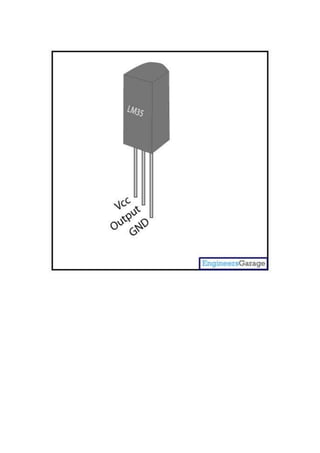
The LM35 is an integrated circuit sensor that can be used to measure 
temperature with an electrical output proportional to the temperature (in oC). The 
LM35 temperature sensor measure temperature more accurately than using a 
thermistor. The sensor circuitry is sealed and not subject to oxidation, etc. The LM35 
generates higher output voltage than thermocouples and may not require that the outpur 
voltage be amplified. It has an output voltage that is proportional to the Celsius 
temperature. The scale factor of LM35 is 0.1 V/ oC. The LM35 draws only 60 micro 
amps from its supply and possesses a low self heating capability. The sensor self 
heating causes less than 0.1 oC temperature rise in still air.
CHAPTER 5 
RECTIFIER 
1. INTRODUCTION 
A rectifier is an electrical device that converts alternating current (AC), which 
periodically reverses direction, to direct current (DC), which flows in only one 
direction. The process is known as rectification. Physically, rectifiers take a number of 
forms, including vacuum tube diodes, mercury-arc valves, copper and selenium oxide 
rectifiers, semiconductor diodes, silicon-controlled rectifiers and other silicon-based 
semiconductor switches. Historically, even synchronous electromechanical switches 
and motors have been used. Early radio receivers, called crystal radios, used a "cat's 
whisker" of fine wire pressing on a crystal of galena (lead sulfide) to serve as a 
point-contact rectifier or "crystal detector". 
Rectifiers have many uses, but are often found serving as components of DC power 
supplies and high-voltage direct current power transmission systems. Rectification 
may serve in roles other than to generate direct current for use as a source of power. As 
noted,detectors of radio signals serve as rectifiers. In gas heating systems flame 
rectification is used to detect presence of a flame. 
Because of the alternating nature of the input AC sine wave, the process of rectification 
alone produces a DC current that, though unidirectional, consists of pulses of current. 
Many applications of rectifiers, such as power supplies for radio, television and 
computer equipment, require a steady constant DC current (as would be produced by 
a battery). In these applications the output of the rectifier is smoothed by an electronic 
filter (usually a capacitor) to produce a steady current. 
Before the development of silicon semiconductor rectifiers, vacuum 
tube thermionic diodes and copper oxide- or selenium-based metal rectifier stacks 
were used. With the introduction of semiconductor electronics, vacuum tube rectifiers
became obsolete, except for some enthusiasts of vacuum tube audio equipment. For 
power rectification from very low to very high current, semiconductor diodes of 
various types (junction diodes, Schottky diodes, etc.) are widely used. 
Other devices that have control electrodes as well as acting as unidirectional current 
valves are used where more than simple rectification is required—e.g., where variable 
output voltage is needed. High-power rectifiers, such as those used in high-voltage 
direct current power transmission, employ silicon semiconductor devices of various 
types. These are thyristors or other controlled switching solid-state switches, which 
effectively function as diodes to pass current in only one direction. 
5.2 RECTIFIER CIRCUITS 
Rectifier circuits may be single-phase or multi-phase (three being the most 
common number of phases). Most low power rectifiers for domestic equipment are 
single-phase, but three-phase rectification is very important for industrial applications 
and for the transmission of energy as DC (HVDC). 
5.2.1 Single-phase rectifiers 
Half-wave rectification 
In half wave rectification of a single-phase supply, either the positive or 
negative half of the AC wave is passed, while the other half is blocked. Because only 
one half of the input waveform reaches the output, mean voltage is lower. Half-wave 
rectification requires a single diode in a single-phase supply, or three in a three-phase 
supply. Rectifiers yield a unidirectional but pulsating direct current; half-wave 
rectifiers produce far more ripple than full-wave rectifiers, and much more filtering is 
needed to eliminate harmonics of the AC frequency from the output.
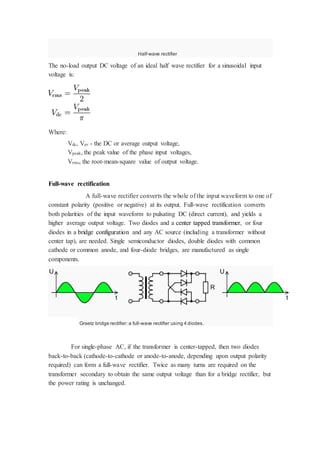
Half-wave rectifier 
The no-load output DC voltage of an ideal half wave rectifier for a sinusoidal input 
voltage is: 
Where: 
Vdc, Vav - the DC or average output voltage, 
Vpeak, the peak value of the phase input voltages, 
Vrms, the root-mean-square value of output voltage. 
Full-wave rectification 
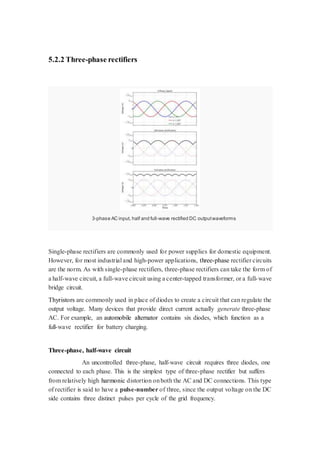
A full-wave rectifier converts the whole of the input waveform to one of 
constant polarity (positive or negative) at its output. Full-wave rectification converts 
both polarities of the input waveform to pulsating DC (direct current), and yields a 
higher average output voltage. Two diodes and a center tapped transformer, or four 
diodes in a bridge configuration and any AC source (including a transformer without 
center tap), are needed. Single semiconductor diodes, double diodes with common 
cathode or common anode, and four-diode bridges, are manufactured as single 
components. 
Graetz bridge rectifier: a full-wave rectifier using 4 diodes. 
For single-phase AC, if the transformer is center-tapped, then two diodes 
back-to-back (cathode-to-cathode or anode-to-anode, depending upon output polarity 
required) can form a full-wave rectifier. Twice as many turns are required on the 
transformer secondary to obtain the same output voltage than for a bridge rectifier, but 
the power rating is unchanged.
5.2.2 Three-phase rectifiers 
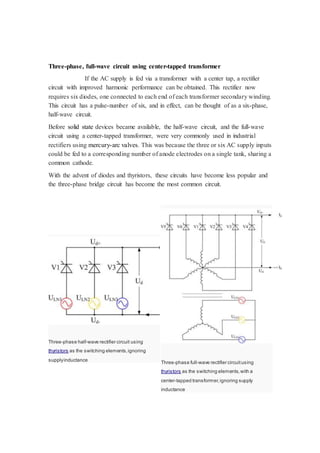
3-phase AC input, half and full-wave rectified DC output waveforms 
Single-phase rectifiers are commonly used for power supplies for domestic equipment. 
However, for most industrial and high-power applications, three-phase rectifier circuits 
are the norm. As with single-phase rectifiers, three-phase rectifiers can take the form of 
a half-wave circuit, a full-wave circuit using a center-tapped transformer, or a full-wave 
bridge circuit. 
Thyristors are commonly used in place of diodes to create a circuit that can regulate the 
output voltage. Many devices that provide direct current actually generate three-phase 
AC. For example, an automobile alternator contains six diodes, which function as a 
full-wave rectifier for battery charging. 
Three-phase, half-wave circuit 
An uncontrolled three-phase, half-wave circuit requires three diodes, one 
connected to each phase. This is the simplest type of three-phase rectifier but suffers 
from relatively high harmonic distortion on both the AC and DC connections. This type 
of rectifier is said to have a pulse-number of three, since the output voltage on the DC 
side contains three distinct pulses per cycle of the grid frequency.
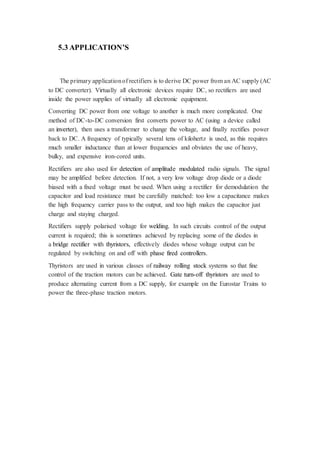
Three-phase, full-wave circuit using center-tapped transformer 
If the AC supply is fed via a transformer with a center tap, a rectifier 
circuit with improved harmonic performance can be obtained. This rectifier now 
requires six diodes, one connected to each end of each transformer secondary winding. 
This circuit has a pulse-number of six, and in effect, can be thought of as a six-phase, 
half-wave circuit. 
Before solid state devices became available, the half-wave circuit, and the full-wave 
circuit using a center-tapped transformer, were very commonly used in industrial 
rectifiers using mercury-arc valves. This was because the three or six AC supply inputs 
could be fed to a corresponding number of anode electrodes on a single tank, sharing a 
common cathode. 
With the advent of diodes and thyristors, these circuits have become less popular and 
the three-phase bridge circuit has become the most common circuit. 
Three-phase half-wave rectifier circuit using 
thyristors as the switching elements, ignoring 
supply inductance 
Three-phase full-wave rectifier circuit using 
thyristors as the switching elements, with a 
center-tapped transformer, ignoring supply 
inductance
5.3 APPLICATION’S 
The primary application of rectifiers is to derive DC power from an AC supply (AC 
to DC converter). Virtually all electronic devices require DC, so rectifiers are used 
inside the power supplies of virtually all electronic equipment. 
Converting DC power from one voltage to another is much more complicated. One 
method of DC-to-DC conversion first converts power to AC (using a device called 
an inverter), then uses a transformer to change the voltage, and finally rectifies power 
back to DC. A frequency of typically several tens of kilohertz is used, as this requires 
much smaller inductance than at lower frequencies and obviates the use of heavy, 
bulky, and expensive iron-cored units. 
Rectifiers are also used for detection of amplitude modulated radio signals. The signal 
may be amplified before detection. If not, a very low voltage drop diode or a diode 
biased with a fixed voltage must be used. When using a rectifier for demodulation the 
capacitor and load resistance must be carefully matched: too low a capacitance makes 
the high frequency carrier pass to the output, and too high makes the capacitor just 
charge and staying charged. 
Rectifiers supply polarised voltage for welding. In such circuits control of the output 
current is required; this is sometimes achieved by replacing some of the diodes in 
a bridge rectifier with thyristors, effectively diodes whose voltage output can be 
regulated by switching on and off with phase fired controllers. 
Thyristors are used in various classes of railway rolling stock systems so that fine 
control of the traction motors can be achieved. Gate turn-off thyristors are used to 
produce alternating current from a DC supply, for example on the Eurostar Trains to 
power the three-phase traction motors.
CHAPTER 6 
VOLTAGE REGULATOR 
6.1 INTRODUCTION 
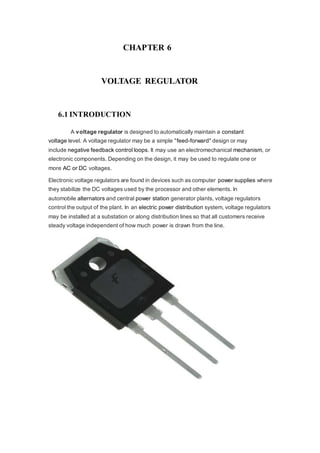
A voltage regulator is designed to automatically maintain a constant 
voltage level. A voltage regulator may be a simple "feed-forward" design or may 
include negative feedback control loops. It may use an electromechanical mechanism, or 
electronic components. Depending on the design, it may be used to regulate one or 
more AC or DC voltages. 
Electronic voltage regulators are found in devices such as computer power supplies where 
they stabilize the DC voltages used by the processor and other elements. In 
automobile alternators and central power station generator plants, voltage regulators 
control the output of the plant. In an electric power distribution system, voltage regulators 
may be installed at a substation or along distribution lines so that all customers receive 
steady voltage independent of how much power is drawn from the line.
6.2 Electronic Voltage Regulators 
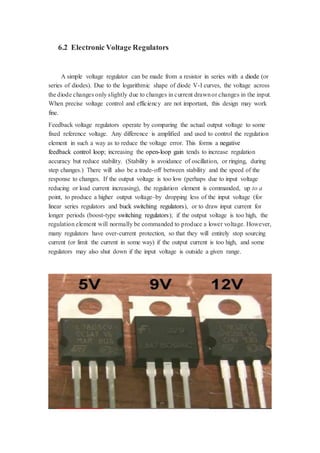
A simple voltage regulator can be made from a resistor in series with a diode (or 
series of diodes). Due to the logarithmic shape of diode V-I curves, the voltage across 
the diode changes only slightly due to changes in current drawn or changes in the input. 
When precise voltage control and efficiency are not important, this design may work 
fine. 
Feedback voltage regulators operate by comparing the actual output voltage to some 
fixed reference voltage. Any difference is amplified and used to control the regulation 
element in such a way as to reduce the voltage error. This forms a negative 
feedback control loop; increasing the open-loop gain tends to increase regulation 
accuracy but reduce stability. (Stability is avoidance of oscillation, or ringing, during 
step changes.) There will also be a trade-off between stability and the speed of the 
response to changes. If the output voltage is too low (perhaps due to input voltage 
reducing or load current increasing), the regulation element is commanded, up to a 
point, to produce a higher output voltage–by dropping less of the input voltage (for 
linear series regulators and buck switching regulators), or to draw input current for 
longer periods (boost-type switching regulators); if the output voltage is too high, the 
regulation element will normally be commanded to produce a lower voltage. However, 
many regulators have over-current protection, so that they will entirely stop sourcing 
current (or limit the current in some way) if the output current is too high, and some 
regulators may also shut down if the input voltage is outside a given range.
6.3 Electromechanical Regulators 
In electromechanical regulators, voltage regulation is easily 
accomplished by coiling the sensing wire to make an electromagnet. The magnetic 
field produced by the current attracts a moving ferrous core held back under spring 
tension or gravitational pull. As voltage increases, so does the current, strengthening 
the magnetic field produced by the coil and pulling the core towards the field. The 
magnet is physically connected to a mechanical power switch, which opens as the 
magnet moves into the field. As voltage decreases, so does the current, releasing spring 
tension or the weight of the core and causing it to retract. This closes the switch and 
allows the power to flow once more. 
If the mechanical regulator design is sensitive to small voltage fluctuations, the motion 
of the solenoid core can be used to move a selector switch across a range of resistances 
or transformer windings to gradually step the output voltage up or down, or to rotate the 
position of a moving-coil AC regulator. 
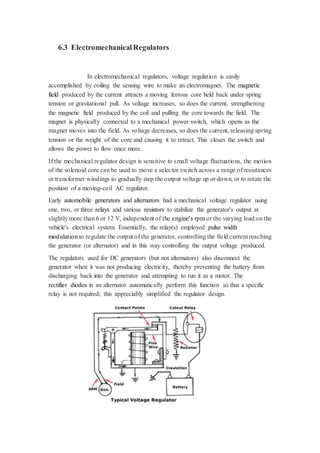
Early automobile generators and alternators had a mechanical voltage regulator using 
one, two, or three relays and various resistors to stabilize the generator's output at 
slightly more than 6 or 12 V, independent of the engine's rpm or the varying load on the 
vehicle's electrical system. Essentially, the relay(s) employed pulse width 
modulation to regulate the output of the generator, controlling the field current reaching 
the generator (or alternator) and in this way controlling the output voltage produced. 
The regulators used for DC generators (but not alternators) also disconnect the 
generator when it was not producing electricity, thereby preventing the battery from 
discharging back into the generator and attempting to run it as a motor. The 
rectifier diodes in an alternator automatically perform this function so that a specific 
relay is not required; this appreciably simplified the regulator design.
6.4 Automatic Voltage Regulator 
To control the output of generators (as seen in ships and power stations, or 
on oil rigs, greenhouses and emergency power systems) automatic voltage regulators 
are used. This is an active system. While the basic principle is the same, the system 
itself is more complex. An automatic voltage regulator (or AVR for short) consist of 
several components such as diodes, capacitors, resistors and potentiometers or even 
microcontrollers, all placed on a circuit board. This is then mounted near the generator 
and connected with several wires to measure and adjust the generator. 
How an AVR works: In the first place the AVR monitors the output voltage and 
controls the input voltage for the exciter of the generator. By increasing or decreasing 
the generator control voltage, the output voltage of the generator increases or decreases 
accordingly. The AVR calculates how much voltage has to be sent to the exciter 
numerous times a second, therefore stabilizing the output voltage to a predetermined 
setpoint. When two or more generators are powering the same system (parallel 
operation) the AVR receives information from more generators to match all output.
CHAPTER 7 
DIODES 
7.1 INTRODUCTION 
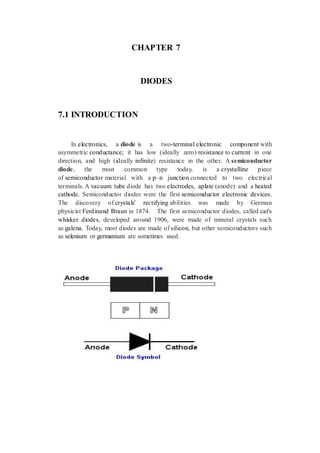
In electronics, a diode is a two-terminal electronic component with 
asymmetric conductance; it has low (ideally zero) resistance to current in one 
direction, and high (ideally infinite) resistance in the other. A semiconductor 
diode, the most common type today, is a crystalline piece 
of semiconductor material with a p–n junction connected to two electrical 
terminals. A vacuum tube diode has two electrodes, aplate (anode) and a heated 
cathode. Semiconductor diodes were the first semiconductor electronic devices. 
The discovery of crystals' rectifying abilities was made by German 
physicist Ferdinand Braun in 1874. The first semiconductor diodes, called cat's 
whisker diodes, developed around 1906, were made of mineral crystals such 
as galena. Today, most diodes are made of silicon, but other semiconductors such 
as selenium or germanium are sometimes used.
7.2 Vacuum tube diodes 
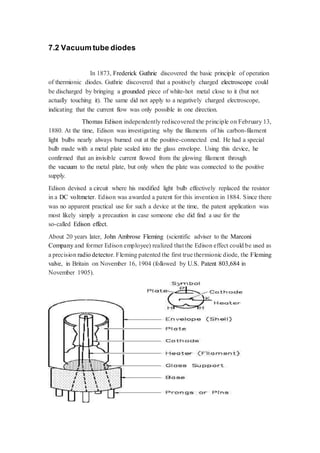
In 1873, Frederick Guthrie discovered the basic principle of operation 
of thermionic diodes. Guthrie discovered that a positively charged electroscope could 
be discharged by bringing a grounded piece of white-hot metal close to it (but not 
actually touching it). The same did not apply to a negatively charged electroscope, 
indicating that the current flow was only possible in one direction. 
Thomas Edison independently rediscovered the principle on February 13, 
1880. At the time, Edison was investigating why the filaments of his carbon-filament 
light bulbs nearly always burned out at the positive-connected end. He had a special 
bulb made with a metal plate sealed into the glass envelope. Using this device, he 
confirmed that an invisible current flowed from the glowing filament through 
the vacuum to the metal plate, but only when the plate was connected to the positive 
supply. 
Edison devised a circuit where his modified light bulb effectively replaced the resistor 
in a DC voltmeter. Edison was awarded a patent for this invention in 1884. Since there 
was no apparent practical use for such a device at the time, the patent application was 
most likely simply a precaution in case someone else did find a use for the 
so-called Edison effect. 
About 20 years later, John Ambrose Fleming (scientific adviser to the Marconi 
Company and former Edison employee) realized that the Edison effect could be used as 
a precision radio detector. Fleming patented the first true thermionic diode, the Fleming 
valve, in Britain on November 16, 1904 (followed by U.S. Patent 803,684 in 
November 1905).
7.3 Solid-state diodes 
In 1874 German scientist Karl Ferdinand Braun discovered the 
"unilateral conduction" of crystals. Braun patented the crystal rectifier in 1899. Copper 
oxide and selenium rectifiers were developed for power applications in the 1930s. 
Indian scientist Jagadish Chandra Bose was the first to use a crystal for 
detecting radio waves in 1894. The crystal detector was developed into a practical 
device for wireless telegraphy by Greenleaf Whittier Pickard, who invented 
a silicon crystal detector in 1903 and received a patent for it on November 20, 1906. 
Other experimenters tried a variety of other substances, of which the most widely used 
was the mineral galena (lead sulfide). Other substances offered slightly better 
performance, but galena was most widely used because it had the advantage of being 
cheap and easy to obtain. The crystal detector in these early crystal radio sets consisted 
of an adjustable wire point-contact (the so-called "cat's whisker"), which could be 
manually moved over the face of the crystal in order to obtain optimum signal. This 
troublesome device was superseded by thermionic diodes by the 1920s, but after high 
purity semiconductor materials became available, the crystal detector returned to 
dominant use with the advent of inexpensive fixed-germanium diodes in the 
1950s. Bell Labs also developed a germanium diode for microwave reception, and 
AT&T used these in their microwave towers that criss-crossed the nation starting in the 
late 1940s, carrying telephone and network television signals. Bell Labs did not 
develop a satisfactory thermionic diode for microwave reception. 
7.4 Point-contact diodes 
A point-contact diode works the same as the junction diodes described 
below, but their construction is simpler. A block of n-type semiconductor is built, and a 
conducting sharp-point contact made with some group-3 metal is placed in contact with 
the semiconductor. Some metal migrates into the semiconductor to make a small region 
of p-type semiconductor near the contact. The long-popular 1N34 germanium version 
is still used in radio receivers as a detector and occasionally in specialized analog 
electronics.
7.5 Junction diodes 
7.5.1 p–n junction diode 
A p–n junction diode is made of a crystal of semiconductor, usually 
silicon, but germanium and gallium arsenide are also used. Impurities are added to it to 
create a region on one side that contains negative charge carriers (electrons), 
called n-type semiconductor, and a region on the other side that contains positive 
charge carriers (holes), called p-type semiconductor. When two materials i.e. n-type 
and p-type are attached together, a momentary flow of electrons occur from n to p side 
resulting in a third region where no charge carriers are present. This region is called 
the depletion region due to the absence of charge carriers (electrons and holes in this 
case). The diode's terminals are attached to the n-type and p-type regions. The boundary 
between these two regions, called a p–n junction, is where the action of the diode takes 
place. The crystal allows electrons to flow from the N-type side (called the cathode) to 
the P-type side (called the anode), but not in the opposite direction. 
7.5.2 Schottky diode 
Another type of junction diode, the Schottky diode, is formed from 
a metal–semiconductor junction rather than a p–n junction, which reduces capacitance 
and increases switching speed.
CHAPTER 8 
CAPACITOR 
8.1 INTROUCTON 
A capacitor (originally known as a condenser) is 
a passive two-terminal electrical component used to store energyelectrostatically in 
an electric field. The forms of practical capacitors vary widely, but all contain at least 
two electrical conductors (plates) separated by a dielectric (i.e. insulator). The 
conductors can be thin films, foils or sintered beads of metal or conductive electrolyte, 
etc. The "nonconducting" dielectric acts to increase the capacitor's charge capacity. A 
dielectric can be glass, ceramic, plastic film, air, vacuum, paper, mica, oxide layer etc. 
Capacitors are widely used as parts of electrical circuits in many common electrical 
devices. Unlike a resistor, an ideal capacitor does not dissipate energy. Instead, a 
capacitor stores energy in the form of an electrostatic field between its plates. 
When there is a potential difference across the conductors (e.g., when a capacitor is 
attached across a battery), an electric field develops across the dielectric, causing 
positive charge +Q to collect on one plate and negative charge −Q to collect on the 
other plate. If a battery has been attached to a capacitor for a sufficient amount of time, 
no current can flow through the capacitor. However, if a time-varying voltage is applied 
across the leads of the capacitor, a displacement current can flow. 
An ideal capacitor is characterized by a single constant value for its capacitance. 
Capacitance is expressed as the ratio of the electric charge Q on each conductor to the 
potential difference V between them. The SI unit of capacitance is the farad (F), which 
is equal to one coulomb per volt (1 C/V). Typical capacitance values range from about 
1 pF (10−12 F) to about 1 mF (10−3 F). 
The capacitance is greater when there is a narrower separation between conductors and 
when the conductors have a larger surface area. In practice, the dielectric between the 
plates passes a small amount of leakage current and also has an electric field strength 
limit, known as the breakdown voltage. The conductors and leads introduce an 
undesired inductance and resistance.
8.2 OPERATION 
A capacitor consists of two conductors separated by a non-conductive 
region. The non-conductive region is called the dielectric. In simpler terms, the 
dielectric is just an electrical insulator. Examples of dielectric media are glass, air, 
paper, vacuum, and even a semiconductor depletion region chemically identical to the 
conductors. A capacitor is assumed to be self-contained and isolated, with no 
net electric charge and no influence from any external electric field. The conductors 
thus hold equal and opposite charges on their facing surfaces, and the dielectric 
develops an electric field. In SI units, a capacitance of one farad means that one 
coulomb of charge on each conductor causes a voltage of one volt across the device. 
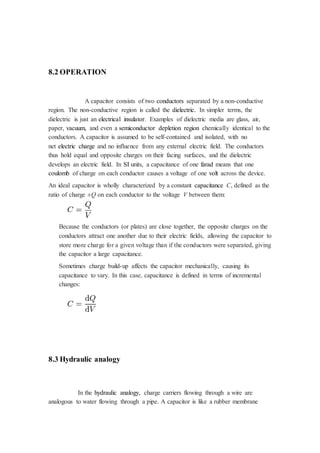
An ideal capacitor is wholly characterized by a constant capacitance C, defined as the 
ratio of charge ±Q on each conductor to the voltage V between them: 
Because the conductors (or plates) are close together, the opposite charges on the 
conductors attract one another due to their electric fields, allowing the capacitor to 
store more charge for a given voltage than if the conductors were separated, giving 
the capacitor a large capacitance. 
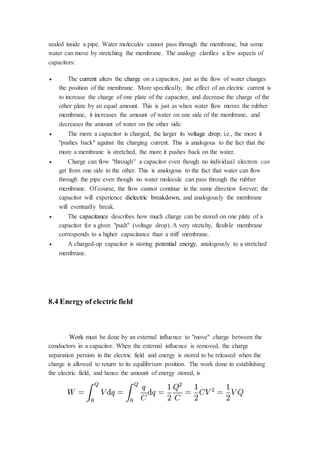
Sometimes charge build-up affects the capacitor mechanically, causing its 
capacitance to vary. In this case, capacitance is defined in terms of incremental 
changes: 
8.3 Hydraulic analogy 
In the hydraulic analogy, charge carriers flowing through a wire are 
analogous to water flowing through a pipe. A capacitor is like a rubber membrane
sealed inside a pipe. Water molecules cannot pass through the membrane, but some 
water can move by stretching the membrane. The analogy clarifies a few aspects of 
capacitors: 
 The current alters the charge on a capacitor, just as the flow of water changes 
the position of the membrane. More specifically, the effect of an electric current is 
to increase the charge of one plate of the capacitor, and decrease the charge of the 
other plate by an equal amount. This is just as when water flow moves the rubber 
membrane, it increases the amount of water on one side of the membrane, and 
decreases the amount of water on the other side. 
 The more a capacitor is charged, the larger its voltage drop; i.e., the more it 
"pushes back" against the charging current. This is analogous to the fact that the 
more a membrane is stretched, the more it pushes back on the water. 
 Charge can flow "through" a capacitor even though no individual electron can 
get from one side to the other. This is analogous to the fact that water can flow 
through the pipe even though no water molecule can pass through the rubber 
membrane. Of course, the flow cannot continue in the same direction forever; the 
capacitor will experience dielectric breakdown, and analogously the membrane 
will eventually break. 
 The capacitance describes how much charge can be stored on one plate of a 
capacitor for a given "push" (voltage drop). A very stretchy, flexible membrane 
corresponds to a higher capacitance than a stiff membrane. 
 A charged-up capacitor is storing potential energy, analogously to a stretched 
membrane. 
8.4 Energy of electric field 
Work must be done by an external influence to "move" charge between the 
conductors in a capacitor. When the external influence is removed, the charge 
separation persists in the electric field and energy is stored to be released when the 
charge is allowed to return to its equilibrium position. The work done in establishing 
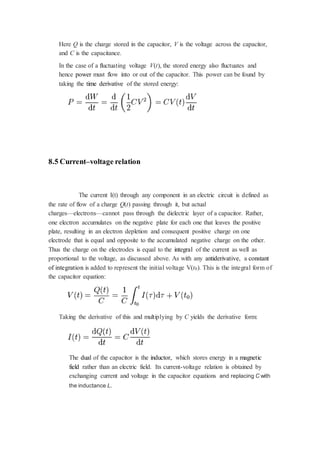
the electric field, and hence the amount of energy stored, is
Here Q is the charge stored in the capacitor, V is the voltage across the capacitor, 
and C is the capacitance. 
In the case of a fluctuating voltage V(t), the stored energy also fluctuates and 
hence power must flow into or out of the capacitor. This power can be found by 
taking the time derivative of the stored energy: 
8.5 Current–voltage relation 
The current I(t) through any component in an electric circuit is defined as 
the rate of flow of a charge Q(t) passing through it, but actual 
charges—electrons—cannot pass through the dielectric layer of a capacitor. Rather, 
one electron accumulates on the negative plate for each one that leaves the positive 
plate, resulting in an electron depletion and consequent positive charge on one 
electrode that is equal and opposite to the accumulated negative charge on the other. 
Thus the charge on the electrodes is equal to the integral of the current as well as 
proportional to the voltage, as discussed above. As with any antiderivative, a constant 
of integration is added to represent the initial voltage V(t0). This is the integral form of 
the capacitor equation: 
Taking the derivative of this and multiplying by C yields the derivative form: 
The dual of the capacitor is the inductor, which stores energy in a magnetic 
field rather than an electric field. Its current-voltage relation is obtained by 
exchanging current and voltage in the capacitor equations and replacing C with 
the inductance L.
8.6 APPLICATION 
8.6.1 Energy storage 
A capacitor can store electric energy when disconnected from its 
charging circuit, so it can be used like a temporary battery, or like other types 
of rechargeable energy storage system. Capacitors are commonly used in electronic 
devices to maintain power supply while batteries are being changed. (This prevents loss 
of information in volatile memory.) 
Conventional capacitors provide less than 360 joules per kilogram of energy density, 
whereas a conventional alkaline battery has a density of 590 kJ/kg. 
In car audio systems, large capacitors store energy for the amplifier to use on demand. 
Also for a flash tube a capacitor is used to hold the high voltage. 
8.6.2 Pulsed power and weapons 
Groups of large, specially constructed, low-inductance high-voltage 
capacitors (capacitor banks) are used to supply huge pulses of current for many pulsed 
power applications. These include electromagnetic forming, Marx generators, 
pulsed lasers (especially TEA lasers), pulse forming networks, radar, fusion research, 
and particle accelerators. 
Large capacitor banks (reservoir) are used as energy sources for 
the exploding-bridgewire detonators or slapper detonators in nuclear weapons and 
other specialty weapons. Experimental work is under way using banks of capacitors as 
power sources for electromagneticarmour and electromagnetic railguns and coilguns. 
8.6.3 Power conditioning 
Reservoir capacitors are used in power supplies where they smooth the output 
of a full or half wave rectifier. They can also be used in charge pump circuits as the 
energy storage element in the generation of higher voltages than the input voltage.
Capacitors are connected in parallel with the power circuits of most electronic devices 
and larger systems (such as factories) to shunt away and conceal current fluctuations 
from the primary power source to provide a "clean" power supply for signal or control 
circuits. Audio equipment, for example, uses several capacitors in this way, to shunt 
away power line hum before it gets into the signal circuitry. The capacitors act as a 
local reserve for the DC power source, and bypass AC currents from the power supply. 
This is used in car audio applications, when a stiffening capacitor compensates for the 
inductance and resistance of the leads to the lead-acid car battery.
CHAPTER 9 
TRANSISTORS 
9.1 INTRODUCTION 
A transistor is a semiconductor device used 
to amplify and switch electronic signals and electrical power. It is composed 
of semiconductor material with at least three terminals for connection to an external 
circuit. A voltage or current applied to one pair of the transistor's terminals changes the 
current through another pair of terminals. Because the controlled (output) power can be 
higher than the controlling (input) power, a transistor can amplify a signal. Today, 
some transistors are packaged individually, but many more are found embedded 
in integrated circuits. 
The transistor is the fundamental building block of modern electronic devices, and is 
ubiquitous in modern electronic systems. Following its development in 1947 by 
American physicists John Bardeen, Walter Brattain, and William Shockley, the 
transistor revolutionized the field of electronics, and paved the way for smaller and 
cheaper radios, calculators, and computers, among other things. The transistor is on the 
list of IEEE milestones in electronics, and the inventors were jointly awarded the 
1956 Nobel Prize in Physics for their achievement.
9.2 Importance 
The transistor is the key active component in practically all 
modern electronics. Many consider it to be one of the greatest inventions of the 20th 
century. Its importance in today's society rests on its ability to be mass-produced using 
a highly automated process (semiconductor device fabrication) that achieves 
astonishingly low per-transistor costs. The invention of the first transistor at Bell 
Labs was named an IEEE Milestone in 2009. 
Although several companies each produce over a billion individually packaged (known 
as discrete) transistors every year, the vast majority of transistors are now produced 
in integrated circuits (often shortened to IC, microchips or simply chips), along 
with diodes, resistors, capacitors and other electronic components, to produce 
complete electronic circuits. A logic gate consists of up to about twenty transistors 
whereas an advanced microprocessor, as of 2009, can use as many as 3 billion 
transistors (MOSFETs). "About 60 million transistors were built in 2002 ... for [each] 
man, woman, and child on Earth." 
The transistor's low cost, flexibility, and reliability have made it a ubiquito us device. 
Transistorized mechatronic circuits have replaced electromechanical devices in 
controlling appliances and machinery. It is often easier and cheaper to use a 
standard microcontroller and write a computer program to carry out a control function 
than to design an equivalent mechanical control function.
9.3 Operation 
The essential usefulness of a transistor comes from its ability to use a small 
signal applied between one pair of its terminals to control a much larger signal at 
another pair of terminals. This property is called gain. It can produce a stronger output 
signal, a voltage or current, that is proportional to a weaker input signal; that is, it can 
act as an amplifier. Alternatively, the transistor can be used to turn current on or off in a 
circuit as an electrically controlled switch, where the amount of current is determined 
by other circuit elements. 
There are two types of transistors, which have slight differences in how they are used in 
a circuit. A bipolar transistor has terminals labeled base, collector, and emitter. A 
small current at the base terminal (that is, flowing between the base and the emitter) can 
control or switch a much larger current between the collector and emitter terminals. For 
a field-effect transistor, the terminals are labeled gate, source, and drain, and a 
voltage at the gate can control a current between source and drain. 
The image to the right represents a typical bipolar transistor in a circuit. Charge will 
flow between emitter and collector terminals depending on the current in the base. 
Because internally the base and emitter connections behave like a semiconductor diode, 
a voltage drop develops between base and emitter while the base current exists. The 
amount of this voltage depends on the material the transistor is made from, and is 
referred to as VBE. 
9.3.1 Transistor as a switch 
Transistors are commonly used as electronic switches, both for high-power 
applications such as switched-mode power supplies and for low-power applications 
such as logic gates. 
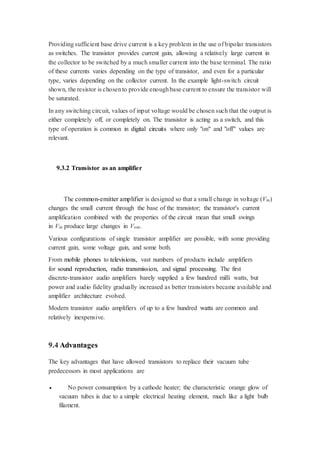
In a grounded-emitter transistor circuit, such as the light-switch circuit shown, as the 
base voltage rises, the emitter and collector currents rise exponentially. The collector 
voltage drops because of reduced resistance from collector to emitter. If the voltage 
difference between the collector and emitter were zero (or near zero), the collector 
current would be limited only by the load resistance (light bulb) and the supply voltage. 
This is called saturation because current is flowing from collector to emitter freely. 
When saturated, the switch is said to be on.
Providing sufficient base drive current is a key problem in the use of bipolar transistors 
as switches. The transistor provides current gain, allowing a relatively large current in 
the collector to be switched by a much smaller current into the base terminal. The ratio 
of these currents varies depending on the type of transistor, and even for a particular 
type, varies depending on the collector current. In the example light-switch circuit 
shown, the resistor is chosen to provide enough base current to ensure the transistor will 
be saturated. 
In any switching circuit, values of input voltage would be chosen such that the output is 
either completely off, or completely on. The transistor is acting as a switch, and this 
type of operation is common in digital circuits where only "on" and "off" values are 
relevant. 
9.3.2 Transistor as an amplifier 
The common-emitter amplifier is designed so that a small change in voltage (Vin) 
changes the small current through the base of the transistor; the transistor's current 
amplification combined with the properties of the circuit mean that small swings 
in Vin produce large changes in Vout. 
Various configurations of single transistor amplifier are possible, with some providing 
current gain, some voltage gain, and some both. 
From mobile phones to televisions, vast numbers of products include amplifiers 
for sound reproduction, radio transmission, and signal processing. The first 
discrete-transistor audio amplifiers barely supplied a few hundred milli watts, but 
power and audio fidelity gradually increased as better transistors became available and 
amplifier architecture evolved. 
Modern transistor audio amplifiers of up to a few hundred watts are common and 
relatively inexpensive. 
9.4 Advantages 
The key advantages that have allowed transistors to replace their vacuum tube 
predecessors in most applications are 
 No power consumption by a cathode heater; the characteristic orange glow of 
vacuum tubes is due to a simple electrical heating element, much like a light bulb 
filament.
 Small size and minimal weight, allowing the development of miniaturized 
electronic devices. 
 Low operating voltages compatible with batteries of only a few cells. 
 No warm-up period for cathode heaters required after power application. 
 Lower power dissipation and generally greater energy efficiency. 
 Higher reliability and greater physical ruggedness. 
 Extremely long life. Some transistorized devices have been in service for more 
than 50 years. 
 Complementary devices available, facilitating the design 
of complementary-symmetry circuits, something not possible with vacuum tubes. 
 Greatly reduced sensitivity to mechanical shock and vibration, thus reducing 
the problem of microphonics in sensitive applications, such as audio. 
CHAPTER 10 
RESISTOR 
10.1 INTRODUCTION 
A resistor is a passive two-terminal electrical component that 
implements electrical resistance as a circuit element. Resistors act to reduce current 
flow, and, at the same time, act to lower voltage levels within circuits. In electronic 
circuits resistors are used to limit current flow, to adjust signal levels, bias active 
elements, terminate transmission lines among other uses. High-power resistors that can 
dissipate many watts of electrical power as heat may be used as part of motor controls, 
in power distribution systems, or as test loads for generators. Resistors may have fixed 
resistances that only change a little with temperature, time or operating voltage. 
Variable resistors can be used to adjust circuit elements (such as a volume control or a 
lamp dimmer), or as sensing devices for heat, light, humidity, force, or chemical 
activity. 
Resistors are common elements of electrical networks and electronic circuits and are 
ubiquitous in electronic equipment. Practical resistors as discrete components can be
composed of various compounds and forms. Resistors are also implemented within 
integrated circuits. 
The electrical function of a resistor is specified by its resistance: common commercial 
resistors are manufactured over a range of more than nine orders of magnitude. The 
nominal value of the resistance will fall within a manufacturing tolerance. 
10.2 Operation 
10.2.1 Ohm's law 
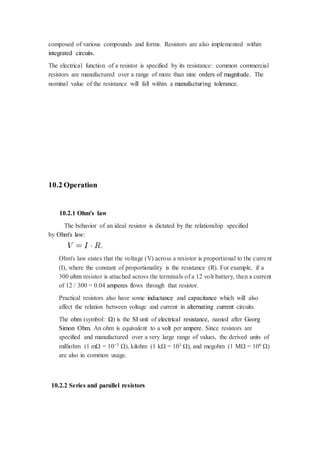
The behavior of an ideal resistor is dictated by the relationship specified 
by Ohm's law: 
Ohm's law states that the voltage (V) across a resistor is proportional to the curre nt 
(I), where the constant of proportionality is the resistance (R). For example, if a 
300 ohm resistor is attached across the terminals of a 12 volt battery, then a current 
of 12 / 300 = 0.04 amperes flows through that resistor. 
Practical resistors also have some inductance and capacitance which will also 
affect the relation between voltage and current in alternating current circuits. 
The ohm (symbol: Ω) is the SI unit of electrical resistance, named after Georg 
Simon Ohm. An ohm is equivalent to a volt per ampere. Since resistors are 
specified and manufactured over a very large range of values, the derived units of 
milliohm (1 mΩ = 10−3 Ω), kilohm (1 kΩ = 103 Ω), and megohm (1 MΩ = 106 Ω) 
are also in common usage. 
10.2.2 Series and parallel resistors
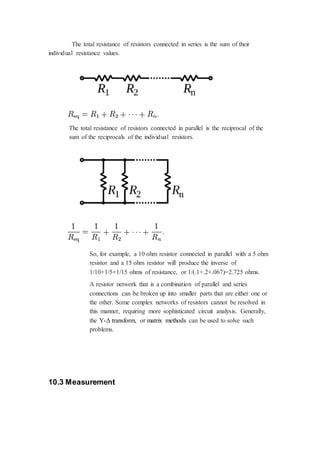
The total resistance of resistors connected in series is the sum of their 
individual resistance values. 
The total resistance of resistors connected in parallel is the reciprocal of the 
sum of the reciprocals of the individual resistors. 
So, for example, a 10 ohm resistor connected in parallel with a 5 ohm 
resistor and a 15 ohm resistor will produce the inverse of 
1/10+1/5+1/15 ohms of resistance, or 1/(.1+.2+.067)=2.725 ohms. 
A resistor network that is a combination of parallel and series 
connections can be broken up into smaller parts that are either one or 
the other. Some complex networks of resistors cannot be resolved in 
this manner, requiring more sophisticated circuit analysis. Generally, 
the Y-Δ transform, or matrix methods can be used to solve such 
problems. 
10.3 Measurement
The value of a resistor can be measured with an ohmmeter, which may be one 
function of a multimeter. Usually, probes on the ends of test leads connect to the 
resistor. A simple ohmmeter may apply a voltage from a battery across the unknown 
resistor (with an internal resistor of a known value in series) producing a current which 
drives a meter movement. The current, in accordance with Ohm's law, is inversely 
proportional to the sum of the internal resistance and the resistor being tested, resulting 
in an analog meter scale which is very non- linear, calibrated from infinity to 0 ohms. A 
digital multimeter, using active electronics, may instead pass a specified current 
through the test resistance. The voltage generated across the test resistance in that case 
is linearly proportional to its resistance, which is measured and displayed. In either case 
the low-resistance ranges of the meter pass much more current through the test leads 
than do high-resistance ranges, in order for the voltages present to be at reasonable 
levels (generally below 10 volts) but still measurable. 
Measuring low-value resistors, such as fractional-ohm resistors, with acceptable 
accuracy requires four-terminal connections. One pair of terminals applies a known, 
calibrated current to the resistor, while the other pair senses the voltage drop across the 
resistor. Some laboratory quality ohmmeters, especially milliohmmeters, and even 
some of the better digital multimeters sense using four input terminals for this purpose, 
which may be used with special test leads. Each of the two so-called Kelvin clips has a 
pair of jaws insulated from each other. One side of each clip applies the measuring 
current, while the other connections are only to sense the voltage drop. The resistance is 
again calculated using Ohm's Law as the measured voltage divided by the applied 
current. 
CHAPTER 11 
TRANSFORMER
11.1 INTRODUCTION 
A transformer is an electrical device that transfers energy between two or 
more circuits through electromagnetic induction. 
A varying current in the transformer's primary winding creates a varying magnetic 
flux in the core and a varying magnetic field impinging on the secondary winding. This 
varying magnetic field at the secondary induces a varying electromotive force (emf) or 
voltage in the secondary winding. Making use of Faraday's Law in conjunction with 
high magnetic permeability core properties, transformers can thus be designed to 
efficiently change AC voltages from one voltage level to another within power 
networks. 
Transformers range in size from RF transformers less than a cubic centimetre in 
volume to units interconnecting the power grid weighing hundreds of tons. A wide 
range of transformer designs is encountered in electronic and electric power 
applications. Since the invention in 1885 of the first constant potential transformer, 
transformers have become essential for the AC transmission, distribution, and 
utilization of electrical energy.
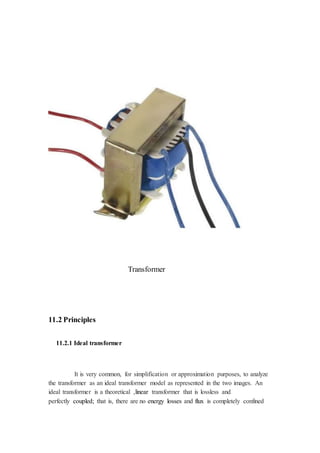
Transformer 
11.2 Principles 
11.2.1 Ideal transformer 
It is very common, for simplification or approximation purposes, to analyze 
the transformer as an ideal transformer model as represented in the two images. An 
ideal transformer is a theoretical ,linear transformer that is lossless and 
perfectly coupled; that is, there are no energy losses and flux is completely confined
within the magnetic core. Perfect coupling implies infinitely high core magnetic 
permeability and winding inductances and zero net magnetomotive force. 
A varying current in the transformer's primary winding creates a varying magnetic flux 
in the core and a varying magnetic field impinging on the secondary winding. This 
varying magnetic field at the secondary induces a varying electromotive force (emf) or 
voltage in the secondary winding. The primary and secondary windings are wrapped 
around a core of infinitely high magnetic permeability[e] so that all of the magnetic flux 
passes through both the primary and secondary windings. With a voltage source 
connected to the primary winding and load impedance connected to the secondary 
winding, the transformer currents flow in the indicated directions. 
According to Faraday's law of induction, since the same magnetic flux passes through 
both the primary and secondary windings in an ideal transformer,[7] a voltage is induced 
in each winding, according to eq. (1) in the secondary winding case, according to eq. (2) 
in the primary winding case. The primary emf is sometimes termed counter emf. This 
is in accordance with Lenz's law, which states that induction of emf always opposes 
development of any such change in magnetic field. 
Ideal transformer equations (eq.) 
By Faraday's law of induction 
. . . (1)[a] 
. . . (2) 
Combining ratio of (1) & (2) 
Turns ratio . . . (3) where 
for step-down transformers, a > 1 
for step-up transformers, a < 1 
By law of Conservation of Energy, apparent,real and reactive power are each 
conserved in the input and output 
. . . (4) 
Combining (3) & (4) with this endnote yields the ideal transformer identity
. (5) 
By Ohm's Law and ideal transformer identity 
. . . (6) 
Apparent load impedance Z'L (ZL referred to the primary) 
. (7) 
11.2.2 Real transformer 
The ideal transformer model assumes that all flux generated by the primary 
winding links all the turns of every winding, including itself. In practice, some flux 
traverses paths that take it outside the windings. Such flux is termed leakage flux, and 
results in leakage inductance in series with the mutually coupled transformer windings. 
Leakage flux results in energy being alternately stored in and discharged from the 
magnetic fields with each cycle of the power supply. It is not directly a power loss, but 
results in inferior voltage regulation, causing the secondary voltage not to be directly 
proportional to the primary voltage, particularly under heavy load. Transformers are 
therefore normally designed to have very low leakage inductance. 
In some applications increased leakage is desired, and long magnetic paths, air gaps, or 
magnetic bypass shunts may deliberately be introduced in a transformer design to limit 
the short-circuit current it will supply. Leaky transformers may be used to supply loads 
that exhibit negative resistance, such as electric arcs, mercury vapor lamps, and neon 
signs or for safely handling loads that become periodically short-circuited such 
as electric arc welders. 
Air gaps are also used to keep a transformer from saturating, especially 
audio-frequency transformers in circuits that have a DC component flowing in the 
windings. 
Knowledge of leakage inductance is also useful when transformers are operated in 
parallel. It can be shown that if the percent impedance[l] and associated winding leakage 
reactance-to-resistance (X/R) ratio of two transformers were hypothetically exactly the
same, the transformers would share power in proportion to their respective volt-ampere 
ratings (e.g. 500 kVA unit in parallel with 1,000 kVA unit, the larger unit would carry 
twice the current). However, the impedance tolerances of commercial transformers are 
significant. Also, the Z impedance and X/R ratio of different capacity transformers 
tends to vary, corresponding 1,000 kVA and 500 kVA units' values being, to illustrate, 
respectively, Z ~ 5.75%, X/R ~ 3.75 and Z ~ 5%, X/R ~ 4.75. 
CHAPTER 12 
ADVANTAGES & DISADVANTAGES &APPLICATION 
12.1 Advantages
1. Low cost 
2. Easy to use. 
3. Implement in single door. 
12.2 Disadvantages 
It is used only when one single purson cuts the rays of the sessor hence it 
cannot be used when two person cross simultaneously. 
12.3 Application 
1. For counting process. 
2. For automatic room light control.

temperature dependent dc fan speed controller withou using micrcontroller

  • 1.
    CHAPTER 1 INTRODUCTION 1.1 Project Background Sometimes electric fan usage is wasting power because of human attitude. Human also mostly demands something that easily to be used without wasting energy. To minimize or reduce the power usage, this project developed an automatic fan system where speed is controlled by the room temperature. 1.2 Problem Statement Most human feels the inconvenient about changing the fan speed level manually when the room temperature changes. So, the automatic fan system that automatically changes the speed level according to temperature changes is recommended to be built for solving this problem. 1.3 Project Objectives The objectives of this project are to: i. Enable the electric fan to automatically change the speed level according to temperature changes. ii. Develop an automatic fan system that can change the speed level due to the environment temperature changes. iii. Develop an automatic fan system that can preview the status of the temperature and the speed level by using Liquid Crystal Display(LCD).
  • 2.
    1.4 Project Scopes The system is built using: i. Temperature sensor LM35 ii. IC 3914 iii. Voltage regulator iv. The DC motor as the output for the system.
  • 3.
    CHAPTER 2 WORKINGPRINCIPLE 2.1 Circuit Diagram 2.2 PCB Layout 2.3 Components List
  • 4.
    2.4 Working Thistemperature dependent controller fan speed uses an LM35 temperature sensor IC for precision sensing of the temperature. The output voltage of LM35 varies linearly with the temperature changes in degree Celsius. Low output impedence, linear output variation with input changes and precise inherent calibration of LM35 make interfacing of this device to read out or control circuitry easy. LM35 exhibits extremely low self heating, as it draws only 60UA from the power supply and operates over a wide temperature range of -50 to +150 C. The output of LM35 is fed to LM3914 IC, which sense the analogue voltage levels and drives five relay. Suddenly changes the fan speed corresponding to the rise in temperature. The output pins of IC LM3914 are pulled high to Vcc. LM3914 contains its own adjustable reference and an accurate 10 step voltage divider network. The buffer drives ten individual camparators referenced to the precision potential divider. When the power supply is applied to circuit, Its goes to bridge regtifier which convert the ac cruuect into dc current. A voltage regulator is also connected across the rectifier which regulate the voltage at 5 volt. Now we can heat the LM35 temperature sensor, the output pin of the sensor is connected to the 5th pin of LM3914 IC. Finally when the sensor temperature reaches 39 degree Celsius, pin 10 goes low to energies relay RL5. As result the fan starts moving at the maximum speed because in this position all the relays are energized. When the temperature decreases below 39 degree Celsius the speed of fan is also decreases.
  • 5.
    CHAPTER 3 INTEGRATEDCIRCUIT 3.1 INTRODUCTION An integrated circuit or monolithic integrated circuit (also referred to as an IC, a chip, or a microchip) is a set of electronic circuits on one small plate ("chip") of semiconductor material, normally silicon. This can be made much smaller than a discrete circuit made from independent components. ICs can be made very compact, having up to several billion transistors and other electronic components in an area the size of a fingernail. The width of each conducting line in a circuit can be made smaller and smaller as the technology advances; in 2008 it dropped below 100 nanometer, and now is tens of nanometers. ICs were made possible by experimental discoveries showing that semiconductor devices could perform the functions of vacuum tubesand by mid-20th-century technology advancements in semiconductor device fabrication. The integration of large numbers of tinytransistors into a small chip was an enormous improvement over the manual assembly of circuits using discrete electronic components. The integrated circuit's mass production capability, reliability and building-block approach to circuit design ensured the rapid adoption of standardized integrated circuits in place of designs using discrete transistors. ICs have two main advantages over discrete circuits: cost and performance. Cost is low because the chips, with all their components, are printed as a unit by photolithography rather than being constructed one transistor at a time. Furthermore, packaged ICs use much less material than discrete circuits. Performance is high because the IC's components switch quickly and consume little power (compared to their discrete counterparts) as a result of the small size and close proximity of the components. As of 2012, typical chip areas range from a few square millimeters to around 450 mm2, with up to 9 million transistors per mm2. Integrated circuits are used in virtually all electronic equipment today and have revolutionized the world of electronics. Computers, mobile phones, and other digital home appliances are now inextricable parts of the structure of modern societies, made possible by the low cost of integrated circuits.
  • 6.
    3.2 LM3914 IC The LM3914 is an integrated circuit (IC) designed by National Semiconductor and used to operate displays that visually show the magnitude of an analog signal. One LM3914 can drive up to 10 LEDs, LCDs, or vacuum fluorescent displays on its outputs. The linear scaling of the output thresholds makes the device usable, for example, as a voltmeter. In the basic configuration it provides a ten step scale which is expandable to over 100 segments with other LM3914 ICs in series. This IC was introduced by National Semiconductor in 1980 and is still available as of 2013 from Texas Instruments. There are also two variants of it produced, the only difference being using 3dB logarithmic (LM3915) or VU-meter (LM3916) scale.
  • 7.
    3.2.1 FEATURES Allthe devices in this group operate with a range of voltages from 3-35 V, can drive LED and VFD displays. They can provide a regulated output current between 2-30 mA to directly drive displays. Internally, each device contains ten comparators and a resistor scaling network, as well as a 1.25 volt reference source. As the input voltage increases, each comparator turns on. The device can be configured for either a bar-graph mode, where all lower-output terminals switch on, or "dot" mode in which only one output goes on. The device is packaged in an 18 pin dual in-line package or in a surface mount leadless chip carrier. 3.3 ADVANTAGES OF IC’S 1. Very small size. 2. Low Cost. 3. Reduced Power Consumption. 4. Higher reliable. 5. Higher operating speed. 6. Reduced external wiring connections.
  • 8.
    CHAPTER 4 TEMPERATURESENSOR 4.1 INTRODUCTION Temperature sensors are vital to a variety of everyday products. For example, household ovens, refrigerators, and thermostats all rely on temperature maintenance and control in order to function properly. Temperature control also has applications in chemical engineering. Examples of this include maintaining the temperature of a chemical reactor at the ideal set-point, monitoring the temperature of a possible runaway reaction to ensure the safety of employees, and maintaining the temperature of streams released to the environment to minimize harmful environmental impact. While temperature is generally sensed by humans as “hot”, “neutral”, or “cold”, chemical engineering requires precise, quantitative measurements of temperature in order to accurately control a process. This is achieved through the use of temperature sensors, and temperature regulators which process the signals they receive from sensors. From a thermodynamics perspective, temperature changes as a function of the average energy of molecular movement. As heat is added to a system, molecular motion increases and the system experiences an increase in temperature. It is difficult, however, to directly measure the energy of molecular movement, so temperature sensors are generally designed to measure a property which changes in response to temperature. The devices are then calibrated to traditional temperature scales using a standard (i.e. the boiling point of water at known pressure). The following sections discuss the various types of sensors and regulators. Temperature sensors are devices used to measure the temperature of a medium. There are 2 kinds on temperature sensors: 1) contact sensors and 2) noncontact sensors. However, the 3 main types are thermometers, resistance temperature detectors, and thermocouples. All three of these sensors measure a physical property (i.e. volume of a liquid, current through a wire), which changes as a function of temperature. In addition to the 3 main types of temperature sensors, there are numerous other temperature sensors available for use.
  • 9.
    Contact Sensors Contacttemperature sensors measure the temperature of the object to which the sensor is in contact by assuming or knowing that the two (sensor and the object) are in thermal equilibrium, in other words, there is no heat flow between them. Examples (further description of each example provide below)  Thermocouples  Resistance Temperature Detectors (RTDs)  Full System Thermometers  Bimetallic Thermometers Noncontact Sensors Most commercial and scientific noncontact temperature sensors measure the thermal radiant power of the Infrared or Optical radiation received from a known or calculated area on its surface or volume within it. An example of noncontact temperature sensors is a pyrometer, which is described into further detail at the bottom of this section. 4.2 lm35 Sensor The LM35 is an integrated circuit sensor that can be used to measure temperature with an electrical output proportional to the temperature (in oC). The LM35 temperature sensor measure temperature more accurately than using a thermistor. The sensor circuitry is sealed and not subject to oxidation, etc. The LM35 generates higher output voltage than thermocouples and may not require that the outpur voltage be amplified. It has an output voltage that is proportional to the Celsius temperature. The scale factor of LM35 is 0.1 V/ oC. The LM35 draws only 60 micro amps from its supply and possesses a low self heating capability. The sensor self heating causes less than 0.1 oC temperature rise in still air.
  • 11.
    CHAPTER 5 RECTIFIER 1. INTRODUCTION A rectifier is an electrical device that converts alternating current (AC), which periodically reverses direction, to direct current (DC), which flows in only one direction. The process is known as rectification. Physically, rectifiers take a number of forms, including vacuum tube diodes, mercury-arc valves, copper and selenium oxide rectifiers, semiconductor diodes, silicon-controlled rectifiers and other silicon-based semiconductor switches. Historically, even synchronous electromechanical switches and motors have been used. Early radio receivers, called crystal radios, used a "cat's whisker" of fine wire pressing on a crystal of galena (lead sulfide) to serve as a point-contact rectifier or "crystal detector". Rectifiers have many uses, but are often found serving as components of DC power supplies and high-voltage direct current power transmission systems. Rectification may serve in roles other than to generate direct current for use as a source of power. As noted,detectors of radio signals serve as rectifiers. In gas heating systems flame rectification is used to detect presence of a flame. Because of the alternating nature of the input AC sine wave, the process of rectification alone produces a DC current that, though unidirectional, consists of pulses of current. Many applications of rectifiers, such as power supplies for radio, television and computer equipment, require a steady constant DC current (as would be produced by a battery). In these applications the output of the rectifier is smoothed by an electronic filter (usually a capacitor) to produce a steady current. Before the development of silicon semiconductor rectifiers, vacuum tube thermionic diodes and copper oxide- or selenium-based metal rectifier stacks were used. With the introduction of semiconductor electronics, vacuum tube rectifiers
  • 12.
    became obsolete, exceptfor some enthusiasts of vacuum tube audio equipment. For power rectification from very low to very high current, semiconductor diodes of various types (junction diodes, Schottky diodes, etc.) are widely used. Other devices that have control electrodes as well as acting as unidirectional current valves are used where more than simple rectification is required—e.g., where variable output voltage is needed. High-power rectifiers, such as those used in high-voltage direct current power transmission, employ silicon semiconductor devices of various types. These are thyristors or other controlled switching solid-state switches, which effectively function as diodes to pass current in only one direction. 5.2 RECTIFIER CIRCUITS Rectifier circuits may be single-phase or multi-phase (three being the most common number of phases). Most low power rectifiers for domestic equipment are single-phase, but three-phase rectification is very important for industrial applications and for the transmission of energy as DC (HVDC). 5.2.1 Single-phase rectifiers Half-wave rectification In half wave rectification of a single-phase supply, either the positive or negative half of the AC wave is passed, while the other half is blocked. Because only one half of the input waveform reaches the output, mean voltage is lower. Half-wave rectification requires a single diode in a single-phase supply, or three in a three-phase supply. Rectifiers yield a unidirectional but pulsating direct current; half-wave rectifiers produce far more ripple than full-wave rectifiers, and much more filtering is needed to eliminate harmonics of the AC frequency from the output.
  • 13.
    Half-wave rectifier Theno-load output DC voltage of an ideal half wave rectifier for a sinusoidal input voltage is: Where: Vdc, Vav - the DC or average output voltage, Vpeak, the peak value of the phase input voltages, Vrms, the root-mean-square value of output voltage. Full-wave rectification A full-wave rectifier converts the whole of the input waveform to one of constant polarity (positive or negative) at its output. Full-wave rectification converts both polarities of the input waveform to pulsating DC (direct current), and yields a higher average output voltage. Two diodes and a center tapped transformer, or four diodes in a bridge configuration and any AC source (including a transformer without center tap), are needed. Single semiconductor diodes, double diodes with common cathode or common anode, and four-diode bridges, are manufactured as single components. Graetz bridge rectifier: a full-wave rectifier using 4 diodes. For single-phase AC, if the transformer is center-tapped, then two diodes back-to-back (cathode-to-cathode or anode-to-anode, depending upon output polarity required) can form a full-wave rectifier. Twice as many turns are required on the transformer secondary to obtain the same output voltage than for a bridge rectifier, but the power rating is unchanged.
  • 14.
    5.2.2 Three-phase rectifiers 3-phase AC input, half and full-wave rectified DC output waveforms Single-phase rectifiers are commonly used for power supplies for domestic equipment. However, for most industrial and high-power applications, three-phase rectifier circuits are the norm. As with single-phase rectifiers, three-phase rectifiers can take the form of a half-wave circuit, a full-wave circuit using a center-tapped transformer, or a full-wave bridge circuit. Thyristors are commonly used in place of diodes to create a circuit that can regulate the output voltage. Many devices that provide direct current actually generate three-phase AC. For example, an automobile alternator contains six diodes, which function as a full-wave rectifier for battery charging. Three-phase, half-wave circuit An uncontrolled three-phase, half-wave circuit requires three diodes, one connected to each phase. This is the simplest type of three-phase rectifier but suffers from relatively high harmonic distortion on both the AC and DC connections. This type of rectifier is said to have a pulse-number of three, since the output voltage on the DC side contains three distinct pulses per cycle of the grid frequency.
  • 15.
    Three-phase, full-wave circuitusing center-tapped transformer If the AC supply is fed via a transformer with a center tap, a rectifier circuit with improved harmonic performance can be obtained. This rectifier now requires six diodes, one connected to each end of each transformer secondary winding. This circuit has a pulse-number of six, and in effect, can be thought of as a six-phase, half-wave circuit. Before solid state devices became available, the half-wave circuit, and the full-wave circuit using a center-tapped transformer, were very commonly used in industrial rectifiers using mercury-arc valves. This was because the three or six AC supply inputs could be fed to a corresponding number of anode electrodes on a single tank, sharing a common cathode. With the advent of diodes and thyristors, these circuits have become less popular and the three-phase bridge circuit has become the most common circuit. Three-phase half-wave rectifier circuit using thyristors as the switching elements, ignoring supply inductance Three-phase full-wave rectifier circuit using thyristors as the switching elements, with a center-tapped transformer, ignoring supply inductance
  • 16.
    5.3 APPLICATION’S Theprimary application of rectifiers is to derive DC power from an AC supply (AC to DC converter). Virtually all electronic devices require DC, so rectifiers are used inside the power supplies of virtually all electronic equipment. Converting DC power from one voltage to another is much more complicated. One method of DC-to-DC conversion first converts power to AC (using a device called an inverter), then uses a transformer to change the voltage, and finally rectifies power back to DC. A frequency of typically several tens of kilohertz is used, as this requires much smaller inductance than at lower frequencies and obviates the use of heavy, bulky, and expensive iron-cored units. Rectifiers are also used for detection of amplitude modulated radio signals. The signal may be amplified before detection. If not, a very low voltage drop diode or a diode biased with a fixed voltage must be used. When using a rectifier for demodulation the capacitor and load resistance must be carefully matched: too low a capacitance makes the high frequency carrier pass to the output, and too high makes the capacitor just charge and staying charged. Rectifiers supply polarised voltage for welding. In such circuits control of the output current is required; this is sometimes achieved by replacing some of the diodes in a bridge rectifier with thyristors, effectively diodes whose voltage output can be regulated by switching on and off with phase fired controllers. Thyristors are used in various classes of railway rolling stock systems so that fine control of the traction motors can be achieved. Gate turn-off thyristors are used to produce alternating current from a DC supply, for example on the Eurostar Trains to power the three-phase traction motors.
  • 17.
    CHAPTER 6 VOLTAGEREGULATOR 6.1 INTRODUCTION A voltage regulator is designed to automatically maintain a constant voltage level. A voltage regulator may be a simple "feed-forward" design or may include negative feedback control loops. It may use an electromechanical mechanism, or electronic components. Depending on the design, it may be used to regulate one or more AC or DC voltages. Electronic voltage regulators are found in devices such as computer power supplies where they stabilize the DC voltages used by the processor and other elements. In automobile alternators and central power station generator plants, voltage regulators control the output of the plant. In an electric power distribution system, voltage regulators may be installed at a substation or along distribution lines so that all customers receive steady voltage independent of how much power is drawn from the line.
  • 18.
    6.2 Electronic VoltageRegulators A simple voltage regulator can be made from a resistor in series with a diode (or series of diodes). Due to the logarithmic shape of diode V-I curves, the voltage across the diode changes only slightly due to changes in current drawn or changes in the input. When precise voltage control and efficiency are not important, this design may work fine. Feedback voltage regulators operate by comparing the actual output voltage to some fixed reference voltage. Any difference is amplified and used to control the regulation element in such a way as to reduce the voltage error. This forms a negative feedback control loop; increasing the open-loop gain tends to increase regulation accuracy but reduce stability. (Stability is avoidance of oscillation, or ringing, during step changes.) There will also be a trade-off between stability and the speed of the response to changes. If the output voltage is too low (perhaps due to input voltage reducing or load current increasing), the regulation element is commanded, up to a point, to produce a higher output voltage–by dropping less of the input voltage (for linear series regulators and buck switching regulators), or to draw input current for longer periods (boost-type switching regulators); if the output voltage is too high, the regulation element will normally be commanded to produce a lower voltage. However, many regulators have over-current protection, so that they will entirely stop sourcing current (or limit the current in some way) if the output current is too high, and some regulators may also shut down if the input voltage is outside a given range.
  • 19.
    6.3 Electromechanical Regulators In electromechanical regulators, voltage regulation is easily accomplished by coiling the sensing wire to make an electromagnet. The magnetic field produced by the current attracts a moving ferrous core held back under spring tension or gravitational pull. As voltage increases, so does the current, strengthening the magnetic field produced by the coil and pulling the core towards the field. The magnet is physically connected to a mechanical power switch, which opens as the magnet moves into the field. As voltage decreases, so does the current, releasing spring tension or the weight of the core and causing it to retract. This closes the switch and allows the power to flow once more. If the mechanical regulator design is sensitive to small voltage fluctuations, the motion of the solenoid core can be used to move a selector switch across a range of resistances or transformer windings to gradually step the output voltage up or down, or to rotate the position of a moving-coil AC regulator. Early automobile generators and alternators had a mechanical voltage regulator using one, two, or three relays and various resistors to stabilize the generator's output at slightly more than 6 or 12 V, independent of the engine's rpm or the varying load on the vehicle's electrical system. Essentially, the relay(s) employed pulse width modulation to regulate the output of the generator, controlling the field current reaching the generator (or alternator) and in this way controlling the output voltage produced. The regulators used for DC generators (but not alternators) also disconnect the generator when it was not producing electricity, thereby preventing the battery from discharging back into the generator and attempting to run it as a motor. The rectifier diodes in an alternator automatically perform this function so that a specific relay is not required; this appreciably simplified the regulator design.
  • 20.
    6.4 Automatic VoltageRegulator To control the output of generators (as seen in ships and power stations, or on oil rigs, greenhouses and emergency power systems) automatic voltage regulators are used. This is an active system. While the basic principle is the same, the system itself is more complex. An automatic voltage regulator (or AVR for short) consist of several components such as diodes, capacitors, resistors and potentiometers or even microcontrollers, all placed on a circuit board. This is then mounted near the generator and connected with several wires to measure and adjust the generator. How an AVR works: In the first place the AVR monitors the output voltage and controls the input voltage for the exciter of the generator. By increasing or decreasing the generator control voltage, the output voltage of the generator increases or decreases accordingly. The AVR calculates how much voltage has to be sent to the exciter numerous times a second, therefore stabilizing the output voltage to a predetermined setpoint. When two or more generators are powering the same system (parallel operation) the AVR receives information from more generators to match all output.
  • 21.
    CHAPTER 7 DIODES 7.1 INTRODUCTION In electronics, a diode is a two-terminal electronic component with asymmetric conductance; it has low (ideally zero) resistance to current in one direction, and high (ideally infinite) resistance in the other. A semiconductor diode, the most common type today, is a crystalline piece of semiconductor material with a p–n junction connected to two electrical terminals. A vacuum tube diode has two electrodes, aplate (anode) and a heated cathode. Semiconductor diodes were the first semiconductor electronic devices. The discovery of crystals' rectifying abilities was made by German physicist Ferdinand Braun in 1874. The first semiconductor diodes, called cat's whisker diodes, developed around 1906, were made of mineral crystals such as galena. Today, most diodes are made of silicon, but other semiconductors such as selenium or germanium are sometimes used.
  • 22.
    7.2 Vacuum tubediodes In 1873, Frederick Guthrie discovered the basic principle of operation of thermionic diodes. Guthrie discovered that a positively charged electroscope could be discharged by bringing a grounded piece of white-hot metal close to it (but not actually touching it). The same did not apply to a negatively charged electroscope, indicating that the current flow was only possible in one direction. Thomas Edison independently rediscovered the principle on February 13, 1880. At the time, Edison was investigating why the filaments of his carbon-filament light bulbs nearly always burned out at the positive-connected end. He had a special bulb made with a metal plate sealed into the glass envelope. Using this device, he confirmed that an invisible current flowed from the glowing filament through the vacuum to the metal plate, but only when the plate was connected to the positive supply. Edison devised a circuit where his modified light bulb effectively replaced the resistor in a DC voltmeter. Edison was awarded a patent for this invention in 1884. Since there was no apparent practical use for such a device at the time, the patent application was most likely simply a precaution in case someone else did find a use for the so-called Edison effect. About 20 years later, John Ambrose Fleming (scientific adviser to the Marconi Company and former Edison employee) realized that the Edison effect could be used as a precision radio detector. Fleming patented the first true thermionic diode, the Fleming valve, in Britain on November 16, 1904 (followed by U.S. Patent 803,684 in November 1905).
  • 23.
    7.3 Solid-state diodes In 1874 German scientist Karl Ferdinand Braun discovered the "unilateral conduction" of crystals. Braun patented the crystal rectifier in 1899. Copper oxide and selenium rectifiers were developed for power applications in the 1930s. Indian scientist Jagadish Chandra Bose was the first to use a crystal for detecting radio waves in 1894. The crystal detector was developed into a practical device for wireless telegraphy by Greenleaf Whittier Pickard, who invented a silicon crystal detector in 1903 and received a patent for it on November 20, 1906. Other experimenters tried a variety of other substances, of which the most widely used was the mineral galena (lead sulfide). Other substances offered slightly better performance, but galena was most widely used because it had the advantage of being cheap and easy to obtain. The crystal detector in these early crystal radio sets consisted of an adjustable wire point-contact (the so-called "cat's whisker"), which could be manually moved over the face of the crystal in order to obtain optimum signal. This troublesome device was superseded by thermionic diodes by the 1920s, but after high purity semiconductor materials became available, the crystal detector returned to dominant use with the advent of inexpensive fixed-germanium diodes in the 1950s. Bell Labs also developed a germanium diode for microwave reception, and AT&T used these in their microwave towers that criss-crossed the nation starting in the late 1940s, carrying telephone and network television signals. Bell Labs did not develop a satisfactory thermionic diode for microwave reception. 7.4 Point-contact diodes A point-contact diode works the same as the junction diodes described below, but their construction is simpler. A block of n-type semiconductor is built, and a conducting sharp-point contact made with some group-3 metal is placed in contact with the semiconductor. Some metal migrates into the semiconductor to make a small region of p-type semiconductor near the contact. The long-popular 1N34 germanium version is still used in radio receivers as a detector and occasionally in specialized analog electronics.
  • 24.
    7.5 Junction diodes 7.5.1 p–n junction diode A p–n junction diode is made of a crystal of semiconductor, usually silicon, but germanium and gallium arsenide are also used. Impurities are added to it to create a region on one side that contains negative charge carriers (electrons), called n-type semiconductor, and a region on the other side that contains positive charge carriers (holes), called p-type semiconductor. When two materials i.e. n-type and p-type are attached together, a momentary flow of electrons occur from n to p side resulting in a third region where no charge carriers are present. This region is called the depletion region due to the absence of charge carriers (electrons and holes in this case). The diode's terminals are attached to the n-type and p-type regions. The boundary between these two regions, called a p–n junction, is where the action of the diode takes place. The crystal allows electrons to flow from the N-type side (called the cathode) to the P-type side (called the anode), but not in the opposite direction. 7.5.2 Schottky diode Another type of junction diode, the Schottky diode, is formed from a metal–semiconductor junction rather than a p–n junction, which reduces capacitance and increases switching speed.
  • 25.
    CHAPTER 8 CAPACITOR 8.1 INTROUCTON A capacitor (originally known as a condenser) is a passive two-terminal electrical component used to store energyelectrostatically in an electric field. The forms of practical capacitors vary widely, but all contain at least two electrical conductors (plates) separated by a dielectric (i.e. insulator). The conductors can be thin films, foils or sintered beads of metal or conductive electrolyte, etc. The "nonconducting" dielectric acts to increase the capacitor's charge capacity. A dielectric can be glass, ceramic, plastic film, air, vacuum, paper, mica, oxide layer etc. Capacitors are widely used as parts of electrical circuits in many common electrical devices. Unlike a resistor, an ideal capacitor does not dissipate energy. Instead, a capacitor stores energy in the form of an electrostatic field between its plates. When there is a potential difference across the conductors (e.g., when a capacitor is attached across a battery), an electric field develops across the dielectric, causing positive charge +Q to collect on one plate and negative charge −Q to collect on the other plate. If a battery has been attached to a capacitor for a sufficient amount of time, no current can flow through the capacitor. However, if a time-varying voltage is applied across the leads of the capacitor, a displacement current can flow. An ideal capacitor is characterized by a single constant value for its capacitance. Capacitance is expressed as the ratio of the electric charge Q on each conductor to the potential difference V between them. The SI unit of capacitance is the farad (F), which is equal to one coulomb per volt (1 C/V). Typical capacitance values range from about 1 pF (10−12 F) to about 1 mF (10−3 F). The capacitance is greater when there is a narrower separation between conductors and when the conductors have a larger surface area. In practice, the dielectric between the plates passes a small amount of leakage current and also has an electric field strength limit, known as the breakdown voltage. The conductors and leads introduce an undesired inductance and resistance.
  • 26.
    8.2 OPERATION Acapacitor consists of two conductors separated by a non-conductive region. The non-conductive region is called the dielectric. In simpler terms, the dielectric is just an electrical insulator. Examples of dielectric media are glass, air, paper, vacuum, and even a semiconductor depletion region chemically identical to the conductors. A capacitor is assumed to be self-contained and isolated, with no net electric charge and no influence from any external electric field. The conductors thus hold equal and opposite charges on their facing surfaces, and the dielectric develops an electric field. In SI units, a capacitance of one farad means that one coulomb of charge on each conductor causes a voltage of one volt across the device. An ideal capacitor is wholly characterized by a constant capacitance C, defined as the ratio of charge ±Q on each conductor to the voltage V between them: Because the conductors (or plates) are close together, the opposite charges on the conductors attract one another due to their electric fields, allowing the capacitor to store more charge for a given voltage than if the conductors were separated, giving the capacitor a large capacitance. Sometimes charge build-up affects the capacitor mechanically, causing its capacitance to vary. In this case, capacitance is defined in terms of incremental changes: 8.3 Hydraulic analogy In the hydraulic analogy, charge carriers flowing through a wire are analogous to water flowing through a pipe. A capacitor is like a rubber membrane
  • 27.
    sealed inside apipe. Water molecules cannot pass through the membrane, but some water can move by stretching the membrane. The analogy clarifies a few aspects of capacitors:  The current alters the charge on a capacitor, just as the flow of water changes the position of the membrane. More specifically, the effect of an electric current is to increase the charge of one plate of the capacitor, and decrease the charge of the other plate by an equal amount. This is just as when water flow moves the rubber membrane, it increases the amount of water on one side of the membrane, and decreases the amount of water on the other side.  The more a capacitor is charged, the larger its voltage drop; i.e., the more it "pushes back" against the charging current. This is analogous to the fact that the more a membrane is stretched, the more it pushes back on the water.  Charge can flow "through" a capacitor even though no individual electron can get from one side to the other. This is analogous to the fact that water can flow through the pipe even though no water molecule can pass through the rubber membrane. Of course, the flow cannot continue in the same direction forever; the capacitor will experience dielectric breakdown, and analogously the membrane will eventually break.  The capacitance describes how much charge can be stored on one plate of a capacitor for a given "push" (voltage drop). A very stretchy, flexible membrane corresponds to a higher capacitance than a stiff membrane.  A charged-up capacitor is storing potential energy, analogously to a stretched membrane. 8.4 Energy of electric field Work must be done by an external influence to "move" charge between the conductors in a capacitor. When the external influence is removed, the charge separation persists in the electric field and energy is stored to be released when the charge is allowed to return to its equilibrium position. The work done in establishing the electric field, and hence the amount of energy stored, is
  • 28.
    Here Q isthe charge stored in the capacitor, V is the voltage across the capacitor, and C is the capacitance. In the case of a fluctuating voltage V(t), the stored energy also fluctuates and hence power must flow into or out of the capacitor. This power can be found by taking the time derivative of the stored energy: 8.5 Current–voltage relation The current I(t) through any component in an electric circuit is defined as the rate of flow of a charge Q(t) passing through it, but actual charges—electrons—cannot pass through the dielectric layer of a capacitor. Rather, one electron accumulates on the negative plate for each one that leaves the positive plate, resulting in an electron depletion and consequent positive charge on one electrode that is equal and opposite to the accumulated negative charge on the other. Thus the charge on the electrodes is equal to the integral of the current as well as proportional to the voltage, as discussed above. As with any antiderivative, a constant of integration is added to represent the initial voltage V(t0). This is the integral form of the capacitor equation: Taking the derivative of this and multiplying by C yields the derivative form: The dual of the capacitor is the inductor, which stores energy in a magnetic field rather than an electric field. Its current-voltage relation is obtained by exchanging current and voltage in the capacitor equations and replacing C with the inductance L.
  • 29.
    8.6 APPLICATION 8.6.1Energy storage A capacitor can store electric energy when disconnected from its charging circuit, so it can be used like a temporary battery, or like other types of rechargeable energy storage system. Capacitors are commonly used in electronic devices to maintain power supply while batteries are being changed. (This prevents loss of information in volatile memory.) Conventional capacitors provide less than 360 joules per kilogram of energy density, whereas a conventional alkaline battery has a density of 590 kJ/kg. In car audio systems, large capacitors store energy for the amplifier to use on demand. Also for a flash tube a capacitor is used to hold the high voltage. 8.6.2 Pulsed power and weapons Groups of large, specially constructed, low-inductance high-voltage capacitors (capacitor banks) are used to supply huge pulses of current for many pulsed power applications. These include electromagnetic forming, Marx generators, pulsed lasers (especially TEA lasers), pulse forming networks, radar, fusion research, and particle accelerators. Large capacitor banks (reservoir) are used as energy sources for the exploding-bridgewire detonators or slapper detonators in nuclear weapons and other specialty weapons. Experimental work is under way using banks of capacitors as power sources for electromagneticarmour and electromagnetic railguns and coilguns. 8.6.3 Power conditioning Reservoir capacitors are used in power supplies where they smooth the output of a full or half wave rectifier. They can also be used in charge pump circuits as the energy storage element in the generation of higher voltages than the input voltage.
  • 30.
    Capacitors are connectedin parallel with the power circuits of most electronic devices and larger systems (such as factories) to shunt away and conceal current fluctuations from the primary power source to provide a "clean" power supply for signal or control circuits. Audio equipment, for example, uses several capacitors in this way, to shunt away power line hum before it gets into the signal circuitry. The capacitors act as a local reserve for the DC power source, and bypass AC currents from the power supply. This is used in car audio applications, when a stiffening capacitor compensates for the inductance and resistance of the leads to the lead-acid car battery.
  • 31.
    CHAPTER 9 TRANSISTORS 9.1 INTRODUCTION A transistor is a semiconductor device used to amplify and switch electronic signals and electrical power. It is composed of semiconductor material with at least three terminals for connection to an external circuit. A voltage or current applied to one pair of the transistor's terminals changes the current through another pair of terminals. Because the controlled (output) power can be higher than the controlling (input) power, a transistor can amplify a signal. Today, some transistors are packaged individually, but many more are found embedded in integrated circuits. The transistor is the fundamental building block of modern electronic devices, and is ubiquitous in modern electronic systems. Following its development in 1947 by American physicists John Bardeen, Walter Brattain, and William Shockley, the transistor revolutionized the field of electronics, and paved the way for smaller and cheaper radios, calculators, and computers, among other things. The transistor is on the list of IEEE milestones in electronics, and the inventors were jointly awarded the 1956 Nobel Prize in Physics for their achievement.
  • 32.
    9.2 Importance Thetransistor is the key active component in practically all modern electronics. Many consider it to be one of the greatest inventions of the 20th century. Its importance in today's society rests on its ability to be mass-produced using a highly automated process (semiconductor device fabrication) that achieves astonishingly low per-transistor costs. The invention of the first transistor at Bell Labs was named an IEEE Milestone in 2009. Although several companies each produce over a billion individually packaged (known as discrete) transistors every year, the vast majority of transistors are now produced in integrated circuits (often shortened to IC, microchips or simply chips), along with diodes, resistors, capacitors and other electronic components, to produce complete electronic circuits. A logic gate consists of up to about twenty transistors whereas an advanced microprocessor, as of 2009, can use as many as 3 billion transistors (MOSFETs). "About 60 million transistors were built in 2002 ... for [each] man, woman, and child on Earth." The transistor's low cost, flexibility, and reliability have made it a ubiquito us device. Transistorized mechatronic circuits have replaced electromechanical devices in controlling appliances and machinery. It is often easier and cheaper to use a standard microcontroller and write a computer program to carry out a control function than to design an equivalent mechanical control function.
  • 33.
    9.3 Operation Theessential usefulness of a transistor comes from its ability to use a small signal applied between one pair of its terminals to control a much larger signal at another pair of terminals. This property is called gain. It can produce a stronger output signal, a voltage or current, that is proportional to a weaker input signal; that is, it can act as an amplifier. Alternatively, the transistor can be used to turn current on or off in a circuit as an electrically controlled switch, where the amount of current is determined by other circuit elements. There are two types of transistors, which have slight differences in how they are used in a circuit. A bipolar transistor has terminals labeled base, collector, and emitter. A small current at the base terminal (that is, flowing between the base and the emitter) can control or switch a much larger current between the collector and emitter terminals. For a field-effect transistor, the terminals are labeled gate, source, and drain, and a voltage at the gate can control a current between source and drain. The image to the right represents a typical bipolar transistor in a circuit. Charge will flow between emitter and collector terminals depending on the current in the base. Because internally the base and emitter connections behave like a semiconductor diode, a voltage drop develops between base and emitter while the base current exists. The amount of this voltage depends on the material the transistor is made from, and is referred to as VBE. 9.3.1 Transistor as a switch Transistors are commonly used as electronic switches, both for high-power applications such as switched-mode power supplies and for low-power applications such as logic gates. In a grounded-emitter transistor circuit, such as the light-switch circuit shown, as the base voltage rises, the emitter and collector currents rise exponentially. The collector voltage drops because of reduced resistance from collector to emitter. If the voltage difference between the collector and emitter were zero (or near zero), the collector current would be limited only by the load resistance (light bulb) and the supply voltage. This is called saturation because current is flowing from collector to emitter freely. When saturated, the switch is said to be on.
  • 34.
    Providing sufficient basedrive current is a key problem in the use of bipolar transistors as switches. The transistor provides current gain, allowing a relatively large current in the collector to be switched by a much smaller current into the base terminal. The ratio of these currents varies depending on the type of transistor, and even for a particular type, varies depending on the collector current. In the example light-switch circuit shown, the resistor is chosen to provide enough base current to ensure the transistor will be saturated. In any switching circuit, values of input voltage would be chosen such that the output is either completely off, or completely on. The transistor is acting as a switch, and this type of operation is common in digital circuits where only "on" and "off" values are relevant. 9.3.2 Transistor as an amplifier The common-emitter amplifier is designed so that a small change in voltage (Vin) changes the small current through the base of the transistor; the transistor's current amplification combined with the properties of the circuit mean that small swings in Vin produce large changes in Vout. Various configurations of single transistor amplifier are possible, with some providing current gain, some voltage gain, and some both. From mobile phones to televisions, vast numbers of products include amplifiers for sound reproduction, radio transmission, and signal processing. The first discrete-transistor audio amplifiers barely supplied a few hundred milli watts, but power and audio fidelity gradually increased as better transistors became available and amplifier architecture evolved. Modern transistor audio amplifiers of up to a few hundred watts are common and relatively inexpensive. 9.4 Advantages The key advantages that have allowed transistors to replace their vacuum tube predecessors in most applications are  No power consumption by a cathode heater; the characteristic orange glow of vacuum tubes is due to a simple electrical heating element, much like a light bulb filament.
  • 35.
     Small sizeand minimal weight, allowing the development of miniaturized electronic devices.  Low operating voltages compatible with batteries of only a few cells.  No warm-up period for cathode heaters required after power application.  Lower power dissipation and generally greater energy efficiency.  Higher reliability and greater physical ruggedness.  Extremely long life. Some transistorized devices have been in service for more than 50 years.  Complementary devices available, facilitating the design of complementary-symmetry circuits, something not possible with vacuum tubes.  Greatly reduced sensitivity to mechanical shock and vibration, thus reducing the problem of microphonics in sensitive applications, such as audio. CHAPTER 10 RESISTOR 10.1 INTRODUCTION A resistor is a passive two-terminal electrical component that implements electrical resistance as a circuit element. Resistors act to reduce current flow, and, at the same time, act to lower voltage levels within circuits. In electronic circuits resistors are used to limit current flow, to adjust signal levels, bias active elements, terminate transmission lines among other uses. High-power resistors that can dissipate many watts of electrical power as heat may be used as part of motor controls, in power distribution systems, or as test loads for generators. Resistors may have fixed resistances that only change a little with temperature, time or operating voltage. Variable resistors can be used to adjust circuit elements (such as a volume control or a lamp dimmer), or as sensing devices for heat, light, humidity, force, or chemical activity. Resistors are common elements of electrical networks and electronic circuits and are ubiquitous in electronic equipment. Practical resistors as discrete components can be
  • 36.
    composed of variouscompounds and forms. Resistors are also implemented within integrated circuits. The electrical function of a resistor is specified by its resistance: common commercial resistors are manufactured over a range of more than nine orders of magnitude. The nominal value of the resistance will fall within a manufacturing tolerance. 10.2 Operation 10.2.1 Ohm's law The behavior of an ideal resistor is dictated by the relationship specified by Ohm's law: Ohm's law states that the voltage (V) across a resistor is proportional to the curre nt (I), where the constant of proportionality is the resistance (R). For example, if a 300 ohm resistor is attached across the terminals of a 12 volt battery, then a current of 12 / 300 = 0.04 amperes flows through that resistor. Practical resistors also have some inductance and capacitance which will also affect the relation between voltage and current in alternating current circuits. The ohm (symbol: Ω) is the SI unit of electrical resistance, named after Georg Simon Ohm. An ohm is equivalent to a volt per ampere. Since resistors are specified and manufactured over a very large range of values, the derived units of milliohm (1 mΩ = 10−3 Ω), kilohm (1 kΩ = 103 Ω), and megohm (1 MΩ = 106 Ω) are also in common usage. 10.2.2 Series and parallel resistors
  • 37.
    The total resistanceof resistors connected in series is the sum of their individual resistance values. The total resistance of resistors connected in parallel is the reciprocal of the sum of the reciprocals of the individual resistors. So, for example, a 10 ohm resistor connected in parallel with a 5 ohm resistor and a 15 ohm resistor will produce the inverse of 1/10+1/5+1/15 ohms of resistance, or 1/(.1+.2+.067)=2.725 ohms. A resistor network that is a combination of parallel and series connections can be broken up into smaller parts that are either one or the other. Some complex networks of resistors cannot be resolved in this manner, requiring more sophisticated circuit analysis. Generally, the Y-Δ transform, or matrix methods can be used to solve such problems. 10.3 Measurement
  • 38.
    The value ofa resistor can be measured with an ohmmeter, which may be one function of a multimeter. Usually, probes on the ends of test leads connect to the resistor. A simple ohmmeter may apply a voltage from a battery across the unknown resistor (with an internal resistor of a known value in series) producing a current which drives a meter movement. The current, in accordance with Ohm's law, is inversely proportional to the sum of the internal resistance and the resistor being tested, resulting in an analog meter scale which is very non- linear, calibrated from infinity to 0 ohms. A digital multimeter, using active electronics, may instead pass a specified current through the test resistance. The voltage generated across the test resistance in that case is linearly proportional to its resistance, which is measured and displayed. In either case the low-resistance ranges of the meter pass much more current through the test leads than do high-resistance ranges, in order for the voltages present to be at reasonable levels (generally below 10 volts) but still measurable. Measuring low-value resistors, such as fractional-ohm resistors, with acceptable accuracy requires four-terminal connections. One pair of terminals applies a known, calibrated current to the resistor, while the other pair senses the voltage drop across the resistor. Some laboratory quality ohmmeters, especially milliohmmeters, and even some of the better digital multimeters sense using four input terminals for this purpose, which may be used with special test leads. Each of the two so-called Kelvin clips has a pair of jaws insulated from each other. One side of each clip applies the measuring current, while the other connections are only to sense the voltage drop. The resistance is again calculated using Ohm's Law as the measured voltage divided by the applied current. CHAPTER 11 TRANSFORMER
  • 39.
    11.1 INTRODUCTION Atransformer is an electrical device that transfers energy between two or more circuits through electromagnetic induction. A varying current in the transformer's primary winding creates a varying magnetic flux in the core and a varying magnetic field impinging on the secondary winding. This varying magnetic field at the secondary induces a varying electromotive force (emf) or voltage in the secondary winding. Making use of Faraday's Law in conjunction with high magnetic permeability core properties, transformers can thus be designed to efficiently change AC voltages from one voltage level to another within power networks. Transformers range in size from RF transformers less than a cubic centimetre in volume to units interconnecting the power grid weighing hundreds of tons. A wide range of transformer designs is encountered in electronic and electric power applications. Since the invention in 1885 of the first constant potential transformer, transformers have become essential for the AC transmission, distribution, and utilization of electrical energy.
  • 40.
    Transformer 11.2 Principles 11.2.1 Ideal transformer It is very common, for simplification or approximation purposes, to analyze the transformer as an ideal transformer model as represented in the two images. An ideal transformer is a theoretical ,linear transformer that is lossless and perfectly coupled; that is, there are no energy losses and flux is completely confined
  • 41.
    within the magneticcore. Perfect coupling implies infinitely high core magnetic permeability and winding inductances and zero net magnetomotive force. A varying current in the transformer's primary winding creates a varying magnetic flux in the core and a varying magnetic field impinging on the secondary winding. This varying magnetic field at the secondary induces a varying electromotive force (emf) or voltage in the secondary winding. The primary and secondary windings are wrapped around a core of infinitely high magnetic permeability[e] so that all of the magnetic flux passes through both the primary and secondary windings. With a voltage source connected to the primary winding and load impedance connected to the secondary winding, the transformer currents flow in the indicated directions. According to Faraday's law of induction, since the same magnetic flux passes through both the primary and secondary windings in an ideal transformer,[7] a voltage is induced in each winding, according to eq. (1) in the secondary winding case, according to eq. (2) in the primary winding case. The primary emf is sometimes termed counter emf. This is in accordance with Lenz's law, which states that induction of emf always opposes development of any such change in magnetic field. Ideal transformer equations (eq.) By Faraday's law of induction . . . (1)[a] . . . (2) Combining ratio of (1) & (2) Turns ratio . . . (3) where for step-down transformers, a > 1 for step-up transformers, a < 1 By law of Conservation of Energy, apparent,real and reactive power are each conserved in the input and output . . . (4) Combining (3) & (4) with this endnote yields the ideal transformer identity
  • 42.
    . (5) ByOhm's Law and ideal transformer identity . . . (6) Apparent load impedance Z'L (ZL referred to the primary) . (7) 11.2.2 Real transformer The ideal transformer model assumes that all flux generated by the primary winding links all the turns of every winding, including itself. In practice, some flux traverses paths that take it outside the windings. Such flux is termed leakage flux, and results in leakage inductance in series with the mutually coupled transformer windings. Leakage flux results in energy being alternately stored in and discharged from the magnetic fields with each cycle of the power supply. It is not directly a power loss, but results in inferior voltage regulation, causing the secondary voltage not to be directly proportional to the primary voltage, particularly under heavy load. Transformers are therefore normally designed to have very low leakage inductance. In some applications increased leakage is desired, and long magnetic paths, air gaps, or magnetic bypass shunts may deliberately be introduced in a transformer design to limit the short-circuit current it will supply. Leaky transformers may be used to supply loads that exhibit negative resistance, such as electric arcs, mercury vapor lamps, and neon signs or for safely handling loads that become periodically short-circuited such as electric arc welders. Air gaps are also used to keep a transformer from saturating, especially audio-frequency transformers in circuits that have a DC component flowing in the windings. Knowledge of leakage inductance is also useful when transformers are operated in parallel. It can be shown that if the percent impedance[l] and associated winding leakage reactance-to-resistance (X/R) ratio of two transformers were hypothetically exactly the
  • 43.
    same, the transformerswould share power in proportion to their respective volt-ampere ratings (e.g. 500 kVA unit in parallel with 1,000 kVA unit, the larger unit would carry twice the current). However, the impedance tolerances of commercial transformers are significant. Also, the Z impedance and X/R ratio of different capacity transformers tends to vary, corresponding 1,000 kVA and 500 kVA units' values being, to illustrate, respectively, Z ~ 5.75%, X/R ~ 3.75 and Z ~ 5%, X/R ~ 4.75. CHAPTER 12 ADVANTAGES & DISADVANTAGES &APPLICATION 12.1 Advantages
  • 44.
    1. Low cost 2. Easy to use. 3. Implement in single door. 12.2 Disadvantages It is used only when one single purson cuts the rays of the sessor hence it cannot be used when two person cross simultaneously. 12.3 Application 1. For counting process. 2. For automatic room light control.