7/30/2018
1
PLC BASED AUTOMATIC
WATER FILLING SYSTEM
 OBJECTIVES
 INTRODUCTION OF AUTOMATION
 TYPES OF AUTOMATION
 IMPORTANCE OF AUTOMATION
 WHAT IS PLC?
 WHY PLC?
 TYPES OPERATIONS AND APPLICATIONS
 BLOCK DIAGRAM, WIRING DIAGRAM AND WORKING OF
AUTOMATIC WATER FILLING SYSTEM
 APPLICATIONS
 ADVANTAGES
 FUTURE SCOPE
 CONCLUSION
ABSTRACT
7/30/2018
2
INTRODUCTION
 The use of machines and technology to make processes run
on their own without manpower.
 The technique of making an apparatus, a system operate
automatically.
BUILDING AUTOMATION :
Eg : Lifts, Smoke detectors
 OFFICE AUTOMATION
Eg : CCTV Camera
 LIGHT AUTOMATION
Eg : Street solar lightening
 INDUSTRIAL AUTOMATION
Eg : Automated bottle filling system,steel factories,etc
Types of Automation
7/30/2018
3
IMPORTANCE OF AUTOMATION
 Increases the machine efficiency.
 Flexibility and convertibility in manufacturing process
 Increase production rates
WHAT IS PLC ?
 PLC means Programmable Logic Controller.
 These systems perform many functions, providing a
variety of analog and digital input and output
interfaces; signal processing; data conversion; and
various communication protocols.
7/30/2018
4
PLC LANGUAGES
 Ladder diagram
 Function Block diagram
 Sequential Function Chart
 Structured Text
 Instruction List
WHY PLC
 PLC play an important role in automaton, this device
can manage and control entire industry to produce
better and quick output. A PLC is a digital computer
used for automation of industrial processes, like
controlling machinery or factory
 Reduces human effort.
 Get maximum effeciency.
7/30/2018
5
 Allen Bradley PLCs (AB)
 ABB PLCs (Asea Brown Boveri)
 Siemens PLCs
 Omron PLCs
 Mitsubishi PLCs
 Hitachi PLCs
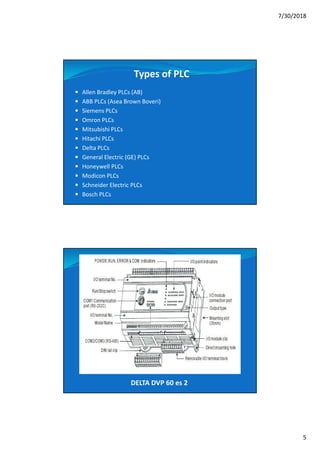
 Delta PLCs
 General Electric (GE) PLCs
 Honeywell PLCs
 Modicon PLCs
 Schneider Electric PLCs
 Bosch PLCs
Types of PLC
DELTA DVP 60 es 2
7/30/2018
6
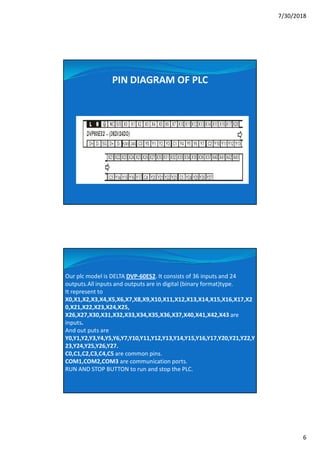
PIN DIAGRAM OF PLC
Our plc model is DELTA DVP-60ES2. It consists of 36 inputs and 24
outputs.All inputs and outputs are in digital (binary format)type.
It represent to
X0,X1,X2,X3,X4,X5,X6,X7,X8,X9,X10,X11,X12,X13,X14,X15,X16,X17,X2
0,X21,X22,X23,X24,X25,
X26,X27,X30,X31,X32,X33,X34,X35,X36,X37,X40,X41,X42,X43 are
inputs.
And out puts are
Y0,Y1,Y2,Y3,Y4,Y5,Y6,Y7,Y10,Y11,Y12,Y13,Y14,Y15,Y16,Y17,Y20,Y21,Y22,Y
23,Y24,Y25,Y26,Y27.
C0,C1,C2,C3,C4,C5 are common pins.
COM1,COM2,COM3 are communication ports.
RUN AND STOP BUTTON to run and stop the PLC.
7/30/2018
7
The operation of the PLC system is simple.
It consists of three processes:
1. Scans or reads, from the input devices.
2. Executes or “solves” the program logic.
3. Writes to the output devices.
OPERATION OF PLC
 Used for packaging machine.
 Spinning machine.
 Winding machine (tension control).
 Molding injection machine.
APPLICATION OF PLC
7/30/2018
8
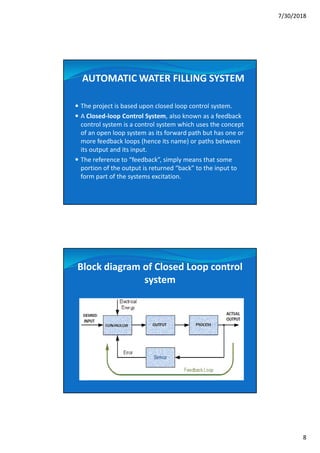
 The project is based upon closed loop control system.
 A Closed-loop Control System, also known as a feedback
control system is a control system which uses the concept
of an open loop system as its forward path but has one or
more feedback loops (hence its name) or paths between
its output and its input.
 The reference to “feedback”, simply means that some
portion of the output is returned “back” to the input to
form part of the systems excitation.
AUTOMATIC WATER FILLING SYSTEM
Block diagram of Closed Loop control
system
7/30/2018
9
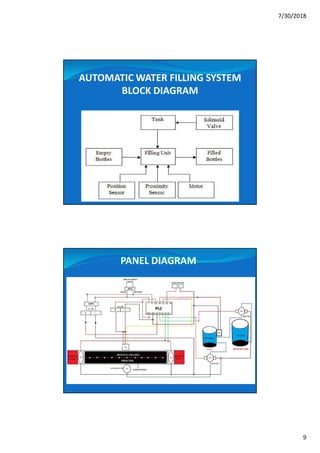
AUTOMATIC WATER FILLING SYSTEM
BLOCK DIAGRAM
7/30/2018
10
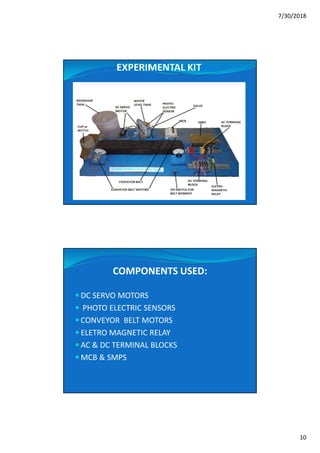
COMPONENTS USED:
 DC SERVO MOTORS
 PHOTO ELECTRIC SENSORS
 CONVEYOR BELT MOTORS
 ELETRO MAGNETIC RELAY
 AC & DC TERMINAL BLOCKS
 MCB & SMPS
7/30/2018
11
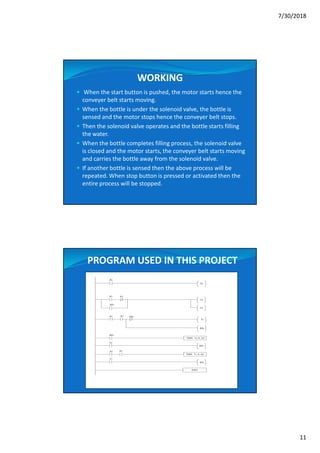
WORKING
 When the start button is pushed, the motor starts hence the
conveyer belt starts moving.
 When the bottle is under the solenoid valve, the bottle is
sensed and the motor stops hence the conveyer belt stops.
 Then the solenoid valve operates and the bottle starts filling
the water.
 When the bottle completes filling process, the solenoid valve
is closed and the motor starts, the conveyer belt starts moving
and carries the bottle away from the solenoid valve.
 If another bottle is sensed then the above process will be
repeated. When stop button is pressed or activated then the
entire process will be stopped.
PROGRAM USED IN THIS PROJECT
7/30/2018
12
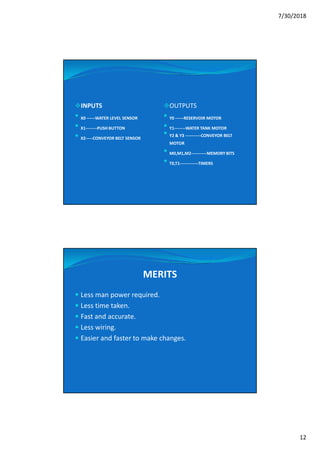
INPUTS
 X0 ------WATER LEVEL SENSOR
 X1--------PUSH BUTTON
 X2-----CONVEYOR BELT SENSOR
OUTPUTS
 Y0 ------RESERVOIR MOTOR
 Y1--------WATER TANK MOTOR
 Y2 & Y3 -----------CONVEYOR BELT
MOTOR
 M0,M1,M2-----------MEMORY BITS
 T0,T1-------------TIMERS
MERITS
 Less man power required.
 Less time taken.
 Fast and accurate.
 Less wiring.
 Easier and faster to make changes.
7/30/2018
13
APPLICATIONS
 Stand alone water bottle booth system.
 Ink filling industry.
 Soft-drink & water filling industries.
 Beer and wine industries.
 Olive oil industries.
CONCLUSION
 We have achieved our objective that is bottle filling
process using PLC.
 This was successfully implemented.
 We consider this project as a journey where we
acquired knowledge on automation industry.
 Also gained some insights into the subject which we
have shared in this report
7/30/2018
14
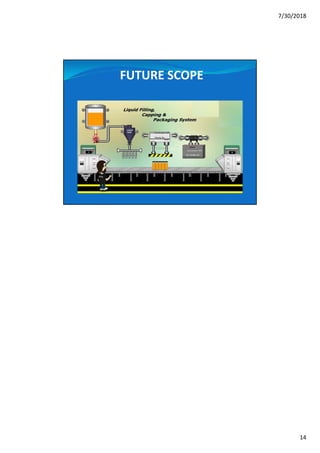
FUTURE SCOPE

Plc based automatic water filling system

  • 1.
    7/30/2018 1 PLC BASED AUTOMATIC WATERFILLING SYSTEM  OBJECTIVES  INTRODUCTION OF AUTOMATION  TYPES OF AUTOMATION  IMPORTANCE OF AUTOMATION  WHAT IS PLC?  WHY PLC?  TYPES OPERATIONS AND APPLICATIONS  BLOCK DIAGRAM, WIRING DIAGRAM AND WORKING OF AUTOMATIC WATER FILLING SYSTEM  APPLICATIONS  ADVANTAGES  FUTURE SCOPE  CONCLUSION ABSTRACT
  • 2.
    7/30/2018 2 INTRODUCTION  The useof machines and technology to make processes run on their own without manpower.  The technique of making an apparatus, a system operate automatically. BUILDING AUTOMATION : Eg : Lifts, Smoke detectors  OFFICE AUTOMATION Eg : CCTV Camera  LIGHT AUTOMATION Eg : Street solar lightening  INDUSTRIAL AUTOMATION Eg : Automated bottle filling system,steel factories,etc Types of Automation
  • 3.
    7/30/2018 3 IMPORTANCE OF AUTOMATION Increases the machine efficiency.  Flexibility and convertibility in manufacturing process  Increase production rates WHAT IS PLC ?  PLC means Programmable Logic Controller.  These systems perform many functions, providing a variety of analog and digital input and output interfaces; signal processing; data conversion; and various communication protocols.
  • 4.
    7/30/2018 4 PLC LANGUAGES  Ladderdiagram  Function Block diagram  Sequential Function Chart  Structured Text  Instruction List WHY PLC  PLC play an important role in automaton, this device can manage and control entire industry to produce better and quick output. A PLC is a digital computer used for automation of industrial processes, like controlling machinery or factory  Reduces human effort.  Get maximum effeciency.
  • 5.
    7/30/2018 5  Allen BradleyPLCs (AB)  ABB PLCs (Asea Brown Boveri)  Siemens PLCs  Omron PLCs  Mitsubishi PLCs  Hitachi PLCs  Delta PLCs  General Electric (GE) PLCs  Honeywell PLCs  Modicon PLCs  Schneider Electric PLCs  Bosch PLCs Types of PLC DELTA DVP 60 es 2
  • 6.
    7/30/2018 6 PIN DIAGRAM OFPLC Our plc model is DELTA DVP-60ES2. It consists of 36 inputs and 24 outputs.All inputs and outputs are in digital (binary format)type. It represent to X0,X1,X2,X3,X4,X5,X6,X7,X8,X9,X10,X11,X12,X13,X14,X15,X16,X17,X2 0,X21,X22,X23,X24,X25, X26,X27,X30,X31,X32,X33,X34,X35,X36,X37,X40,X41,X42,X43 are inputs. And out puts are Y0,Y1,Y2,Y3,Y4,Y5,Y6,Y7,Y10,Y11,Y12,Y13,Y14,Y15,Y16,Y17,Y20,Y21,Y22,Y 23,Y24,Y25,Y26,Y27. C0,C1,C2,C3,C4,C5 are common pins. COM1,COM2,COM3 are communication ports. RUN AND STOP BUTTON to run and stop the PLC.
  • 7.
    7/30/2018 7 The operation ofthe PLC system is simple. It consists of three processes: 1. Scans or reads, from the input devices. 2. Executes or “solves” the program logic. 3. Writes to the output devices. OPERATION OF PLC  Used for packaging machine.  Spinning machine.  Winding machine (tension control).  Molding injection machine. APPLICATION OF PLC
  • 8.
    7/30/2018 8  The projectis based upon closed loop control system.  A Closed-loop Control System, also known as a feedback control system is a control system which uses the concept of an open loop system as its forward path but has one or more feedback loops (hence its name) or paths between its output and its input.  The reference to “feedback”, simply means that some portion of the output is returned “back” to the input to form part of the systems excitation. AUTOMATIC WATER FILLING SYSTEM Block diagram of Closed Loop control system
  • 9.
  • 10.
    7/30/2018 10 COMPONENTS USED:  DCSERVO MOTORS  PHOTO ELECTRIC SENSORS  CONVEYOR BELT MOTORS  ELETRO MAGNETIC RELAY  AC & DC TERMINAL BLOCKS  MCB & SMPS
  • 11.
    7/30/2018 11 WORKING  When thestart button is pushed, the motor starts hence the conveyer belt starts moving.  When the bottle is under the solenoid valve, the bottle is sensed and the motor stops hence the conveyer belt stops.  Then the solenoid valve operates and the bottle starts filling the water.  When the bottle completes filling process, the solenoid valve is closed and the motor starts, the conveyer belt starts moving and carries the bottle away from the solenoid valve.  If another bottle is sensed then the above process will be repeated. When stop button is pressed or activated then the entire process will be stopped. PROGRAM USED IN THIS PROJECT
  • 12.
    7/30/2018 12 INPUTS  X0 ------WATERLEVEL SENSOR  X1--------PUSH BUTTON  X2-----CONVEYOR BELT SENSOR OUTPUTS  Y0 ------RESERVOIR MOTOR  Y1--------WATER TANK MOTOR  Y2 & Y3 -----------CONVEYOR BELT MOTOR  M0,M1,M2-----------MEMORY BITS  T0,T1-------------TIMERS MERITS  Less man power required.  Less time taken.  Fast and accurate.  Less wiring.  Easier and faster to make changes.
  • 13.
    7/30/2018 13 APPLICATIONS  Stand alonewater bottle booth system.  Ink filling industry.  Soft-drink & water filling industries.  Beer and wine industries.  Olive oil industries. CONCLUSION  We have achieved our objective that is bottle filling process using PLC.  This was successfully implemented.  We consider this project as a journey where we acquired knowledge on automation industry.  Also gained some insights into the subject which we have shared in this report
  • 14.