Methods and algorithms of speech recognition
                   course

                 Lection 4

             Nikolay V. Karpov

              nkarpov(а)hse.ru
   Aims of Linear Prediction
   Derivation of Linear Prediction Equations
   Autocorrelation method of LPC
   Interpretation of LPC filter as a spectral
    whitener
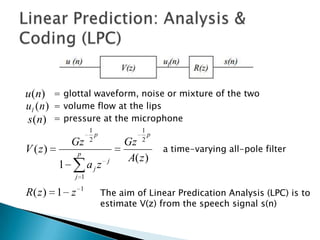
u (n)     = glottal waveform, noise or mixture of the two
ul (n )   = volume flow at the lips
s(n)      = pressure at the microphone
                     1               1
                       p               p
                     2               2
               Gz               Gz
V ( z)          p
                                           a time-varying all-pole filter
                            j    A( z )
           1         ajz
               j 1

                           The aim of Linear Predication Analysis (LPC) is to
                1
R( z ) 1 z
                           estimate V(z) from the speech signal s(n)
1              1
                             p              p
                           2              2
                     Gz              Gz
        V ( z)        p
                                 j    A( z )
                 1         ajz
                     j 1


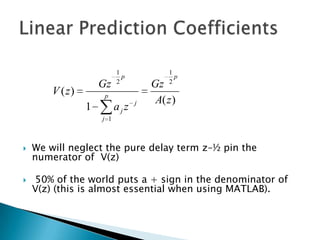
   We will neglect the pure delay term z–½ pin the
    numerator of V(z)

   50% of the world puts a + sign in the denominator of
    V(z) (this is almost essential when using MATLAB).
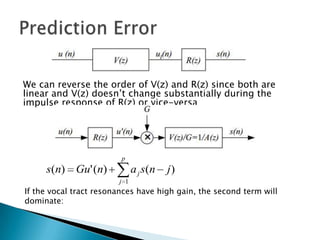
We can reverse the order of V(z) and R(z) since both are
linear and V(z) doesn’t change substantially during the
impulse response of R(z) or vice-versa


                         p
     s(n) Gu' (n)             a j s (n   j)
                        j 1
If the vocal tract resonances have high gain, the second term will
dominate:
p
                     s(n)             a j s(n         j)
                                j 1

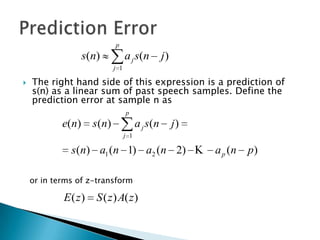
   The right hand side of this expression is a prediction of
    s(n) as a linear sum of past speech samples. Define the
    prediction error at sample n as
                                      p
            e( n )     s ( n)               a j s(n        j)
                                      j 1

              s (n) a1 (n 1) a2 (n 2)                           a p (n   p)

    or in terms of z-transform

            E( z)       S ( z ) A( z )
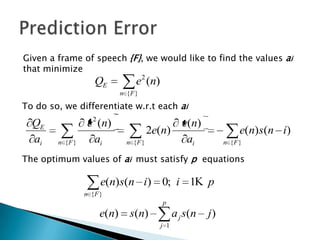
Given a frame of speech {F}, we would like to find the values ai
that minimize
                    QE            e2 (n)
                             n {F }

To do so, we differentiate w.r.t each ai
  QE              e 2 (n)                          e(n)
                                        2e(n)                        e(n)s(n i)
  ai    n {F }      ai         n {F }               ai          n {F }

The optimum values of ai must satisfy p equations

                      e(n)s(n i) 0; i 1                    p
                 n {F }
                                           p
                      e(n)      s(n)             a j s(n   j)
                                           j 1
p
              s ( n) s ( n i )              a j s(n       j ) s(n i)         0
n {F }                                j 1
 p                                                    p
      aj           s (n         j ) s (n i )              s ( n) s ( n i )
j 1           n {F }                             n {F }
 p

         ij   aj       i0   ;   ij          s (n i ) s (n        j)
j 1                                  n {F }

     or in matrix form
Φa c                   a Φ 1c
     the matrix Φ is symmetric and positive semi-definite
   Symmetric             ij        ij        ΦT      Φ
   Positive                                               for any x!=0
    Definite            xi ij x j        0     xT Φx 0
                i, j


   Positive            xi ij x j        0      xT Φx 0
    Semi-
    Definite:    i, j


   Toeplitz:                                  f (i   j)
    Constant            i 1, j 1         ij

    diagonals
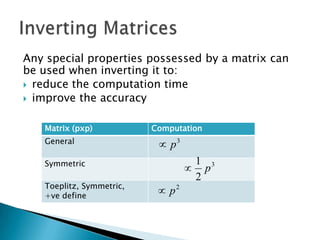
Any special properties possessed by a matrix can
be used when inverting it to:
 reduce the computation time
 improve the accuracy


   Matrix (pxp)           Computation
   General                    p3
   Symmetric                       1 3
                                     p
                                   2
   Toeplitz, Symmetric,
   +ve define
                             p2
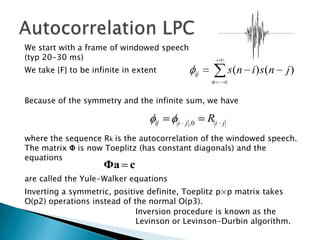
We start with a frame of windowed speech
(typ 20-30 ms)
We take {F} to be infinite in extent             ij            s (n i) s(n   j)
                                                      n

Because of the symmetry and the infinite sum, we have

                                   ij   i j ,0
                                                      Ri   j

where the sequence Rk is the autocorrelation of the windowed speech.
The matrix Φ is now Toeplitz (has constant diagonals) and the
equations
                     Φa c
are called the Yule-Walker equations
Inverting a symmetric, positive definite, Toeplitz p×p matrix takes
O(p2) operations instead of the normal O(p3).
                             Inversion procedure is known as the
                             Levinson or Levinson-Durbin algorithm.
s ( n)   E( z)   S ( z ) A( z )

e( n )


          Poles of V (z )
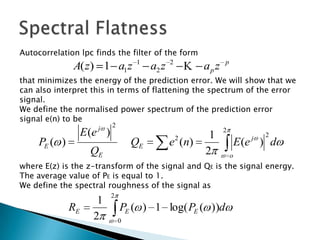
Autocorrelation lpc finds the filter of the form
                                    1           2              p
              A( z) 1 a1 z               a2 z           ap z
that minimizes the energy of the prediction error. We will show that we
can also interpret this in terms of flattening the spectrum of the error
signal.
We define the normalised power spectrum of the prediction error
signal e(n) to be
                      j     2
                                                               2
                   E (e )                           2    1             j   2
     PE ( )                         QE          e (n)              E (e ) d
                     QE                                 2          o
where E(z) is the z-transform of the signal and QE is the signal energy.
The average value of PE is equal to 1.
We define the spectral roughness of the signal as
                            2
                      1
              RE                PE ( ) 1 log( PE ( ))d
                     2          0
2
         1
 RE                PE ( ) 1 log( PE ( ))d
        2          0

 RE is similar to the variance of PE
 since the integrand is similar to
 1         2    where mean(PE)=1
     ( PE 1)
 2
We can find an alternative expression for RE
               2
          1
 RE                    log( PE ( ))d              since PE ( )d      1
         2         0
                         2                        Thus the spectral roughness
                 1                         2
                                                  of a signal equals the
     log(QE ) -                  log E (e j ) d
                2            0
                                                  difference between its log
                                                  energy and the average of
                                                  its log energy spectrum
We know that       E( z)          S ( z ) A( z )
                j     2                               j       2                 j   2
      log E (e )                  log S (e )                      log A(e )
 Substituting this in the expression for RE gives
                          2                                             2
                 1                            j           2         1                   j   2
RE   log(QE ) -                   log S (e ) d                                  log A(e ) d
                2             0
                                                                   2        0
 We saw in the section on filter properties that the term involving
 A is zero since a0=1 and all roots of A lie in the unit circle. Hence
                          2
                 1                                j       2
RE   log(QE ) -                   log S (e ) d
                2             0
     The term involving S is independent of A. It follows that if A is
       chosen to minimize QE, it will also minimize RE, the spectral
        roughness of e(n). The filter A(z) is called a whitening filter
                              because it makes the spectrum flatter
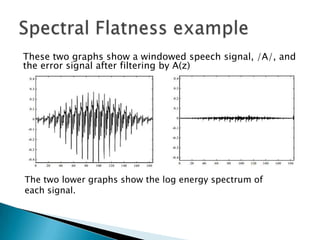
These two graphs show a windowed speech signal, /A/, and
the error signal after filtering by A(z)


The two lower graphs show the log energy spectrum of
each signal.
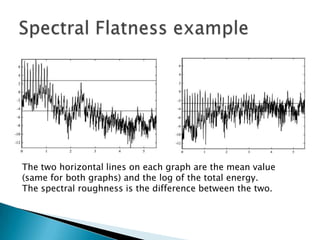
The two horizontal lines on each graph are the mean value
(same for both graphs) and the log of the total energy.
The spectral roughness is the difference between the two.
   Covariance method of LPC
   Preemphasis
   Closed Phase Covariance LPC
   Alternative LPC parameter sets:
    ◦ Pole positions
    ◦ Reflection Coefficients
    ◦ Log Area Ratios
   We consider two variants of LPC analysis which differ
    only in their choice of speech frame, {F}:
   Autocorrelation LPC Analysis
    ◦ Requires a windowed signal ⇒tradeoff between spectral
      resolution and time resolution
    ◦ Requires >20 ms of data
    ◦ Has a fast algorithm because Φ is Toeplitz
    ◦ Guarantees a stable filter V(z)
   Covariance LPC Analysis (Prony’s method)
    ◦   No windowing required
    ◦   Gives infinite spectral resolution
    ◦   Requires >2 ms of data
    ◦   Slower algorithm because Φ is not Toeplitz
    ◦   Sometimes gives an unstable filter V(z)
From previous slide
               p

                     ij   aj     i0   ;     ij        s (n i ) s (n           j)
               j 1                               n {F }
We chose {F} to be a finite segment of speech: {F} = s(n) for
0 ≤ n ≤ (N-1) then we have:

                          ij              s (n i ) s (n        j)
                               n {F }
The matrix Φ is still symmetric but is no longer Toeplitz
           N 2

    ij              s (n i 1) s (n               j 1)
           n    1
                                                                    N 1
         s( i)s( j ) s( N i)s( N                          j)              s (n i 1) s (n   j 1)
                                                                    n 0

                                             s( i)s( j ) s( N i)s( N                  j)   i 1, j 1
   This allows the entire matrix Φ to be calculated
    recursively from its first row or column.
   Since the matrix is not Toeplitz, the computation
    involved in inverting Φ is ∝ p3 rather than ∝ p2
    and so takes longer.
   Covariance LPC generally gives better results
    than Autocorrelation LPC but is more sensitive to
    the precise position of the frame in relation to
    the vocal fold closures
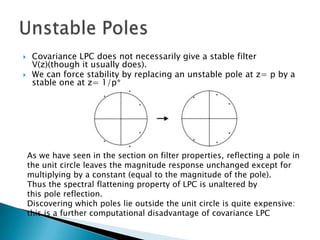
    Covariance LPC does not necessarily give a stable filter
     V(z)(though it usually does).
    We can force stability by replacing an unstable pole at z= p by a
     stable one at z= 1/p*


    As we have seen in the section on filter properties, reflecting a pole in
    the unit circle leaves the magnitude response unchanged except for
    multiplying by a constant (equal to the magnitude of the pole).
    Thus the spectral flattening property of LPC is unaltered by
    this pole reflection.
    Discovering which poles lie outside the unit circle is quite expensive:
    this is a further computational disadvantage of covariance LPC
   The matrix Φ is always non-singular, but not necessarily by very much. A
    measure of how close a matrix is to being singular is given by its
    condition number: for a symmetric +ve definite matrix, this is the ratio
    of its largest to its smallest eigenvalue.

   For large p, the condition number of Φ tends to the ratio
    Smax(ω)/Smin(ω). We can thus improve the numerical properties of the
    LPC analysis procedure by flattening the speech spectrum before
    calculating the autocorrelation matrix Φ.

   For voiced speech, the input to V(z) is ug′(n) whose spectrum falls off at
    high frequencies at around – 6dB/octave. This can be compensated with
    a 1st-order high-pass filter with a zero near z=1:                   1
                                                        P( z ) 1      z
   P(z) is approximately a differentiator. The normalised corner frequency
    of P(z)is approximately (1–α)/2π: This is typically placed in the range 0
    to 150 Hz. From a spectral flatness point of view, the optimum value of
    αis φ10/φ00 (obtained from autocorrelation LPC with p= 1)
p
  From previous slide    s(n) Gu' (n)             a j s (n   j)
                                            j 1
We have neglected the term Gu′(n) because we don’t know
what it is and it is assumed to be much smaller than the
second term.
If we knew when the vocal folds were closed, we could
restrict {F} to those particular intervals. We can estimate the
times of vocal fold closure in two ways:
 Looking for spikes in the e(n) signal
 Using a Laryngograph (or Electroglottograph or EGG): this
   instrument measures the radio-frequency conductance
   across the larynx.
  ◦ Conductance ∝Vocal fold contact area.
  ◦ Accurate but inconvenient.
In Closed-Phase LPC, we choose our analysis interval {F} to
consist of one or more closed phase intervals (not
necessarily contiguous). No preemphasis is necessary
because the excitation now has a flat spectrum.
s(n)

                V (e j T )
e(n) ug ' (n)

u g (n)

                             Frequency (Hz)
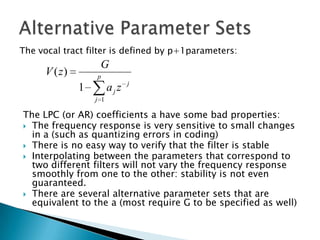
The vocal tract filter is defined by p+1parameters:
                    G
      V ( z)       p
                               j
               1         ajz
                   j 1

The LPC (or AR) coefficients a have some bad properties:
 The frequency response is very sensitive to small changes
  in a (such as quantizing errors in coding)
 There is no easy way to verify that the filter is stable
 Interpolating between the parameters that correspond to
  two different filters will not vary the frequency response
  smoothly from one to the other: stability is not even
  guaranteed.
 There are several alternative parameter sets that are
  equivalent to the a (most require G to be specified as well)
We can factorize the denominator of V(z) to give its poles

       p                p
                   j
 1           ajz             (1 xk z 1 )
       j 1             k 1


    The polynomial roots xk are either real or occur in
     complex conjugate pairs. |xk| must be <1 for stability.
     Factorizing polynomials is computationally expensive.
     The frequency response is sensitive to pole position
     errors near |z|=1
 Any all-pole filter is equivalent to a tube with p sections:
this is characterised by p reflection coefficients (assuming
r0=1). We can convert between the reflection coefficients
and the polynomial coefficients by using the formulae given
previously.
Properties:
 An all-pole filter is stable if the corresponding reflection
  coefficients all lie between -1 and +1.
 Interpolating between two of reflection coefficient sets will
  give a smoothly changing frequency response.
 High coefficient sensitivity near ±1.
 The negative reflection coefficients are sometimes called
  the PARCOR coefficients (PARCOR = partial correlation).
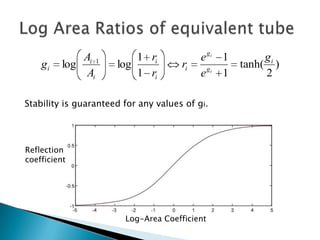
Ai 1        1 ri             e gi 1        gi
    gi    log         log             ri            tanh( )
               Ai         1 ri             e gi 1        2

Stability is guaranteed for any values of gi.


Reflection
coefficient


                        Log-Area Coefficient
Linear prediction

Linear prediction

  • 1.
    Methods and algorithmsof speech recognition course Lection 4 Nikolay V. Karpov nkarpov(а)hse.ru
  • 2.
    Aims of Linear Prediction  Derivation of Linear Prediction Equations  Autocorrelation method of LPC  Interpretation of LPC filter as a spectral whitener
  • 3.
    u (n) = glottal waveform, noise or mixture of the two ul (n ) = volume flow at the lips s(n) = pressure at the microphone 1 1 p p 2 2 Gz Gz V ( z) p a time-varying all-pole filter j A( z ) 1 ajz j 1 The aim of Linear Predication Analysis (LPC) is to 1 R( z ) 1 z estimate V(z) from the speech signal s(n)
  • 4.
    1 1 p p 2 2 Gz Gz V ( z) p j A( z ) 1 ajz j 1  We will neglect the pure delay term z–½ pin the numerator of V(z)  50% of the world puts a + sign in the denominator of V(z) (this is almost essential when using MATLAB).
  • 5.
    We can reversethe order of V(z) and R(z) since both are linear and V(z) doesn’t change substantially during the impulse response of R(z) or vice-versa p s(n) Gu' (n) a j s (n j) j 1 If the vocal tract resonances have high gain, the second term will dominate:
  • 6.
    p s(n) a j s(n j) j 1  The right hand side of this expression is a prediction of s(n) as a linear sum of past speech samples. Define the prediction error at sample n as p e( n ) s ( n) a j s(n j) j 1 s (n) a1 (n 1) a2 (n 2) a p (n p) or in terms of z-transform E( z) S ( z ) A( z )
  • 7.
    Given a frameof speech {F}, we would like to find the values ai that minimize QE e2 (n) n {F } To do so, we differentiate w.r.t each ai QE e 2 (n) e(n) 2e(n) e(n)s(n i) ai n {F } ai n {F } ai n {F } The optimum values of ai must satisfy p equations e(n)s(n i) 0; i 1 p n {F } p e(n) s(n) a j s(n j) j 1
  • 8.
    p s ( n) s ( n i ) a j s(n j ) s(n i) 0 n {F } j 1 p p aj s (n j ) s (n i ) s ( n) s ( n i ) j 1 n {F } n {F } p ij aj i0 ; ij s (n i ) s (n j) j 1 n {F } or in matrix form Φa c a Φ 1c the matrix Φ is symmetric and positive semi-definite
  • 9.
    Symmetric ij ij ΦT Φ  Positive for any x!=0 Definite xi ij x j 0 xT Φx 0 i, j  Positive xi ij x j 0 xT Φx 0 Semi- Definite: i, j  Toeplitz: f (i j) Constant i 1, j 1 ij diagonals
  • 10.
    Any special propertiespossessed by a matrix can be used when inverting it to:  reduce the computation time  improve the accuracy Matrix (pxp) Computation General p3 Symmetric 1 3 p 2 Toeplitz, Symmetric, +ve define p2
  • 11.
    We start witha frame of windowed speech (typ 20-30 ms) We take {F} to be infinite in extent ij s (n i) s(n j) n Because of the symmetry and the infinite sum, we have ij i j ,0 Ri j where the sequence Rk is the autocorrelation of the windowed speech. The matrix Φ is now Toeplitz (has constant diagonals) and the equations Φa c are called the Yule-Walker equations Inverting a symmetric, positive definite, Toeplitz p×p matrix takes O(p2) operations instead of the normal O(p3). Inversion procedure is known as the Levinson or Levinson-Durbin algorithm.
  • 12.
    s ( n) E( z) S ( z ) A( z ) e( n ) Poles of V (z )
  • 13.
    Autocorrelation lpc findsthe filter of the form 1 2 p A( z) 1 a1 z a2 z ap z that minimizes the energy of the prediction error. We will show that we can also interpret this in terms of flattening the spectrum of the error signal. We define the normalised power spectrum of the prediction error signal e(n) to be j 2 2 E (e ) 2 1 j 2 PE ( ) QE e (n) E (e ) d QE 2 o where E(z) is the z-transform of the signal and QE is the signal energy. The average value of PE is equal to 1. We define the spectral roughness of the signal as 2 1 RE PE ( ) 1 log( PE ( ))d 2 0
  • 14.
    2 1 RE PE ( ) 1 log( PE ( ))d 2 0 RE is similar to the variance of PE since the integrand is similar to 1 2 where mean(PE)=1 ( PE 1) 2 We can find an alternative expression for RE 2 1 RE log( PE ( ))d since PE ( )d 1 2 0 2 Thus the spectral roughness 1 2 of a signal equals the log(QE ) - log E (e j ) d 2 0 difference between its log energy and the average of its log energy spectrum
  • 15.
    We know that E( z) S ( z ) A( z ) j 2 j 2 j 2 log E (e ) log S (e ) log A(e ) Substituting this in the expression for RE gives 2 2 1 j 2 1 j 2 RE log(QE ) - log S (e ) d log A(e ) d 2 0 2 0 We saw in the section on filter properties that the term involving A is zero since a0=1 and all roots of A lie in the unit circle. Hence 2 1 j 2 RE log(QE ) - log S (e ) d 2 0 The term involving S is independent of A. It follows that if A is chosen to minimize QE, it will also minimize RE, the spectral roughness of e(n). The filter A(z) is called a whitening filter because it makes the spectrum flatter
  • 16.
    These two graphsshow a windowed speech signal, /A/, and the error signal after filtering by A(z) The two lower graphs show the log energy spectrum of each signal.
  • 17.
    The two horizontallines on each graph are the mean value (same for both graphs) and the log of the total energy. The spectral roughness is the difference between the two.
  • 18.
    Covariance method of LPC  Preemphasis  Closed Phase Covariance LPC  Alternative LPC parameter sets: ◦ Pole positions ◦ Reflection Coefficients ◦ Log Area Ratios
  • 19.
    We consider two variants of LPC analysis which differ only in their choice of speech frame, {F}:  Autocorrelation LPC Analysis ◦ Requires a windowed signal ⇒tradeoff between spectral resolution and time resolution ◦ Requires >20 ms of data ◦ Has a fast algorithm because Φ is Toeplitz ◦ Guarantees a stable filter V(z)  Covariance LPC Analysis (Prony’s method) ◦ No windowing required ◦ Gives infinite spectral resolution ◦ Requires >2 ms of data ◦ Slower algorithm because Φ is not Toeplitz ◦ Sometimes gives an unstable filter V(z)
  • 20.
    From previous slide p ij aj i0 ; ij s (n i ) s (n j) j 1 n {F } We chose {F} to be a finite segment of speech: {F} = s(n) for 0 ≤ n ≤ (N-1) then we have: ij s (n i ) s (n j) n {F } The matrix Φ is still symmetric but is no longer Toeplitz N 2 ij s (n i 1) s (n j 1) n 1 N 1 s( i)s( j ) s( N i)s( N j) s (n i 1) s (n j 1) n 0 s( i)s( j ) s( N i)s( N j) i 1, j 1
  • 21.
    This allows the entire matrix Φ to be calculated recursively from its first row or column.  Since the matrix is not Toeplitz, the computation involved in inverting Φ is ∝ p3 rather than ∝ p2 and so takes longer.  Covariance LPC generally gives better results than Autocorrelation LPC but is more sensitive to the precise position of the frame in relation to the vocal fold closures
  • 22.
    Covariance LPC does not necessarily give a stable filter V(z)(though it usually does).  We can force stability by replacing an unstable pole at z= p by a stable one at z= 1/p* As we have seen in the section on filter properties, reflecting a pole in the unit circle leaves the magnitude response unchanged except for multiplying by a constant (equal to the magnitude of the pole). Thus the spectral flattening property of LPC is unaltered by this pole reflection. Discovering which poles lie outside the unit circle is quite expensive: this is a further computational disadvantage of covariance LPC
  • 23.
    The matrix Φ is always non-singular, but not necessarily by very much. A measure of how close a matrix is to being singular is given by its condition number: for a symmetric +ve definite matrix, this is the ratio of its largest to its smallest eigenvalue.  For large p, the condition number of Φ tends to the ratio Smax(ω)/Smin(ω). We can thus improve the numerical properties of the LPC analysis procedure by flattening the speech spectrum before calculating the autocorrelation matrix Φ.  For voiced speech, the input to V(z) is ug′(n) whose spectrum falls off at high frequencies at around – 6dB/octave. This can be compensated with a 1st-order high-pass filter with a zero near z=1: 1 P( z ) 1 z  P(z) is approximately a differentiator. The normalised corner frequency of P(z)is approximately (1–α)/2π: This is typically placed in the range 0 to 150 Hz. From a spectral flatness point of view, the optimum value of αis φ10/φ00 (obtained from autocorrelation LPC with p= 1)
  • 24.
    p Fromprevious slide s(n) Gu' (n) a j s (n j) j 1 We have neglected the term Gu′(n) because we don’t know what it is and it is assumed to be much smaller than the second term. If we knew when the vocal folds were closed, we could restrict {F} to those particular intervals. We can estimate the times of vocal fold closure in two ways:  Looking for spikes in the e(n) signal  Using a Laryngograph (or Electroglottograph or EGG): this instrument measures the radio-frequency conductance across the larynx. ◦ Conductance ∝Vocal fold contact area. ◦ Accurate but inconvenient. In Closed-Phase LPC, we choose our analysis interval {F} to consist of one or more closed phase intervals (not necessarily contiguous). No preemphasis is necessary because the excitation now has a flat spectrum.
  • 25.
    s(n) V (e j T ) e(n) ug ' (n) u g (n) Frequency (Hz)
  • 26.
    The vocal tractfilter is defined by p+1parameters: G V ( z) p j 1 ajz j 1 The LPC (or AR) coefficients a have some bad properties:  The frequency response is very sensitive to small changes in a (such as quantizing errors in coding)  There is no easy way to verify that the filter is stable  Interpolating between the parameters that correspond to two different filters will not vary the frequency response smoothly from one to the other: stability is not even guaranteed.  There are several alternative parameter sets that are equivalent to the a (most require G to be specified as well)
  • 27.
    We can factorizethe denominator of V(z) to give its poles p p j 1 ajz (1 xk z 1 ) j 1 k 1  The polynomial roots xk are either real or occur in complex conjugate pairs. |xk| must be <1 for stability. Factorizing polynomials is computationally expensive. The frequency response is sensitive to pole position errors near |z|=1
  • 28.
     Any all-polefilter is equivalent to a tube with p sections: this is characterised by p reflection coefficients (assuming r0=1). We can convert between the reflection coefficients and the polynomial coefficients by using the formulae given previously. Properties:  An all-pole filter is stable if the corresponding reflection coefficients all lie between -1 and +1.  Interpolating between two of reflection coefficient sets will give a smoothly changing frequency response.  High coefficient sensitivity near ±1.  The negative reflection coefficients are sometimes called the PARCOR coefficients (PARCOR = partial correlation).
  • 29.
    Ai 1 1 ri e gi 1 gi gi log log ri tanh( ) Ai 1 ri e gi 1 2 Stability is guaranteed for any values of gi. Reflection coefficient Log-Area Coefficient