Technology Integration Now:Why and HowA Guide for Teachers and Administratorsby Matthew Gudenius
The EdTech FAQWhy use educational technology?Do students really need more than they already get on the computers in the classroom or lab?Isn’t it too expensive?
Why use technology?DifferentiationInterventionAssessmentCognitive Growth:Develop higher-order thinking skillsReal-world Application
Technology for DifferentiationTechnology – especially computers – can ease the burden of differentiating learning for a variety of learners by having these qualities:Tailored to ability levelSelf-pacedIndependent or collaborativeCaters to multiple intelligences
Technology for InterventionCustom-tailored assessments and tutorialsDrill-and-practice software and games build automaticity as defined by Gagné (1982) and Bloom (1986)Engages student without need for one-on-one tutor or paraprofessionalSpecial technologies exist to accommodate special needsAdvanced students can pursue challenging problem/project-based tasks
Technology for AssessmentAutomatic scoring reduces labor for teacher and/or aidesProvides immediate feedback to studentCan be more fun or engaging, improving student motivation (click here for example)
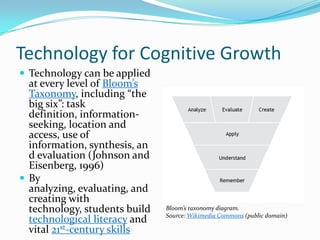
Technology for Cognitive GrowthTechnology can be applied at every level of Bloom’s Taxonomy, including “the big six”: task definition, information-seeking, location and access, use of information, synthesis, and evaluation (Johnson and Eisenberg, 1996)By analyzing, evaluating, and creating with technology, students build technological literacy and vital 21st-century skillsBloom’s taxonomy diagram.Source: Wikimedia Commons(public domain)
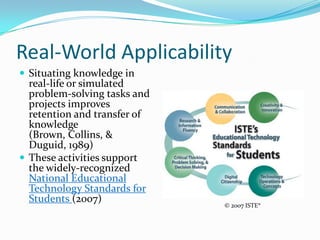
Real-World ApplicabilitySituating knowledge in real-life or simulated problem-solving tasks and projects improves retention and transfer of knowledge (Brown, Collins, & Duguid, 1989)These activities support the widely-recognized National Educational Technology Standards for Students (2007)© 2007 ISTE®
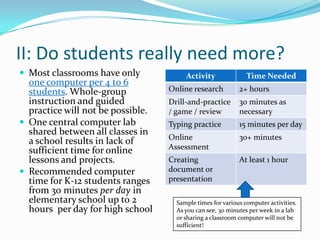
II: Do students really need more?Most classrooms have only one computer per 4 to 6 students. Whole-group instruction and guided practice will not be possible.One central computer lab shared between all classes in a school results in lack of sufficient time for online lessons and projects.Recommended computer time for K-12 students ranges from 30 minutes per day in elementary school up to 2 hours  per day for high schoolSample times for various computer activities.As you can see, 30 minutes per week in a labor sharing a classroom computer will not be sufficient!
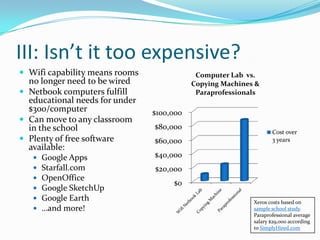
III: Isn’t it too expensive?Wifi capability means rooms no longer need to be wiredNetbook computers fulfill educational needs for under $300/computerCan move to any classroom in the schoolPlenty of free software available:Google AppsStarfall.comOpenOfficeGoogle SketchUpGoogle Earth…and more!Xerox costs based on sample school study.Paraprofessional average salary $29,000 accordingto SimplyHired.com
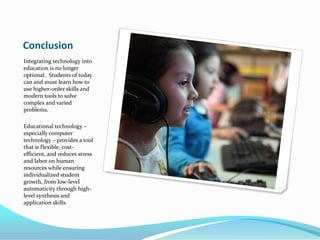
ConclusionIntegrating technology into education is no longer optional.  Students of today can and must learn how to use higher-order skills and modern tools to solve complex and varied problems.Educational technology – especially computer technology – provides a tool that is flexible, cost-efficient, and reduces stress and labor on human resources while ensuring individualized student growth, from low-level automaticity through high-level synthesis and application skills.
ReferencesBloom, B. (1986). Automaticity. Educational Leadership, 43(5), 70-77.Brown, J.S., Collins, A., & Duguid, P. (1989). Situated cognition and the culture of learning. Educational Researcher, 18(1), 32-41.Churches, A. (2008, April 1). Bloom's taxonomy blooms digitally.   Retrieved February 8, 2010 from: http://www.techlearning.com/article/8670Gagné, R. (1982). Developments in learning psychology: Implications for instructional design. Educational Technology, 22(6), 11-15.International Society for Technology in Education. (2007). National educational technology standards for students. Eugene, OR: Author.Johnson, D. & Eisenberg, M. (1996). Computer literacy and information literacy: A natural combination. Emergency Librarian, 23(5), 12-16.

Technology Integration Now

  • 1.
    Technology Integration Now:Whyand HowA Guide for Teachers and Administratorsby Matthew Gudenius
  • 2.
    The EdTech FAQWhyuse educational technology?Do students really need more than they already get on the computers in the classroom or lab?Isn’t it too expensive?
  • 3.
    Why use technology?DifferentiationInterventionAssessmentCognitiveGrowth:Develop higher-order thinking skillsReal-world Application
  • 4.
    Technology for DifferentiationTechnology– especially computers – can ease the burden of differentiating learning for a variety of learners by having these qualities:Tailored to ability levelSelf-pacedIndependent or collaborativeCaters to multiple intelligences
  • 5.
    Technology for InterventionCustom-tailoredassessments and tutorialsDrill-and-practice software and games build automaticity as defined by Gagné (1982) and Bloom (1986)Engages student without need for one-on-one tutor or paraprofessionalSpecial technologies exist to accommodate special needsAdvanced students can pursue challenging problem/project-based tasks
  • 6.
    Technology for AssessmentAutomaticscoring reduces labor for teacher and/or aidesProvides immediate feedback to studentCan be more fun or engaging, improving student motivation (click here for example)
  • 7.
    Technology for CognitiveGrowthTechnology can be applied at every level of Bloom’s Taxonomy, including “the big six”: task definition, information-seeking, location and access, use of information, synthesis, and evaluation (Johnson and Eisenberg, 1996)By analyzing, evaluating, and creating with technology, students build technological literacy and vital 21st-century skillsBloom’s taxonomy diagram.Source: Wikimedia Commons(public domain)
  • 8.
    Real-World ApplicabilitySituating knowledgein real-life or simulated problem-solving tasks and projects improves retention and transfer of knowledge (Brown, Collins, & Duguid, 1989)These activities support the widely-recognized National Educational Technology Standards for Students (2007)© 2007 ISTE®
  • 9.
    II: Do studentsreally need more?Most classrooms have only one computer per 4 to 6 students. Whole-group instruction and guided practice will not be possible.One central computer lab shared between all classes in a school results in lack of sufficient time for online lessons and projects.Recommended computer time for K-12 students ranges from 30 minutes per day in elementary school up to 2 hours per day for high schoolSample times for various computer activities.As you can see, 30 minutes per week in a labor sharing a classroom computer will not be sufficient!
  • 10.
    III: Isn’t ittoo expensive?Wifi capability means rooms no longer need to be wiredNetbook computers fulfill educational needs for under $300/computerCan move to any classroom in the schoolPlenty of free software available:Google AppsStarfall.comOpenOfficeGoogle SketchUpGoogle Earth…and more!Xerox costs based on sample school study.Paraprofessional average salary $29,000 accordingto SimplyHired.com
  • 11.
    ConclusionIntegrating technology intoeducation is no longer optional. Students of today can and must learn how to use higher-order skills and modern tools to solve complex and varied problems.Educational technology – especially computer technology – provides a tool that is flexible, cost-efficient, and reduces stress and labor on human resources while ensuring individualized student growth, from low-level automaticity through high-level synthesis and application skills.
  • 12.
    ReferencesBloom, B. (1986).Automaticity. Educational Leadership, 43(5), 70-77.Brown, J.S., Collins, A., & Duguid, P. (1989). Situated cognition and the culture of learning. Educational Researcher, 18(1), 32-41.Churches, A. (2008, April 1). Bloom's taxonomy blooms digitally.   Retrieved February 8, 2010 from: http://www.techlearning.com/article/8670Gagné, R. (1982). Developments in learning psychology: Implications for instructional design. Educational Technology, 22(6), 11-15.International Society for Technology in Education. (2007). National educational technology standards for students. Eugene, OR: Author.Johnson, D. & Eisenberg, M. (1996). Computer literacy and information literacy: A natural combination. Emergency Librarian, 23(5), 12-16.