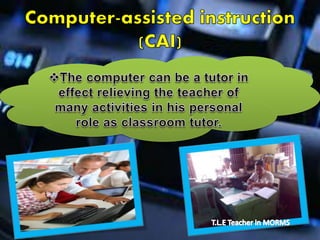
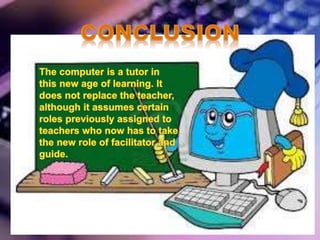
The Computer as a Tutor
The computer is the human ingenuity. Even its
original design in the 1950’s. With the intervention
of the microcomputer (now also commonly referred
to PC’s or personal computers, the PC has
become the tool for program instructions.
Educators saw much
use of the PC. It has
become affordable to
small business,
industries and homes.
They saw its potential
for individualization in
learning, especially as
individualized
learning is a problem
since teachers usually
with a class of forty
one or more learners.
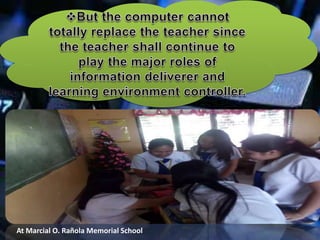
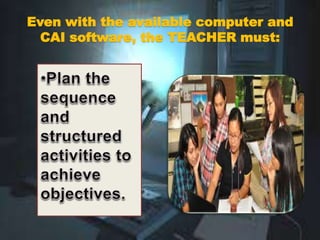
At Marcial O. Rañola Memorial School
Even with the available computer and
CAI software, the TEACHER must:
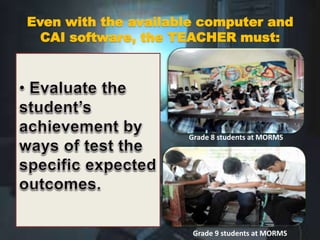
Even with the available computer and
CAI software, the TEACHER must:
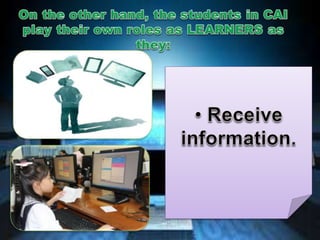
Even with the available computer and
CAI software, the TEACHER must:
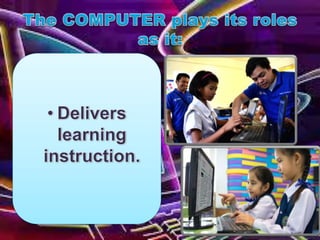
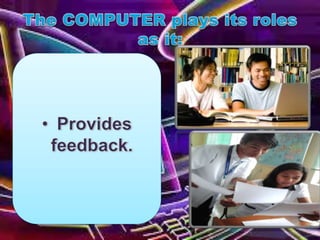
Grade 8 students at MORMS
Grade 9 students at MORMS
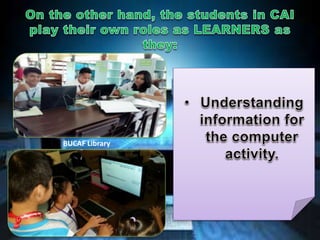
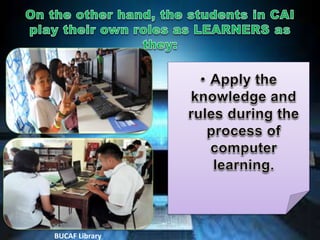
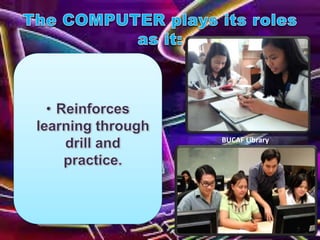
BUCAF Library
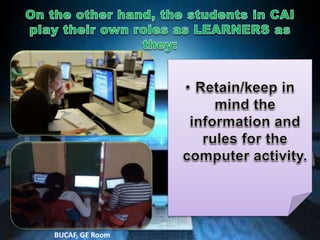
BUCAF, GE Room
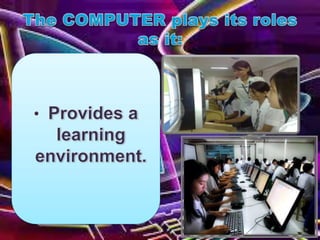
BUCAF Library
BUCAF Library
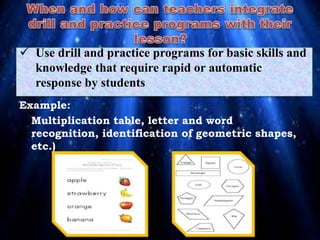
Example:
Multiplication table, letter and word
recognition, identification of geometric shapes,
etc.)
 Use drill and practice programs for basic skills and
knowledge that require rapid or automatic
response by students
 Ensure that drill and practice activities conform
to the lesson plan/curriculum.
 Limit drill and practice to 20-30 minutes to avoid
boredom.
 Use drill and practice to assist students with
particular weakness in basic skills.
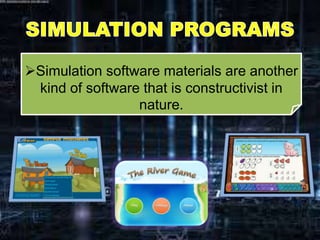
Simulation software materials are another
kind of software that is constructivist in
nature.
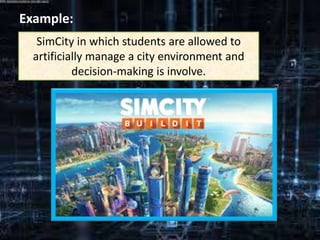
Example:
SimCity in which students are allowed to
artificially manage a city environment and
decision-making is involve.
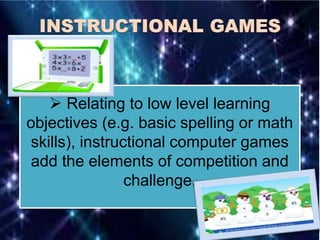
 Relating to low level learning
objectives (e.g. basic spelling or math
skills), instructional computer games
add the elements of competition and
challenge.
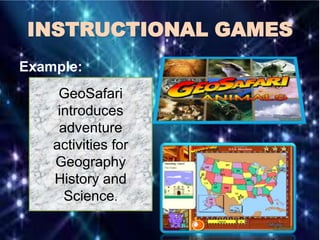
INSTRUCTIONAL GAMES
Example:
GeoSafari
introduces
adventure
activities for
Geography
History and
Science.
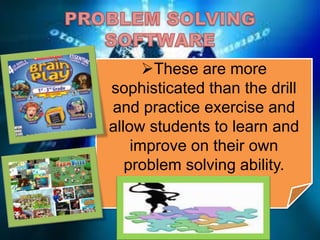
These are more
sophisticated than the drill
and practice exercise and
allow students to learn and
improve on their own
problem solving ability.
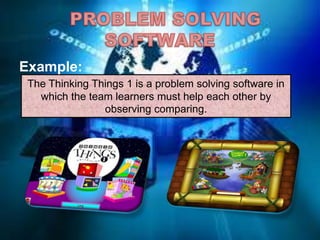
Example:
The Thinking Things 1 is a problem solving software in
which the team learners must help each other by
observing comparing.
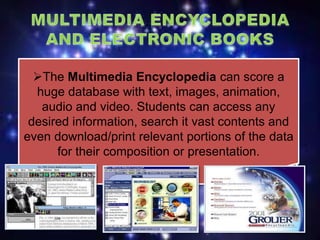
The Multimedia Encyclopedia can score a
huge database with text, images, animation,
audio and video. Students can access any
desired information, search it vast contents and
even download/print relevant portions of the data
for their composition or presentation.
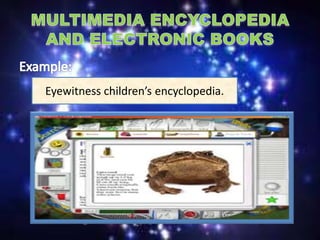
Eyewitness children’s encyclopedia.
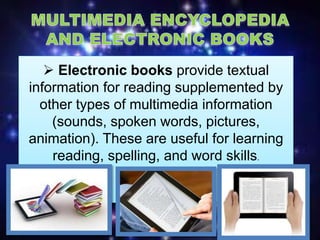
 Electronic books provide textual
information for reading supplemented by
other types of multimedia information
(sounds, spoken words, pictures,
animation). These are useful for learning
reading, spelling, and word skills.
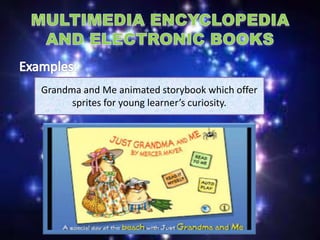
Grandma and Me animated storybook which offer
sprites for young learner’s curiosity.
Assignment:
1. Many software materials available in
developed countries are not yet available in
developing countries. Do you think
awareness of the existence of these materials
can still help teachers in developing
countries ?
2. Students play games at home and nearby
school computer cafes. How do these games
differ from instructional computer games?
Reference:
Paz I. Lucido, Ph. D, Educational
Technology 2, Lorimar Publishing Inc.
Copyright 2012
Lesson 10 The Computer As A Tutor

Lesson 10 The Computer As A Tutor

  • 2.
    The Computer asa Tutor The computer is the human ingenuity. Even its original design in the 1950’s. With the intervention of the microcomputer (now also commonly referred to PC’s or personal computers, the PC has become the tool for program instructions.
  • 3.
    Educators saw much useof the PC. It has become affordable to small business, industries and homes. They saw its potential for individualization in learning, especially as individualized learning is a problem since teachers usually with a class of forty one or more learners.
  • 5.
    At Marcial O.Rañola Memorial School
  • 7.
    Even with theavailable computer and CAI software, the TEACHER must:
  • 8.
    Even with theavailable computer and CAI software, the TEACHER must:
  • 9.
    Even with theavailable computer and CAI software, the TEACHER must: Grade 8 students at MORMS Grade 9 students at MORMS
  • 11.
  • 12.
  • 13.
  • 18.
  • 21.
    Example: Multiplication table, letterand word recognition, identification of geometric shapes, etc.)  Use drill and practice programs for basic skills and knowledge that require rapid or automatic response by students
  • 22.
     Ensure thatdrill and practice activities conform to the lesson plan/curriculum.  Limit drill and practice to 20-30 minutes to avoid boredom.  Use drill and practice to assist students with particular weakness in basic skills.
  • 26.
    Simulation software materialsare another kind of software that is constructivist in nature.
  • 28.
    Example: SimCity in whichstudents are allowed to artificially manage a city environment and decision-making is involve.
  • 29.
     Relating tolow level learning objectives (e.g. basic spelling or math skills), instructional computer games add the elements of competition and challenge.
  • 30.
  • 31.
    These are more sophisticatedthan the drill and practice exercise and allow students to learn and improve on their own problem solving ability.
  • 32.
    Example: The Thinking Things1 is a problem solving software in which the team learners must help each other by observing comparing.
  • 33.
    The Multimedia Encyclopediacan score a huge database with text, images, animation, audio and video. Students can access any desired information, search it vast contents and even download/print relevant portions of the data for their composition or presentation.
  • 34.
  • 35.
     Electronic booksprovide textual information for reading supplemented by other types of multimedia information (sounds, spoken words, pictures, animation). These are useful for learning reading, spelling, and word skills.
  • 36.
    Grandma and Meanimated storybook which offer sprites for young learner’s curiosity.
  • 38.
    Assignment: 1. Many softwarematerials available in developed countries are not yet available in developing countries. Do you think awareness of the existence of these materials can still help teachers in developing countries ? 2. Students play games at home and nearby school computer cafes. How do these games differ from instructional computer games?
  • 39.
    Reference: Paz I. Lucido,Ph. D, Educational Technology 2, Lorimar Publishing Inc. Copyright 2012