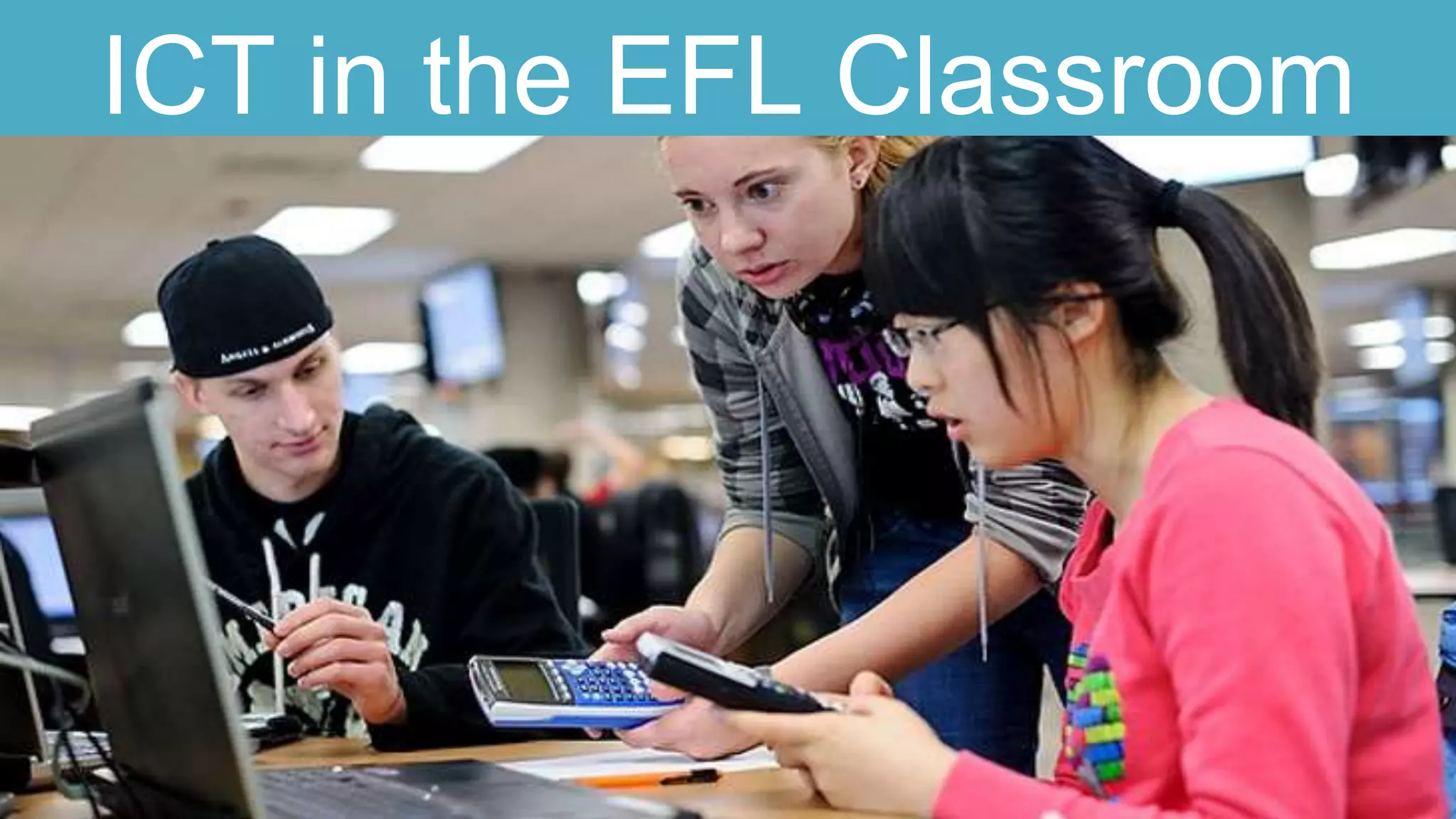







ICT in the EFL Classroom
● Opportunities & challenges for learner
● Opportunities & challenges for teacher
● Learning is change
● Learning by teaching
● Copyright and plagiarism
● Moodle layout and navigation
● Showcasing tools
● Grading
● Final Project
Opportunities for Learner
● Increases student motivation
● Improves independent learning
● Opportunities for learner collaboration
● Improves learner output
● Content and Language Integrated Learning
● Instant feedback and support
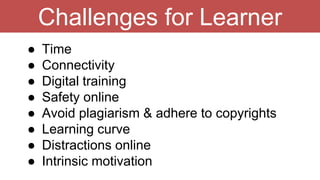
Challenges for Learner
● Time
● Connectivity
● Digital training
● Safety online
● Avoid plagiarism & adhere to copyrights
● Learning curve
● Distractions online
● Intrinsic motivation
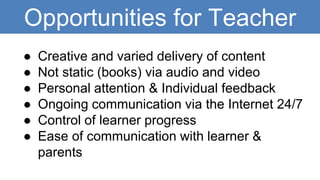
Opportunities for Teacher
● Creative and varied delivery of content
● Not static (books) via audio and video
● Personal attention & Individual feedback
● Ongoing communication via the Internet 24/7
● Control of learner progress
● Ease of communication with learner &
parents
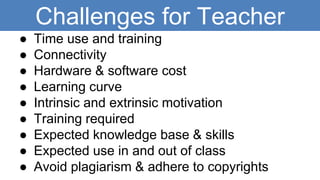
Challenges for Teacher
● Time use and training
● Connectivity
● Hardware & software cost
● Learning curve
● Intrinsic and extrinsic motivation
● Training required
● Expected knowledge base & skills
● Expected use in and out of class
● Avoid plagiarism & adhere to copyrights
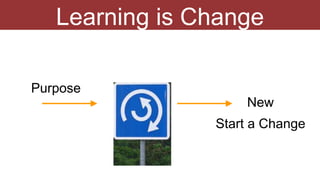
Purpose
New
Start a Change
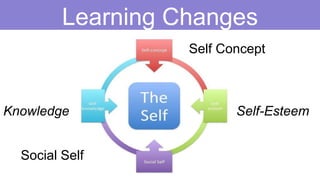
Learning is Change
Knowledge Self-Esteem
Learning Changes
Self Concept
Social Self
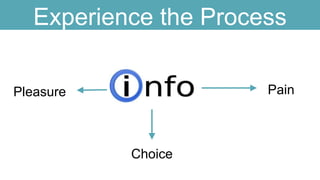
PainPleasure
Choice
Experience the Process
● Present information
● Apply tools to reach audiences globally
● Receiving widespread feedback
● Experiencing information
● Self-development
● Gain recognition (locally and globally)
● Expert (area researched)
Learning by Teaching
● Active Learning
● Learning by doing
● Applying information
● Demonstrating learning outcomes
● Sharing as a way to learn
● Socially engaging with others
● Experiential learning
Teaching as a Way to Learn
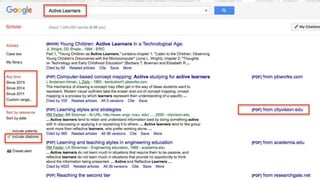
Copyrights for Images
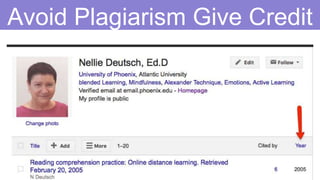
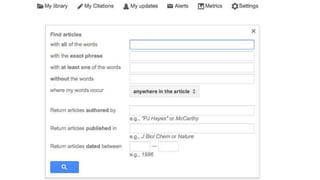
Plagiarism in the EFL Class
Avoid Plagiarism Give Credit
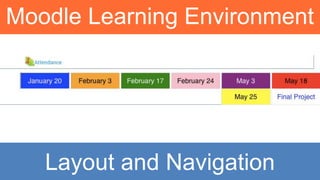
Moodle Learning Environment
Layout and Navigation
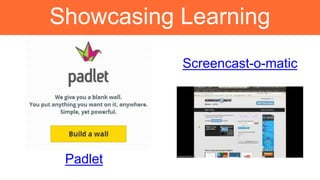
Showcasing Learning
Screencast-o-matic
Padlet
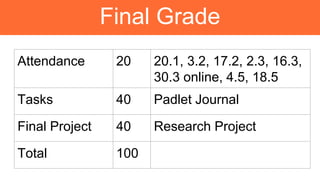
Final Grade
Attendance 20 20.1, 3.2, 17.2, 2.3, 16.3,
30.3 online, 4.5, 18.5
Tasks 40 Padlet Journal
Final Project 40 Research Project
Total 100
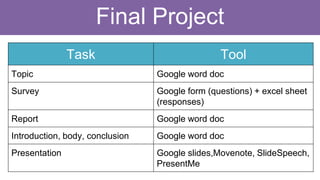
Final Project
Task Tool
Topic Google word doc
Survey Google form (questions) + excel sheet
(responses)
Report Google word doc
Introduction, body, conclusion Google word doc
Presentation Google slides,Movenote, SlideSpeech,
PresentMe
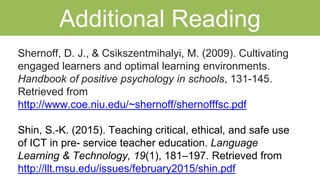
Additional Reading
Shernoff, D. J., & Csikszentmihalyi, M. (2009). Cultivating
engaged learners and optimal learning environments.
Handbook of positive psychology in schools, 131-145.
Retrieved from
http://www.coe.niu.edu/~shernoff/shernofffsc.pdf
Shin, S.-K. (2015). Teaching critical, ethical, and safe use
of ICT in pre- service teacher education. Language
Learning & Technology, 19(1), 181–197. Retrieved from
http://llt.msu.edu/issues/february2015/shin.pdf
ICT in the EFL Classroom

ICT in the EFL Classroom

  • 1.
    ICT in theEFL Classroom
  • 2.
    ICT in theEFL Classroom ● Opportunities & challenges for learner ● Opportunities & challenges for teacher ● Learning is change ● Learning by teaching ● Copyright and plagiarism ● Moodle layout and navigation ● Showcasing tools ● Grading ● Final Project
  • 3.
    Opportunities for Learner ●Increases student motivation ● Improves independent learning ● Opportunities for learner collaboration ● Improves learner output ● Content and Language Integrated Learning ● Instant feedback and support
  • 7.
    Challenges for Learner ●Time ● Connectivity ● Digital training ● Safety online ● Avoid plagiarism & adhere to copyrights ● Learning curve ● Distractions online ● Intrinsic motivation
  • 8.
    Opportunities for Teacher ●Creative and varied delivery of content ● Not static (books) via audio and video ● Personal attention & Individual feedback ● Ongoing communication via the Internet 24/7 ● Control of learner progress ● Ease of communication with learner & parents
  • 11.
    Challenges for Teacher ●Time use and training ● Connectivity ● Hardware & software cost ● Learning curve ● Intrinsic and extrinsic motivation ● Training required ● Expected knowledge base & skills ● Expected use in and out of class ● Avoid plagiarism & adhere to copyrights
  • 12.
  • 13.
  • 14.
  • 15.
    ● Present information ●Apply tools to reach audiences globally ● Receiving widespread feedback ● Experiencing information ● Self-development ● Gain recognition (locally and globally) ● Expert (area researched) Learning by Teaching
  • 16.
    ● Active Learning ●Learning by doing ● Applying information ● Demonstrating learning outcomes ● Sharing as a way to learn ● Socially engaging with others ● Experiential learning Teaching as a Way to Learn
  • 17.
  • 18.
  • 19.
  • 21.
  • 24.
  • 25.
  • 26.
  • 27.
    Final Grade Attendance 2020.1, 3.2, 17.2, 2.3, 16.3, 30.3 online, 4.5, 18.5 Tasks 40 Padlet Journal Final Project 40 Research Project Total 100
  • 28.
    Final Project Task Tool TopicGoogle word doc Survey Google form (questions) + excel sheet (responses) Report Google word doc Introduction, body, conclusion Google word doc Presentation Google slides,Movenote, SlideSpeech, PresentMe
  • 29.
    Additional Reading Shernoff, D.J., & Csikszentmihalyi, M. (2009). Cultivating engaged learners and optimal learning environments. Handbook of positive psychology in schools, 131-145. Retrieved from http://www.coe.niu.edu/~shernoff/shernofffsc.pdf Shin, S.-K. (2015). Teaching critical, ethical, and safe use of ICT in pre- service teacher education. Language Learning & Technology, 19(1), 181–197. Retrieved from http://llt.msu.edu/issues/february2015/shin.pdf
  • 30.
    ICT in theEFL Classroom