INTEGRATING
TECHNOLOGY IN
EDUCATION
Cansu Kutlu
TECHNOLOGY IN EDUCATION
Key Terminology
Talking about a topic requires knowing the
vocabulary relevant to that topic. The term
educational technology and related terms
are not defined the same by everyone.
Educators who want to study the field must
recognize that language used to describe
technology reflects differing perspectives on
the appropriate uses of educational
technology.
Reflecting on the Past
Showing where the field began helps us
understand where it is headed and why.
Reviewing changes in goals and methods in the
field over time provides a foundation on which
to build even more successful and useful
structures to respond to the challenges of
modern education.
TECHNOLOGY IN EDUCATION
Considering the Present
The current role of educational technology
is shaped primarily by two factors: avaliable
technology resources and our perspectives
on how to make use of them. Avaliable
technologies dictate what is possible; a
combination of social, instructional, cultural
and legal issues influence the directions we
choose to take.
Looking Ahead to the Future
Technology resources and societal conditions
change so rapidly that today’s choices are
always influenced as much by emerging trends
as by current conditions. To be informed
citizens of an Information Society, teachers
must be futurists.
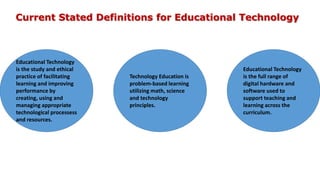
Current Stated Definitions for Educational Technology
Educational Technology
is the study and ethical
practice of facilitating
learning and improving
performance by
creating, using and
managing appropriate
technological processess
and resources.
Technology Education is
problem-based learning
utilizing math, science
and technology
principles.
Educational Technology
is the full range of
digital hardware and
software used to
support teaching and
learning across the
curriculum.
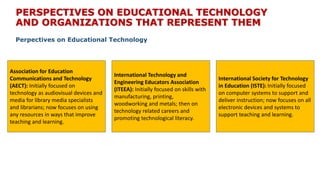
PERSPECTIVES ON EDUCATIONAL TECHNOLOGY
AND ORGANIZATIONS THAT REPRESENT THEM
Perpectives on Educational Technology
Association for Education
Communications and Technology
(AECT): Initially focused on
technology as audiovisual devices and
media for library media specialists
and librarians; now focuses on using
any resources in ways that improve
teaching and learning.
International Society for Technology
in Education (ISTE): Initially focused
on computer systems to support and
deliver instruction; now focuses on all
electronic devices and systems to
support teaching and learning.
International Technology and
Engineering Educators Association
(ITEEA): Initially focused on skills with
manufacturing, printing,
woodworking and metals; then on
technology related careers and
promoting technological literacy.
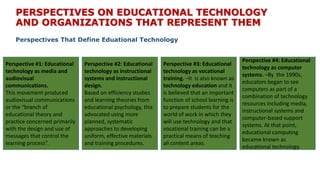
PERSPECTIVES ON EDUCATIONAL TECHNOLOGY
AND ORGANIZATIONS THAT REPRESENT THEM
Perspectives That Define Eduational Technology
Perspective #1: Educational
technology as media and
audiovisual
communications.
This movement produced
audiovisual communications
or the “branch of
educational theory and
practice concerned primarily
with the design and use of
messages that control the
learning process”.
Perspective #2: Educational
technology as instructional
systems and instructional
design.
Based on efficiency studies
and learning theories from
educational psychology, this
advocated using more
planned, systematic
approaches to developing
uniform, effective materials
and training procedures.
Perspective #3: Educational
technology as vocational
training. –It is also known as
technology education and it
is believed that an important
function of school learning is
to prepare students for the
world of work in which they
will use technology and that
vocational training can be a
practical means of teaching
all content areas.
Perspective #4: Educational
technology as computer
systems. –By the 1990s,
educators began to see
computers as part of a
combination of technology
resources including media,
instructional systems and
computer-based support
systems. At that point,
educational computing
became known as
educational technology.
• Educational Technology is a combination of the processes and tools involved in addressing educational needs and
problems with an emphasis on applying the most current digital and information tools.
• Integrating educational technology refers to the process of determining which digital tools and which methods for
implementing them are the most appropriate responses to given educational needs and problems.
• Instructional technology is the subset of educational technology that deals directly with teaching and learning
applications.
Terms:
A BRIEF HISTORY OF DIGITAL TECHNOLOGIES:
FOUR ERAS
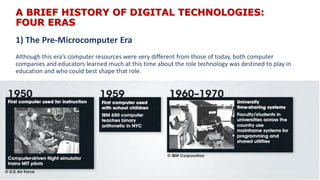
Although this era’s computer resources were very different from those of today, both computer
companies and educators learned much at this time about the role technology was destined to play in
education and who could best shape that role.
1) The Pre-Microcomputer Era
2) The Microcomputer Era
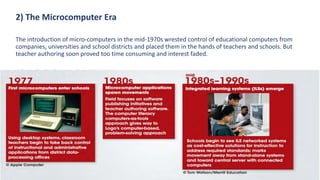
The introduction of micro-computers in the mid-1970s wrested control of educational computers from
companies, universities and school districts and placed them in the hands of teachers and schools. But
teacher authoring soon proved too time consuming and interest faded.
2) The Microcomputer Era
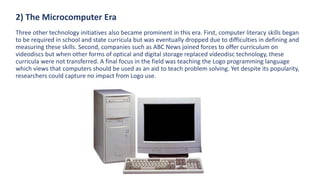
Three other technology initiatives also became prominent in this era. First, computer literacy skills began
to be required in school and state curricula but was eventually dropped due to difficulties in defining and
measuring these skills. Second, companies such as ABC News joined forces to offer curriculum on
videodiscs but when other forms of optical and digital storage replaced videodisc technology, these
curricula were not transferred. A final focus in the field was teaching the Logo programming language
which views that computers should be used as an aid to teach problem solving. Yet despite its popularity,
researchers could capture no impact from Logo use.
3) The Internet Era
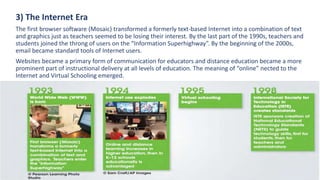
The first browser software (Mosaic) transformed a formerly text-based Internet into a combination of text
and graphics just as teachers seemed to be losing their interest. By the last part of the 1990s, teachers and
students joined the throng of users on the “Information Superhighway”. By the beginning of the 2000s,
email became standard tools of Internet users.
Websites became a primary form of communication for educators and distance education became a more
prominent part of instructional delivery at all levels of education. The meaning of “online” nected to the
Internet and Virtual Schooling emerged.
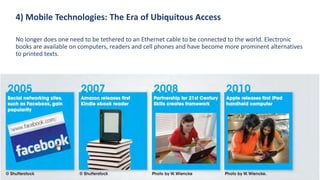
4) Mobile Technologies: The Era of Ubiquitous Access
No longer does one need to be tethered to an Ethernet cable to be connected to the world. Electronic
books are available on computers, readers and cell phones and have become more prominent alternatives
to printed texts.
WHAT WE HAVE LEARNED FROM THE PAST:
• No technology is panacea for education.
• Teachers usually do not develop technology materials or
curriculum.
• “Technically possible” does not equal “desirable, feasible or
inevitable”.
• Technologies change faster than teachers can keep up.
• Older technologies can be useful.
• Teachers always will be more important than technology.
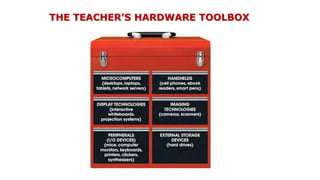
THE TEACHER’S HARDWARE TOOLBOX
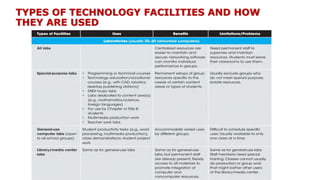
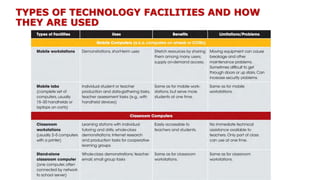
TYPES OF TECHNOLOGY FACILITIES AND HOW
THEY ARE USED
TYPES OF TECHNOLOGY FACILITIES AND HOW
THEY ARE USED
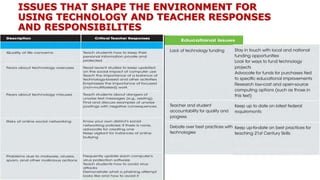
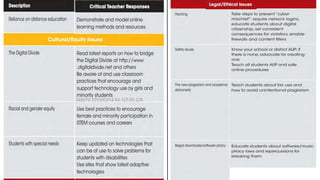
ISSUES THAT SHAPE THE ENVIRONMENT FOR
USING TECHNOLOGY AND TEACHER RESPONSES
AND RESPONSIBILITES
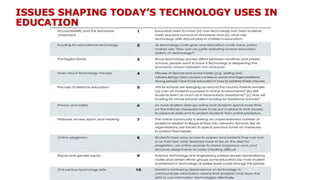
ISSUES SHAPING TODAY’S TECHNOLOGY USES IN
EDUCATION
NETS FOR TEACHERS, STUDENTS AND
ADMINISTRATORS
ISTE NETS for teachers have become the benchmark for technology infusion in teacher education
programs.
21st CENTURY SKILLS FOR STUDENTS AND
TEACHERS
P21 is a unique public-private organization formed in 2002 to create a successful model of learning
for this millennium that incorporates 21st century skills into our system of education”.
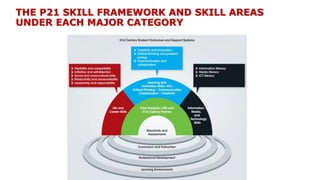
THE P21 SKILL FRAMEWORK AND SKILL AREAS
UNDER EACH MAJOR CATEGORY
THE ICT COMPETENCY FRAMEWORK FOR TEACHERS
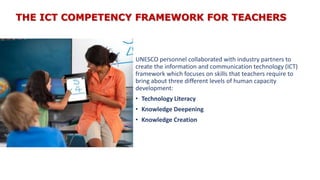
UNESCO personnel collaborated with industry partners to
create the information and communication technology (ICT)
framework which focuses on skills that teachers require to
bring about three different levels of human capacity
development:
• Technology Literacy
• Knowledge Deepening
• Knowledge Creation
Technology Literacy needed to prepare learners, citizens and the workforce that is capable of
taking up new technologies so as to support social development and economic productivity.
Knowledge Deepening increases the ability of students, citizens and the workforce to add
value to society and the economy by applying the knowledge of school subjects to solve complex,
high priority problems encountered in real world situations.
Knowledge Creation intended to increase productivity by creating students, citizens and a
workforce that is continually engaged in and benefits from life-long learning.
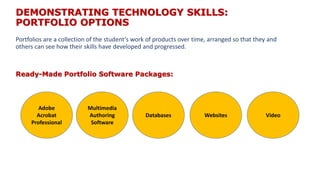
DEMONSTRATING TECHNOLOGY SKILLS:
PORTFOLIO OPTIONS
Portfolios are a collection of the student’s work of products over time, arranged so that they and
others can see how their skills have developed and progressed.
Ready-Made Portfolio Software Packages:
Adobe
Acrobat
Professional
VideoWebsitesDatabases
Multimedia
Authoring
Software
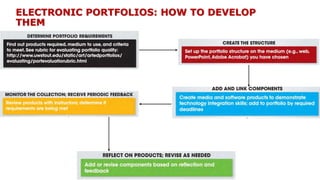
ELECTRONIC PORTFOLIOS: HOW TO DEVELOP
THEM
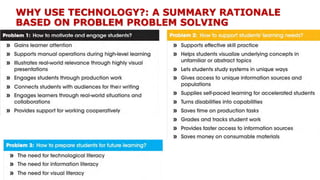
WHY USE TECHNOLOGY?: A SUMMARY RATIONALE
BASED ON PROBLEM PROBLEM SOLVING
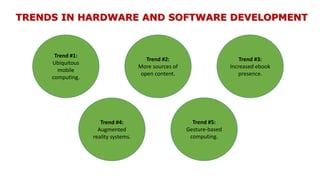
TRENDS IN HARDWARE AND SOFTWARE DEVELOPMENT
Trend #1:
Ubiquitous
mobile
computing.
Trend #2:
More sources of
open content.
Trend #3:
Increased ebook
presence.
Trend #4:
Augmented
reality systems.
Trend #5:
Gesture-based
computing.
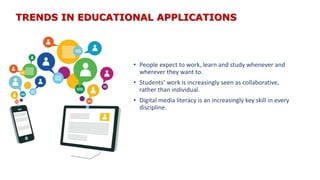
TRENDS IN EDUCATIONAL APPLICATIONS
• People expect to work, learn and study whenever and
wherever they want to.
• Students’ work is increasingly seen as collaborative,
rather than individual.
• Digital media literacy is an increasingly key skill in every
discipline.
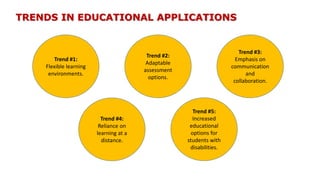
TRENDS IN EDUCATIONAL APPLICATIONS
Trend #1:
Flexible learning
environments.
Trend #2:
Adaptable
assessment
options.
Trend #3:
Emphasis on
communication
and
collaboration.
Trend #4:
Reliance on
learning at a
distance.
Trend #5:
Increased
educational
options for
students with
disabilities.
Prepared by:
Cansu Kutlu
Reference:
Integrating
Technology into
Teaching by
Roblyer, M.D.,
Doering (2013)

technology integration

  • 1.
  • 2.
    TECHNOLOGY IN EDUCATION KeyTerminology Talking about a topic requires knowing the vocabulary relevant to that topic. The term educational technology and related terms are not defined the same by everyone. Educators who want to study the field must recognize that language used to describe technology reflects differing perspectives on the appropriate uses of educational technology. Reflecting on the Past Showing where the field began helps us understand where it is headed and why. Reviewing changes in goals and methods in the field over time provides a foundation on which to build even more successful and useful structures to respond to the challenges of modern education.
  • 3.
    TECHNOLOGY IN EDUCATION Consideringthe Present The current role of educational technology is shaped primarily by two factors: avaliable technology resources and our perspectives on how to make use of them. Avaliable technologies dictate what is possible; a combination of social, instructional, cultural and legal issues influence the directions we choose to take. Looking Ahead to the Future Technology resources and societal conditions change so rapidly that today’s choices are always influenced as much by emerging trends as by current conditions. To be informed citizens of an Information Society, teachers must be futurists.
  • 4.
    Current Stated Definitionsfor Educational Technology Educational Technology is the study and ethical practice of facilitating learning and improving performance by creating, using and managing appropriate technological processess and resources. Technology Education is problem-based learning utilizing math, science and technology principles. Educational Technology is the full range of digital hardware and software used to support teaching and learning across the curriculum.
  • 5.
    PERSPECTIVES ON EDUCATIONALTECHNOLOGY AND ORGANIZATIONS THAT REPRESENT THEM Perpectives on Educational Technology Association for Education Communications and Technology (AECT): Initially focused on technology as audiovisual devices and media for library media specialists and librarians; now focuses on using any resources in ways that improve teaching and learning. International Society for Technology in Education (ISTE): Initially focused on computer systems to support and deliver instruction; now focuses on all electronic devices and systems to support teaching and learning. International Technology and Engineering Educators Association (ITEEA): Initially focused on skills with manufacturing, printing, woodworking and metals; then on technology related careers and promoting technological literacy.
  • 6.
    PERSPECTIVES ON EDUCATIONALTECHNOLOGY AND ORGANIZATIONS THAT REPRESENT THEM Perspectives That Define Eduational Technology Perspective #1: Educational technology as media and audiovisual communications. This movement produced audiovisual communications or the “branch of educational theory and practice concerned primarily with the design and use of messages that control the learning process”. Perspective #2: Educational technology as instructional systems and instructional design. Based on efficiency studies and learning theories from educational psychology, this advocated using more planned, systematic approaches to developing uniform, effective materials and training procedures. Perspective #3: Educational technology as vocational training. –It is also known as technology education and it is believed that an important function of school learning is to prepare students for the world of work in which they will use technology and that vocational training can be a practical means of teaching all content areas. Perspective #4: Educational technology as computer systems. –By the 1990s, educators began to see computers as part of a combination of technology resources including media, instructional systems and computer-based support systems. At that point, educational computing became known as educational technology.
  • 7.
    • Educational Technologyis a combination of the processes and tools involved in addressing educational needs and problems with an emphasis on applying the most current digital and information tools. • Integrating educational technology refers to the process of determining which digital tools and which methods for implementing them are the most appropriate responses to given educational needs and problems. • Instructional technology is the subset of educational technology that deals directly with teaching and learning applications. Terms:
  • 8.
    A BRIEF HISTORYOF DIGITAL TECHNOLOGIES: FOUR ERAS Although this era’s computer resources were very different from those of today, both computer companies and educators learned much at this time about the role technology was destined to play in education and who could best shape that role. 1) The Pre-Microcomputer Era
  • 9.
    2) The MicrocomputerEra The introduction of micro-computers in the mid-1970s wrested control of educational computers from companies, universities and school districts and placed them in the hands of teachers and schools. But teacher authoring soon proved too time consuming and interest faded.
  • 10.
    2) The MicrocomputerEra Three other technology initiatives also became prominent in this era. First, computer literacy skills began to be required in school and state curricula but was eventually dropped due to difficulties in defining and measuring these skills. Second, companies such as ABC News joined forces to offer curriculum on videodiscs but when other forms of optical and digital storage replaced videodisc technology, these curricula were not transferred. A final focus in the field was teaching the Logo programming language which views that computers should be used as an aid to teach problem solving. Yet despite its popularity, researchers could capture no impact from Logo use.
  • 11.
    3) The InternetEra The first browser software (Mosaic) transformed a formerly text-based Internet into a combination of text and graphics just as teachers seemed to be losing their interest. By the last part of the 1990s, teachers and students joined the throng of users on the “Information Superhighway”. By the beginning of the 2000s, email became standard tools of Internet users. Websites became a primary form of communication for educators and distance education became a more prominent part of instructional delivery at all levels of education. The meaning of “online” nected to the Internet and Virtual Schooling emerged.
  • 12.
    4) Mobile Technologies:The Era of Ubiquitous Access No longer does one need to be tethered to an Ethernet cable to be connected to the world. Electronic books are available on computers, readers and cell phones and have become more prominent alternatives to printed texts.
  • 13.
    WHAT WE HAVELEARNED FROM THE PAST: • No technology is panacea for education. • Teachers usually do not develop technology materials or curriculum. • “Technically possible” does not equal “desirable, feasible or inevitable”. • Technologies change faster than teachers can keep up. • Older technologies can be useful. • Teachers always will be more important than technology.
  • 14.
  • 15.
    TYPES OF TECHNOLOGYFACILITIES AND HOW THEY ARE USED
  • 16.
    TYPES OF TECHNOLOGYFACILITIES AND HOW THEY ARE USED
  • 17.
    ISSUES THAT SHAPETHE ENVIRONMENT FOR USING TECHNOLOGY AND TEACHER RESPONSES AND RESPONSIBILITES
  • 19.
    ISSUES SHAPING TODAY’STECHNOLOGY USES IN EDUCATION
  • 20.
    NETS FOR TEACHERS,STUDENTS AND ADMINISTRATORS ISTE NETS for teachers have become the benchmark for technology infusion in teacher education programs. 21st CENTURY SKILLS FOR STUDENTS AND TEACHERS P21 is a unique public-private organization formed in 2002 to create a successful model of learning for this millennium that incorporates 21st century skills into our system of education”.
  • 21.
    THE P21 SKILLFRAMEWORK AND SKILL AREAS UNDER EACH MAJOR CATEGORY
  • 22.
    THE ICT COMPETENCYFRAMEWORK FOR TEACHERS UNESCO personnel collaborated with industry partners to create the information and communication technology (ICT) framework which focuses on skills that teachers require to bring about three different levels of human capacity development: • Technology Literacy • Knowledge Deepening • Knowledge Creation
  • 23.
    Technology Literacy neededto prepare learners, citizens and the workforce that is capable of taking up new technologies so as to support social development and economic productivity. Knowledge Deepening increases the ability of students, citizens and the workforce to add value to society and the economy by applying the knowledge of school subjects to solve complex, high priority problems encountered in real world situations. Knowledge Creation intended to increase productivity by creating students, citizens and a workforce that is continually engaged in and benefits from life-long learning.
  • 24.
    DEMONSTRATING TECHNOLOGY SKILLS: PORTFOLIOOPTIONS Portfolios are a collection of the student’s work of products over time, arranged so that they and others can see how their skills have developed and progressed. Ready-Made Portfolio Software Packages: Adobe Acrobat Professional VideoWebsitesDatabases Multimedia Authoring Software
  • 25.
  • 26.
    WHY USE TECHNOLOGY?:A SUMMARY RATIONALE BASED ON PROBLEM PROBLEM SOLVING
  • 27.
    TRENDS IN HARDWAREAND SOFTWARE DEVELOPMENT Trend #1: Ubiquitous mobile computing. Trend #2: More sources of open content. Trend #3: Increased ebook presence. Trend #4: Augmented reality systems. Trend #5: Gesture-based computing.
  • 28.
    TRENDS IN EDUCATIONALAPPLICATIONS • People expect to work, learn and study whenever and wherever they want to. • Students’ work is increasingly seen as collaborative, rather than individual. • Digital media literacy is an increasingly key skill in every discipline.
  • 29.
    TRENDS IN EDUCATIONALAPPLICATIONS Trend #1: Flexible learning environments. Trend #2: Adaptable assessment options. Trend #3: Emphasis on communication and collaboration. Trend #4: Reliance on learning at a distance. Trend #5: Increased educational options for students with disabilities.
  • 30.
    Prepared by: Cansu Kutlu Reference: Integrating Technologyinto Teaching by Roblyer, M.D., Doering (2013)