Technology Integration Levels
              NOn-existent             Technology is rarely used. Students don’t
                                       use technology to complete assignments or
                                       projects.
                                       (the teacher spends a lot of time at the copy
                                       machine, the SmartBoard is used as only a
                                       projector if used at all)
                                       Technology is used occasionally. Often in the lab

                            BASIC      rather than the classroom. Students are comfortable
                                       with one or two tools and rarely use these tools to
                                       create projects that show understanding of content.
                                       (Students are using TumbleBooks to listen to stories,
                                       a website to play a game, the teacher is checking
                                       email)
   Most people fall here
                                       Technology is used in the classroom on a fairly
                 Comfortable           regular basis. Students are comfortable with a variety
                                       of tools and often use these tools to create projects
                                       that show understanding of content.
                                       (Students are creating PowerPoints, and using Word
                                       Processing to type reports, type to learn)


Wednesday, January 30, 13
Technology Integration Levels

                                    Students and teachers employ technology
                                    daily in the classroom using a variety of tools
                                    to complete assignments and create projects
                                    that show a deep understanding of content.
                                    (Lessons begin in the classroom, continue in
                                    the computer lab.. begin in the computer lab
                                    continue in the classroom.
                      Seamless      Students are creating, collaborating, sharing,
                                    & publishing. Teachers are modeling,
                                    demonstrating, and allowing students to take
                                    ownership of their learning)
                                    (Ex: Students compose a song in Garage
                                    Band and shoot a music video to show
                                    learning The order of Operations in Math)


                                    Note: This table is by no means perfect, but is a starting point to think about how
                                    technology integration looks in your own classroom. In addition, your classroom
                                    may move through these levels over the course of the year.


Wednesday, January 30, 13
To get to "seamless," you must ask yourself:
              • What skills are applied to nearly all tools? (i.e. saving
                a file, naming a file, finding a file)
              • How many different tools will you introduce this year?
                (How many is too many?)
              • How will technology help your students better
                understand content--will it push them to deeper
                understanding?
              • What level of integration do you want in your
                classroom by the end of the school year?


Wednesday, January 30, 13
GET READY TO INTEGRATE
                        Ten Tips


                                                    #10 GAIN PERSPECTIVE
                   Put last year into perspective. To achieve this perspective, ask yourself these questions
              Did I use technology? If I did, did the technology enhance the lessons? If not, why not?
               If I didn't use technology, how can I use it this year to enhance and/or reinforce what I teach?


                                                                #9 GET ORGANIZED


                            •   Go through old files and delete those that are useless or outdated.
                            •   Group remaining files in folders by subject and/or topic.
                            •   Back up important and regularly used files.
                            •   Transfer all previous student projects to a flash drive or one folder
                            •   Check all bookmarked Internet sites, and delete those that are no longer valid or useful.
                            •   Organize remaining bookmarks by subject or topic.


Wednesday, January 30, 13
GET READY TO INTEGRATE
                            Ten Tips


                                                     #8 TAKE A COURSE
           •   Take an online course, or attend a webinar to learn about teaching and learning with
               technology. There are tons of tutorials on the Internet on a variety of topics.
           •   Attend local workshops on software or hardware you might want to use.


                                                              #7 NETWORK WITH PEERS


                              •   Join a networking goup for teachers, such as the Google for Educators Discussion
                                  Group. Or start your own group. (Visit Social Networking for Teachers for more
                                  information.) Twitter, Pinterest, Facebook
                              •   Contribute to a discussion or message board.
                              •   Subscribe to a mailing list or newsletter. Develop your Online Personal Learning Network


Wednesday, January 30, 13
GET READY TO INTEGRATE
                            Ten Tips

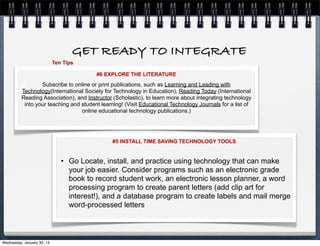
                                         #6 EXPLORE THE LITERATURE
                  Subscribe to online or print publications, such as Learning and Leading with
          Technology(International Society for Technology in Education), Reading Today (International
          Reading Association), and Instructor (Scholastic), to learn more about integrating technology
           into your teaching and student learning! (Visit Educational Technology Journals for a list of
                                  online educational technology publications.)


                                               #5 INSTALL TIME SAVING TECHNOLOGY TOOLS


                               • Go Locate, install, and practice using technology that can make
                                 your job easier. Consider programs such as an electronic grade
                                 book to record student work, an electronic lesson planner, a word
                                 processing program to create parent letters (add clip art for
                                 interest!), and a database program to create labels and mail merge
                                 word-processed letters


Wednesday, January 30, 13
GET READY TO INTEGRATE
                            Ten Tips

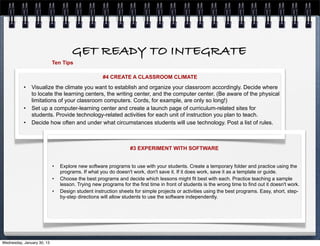
                                                    #4 CREATE A CLASSROOM CLIMATE
           •   Visualize the climate you want to establish and organize your classroom accordingly. Decide where
               to locate the learning centers, the writing center, and the computer center. (Be aware of the physical
               limitations of your classroom computers. Cords, for example, are only so long!)
           •   Set up a computer-learning center and create a launch page of curriculum-related sites for
               students. Provide technology-related activities for each unit of instruction you plan to teach.
           •   Decide how often and under what circumstances students will use technology. Post a list of rules.


                                                                 #3 EXPERIMENT WITH SOFTWARE


                            •   Explore new software programs to use with your students. Create a temporary folder and practice using the
                                programs. If what you do doesn't work, don't save it. If it does work, save it as a template or guide.
                            •   Choose the best programs and decide which lessons might fit best with each. Practice teaching a sample
                                lesson. Trying new programs for the first time in front of students is the wrong time to find out it doesn't work.
                            •   Design student instruction sheets for simple projects or activities using the best programs. Easy, short, step-
                                by-step directions will allow students to use the software independently.


Wednesday, January 30, 13
GET READY TO INTEGRATE
                            Ten Tips


                                             #2 PUNCH UP EXISTING LESSONS
           •   Take a look at the previous year's lessons and decide which ones can use more punch or a
               technological boost.
           •   Explore lesson plan archives to see what other teachers are doing.
           •   Search the Internet for Web sites that complement and extend your already successful lessons.
               Look for interesting text, pictures, movies, and activities that convey the message you want to give
               students


Wednesday, January 30, 13
GET READY TO INTEGRATE
                            Ten Tips


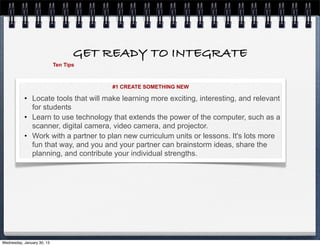
                                       #1 CREATE SOMETHING NEW

           • Locate tools that will make learning more exciting, interesting, and relevant
             for students
           • Learn to use technology that extends the power of the computer, such as a
             scanner, digital camera, video camera, and projector.
           • Work with a partner to plan new curriculum units or lessons. It's lots more
             fun that way, and you and your partner can brainstorm ideas, share the
             planning, and contribute your individual strengths.


Wednesday, January 30, 13

Technology Classroom Integration Levels

  • 1.
    Technology Integration Levels NOn-existent Technology is rarely used. Students don’t use technology to complete assignments or projects. (the teacher spends a lot of time at the copy machine, the SmartBoard is used as only a projector if used at all) Technology is used occasionally. Often in the lab BASIC rather than the classroom. Students are comfortable with one or two tools and rarely use these tools to create projects that show understanding of content. (Students are using TumbleBooks to listen to stories, a website to play a game, the teacher is checking email) Most people fall here Technology is used in the classroom on a fairly Comfortable regular basis. Students are comfortable with a variety of tools and often use these tools to create projects that show understanding of content. (Students are creating PowerPoints, and using Word Processing to type reports, type to learn) Wednesday, January 30, 13
  • 2.
    Technology Integration Levels Students and teachers employ technology daily in the classroom using a variety of tools to complete assignments and create projects that show a deep understanding of content. (Lessons begin in the classroom, continue in the computer lab.. begin in the computer lab continue in the classroom. Seamless Students are creating, collaborating, sharing, & publishing. Teachers are modeling, demonstrating, and allowing students to take ownership of their learning) (Ex: Students compose a song in Garage Band and shoot a music video to show learning The order of Operations in Math) Note: This table is by no means perfect, but is a starting point to think about how technology integration looks in your own classroom. In addition, your classroom may move through these levels over the course of the year. Wednesday, January 30, 13
  • 3.
    To get to"seamless," you must ask yourself: • What skills are applied to nearly all tools? (i.e. saving a file, naming a file, finding a file) • How many different tools will you introduce this year? (How many is too many?) • How will technology help your students better understand content--will it push them to deeper understanding? • What level of integration do you want in your classroom by the end of the school year? Wednesday, January 30, 13
  • 4.
    GET READY TOINTEGRATE Ten Tips #10 GAIN PERSPECTIVE Put last year into perspective. To achieve this perspective, ask yourself these questions Did I use technology? If I did, did the technology enhance the lessons? If not, why not? If I didn't use technology, how can I use it this year to enhance and/or reinforce what I teach? #9 GET ORGANIZED • Go through old files and delete those that are useless or outdated. • Group remaining files in folders by subject and/or topic. • Back up important and regularly used files. • Transfer all previous student projects to a flash drive or one folder • Check all bookmarked Internet sites, and delete those that are no longer valid or useful. • Organize remaining bookmarks by subject or topic. Wednesday, January 30, 13
  • 5.
    GET READY TOINTEGRATE Ten Tips #8 TAKE A COURSE • Take an online course, or attend a webinar to learn about teaching and learning with technology. There are tons of tutorials on the Internet on a variety of topics. • Attend local workshops on software or hardware you might want to use. #7 NETWORK WITH PEERS • Join a networking goup for teachers, such as the Google for Educators Discussion Group. Or start your own group. (Visit Social Networking for Teachers for more information.) Twitter, Pinterest, Facebook • Contribute to a discussion or message board. • Subscribe to a mailing list or newsletter. Develop your Online Personal Learning Network Wednesday, January 30, 13
  • 6.
    GET READY TOINTEGRATE Ten Tips #6 EXPLORE THE LITERATURE Subscribe to online or print publications, such as Learning and Leading with Technology(International Society for Technology in Education), Reading Today (International Reading Association), and Instructor (Scholastic), to learn more about integrating technology into your teaching and student learning! (Visit Educational Technology Journals for a list of online educational technology publications.) #5 INSTALL TIME SAVING TECHNOLOGY TOOLS • Go Locate, install, and practice using technology that can make your job easier. Consider programs such as an electronic grade book to record student work, an electronic lesson planner, a word processing program to create parent letters (add clip art for interest!), and a database program to create labels and mail merge word-processed letters Wednesday, January 30, 13
  • 7.
    GET READY TOINTEGRATE Ten Tips #4 CREATE A CLASSROOM CLIMATE • Visualize the climate you want to establish and organize your classroom accordingly. Decide where to locate the learning centers, the writing center, and the computer center. (Be aware of the physical limitations of your classroom computers. Cords, for example, are only so long!) • Set up a computer-learning center and create a launch page of curriculum-related sites for students. Provide technology-related activities for each unit of instruction you plan to teach. • Decide how often and under what circumstances students will use technology. Post a list of rules. #3 EXPERIMENT WITH SOFTWARE • Explore new software programs to use with your students. Create a temporary folder and practice using the programs. If what you do doesn't work, don't save it. If it does work, save it as a template or guide. • Choose the best programs and decide which lessons might fit best with each. Practice teaching a sample lesson. Trying new programs for the first time in front of students is the wrong time to find out it doesn't work. • Design student instruction sheets for simple projects or activities using the best programs. Easy, short, step- by-step directions will allow students to use the software independently. Wednesday, January 30, 13
  • 8.
    GET READY TOINTEGRATE Ten Tips #2 PUNCH UP EXISTING LESSONS • Take a look at the previous year's lessons and decide which ones can use more punch or a technological boost. • Explore lesson plan archives to see what other teachers are doing. • Search the Internet for Web sites that complement and extend your already successful lessons. Look for interesting text, pictures, movies, and activities that convey the message you want to give students Wednesday, January 30, 13
  • 9.
    GET READY TOINTEGRATE Ten Tips #1 CREATE SOMETHING NEW • Locate tools that will make learning more exciting, interesting, and relevant for students • Learn to use technology that extends the power of the computer, such as a scanner, digital camera, video camera, and projector. • Work with a partner to plan new curriculum units or lessons. It's lots more fun that way, and you and your partner can brainstorm ideas, share the planning, and contribute your individual strengths. Wednesday, January 30, 13