- By Krishna Naikwade (final year)
 At one time endodontic instruments were made
according to the whim manufacturer, with no definite
specification regarding diameter, taper, length or
tapering blade.
 Significant differences in width of instruments
supposedly of same size were found when they were
measured with a microscopic measuring microscope.
 Ingle and LeVine, suggested a definite instrument in
diameter as size progressed while maintaining a
constant taper of all blades regardless of size.
 Instruments shall be numbered from 10 to 100; the
numbers to advance by 5 units to size 60 and then by 10 to
size 100. This has been revised to include number from 6 to
140.
 Each number shall be representative of the diameter of the
instrument in hundreadths of a millimetre at the tip. Ex-
No. 10 is 10/100 or 0.1 mm at the tip.
 The working blade shall begin at tip, designated site D0
and shall extend exactly 16 mm up the shaft, terminating at
designated site D16.
 The diameter of D16 shall be 32/100 0r 0.32mm greater than
that of D0; ex- a no. 20 reamer shall have a diameter of 0.2
plus 0.32 or 0.52mm at D16.
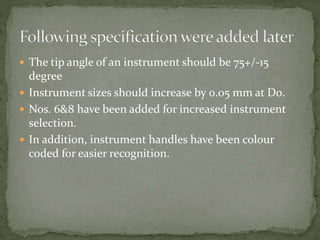
 The tip angle of an instrument should be 75+/-15
degree
 Instrument sizes should increase by 0.05 mm at D0.
 Nos. 6&8 have been added for increased instrument
selection.
 In addition, instrument handles have been colour
coded for easier recognition.
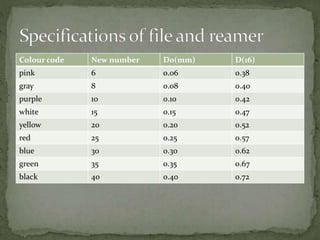
Colour code New number D0(mm) D(16)
pink 6 0.06 0.38
gray 8 0.08 0.40
purple 10 0.10 0.42
white 15 0.15 0.47
yellow 20 0.20 0.52
red 25 0.25 0.57
blue 30 0.30 0.62
green 35 0.35 0.67
black 40 0.40 0.72
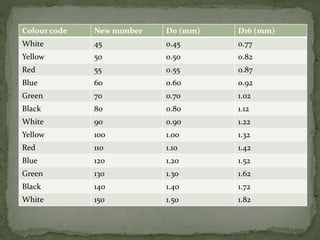
Colour code New number D0 (mm) D16 (mm)
White 45 0.45 0.77
Yellow 50 0.50 0.82
Red 55 0.55 0.87
Blue 60 0.60 0.92
Green 70 0.70 1.02
Black 80 0.80 1.12
White 90 0.90 1.22
Yellow 100 1.00 1.32
Red 110 1.10 1.42
Blue 120 1.20 1.52
Green 130 1.30 1.62
Black 140 1.40 1.72
White 150 1.50 1.82
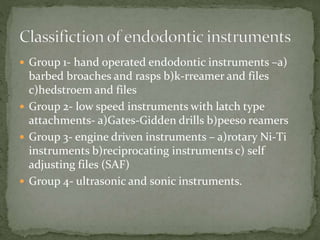
 Group 1- hand operated endodontic instruments –a)
barbed broaches and rasps b)k-rreamer and files
c)hedstroem and files
 Group 2- low speed instruments with latch type
attachments- a)Gates-Gidden drills b)peeso reamers
 Group 3- engine driven instruments – a)rotary Ni-Ti
instruments b)reciprocating instruments c) self
adjusting files (SAF)
 Group 4- ultrasonic and sonic instruments.
 Barbed Broaches and Rasps: earlier instrument, used
to aspirate the pulp and enlarge the canal. Barbed
Broach is short handled instrument often used for the
extirpation of the entire pulp for the removal of
necrotic debris, absorbent points, cotton pledget, and
other foreign material from root canal.
 K-type of reamer and file: files are used with pushing-
rotating motion and files were used with rasping or
pulling motion. Significance of these instrument type
is these do not fracture unless used with undetected
defect in steel shaft or strained or deformed
instrument. Modifications- k-flex file, flex-R file.
 Hedstroem file: also known as H- file. This instrument
has higher cutting efficiency than k-instruments, but
it is fragile and fracture easily. H-file should be used
only in one direction , retraction and never in a
torquing direction. Modification- safety hedstroem,
hyflex file, unifile, s-file.
 Gates-Glidden drills- has a long thin shaft ending in a
flame shaped head with a safe tip to guard against
perforation.
 Peeso reamer- it has long, sharp flutes connected to
thick shaft it cuts laterally and it is primarily used for
preparation of post space when gutta-percha has to be
removed from obturated root canal
 Nickel-titanium rotary endodontic instruments-
superelastic alloy does not exhibit strain under stress
until a specific level is attained that causes fracture.
 Reciprocating instruments- these function at unequal
bidirectional angles. The counterwise engaging angle
is five times the clockwise disengaging angle and
designated to the less than elastic limit of the file. Ex-
waweone system and reciproc.
 Self adjusting file- The fie three dimensionally adapts
both longitudinally and along the cross-section of the
root canal system.
 These instruments mainly developed for cleaning the
root canal and have limited role in shaping of root
canals.
 The ultrasonic instrument have peizoelectric or a
magnetostrictive unit that generates ultrasonic waves.

Standardisation of endodontic instruments

  • 1.
    - By KrishnaNaikwade (final year)
  • 2.
     At onetime endodontic instruments were made according to the whim manufacturer, with no definite specification regarding diameter, taper, length or tapering blade.  Significant differences in width of instruments supposedly of same size were found when they were measured with a microscopic measuring microscope.  Ingle and LeVine, suggested a definite instrument in diameter as size progressed while maintaining a constant taper of all blades regardless of size.
  • 3.
     Instruments shallbe numbered from 10 to 100; the numbers to advance by 5 units to size 60 and then by 10 to size 100. This has been revised to include number from 6 to 140.  Each number shall be representative of the diameter of the instrument in hundreadths of a millimetre at the tip. Ex- No. 10 is 10/100 or 0.1 mm at the tip.  The working blade shall begin at tip, designated site D0 and shall extend exactly 16 mm up the shaft, terminating at designated site D16.  The diameter of D16 shall be 32/100 0r 0.32mm greater than that of D0; ex- a no. 20 reamer shall have a diameter of 0.2 plus 0.32 or 0.52mm at D16.
  • 4.
     The tipangle of an instrument should be 75+/-15 degree  Instrument sizes should increase by 0.05 mm at D0.  Nos. 6&8 have been added for increased instrument selection.  In addition, instrument handles have been colour coded for easier recognition.
  • 5.
    Colour code Newnumber D0(mm) D(16) pink 6 0.06 0.38 gray 8 0.08 0.40 purple 10 0.10 0.42 white 15 0.15 0.47 yellow 20 0.20 0.52 red 25 0.25 0.57 blue 30 0.30 0.62 green 35 0.35 0.67 black 40 0.40 0.72
  • 6.
    Colour code Newnumber D0 (mm) D16 (mm) White 45 0.45 0.77 Yellow 50 0.50 0.82 Red 55 0.55 0.87 Blue 60 0.60 0.92 Green 70 0.70 1.02 Black 80 0.80 1.12 White 90 0.90 1.22 Yellow 100 1.00 1.32 Red 110 1.10 1.42 Blue 120 1.20 1.52 Green 130 1.30 1.62 Black 140 1.40 1.72 White 150 1.50 1.82
  • 7.
     Group 1-hand operated endodontic instruments –a) barbed broaches and rasps b)k-rreamer and files c)hedstroem and files  Group 2- low speed instruments with latch type attachments- a)Gates-Gidden drills b)peeso reamers  Group 3- engine driven instruments – a)rotary Ni-Ti instruments b)reciprocating instruments c) self adjusting files (SAF)  Group 4- ultrasonic and sonic instruments.
  • 8.
     Barbed Broachesand Rasps: earlier instrument, used to aspirate the pulp and enlarge the canal. Barbed Broach is short handled instrument often used for the extirpation of the entire pulp for the removal of necrotic debris, absorbent points, cotton pledget, and other foreign material from root canal.  K-type of reamer and file: files are used with pushing- rotating motion and files were used with rasping or pulling motion. Significance of these instrument type is these do not fracture unless used with undetected defect in steel shaft or strained or deformed instrument. Modifications- k-flex file, flex-R file.
  • 9.
     Hedstroem file:also known as H- file. This instrument has higher cutting efficiency than k-instruments, but it is fragile and fracture easily. H-file should be used only in one direction , retraction and never in a torquing direction. Modification- safety hedstroem, hyflex file, unifile, s-file.
  • 10.
     Gates-Glidden drills-has a long thin shaft ending in a flame shaped head with a safe tip to guard against perforation.  Peeso reamer- it has long, sharp flutes connected to thick shaft it cuts laterally and it is primarily used for preparation of post space when gutta-percha has to be removed from obturated root canal
  • 11.
     Nickel-titanium rotaryendodontic instruments- superelastic alloy does not exhibit strain under stress until a specific level is attained that causes fracture.  Reciprocating instruments- these function at unequal bidirectional angles. The counterwise engaging angle is five times the clockwise disengaging angle and designated to the less than elastic limit of the file. Ex- waweone system and reciproc.  Self adjusting file- The fie three dimensionally adapts both longitudinally and along the cross-section of the root canal system.
  • 12.
     These instrumentsmainly developed for cleaning the root canal and have limited role in shaping of root canals.  The ultrasonic instrument have peizoelectric or a magnetostrictive unit that generates ultrasonic waves.