 Introduction
 Definition
 Factors affecting retention
- Classification
- Interfacial force
- Adhesion
-Cohesion
-Oral & facial musculature
-Atmospheric Pressure
-Undercuts, Rotational insertion paths,
Parallel walls
-Gravity
 Denture Adhesives
 Conclusion
 Bibliography
 Success of treatment with CD
 Integration of oral functions +
psychological acceptance
 Perception of the dentures as stationary
during function
 ‘That quality inherent in the prosthesis
which resists the force of gravity,
adhesiveness of foods, and the forces
associated with the opening of jaws’
- GPT
 The resistance of removal in a direction
opposite that of insertion
- Boucher
 The resistance of the movement of a
denture from its basal seat, especially in
a vertical direction
- Winkler
 The resistance it poses to withdrawal
from its planned position in the mouth
-Grant & Johnson
 Atmospheric pressure
 Surface tension
 Viscosity of saliva
 Physical retention:
area of the denture
adaptation of denture
viscosity of saliva
volume of saliva
wettability of the denture base resin
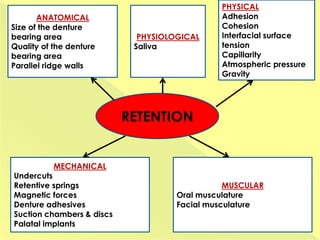
RETENTION
ANATOMICAL
Size of the denture
bearing area
Quality of the denture
bearing area
Parallel ridge walls
PHYSIOLOGICAL
Saliva
PHYSICAL
Adhesion
Cohesion
Interfacial surface
tension
Capillarity
Atmospheric pressure
Gravity
MECHANICAL
Undercuts
Retentive springs
Magnetic forces
Denture adhesives
Suction chambers & discs
Palatal implants
MUSCULAR
Oral musculature
Facial musculature
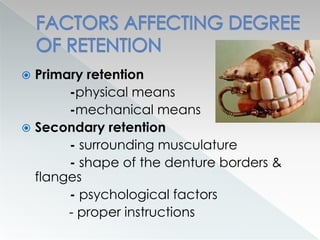
 Primary retention
-physical means
-mechanical means
 Secondary retention
- surrounding musculature
- shape of the denture borders &
flanges
- psychological factors
- proper instructions
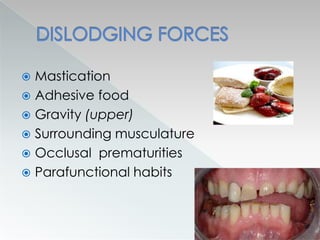
 Mastication
 Adhesive food
 Gravity (upper)
 Surrounding musculature
 Occlusal prematurities
 Parafunctional habits
 ‘The tension or resistance to separation
possessed by the film of liquid between
two well-adapted surfaces’
- GPT
 ‘The resistance to separation of two
parallel surfaces that is imparted by a
film of liquid between them’
 Interfacial surface tension
 Viscous tension
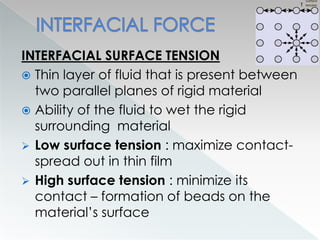
INTERFACIAL SURFACE TENSION
 Thin layer of fluid that is present between
two parallel planes of rigid material
 Ability of the fluid to wet the rigid
surrounding material
 Low surface tension : maximize contact-
spread out in thin film
 High surface tension : minimize its
contact – formation of beads on the
material’s surface
 Processed denture base materials-
higher wettability
 High surface tension reduced on coating
by the salivary pellicle
› Retention by virtue of the tendency of the
fluid to maximize the contact between the
denture base & mucosa
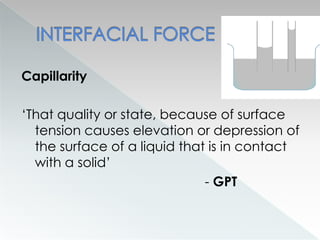
Capillarity
‘That quality or state, because of surface
tension causes elevation or depression of
the surface of a liquid that is in contact
with a solid’
- GPT
 Close adaptation between denture
base & mucosa- thin film of saliva in the
space
› Retention- Capillary tube in which the liquid
seeks to increase its contact
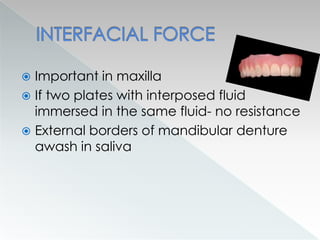
 Important in maxilla
 If two plates with interposed fluid
immersed in the same fluid- no resistance
 External borders of mandibular denture
awash in saliva
INTERFACIAL VISCOUS TENSION
 Force holding two parallel plates
together that is due to viscosity of the
interposed liquid
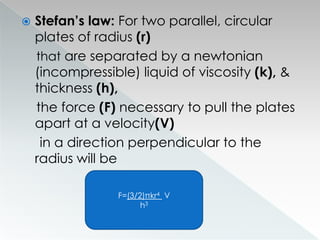
 Stefan’s law: For two parallel, circular
plates of radius (r)
that are separated by a newtonian
(incompressible) liquid of viscosity (k), &
thickness (h),
the force (F) necessary to pull the plates
apart at a velocity(V)
in a direction perpendicular to the
radius will be
F=(3/2)πkr4 V
h3
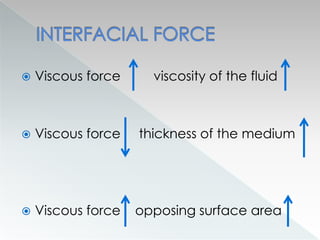
 Viscous force viscosity of the fluid
 Viscous force thickness of the medium
 Viscous force opposing surface area
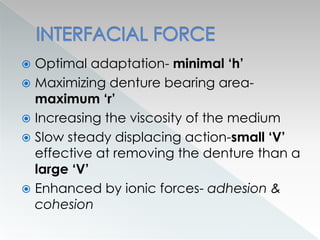
 Optimal adaptation- minimal ‘h’
 Maximizing denture bearing area-
maximum ‘r’
 Increasing the viscosity of the medium
 Slow steady displacing action-small ‘V’
effective at removing the denture than a
large ‘V’
 Enhanced by ionic forces- adhesion &
cohesion
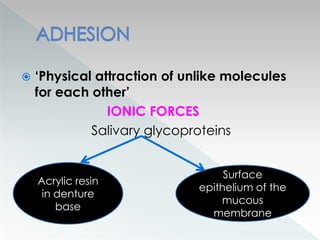
 ‘Physical attraction of unlike molecules
for each other’
IONIC FORCES
Salivary glycoproteins
Acrylic resin
in denture
base
Surface
epithelium of the
mucous
membrane
 Xerostomia :Adhesion between denture
base & the dry mucosa
 Not very effective- mucosal abrasions &
lacerations
 Ethanol free rinse with aloe or lanolin
 Saliva substitute with
carboxymethylcellulose/ mammalian
mucin
 Sjogren’s syndrome: 5-10mg oral
pilocarpine tds
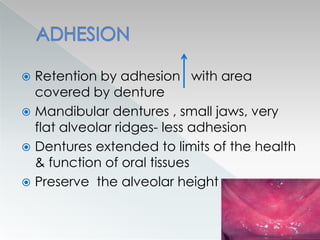
 Retention by adhesion with area
covered by denture
 Mandibular dentures , small jaws, very
flat alveolar ridges- less adhesion
 Dentures extended to limits of the health
& function of oral tissues
 Preserve the alveolar height
 ‘Physical attraction of like molecules for
each other’
 Within the layer of interposed saliva &
maintains its integrity
 Normal saliva not very cohesive unless
modified
 High mucinous saliva- though more
cohesive, less retentive
 Supplement retention if:
 Teeth are positioned in the neutral zone
 Polished surfaces of the denture are
properly shaped
 Buccal & lingual flanges should be so
shaped that the musculature fits
automatically
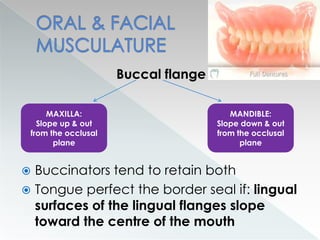
Buccal flange
 Buccinators tend to retain both
 Tongue perfect the border seal if: lingual
surfaces of the lingual flanges slope
toward the centre of the mouth
MAXILLA:
Slope up & out
from the occlusal
plane
MANDIBLE:
Slope down & out
from the occlusal
plane
 Lingual side of the distal end of the
lingual flange:
 Guides the base of the tongue on top of
the lingual flange
 Ensures the border seal at the back end
of mandibular denture
 Base of tongue: emergency retentive
force
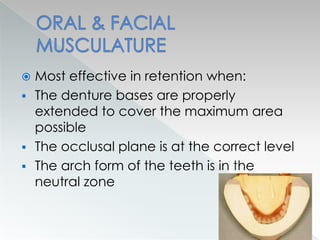
 Most effective in retention when:
 The denture bases are properly
extended to cover the maximum area
possible
 The occlusal plane is at the correct level
 The arch form of the teeth is in the
neutral zone
 Resist dislodging forces to dentures with
an effective seal
 Called Suction: resistance to removal
from the basal seat
 No suction unless another force is
applied
 Suction alone applied: serious damage
to the health of the soft tissues
 Force exerted perpendicular to & away
from the basal seat of a properly
extended & fully seated denture
 Pressure between the tissues & the
denture drops below the atmospheric
pressure: resists displacement
 Retention area covered by the
denture
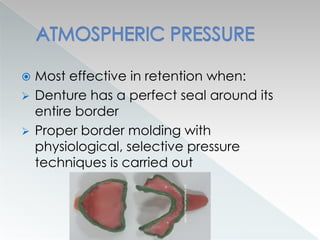
 Most effective in retention when:
 Denture has a perfect seal around its
entire border
 Proper border molding with
physiological, selective pressure
techniques is carried out
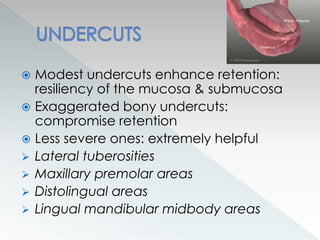
 Modest undercuts enhance retention:
resiliency of the mucosa & submucosa
 Exaggerated bony undercuts:
compromise retention
 Less severe ones: extremely helpful
 Lateral tuberosities
 Maxillary premolar areas
 Distolingual areas
 Lingual mandibular midbody areas
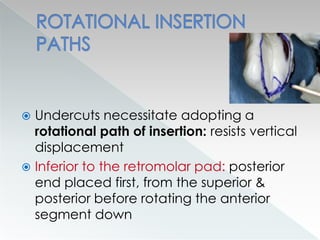
 Undercuts necessitate adopting a
rotational path of insertion: resists vertical
displacement
 Inferior to the retromolar pad: posterior
end placed first, from the superior &
posterior before rotating the anterior
segment down
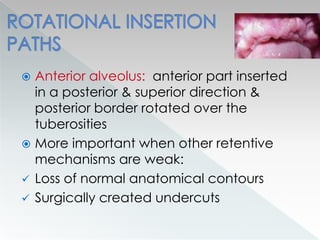
 Anterior alveolus: anterior part inserted
in a posterior & superior direction &
posterior border rotated over the
tuberosities
 More important when other retentive
mechanisms are weak:
 Loss of normal anatomical contours
 Surgically created undercuts
 Prominent alveolar ridges with parallel
buccal & lingual walls increase
the surface area maximize
interfacial & atmospheric forces
 Limit the range of displacive force
directions
 Flat ridges resist displacing forces
perpendicular to the basal seat, but
susceptible to movement parallel to it
 Retentive force for the mandibular &
displacive for the maxillary- when the
person is upright
 Weight of the prosthesis- gravitational
force insignificant
 Heavy maxillary prosthesis unseat if the
other retentive forces – suboptimal
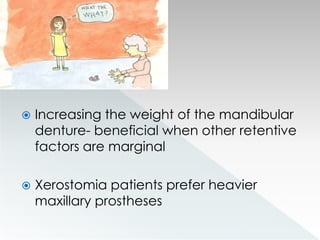
 Increasing the weight of the mandibular
denture- beneficial when other retentive
factors are marginal
 Xerostomia patients prefer heavier
maxillary prostheses
 Commercially available
nontoxic, soluble material that is applied
to the tissue surface of the denture to
enhance retention, stability&
performance
 Products which enhance the treatment
outcome
 US: 33% of denture wearers use adhesive
products
 Sale exceeded 200 million$ in 2001
Dentists should:
 Educate all denture wearing patients
about the advantages, disadvantages&
uses of adhesives
 Identify those patients for whom such a
product is advisable and/or necessary
for a satisfactory denture wearing
experience
STRICTLY INADVISABLE FORMS OF
ADHESIVES
 Home reliner/repair kits
 Paper/cloth pads
 Self applied cushions
 Thin wafers of water soluble material:
adherent to denture & basal tissue- don’t
flow
Possible sequelae:
 Soft tissue damage
 Alterations in occlusal relations & VD
 Exacerbation alveolar bone destruction
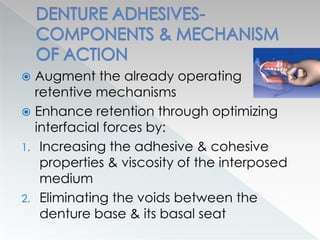
 Augment the already operating
retentive mechanisms
 Enhance retention through optimizing
interfacial forces by:
1. Increasing the adhesive & cohesive
properties & viscosity of the interposed
medium
2. Eliminating the voids between the
denture base & its basal seat
 Hydrated material formed by adhesives-
stick readily to the tissue surface & the
mucosal surface of the denture
 More cohesive than saliva- resists
displacing pull
 Increases viscosity of saliva
 Hydrated material swells up in the
presence of saliva/water: obliterates
voids
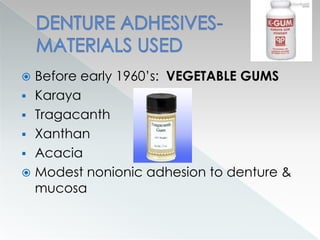
 Before early 1960’s: VEGETABLE GUMS
 Karaya
 Tragacanth
 Xanthan
 Acacia
 Modest nonionic adhesion to denture &
mucosa
Drawbacks
 Very little cohesive strength
 Highly water soluble(particularly in hot):
washed out readily
 Allergic reactions- Karaya & methyl
paraben(preservative)
 Acetic acid odor
 Short-lived & unsatisfactory adhesive
performance
 Presently : SYNTHETIC MATERIALS
 Mixtures of the salts of short acting
Carboxymethylcellulose (CMC)
long acting (polyvinyl methyl ether
maleate)
‘gantrez’ polymers
 CMC hydrates & displays quick-onset
ionic adherence to both dentures&
mucous epithelium
 Original fluid increases its viscosity &
CMC increases in volume- eliminates
voids between prosthesis & basal seat
 Enhance the interfacial forces acting on
the denture
 Polyvinylpyrrolidone (‘povidone’)
behaves like CMC
 Gantrez salts: More protracted time
course than necessary for the onset of
hydration than CMC,
hydrate & increase adherence &
viscosity
 Display molecular cross-linking more
pronounced & longer lived in Calcium-
Zinc gantrez than in Calcium- Sodium
gantrez
 All polymers fully solubilised & washed
out by saliva : hastened by the presence
of hot liquid
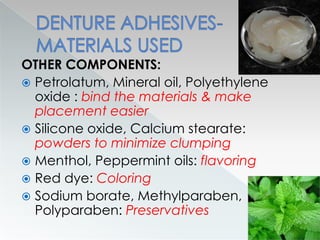
OTHER COMPONENTS:
 Petrolatum, Mineral oil, Polyethylene
oxide : bind the materials & make
placement easier
 Silicone oxide, Calcium stearate:
powders to minimize clumping
 Menthol, Peppermint oils: flavoring
 Red dye: Coloring
 Sodium borate, Methylparaben,
Polyparaben: Preservatives
 No reports of tissue reactions excepting
uncommon allergic reactons to karaya/
methyl paraben
 Earlier formulations had benzene-
carcinogen
 Lessened inflammation of the underlying
tissues if dental hygiene is maintained
 Incisal bite force in well fitting dentures
over well- keratinized ridges with
favorable anatomical features
 Can be improved for well fitting dentures
over inferior basal tissues
 Frequency of dislodgement - chewing
 Increased confidence & security in
chewing- but no improvement in
chewing performance
 Improvement in chewing efficiency
during adjustment to new dentures
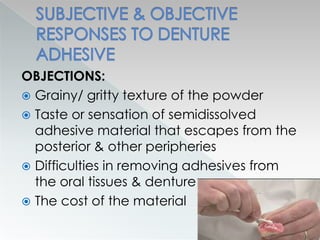
OBJECTIONS:
 Grainy/ gritty texture of the powder
 Taste or sensation of semidissolved
adhesive material that escapes from the
posterior & other peripheries
 Difficulties in removing adhesives from
the oral tissues & denture
 The cost of the material
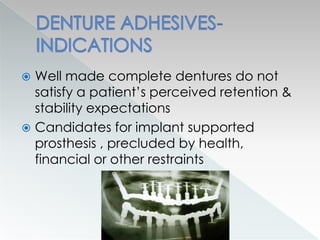
 Well made complete dentures do not
satisfy a patient’s perceived retention &
stability expectations
 Candidates for implant supported
prosthesis , precluded by health,
financial or other restraints
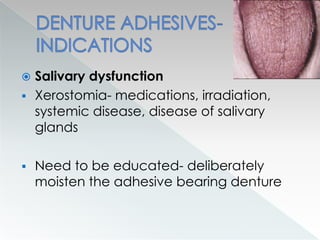
 Salivary dysfunction
 Xerostomia- medications, irradiation,
systemic disease, disease of salivary
glands
 Need to be educated- deliberately
moisten the adhesive bearing denture
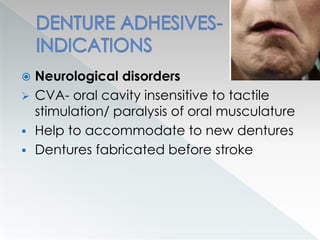
 Neurological disorders
 CVA- oral cavity insensitive to tactile
stimulation/ paralysis of oral musculature
 Help to accommodate to new dentures
 Dentures fabricated before stroke
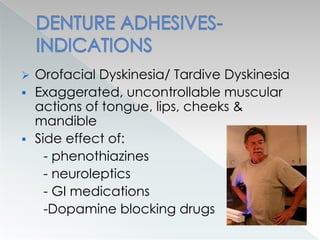
 Orofacial Dyskinesia/ Tardive Dyskinesia
 Exaggerated, uncontrollable muscular
actions of tongue, lips, cheeks &
mandible
 Side effect of:
- phenothiazines
- neuroleptics
- GI medications
-Dopamine blocking drugs
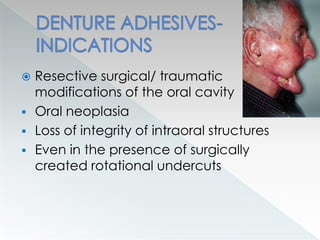
 Resective surgical/ traumatic
modifications of the oral cavity
 Oral neoplasia
 Loss of integrity of intraoral structures
 Even in the presence of surgically
created rotational undercuts
 Poorly fitting or improperly fabricated
prosthesis
 Hypersensitivity to any of the
components
 Major information source to the patient-
dentist
 Effects of powder formulations do not last
long compared to cream formulations
 Initial ‘hold’ is better for them compared to
creams
 Easier to clean out
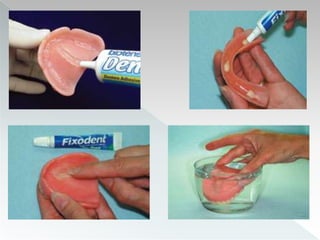
 The least amount of the material that is
effective should be used:
0.5-1g/denture unit
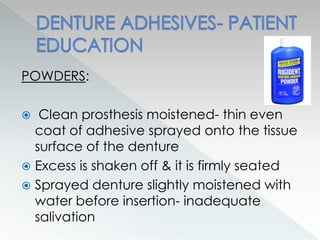
POWDERS:
 Clean prosthesis moistened- thin even
coat of adhesive sprayed onto the tissue
surface of the denture
 Excess is shaken off & it is firmly seated
 Sprayed denture slightly moistened with
water before insertion- inadequate
salivation
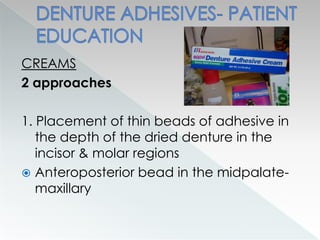
CREAMS
2 approaches
1. Placement of thin beads of adhesive in
the depth of the dried denture in the
incisor & molar regions
 Anteroposterior bead in the midpalate-
maxillary
2. Small spots of cream placed at 5mm
intervals throughout the fitting surface of
the dried denture- even distribution
 Denture then seated & inserted firmly
 Requires moistening before placement in
cases of xerostomia
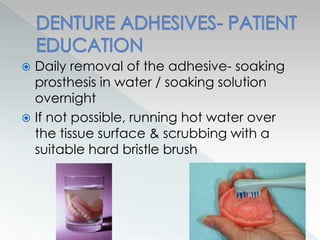
 Daily removal of the adhesive- soaking
prosthesis in water / soaking solution
overnight
 If not possible, running hot water over
the tissue surface & scrubbing with a
suitable hard bristle brush
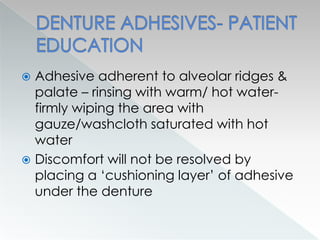
 Adhesive adherent to alveolar ridges &
palate – rinsing with warm/ hot water-
firmly wiping the area with
gauze/washcloth saturated with hot
water
 Discomfort will not be resolved by
placing a ‘cushioning layer’ of adhesive
under the denture
 Professional management required:
 Pain /soreness
 Gradual increase in the quantity of
adhesive required
 Patients recalled annually for mucosal
evaluation& prosthesis assessment
 Frequently regarded as unesthetic,
impedes dentist’s ability to appraise the
health of oral tissues & the true
adaptation
 Use of denture adhesive & residual ridge
resorption- believed to be correlated:
no scientific basis
 Reduce the amount of lateral
movements that denture undergoes
while in contact with basal tissues
 Patient may ignore the need for
professional help when dentures actually
become ill fitting
 Integral part of a professional service &
their adjunctive benefits must be
recognised
 Irrespective of the underlying reasons for
the patient’s dissatisfaction with the
prosthesis, dentist must realize that a
patient’s judgement of the treatment
outcome is what defines prosthodontic
success
 Though complete denture retention is a
complex phenomenon, it is every patient’s
invariable need that the prosthesis stays firm
& stable during function & hence every
possible attempt should be made by the
dentist to achieve it
 Prosthodontic Treatment for Edentulous
Patients- Zarb & Bolender,Twelfth edition
 Essentials of CompleteDenture
Prosthodontics- Sheldon Winkler,Second
edition
 Textbook of Prosthodontics- Deepak
Nallaswamy
 Complete Denture Prosthodontics- John
Joy Manappallil
Retention of complete dentures

Retention of complete dentures

  • 3.
     Introduction  Definition Factors affecting retention - Classification - Interfacial force - Adhesion -Cohesion -Oral & facial musculature
  • 4.
    -Atmospheric Pressure -Undercuts, Rotationalinsertion paths, Parallel walls -Gravity  Denture Adhesives  Conclusion  Bibliography
  • 5.
     Success oftreatment with CD  Integration of oral functions + psychological acceptance  Perception of the dentures as stationary during function
  • 6.
     ‘That qualityinherent in the prosthesis which resists the force of gravity, adhesiveness of foods, and the forces associated with the opening of jaws’ - GPT  The resistance of removal in a direction opposite that of insertion - Boucher
  • 7.
     The resistanceof the movement of a denture from its basal seat, especially in a vertical direction - Winkler  The resistance it poses to withdrawal from its planned position in the mouth -Grant & Johnson
  • 8.
     Atmospheric pressure Surface tension  Viscosity of saliva  Physical retention: area of the denture adaptation of denture viscosity of saliva volume of saliva wettability of the denture base resin
  • 9.
    RETENTION ANATOMICAL Size of thedenture bearing area Quality of the denture bearing area Parallel ridge walls PHYSIOLOGICAL Saliva PHYSICAL Adhesion Cohesion Interfacial surface tension Capillarity Atmospheric pressure Gravity MECHANICAL Undercuts Retentive springs Magnetic forces Denture adhesives Suction chambers & discs Palatal implants MUSCULAR Oral musculature Facial musculature
  • 10.
     Primary retention -physicalmeans -mechanical means  Secondary retention - surrounding musculature - shape of the denture borders & flanges - psychological factors - proper instructions
  • 11.
     Mastication  Adhesivefood  Gravity (upper)  Surrounding musculature  Occlusal prematurities  Parafunctional habits
  • 12.
     ‘The tensionor resistance to separation possessed by the film of liquid between two well-adapted surfaces’ - GPT  ‘The resistance to separation of two parallel surfaces that is imparted by a film of liquid between them’
  • 13.
     Interfacial surfacetension  Viscous tension
  • 14.
    INTERFACIAL SURFACE TENSION Thin layer of fluid that is present between two parallel planes of rigid material  Ability of the fluid to wet the rigid surrounding material  Low surface tension : maximize contact- spread out in thin film  High surface tension : minimize its contact – formation of beads on the material’s surface
  • 15.
     Processed denturebase materials- higher wettability  High surface tension reduced on coating by the salivary pellicle › Retention by virtue of the tendency of the fluid to maximize the contact between the denture base & mucosa
  • 16.
    Capillarity ‘That quality orstate, because of surface tension causes elevation or depression of the surface of a liquid that is in contact with a solid’ - GPT
  • 17.
     Close adaptationbetween denture base & mucosa- thin film of saliva in the space › Retention- Capillary tube in which the liquid seeks to increase its contact
  • 18.
     Important inmaxilla  If two plates with interposed fluid immersed in the same fluid- no resistance  External borders of mandibular denture awash in saliva
  • 19.
    INTERFACIAL VISCOUS TENSION Force holding two parallel plates together that is due to viscosity of the interposed liquid
  • 20.
     Stefan’s law:For two parallel, circular plates of radius (r) that are separated by a newtonian (incompressible) liquid of viscosity (k), & thickness (h), the force (F) necessary to pull the plates apart at a velocity(V) in a direction perpendicular to the radius will be F=(3/2)πkr4 V h3
  • 21.
     Viscous forceviscosity of the fluid  Viscous force thickness of the medium  Viscous force opposing surface area
  • 22.
     Optimal adaptation-minimal ‘h’  Maximizing denture bearing area- maximum ‘r’  Increasing the viscosity of the medium  Slow steady displacing action-small ‘V’ effective at removing the denture than a large ‘V’  Enhanced by ionic forces- adhesion & cohesion
  • 23.
     ‘Physical attractionof unlike molecules for each other’ IONIC FORCES Salivary glycoproteins Acrylic resin in denture base Surface epithelium of the mucous membrane
  • 24.
     Xerostomia :Adhesionbetween denture base & the dry mucosa  Not very effective- mucosal abrasions & lacerations  Ethanol free rinse with aloe or lanolin  Saliva substitute with carboxymethylcellulose/ mammalian mucin  Sjogren’s syndrome: 5-10mg oral pilocarpine tds
  • 25.
     Retention byadhesion with area covered by denture  Mandibular dentures , small jaws, very flat alveolar ridges- less adhesion  Dentures extended to limits of the health & function of oral tissues  Preserve the alveolar height
  • 26.
     ‘Physical attractionof like molecules for each other’  Within the layer of interposed saliva & maintains its integrity  Normal saliva not very cohesive unless modified  High mucinous saliva- though more cohesive, less retentive
  • 27.
     Supplement retentionif:  Teeth are positioned in the neutral zone  Polished surfaces of the denture are properly shaped  Buccal & lingual flanges should be so shaped that the musculature fits automatically
  • 28.
    Buccal flange  Buccinatorstend to retain both  Tongue perfect the border seal if: lingual surfaces of the lingual flanges slope toward the centre of the mouth MAXILLA: Slope up & out from the occlusal plane MANDIBLE: Slope down & out from the occlusal plane
  • 29.
     Lingual sideof the distal end of the lingual flange:  Guides the base of the tongue on top of the lingual flange  Ensures the border seal at the back end of mandibular denture  Base of tongue: emergency retentive force
  • 30.
     Most effectivein retention when:  The denture bases are properly extended to cover the maximum area possible  The occlusal plane is at the correct level  The arch form of the teeth is in the neutral zone
  • 31.
     Resist dislodgingforces to dentures with an effective seal  Called Suction: resistance to removal from the basal seat  No suction unless another force is applied  Suction alone applied: serious damage to the health of the soft tissues
  • 32.
     Force exertedperpendicular to & away from the basal seat of a properly extended & fully seated denture  Pressure between the tissues & the denture drops below the atmospheric pressure: resists displacement  Retention area covered by the denture
  • 33.
     Most effectivein retention when:  Denture has a perfect seal around its entire border  Proper border molding with physiological, selective pressure techniques is carried out
  • 34.
     Modest undercutsenhance retention: resiliency of the mucosa & submucosa  Exaggerated bony undercuts: compromise retention  Less severe ones: extremely helpful  Lateral tuberosities  Maxillary premolar areas  Distolingual areas  Lingual mandibular midbody areas
  • 35.
     Undercuts necessitateadopting a rotational path of insertion: resists vertical displacement  Inferior to the retromolar pad: posterior end placed first, from the superior & posterior before rotating the anterior segment down
  • 36.
     Anterior alveolus:anterior part inserted in a posterior & superior direction & posterior border rotated over the tuberosities  More important when other retentive mechanisms are weak:  Loss of normal anatomical contours  Surgically created undercuts
  • 37.
     Prominent alveolarridges with parallel buccal & lingual walls increase the surface area maximize interfacial & atmospheric forces  Limit the range of displacive force directions  Flat ridges resist displacing forces perpendicular to the basal seat, but susceptible to movement parallel to it
  • 38.
     Retentive forcefor the mandibular & displacive for the maxillary- when the person is upright  Weight of the prosthesis- gravitational force insignificant  Heavy maxillary prosthesis unseat if the other retentive forces – suboptimal
  • 39.
     Increasing theweight of the mandibular denture- beneficial when other retentive factors are marginal  Xerostomia patients prefer heavier maxillary prostheses
  • 40.
     Commercially available nontoxic,soluble material that is applied to the tissue surface of the denture to enhance retention, stability& performance  Products which enhance the treatment outcome  US: 33% of denture wearers use adhesive products  Sale exceeded 200 million$ in 2001
  • 41.
    Dentists should:  Educateall denture wearing patients about the advantages, disadvantages& uses of adhesives  Identify those patients for whom such a product is advisable and/or necessary for a satisfactory denture wearing experience
  • 42.
    STRICTLY INADVISABLE FORMSOF ADHESIVES  Home reliner/repair kits  Paper/cloth pads  Self applied cushions  Thin wafers of water soluble material: adherent to denture & basal tissue- don’t flow
  • 43.
    Possible sequelae:  Softtissue damage  Alterations in occlusal relations & VD  Exacerbation alveolar bone destruction
  • 44.
     Augment thealready operating retentive mechanisms  Enhance retention through optimizing interfacial forces by: 1. Increasing the adhesive & cohesive properties & viscosity of the interposed medium 2. Eliminating the voids between the denture base & its basal seat
  • 45.
     Hydrated materialformed by adhesives- stick readily to the tissue surface & the mucosal surface of the denture  More cohesive than saliva- resists displacing pull  Increases viscosity of saliva  Hydrated material swells up in the presence of saliva/water: obliterates voids
  • 46.
     Before early1960’s: VEGETABLE GUMS  Karaya  Tragacanth  Xanthan  Acacia  Modest nonionic adhesion to denture & mucosa
  • 47.
    Drawbacks  Very littlecohesive strength  Highly water soluble(particularly in hot): washed out readily  Allergic reactions- Karaya & methyl paraben(preservative)  Acetic acid odor  Short-lived & unsatisfactory adhesive performance
  • 48.
     Presently :SYNTHETIC MATERIALS  Mixtures of the salts of short acting Carboxymethylcellulose (CMC) long acting (polyvinyl methyl ether maleate) ‘gantrez’ polymers
  • 49.
     CMC hydrates& displays quick-onset ionic adherence to both dentures& mucous epithelium  Original fluid increases its viscosity & CMC increases in volume- eliminates voids between prosthesis & basal seat  Enhance the interfacial forces acting on the denture
  • 50.
     Polyvinylpyrrolidone (‘povidone’) behaveslike CMC  Gantrez salts: More protracted time course than necessary for the onset of hydration than CMC, hydrate & increase adherence & viscosity
  • 51.
     Display molecularcross-linking more pronounced & longer lived in Calcium- Zinc gantrez than in Calcium- Sodium gantrez  All polymers fully solubilised & washed out by saliva : hastened by the presence of hot liquid
  • 52.
    OTHER COMPONENTS:  Petrolatum,Mineral oil, Polyethylene oxide : bind the materials & make placement easier  Silicone oxide, Calcium stearate: powders to minimize clumping  Menthol, Peppermint oils: flavoring  Red dye: Coloring  Sodium borate, Methylparaben, Polyparaben: Preservatives
  • 53.
     No reportsof tissue reactions excepting uncommon allergic reactons to karaya/ methyl paraben  Earlier formulations had benzene- carcinogen  Lessened inflammation of the underlying tissues if dental hygiene is maintained
  • 54.
     Incisal biteforce in well fitting dentures over well- keratinized ridges with favorable anatomical features  Can be improved for well fitting dentures over inferior basal tissues
  • 55.
     Frequency ofdislodgement - chewing  Increased confidence & security in chewing- but no improvement in chewing performance  Improvement in chewing efficiency during adjustment to new dentures
  • 56.
    OBJECTIONS:  Grainy/ grittytexture of the powder  Taste or sensation of semidissolved adhesive material that escapes from the posterior & other peripheries  Difficulties in removing adhesives from the oral tissues & denture  The cost of the material
  • 57.
     Well madecomplete dentures do not satisfy a patient’s perceived retention & stability expectations  Candidates for implant supported prosthesis , precluded by health, financial or other restraints
  • 58.
     Salivary dysfunction Xerostomia- medications, irradiation, systemic disease, disease of salivary glands  Need to be educated- deliberately moisten the adhesive bearing denture
  • 59.
     Neurological disorders CVA- oral cavity insensitive to tactile stimulation/ paralysis of oral musculature  Help to accommodate to new dentures  Dentures fabricated before stroke
  • 60.
     Orofacial Dyskinesia/Tardive Dyskinesia  Exaggerated, uncontrollable muscular actions of tongue, lips, cheeks & mandible  Side effect of: - phenothiazines - neuroleptics - GI medications -Dopamine blocking drugs
  • 61.
     Resective surgical/traumatic modifications of the oral cavity  Oral neoplasia  Loss of integrity of intraoral structures  Even in the presence of surgically created rotational undercuts
  • 62.
     Poorly fittingor improperly fabricated prosthesis  Hypersensitivity to any of the components
  • 63.
     Major informationsource to the patient- dentist  Effects of powder formulations do not last long compared to cream formulations  Initial ‘hold’ is better for them compared to creams  Easier to clean out  The least amount of the material that is effective should be used: 0.5-1g/denture unit
  • 64.
    POWDERS:  Clean prosthesismoistened- thin even coat of adhesive sprayed onto the tissue surface of the denture  Excess is shaken off & it is firmly seated  Sprayed denture slightly moistened with water before insertion- inadequate salivation
  • 65.
    CREAMS 2 approaches 1. Placementof thin beads of adhesive in the depth of the dried denture in the incisor & molar regions  Anteroposterior bead in the midpalate- maxillary
  • 66.
    2. Small spotsof cream placed at 5mm intervals throughout the fitting surface of the dried denture- even distribution  Denture then seated & inserted firmly  Requires moistening before placement in cases of xerostomia
  • 68.
     Daily removalof the adhesive- soaking prosthesis in water / soaking solution overnight  If not possible, running hot water over the tissue surface & scrubbing with a suitable hard bristle brush
  • 69.
     Adhesive adherentto alveolar ridges & palate – rinsing with warm/ hot water- firmly wiping the area with gauze/washcloth saturated with hot water  Discomfort will not be resolved by placing a ‘cushioning layer’ of adhesive under the denture
  • 70.
     Professional managementrequired:  Pain /soreness  Gradual increase in the quantity of adhesive required  Patients recalled annually for mucosal evaluation& prosthesis assessment
  • 71.
     Frequently regardedas unesthetic, impedes dentist’s ability to appraise the health of oral tissues & the true adaptation  Use of denture adhesive & residual ridge resorption- believed to be correlated: no scientific basis  Reduce the amount of lateral movements that denture undergoes while in contact with basal tissues
  • 72.
     Patient mayignore the need for professional help when dentures actually become ill fitting  Integral part of a professional service & their adjunctive benefits must be recognised
  • 73.
     Irrespective ofthe underlying reasons for the patient’s dissatisfaction with the prosthesis, dentist must realize that a patient’s judgement of the treatment outcome is what defines prosthodontic success  Though complete denture retention is a complex phenomenon, it is every patient’s invariable need that the prosthesis stays firm & stable during function & hence every possible attempt should be made by the dentist to achieve it
  • 74.
     Prosthodontic Treatmentfor Edentulous Patients- Zarb & Bolender,Twelfth edition  Essentials of CompleteDenture Prosthodontics- Sheldon Winkler,Second edition  Textbook of Prosthodontics- Deepak Nallaswamy  Complete Denture Prosthodontics- John Joy Manappallil