• The method used to fill and seal a cleaned and shaped root
canal using a root canal sealer and core filling material;
sealers are frequently used as the sole obturating material
in deciduous teeth; there are a variety of techniques used
to obturate the canal space
• Glossary of Endodontic Terms.
1. Three-dimensional obturation close to CDJ.
2. Radiographically, filling should be seen 0.5-0.75 mm from
radiographic apex.
3. Minimal use of a root canal sealer which is confined to
root canal.
1. Easily introduced in the canal.
2. Seal canal laterally and apically.
3. Dimensionally stable after being inserted.
4. Impervious to moisture.
5. Bacteriostatic or at least should not encourage bacterial
growth.
6. Radiopaque.
7. Non staining to tooth structure.
8. Non irritating.
9. Sterile/easily sterilized.
10. Removed easily from canal if required.
• Plastics: Gutta-percha, resilon
• Solids or metal cores: Silver points, Gold, stainless steel,
titanium
• Cements and pastes:
– Hydron
– MTA
– Calcium phosphate
– Gutta flow
• Gutta-percha is derived from two words.
• “GETAH” - meaning gum
• “PERTJA” - name of the tree
• 1843 : Sir Jose d Almeida – First introduced gutta-percha to
Royal Asiatic society of England
• In Dentistry : Edwin Truman – Introduced gutta-percha as
temporary filling material.
• 1867 : Bowman – First to use gutta-percha as root canal
filling material
Gutta-percha cones
• 1887 : SS White company – First company to start the
commercial manufacture of gutta-percha points.
• Sources
• Gutta-percha is a dried coagulated extract which is
derived from Brazillian trees (Palaquium).
• These trees belong to Sapotaceae family. In India, these
are found in Assam and Western Ghats.
Matrix
(Organic)-
Gutta-percha 20
%
Filler
(Inorganic)-
Zinc Oxide 66 %
Radio-
opacifiers
(Inorganic) -
Heavy metal
sulfates 11 %
Plasticizers
(Organic)-
Waxes or resins
3 %
Alpha form
• Pliable and tacky at 56°-64°.
• Available in form of bars or pellets.
• Used in thermo-plasticized obturation technique.
Beta form
• Rigid and solid 42°-44°.
• Used for manufacturing gutta-percha points and sticks.
Amorphous form
• Exists in molten stage.
These phases are inter-convertible.
• α - runny, tacky and sticky (lower viscosity)
• β - solid, compactable and elongatable (higher viscosity)
• γ - unstable form
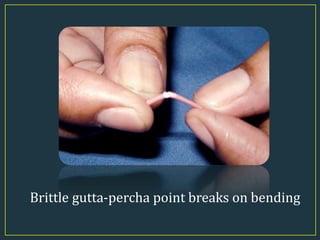
• It causes brittleness because of the oxidation process.
Storage under artificial light also speeds up their
deterioration.
• This brittle gutta-percha can be rejuvenated by a technique
described by Sorien and Oliet.
• In this, gutta-percha is immersed in hot water (55°C) for
one or two seconds and then immediately immersed in cold
water for few seconds.
Brittle gutta-percha point breaks on bending
• Gutta-percha cannot be heat sterilized.
• For disinfection of gutta-percha points, they should be
immersed in 5.25 percent NaOCl for one minute.
• Then, gutta-percha should be rinsed in hydrogen peroxide
or ethyl alcohol.
• The aim of rinsing is to remove crystallized NaOCl before
obturation, as these crystallized particles impair the
obturation.
Sterilization of gutta-percha by immersing them
in 5.25 percent sodium hypochlorite for one
minute
• Gutta-percha points:
Standard cones are of same
size and shape as that of ISO
endodontic instruments.
• Auxiliary points: Non-
standardized cones; perceive
form of root canal.
• Greater taper gutta-percha
points: Available in 4
percent,6 percent, 80 percent
and 10 percent taper
• Precoated core carrier gutta-
percha: In these stainless
steel, titanium or plastic
carriers are precoated with
alpha phase gutta-percha for
use in canal. e.g. thermafil
• Syringe systems: They use low
viscosity gutta-percha. e.g.
successful and alpha seal.
• Gutta flow: In this gutta-
percha powder is
incorporated into resin based
sealer.
• Gutta-percha sealers like chloropercha and eucopercha:- In
these gutta-percha is dissolved in chloroform/eucalyptol to
be used in the canal.
• Medicated gutta-percha: calcium hydroxide, iodoform or
chlorhexidine diacetate containing gutta-percha points.
• Gutta-percha pellets/bars: They are used in
thermoplastisized gutta-percha obturation e.g. obtura
system.
• Compactiblity: adaptation to canal walls
• Inertness: makes it non-reactive material
• Dimensionally stable
• Tissue tolerance
• Radiopacity: easily recognizable on radiograph (Fig. 18.12)
• Plasticity: becomes plastic when heated
• Dissolve in some solvents like chloroform, eucalyptus oil, etc.
This property makes it more versatile as canal filling material.
• Lack of rigidity: Bending of gutta-percha is seen when
lateral pressure is applied. So, difficult to use in smaller
canals
• Easily displaced by pressure
• Lacks adhesive quality.
1. Use of cold gutta-percha
• Lateral compaction technique
2. Use of chemically softened gutta-percha
• Chloroform
• Halothane
• Eucalyptol
3. Use of heat softened gutta-percha
• Vertical compaction technique
• System B continuous wave condensation technique
• Lateral/vertical compaction
• Sectional compaction technique
• McSpadden compaction of gutta-percha
• Thermoplasticized gutta-percha technique including
– Obtura II
– Ultrasonic plasticizing
– Ultrafil system
• Solid core obturation technique including
– Thermafil system
– Silver point obturation
• Primary and accessory gutta-percha points.
• Spreaders and pluggers for compaction of gutta-percha
• Absorbent paper points for drying the prepared root canal
before applying sealer.
• Lentulospirals for placing sealer
• Scissors for cutting gutta-percha
• Endo gauge for measuring size of gutta-percha
• Endo block for measuring gutta-percha points
• Endo organizer for arranging gutta-percha and accessory points
of various sizes.
• Heating device like spirit lamp or butane gas torch
• Heating instrument like ball burnisher, spoon excavator, etc.
Following the canal preparation, select the master gutta
percha cone whose diameter is consistent with largest file
used in the canal up to the working length.
One should feel the tugback with master gutta-percha point.
Master gutta-percha point is notched at the working
distance analogous to the level of incisal or occlusal edge
reference point
Check the fit of cone radiographically.
– If found satisfactory, remove the cone from the canal and
place it in sodium hypochlorite.
– If cone fits short of the working length, check for dentin
chip debris, any ledge or curve in the canal and treat them
accordingly
– If cone selected is going beyond the foramen, either select
the larger number cone or cut that cone to the working
length.
If cone shows “s” shaped appearance in the radiograph that
means cone is too small for the canal. Here a larger cone
must be selected to fit in the canal.
Select the size of spreader to be used for lateral compaction of that tooth.
It should reach 1-2 mm of true working length
Dry the canal with paper points.
Apply sealer in the prepared root canal
Now premeasured cone is coated with sealer and placed into the canal.
After master cone placement, spreader is placed into the canal alongside the cone.
Spreader helps in compaction of gutta-percha.
It act as a wedge to squeeze the gutta-percha laterally under vertical pressure not
by pushing it sideways
After placement, spreader is removed from the canal
by rotating it back and forth.
This compacts the gutta-percha and a space gets
created lateral to the master cone.
An accessory cone is placed in this space and the
above procedure is repeated until the spreader can no
longer penetrate beyond the cervical line
Now sever the protruding gutta-percha points at
canal orifice with hot instrument
Advantages of Lateral Compaction Technique
1. Can be used in most clinical situations.
2. During compaction of gutta-percha, it provides length control, thus
decreases the chances of overfilling.
Disadvantages
1. May not fill the canal irregularities efficiently.
2. Does not produce homogenous mass.
3. Space may exist between accessory and master cones
• Vertical compaction of warm gutta-percha method of filling
the root canal was introduced by Schilder with an objective
of filling all the portals of exit with maximum amount of
guttapercha and minimum amount of sealer.
• This is also known as Schilder’s technique of obturation.
Select a master cone according to shape and size of
the prepared canal.
Cone should fit in 1-2 mm of apical stop because
when softened material moves apically into
prepared canal, it adapts more intimately to the
canal walls.
Confirm the fit of cone radiographically, if found
satisfactory, remove it from the canal and place in
sodium hypochlorite.
Irrigate the canal and then dry by rinsing it with
alcohol and latter using the paper points.
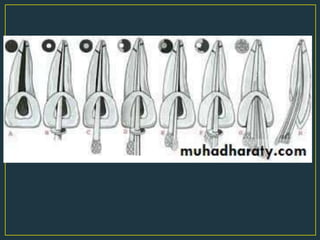
Now use the heated plugger to force the gutta-
percha into the canal.
The blunted end of plugger creates a deep
depression in the centre of master cone .
The outer walls of softened gutta-percha are then
folded inward to fill the central void, at the same
time mass of softened gutta-percha is moved
apically and laterally.
This procedure also removes 2-3 mm of coronal
part of gutta-percha.
Once apical filling is done, complete obturation by
doing backfilling.
Obturate the remaining canal by heating small
segments of gutta-percha, carrying them into the
canal and then compacting them using heated
pluggers as described above
Take care not to overheat the gutta-percha because
it will become too soft to handle.
Do not apply sealer on the softened segments of
guttapercha because sealer will prevent their
adherence to the body of gutta-percha present in
the canal.
After completion of obturation, clean the pulp
chamber with alcohol to remove remnants of sealer
or gutta-percha.
Advantage of Vertical Compaction Technique
• Excellent sealing of canal apically, laterally and
obturation of lateral as well as accessory canals.
Disadvantages of this Technique
• Increased risk of vertical root fracture.
• Overfilling of canals with gutta-percha or sealer from
apex.
• Time consuming.
• In this technique, small pieces of gutta-percha cones are
used to fill the sections of the canal.
• It is also known as Chicago technique because it was widely
promoted by Coolidge, Lundquist, Blayney, all from Chicago.
1. A gutta-percha cone of same size of the prepared root canal is selected
and cut into sections of 3 to 4 mm long.
2. Select a plugger which loosely fits within 3 mm of working length.
3. Apply sealer in the canal.
4. One end of gutta-percha is mounted to heated plugger and is then
carried into the canal and apical pressure is given.
After this disengage the plugger from gutta-percha by rotating it.
5. Radiograph is taken to confirm its fit. If found satisfactory, fill the
remainder of the canal in same manner.
Advantages
• It seals the canals apically and laterally.
• In case of post and core cases, only apical section of canal
is filled.
Disadvantages
• Time consuming.
• If canal gets overfilled, difficult to remove sections of
guttapercha.
• The purpose of sealing root canals is to prevent periapical
exudates from diffusing into the unfilled part of the canal, to
avoid reentry and colonization of bacteria and to check
residual bacteria from reaching the periapical tissues.
• Therefore, to accomplish a fluid tight seal, a root canal
sealer is needed.
• Should be tacky when mixed to provide good adhesion
between it and the canal wall when set.
• Should create hermetic seal.
• Should be radiopaque.
• Powder particles size should be very fine, for easy mixing
with liquid.
• Should not shrink upon setting.
• Should not stain tooth structure.
• Should be bacteriostatic.
• Should set slowly.
• Should be insoluble in tissue fluids.
• Should be non-irritating to periradicular tissue.
• Should be soluble in a common solvent.
• Should not provide immune response in periradicular tissue.
• Should not be mutagenic or carcinogenic.
• As antimicrobial agent
• Fill the discrepancies between the materials and dentin
walls
• As binding agent
• As lubricant
• Give radiopacity
• As canal obturating material
Classification of sealer according to Grossman
• Zinc oxide resin cements
• Calcium hydroxide cements
• Paraformaldehyde cements
• Pastes
According Cohen (ADA and ANSI)
Type I: Material’s intended to be used with core material.
• Class I: Includes materials in the form of powder and liquid
that set through a non polymerizing process.
• Class II: Includes materials in the form of two pastes that
set through a non polymerizing process.
• Class III: Includes polymers and resin systems that set
through polymerization.
According Cohen (ADA and ANSI)
• Type II Intended for use with or without core material or
sealer.
• Class I: Powder and liquid-non polymerizing
• Class II: Paste and paste-non polymerizing
• Class III: Metal amalgams
• Class IV: Polymer and resin systems-polymerization
According to Composition
1 . Eugenol group may be divided into subgroups namely:
a. Silver containing cements:
• Kerr sealer (Rickert, 1931)
• Procosol radiopaque silver cement (Grossman, 1936)
b. Silver free cements:
• Procosol nonstaining cement (Grossman, 1958)
• Grossman’s sealer (Grossman, 1974)
• Tubliseal (Kerr, 1961)
• Wach’s paste (Wach)
Composition:
Powder
Zinc oxide 34-41.2 percent
Precipitated silver 25-30.0 percent
Oleo resins 30-16 percent
Thymol iodide 11-12 percent
Liquid
Oil of cloves 78-80 percent
Canada balsam 20-22 percent
1. Excellent lubricating properties.
2. It allows a working time of more than 30 minutes, when
mixed in 1:1 ratio.
3. Germicidal action and biocompatibility.
4. Greater bulk than any sealer and thus makes it ideal for
condensation techniques to fill voids, auxilliary canals and
irregularities present lateral to gutta-percha cones.
• The major disadvantage is that the presence of silver makes
the sealer extremely staining if any of the material enters
the dentinal tubuli.
• So sealers must be removed carefully from the pulp
chamber with xylol.
• Powder is contained in a pellet and the liquid in a bottle.
One drop of liquid is added to one pellet of powder and
mixed with a heavy spatula until relative homogenicity is
obtained.
• Kerr pulp canal sealer completely sets and is inert within
15-30 minutes, thus reduces the inflammatory responses.
Composition
Powder
Zinc oxide (reagent) - 40 parts
Staybelite resin - 30 parts
Bismuth Subcarbonate -15 parts
Barium Sulfate - 15 parts
Sodiumborate - 1 part
Liquid
Eugenol
1. It has plasticity and slow setting time due to the presence
of sodiumborate anhydrate.
2. It has good sealing potential.
3. Zinc eugenolate is decomposed by water through
continuous loss of eugenol, which makes zinc oxide eugenol a
weak unstable compound.
• Resin has coarse particle size, so the material is spatulated
vigorously during mixing.
• If it is not done, a piece of resin may lodge on the canal
walls.
Cement hardens approximately in 2 hours at 37°C.
The setting time is influenced by:
1. Quality of the ZnO and pH of the resin used.
2. Technique used in mixing the cement.
3. Amount of humidity in the temperature.
4. Temperature and dryness of the mixing slab and
spatula.
According to Composition
Non-eugenol: These sealers do not contain eugenol and
consist of wide variety of chemicals.
Examples:
• Diaket
• AH-26
• Chloropercha and Eucapercha
• Nogenol
• Hydron
• Endofil
• Glass ionomer
• Polycarboxylate
• Calcium Phosphate cement
• This is an epoxy resin recommended by Shroeder in 1957.
Epoxy
• resin based sealers are characterized by the reactive
epoxide ring
• and are polymerized by the breaking this ring. Feldman and
• Nyborg gave the following composition.
• Powder
Bismuth oxide 60 percent
Hexamethylene tetramine 25 percent
Silver powder 10 percent
Titanium oxide 5 percent
• Liquid
• Bisphenol diglycidyl ether
1. Good adhesive property.
2. Good flow
3. Antibacterial
4. Contracts slightly while hardening
5. Low toxicity and well tolerated by periapical tissue.
6. The addition of a hardener, hexamethylene tetramine,
makes the cured resin inert chemically and biologically.
• AH 26 consists of a yellow powder and viscous resin liquid
and mixed to a thick creamy consistency.
• The setting time is 36 to 48 hours at body temperature and
5-7 days at room temperature.
• AH 26 produces greater adhesion to dentin especially when
smear layer is removed.
• Smear layer removal exposes the dentinal tubules creating
an irritating surface thus enhancing adhesion.
• AH Plus is an Epoxide-Amine resin pulp canal sealer,
developed from its predecessor
• AH26 because of color and shade stability, this is the
material of choice where aesthetic demands are high.
• AH Plus Paste A
• Epoxy Resins
• Calcium tungstate
• Zirconium oxide
• Silica
• Iron oxide
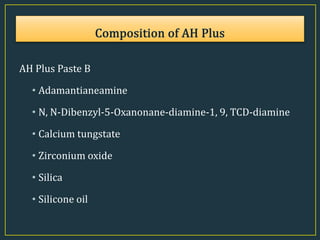
AH Plus Paste B
• Adamantianeamine
• N, N-Dibenzyl-5-Oxanonane-diamine-1, 9, TCD-diamine
• Calcium tungstate
• Zirconium oxide
• Silica
• Silicone oil
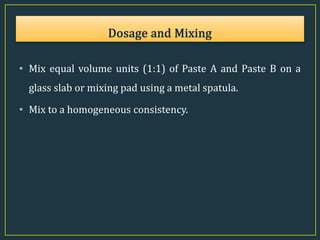
• Mix equal volume units (1:1) of Paste A and Paste B on a
glass slab or mixing pad using a metal spatula.
• Mix to a homogeneous consistency.
AH 26
• Available in powder and liquid
systems
• Releases small amount of
formaldehyde on
mixing,making it toxic in
nature
• Less soluble.
• Causes tooth staining
• Film thickness is 39 μm.
• Setting time 24-36 hrs.
• Good radiopacity
AH plus
• Available in two paste systems.
• Less toxic so biocompatible
• Half solubility when
• compared to AH 26
• Does not cause staining
• It is 20 μm.
• Setting time 8 hrs.
• Better radiopacity.
According to Composition
Medicated: These include the group of root canal sealers which
have therapeutic properties. These materials are usually used
without core materials.
Examples:
• Diaket-A
• N2
• Endomethasone
• SPAD
• Iodoform paste
• Riebler’s paste
• Mynol cement
• Ca(OH)2 paste
• Calcium hydroxide has been used in endodontics as a root
canal filling material, intra canal medicaments or as a sealer
in combination with solid core materials.
• The pure calcium hydroxide powder can be used alone or it
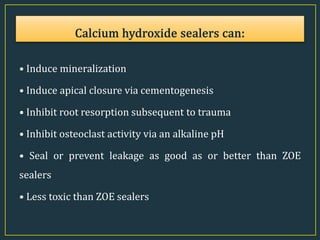
• Induce mineralization
• Induce apical closure via cementogenesis
• Inhibit root resorption subsequent to trauma
• Inhibit osteoclast activity via an alkaline pH
• Seal or prevent leakage as good as or better than ZOE
sealers
• Less toxic than ZOE sealers
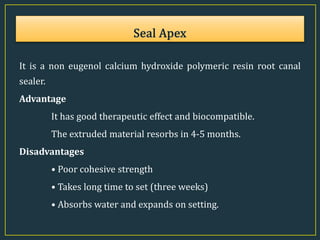
It is a non eugenol calcium hydroxide polymeric resin root canal
sealer.
Advantage
It has good therapeutic effect and biocompatible.
The extruded material resorbs in 4-5 months.
Disadvantages
• Poor cohesive strength
• Takes long time to set (three weeks)
• Absorbs water and expands on setting.
Base
• Calcium hydroxide 25 percent
• Zinc oxide 6.5 percent
• Calcium oxide
• Butyl benzene
• Fumed silica (silicon dioxide)
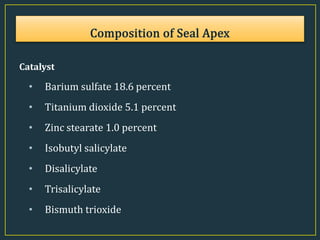
Catalyst
• Barium sulfate 18.6 percent
• Titanium dioxide 5.1 percent
• Zinc stearate 1.0 percent
• Isobutyl salicylate
• Disalicylate
• Trisalicylate
• Bismuth trioxide
• The monoblock concept means the creation of a solid,
bonded, continuous material from one dentin wall of the
canal to the other.
• One added benefit of the monoblock is that research has
shown that it strengthens the root by approximately 20%
• Primary:
• In this obturation is completely done with core material,
for example, use of MTA for obturation in cases of
apexification.
• Secondary:
• In this bond is there between etched dentin of canal
wall impregnated with resin tags which are attached
to resin cement that is bonded to core layer, e.g.
resilon based system.
Tertiary:
• In this conventional gutta-percha surface is coated
with resin which bond with the sealer, which further
bond to canal walls, e.g. Endo Rez and Activ GP system.
• Overfilling is complete obturation of root canal system with
excess material extruding beyond apical foramen.
• Overextension is extrusion of filling material beyond apical
foramen but the canal may not have been filled completely.

Obturation

  • 2.
    • The methodused to fill and seal a cleaned and shaped root canal using a root canal sealer and core filling material; sealers are frequently used as the sole obturating material in deciduous teeth; there are a variety of techniques used to obturate the canal space • Glossary of Endodontic Terms.
  • 3.
    1. Three-dimensional obturationclose to CDJ. 2. Radiographically, filling should be seen 0.5-0.75 mm from radiographic apex. 3. Minimal use of a root canal sealer which is confined to root canal.
  • 4.
    1. Easily introducedin the canal. 2. Seal canal laterally and apically. 3. Dimensionally stable after being inserted. 4. Impervious to moisture. 5. Bacteriostatic or at least should not encourage bacterial growth. 6. Radiopaque. 7. Non staining to tooth structure. 8. Non irritating. 9. Sterile/easily sterilized. 10. Removed easily from canal if required.
  • 5.
    • Plastics: Gutta-percha,resilon • Solids or metal cores: Silver points, Gold, stainless steel, titanium • Cements and pastes: – Hydron – MTA – Calcium phosphate – Gutta flow
  • 6.
    • Gutta-percha isderived from two words. • “GETAH” - meaning gum • “PERTJA” - name of the tree • 1843 : Sir Jose d Almeida – First introduced gutta-percha to Royal Asiatic society of England • In Dentistry : Edwin Truman – Introduced gutta-percha as temporary filling material. • 1867 : Bowman – First to use gutta-percha as root canal filling material
  • 7.
  • 8.
    • 1887 :SS White company – First company to start the commercial manufacture of gutta-percha points. • Sources • Gutta-percha is a dried coagulated extract which is derived from Brazillian trees (Palaquium). • These trees belong to Sapotaceae family. In India, these are found in Assam and Western Ghats.
  • 9.
    Matrix (Organic)- Gutta-percha 20 % Filler (Inorganic)- Zinc Oxide66 % Radio- opacifiers (Inorganic) - Heavy metal sulfates 11 % Plasticizers (Organic)- Waxes or resins 3 %
  • 10.
    Alpha form • Pliableand tacky at 56°-64°. • Available in form of bars or pellets. • Used in thermo-plasticized obturation technique. Beta form • Rigid and solid 42°-44°. • Used for manufacturing gutta-percha points and sticks. Amorphous form • Exists in molten stage.
  • 11.
    These phases areinter-convertible. • α - runny, tacky and sticky (lower viscosity) • β - solid, compactable and elongatable (higher viscosity) • γ - unstable form
  • 12.
    • It causesbrittleness because of the oxidation process. Storage under artificial light also speeds up their deterioration. • This brittle gutta-percha can be rejuvenated by a technique described by Sorien and Oliet. • In this, gutta-percha is immersed in hot water (55°C) for one or two seconds and then immediately immersed in cold water for few seconds.
  • 13.
    Brittle gutta-percha pointbreaks on bending
  • 14.
    • Gutta-percha cannotbe heat sterilized. • For disinfection of gutta-percha points, they should be immersed in 5.25 percent NaOCl for one minute. • Then, gutta-percha should be rinsed in hydrogen peroxide or ethyl alcohol. • The aim of rinsing is to remove crystallized NaOCl before obturation, as these crystallized particles impair the obturation.
  • 15.
    Sterilization of gutta-perchaby immersing them in 5.25 percent sodium hypochlorite for one minute
  • 16.
    • Gutta-percha points: Standardcones are of same size and shape as that of ISO endodontic instruments. • Auxiliary points: Non- standardized cones; perceive form of root canal.
  • 17.
    • Greater tapergutta-percha points: Available in 4 percent,6 percent, 80 percent and 10 percent taper • Precoated core carrier gutta- percha: In these stainless steel, titanium or plastic carriers are precoated with alpha phase gutta-percha for use in canal. e.g. thermafil
  • 18.
    • Syringe systems:They use low viscosity gutta-percha. e.g. successful and alpha seal. • Gutta flow: In this gutta- percha powder is incorporated into resin based sealer.
  • 19.
    • Gutta-percha sealerslike chloropercha and eucopercha:- In these gutta-percha is dissolved in chloroform/eucalyptol to be used in the canal. • Medicated gutta-percha: calcium hydroxide, iodoform or chlorhexidine diacetate containing gutta-percha points. • Gutta-percha pellets/bars: They are used in thermoplastisized gutta-percha obturation e.g. obtura system.
  • 20.
    • Compactiblity: adaptationto canal walls • Inertness: makes it non-reactive material • Dimensionally stable • Tissue tolerance • Radiopacity: easily recognizable on radiograph (Fig. 18.12) • Plasticity: becomes plastic when heated • Dissolve in some solvents like chloroform, eucalyptus oil, etc. This property makes it more versatile as canal filling material.
  • 21.
    • Lack ofrigidity: Bending of gutta-percha is seen when lateral pressure is applied. So, difficult to use in smaller canals • Easily displaced by pressure • Lacks adhesive quality.
  • 22.
    1. Use ofcold gutta-percha • Lateral compaction technique 2. Use of chemically softened gutta-percha • Chloroform • Halothane • Eucalyptol
  • 23.
    3. Use ofheat softened gutta-percha • Vertical compaction technique • System B continuous wave condensation technique • Lateral/vertical compaction • Sectional compaction technique • McSpadden compaction of gutta-percha
  • 24.
    • Thermoplasticized gutta-perchatechnique including – Obtura II – Ultrasonic plasticizing – Ultrafil system • Solid core obturation technique including – Thermafil system – Silver point obturation
  • 25.
    • Primary andaccessory gutta-percha points. • Spreaders and pluggers for compaction of gutta-percha • Absorbent paper points for drying the prepared root canal before applying sealer.
  • 26.
    • Lentulospirals forplacing sealer • Scissors for cutting gutta-percha • Endo gauge for measuring size of gutta-percha • Endo block for measuring gutta-percha points • Endo organizer for arranging gutta-percha and accessory points of various sizes. • Heating device like spirit lamp or butane gas torch • Heating instrument like ball burnisher, spoon excavator, etc.
  • 28.
    Following the canalpreparation, select the master gutta percha cone whose diameter is consistent with largest file used in the canal up to the working length. One should feel the tugback with master gutta-percha point. Master gutta-percha point is notched at the working distance analogous to the level of incisal or occlusal edge reference point
  • 29.
    Check the fitof cone radiographically. – If found satisfactory, remove the cone from the canal and place it in sodium hypochlorite. – If cone fits short of the working length, check for dentin chip debris, any ledge or curve in the canal and treat them accordingly – If cone selected is going beyond the foramen, either select the larger number cone or cut that cone to the working length. If cone shows “s” shaped appearance in the radiograph that means cone is too small for the canal. Here a larger cone must be selected to fit in the canal.
  • 30.
    Select the sizeof spreader to be used for lateral compaction of that tooth. It should reach 1-2 mm of true working length Dry the canal with paper points. Apply sealer in the prepared root canal Now premeasured cone is coated with sealer and placed into the canal. After master cone placement, spreader is placed into the canal alongside the cone. Spreader helps in compaction of gutta-percha. It act as a wedge to squeeze the gutta-percha laterally under vertical pressure not by pushing it sideways
  • 31.
    After placement, spreaderis removed from the canal by rotating it back and forth. This compacts the gutta-percha and a space gets created lateral to the master cone. An accessory cone is placed in this space and the above procedure is repeated until the spreader can no longer penetrate beyond the cervical line Now sever the protruding gutta-percha points at canal orifice with hot instrument
  • 32.
    Advantages of LateralCompaction Technique 1. Can be used in most clinical situations. 2. During compaction of gutta-percha, it provides length control, thus decreases the chances of overfilling. Disadvantages 1. May not fill the canal irregularities efficiently. 2. Does not produce homogenous mass. 3. Space may exist between accessory and master cones
  • 34.
    • Vertical compactionof warm gutta-percha method of filling the root canal was introduced by Schilder with an objective of filling all the portals of exit with maximum amount of guttapercha and minimum amount of sealer. • This is also known as Schilder’s technique of obturation.
  • 35.
    Select a mastercone according to shape and size of the prepared canal. Cone should fit in 1-2 mm of apical stop because when softened material moves apically into prepared canal, it adapts more intimately to the canal walls. Confirm the fit of cone radiographically, if found satisfactory, remove it from the canal and place in sodium hypochlorite. Irrigate the canal and then dry by rinsing it with alcohol and latter using the paper points.
  • 36.
    Now use theheated plugger to force the gutta- percha into the canal. The blunted end of plugger creates a deep depression in the centre of master cone . The outer walls of softened gutta-percha are then folded inward to fill the central void, at the same time mass of softened gutta-percha is moved apically and laterally. This procedure also removes 2-3 mm of coronal part of gutta-percha.
  • 37.
    Once apical fillingis done, complete obturation by doing backfilling. Obturate the remaining canal by heating small segments of gutta-percha, carrying them into the canal and then compacting them using heated pluggers as described above Take care not to overheat the gutta-percha because it will become too soft to handle.
  • 38.
    Do not applysealer on the softened segments of guttapercha because sealer will prevent their adherence to the body of gutta-percha present in the canal. After completion of obturation, clean the pulp chamber with alcohol to remove remnants of sealer or gutta-percha.
  • 39.
    Advantage of VerticalCompaction Technique • Excellent sealing of canal apically, laterally and obturation of lateral as well as accessory canals. Disadvantages of this Technique • Increased risk of vertical root fracture. • Overfilling of canals with gutta-percha or sealer from apex. • Time consuming.
  • 41.
    • In thistechnique, small pieces of gutta-percha cones are used to fill the sections of the canal. • It is also known as Chicago technique because it was widely promoted by Coolidge, Lundquist, Blayney, all from Chicago.
  • 42.
    1. A gutta-perchacone of same size of the prepared root canal is selected and cut into sections of 3 to 4 mm long. 2. Select a plugger which loosely fits within 3 mm of working length. 3. Apply sealer in the canal. 4. One end of gutta-percha is mounted to heated plugger and is then carried into the canal and apical pressure is given. After this disengage the plugger from gutta-percha by rotating it. 5. Radiograph is taken to confirm its fit. If found satisfactory, fill the remainder of the canal in same manner.
  • 43.
    Advantages • It sealsthe canals apically and laterally. • In case of post and core cases, only apical section of canal is filled. Disadvantages • Time consuming. • If canal gets overfilled, difficult to remove sections of guttapercha.
  • 45.
    • The purposeof sealing root canals is to prevent periapical exudates from diffusing into the unfilled part of the canal, to avoid reentry and colonization of bacteria and to check residual bacteria from reaching the periapical tissues. • Therefore, to accomplish a fluid tight seal, a root canal sealer is needed.
  • 46.
    • Should betacky when mixed to provide good adhesion between it and the canal wall when set. • Should create hermetic seal. • Should be radiopaque. • Powder particles size should be very fine, for easy mixing with liquid. • Should not shrink upon setting.
  • 47.
    • Should notstain tooth structure. • Should be bacteriostatic. • Should set slowly. • Should be insoluble in tissue fluids. • Should be non-irritating to periradicular tissue. • Should be soluble in a common solvent. • Should not provide immune response in periradicular tissue. • Should not be mutagenic or carcinogenic.
  • 48.
    • As antimicrobialagent • Fill the discrepancies between the materials and dentin walls • As binding agent • As lubricant • Give radiopacity • As canal obturating material
  • 49.
    Classification of sealeraccording to Grossman • Zinc oxide resin cements • Calcium hydroxide cements • Paraformaldehyde cements • Pastes
  • 50.
    According Cohen (ADAand ANSI) Type I: Material’s intended to be used with core material. • Class I: Includes materials in the form of powder and liquid that set through a non polymerizing process. • Class II: Includes materials in the form of two pastes that set through a non polymerizing process. • Class III: Includes polymers and resin systems that set through polymerization.
  • 51.
    According Cohen (ADAand ANSI) • Type II Intended for use with or without core material or sealer. • Class I: Powder and liquid-non polymerizing • Class II: Paste and paste-non polymerizing • Class III: Metal amalgams • Class IV: Polymer and resin systems-polymerization
  • 52.
    According to Composition 1. Eugenol group may be divided into subgroups namely: a. Silver containing cements: • Kerr sealer (Rickert, 1931) • Procosol radiopaque silver cement (Grossman, 1936) b. Silver free cements: • Procosol nonstaining cement (Grossman, 1958) • Grossman’s sealer (Grossman, 1974) • Tubliseal (Kerr, 1961) • Wach’s paste (Wach)
  • 53.
    Composition: Powder Zinc oxide 34-41.2percent Precipitated silver 25-30.0 percent Oleo resins 30-16 percent Thymol iodide 11-12 percent Liquid Oil of cloves 78-80 percent Canada balsam 20-22 percent
  • 54.
    1. Excellent lubricatingproperties. 2. It allows a working time of more than 30 minutes, when mixed in 1:1 ratio. 3. Germicidal action and biocompatibility. 4. Greater bulk than any sealer and thus makes it ideal for condensation techniques to fill voids, auxilliary canals and irregularities present lateral to gutta-percha cones.
  • 55.
    • The majordisadvantage is that the presence of silver makes the sealer extremely staining if any of the material enters the dentinal tubuli. • So sealers must be removed carefully from the pulp chamber with xylol.
  • 56.
    • Powder iscontained in a pellet and the liquid in a bottle. One drop of liquid is added to one pellet of powder and mixed with a heavy spatula until relative homogenicity is obtained. • Kerr pulp canal sealer completely sets and is inert within 15-30 minutes, thus reduces the inflammatory responses.
  • 57.
    Composition Powder Zinc oxide (reagent)- 40 parts Staybelite resin - 30 parts Bismuth Subcarbonate -15 parts Barium Sulfate - 15 parts Sodiumborate - 1 part Liquid Eugenol
  • 58.
    1. It hasplasticity and slow setting time due to the presence of sodiumborate anhydrate. 2. It has good sealing potential. 3. Zinc eugenolate is decomposed by water through continuous loss of eugenol, which makes zinc oxide eugenol a weak unstable compound.
  • 59.
    • Resin hascoarse particle size, so the material is spatulated vigorously during mixing. • If it is not done, a piece of resin may lodge on the canal walls.
  • 60.
    Cement hardens approximatelyin 2 hours at 37°C. The setting time is influenced by: 1. Quality of the ZnO and pH of the resin used. 2. Technique used in mixing the cement. 3. Amount of humidity in the temperature. 4. Temperature and dryness of the mixing slab and spatula.
  • 61.
    According to Composition Non-eugenol:These sealers do not contain eugenol and consist of wide variety of chemicals. Examples: • Diaket • AH-26 • Chloropercha and Eucapercha • Nogenol • Hydron • Endofil • Glass ionomer • Polycarboxylate • Calcium Phosphate cement
  • 62.
    • This isan epoxy resin recommended by Shroeder in 1957. Epoxy • resin based sealers are characterized by the reactive epoxide ring • and are polymerized by the breaking this ring. Feldman and • Nyborg gave the following composition.
  • 63.
    • Powder Bismuth oxide60 percent Hexamethylene tetramine 25 percent Silver powder 10 percent Titanium oxide 5 percent • Liquid • Bisphenol diglycidyl ether
  • 64.
    1. Good adhesiveproperty. 2. Good flow 3. Antibacterial 4. Contracts slightly while hardening 5. Low toxicity and well tolerated by periapical tissue. 6. The addition of a hardener, hexamethylene tetramine, makes the cured resin inert chemically and biologically.
  • 65.
    • AH 26consists of a yellow powder and viscous resin liquid and mixed to a thick creamy consistency. • The setting time is 36 to 48 hours at body temperature and 5-7 days at room temperature. • AH 26 produces greater adhesion to dentin especially when smear layer is removed. • Smear layer removal exposes the dentinal tubules creating an irritating surface thus enhancing adhesion.
  • 66.
    • AH Plusis an Epoxide-Amine resin pulp canal sealer, developed from its predecessor • AH26 because of color and shade stability, this is the material of choice where aesthetic demands are high.
  • 67.
    • AH PlusPaste A • Epoxy Resins • Calcium tungstate • Zirconium oxide • Silica • Iron oxide
  • 68.
    AH Plus PasteB • Adamantianeamine • N, N-Dibenzyl-5-Oxanonane-diamine-1, 9, TCD-diamine • Calcium tungstate • Zirconium oxide • Silica • Silicone oil
  • 69.
    • Mix equalvolume units (1:1) of Paste A and Paste B on a glass slab or mixing pad using a metal spatula. • Mix to a homogeneous consistency.
  • 70.
    AH 26 • Availablein powder and liquid systems • Releases small amount of formaldehyde on mixing,making it toxic in nature • Less soluble. • Causes tooth staining • Film thickness is 39 μm. • Setting time 24-36 hrs. • Good radiopacity AH plus • Available in two paste systems. • Less toxic so biocompatible • Half solubility when • compared to AH 26 • Does not cause staining • It is 20 μm. • Setting time 8 hrs. • Better radiopacity.
  • 71.
    According to Composition Medicated:These include the group of root canal sealers which have therapeutic properties. These materials are usually used without core materials. Examples: • Diaket-A • N2 • Endomethasone • SPAD • Iodoform paste • Riebler’s paste • Mynol cement • Ca(OH)2 paste
  • 72.
    • Calcium hydroxidehas been used in endodontics as a root canal filling material, intra canal medicaments or as a sealer in combination with solid core materials. • The pure calcium hydroxide powder can be used alone or it
  • 73.
    • Induce mineralization •Induce apical closure via cementogenesis • Inhibit root resorption subsequent to trauma • Inhibit osteoclast activity via an alkaline pH • Seal or prevent leakage as good as or better than ZOE sealers • Less toxic than ZOE sealers
  • 74.
    It is anon eugenol calcium hydroxide polymeric resin root canal sealer. Advantage It has good therapeutic effect and biocompatible. The extruded material resorbs in 4-5 months. Disadvantages • Poor cohesive strength • Takes long time to set (three weeks) • Absorbs water and expands on setting.
  • 75.
    Base • Calcium hydroxide25 percent • Zinc oxide 6.5 percent • Calcium oxide • Butyl benzene • Fumed silica (silicon dioxide)
  • 76.
    Catalyst • Barium sulfate18.6 percent • Titanium dioxide 5.1 percent • Zinc stearate 1.0 percent • Isobutyl salicylate • Disalicylate • Trisalicylate • Bismuth trioxide
  • 78.
    • The monoblockconcept means the creation of a solid, bonded, continuous material from one dentin wall of the canal to the other. • One added benefit of the monoblock is that research has shown that it strengthens the root by approximately 20%
  • 79.
    • Primary: • Inthis obturation is completely done with core material, for example, use of MTA for obturation in cases of apexification. • Secondary: • In this bond is there between etched dentin of canal wall impregnated with resin tags which are attached to resin cement that is bonded to core layer, e.g. resilon based system.
  • 80.
    Tertiary: • In thisconventional gutta-percha surface is coated with resin which bond with the sealer, which further bond to canal walls, e.g. Endo Rez and Activ GP system.
  • 81.
    • Overfilling iscomplete obturation of root canal system with excess material extruding beyond apical foramen. • Overextension is extrusion of filling material beyond apical foramen but the canal may not have been filled completely.