WAR MEANS DESTRUCTION OF INNOCENT
LIVES, TEARS TO THOUSANDS OF
MOTHERS EYES…
-EDWIN STARR
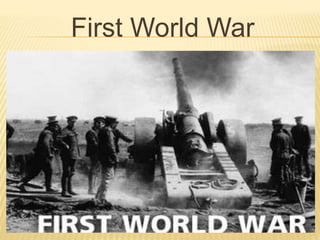
First World War
FIRST WORLD WAR AT A GLANCE
o Started in 28th July 1914 & finished 10th Nov 1918.
o Two force Central force & Allied force.
o Central force: Germany , Austria & Hungary.
o Allied force: United Kingdom, France & Russian
Empire.
o Bitter nationalism & militarism of Germany uprooted
the war.
o 2/3 people of the world were under the war.
o Civil people killed more than military people.
o Weapons like tank, big gun, submarine, poisonous gases
used for the first time.
o Central force defeated in the war
o Deaths were twice in number in first world war than all wars of Europe till 1790-1913.
o Industries expanded for industrial revolution used in war.
THE FIRST WORLD WAR- CAUSES
 Raiseof Germany&leadershipofBismarck
 Mutual defense alliance
 RoughNationalism
 Militarycompetition
 SocialDarwinism
RAISE OF GERMANY & LEADERSHIP OF BISMARCK
 In Franco Prussian war Germany won & seized Alsace &
Lorraine province from France.
 A large empire through Prussian’s
leadership.
 Blood & iron policy of
Bismarck
Germany
MUTUAL DEFENSE ALLIANCES
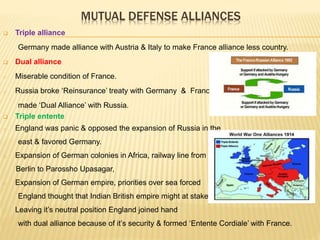
 Triple alliance
Germany made alliance with Austria & Italy to make France alliance less country.
 Dual alliance
o Miserable condition of France.
o Russia broke ‘Reinsurance’ treaty with Germany & France
made ‘Dual Alliance’ with Russia.
 Triple entente
o England was panic & opposed the expansion of Russia in the
east & favored Germany.
o Expansion of German colonies in Africa, railway line from
Berlin to Parossho Upasagar,
o Expansion of German empire, priorities over sea forced
England thought that Indian British empire might at stake.
o Leaving it’s neutral position England joined hand
with dual alliance because of it’s security & formed ‘Entente Cordiale’ with France.
ROUGH NATIONALISM
 Competition between German & Britain encouraged by
intense navy & armed forces.
 Arrogant nationalism derived to get imperial power in Asia,
Africa & Balkan regions.
 Jealousy, power, domination lead to start war.
 Uses of Newspapers.
 Armed peace or Pacism.
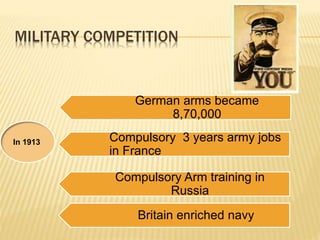
MILITARY COMPETITION
German arms became
8,70,000
In 1913 Compulsory 3 years army jobs
in France
Compulsory Arm training in
Russia
Britain enriched navy
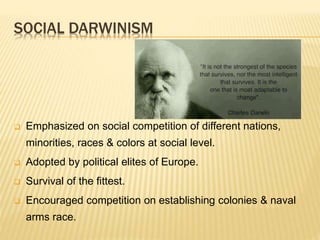
SOCIAL DARWINISM
 Emphasized on social competition of different nations,
minorities, races & colors at social level.
 Adopted by political elites of Europe.
 Survival of the fittest.
 Encouraged competition on establishing colonies & naval
arms race.
IMMEDIATE CAUSE
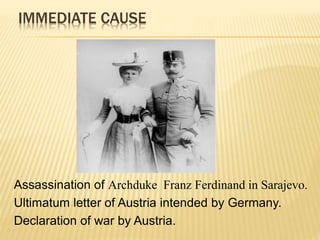
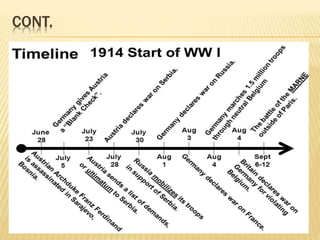
Assassination of Archduke Franz Ferdinand in Sarajevo.
Ultimatum letter of Austria intended by Germany.
Declaration of war by Austria.
CONT.
CENTRAL POWER & ALLIES
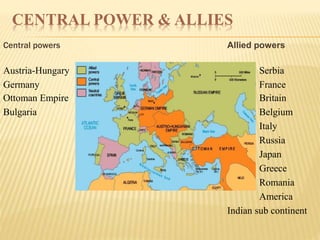
Central powers Allied powers
Austria-Hungary Serbia
Germany France
Ottoman Empire Britain
Bulgaria Belgium
Italy
Russia
Japan
Greece
Romania
America
Indian sub continent
BEGINNING & PARTICIPATION OF THE COUNTRIES IN
WAR
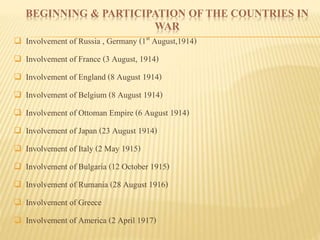
 Involvement of Russia , Germany (1st August,1914)
 Involvement of France (3 August, 1914)
 Involvement of England (8 August 1914)
 Involvement of Belgium (8 August 1914)
 Involvement of Ottoman Empire (6 August 1914)
 Involvement of Japan (23 August 1914)
 Involvement of Italy (2 May 1915)
 Involvement of Bulgaria (12 October 1915)
 Involvement of Rumania (28 August 1916)
 Involvement of Greece
 Involvement of America (2 April 1917)
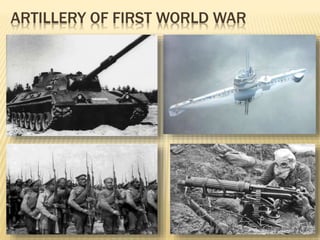
ARTILLERY OF FIRST WORLD WAR
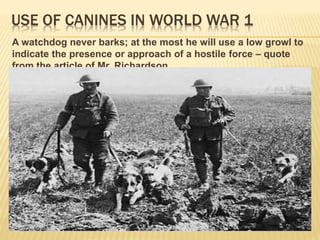
USE OF CANINES IN WORLD WAR 1
A watchdog never barks; at the most he will use a low growl to
indicate the presence or approach of a hostile force – quote
from the article of Mr. Richardson
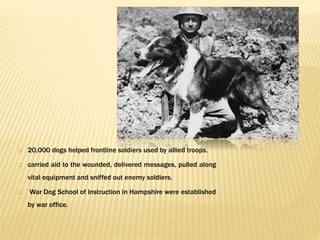
 20,000 dogs helped frontline soldiers used by allied troops.
 carried aid to the wounded, delivered messages, pulled along
vital equipment and sniffed out enemy soldiers.
 War Dog School of Instruction in Hampshire were established
by war office.
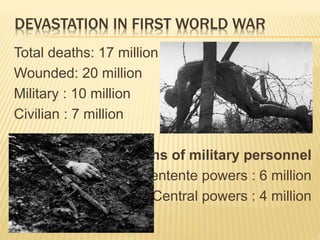
DEVASTATION IN FIRST WORLD WAR
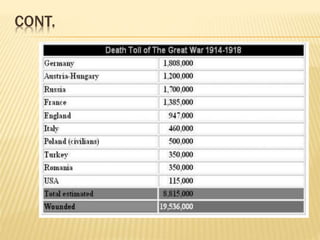
Total deaths: 17 million
Wounded: 20 million
Military : 10 million
Civilian : 7 million
Deaths of military personnel
The entente powers : 6 million
Central powers : 4 million
CONT.
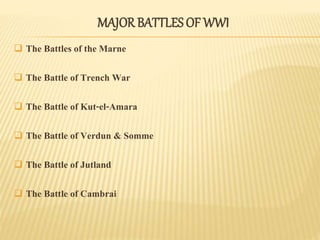
MAJOR BATTLES OF WWI
 The Battles of the Marne
 The Battle of Trench War
 The Battle of Kut-el-Amara
 The Battle of Verdun & Somme
 The Battle of Jutland
 The Battle of Cambrai
CONSEQUENCE OF 1ST WORLD WAR
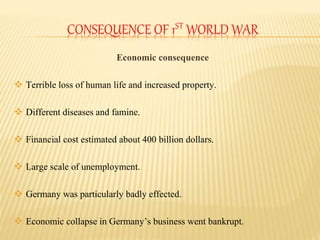
Economic consequence
 Terrible loss of human life and increased property.
 Different diseases and famine.
 Financial cost estimated about 400 billion dollars.
 Large scale of unemployment.
 Germany was particularly badly effected.
 Economic collapse in Germany’s business went bankrupt.
CONSEQUENCE OF 1ST WORLD WAR
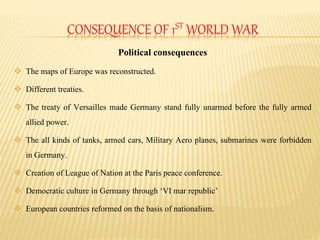
Political consequences
 The maps of Europe was reconstructed.
 Different treaties.
 The treaty of Versailles made Germany stand fully unarmed before the fully armed
allied power.
 The all kinds of tanks, armed cars, Military Aero planes, submarines were forbidden
in Germany.
 Creation of League of Nation at the Paris peace conference.
 Democratic culture in Germany through ‘VI mar republic’
 European countries reformed on the basis of nationalism.
CONSEQUENCE OF 1ST WORLD WAR
Colonial consequence
 Deprivation of Germany’s colonies & was totally disarmed by the
Versailles treaty.
 Emergence of great power in Europe, USA, far East and Great Britain.
 Great Britain proved to be leading maritime & colonial power on the Earth.
 New nations were established on the ruins of old ones.
 Nationalist independence protest will lead to the process of colonial
emancipation.
CONSEQUENCE OF 1ST WORLD WAR
Emergence of new power
 France came to be the regarded as a great military power in Europe.
 Japan enhanced it’s power & prestige in the far East.
 USA emerged from 1st world war as a great world power.
 Autocratic leadership of Adolph Hitler.
 Victorious countries emerged as the strong world power.
THE PEACE TREATIES
Paris Peace treaty (1919)
 Treaty of Versailles
-between Germany & Versailles
 Treaty of Saint Germain
-between Austria & Saint Germain
 Treaty of Trianon
-between Hungery & Trianon
 Treaty of Neville
-between Bulgeria & Neville
 Treaty of Sevres
-between Turkey & Sevres
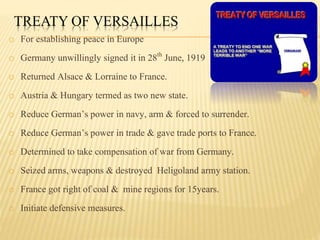
TREATY OF VERSAILLES
o For establishing peace in Europe
o Germany unwillingly signed it in 28th June, 1919
o Returned Alsace & Lorraine to France.
o Austria & Hungary termed as two new state.
o Reduce German’s power in navy, arm & forced to surrender.
o Reduce German’s power in trade & gave trade ports to France.
o Determined to take compensation of war from Germany.
o Seized arms, weapons & destroyed Heligoland army station.
o France got right of coal & mine regions for 15years.
o Initiate defensive measures.
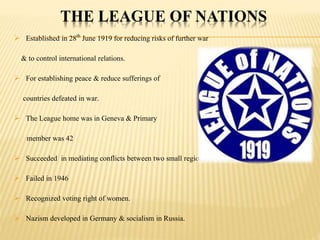
THE LEAGUE OF NATIONS
 Established in 28th June 1919 for reducing risks of further war
& to control international relations.
 For establishing peace & reduce sufferings of
countries defeated in war.
 The League home was in Geneva & Primary
member was 42
 Succeeded in mediating conflicts between two small regions of Bolkan.
 Failed in 1946
 Recognized voting right of women.
 Nazism developed in Germany & socialism in Russia.
Thank you 

World war 1

  • 1.
    WAR MEANS DESTRUCTIONOF INNOCENT LIVES, TEARS TO THOUSANDS OF MOTHERS EYES… -EDWIN STARR
  • 2.
  • 3.
    FIRST WORLD WARAT A GLANCE o Started in 28th July 1914 & finished 10th Nov 1918. o Two force Central force & Allied force. o Central force: Germany , Austria & Hungary. o Allied force: United Kingdom, France & Russian Empire. o Bitter nationalism & militarism of Germany uprooted the war. o 2/3 people of the world were under the war. o Civil people killed more than military people. o Weapons like tank, big gun, submarine, poisonous gases used for the first time. o Central force defeated in the war o Deaths were twice in number in first world war than all wars of Europe till 1790-1913. o Industries expanded for industrial revolution used in war.
  • 4.
    THE FIRST WORLDWAR- CAUSES  Raiseof Germany&leadershipofBismarck  Mutual defense alliance  RoughNationalism  Militarycompetition  SocialDarwinism
  • 5.
    RAISE OF GERMANY& LEADERSHIP OF BISMARCK  In Franco Prussian war Germany won & seized Alsace & Lorraine province from France.  A large empire through Prussian’s leadership.  Blood & iron policy of Bismarck Germany
  • 6.
    MUTUAL DEFENSE ALLIANCES Triple alliance Germany made alliance with Austria & Italy to make France alliance less country.  Dual alliance o Miserable condition of France. o Russia broke ‘Reinsurance’ treaty with Germany & France made ‘Dual Alliance’ with Russia.  Triple entente o England was panic & opposed the expansion of Russia in the east & favored Germany. o Expansion of German colonies in Africa, railway line from Berlin to Parossho Upasagar, o Expansion of German empire, priorities over sea forced England thought that Indian British empire might at stake. o Leaving it’s neutral position England joined hand with dual alliance because of it’s security & formed ‘Entente Cordiale’ with France.
  • 7.
    ROUGH NATIONALISM  Competitionbetween German & Britain encouraged by intense navy & armed forces.  Arrogant nationalism derived to get imperial power in Asia, Africa & Balkan regions.  Jealousy, power, domination lead to start war.  Uses of Newspapers.  Armed peace or Pacism.
  • 8.
    MILITARY COMPETITION German armsbecame 8,70,000 In 1913 Compulsory 3 years army jobs in France Compulsory Arm training in Russia Britain enriched navy
  • 9.
    SOCIAL DARWINISM  Emphasizedon social competition of different nations, minorities, races & colors at social level.  Adopted by political elites of Europe.  Survival of the fittest.  Encouraged competition on establishing colonies & naval arms race.
  • 10.
    IMMEDIATE CAUSE Assassination ofArchduke Franz Ferdinand in Sarajevo. Ultimatum letter of Austria intended by Germany. Declaration of war by Austria.
  • 11.
  • 12.
    CENTRAL POWER &ALLIES Central powers Allied powers Austria-Hungary Serbia Germany France Ottoman Empire Britain Bulgaria Belgium Italy Russia Japan Greece Romania America Indian sub continent
  • 13.
    BEGINNING & PARTICIPATIONOF THE COUNTRIES IN WAR  Involvement of Russia , Germany (1st August,1914)  Involvement of France (3 August, 1914)  Involvement of England (8 August 1914)  Involvement of Belgium (8 August 1914)  Involvement of Ottoman Empire (6 August 1914)  Involvement of Japan (23 August 1914)  Involvement of Italy (2 May 1915)  Involvement of Bulgaria (12 October 1915)  Involvement of Rumania (28 August 1916)  Involvement of Greece  Involvement of America (2 April 1917)
  • 14.
  • 15.
    USE OF CANINESIN WORLD WAR 1 A watchdog never barks; at the most he will use a low growl to indicate the presence or approach of a hostile force – quote from the article of Mr. Richardson
  • 16.
     20,000 dogshelped frontline soldiers used by allied troops.  carried aid to the wounded, delivered messages, pulled along vital equipment and sniffed out enemy soldiers.  War Dog School of Instruction in Hampshire were established by war office.
  • 17.
    DEVASTATION IN FIRSTWORLD WAR Total deaths: 17 million Wounded: 20 million Military : 10 million Civilian : 7 million Deaths of military personnel The entente powers : 6 million Central powers : 4 million
  • 18.
  • 19.
    MAJOR BATTLES OFWWI  The Battles of the Marne  The Battle of Trench War  The Battle of Kut-el-Amara  The Battle of Verdun & Somme  The Battle of Jutland  The Battle of Cambrai
  • 20.
    CONSEQUENCE OF 1STWORLD WAR Economic consequence  Terrible loss of human life and increased property.  Different diseases and famine.  Financial cost estimated about 400 billion dollars.  Large scale of unemployment.  Germany was particularly badly effected.  Economic collapse in Germany’s business went bankrupt.
  • 21.
    CONSEQUENCE OF 1STWORLD WAR Political consequences  The maps of Europe was reconstructed.  Different treaties.  The treaty of Versailles made Germany stand fully unarmed before the fully armed allied power.  The all kinds of tanks, armed cars, Military Aero planes, submarines were forbidden in Germany.  Creation of League of Nation at the Paris peace conference.  Democratic culture in Germany through ‘VI mar republic’  European countries reformed on the basis of nationalism.
  • 22.
    CONSEQUENCE OF 1STWORLD WAR Colonial consequence  Deprivation of Germany’s colonies & was totally disarmed by the Versailles treaty.  Emergence of great power in Europe, USA, far East and Great Britain.  Great Britain proved to be leading maritime & colonial power on the Earth.  New nations were established on the ruins of old ones.  Nationalist independence protest will lead to the process of colonial emancipation.
  • 23.
    CONSEQUENCE OF 1STWORLD WAR Emergence of new power  France came to be the regarded as a great military power in Europe.  Japan enhanced it’s power & prestige in the far East.  USA emerged from 1st world war as a great world power.  Autocratic leadership of Adolph Hitler.  Victorious countries emerged as the strong world power.
  • 24.
    THE PEACE TREATIES ParisPeace treaty (1919)  Treaty of Versailles -between Germany & Versailles  Treaty of Saint Germain -between Austria & Saint Germain  Treaty of Trianon -between Hungery & Trianon  Treaty of Neville -between Bulgeria & Neville  Treaty of Sevres -between Turkey & Sevres
  • 25.
    TREATY OF VERSAILLES oFor establishing peace in Europe o Germany unwillingly signed it in 28th June, 1919 o Returned Alsace & Lorraine to France. o Austria & Hungary termed as two new state. o Reduce German’s power in navy, arm & forced to surrender. o Reduce German’s power in trade & gave trade ports to France. o Determined to take compensation of war from Germany. o Seized arms, weapons & destroyed Heligoland army station. o France got right of coal & mine regions for 15years. o Initiate defensive measures.
  • 26.
    THE LEAGUE OFNATIONS  Established in 28th June 1919 for reducing risks of further war & to control international relations.  For establishing peace & reduce sufferings of countries defeated in war.  The League home was in Geneva & Primary member was 42  Succeeded in mediating conflicts between two small regions of Bolkan.  Failed in 1946  Recognized voting right of women.  Nazism developed in Germany & socialism in Russia.
  • 27.