Localization &
Contextualization
May 25-30, 2014
Grade 9 Mass Training
University of the Cordilleras
Ms. HenrietaA. Bringas
Localization
Contextualization
• How did you find the activity?
• How did you react to the work the other
groups?
• What difficulties did you encounter?
• How did you treat them?
• What is this telling us about the way
lessons should be taught?
• What have you realized from the activity?
• Why is there a need to localize in
teaching?
• Should there be a limitation on localization
in teaching? Why?
CONTEXTUALIZATION
•Developing new skills, knowledge,
abilities and attitudes in students in
presenting new subject matter in
meaningful and relevant context:
• Context of previous experience
• Real-life
• workplace
LOCALIZATION
Freedom for schools or local
authorities to adapt the curriculum to
local conditions and relating the
context of the curriculum and the
process of teaching and learning to
the local environment (Taylor 2004)
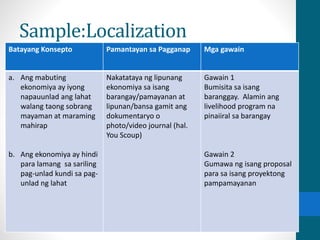
Sample:Localization
Batayang Konsepto Pamantayan sa Pagganap Mga gawain
a. Ang mabuting
ekonomiya ay iyong
napauunlad ang lahat
walang taong sobrang
mayaman at maraming
mahirap
b. Ang ekonomiya ay hindi
para lamang sa sariling
pag-unlad kundi sa pag-
unlad ng lahat
Nakatataya ng lipunang
ekonomiya sa isang
barangay/pamayanan at
lipunan/bansa gamit ang
dokumentaryo o
photo/video journal (hal.
You Scoup)
Gawain 1
Bumisita sa isang
baranggay. Alamin ang
livelihood program na
pinaiiral sa barangay
Gawain 2
Gumawa ng isang proposal
para sa isang proyektong
pampamayanan
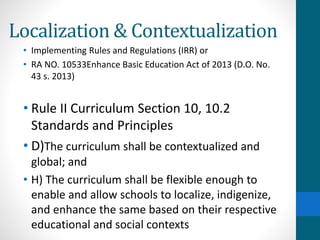
Localization & Contextualization
• Implementing Rules and Regulations (IRR) or
• RA NO. 10533Enhance Basic Education Act of 2013 (D.O. No.
43 s. 2013)
• Rule II Curriculum Section 10, 10.2
Standards and Principles
• D)The curriculum shall be contextualized and
global; and
• H) The curriculum shall be flexible enough to
enable and allow schools to localize, indigenize,
and enhance the same based on their respective
educational and social contexts
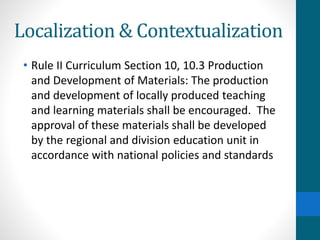
Localization & Contextualization
• Rule II Curriculum Section 10, 10.3 Production
and Development of Materials: The production
and development of locally produced teaching
and learning materials shall be encouraged. The
approval of these materials shall be developed
by the regional and division education unit in
accordance with national policies and standards
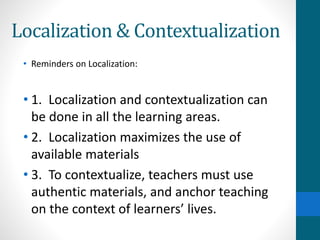
Localization & Contextualization
• Reminders on Localization:
• 1. Localization and contextualization can
be done in all the learning areas.
• 2. Localization maximizes the use of
available materials
• 3. To contextualize, teachers must use
authentic materials, and anchor teaching
on the context of learners’ lives.
Localization & Contextualization
• Reminders on Localization:
• 4. Teachers should encourage students to
pose problems and issues and use
strategies to address these.
• 5. The localized or contextualized
curriculum is based on local needs and
relevance for the learners; thus allowing
for its flexibility and creativity in the
lessons.
Localization & Contextualization
• Reminders on Localization:
• 6. Teachers must build on what resources
the school have.
• Teachers must accommodate and respect
cultural, linguistic and racial diversity.
• Magtala ng mga pamamaraan kung paano
mapagyaman ang lokalisasyon sa proseso
ng pagtututro sa inyong
dibisyon/probinsya
•Thank you!

Localization & contextualization

  • 1.
    Localization & Contextualization May 25-30,2014 Grade 9 Mass Training University of the Cordilleras Ms. HenrietaA. Bringas
  • 2.
  • 3.
  • 4.
    • How didyou find the activity? • How did you react to the work the other groups? • What difficulties did you encounter? • How did you treat them? • What is this telling us about the way lessons should be taught? • What have you realized from the activity?
  • 5.
    • Why isthere a need to localize in teaching? • Should there be a limitation on localization in teaching? Why?
  • 6.
    CONTEXTUALIZATION •Developing new skills,knowledge, abilities and attitudes in students in presenting new subject matter in meaningful and relevant context: • Context of previous experience • Real-life • workplace
  • 7.
    LOCALIZATION Freedom for schoolsor local authorities to adapt the curriculum to local conditions and relating the context of the curriculum and the process of teaching and learning to the local environment (Taylor 2004)
  • 8.
    Sample:Localization Batayang Konsepto Pamantayansa Pagganap Mga gawain a. Ang mabuting ekonomiya ay iyong napauunlad ang lahat walang taong sobrang mayaman at maraming mahirap b. Ang ekonomiya ay hindi para lamang sa sariling pag-unlad kundi sa pag- unlad ng lahat Nakatataya ng lipunang ekonomiya sa isang barangay/pamayanan at lipunan/bansa gamit ang dokumentaryo o photo/video journal (hal. You Scoup) Gawain 1 Bumisita sa isang baranggay. Alamin ang livelihood program na pinaiiral sa barangay Gawain 2 Gumawa ng isang proposal para sa isang proyektong pampamayanan
  • 9.
    Localization & Contextualization •Implementing Rules and Regulations (IRR) or • RA NO. 10533Enhance Basic Education Act of 2013 (D.O. No. 43 s. 2013) • Rule II Curriculum Section 10, 10.2 Standards and Principles • D)The curriculum shall be contextualized and global; and • H) The curriculum shall be flexible enough to enable and allow schools to localize, indigenize, and enhance the same based on their respective educational and social contexts
  • 10.
    Localization & Contextualization •Rule II Curriculum Section 10, 10.3 Production and Development of Materials: The production and development of locally produced teaching and learning materials shall be encouraged. The approval of these materials shall be developed by the regional and division education unit in accordance with national policies and standards
  • 11.
    Localization & Contextualization •Reminders on Localization: • 1. Localization and contextualization can be done in all the learning areas. • 2. Localization maximizes the use of available materials • 3. To contextualize, teachers must use authentic materials, and anchor teaching on the context of learners’ lives.
  • 12.
    Localization & Contextualization •Reminders on Localization: • 4. Teachers should encourage students to pose problems and issues and use strategies to address these. • 5. The localized or contextualized curriculum is based on local needs and relevance for the learners; thus allowing for its flexibility and creativity in the lessons.
  • 13.
    Localization & Contextualization •Reminders on Localization: • 6. Teachers must build on what resources the school have. • Teachers must accommodate and respect cultural, linguistic and racial diversity.
  • 14.
    • Magtala ngmga pamamaraan kung paano mapagyaman ang lokalisasyon sa proseso ng pagtututro sa inyong dibisyon/probinsya
  • 15.