TECHNICAL
TEXTILES
A VISION OF FUTURE
INTRODUCTION
 Technical Textiles (TT) offers new ways, means and opportunity
to the Indian textile industry to sustain the present growth and
thrive in near future. It would offer not only an opportunity for
augment the growth, but also a new direction for advancement
of the industry.
 The field of technical textiles had not receive adequate
importance in Indian context so far, however, it is a potential
area where the textile industry can excel.
 Traditional textiles today are unable to cope with cost of
production for various reasons like fast technological
obsolescence, high cost of modernization, power, etc.
 Present product mix of traditional textiles are not remunerative
enough and therefore, more and more ideas of value-addition to
textile products is gaining momentum.
 Technical textiles, in this context, are just perfect.
DEFINITION
 The technical textiles is defined as textile material and
product manufactured primarily for their technical
performance and functional properties rather than their
aesthetic or decorative characteristics.
OR
 A Technical textile is a textile product manufactured for
non-aesthetic purposes, where function is the primary
criterion.
 It is a large and growing sector and supports a vast
array of other industries.
HISTORY
 Technical textile touched its peak as soon as the manmade fibre
was discovered in1900 AD , before that the only source was the
natural fibres & it was treated with chemicals to make the same.
 Simultaneously new technology such as special weaving
process, nonwoven technique etc was developed to manufacture
the technical textile.
 In the last three hundred years, world has observed a fast growth
in fiber production which has a very distinguished characteristics
such as
 High resistance to temperature
 Stable under stress and strain
 Strong enough to absorb impact of highly reactive chemicals etc.
 Textile industry has created various products by using such
fibres. The result of these efforts have enhanced the growth of
industrial and technical textiles.
INDUSTRIAL OR TECHNICAL TEXTILES
 Non-conventional textiles encompassing a wide spectrum
of end-applications raised a debate as to whether the term
industrial textiles used so far is appropriate to be
continued, or it is time now that "industrial textiles" having
specific meaning should include those products used as
part of industrial processes or which are incorporated in
some way into industrial products.
 Textiles used for medicine, defence, agriculture, fishing,
etc. do not attach any specific meaning to "industry" but for
the age-old practice of using the term "industrial textiles".
 Today, the term Technical Textiles has emerged as the
most widely acceptable term for this expanding field of
textile applications.
INDIAN SCENARIO
 A systematic survey had been undertaken by Ministry of
Textiles (MOT) to assess the progress of technical
textiles in India. With this study, it is established that
India is yet to find a significant place in the global
scenario in this area.
 Traditionally, Indian textile industry is composed of four
sectors, viz., composite mill sector, decentralised
powerloom , hosiery and handloom sectors. Indian
textile industry was dominated by the composite mill
sector in the post-independence period.
 Technical textiles did never find a place of priority in this
sector, though a few mills produced a limited range of
industrial textiles in their product mix.
A
 However, facing stiff competition from the powerloom
sector, gradually the composite mill sector suffered
various set backs. Even in their revival effort, technical
textiles did not find a strategic place as it deserved.
 They still focused their priority in modernisation in
conventional apparel and home textile products, yarn
manufacturing etc.
 So far, the contribution of Indian textile industry towards
technical textiles was restricted to a few low technology
and less sophisticated items like tarpaulin, industrial filter
cloth, bolting cloth, textiles for luggage, tyre cords,
belting etc.
PRESENT SCENARIO OF TECHNICAL
TEXTILES
 India is the world second largest producer of textile and
garments. The textile industry in India contributes 14 %
towards the GDP of USD 1.18 billion. This market itself being
so big, there is tremendous potential for technical textiles as
well.
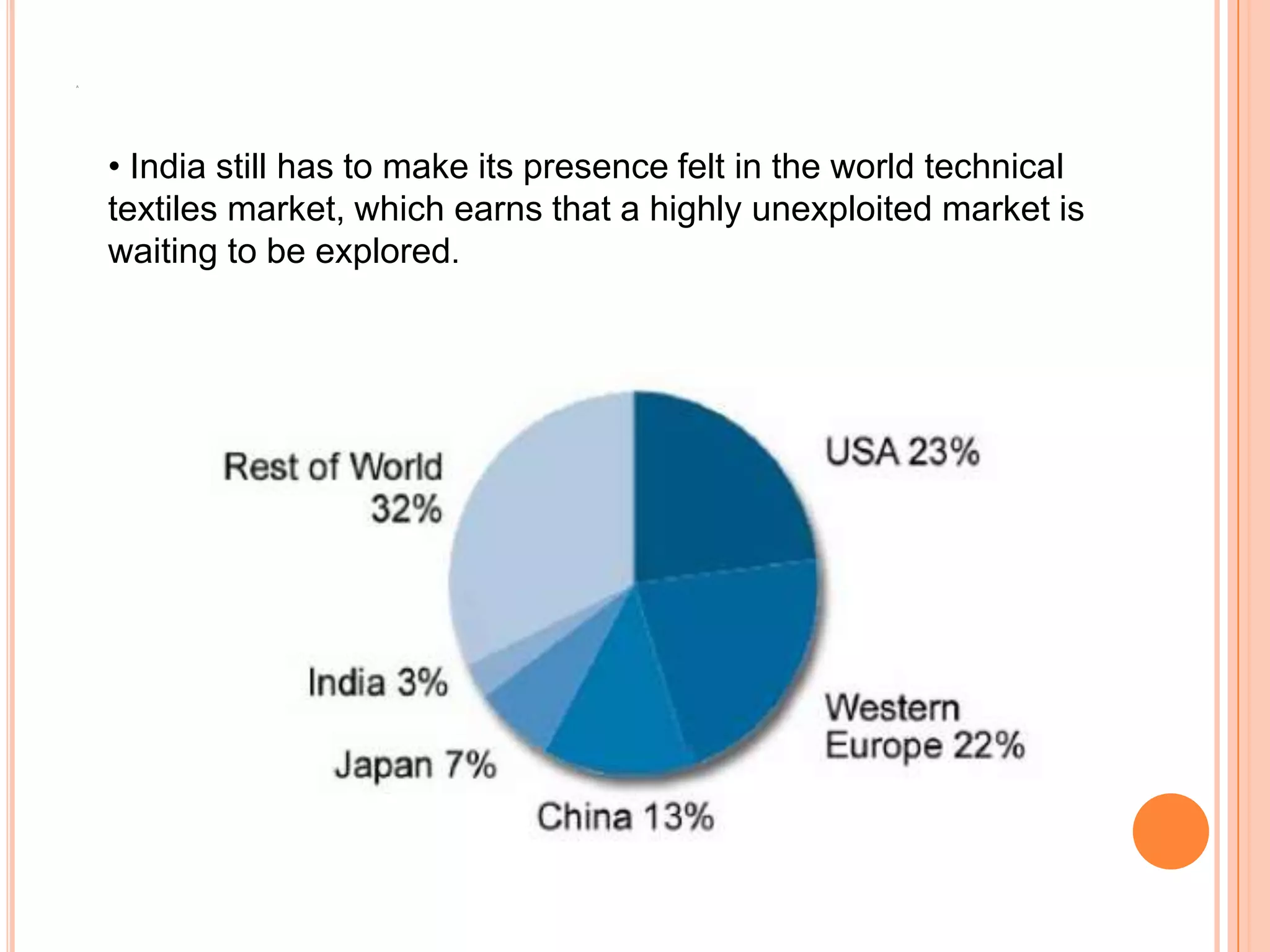
 Currently the consumption of technical textiles in India forms
only 3 % of the total world consumption; however, it is growing
at a rate higher than most developed countries.
 The reasons for low penetration in this market are several,
such as scattered production structure, inadequate research
and development (R&D), lack of skilled personnel.
 Another major contributing factor is that there is lack of
awareness about the benefits of using technical textile
A
• India still has to make its presence felt in the world technical
textiles market, which earns that a highly unexploited market is
waiting to be explored.
MARKET SIZE OF INDIAN TECHNICAL
TEXTILE INDUSTRY
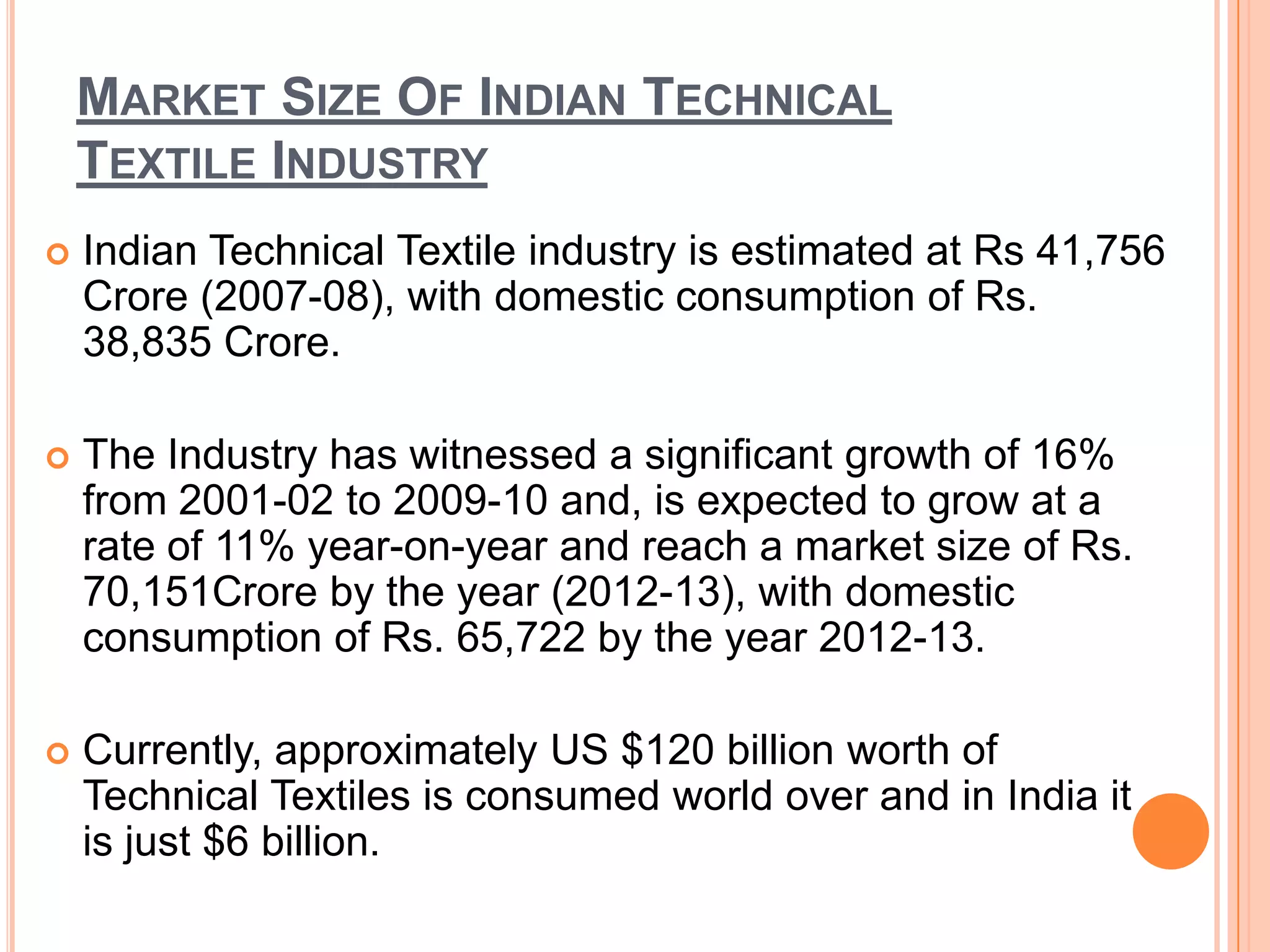
 Indian Technical Textile industry is estimated at Rs 41,756
Crore (2007-08), with domestic consumption of Rs.
38,835 Crore.
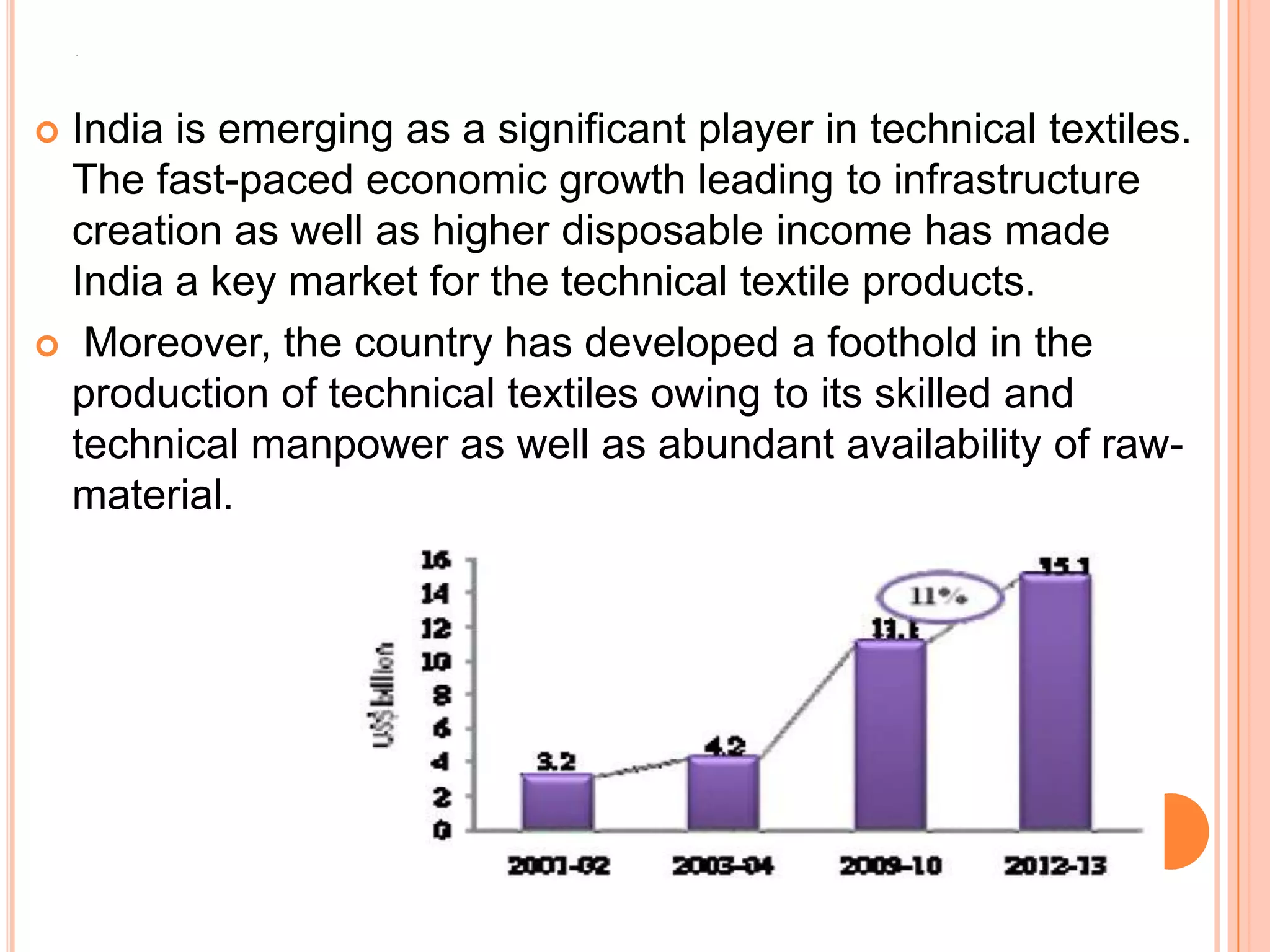
 The Industry has witnessed a significant growth of 16%
from 2001-02 to 2009-10 and, is expected to grow at a
rate of 11% year-on-year and reach a market size of Rs.
70,151Crore by the year (2012-13), with domestic
consumption of Rs. 65,722 by the year 2012-13.
 Currently, approximately US $120 billion worth of
Technical Textiles is consumed world over and in India it
is just $6 billion.
A
 India is emerging as a significant player in technical textiles.
The fast-paced economic growth leading to infrastructure
creation as well as higher disposable income has made
India a key market for the technical textile products.
 Moreover, the country has developed a foothold in the
production of technical textiles owing to its skilled and
technical manpower as well as abundant availability of raw-
material.
GROWTH RATES FOR CONSUMPTION OF
TECHNICAL TEXTILE
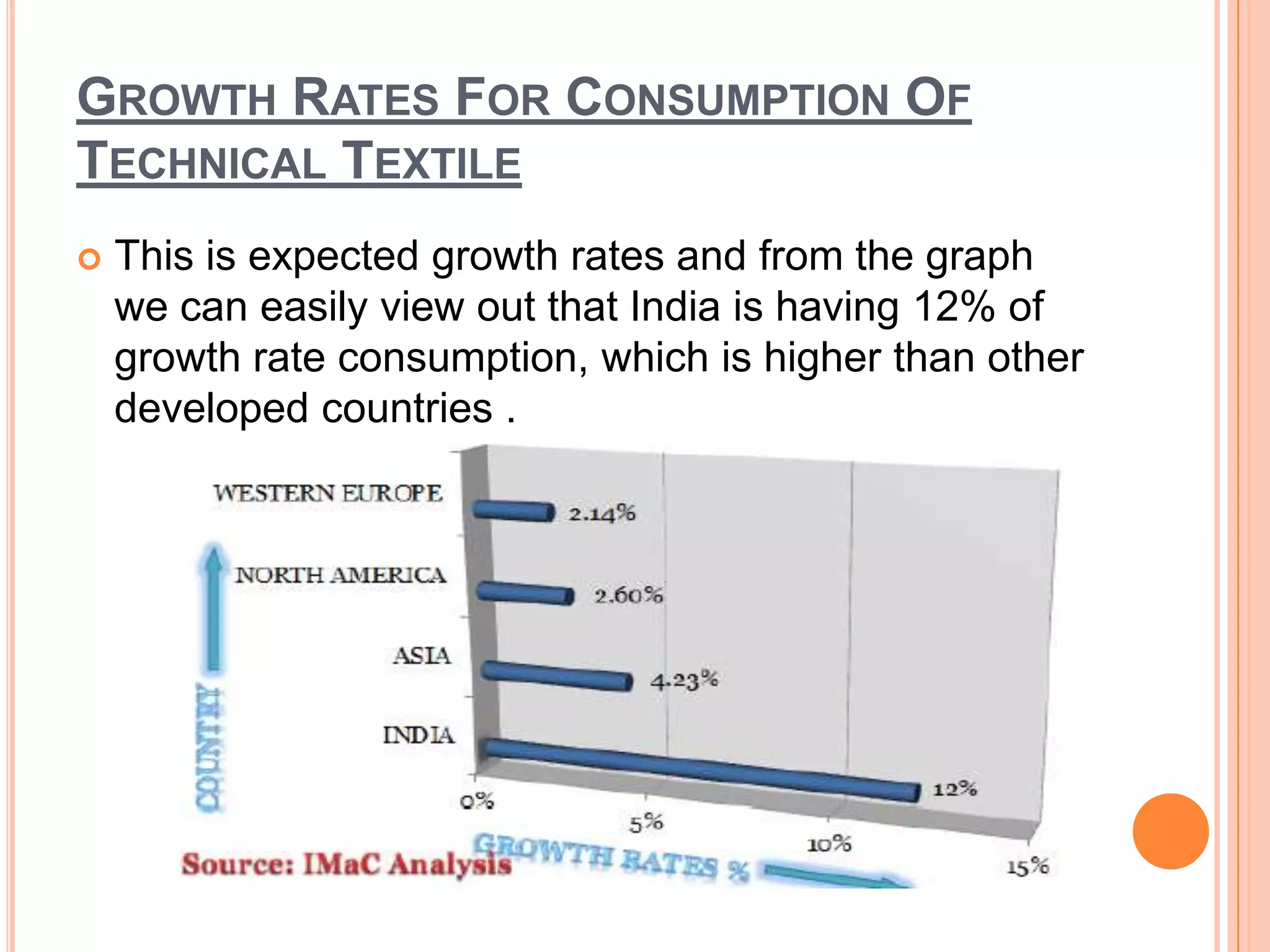
 This is expected growth rates and from the graph
we can easily view out that India is having 12% of
growth rate consumption, which is higher than other
developed countries .
TARGET IN NEXT 10 YEARS
 Strategy should be to fix up a target of 10% - 12% of
global market in next 10 years. Accordingly, the planning
should be made to ensure the inputs and to offer a
congenial environment, both regulatory and fiscal, to
achieve the target of almost about US $ 6-8 billion share in
the global technical textile market in next 10 years or so.
 To fulfil the social objectives of providing cheaper and
efficient products like shelters, protective clothing etc. to
the masses in the event of disasters like flood, draught,
earthquake etc. Logistically, it will also be easier and
convenient to position such products more speedily than
conventional material.
APPLICATION AREAS
 To identify application areas with a strong potential in the
domestic market, and which will in the long run, help exports.
 Initially such items should be selected for which there exists
know-how, production facilities, raw material etc. Such
products may be on the lower end of technology but should
have a big impact in terms of volume, value addition, etc.
 It will create a favourable psychological impact and climate for
future investment in more demanding products.
 Indigenisation of value added products of relatively easier
technology capable of quick assimilation should be aimed at
the beginning. To develop technical textiles in high tech
application of aerospace, defence, etc.
RAW MATERIAL
 Attempts should be made to use indigeneously available
fibres - both natural and man made, for the technical
textile products. However, it is not a deterrent to import of
high performance fibres for specific products where
volume is less.
 To exploit the traditional eco-friendly natural fibres like
cotton, jute, coir, hemp etc. by product diversification with
value addition for medical textiles, agro textiles etc.
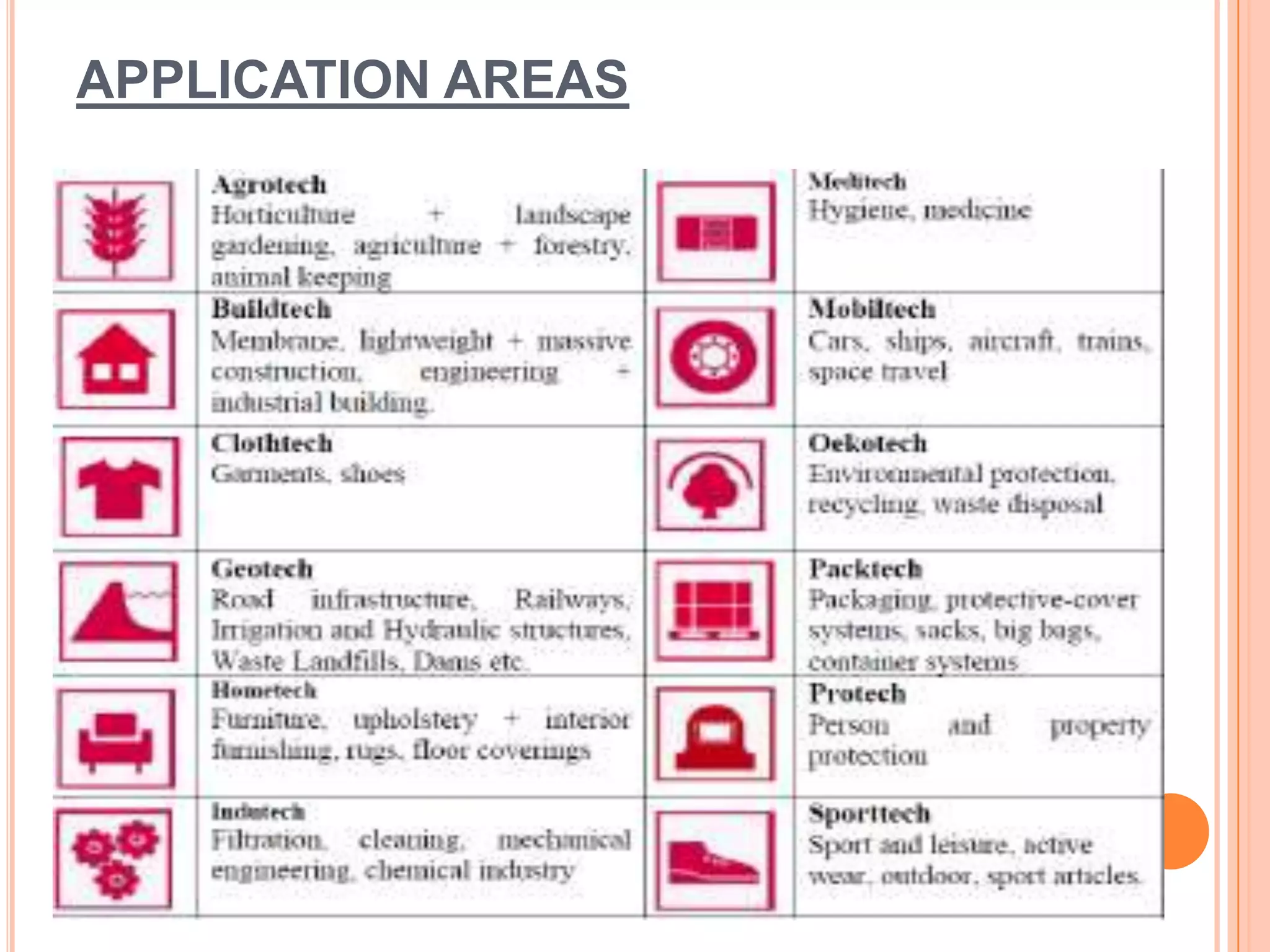
APPLICATION AREAS
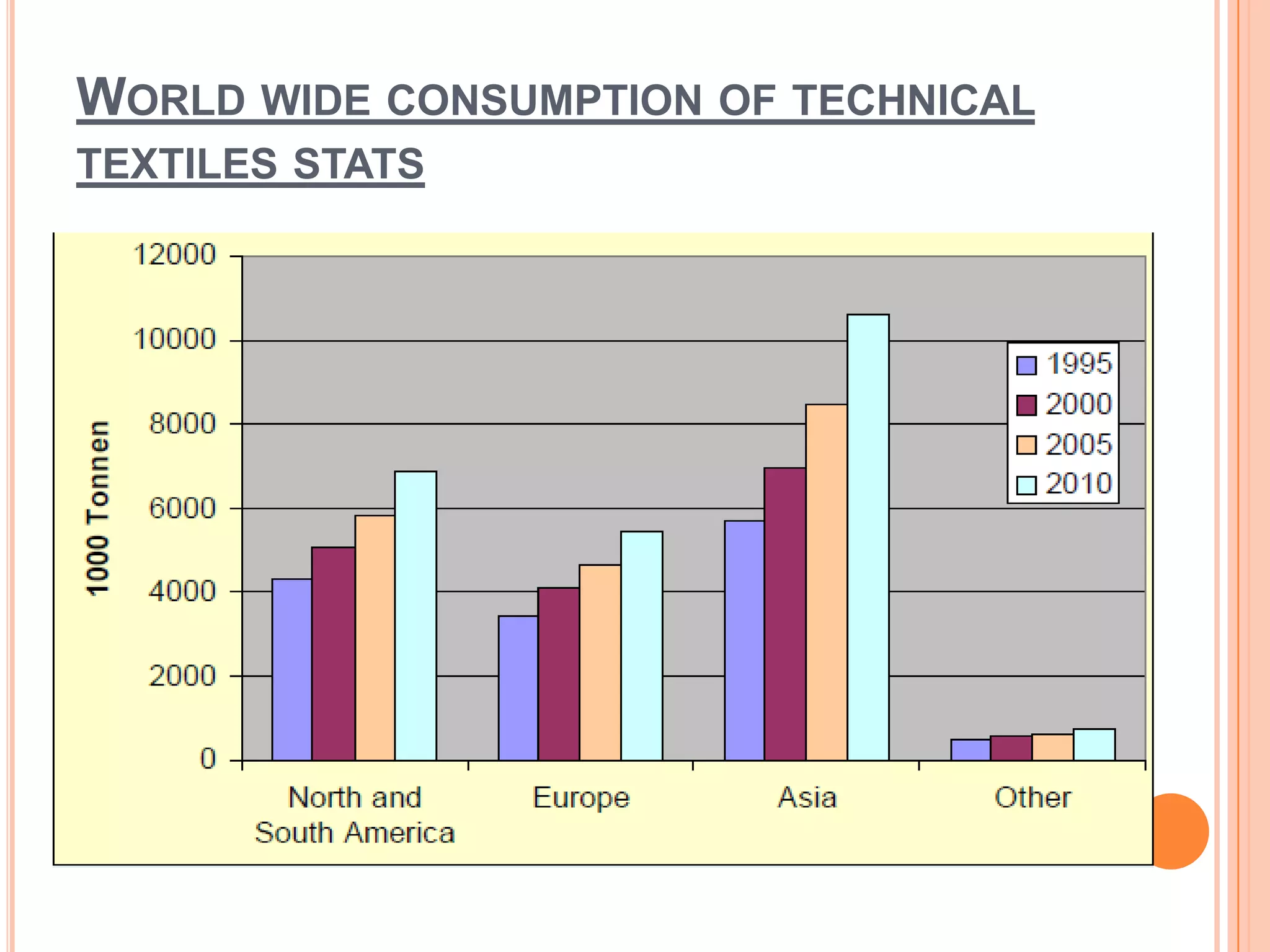
WORLD WIDE CONSUMPTION OF TECHNICAL
TEXTILES STATS
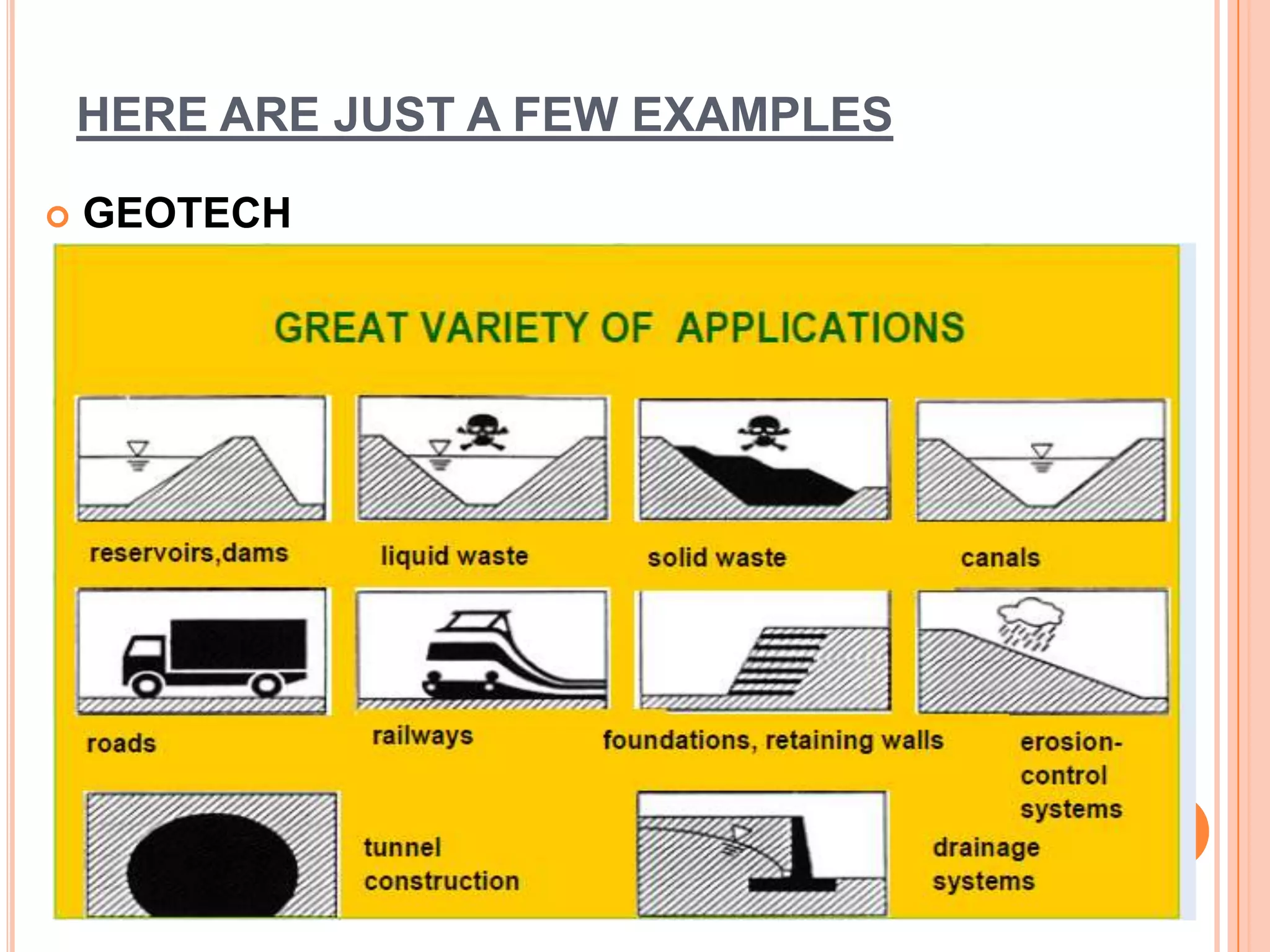
HERE ARE JUST A FEW EXAMPLES
 GEOTECH
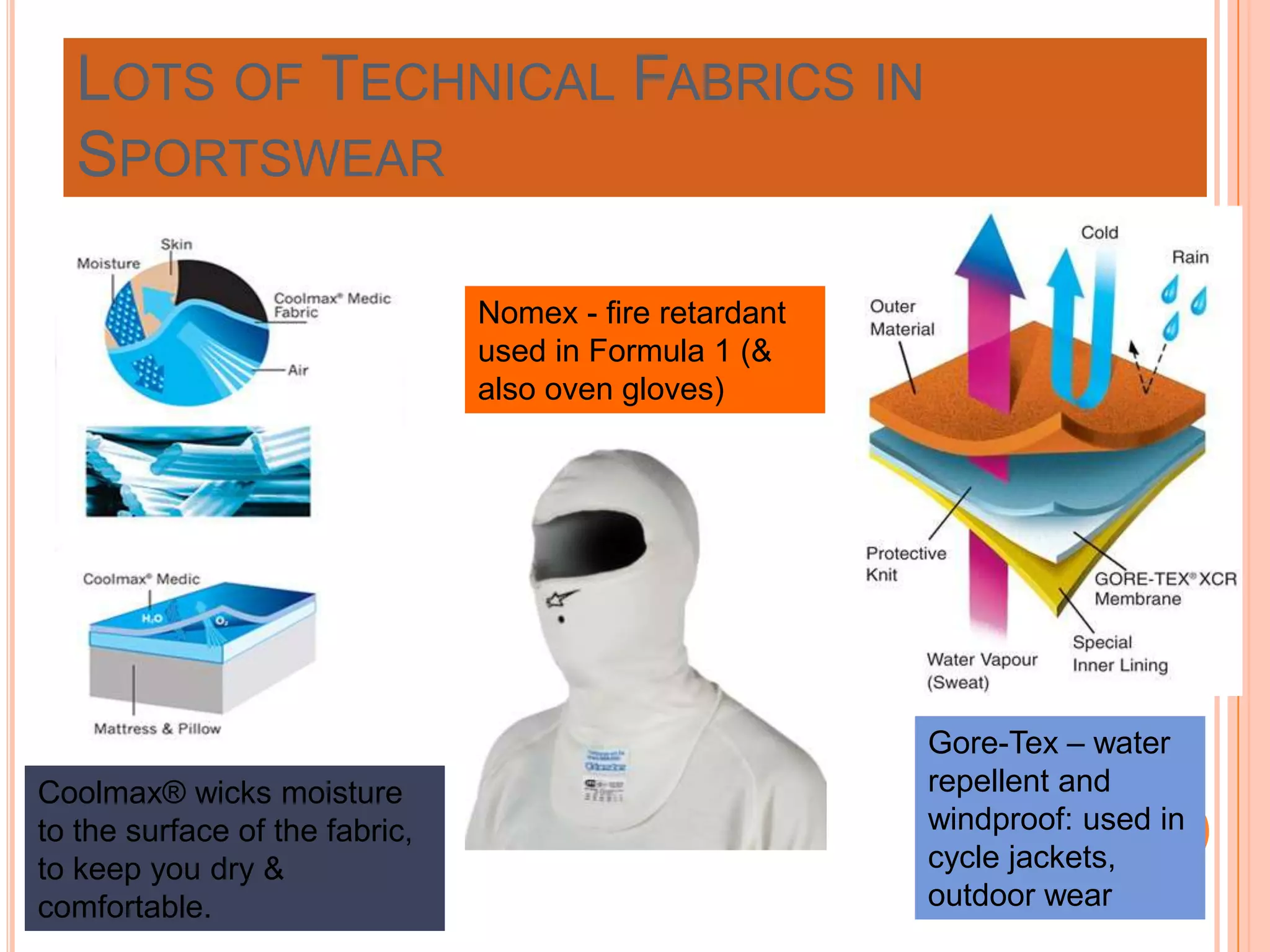
LOTS OF TECHNICAL FABRICS IN
SPORTSWEAR
Gore-Tex – water
repellent and
windproof: used in
cycle jackets,
outdoor wear
Nomex - fire retardant
used in Formula 1 (&
also oven gloves)
Coolmax® wicks moisture
to the surface of the fabric,
to keep you dry &
comfortable.
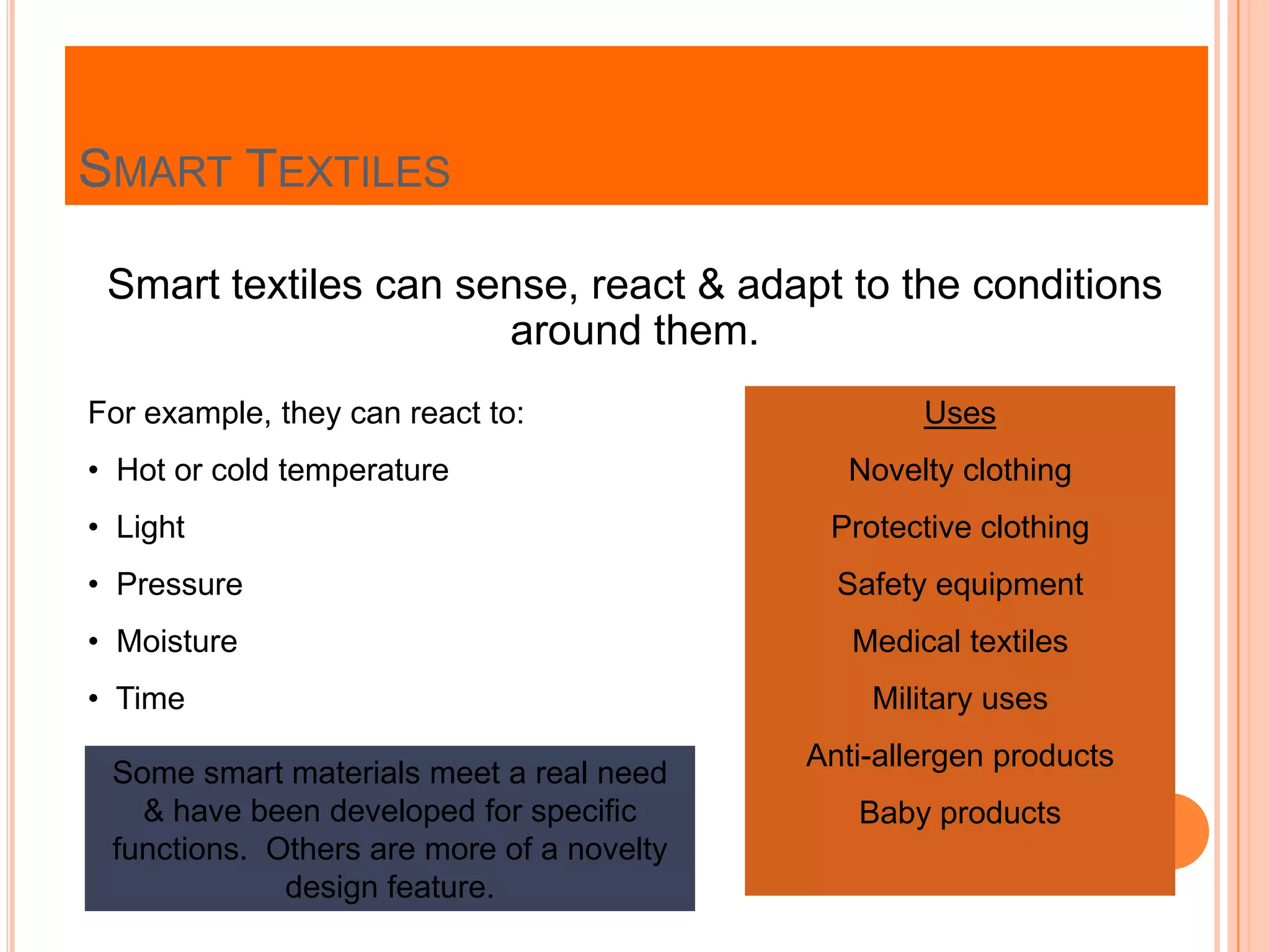
SMART TEXTILES
Smart textiles can sense, react & adapt to the conditions
around them.
For example, they can react to:
• Hot or cold temperature
• Light
• Pressure
• Moisture
• Time
Uses
Novelty clothing
Protective clothing
Safety equipment
Medical textiles
Military uses
Anti-allergen products
Baby products
Some smart materials meet a real need
& have been developed for specific
functions. Others are more of a novelty
design feature.
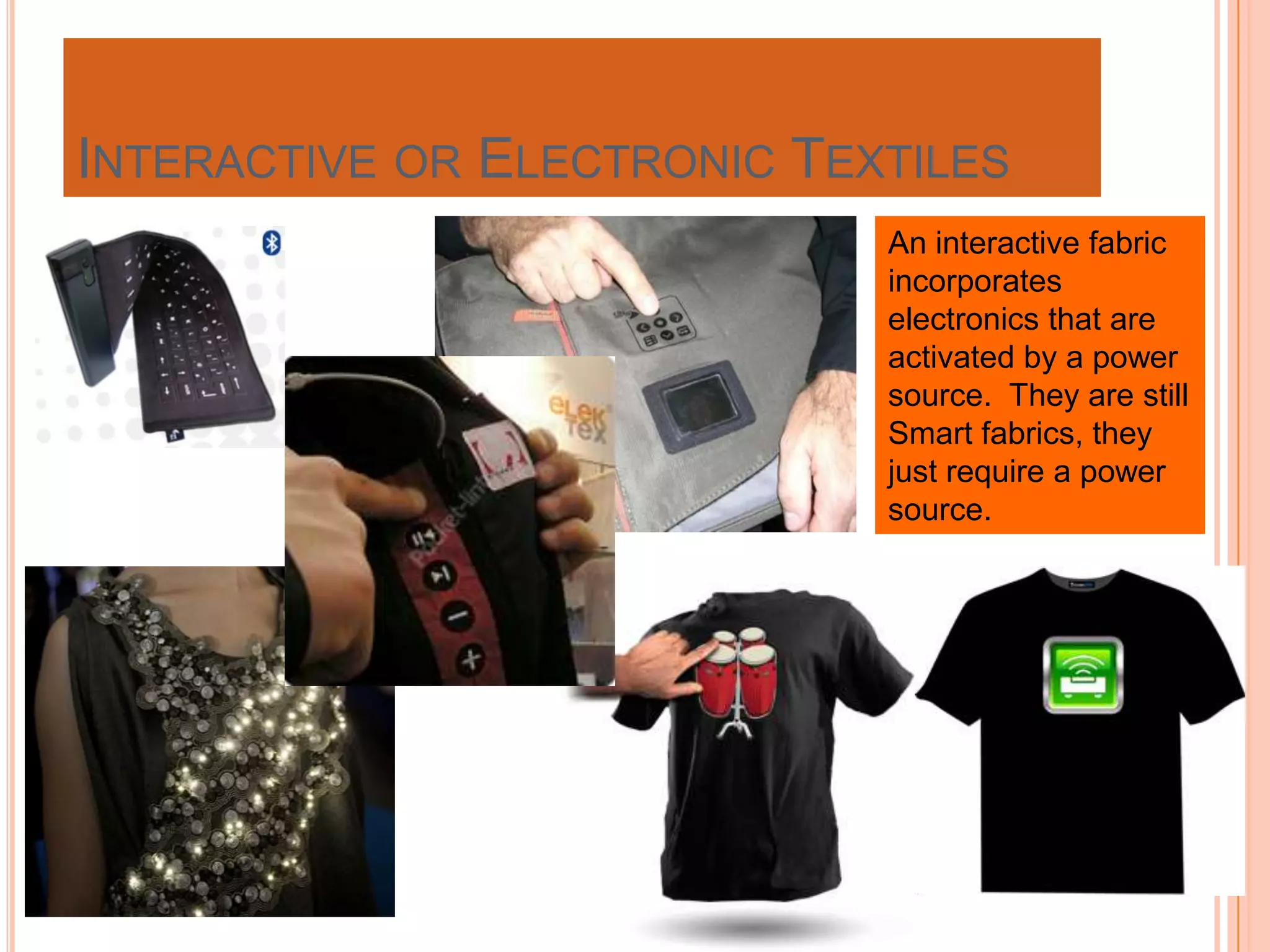
INTERACTIVE OR ELECTRONIC TEXTILES
An interactive fabric
incorporates
electronics that are
activated by a power
source. They are still
Smart fabrics, they
just require a power
source.
REFRENCES
 Man made textiles in India, may, 1997, p- 199-204.
 Hand book of industrial textiles ,ed. 1985, p-6.
 Indian textile journal , aug, 2006, p-72- 75.
 Man made textiles in India, july 2001.
 Seminar on technical textiles, SASMIRA, june 2001.
 Man made textiles in India, may, 1997, no.5 .
 Textile association of India, jan, 1998.
 Seminar on Geo-synthetics – emerging opportunities in
India, july, 2000.
 Man made textiles in India, march, 1998, p- 126-129.
 Indian textile journal, october, 1994, p- 82-86.
Introduction to technical textiles1

Introduction to technical textiles1

  • 1.
  • 2.
    INTRODUCTION  Technical Textiles(TT) offers new ways, means and opportunity to the Indian textile industry to sustain the present growth and thrive in near future. It would offer not only an opportunity for augment the growth, but also a new direction for advancement of the industry.  The field of technical textiles had not receive adequate importance in Indian context so far, however, it is a potential area where the textile industry can excel.  Traditional textiles today are unable to cope with cost of production for various reasons like fast technological obsolescence, high cost of modernization, power, etc.  Present product mix of traditional textiles are not remunerative enough and therefore, more and more ideas of value-addition to textile products is gaining momentum.  Technical textiles, in this context, are just perfect.
  • 3.
    DEFINITION  The technicaltextiles is defined as textile material and product manufactured primarily for their technical performance and functional properties rather than their aesthetic or decorative characteristics. OR  A Technical textile is a textile product manufactured for non-aesthetic purposes, where function is the primary criterion.  It is a large and growing sector and supports a vast array of other industries.
  • 4.
    HISTORY  Technical textiletouched its peak as soon as the manmade fibre was discovered in1900 AD , before that the only source was the natural fibres & it was treated with chemicals to make the same.  Simultaneously new technology such as special weaving process, nonwoven technique etc was developed to manufacture the technical textile.  In the last three hundred years, world has observed a fast growth in fiber production which has a very distinguished characteristics such as  High resistance to temperature  Stable under stress and strain  Strong enough to absorb impact of highly reactive chemicals etc.  Textile industry has created various products by using such fibres. The result of these efforts have enhanced the growth of industrial and technical textiles.
  • 5.
    INDUSTRIAL OR TECHNICALTEXTILES  Non-conventional textiles encompassing a wide spectrum of end-applications raised a debate as to whether the term industrial textiles used so far is appropriate to be continued, or it is time now that "industrial textiles" having specific meaning should include those products used as part of industrial processes or which are incorporated in some way into industrial products.  Textiles used for medicine, defence, agriculture, fishing, etc. do not attach any specific meaning to "industry" but for the age-old practice of using the term "industrial textiles".  Today, the term Technical Textiles has emerged as the most widely acceptable term for this expanding field of textile applications.
  • 6.
    INDIAN SCENARIO  Asystematic survey had been undertaken by Ministry of Textiles (MOT) to assess the progress of technical textiles in India. With this study, it is established that India is yet to find a significant place in the global scenario in this area.  Traditionally, Indian textile industry is composed of four sectors, viz., composite mill sector, decentralised powerloom , hosiery and handloom sectors. Indian textile industry was dominated by the composite mill sector in the post-independence period.  Technical textiles did never find a place of priority in this sector, though a few mills produced a limited range of industrial textiles in their product mix.
  • 7.
    A  However, facingstiff competition from the powerloom sector, gradually the composite mill sector suffered various set backs. Even in their revival effort, technical textiles did not find a strategic place as it deserved.  They still focused their priority in modernisation in conventional apparel and home textile products, yarn manufacturing etc.  So far, the contribution of Indian textile industry towards technical textiles was restricted to a few low technology and less sophisticated items like tarpaulin, industrial filter cloth, bolting cloth, textiles for luggage, tyre cords, belting etc.
  • 8.
    PRESENT SCENARIO OFTECHNICAL TEXTILES  India is the world second largest producer of textile and garments. The textile industry in India contributes 14 % towards the GDP of USD 1.18 billion. This market itself being so big, there is tremendous potential for technical textiles as well.  Currently the consumption of technical textiles in India forms only 3 % of the total world consumption; however, it is growing at a rate higher than most developed countries.  The reasons for low penetration in this market are several, such as scattered production structure, inadequate research and development (R&D), lack of skilled personnel.  Another major contributing factor is that there is lack of awareness about the benefits of using technical textile
  • 9.
    A • India stillhas to make its presence felt in the world technical textiles market, which earns that a highly unexploited market is waiting to be explored.
  • 10.
    MARKET SIZE OFINDIAN TECHNICAL TEXTILE INDUSTRY  Indian Technical Textile industry is estimated at Rs 41,756 Crore (2007-08), with domestic consumption of Rs. 38,835 Crore.  The Industry has witnessed a significant growth of 16% from 2001-02 to 2009-10 and, is expected to grow at a rate of 11% year-on-year and reach a market size of Rs. 70,151Crore by the year (2012-13), with domestic consumption of Rs. 65,722 by the year 2012-13.  Currently, approximately US $120 billion worth of Technical Textiles is consumed world over and in India it is just $6 billion.
  • 11.
    A  India isemerging as a significant player in technical textiles. The fast-paced economic growth leading to infrastructure creation as well as higher disposable income has made India a key market for the technical textile products.  Moreover, the country has developed a foothold in the production of technical textiles owing to its skilled and technical manpower as well as abundant availability of raw- material.
  • 12.
    GROWTH RATES FORCONSUMPTION OF TECHNICAL TEXTILE  This is expected growth rates and from the graph we can easily view out that India is having 12% of growth rate consumption, which is higher than other developed countries .
  • 13.
    TARGET IN NEXT10 YEARS  Strategy should be to fix up a target of 10% - 12% of global market in next 10 years. Accordingly, the planning should be made to ensure the inputs and to offer a congenial environment, both regulatory and fiscal, to achieve the target of almost about US $ 6-8 billion share in the global technical textile market in next 10 years or so.  To fulfil the social objectives of providing cheaper and efficient products like shelters, protective clothing etc. to the masses in the event of disasters like flood, draught, earthquake etc. Logistically, it will also be easier and convenient to position such products more speedily than conventional material.
  • 14.
    APPLICATION AREAS  Toidentify application areas with a strong potential in the domestic market, and which will in the long run, help exports.  Initially such items should be selected for which there exists know-how, production facilities, raw material etc. Such products may be on the lower end of technology but should have a big impact in terms of volume, value addition, etc.  It will create a favourable psychological impact and climate for future investment in more demanding products.  Indigenisation of value added products of relatively easier technology capable of quick assimilation should be aimed at the beginning. To develop technical textiles in high tech application of aerospace, defence, etc.
  • 15.
    RAW MATERIAL  Attemptsshould be made to use indigeneously available fibres - both natural and man made, for the technical textile products. However, it is not a deterrent to import of high performance fibres for specific products where volume is less.  To exploit the traditional eco-friendly natural fibres like cotton, jute, coir, hemp etc. by product diversification with value addition for medical textiles, agro textiles etc.
  • 16.
  • 17.
    WORLD WIDE CONSUMPTIONOF TECHNICAL TEXTILES STATS
  • 18.
    HERE ARE JUSTA FEW EXAMPLES  GEOTECH
  • 19.
    LOTS OF TECHNICALFABRICS IN SPORTSWEAR Gore-Tex – water repellent and windproof: used in cycle jackets, outdoor wear Nomex - fire retardant used in Formula 1 (& also oven gloves) Coolmax® wicks moisture to the surface of the fabric, to keep you dry & comfortable.
  • 20.
    SMART TEXTILES Smart textilescan sense, react & adapt to the conditions around them. For example, they can react to: • Hot or cold temperature • Light • Pressure • Moisture • Time Uses Novelty clothing Protective clothing Safety equipment Medical textiles Military uses Anti-allergen products Baby products Some smart materials meet a real need & have been developed for specific functions. Others are more of a novelty design feature.
  • 21.
    INTERACTIVE OR ELECTRONICTEXTILES An interactive fabric incorporates electronics that are activated by a power source. They are still Smart fabrics, they just require a power source.
  • 22.
    REFRENCES  Man madetextiles in India, may, 1997, p- 199-204.  Hand book of industrial textiles ,ed. 1985, p-6.  Indian textile journal , aug, 2006, p-72- 75.  Man made textiles in India, july 2001.  Seminar on technical textiles, SASMIRA, june 2001.  Man made textiles in India, may, 1997, no.5 .  Textile association of India, jan, 1998.  Seminar on Geo-synthetics – emerging opportunities in India, july, 2000.  Man made textiles in India, march, 1998, p- 126-129.  Indian textile journal, october, 1994, p- 82-86.