BY-
AMIT KUMAR
MONDAL
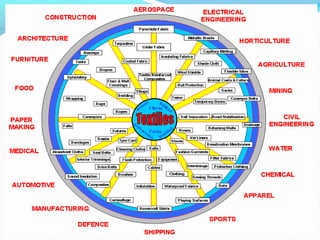
• Technical Textiles can be defined as -
“Textile material and products
manufactured primarily for their technical
performance and functional properties rather
than for aesthetic or decorative characteristic.”
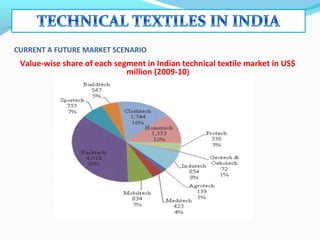
CURRENT A FUTURE MARKET SCENARIO
Value-wise share of each segment in Indian technical textile market in US$
million (2009-10)
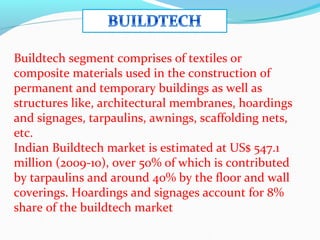
Buildtech segment comprises of textiles or
composite materials used in the construction of
permanent and temporary buildings as well as
structures like, architectural membranes, hoardings
and signages, tarpaulins, awnings, scaffolding nets,
etc.
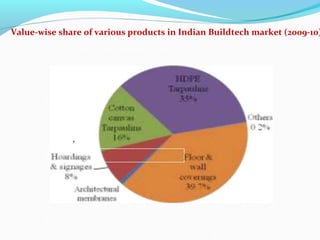
Indian Buildtech market is estimated at US$ 547.1
million (2009-10), over 50% of which is contributed
by tarpaulins and around 40% by the floor and wall
coverings. Hoardings and signages account for 8%
share of the buildtech market
Value-wise share of various products in Indian Buildtech market (2009-10)
High-strength, high-modulus textile fabrics are increasingly
being used in the Building and construction industry as a
replacement for more traditional materials , Such as wood,
concrete, masonry and steel. The mechanical properties of
fabrics made With aramid carbon and glass fibres , combined
with cross-linking resin systems to form a Composite, provide
civil engineers with a range of new materials that offer high
strength to weight, High stiffness to weight, and extreme
flexibility in design and used.
Fabrics for sun protection made of polyester and combined
with polyvinyl chloride (PVC) Or polytetrafluroethylene
(PTFE) coatings offer many applications and provide function
combined With design to modern architecture, where flexible
roofs and wall coverings are a feature.
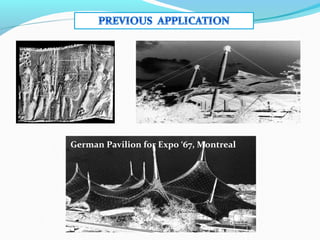
German Pavilion for Expo ‘67, Montreal
American Pavilion in Osaka Expo
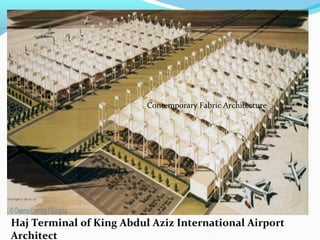
Haj Terminal of King Abdul Aziz International Airport
Architect
Contemporary Fabric Architecture
Technical textile in architecture and construction

Technical textile in architecture and construction

  • 1.
  • 2.
    • Technical Textilescan be defined as - “Textile material and products manufactured primarily for their technical performance and functional properties rather than for aesthetic or decorative characteristic.”
  • 4.
    CURRENT A FUTUREMARKET SCENARIO Value-wise share of each segment in Indian technical textile market in US$ million (2009-10)
  • 5.
    Buildtech segment comprisesof textiles or composite materials used in the construction of permanent and temporary buildings as well as structures like, architectural membranes, hoardings and signages, tarpaulins, awnings, scaffolding nets, etc. Indian Buildtech market is estimated at US$ 547.1 million (2009-10), over 50% of which is contributed by tarpaulins and around 40% by the floor and wall coverings. Hoardings and signages account for 8% share of the buildtech market
  • 6.
    Value-wise share ofvarious products in Indian Buildtech market (2009-10)
  • 7.
    High-strength, high-modulus textilefabrics are increasingly being used in the Building and construction industry as a replacement for more traditional materials , Such as wood, concrete, masonry and steel. The mechanical properties of fabrics made With aramid carbon and glass fibres , combined with cross-linking resin systems to form a Composite, provide civil engineers with a range of new materials that offer high strength to weight, High stiffness to weight, and extreme flexibility in design and used. Fabrics for sun protection made of polyester and combined with polyvinyl chloride (PVC) Or polytetrafluroethylene (PTFE) coatings offer many applications and provide function combined With design to modern architecture, where flexible roofs and wall coverings are a feature.
  • 8.
    German Pavilion forExpo ‘67, Montreal
  • 10.
  • 11.
    Haj Terminal ofKing Abdul Aziz International Airport Architect Contemporary Fabric Architecture