Team Building
By / Mahmoud Shaqria
‫شقريه‬ ‫محمد‬ ‫محمود‬
Outline:
1-Definitions of (Team ,Group , Teamwork ,Team player and
Team Building.
2-Stages in Team Building
3-Types of teams.
4- Advantages of Teams
5- Disadvantages of Teams
6-Characteristics of Effective Teams
7- Characteristics of ineffective Teams
8- Successful team building
9-Barriers to Team Communication
Definitions :
Team …
is a unit of two or more people who work
together to achieve a goal.
Group:
A collection of two or more interacting
individuals with a stable pattern of
relationships among them, who share
common goals and who perceive
themselves as being a group.
Teamwork
Concept of people working together as a team
Team player
A team player is someone who is able to get
along with their colleagues and work together in a
cohesive group
Team Building
Process of establishing and developing a greater
sense of collaboration and trust between
members
Team Building
It is a group that has spent some time together,
whether in smaller increments over a long
period of time, or by spending a weekend or
more working together on something.
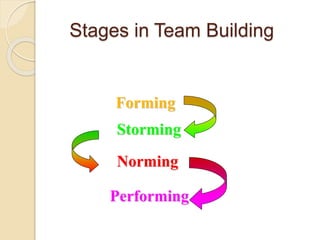
Stages in Team Building
Forming
Storming
Norming
Performing
Stage 1: FORMING
The Team
*defines the problem
*agrees on goals and formulates strategies for
tackling the tasks
*determines the challenges and identifies
information needed
*Individuals take on certain roles
*develops trust and communication
Team Roles - Leader
1-Encourages and maintains open
communication
2-Leads by setting a good example
3-Motivates and inspires team members
4-Helps the team focus on the task
5-Facilitates problem solving and collaboration
6-Maintains healthy group dynamics
7-Encourages creativity and risk-taking
8-Recognizes and celebrates team member
contributions
Other Team Roles – Members Can Formally or
Informally Take on These Roles
Initiator - Someone who suggests new ideas.
One or more people can have this role at a
time.
Recorder - This person records whatever
ideas a team member may have. It is
important that this person quote a team
member accurately and not "edit" or
evaluate them.
Devil's Advocate/Skeptic - This is someone
whose responsibility is to look for potential
flaws in an idea.
Optimist - This is someone who tries to maintain a
positive frame of mind and facilitates the search
for solutions.
Timekeeper - Someone who tracks time spent on
each portion of the meeting.
Gate Keeper - This person works to ensure that
each member gives input on an issue. One
strategy to do this is to ask everyone to voice
their opinion one at a time. Another is to cast
votes.
Summarizer - Someone who summarizes a list of
options
Stage 2: STORMING
During the Storming stage team
members:
*realize that the task is more difficult than they
imagined
*have fluctuations in attitude about chances of
success
*may be resistant to the task
*have poor collaboration
Stage 3: NORMING
*During this stage members accept:
_their team
_team rules and procedures
_their roles in the team
_the individuality of fellow members
*Team members realize that they are not
going to crash-and-burn and start helping
each other.
Behaviors
*Competitive relationships become more
cooperative.
*There is a willingness to confront
issues
and solve problems.
*Teams develop the ability to express
criticism constructively.
*There is a sense of team spirit.
Giving Constructive Feedback
•Be descriptive -- relate what you saw or heard the
other person do. Give specific recent examples
•Don’t use labels -- Be specific and unambiguous.
Don’t use words like immature, unprofessional,
irresponsible which are labels attached to behavior.
For example, say “ You missed the deadline we had
agreed to meet rather than, “You’re being irresponsible
and I want to know what you are going to do about it.
• Don’t exaggerate. Be exact. To say, “You’re always
late for deadlines” is probably untrue and unfair. It
invites the receiver to argue with exaggeration rather
than respond to real issue
• Don’t be judgmental. Don’t use words like good, better,
bad, worst or should which place you in the role of
controlling parent. This invites the receiver to respond
as a child.
• Speak for yourself. Don’t refer to absent, anonymous
people. Avoid references like “A lot of people here
don’t like it when you…” Encourage others to speak for
themselves
Receiving Feedback
*Listen carefully.
*Ask questions for clarity.
*Acknowledge the feedback.
*Acknowledge the valid points.
*Take time to sort out what you heard.
Stage 4: PERFORMING
Team members have:
*gained insight into personal and team
processes
*a better understanding of each other’s
strengths and weaknesses
*gained the ability to prevent or work through
group conflict and resolve differences
*developed a close attachment to the team
:Stage 5: Adjourning
*In the "adjourning" stage the project is
coming to an end and the team members
are moving off into different directions.
*This stage looks at the team from the
perspective of the well-being of the team
rather than from the perspective of
managing a team through the original four
stages of team growth.
*
Stage 6: Re-forming :
• Group celebrates achievements or
disbands & mourns loss of group
• Most groups reform when goals achieved,
new goals created or members & leaders
turn over
• Once group progresses thru stages,
subsequent team building goes faster
TYPES OF TEAMS:
1-Problem-Solving Teams:
These teams are formed for a temporary
period until a problem is solved, and then
they disband. Team members often
consist of one level of management.
2-Cross-Functional Teams:
This type of team is made up of members
from different areas of the business and
often from a common managerial level.
The Advantages of Teams:
1-Increased information and
knowledge
2-Increased diversity of views
3-Increased acceptance of a solution
4-Higher performance levels
5-Synergy & Creativity 22
the Disadvantages of Teams:
1-Unproductive, frustrating, or
2counterproductive
3-Hidden agendas
4-Free riders
23
Characteristics of Effective Teams
1. Clear vision or purpose
2. Shared commitment
3. Clear roles and responsibilities
4. Trust
5. Mutual accountability
6. Celebrate individual and team success
7. Concern for group tasks and process
8. Address challenges with creativity
9. Inclusive in decision making
10. Regular communication and feedback
Characteristics of ineffective Teams:
1-You cannot easily describe the team’s
mission.
2-The meetings are formal, stuffy, or
tense. People do not do their best in an
uncomfortable atmosphere.
3-There is a great deal of participation but
little accomplishment.
5-Disagreements are aired in private
conversations.
6-Decisions tend to be made by the formal
leader with little meaningful involvement of
other team members.
7-Members are not open with each other
because trust is low.
8-There is confusion or disagreement about
roles or work.
Successful team building
can:
1- coordinate the efforts of individuals as they tackle
complex tasks
2- make the most of expertise and knowledge which
might otherwise remain untapped
3-build on the complementary strengths of team members
to produce results which could not be achieved by
employees working individually
4-raise and sustain motivation and confidence as team
members feel supported and involved
5-encourage members to work together to generate
fresh ideas solve problems, and find new ways forward
6- help to break down communication barriers and
avoid unhealthy competition, rivalry and point-scoring
between departments
7-raise the level of individual and collective
empowerment
8- enhance engagement with and ownership of the task
in hand.
Barriers to Team Communication
1-Stress & Change
2-Direct vs. Indirect
3-Lack of Balanced Participation
4-Different Styles, Personalities,
Experiences
5-Conflict Adverse
6-Nobody’s Listening!
THANK YOU!

Team building

  • 1.
    Team Building By /Mahmoud Shaqria ‫شقريه‬ ‫محمد‬ ‫محمود‬
  • 2.
    Outline: 1-Definitions of (Team,Group , Teamwork ,Team player and Team Building. 2-Stages in Team Building 3-Types of teams. 4- Advantages of Teams 5- Disadvantages of Teams 6-Characteristics of Effective Teams 7- Characteristics of ineffective Teams 8- Successful team building 9-Barriers to Team Communication
  • 3.
    Definitions : Team … isa unit of two or more people who work together to achieve a goal. Group: A collection of two or more interacting individuals with a stable pattern of relationships among them, who share common goals and who perceive themselves as being a group.
  • 4.
    Teamwork Concept of peopleworking together as a team Team player A team player is someone who is able to get along with their colleagues and work together in a cohesive group Team Building Process of establishing and developing a greater sense of collaboration and trust between members
  • 5.
    Team Building It isa group that has spent some time together, whether in smaller increments over a long period of time, or by spending a weekend or more working together on something.
  • 6.
    Stages in TeamBuilding Forming Storming Norming Performing
  • 7.
    Stage 1: FORMING TheTeam *defines the problem *agrees on goals and formulates strategies for tackling the tasks *determines the challenges and identifies information needed *Individuals take on certain roles *develops trust and communication
  • 8.
    Team Roles -Leader 1-Encourages and maintains open communication 2-Leads by setting a good example 3-Motivates and inspires team members 4-Helps the team focus on the task 5-Facilitates problem solving and collaboration 6-Maintains healthy group dynamics 7-Encourages creativity and risk-taking 8-Recognizes and celebrates team member contributions
  • 9.
    Other Team Roles– Members Can Formally or Informally Take on These Roles Initiator - Someone who suggests new ideas. One or more people can have this role at a time. Recorder - This person records whatever ideas a team member may have. It is important that this person quote a team member accurately and not "edit" or evaluate them. Devil's Advocate/Skeptic - This is someone whose responsibility is to look for potential flaws in an idea.
  • 10.
    Optimist - Thisis someone who tries to maintain a positive frame of mind and facilitates the search for solutions. Timekeeper - Someone who tracks time spent on each portion of the meeting. Gate Keeper - This person works to ensure that each member gives input on an issue. One strategy to do this is to ask everyone to voice their opinion one at a time. Another is to cast votes. Summarizer - Someone who summarizes a list of options
  • 11.
    Stage 2: STORMING Duringthe Storming stage team members: *realize that the task is more difficult than they imagined *have fluctuations in attitude about chances of success *may be resistant to the task *have poor collaboration
  • 12.
    Stage 3: NORMING *Duringthis stage members accept: _their team _team rules and procedures _their roles in the team _the individuality of fellow members *Team members realize that they are not going to crash-and-burn and start helping each other.
  • 13.
    Behaviors *Competitive relationships becomemore cooperative. *There is a willingness to confront issues and solve problems. *Teams develop the ability to express criticism constructively. *There is a sense of team spirit.
  • 14.
    Giving Constructive Feedback •Bedescriptive -- relate what you saw or heard the other person do. Give specific recent examples •Don’t use labels -- Be specific and unambiguous. Don’t use words like immature, unprofessional, irresponsible which are labels attached to behavior. For example, say “ You missed the deadline we had agreed to meet rather than, “You’re being irresponsible and I want to know what you are going to do about it.
  • 15.
    • Don’t exaggerate.Be exact. To say, “You’re always late for deadlines” is probably untrue and unfair. It invites the receiver to argue with exaggeration rather than respond to real issue • Don’t be judgmental. Don’t use words like good, better, bad, worst or should which place you in the role of controlling parent. This invites the receiver to respond as a child. • Speak for yourself. Don’t refer to absent, anonymous people. Avoid references like “A lot of people here don’t like it when you…” Encourage others to speak for themselves
  • 16.
    Receiving Feedback *Listen carefully. *Askquestions for clarity. *Acknowledge the feedback. *Acknowledge the valid points. *Take time to sort out what you heard.
  • 17.
    Stage 4: PERFORMING Teammembers have: *gained insight into personal and team processes *a better understanding of each other’s strengths and weaknesses *gained the ability to prevent or work through group conflict and resolve differences *developed a close attachment to the team
  • 18.
    :Stage 5: Adjourning *Inthe "adjourning" stage the project is coming to an end and the team members are moving off into different directions. *This stage looks at the team from the perspective of the well-being of the team rather than from the perspective of managing a team through the original four stages of team growth. *
  • 19.
    Stage 6: Re-forming: • Group celebrates achievements or disbands & mourns loss of group • Most groups reform when goals achieved, new goals created or members & leaders turn over • Once group progresses thru stages, subsequent team building goes faster
  • 20.
    TYPES OF TEAMS: 1-Problem-SolvingTeams: These teams are formed for a temporary period until a problem is solved, and then they disband. Team members often consist of one level of management.
  • 21.
    2-Cross-Functional Teams: This typeof team is made up of members from different areas of the business and often from a common managerial level.
  • 22.
    The Advantages ofTeams: 1-Increased information and knowledge 2-Increased diversity of views 3-Increased acceptance of a solution 4-Higher performance levels 5-Synergy & Creativity 22
  • 23.
    the Disadvantages ofTeams: 1-Unproductive, frustrating, or 2counterproductive 3-Hidden agendas 4-Free riders 23
  • 24.
    Characteristics of EffectiveTeams 1. Clear vision or purpose 2. Shared commitment 3. Clear roles and responsibilities 4. Trust 5. Mutual accountability 6. Celebrate individual and team success 7. Concern for group tasks and process 8. Address challenges with creativity 9. Inclusive in decision making 10. Regular communication and feedback
  • 25.
    Characteristics of ineffectiveTeams: 1-You cannot easily describe the team’s mission. 2-The meetings are formal, stuffy, or tense. People do not do their best in an uncomfortable atmosphere. 3-There is a great deal of participation but little accomplishment.
  • 26.
    5-Disagreements are airedin private conversations. 6-Decisions tend to be made by the formal leader with little meaningful involvement of other team members. 7-Members are not open with each other because trust is low. 8-There is confusion or disagreement about roles or work.
  • 27.
    Successful team building can: 1-coordinate the efforts of individuals as they tackle complex tasks 2- make the most of expertise and knowledge which might otherwise remain untapped 3-build on the complementary strengths of team members to produce results which could not be achieved by employees working individually
  • 28.
    4-raise and sustainmotivation and confidence as team members feel supported and involved 5-encourage members to work together to generate fresh ideas solve problems, and find new ways forward 6- help to break down communication barriers and avoid unhealthy competition, rivalry and point-scoring between departments 7-raise the level of individual and collective empowerment 8- enhance engagement with and ownership of the task in hand.
  • 29.
    Barriers to TeamCommunication 1-Stress & Change 2-Direct vs. Indirect 3-Lack of Balanced Participation 4-Different Styles, Personalities, Experiences 5-Conflict Adverse 6-Nobody’s Listening!
  • 30.