Introduction to Online
Teaching and Learning
Jason Rhode
Faculty Development and
Instructional Design Center
Overview

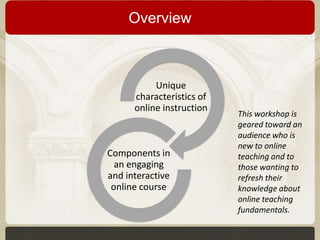
Unique
characteristics of
online instruction

Components in
an engaging
and interactive
online course

This workshop is
geared toward an
audience who is
new to online
teaching and to
those wanting to
refresh their
knowledge about
online teaching
fundamentals.
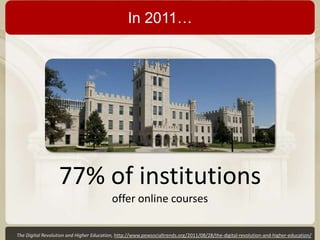
In 2011…

77% of institutions
offer online courses
The Digital Revolution and Higher Education, http://www.pewsocialtrends.org/2011/08/28/the-digital-revolution-and-higher-education/
6.7 Million students

Photo credit: flickr.com/photos/thirdworld/6284678180/

In 2012…

were enrolled in at least one online course
Allen & Seamen, 2013, http://www.onlinelearningsurvey.com/reports/changingcourse.pdf
32% of students

Photo credit: flickr.com/photos/thirdworld/6284678180/

In 2012…

were enrolled in at least one online course
Allen & Seamen, 2013, http://www.onlinelearningsurvey.com/reports/changingcourse.pdf
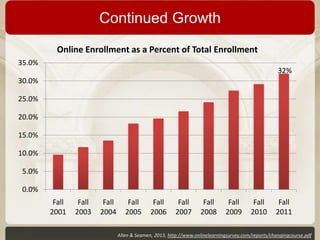
Continued Growth
Online Enrollment as a Percent of Total Enrollment
35.0%

32%

30.0%
25.0%
20.0%
15.0%
10.0%
5.0%
0.0%
Fall
2001

Fall
2003

Fall
2004

Fall
2005

Fall
2006

Fall
2007

Fall
2008

Fall
2009

Fall
2010

Fall
2011

Allen & Seamen, 2013, http://www.onlinelearningsurvey.com/reports/changingcourse.pdf
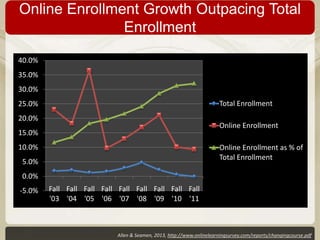
Online Enrollment Growth Outpacing Total
Enrollment
40.0%

35.0%
30.0%
Total Enrollment

25.0%
20.0%

Online Enrollment

15.0%
10.0%

Online Enrollment as % of
Total Enrollment

5.0%
0.0%
-5.0%

Fall Fall Fall Fall Fall Fall Fall Fall Fall
'03 '04 '05 '06 '07 '08 '09 '10 '11

Allen & Seamen, 2013, http://www.onlinelearningsurvey.com/reports/changingcourse.pdf
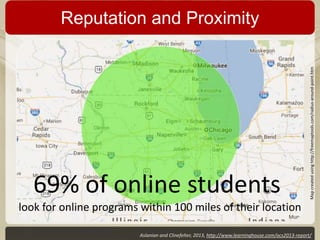
69% of online students

Map created using http://freemaptools.com/radius-around-point.htm

Reputation and Proximity

look for online programs within 100 miles of their location
Aslanian and Clinefelter, 2013, http://www.learninghouse.com/ocs2013-report/
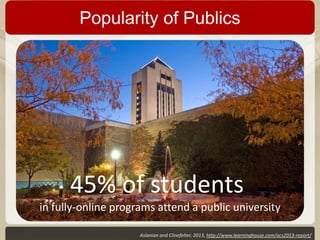
Popularity of Publics

45% of students
in fully-online programs attend a public university
Aslanian and Clinefelter, 2013, http://www.learninghouse.com/ocs2013-report/
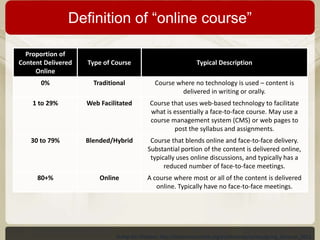
Definition of “online course”
Proportion of
Content Delivered
Online

Type of Course

Typical Description

0%

Traditional

Course where no technology is used – content is
delivered in writing or orally.

1 to 29%

Web Facilitated

Course that uses web-based technology to facilitate
what is essentially a face-to-face course. May use a
course management system (CMS) or web pages to
post the syllabus and assignments.

30 to 79%

Blended/Hybrid

Course that blends online and face-to-face delivery.
Substantial portion of the content is delivered online,
typically uses online discussions, and typically has a
reduced number of face-to-face meetings.

80+%

Online

A course where most or all of the content is delivered
online. Typically have no face-to-face meetings.

Going the Distance, http://sloanconsortium.org/publications/survey/going_distance_2011
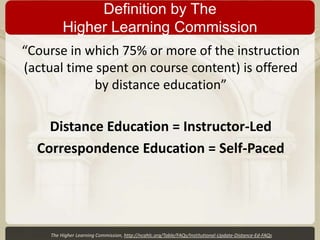
Definition by The
Higher Learning Commission
“Course in which 75% or more of the instruction
(actual time spent on course content) is offered
by distance education”

Distance Education = Instructor-Led
Correspondence Education = Self-Paced

The Higher Learning Commission, http://ncahlc.org/Table/FAQs/Institutional-Update-Distance-Ed-FAQs
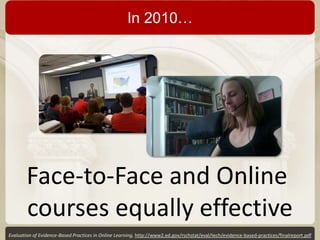
In 2010…

Face-to-Face and Online
courses equally effective
Evaluation of Evidence-Based Practices in Online Learning, http://www2.ed.gov/rschstat/eval/tech/evidence-based-practices/finalreport.pdf
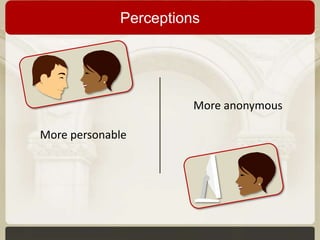
Perceptions

More anonymous

More personable
Perceptions

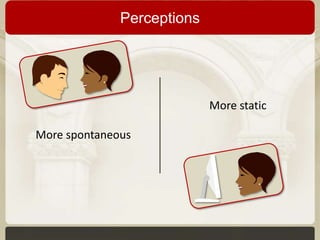
More static

More spontaneous
Perceptions

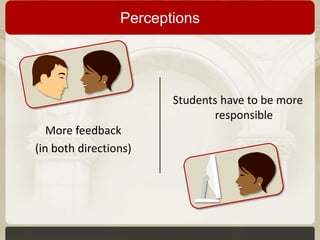
Students have to be more
responsible
More feedback
(in both directions)
Perceptions

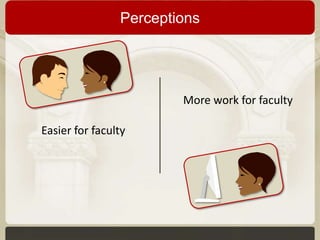
More work for faculty
Easier for faculty
Initial Considerations
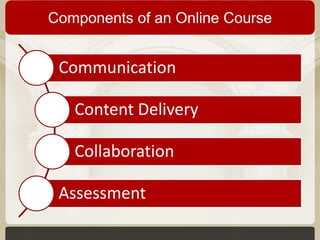
Components of an
online course

s
Components of an Online Course

Communication
Content Delivery
Collaboration

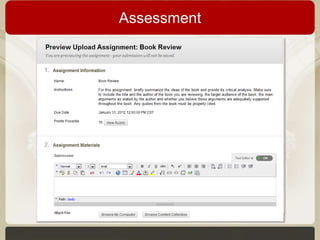
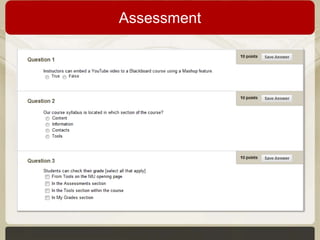
Assessment
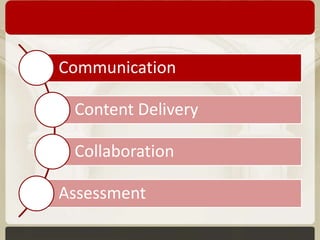
Communication
Content Delivery
Collaboration

Assessment
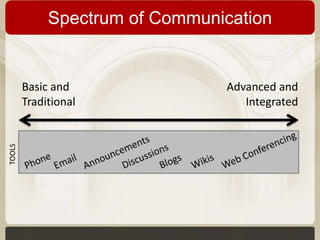
Spectrum of Communication

TOOLS

Basic and
Traditional

Advanced and
Integrated
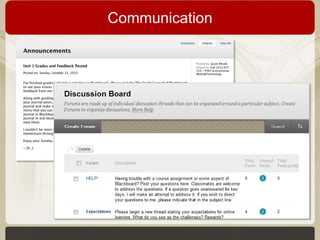
Communication
Communication
Communication
Communication
Content Delivery
Collaboration

Assessment
Content Delivery
Content Delivery
Content Delivery
Content Delivery
Content Delivery
Communication
Content Delivery
Collaboration

Assessment
Collaboration
Collaboration
Communication
Content Delivery
Collaboration

Assessment
Assessment
Assessment
Designing an Online
Course

s
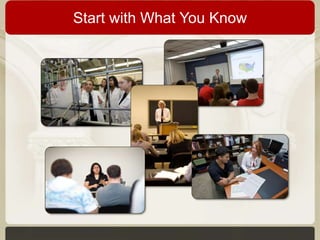
Start with What You Know
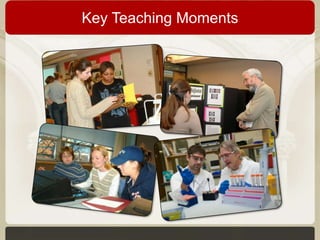
Key Teaching Moments
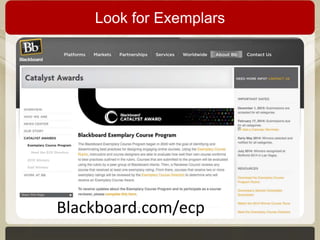
Look for Exemplars

Blackboard.com/ecp
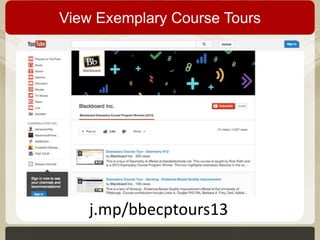
View Exemplary Course Tours

j.mp/bbecptours13
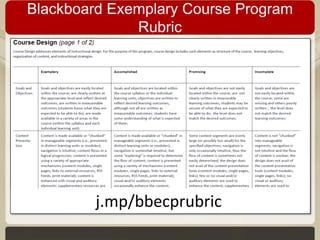
Blackboard Exemplary Course Program
Rubric

j.mp/bbecprubric
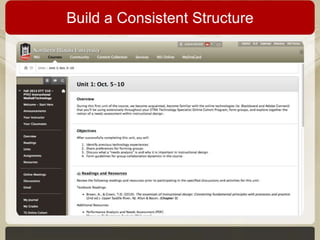
Build a Consistent Structure
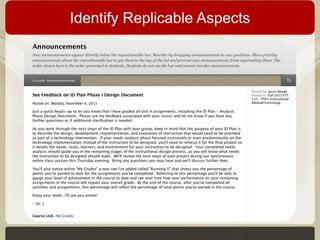
Identify Replicable Aspects
Teaching an Online
Course

s
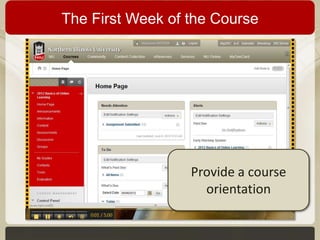
The First Week of the Course

Provide a course
orientation
The First Week of the Course

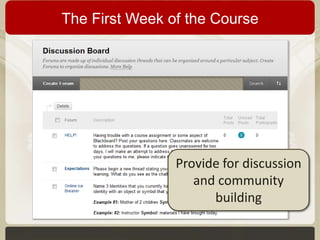
Provide for discussion
and community
building
The First Week of the Course
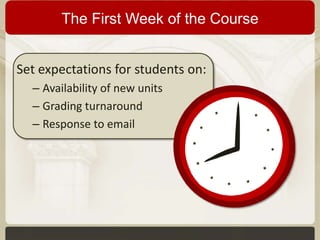
Set expectations for students on:
– Availability of new units
– Grading turnaround
– Response to email
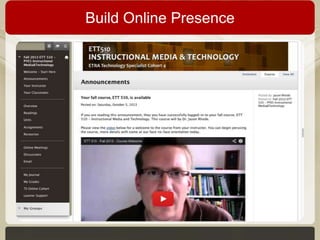
Build Online Presence
During the Course

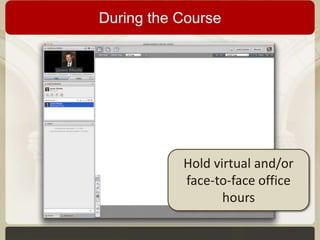
Hold virtual and/or
face-to-face office
hours
During the Course

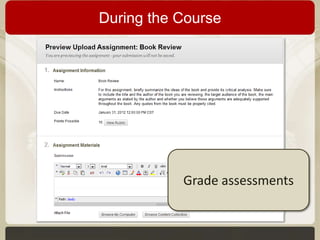
Grade assessments
During the Course

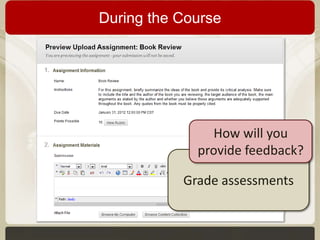
How will you
provide feedback?
Grade assessments
During the Course

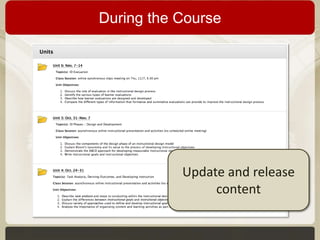
Update and release
content
The End of the Course

Reflect on the course
content, interactions, and
assessment
Plan updates for
the next semester
Enjoy the experience
of teaching online

s
Resources
• Allen, I. E., & Seaman, J. (2013). Changing course: Ten years of tracking
online education in the United States. Babson Survey Research Group and
Quahog Research Group, LLC. Retrieved from
http://sloanconsortium.org/publications/survey/changing_course_2012
• Aslanian, C. B., & Clinefelter, D. L. (2013). Online college students 2013:
Comprehensive data on demands and preferences. Louisville, KY: The
Learning House, Inc. Retrieved from
http://www.learninghouse.com/ocs2013-report/
• Eduventures, Inc. (2012). Online higher education market update 2012/13:
Executive summary. Retrieved from
http://www.eduventures.com/insights/online-higher-education-marketupdate/download/
• Fink, L. D. (2003). Creating significant learning experiences: An integrated
approach to designing college courses. San Francisco, CA: Jossey-Bass.
• Illinois Online Network (2007). Instructional Design.
www.ion.uillinois.edu/resources/tutorials/id/index.asp
• Minnesota State Colleges and Universities. (2007). Getting Started Online:
Advantages, Disadvantages and How to Begin. vfc.
• University of Central Florida (2008). Teaching Online.
h.ucf.eduproject.mnscu.edu
Questions?
Contact Me

Jason Rhode
Email: jrhode@niu.edu
Phone: 815.753.2475
Twitter: @jrhode

Introduction to Online Teaching and Learning

Editor's Notes

  • #3 It is important to begin planning online courses early because teaching in the online environment involves principles and practices different from those used in traditional face-to-face instruction. This workshop is a great opportunity to get started on an online course for the spring semester. In this session, we will introduce the unique characteristics of online instruction and provide an overview of the components in an engaging and interactive online course. This workshop is geared toward an audience who is new to online teaching and to those wanting to refresh their knowledge about online teaching fundamentals.
  • #7 The growth in online enrollment has been steady over the past decade. In the first year of this same study (2002), slightly less than 10 percent of all higher education students in the U.S.took an online course. That proportion has continued its steady increase over this nine-year time span, having grown to 32 percent of total U.S. higher education enrollment in 2011.
  • #8 The rate of online enrollment growth has consistently and dramatically outpaced total enrollment growth in U.S. higher education during the past decade. The bottom line in this chart depicts the annual growth rate of total enrollment in U.S. higher education, averaging just over 2 percent during the 9 years from 2003 to 2011. During this same time period, online enrollment grew an average of 18.5 percent and online enrollment as a percentage of total enrollment grew steadily as a result. Online courses are steadily becoming a larger proportion of all courses offered by higher education institutions today.
  • #11 There are established definitions for what constitutes an online course. For example, the Sloan Consortium, a leading organization committed to quality education online, has formalized the definition for an online course as being a course where 80+% of the content is delivered online, typically having no face-to-face meetings. Other variations of “online” may include “blended” or “hybrid” courses that blend online and face-to-face delivery, as well as “web facilitated” courses that use web-based technology such as a course management system (CMS) to facilitate what is essentially a face-to-face course.
  • #12 Online courses are also at times referred to as “distance education courses.” For example, the Higher Learning Commission refers to online courses as “distance education courses” and differentiates them from “correspondence education courses” which are self-paced. The Commission defines a distance education course as one in which 75% or more of the instruction (meaning, actual time spent on course content) is offered by distance education. The Commission therefore defines distance education courses as being instructor-led, drawing the distinction between correspondence education courses as being self-paced.Online courses have indeed been recognized as unique and increasingly popular modes for instruction, distinct from face-to-face or other education delivery methods.
  • #13 This perception that online courses are not as effective as face-to-face courses persists despite evidence to the contrary. A 2010 meta-analysis commissioned by the US Department of Education of 45 quantitative studies comparing online and face-to-face instruction found no significant difference in learning outcomes based on how the students received instruction.
  • #14 In my discussions with faculty, I have found many perceptions that faculty bring to online teaching. I think the most common perceptions have to do with communication in an online course. Generally, I think faculty who are new to online teaching feel that online courses are anonymous and distant, where face-to-face can be more personable and friendly. I hear concerns frequently about not being able to see students’ reactions through body language and facial expressions, so faculty assume that online courses will mean they are less connected with their students. The corollary to this, of course, is that the lack of connection means that students will struggle more and learn less. This really isn’t true. Some students will definitely be less talkative and less connected in an online course. But many faculty find they actually know their students better in an online course. To be successful, students must
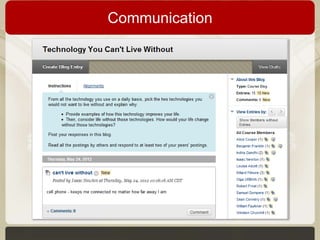
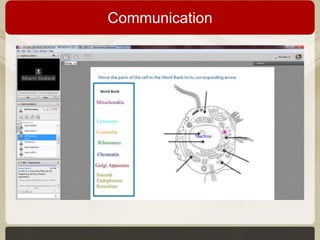
  • #30 The first common component of an online course is communication. In fact, communication is possibly one of the most important components in an online course, since you won’t be meeting face-to-face for the majority, or perhaps entirety, of your course. There are indeed many different communication approaches and available tools for facilitating communication, varying from more traditional and basic communication tools such as phone and email to more sophisticated and integrated communication tools within the learning management system, such as announcements and discussions, blogs, wikis, and web conferencing.
  • #31 Some communication tools may look familiar, like announcements or discussion boards, since you may use these already. Announcements and discussion boards are both great for asynchronous communications as they allow for communications between faculty and students that can be viewed and responded to at any time.
  • #32 A variety of other communication tools are available and integrated into the course management system, like blogs or journals, that offer more collaborative features and can be used to build a stronger sense of community within an online course.
  • #33 Furthermore, you may also choose to use more advanced communication tools, like web conferencing, to have live discussions or debates.
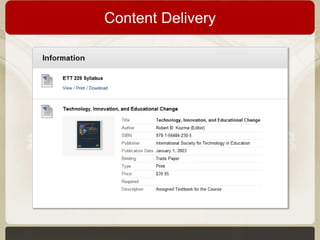
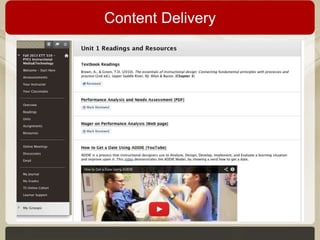
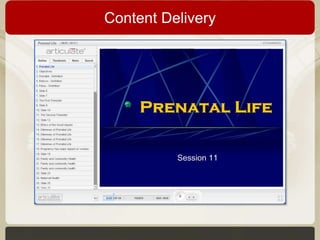
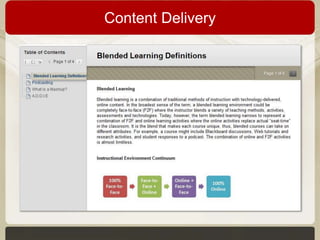
  • #35 The second common component of an online course is content delivery. In your online course, you will need to find methods to present content. A textbook can still be a primary content source, but you will need to find ways to present additional information.
  • #37 Narrated presentations and tutorials are great tools to create online lectures. You can either use a PowerPoint presentation as a base, like this example, or create a screencast that can record anything on your computer screen. Because these can incorporate audio, they give students a sense of your presence in the course and make it seem more personal.
  • #38 You should also consider other web resources that can support your content, like videos, photos, and podcasts.
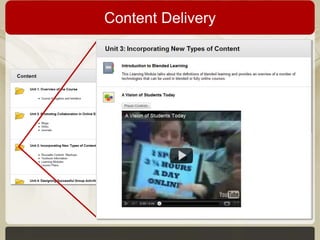
  • #39 As you build your content online, it’s important to create a logical structure so that students can see the connection between resources. You can also use a series of folders or more advanced tools, like this Learning Module that is available in Blackboard.
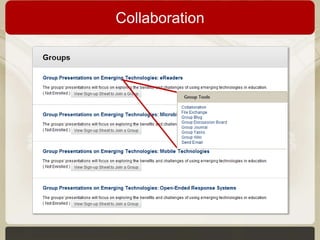
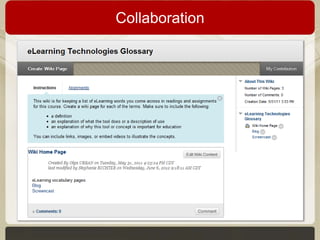
  • #40 The third common component of an online course is collaboration. Beyond just communicating with your students and delivering instructional content for them, you may choose to further engage students in the learning process through other collaborative activities.
  • #41 It is certainlypossible for students to collaborate with one another in an online course. Students can be organized into groups and use email, discussion boards, blogs, wikis, or web conferencing to work together as they learn.
  • #43 The fourth common component of an online course is assessment. In the same way that you assess student learning and achievement of course objectives in a face-to-face course, there are a wide variety of approaches for assessing students in an online course. While it can be challenging online to replicate objective true/false and multiple choice tests online as students often will use the textbook, their notes, and web resources when taking an online test, supplementing or replacing multiple-choice tests with more open-ended assessments, like research papers, discussions, media projects, or reflection logs can effectively be used to assess online student learning.
  • #51 Blackboard’s Exemplary Course Program recognizes courses that demonstrate excellence in course design, interaction & collaboration, assessment, and learner support. The exemplary course rubric is used by volunteer course reviewers to rate nominated courses. The rubric is comprehensive and offers valuable tips for improving the design of an online course. The Blackboard Exemplary Course Rubric is available in the Supplementary Readings area of this module.