TEACHING WITH  BrazTESOL 2010 July 21st, 2010
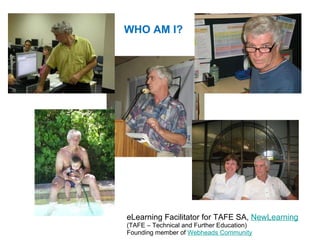
WHO AM I? eLearning Facilitator for TAFE SA,  NewLearning (TAFE – Technical and Further Education) Founding member of  Webheads Community
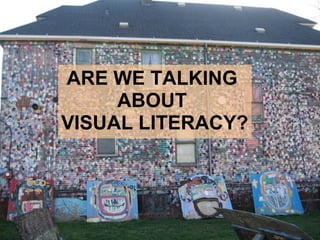
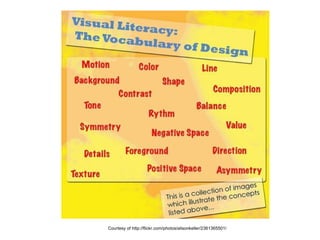
ARE WE TALKING  ABOUT  VISUAL LITERACY?
Courtesy of http://flickr.com/photos/alisonkeller/2361365501/
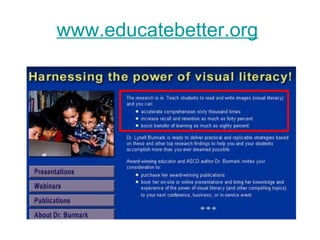
www.educatebetter.org
Visual Literacy: Wikipedia the ability to  interpret , negotiate, and make meaning from information presented in the form of an  image . Visual literacy is based on the idea that  pictures  can be “read” and that meaning can be communicated through a process of reading.  The term first used in 1969  because multiple disciplines such as  education ,  art history  and  criticism ,  rhetoric ,  semiotics ,  philosophy ,  information design , and  graphic design  make use of the term visual literacy,  arriving at a common definition of visual literacy has been contested Commonly refers to the ability to read eg graphs, colour coded diagrams, tables, flow charts, etc  many educators in the twenty-first century promote the learning of visual literacies as indispensable to life in the  information age . …  educators are recognizing the importance of helping students develop visual literacies in order to survive and communicate in a highly complex world .  Kress et al: linguistic and visual literacies complement each other I suspect that in our context as ’21stcentury educators’ we are referring to a subset of multiliteracy, or digital literacy, and the term visual literacy might best be avoided, or at least used with caution.
 
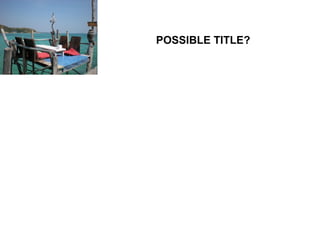
POSSIBLE TITLE?
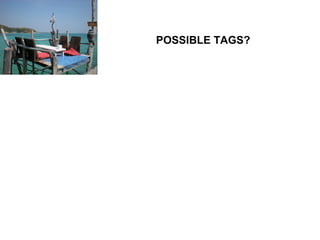
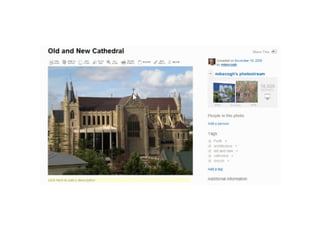
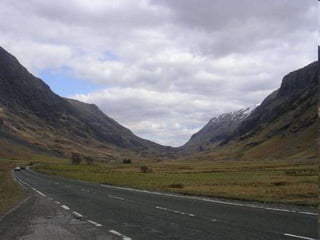
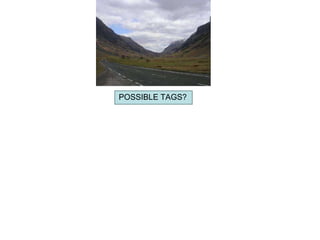
POSSIBLE TAGS?
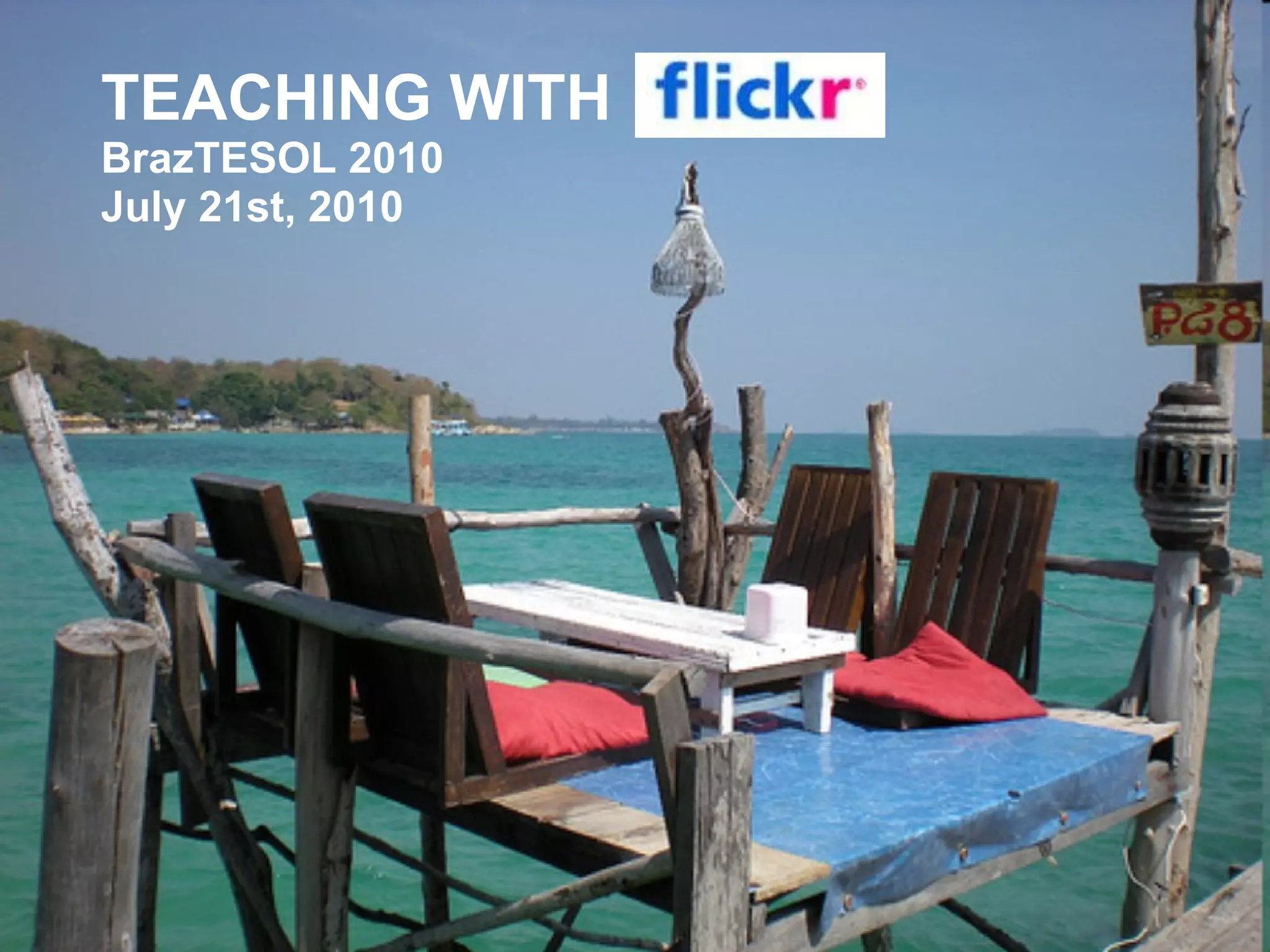
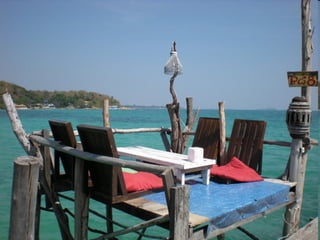
Title:  Public Privacy Tags: Thailand, Koh Samet, jetty, pier, sea, privacy
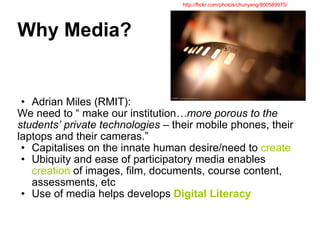
Why Media? Adrian Miles (RMIT): We need to “ make our institution …more porous to the students’ private technologies  – their mobile phones, their laptops and their cameras.” Capitalises on the innate human desire/need to  create Ubiquity and ease of participatory media enables  creation  of images, film, documents, course content, assessments, etc Use of media helps develops  Digital Literacy http://flickr.com/photos/chunyang/800589975/
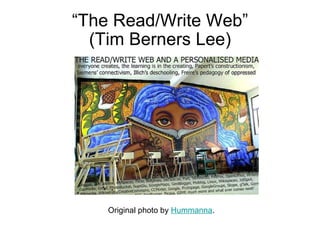
“ The Read/Write Web” (Tim Berners Lee) Original photo by  Hummanna .
My  Experience  with  Flickr Background courtesy of http://flickr.com/photos/andrearusky/2240595375/
Using Flickr Repository Convenience Would anyone else look at them? Photographic Journal/Blog Background courtesy of http://flickr.com/photos/andrearusky/2538222041/in/set-72157606561568609/
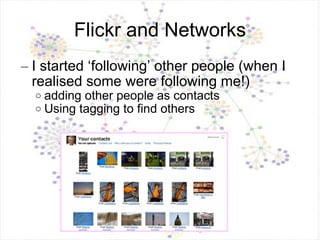
Flickr and Networks I started ‘following’ other people (when I realised some were following me!) adding other people as contacts Using tagging to find others
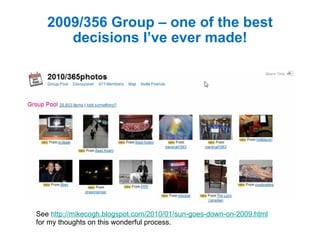
2009/356 Group – one of the best decisions I’ve ever made! See  http://mikecogh.blogspot.com/2010/01/sun-goes-down-on-2009.html for my thoughts on this wonderful process.
DIGITAL LITERACY Naming, Describing, Tagging Adds value to your image Easier to find (for you and others) Becomes part of a body of  organised  knowledge Background: http://flickr.com/photos/andrearusky/2736194440/in/set-72157606561568609/
 
 
POSSIBLE TAGS?
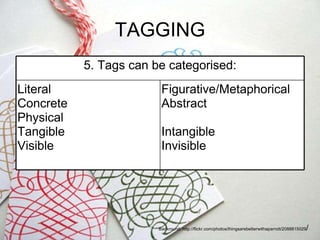
TAGGING 5. Tags can be categorised: Literal Concrete Physical Tangible Visible Figurative/Metaphorical Abstract Intangible Invisible Backround: http://flickr.com/photos/thingsarebetterwithaparrott/2088815029 /
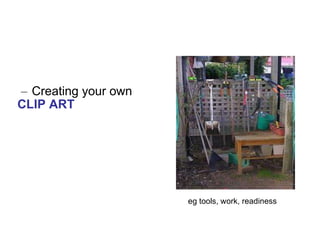
Creating your own  CLIP ART eg tools, work, readiness
Image from http://flickr.com/photos/aaronescobar/2633772161/ 7.  DOCUMENTING  THE  PLANET!
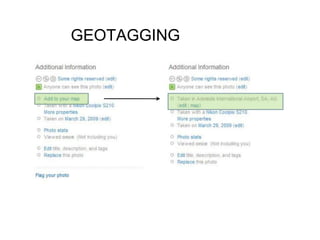
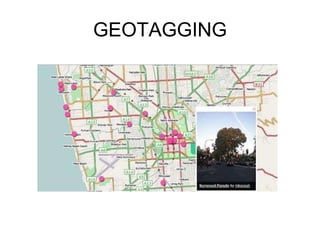
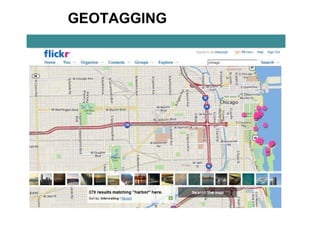
Image from http://flickr.com/photos/aaronescobar/2633772161/ 7.  DOCUMENTING  THE  PLANET! GEOTAGGING
GEOTAGGING
Image from http://flickr.com/photos/aaronescobar/2633772161/ 7.  DOCUMENTING  THE  PLANET! GEOTAGGING
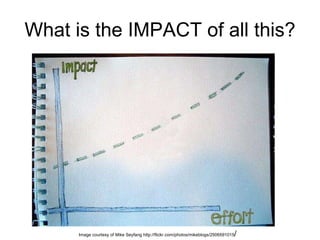
What is the IMPACT of all this? Image courtesy of Mike Seyfang http://flickr.com/photos/mikeblogs/2506591015 /
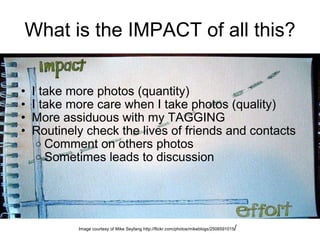
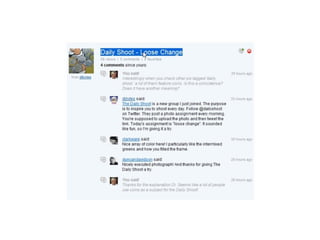
What is the IMPACT of all this? I take more photos (quantity) I take more care when I take photos (quality) More assiduous with my TAGGING Routinely check the lives of friends and contacts Comment on others photos Sometimes leads to discussion Image courtesy of Mike Seyfang http://flickr.com/photos/mikeblogs/2506591015 /
 
http://teachingwithflickr.wikispaces.com/
PHOTOS IN THE CLASSROOM Dennisinphoenix  says:  Photos—individual ones, pairs, collages—make wonderful prompts for any kind of discussion or writing project in which there's a focus on impressions, conclusions, comparisons, descriptions, and reflections. Photos can be the basis for activities which are highly directed (such as an exercise focusing on a particular grammar point or an argument pro, con, or in-between) or only suggestive (e.g., looking at a photo, thinking about it, and then using one's own words to make a conclusion, invent a story, give an opinion, write a reflection, guess a location, describe / explain how a photo makes one feel, and much more). Photos and graphics are much more engaging than relying solely on written or oral directions…  Background courtesy of http://flickr.com/photos/epzibah/273262048/
THE BIG CHANGE : We can now all create and supply media from our own lives for use in educational contexts Ease of production; ease of access Quality of product (not photocopied, or via overhead projector) Frees teachers and students from reliance on published texts/mainstream media for source materials Personalises  the educational experience
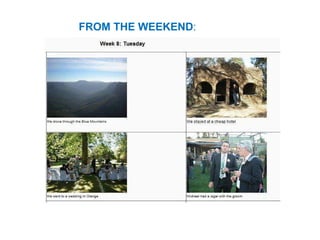
FROM THE WEEKEND :
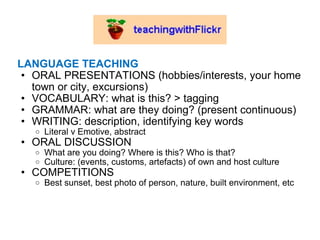
LANGUAGE TEACHING ORAL PRESENTATIONS (hobbies/interests, your home town or city, excursions) VOCABULARY: what is this? > tagging  GRAMMAR: what are they doing? (present continuous) WRITING: description, identifying key words Literal v Emotive, abstract  ORAL DISCUSSION What are you doing? Where is this? Who is that?  Culture: (events, customs, artefacts) of own and host culture COMPETITIONS Best sunset, best photo of person, nature, built environment, etc
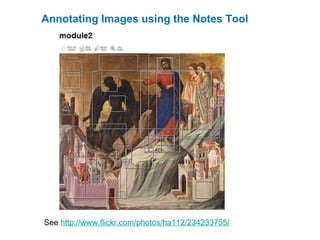
Annotating Images using the Notes Tool See  http://www.flickr.com/photos/ha112/234233755/
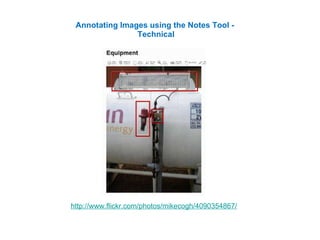
Annotating Images using the Notes Tool -  Technical http://www.flickr.com/photos/mikecogh/4090354867/
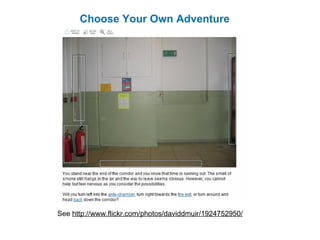
Choose Your Own Adventure See  http://www.flickr.com/photos/daviddmuir/1924752950/
TEACHER THOUGHTS #1 yya2 says:  Spanish students in my beginner class have to read a short novelette. I usually ask them to recreate the story without using words to measure their reading comprehension (They don't have enough Spanish). Students search for pictures or upload theirs to portrait the main events and characters in the story. They work in pairs and prepare a slide show and post it in the class wiki. They really have fun doing this project. Background courtesy of http://flickr.com/photos/epzibah/273262048/
TEACHER THOUGHTS #2 Noa Naveh says:  I think it is almost impossible to take children to the computer room and expect them to work on your terms, when they know so much in computers and may sometimes teach you a thing or to...This is why a teacher must have good relationship of honor and respect from the pupils, in order to succeed in it. Background courtesy of http://flickr.com/photos/epzibah/273262048/
Creative Commons Licensing from Jeffrey Beall at http://www.flickr.com/photos/denverjeffrey/301014978/
MORE IDEAS AT: http://teachingwithflickr.wikispaces.com/ This is a public wiki and can be edited by all so please add any new resources or ideas you find or think of. Michael Coghlan NewLearning [email_address]

Teaching with flickr_braz_tesol_2010

  • 1.
    TEACHING WITH BrazTESOL 2010 July 21st, 2010
  • 2.
    WHO AM I?eLearning Facilitator for TAFE SA, NewLearning (TAFE – Technical and Further Education) Founding member of Webheads Community
  • 3.
    ARE WE TALKING ABOUT VISUAL LITERACY?
  • 4.
  • 5.
  • 6.
    Visual Literacy: Wikipediathe ability to interpret , negotiate, and make meaning from information presented in the form of an image . Visual literacy is based on the idea that pictures can be “read” and that meaning can be communicated through a process of reading. The term first used in 1969 because multiple disciplines such as education , art history and criticism , rhetoric , semiotics , philosophy , information design , and graphic design make use of the term visual literacy, arriving at a common definition of visual literacy has been contested Commonly refers to the ability to read eg graphs, colour coded diagrams, tables, flow charts, etc many educators in the twenty-first century promote the learning of visual literacies as indispensable to life in the information age . … educators are recognizing the importance of helping students develop visual literacies in order to survive and communicate in a highly complex world . Kress et al: linguistic and visual literacies complement each other I suspect that in our context as ’21stcentury educators’ we are referring to a subset of multiliteracy, or digital literacy, and the term visual literacy might best be avoided, or at least used with caution.
  • 7.
  • 8.
  • 9.
  • 10.
    Title: PublicPrivacy Tags: Thailand, Koh Samet, jetty, pier, sea, privacy
  • 11.
    Why Media? AdrianMiles (RMIT): We need to “ make our institution …more porous to the students’ private technologies – their mobile phones, their laptops and their cameras.” Capitalises on the innate human desire/need to create Ubiquity and ease of participatory media enables creation of images, film, documents, course content, assessments, etc Use of media helps develops Digital Literacy http://flickr.com/photos/chunyang/800589975/
  • 12.
    “ The Read/WriteWeb” (Tim Berners Lee) Original photo by Hummanna .
  • 13.
    My Experience with Flickr Background courtesy of http://flickr.com/photos/andrearusky/2240595375/
  • 14.
    Using Flickr RepositoryConvenience Would anyone else look at them? Photographic Journal/Blog Background courtesy of http://flickr.com/photos/andrearusky/2538222041/in/set-72157606561568609/
  • 15.
    Flickr and NetworksI started ‘following’ other people (when I realised some were following me!) adding other people as contacts Using tagging to find others
  • 16.
    2009/356 Group –one of the best decisions I’ve ever made! See http://mikecogh.blogspot.com/2010/01/sun-goes-down-on-2009.html for my thoughts on this wonderful process.
  • 17.
    DIGITAL LITERACY Naming,Describing, Tagging Adds value to your image Easier to find (for you and others) Becomes part of a body of organised knowledge Background: http://flickr.com/photos/andrearusky/2736194440/in/set-72157606561568609/
  • 18.
  • 19.
  • 20.
  • 21.
    TAGGING 5. Tagscan be categorised: Literal Concrete Physical Tangible Visible Figurative/Metaphorical Abstract Intangible Invisible Backround: http://flickr.com/photos/thingsarebetterwithaparrott/2088815029 /
  • 22.
    Creating your own CLIP ART eg tools, work, readiness
  • 23.
  • 24.
  • 25.
  • 26.
  • 27.
    What is theIMPACT of all this? Image courtesy of Mike Seyfang http://flickr.com/photos/mikeblogs/2506591015 /
  • 28.
    What is theIMPACT of all this? I take more photos (quantity) I take more care when I take photos (quality) More assiduous with my TAGGING Routinely check the lives of friends and contacts Comment on others photos Sometimes leads to discussion Image courtesy of Mike Seyfang http://flickr.com/photos/mikeblogs/2506591015 /
  • 29.
  • 30.
  • 31.
    PHOTOS IN THECLASSROOM Dennisinphoenix says: Photos—individual ones, pairs, collages—make wonderful prompts for any kind of discussion or writing project in which there's a focus on impressions, conclusions, comparisons, descriptions, and reflections. Photos can be the basis for activities which are highly directed (such as an exercise focusing on a particular grammar point or an argument pro, con, or in-between) or only suggestive (e.g., looking at a photo, thinking about it, and then using one's own words to make a conclusion, invent a story, give an opinion, write a reflection, guess a location, describe / explain how a photo makes one feel, and much more). Photos and graphics are much more engaging than relying solely on written or oral directions… Background courtesy of http://flickr.com/photos/epzibah/273262048/
  • 32.
    THE BIG CHANGE: We can now all create and supply media from our own lives for use in educational contexts Ease of production; ease of access Quality of product (not photocopied, or via overhead projector) Frees teachers and students from reliance on published texts/mainstream media for source materials Personalises the educational experience
  • 33.
  • 34.
    LANGUAGE TEACHING ORALPRESENTATIONS (hobbies/interests, your home town or city, excursions) VOCABULARY: what is this? > tagging GRAMMAR: what are they doing? (present continuous) WRITING: description, identifying key words Literal v Emotive, abstract ORAL DISCUSSION What are you doing? Where is this? Who is that? Culture: (events, customs, artefacts) of own and host culture COMPETITIONS Best sunset, best photo of person, nature, built environment, etc
  • 35.
    Annotating Images usingthe Notes Tool See http://www.flickr.com/photos/ha112/234233755/
  • 36.
    Annotating Images usingthe Notes Tool - Technical http://www.flickr.com/photos/mikecogh/4090354867/
  • 37.
    Choose Your OwnAdventure See http://www.flickr.com/photos/daviddmuir/1924752950/
  • 38.
    TEACHER THOUGHTS #1yya2 says: Spanish students in my beginner class have to read a short novelette. I usually ask them to recreate the story without using words to measure their reading comprehension (They don't have enough Spanish). Students search for pictures or upload theirs to portrait the main events and characters in the story. They work in pairs and prepare a slide show and post it in the class wiki. They really have fun doing this project. Background courtesy of http://flickr.com/photos/epzibah/273262048/
  • 39.
    TEACHER THOUGHTS #2Noa Naveh says: I think it is almost impossible to take children to the computer room and expect them to work on your terms, when they know so much in computers and may sometimes teach you a thing or to...This is why a teacher must have good relationship of honor and respect from the pupils, in order to succeed in it. Background courtesy of http://flickr.com/photos/epzibah/273262048/
  • 40.
    Creative Commons Licensingfrom Jeffrey Beall at http://www.flickr.com/photos/denverjeffrey/301014978/
  • 41.
    MORE IDEAS AT:http://teachingwithflickr.wikispaces.com/ This is a public wiki and can be edited by all so please add any new resources or ideas you find or think of. Michael Coghlan NewLearning [email_address]