BASIC ENTOMOLOGY
(BIO: 3202)
OPOKE ROBERT (PhD)
1
Entomology
Introduction
• Entomology is the study of insects.
• Insects are extremely successful animals and they
affect many aspects of our lives, despite their
small size.
• All kinds of natural and modified ecosystems, both
terrestrial and aquatic, support communities of
insects.
• They may be aquatic or terrestrial throughout, or
during part of their lives.
• They may be conspicuous or concealed and active
by day or night.
2
Evolution of insects
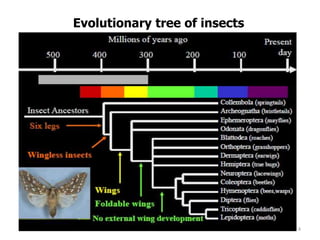
• Insects first appeared by the early Devonian period
(419.2 Mya).
• By Carboniferous (80 million years later), they evolved
into a diverse array of winged forms.
• Shortly thereafter they evolved metamorphosis.
• Then in Late Jurassic or Early Cretaceous (150–140
million years ago), the first complex societies evolved.
• Major adaptive features of the insects developed at
that time were;
-terrestriality (the origin of hexapods)
-flight (the origin of pterygote insects)
-complete metamorphosis (the origin of the Holometabola)
-eusociality (origin of sociality) 3
Evolutionary tree of insects
4
Habitats of insects
• The soil e.g., ants, termites, beetles, wasps, flies,
crickets, cockroaches, moths, fleas, etc.
• Water e.g., mosquitoes, etc.
• In the ambient air (temporary fliers) e.g., Bees,
beetles, mosquitoes, flies, grasshoppers, wasps,
butterflies, moths, dragonflies, ants and termites.
• On man e.g., lice, etc
• On animals e.g., lice, fleas, mosquitoes, ox-warble
fly, etc.
• On plants e.g., Beetles, aphids, gall insects, scale
insects, manna insects, etc.
5
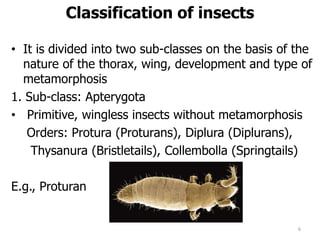
Classification of insects
• It is divided into two sub-classes on the basis of the
nature of the thorax, wing, development and type of
metamorphosis
1. Sub-class: Apterygota
• Primitive, wingless insects without metamorphosis
Orders: Protura (Proturans), Diplura (Diplurans),
Thysanura (Bristletails), Collembolla (Springtails)
E.g., Proturan
6
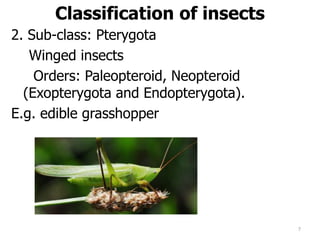
Classification of insects
2. Sub-class: Pterygota
Winged insects
Orders: Paleopteroid, Neopteroid
(Exopterygota and Endopterygota).
E.g. edible grasshopper
7
Classification of insects
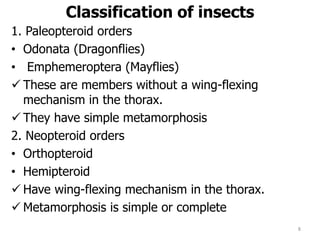
1. Paleopteroid orders
• Odonata (Dragonflies)
• Emphemeroptera (Mayflies)
 These are members without a wing-flexing
mechanism in the thorax.
 They have simple metamorphosis
2. Neopteroid orders
• Orthopteroid
• Hemipteroid
 Have wing-flexing mechanism in the thorax.
 Metamorphosis is simple or complete
8
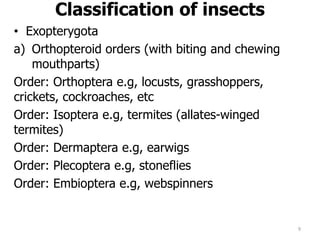
Classification of insects
• Exopterygota
a) Orthopteroid orders (with biting and chewing
mouthparts)
Order: Orthoptera e.g, locusts, grasshoppers,
crickets, cockroaches, etc
Order: Isoptera e.g, termites (allates-winged
termites)
Order: Dermaptera e.g, earwigs
Order: Plecoptera e.g, stoneflies
Order: Embioptera e.g, webspinners
9
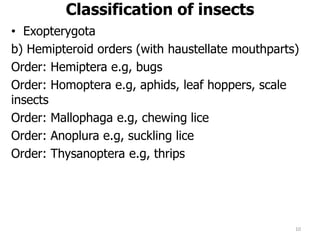
Classification of insects
• Exopterygota
b) Hemipteroid orders (with haustellate mouthparts)
Order: Hemiptera e.g, bugs
Order: Homoptera e.g, aphids, leaf hoppers, scale
insects
Order: Mallophaga e.g, chewing lice
Order: Anoplura e.g, suckling lice
Order: Thysanoptera e.g, thrips
10
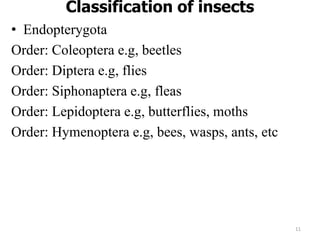
Classification of insects
• Endopterygota
Order: Coleoptera e.g, beetles
Order: Diptera e.g, flies
Order: Siphonaptera e.g, fleas
Order: Lepidoptera e.g, butterflies, moths
Order: Hymenoptera e.g, bees, wasps, ants, etc
11
Insect external morphology
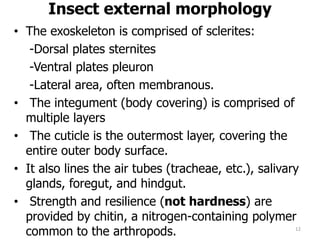
• The exoskeleton is comprised of sclerites:
-Dorsal plates sternites
-Ventral plates pleuron
-Lateral area, often membranous.
• The integument (body covering) is comprised of
multiple layers
• The cuticle is the outermost layer, covering the
entire outer body surface.
• It also lines the air tubes (tracheae, etc.), salivary
glands, foregut, and hindgut.
• Strength and resilience (not hardness) are
provided by chitin, a nitrogen-containing polymer
common to the arthropods. 12
Insect external morphology
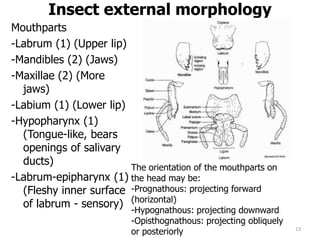
Mouthparts
-Labrum (1) (Upper lip)
-Mandibles (2) (Jaws)
-Maxillae (2) (More
jaws)
-Labium (1) (Lower lip)
-Hypopharynx (1)
(Tongue-like, bears
openings of salivary
ducts)
-Labrum-epipharynx (1)
(Fleshy inner surface
of labrum - sensory)
13
The orientation of the mouthparts on
the head may be:
-Prognathous: projecting forward
(horizontal)
-Hypognathous: projecting downward
-Opisthognathous: projecting obliquely
or posteriorly
Insect external morphology
• Eyes: Compound eyes: Individual units are facets or
ommatidia.
• Ocellus (Ocelli), or simple eyes: small, usually a single
lens
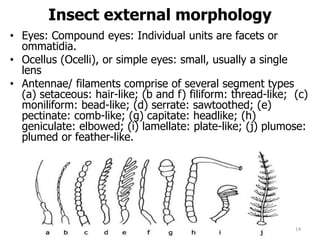
• Antennae/ filaments comprise of several segment types
(a) setaceous: hair-like; (b and f) filiform: thread-like; (c)
moniliform: bead-like; (d) serrate: sawtoothed; (e)
pectinate: comb-like; (g) capitate: headlike; (h)
geniculate: elbowed; (i) lamellate: plate-like; (j) plumose:
plumed or feather-like.
14
Insect external morphology
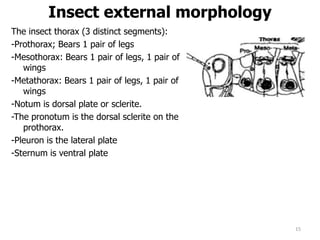
The insect thorax (3 distinct segments):
-Prothorax; Bears 1 pair of legs
-Mesothorax: Bears 1 pair of legs, 1 pair of
wings
-Metathorax: Bears 1 pair of legs, 1 pair of
wings
-Notum is dorsal plate or sclerite.
-The pronotum is the dorsal sclerite on the
prothorax.
-Pleuron is the lateral plate
-Sternum is ventral plate
15
Insect external morphology
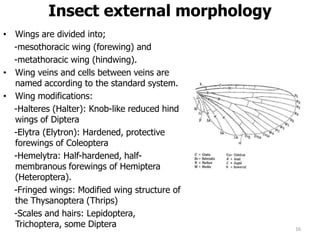
• Wings are divided into;
-mesothoracic wing (forewing) and
-metathoracic wing (hindwing).
• Wing veins and cells between veins are
named according to the standard system.
• Wing modifications:
-Halteres (Halter): Knob-like reduced hind
wings of Diptera
-Elytra (Elytron): Hardened, protective
forewings of Coleoptera
-Hemelytra: Half-hardened, half-
membranous forewings of Hemiptera
(Heteroptera).
-Fringed wings: Modified wing structure of
the Thysanoptera (Thrips)
-Scales and hairs: Lepidoptera,
Trichoptera, some Diptera 16
Insect external morphology
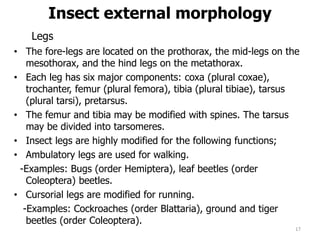
Legs
• The fore-legs are located on the prothorax, the mid-legs on the
mesothorax, and the hind legs on the metathorax.
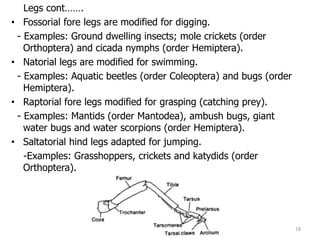
• Each leg has six major components: coxa (plural coxae),
trochanter, femur (plural femora), tibia (plural tibiae), tarsus
(plural tarsi), pretarsus.
• The femur and tibia may be modified with spines. The tarsus
may be divided into tarsomeres.
• Insect legs are highly modified for the following functions;
• Ambulatory legs are used for walking.
-Examples: Bugs (order Hemiptera), leaf beetles (order
Coleoptera) beetles.
• Cursorial legs are modified for running.
-Examples: Cockroaches (order Blattaria), ground and tiger
beetles (order Coleoptera).
17
Legs cont…….
• Fossorial fore legs are modified for digging.
- Examples: Ground dwelling insects; mole crickets (order
Orthoptera) and cicada nymphs (order Hemiptera).
• Natorial legs are modified for swimming.
- Examples: Aquatic beetles (order Coleoptera) and bugs (order
Hemiptera).
• Raptorial fore legs modified for grasping (catching prey).
- Examples: Mantids (order Mantodea), ambush bugs, giant
water bugs and water scorpions (order Hemiptera).
• Saltatorial hind legs adapted for jumping.
-Examples: Grasshoppers, crickets and katydids (order
Orthoptera).
18
Insect external morphology
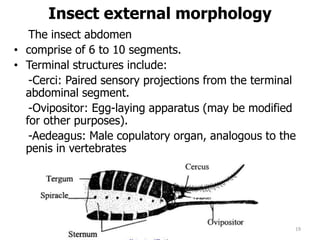
The insect abdomen
• comprise of 6 to 10 segments.
• Terminal structures include:
-Cerci: Paired sensory projections from the terminal
abdominal segment.
-Ovipositor: Egg-laying apparatus (may be modified
for other purposes).
-Aedeagus: Male copulatory organ, analogous to the
penis in vertebrates
19
Internal anatomy of insects
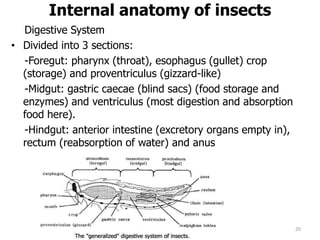
Digestive System
• Divided into 3 sections:
-Foregut: pharynx (throat), esophagus (gullet) crop
(storage) and proventriculus (gizzard-like)
-Midgut: gastric caecae (blind sacs) (food storage and
enzymes) and ventriculus (most digestion and absorption
food here).
-Hindgut: anterior intestine (excretory organs empty in),
rectum (reabsorption of water) and anus
20
Internal anatomy of insects
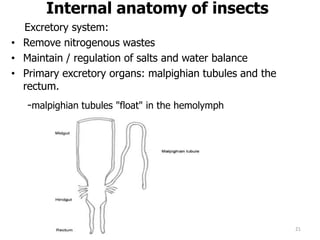
Excretory system:
• Remove nitrogenous wastes
• Maintain / regulation of salts and water balance
• Primary excretory organs: malpighian tubules and the
rectum.
-malpighian tubules "float" in the hemolymph
21
Internal anatomy of insects
Nervous system
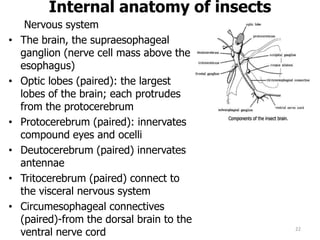
• The brain, the supraesophageal
ganglion (nerve cell mass above the
esophagus)
• Optic lobes (paired): the largest
lobes of the brain; each protrudes
from the protocerebrum
• Protocerebrum (paired): innervates
compound eyes and ocelli
• Deutocerebrum (paired) innervates
antennae
• Tritocerebrum (paired) connect to
the visceral nervous system
• Circumesophageal connectives
(paired)-from the dorsal brain to the
ventral nerve cord 22
Internal anatomy of insects
Nervous system cont……
• The ventral nerve cord: connects segmental ganglia
(nerve cell bundles). Thoracic and abdominal ganglia
control many body operations.
• The corpora cardiaca and corpora allata are
neuroendocrine glands.
• Chemoreceptors (taste and smell) take the form of
sensory pegs on various body structures, particularly
antennae, tarsi, and palpi.
• Photoreceptors are located in the compound eyes and the
ocelli (and also the cuticle).
• Hearing organs may be located on the abdomen
(grasshoppers), tibiae (crickets), or thorax (moths).
23
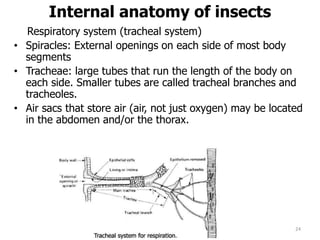
Internal anatomy of insects
Respiratory system (tracheal system)
• Spiracles: External openings on each side of most body
segments
• Tracheae: large tubes that run the length of the body on
each side. Smaller tubes are called tracheal branches and
tracheoles.
• Air sacs that store air (air, not just oxygen) may be located
in the abdomen and/or the thorax.
24
Internal anatomy of insects
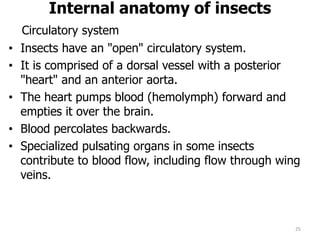
Circulatory system
• Insects have an "open" circulatory system.
• It is comprised of a dorsal vessel with a posterior
"heart" and an anterior aorta.
• The heart pumps blood (hemolymph) forward and
empties it over the brain.
• Blood percolates backwards.
• Specialized pulsating organs in some insects
contribute to blood flow, including flow through wing
veins.
25
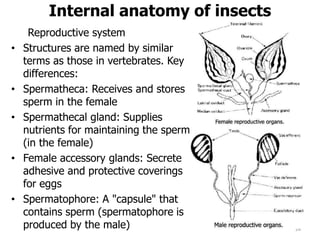
Internal anatomy of insects
Reproductive system
• Structures are named by similar
terms as those in vertebrates. Key
differences:
• Spermatheca: Receives and stores
sperm in the female
• Spermathecal gland: Supplies
nutrients for maintaining the sperm
(in the female)
• Female accessory glands: Secrete
adhesive and protective coverings
for eggs
• Spermatophore: A "capsule" that
contains sperm (spermatophore is
produced by the male) 26
Economic importance of insects
• They bite and suck blood e.g., mosquitoes
• They pass infective organisms and may inject toxin
to man and animals (mechanically or biologically).
• They cause myiasis on man and animals.
• Annoy and irritate man and animals.
• They cause envenomization by their bite, sting,
spines or by their secretions.
• Insects parasitize man, animals and plants.
• Cause accidental injury to sense organs: they enter
the eyes, ears, mouth or nostrils.
• They cause allergic/asthmatic reactions by their
odour, secretions, and by their dead body fragments.
27
• Insects adulterate crop is another effect of
arthropods due to their droppings of fecula, dead
body, egg shells, urine or microorganisms.
• Insects cause Entomophobia (fear of insects):
nervous disorder, hysterics, hallucination etc.
• One of the greatest benefits man receives through
insects is the pollonization of plants.
• Silk is produced by insects (Bombyx mori).
• Honey and wax is the other product of insects-honey
bees.
• Insects attack man, domestic and wild animals
28
• Insects improve the soil fertility e.g., dung
beetles
• Lac insect (Kerria lacca) is a source of a
commercial varnish.
• Predatory insects help to reduce the number of
other insects. e.g., dragon flies, preying mantis.
• Some insects are parasitoids e.g., tachnid fly,
wasps, etc.
• Insects are valuable as food for humans and
animals.
• Sources for scientific knowledge and
technological innovations e.g. manufacture of
aeroplanes.
29
Insect physiology: nutrition
• Insects have adapted to all types of diets.
• The mouthparts are modified in line with the
method by which food is obtained.
• The mandibles are heavy and capable of cutting,
tearing and crushing.
• Insects with biting mouthparts include primitive
apterygotes, dragon flies, grasshoppers, crickets,
cockroaches, beetles, etc.
• The larvae of insects like moth and butterflies have
chewing mouthparts, although the adult mouthparts
are highly modified
• The diets of chewing insects may be herbivorous or
carnivorous, and some diets may be restrictive. 30
Nutrition
• The specialisation of insect mouthparts has been
primarily in modifications for piercing and sucking.
• Adaptations for the same feeding habits are not
uniform, because a sucking or piercing feeding habit
evolved independently in different insect orders.
• The mouthparts may be adapted for more than one
function; chewing and sucking, cutting and sucking,
piercing and sucking, etc
• The mouthparts of moths and butterflies are
adapted for sucking liquid food such as nectar from
flowers.
• A part of each of the two greatly modified maxillae
forms a long tube through which food is sucked.
• When the insect is not feeding, the tube is coiled.
31
Nutrition
• Piercing mouthparts are characteristics of herbivorous
insects e.g, aphids and leaf hoppers which feed on plant
juices.
• Predacious insects (bugs and mosquitoes) which feed on
animal body fluids also have piercing and sucking
mouthparts.
• These insect groups have the mouthparts elongated and
are organised in various ways to form a beak.
• They typically possess stylets (modified mandibles and
maxillae) which are adapted for penetration of prey or
plant tissues.
• The stylets also contain a lumen for sucking in fluids;
other parts of the beak do not penetrate.
• Bees and wasps have mouthparts adapted for both
chewing and sucking.
32
Nutrition
• In bees, nectar is gathered by elongated maxillae and the
labium.
• Pollen and wax are handled by the labrum and mandibles,
which retain the chewing form.
• In biting flies e.g, horseflies, the knife-like mandibles
produce a wound.
• Blood is collected from the wound by a spong-like labium
and conveyed to the mouth by a tube formed from the
hypopharynx and epipharynx.
• None biting flies e.g, houseflies use sponge-like labium
alone for obtaining food, the mandibles and maxillae are
reduced.
• Houseflies can exude saliva through the labium onto solid
food material, and then suck back the fluid into the
mouth.
33
Nutrition
• Food taken into the mouth passes the pharynx
into the digestive tract, divided into;
 Foregut, midgut and hindgut.
• The foregut is sub-divided into;
 Oesophagous-for food passage
 Crop-usually storage chamber; in blood sucking
insects it absorbs most of the water and
concentrate it.
 Proventriculus- in insects that eat solid food, its
is modified as gizzard with features for
marcerating and shredding food.
34
Nutrition
• Salivary glands secrete saliva which moistens the
mouthparts and provides a solvent for food eaten
• Salivary glands may carry digestive enzymes such
as amylase and invertase, which are secreted into
food mass before it is swallowed.
• In some hymenopterans e.g, silk worms, the gland
secretes silk used to make pupal cells.
• Other special secretions of salivary glands include
mucoid materials, venoms, anticoagulants,
antigens e.g, mosquito bites.
• The insect midgut (ventriculus or stomach), is the
principal site of enzyme production, digestion and
absorption.
35
Nutrition
• A characteristic feature of the midgut of many
insects is the present of peritrophic membrane;
secreted by epithelial cells at the end of foregut.
• The membrane forms the covering around the
food mass moving through the midgut
• The covering protects the midgut epithelium, is
permeable to enzymes and digested foods.
• Insects which live on liquid diet do not secrete
peritrophic membrane.
• The hindgut or proctodeum consists of; anterior
intestine and posterior rectum.
• Both of these are lined by cuticle.
36
Nutrition
• The functions of hindgut is not completely
understood
• However, water, fats and sodium chloride are
absorbed here.
• Digestion of cellulose by termites and some
wood-eating insects is made possible by action
of enzyme produced by protozoans which
inhabit the hindgut
• Acetic acid, the end product from breakdown of
wood is actively absorbed by the hindgut
epithelium in these insects
37
Circulation
• The heart of insects is tubular and extends through
the first 9 abdominal segments
• Blood normally flows from the posterior to anterior.
 reversal of blood flow occurs in few groups
• Blood flow may be aided by;
 accessory pulsating structures in the head, thorax, legs
or wings
 a contractile ventral diaphragm in the abdomen
• In many rapid flying insects, there is an additional
thoracic heart which draws blood through the wings
and discharges it into the aorta.
• Blood flow is facilitated by various body
movements, such as the ventilating abdominal
contractions.
38
Circulation
• In addition to bringing about blood transport,
localised elevations of blood pressure may serve a
variety of functions;
 The unrolling of the proboscis in Lepidoptera
 The egestion of faecal pellets
 The swelling of body during moulting and hatching
 Concentration of blood meal in tsetse flies.
• The blood of insects is usually colourless or green
• Some insects possess clotting agents in the blood
39
Circulation
• Insect blood differs from the blood of other
animals in its ionic content
• Most animals rely on inorganic ions such as
sodium and chloride ions, as osmotic regulators of
body fluid.
• In insects most inorganic ions have been replaced
by organic molecules, especially free amino acids
• Haemolymph also contain high concentrations of
dissolved uric acid, organic phosphates, non-
reducing sugar, trehalose, etc.
40
Gas exchange
• Gas exchange in insects occurs through trachea
• A pair of spiracles is usually located above the second
and third pair of legs, or only on the last pair
• The first 7 or 8 abdominal segments possess a spiracle
on each lateral surface
• Spiracle is provided with a closing mechanism (valves)
• The opening and closing of the spiracles are controlled
by both direct innervation and by neuro-secretions
• The stimulation to open and close is apparently related
to oxygen-carbondioxide tension of the blood
• The smallest sub-divisions of the trachea are tracheoles-
branch into a fine network over the tissue cells
41
Gas exchange
• Within the tracheal system, gas transport takes place
either by;
 Diffusion along a concentration gradient or
 A ventilating mass flow of air down a pressure gradient
or
 A combination of both
• Ventilating pressure gradients result from body
movements (largely abdominal) which bring about
compression of the air sacs and of certain elastic
trachea.
• Ventilation is facilitated by the sequence in which certain
spiracles are opened and closed
• Diffusion along concentration gradient can supply
enough oxygen for small insects
42
Gas exchange
• Heavy insects and those highly active require some of
ventilation
• At tissue-tracheole level, gases are exchanged by
diffusion across a concentration gradient
• Tracheoles are permeable to liquids, and in most
insects their tips are filled with fluid
• This fluid is believed to be involved in the final
transport of oxygen
• Some carbon dioxide is probably released from the
tissues directly into the haemolymph, and diffuse out
through the integument
43
Gas exchange
• Small insects e.g collembolans which live in moist
surroundings lack tracheae
 Gas exchange occurs over the general body surface
• Some aquatic immature insects also lack tracheae
during early stages
 Nymphs and adults may possess special adaptations for
gas exchange in water e.g. gills supplied with trachea.
 Usually gas exchange in aquatic immature insects
occurs across the general integument between tracheae
and water
 Larvae of mosquitoes have few functional spiracles
associated with one or more breathing tubes
• The adults utilise air from air bubbles or films trapped
against the body surface
44
Excretion and water balance
• The chief organs of excretion insects are the malphigian
tubules, which originates from mid-gut
• They lie free in the haemocoel
• The tubules are capable of peristalsis and can undergo
some movement within the haemocoel
• Uric acid formed in the tissues and passed into the
haemolymph is selectively absorbed by the malpighian
tubule cells along with amino acids, water and dissolved
salts
• These substances form a sediment-like material, which
is discharged into the gut where it is eventually moulded
into faecel pellets along with waste of digestion
45
Excretion and water balance
• Re-absorption of water, salts and other nutritive
substances occurs in the course of elimination.
• Some re-absorption of water and inorganic ions may
take place in the proximal parts of the tubules
themselves and returned to the haemolymph
• Not all the waste products are removed by the
malpighian tubules
• Some excess salts and other substances are deposited
in the cuticle to be disposed at ecdysis.
• Some of the calcium and uric acid salts are excreted
through the walls of the gut
• The fat bodies may be used as storage place for uric
acid.
46
Excretion and water balance
• Insects are among the best adapted for the
prevention of water loss of all the arthropods.
• The epicuticle is impregnated with waxy
compound, which reduce water loss
• The excretion of uric acid also reduces loss of
water due to protein metabolism
• The re-absorption of water by the rectum further
conserves water that would be lost through
excretion and egestion
47
Nervous system and sense organs
• The brain is composed of;
 Protecerebrum
 Deuterocerebrum
 Tritocerebrum
• The ventral nerve cord forms a chain of median
segmental ganglia
• Both thoracic and abdominal are often fused
• Sense organs are scattered over the body, but are
especially numerous on the wings and antennae
• These sense organs evaluate substrate vibrations,
air or water currents and the animal’s course or
position in space
• They are stimulated by even a slight vibration of
the cuticle 48
Nervous system and sense organs
• There are chemoreceptors located in cup-like
depression of the epidermis
• Auditory sense organs are developed in species that
have sound-producing organs e.g grasshoppers,
crickets, etc
• The visual receptors are the ocelli and compound
• The principal function of ocelli is perception of light and
dark
• Compound eyes are laterally situated on the head
• The number of facets is greatest in flying insects which
depend on vision of feeding
• Facets are reduced in parasitic and cave dwelling
insects
• Facets are larger in nocturnal than in diurnal insects
49
Reproduction
• Female reproductive system consists of; 2 ovaries and
2 lateral oviducts
• The paired oviducts usually unite to form a common
oviduct which leads into a vagina
• The vagina in turn opens onto the ventral surface
behind the 7th , 8th or 9th segments
• Spermatheca and accessory glands open into vagina
• Each ovary is made up of a group of tubules-ovarioles
• Male reproductive system includes;
• a pair of testes
• A pair of lateral ducts
• A median duct opening through a ventral penis
associated with the 8th segment 50
Reproduction
• Each testis consist of a group of sperm tubes
containing spermatozoa in various stages of
development
• These tubes empty into lateral duct-vas deferens,
which unite to form a common ejaculatory duct
• Vas deferens enlarged into seminal vesicle where
sperms are stored
• Accessory glands are located at the upper end of
the ejaculatory duct
• In copulation, penis of male is inserted into the
female genital orifice
• Sperms are transferred in spermatophore-deposited
directly into the female reproductive system
51
Reproduction
• In primitive insects e.g., Thysanurans, spermatophore
is deposited on the ground and then taken by female.
• In Odonata, copulation occurs in flight-the male clasps
the thorax or head of female with his abdominal cerci
• Sperms are deposited in vagina, common oviduct and
end up in spermatheca where they are stored until the
eggs are being laid
• Fertilisation of more than one batch of eggs
• Many insects mate only once in their lifetime
• When eggs reach oviduct, they are surrounded by a
shell-like membrane (chorion) secreted by ovarian
follicle cells
52
Reproduction
• The chorion is perforated by minute openings,
through which sperms enters
• Eggs are deposited through ovipositor, derived
from 8th and 9th abdominal segments
• The site for egg laying varies depending on the
mode of existence of adults
• Eggs are attached to the substratum or to each
other by adhesive materials produced by
accessory glands
• In aquatic species, accessory glands produce
gelatinous coating which swells in water.
53
Reproduction
• Some hymenopterans and dipterans, deposit their
eggs in plant tissues
• The plant tissue surrounding the egg is induced to
undergo abnormal growth and forms a gall, which
has a shape characteristic of the insect producing it
• The gall forms a protective chamber for the
developing eggs, larvae and pupae
• The larvae feed on the gall tissues
54
Development
• Young insects vary in the degree of development after
hatching
• Young Apterygotes are like the adults, except in size and
sexual maturity (Ametabolous-no metamorphosis) e.g.,
collembolla (small soil dwelling insects).
• Newly hatched grasshoppers, cockroaches resemble
adults, except that the wings and reproductive organs are
undeveloped
• The wings of 1st instar nymphs are merely external pads,
which only begin to look like wings at pre-adult moult
• The adult form is reached gradually with successive
moults
• This type of development is called gradual or incomplete
metamorphosis (Hemimetabolous development)-all
immature stages are nymphs.
55
Development
• In many insects (bees, wasps, flies, beetles) the wing
rudiments develop internally-the wings appear
suddenly in adults
• This type of development is a complete
metamorphosis (Holometabolous development) and
consists of 4 distinct stages;
 egg
 larva
 pupa
 adult
• The newly hatched larval stage (no wings) is the
caterpillar of butterflies, maggots of flies
• This is an active feeding stage-the food usually
different from of adults
56
Development
• In some species, the larvae and adults have different kinds
of mouthparts
 caterpillar larvae have chewing mouthparts
 adults have sucking mouthpart
• So parasitic groups may have 2 or more different larval
habit and structures (Hypermetamorphosis)
• At the end of larva period, the young become non-
feeding and quiescent
• This stage is called pupa and is usually passed in
protective locations such as ground, cocoon or plant
tissues
• During pupation, adult structures are developed
• The number of moults required to reach adult stages
ranges from about 3 to over 30 depending on the type of
development
• The transformation of immature insects into reproductive
adults is known to be under endocrine control 57
Development
• A hormonal secretion from the brain stimulates a
gland in the prothorax (prothoracic gland) which
produces ecdysone A and B (hormones) that
stimulate growth and moulting
• At larval stages, juvenile hormone is secreted by
corpora allata of the brain
• This hormone is responsible for maintenance of
larval structures and inhibits metamorphosis
• High level of this hormone allows only larva to
larva moult
• When the level is less, the moult is larva to pupa
• In the absence of the hormone, there is pupa to
adult moult 58
Insect vectors
Mosquitoes
• About 100 species are vectors of medical importance
• Mosquitoes have two subfamily groups;
1. The anopheline-Anopheles which transmit malaria and
filariasis.
2. The culicine subfamily-Aedes, Culex, and Mansonia belong.
• Both male and female mosquitoes feed on sugary
secretions such as nectar from plants.
• Only the female mosquito takes blood-meals.
• Female mosquitoes are attracted to odour, the carbon
dioxide and the heat from animals and humans.
• The blood sucked is used to provide proteins to mature
batches of eggs.
59
Life cycle of the mosquito
• Four different stages of mosquito life-cycle:
 the immature stages of egg, larva, and pupa require
an aquatic environment.
• The females are able to lay between 30 and 300 eggs
at a time, according to species.
• The anopheline mosquitoes lay their eggs separately
over the surface of any kind of unpolluted water.
• The culicine mosquitoes, Culex and Mansonia, lay
their eggs on water as an egg-raft form.
• The eggs of Aedes mosquitoes are laid just above the
water line or in wet mud.
60
Life cycle of the mosquito
• Each species oviposit eggs that hatch in aquatic
habitats where the larval-stage feeds and acquires
bacteria that colonize the digestive tract.
• Larvae undergo metamorphosis after the fourth instar
to form pupae that float on the surface of the aquatic
habitat.
• Adults emerge from the pupal stage, imbibe water and
persist in terrestrial habitats.
• Adults of each species also feed on sugar sources.
• An autogenous species oviposits a first clutch of eggs
without taking a blood meal, e.g. G. atropalpus.
• Adult female Ae. aegypti and An. gambiae are
anautogenous and must take blood meals before
laying eggs.
61
Mosquito vectors in Uganda
1. Anopheles spp. vectors of malaria and lymphatic
filariasis
 Mainly night biters
 Breed mainly in clean and clear stagnant water
exposed to sunlight
2. Culex spp (C. quinquefasciatus). vectors of
filariasis
 Mainly night biters
 Breed in any type of fresh water but preferably
polluted water like flooded pit latrines, septic
tanks, etc.
62
Mosquito vectors in Uganda
3. Aedes spp. Vectors of yellow fever, denque fever,
o’nyong nyong, Rift valley fever, and other arboviral
diseases
 Mainly night biters
 Breed mainly in discarded containers (Ae. aegypti)
plant axils (Ae. simpsoni) and tree holes (Ae.
Africanus)
4. Mansonia spp. vectors of minor arboviral diseases in
Uganda but major vector of Brugian filariasis in Asia
 Both night and day biters
 Breed in swamps with larvae and pupae attached to
water plants like papyrus, Pistia (Nile cabbage) waters
63
Anopheles mosquitoes in Uganda
• About 400 Anopheles mosquito species in world but
only about 36 are malaria vectors
• Malaria is transmitted by bites of infected female
mosquitoes of the genus Anopheles
• Male Anopheles do not transmit diseases
• Major vectors in Uganda. An. gambiae s.s., An.
arabiensis and An. funestus, An. stephensi, etc.
• Minor vectors. An. moucheti, An. Bwambae, An.
gibbinsi.
64
Habitats of malaria vectors
• There are two major malaria vectors in Uganda.
Anopheles gambia s.l and An. funestus
• An. gambia s.l usually prefer shallow open sunlit
pools, including: burrow-pits, drains, ruts, car-tracks,
newly constructed fish ponds,
brick/sand/mud/murrum/stone pits, new rice fields,
and hoof-prints around ponds and water holes, pools
left behind by receding rivers, pools in depressions,
etc.
• Reports of An. gambiae s.l is adapting to live in
polluted environments in urban areas of Malindi and
Kisumu in Kenya. Also observed on a limited scale in
seawage lagoons in Tororo district.
65
Habitats of malaria vectors
• An. funestus prefers bodies of clear water that are
either large and more or less permanent e.g., swamps
(near edges if deep), weedy sides of the streams,
rivers, rice fields, furrows or ditches, protected portion
of lake shore, ponds, etc, especially when weedy or
water such as seepages fed from underground
permanent sources
• This diversity of breeding sites makes it very difficult to
control malaria vectors through environmental
management methods as not all breeding sites are not
easily accessible for filing in or draining.
• Malaria mosquitoes do not usually breed in dirty or
polluted water or discarded containers, although 66
Man-made malaria
• A lot of malaria vector breeding habitats are man-
made, e.g. brick/murrum/sand pits, swamps
reclaimed or forests cleared for agricultural purposes,
etc resulting in man-made malaria
• Papyrus swamps or uncleared forests are not ideal
breeding sites
• However, once reclaimed they become very ideal for
anopheline mosquito breeding sites resulting in
increased malaria transmission
• Bye-laws are necessary to deal with these man-made
malaria vector breeding habitats
67
Malaria adult vector behaviours
• Feed mostly on humans (anthropophilic)
• Feed indoors (endophagic), with peak of biting
activity between 10.00pm -5.00am
• Rest indoors (endophilic)
• Knowledge of young and adult mosquitoes is very
crucial when designing control measures
• Knowledge of mosquito breeding sites has bearing
on environmental management control measures
you can use against these mosquito species, and
thus the disease you can control.
68
Purposes of mosquito sampling
• To map out the distribution of various mosquito
species in the country/district for purposes of
choosing appropriate interventions
• To determine the mosquito species composition
and density in an area
• To provide baseline data for starting a mosquito
control program
• For monitoring impact of mosquito control
interventions
• For research purposes e.g., resistance status of
major vectors, blood meal analysis
• For determining major mosquito breeding habitats
• For teaching purposes
• To study mosquito behaviour 69
Mosquito sampling techniques
• Man baited traps
• Animal baited traps
• Centre for Disease Control (CDC) light trap
collections
• Exit window trap collections
• Pyrethrum spray collections-in house/huts
• Hand collection in natural or artificial shelters using
sucking tubes
• Emergency traps over breeding places
• Pit latrine exit traps
• Mosquito net entrance trap
• Larval sampling using scoop 70
Most commonly used techniques
• Larval sampling scoops
• Pyrethrum spray collections-in huts/houses
• Centre for Disease Control (CDC) light trap
collections
• Man baited traps
• Animal baited traps
• Exit window trap collections
71
Pyrethrum spray collections (PSC)
• PSC is used for sampling adult mosquito populations
that rest indoor (e.g. human habitations, preferably
huts) or outdoors in well defined shelters (granaries,
animal shelters)
• PSC catches are performed during early hours of
morning between 7:00am to 10:00am to allow ample
time for dealing with specimens
• Huts where PSC will be performed should be small to
medium size, and having been occupied by people the
previous night. These developing should be identified
and consent of owners sought
• Take out all movable objects
• Remove or properly cover food and water containers
• Spread white cotton sheets (ground sheets) on the
floor to cover under beds and rest of the floor 72
Using PSC in huts/houses
• Cover beds and other immovable objects with sheets
• Close all windows and doors
• Dispense the insecticide using hand sprayers or mist
blowers that have adjustable nozzles, come out of the
houses/hut and close the door
• Wait for 10 minutes, open the room and starting from
doorway, pick up the sheets one at a time by their
corners.
• Carry the sheets outside and collect the mosquitoes
from the sheet with fine forceps and place onto petri-
dish staffed with wet cotton wool overlaid with a filter
paper for later identification
• Put an identification label into the petri-dish indicating
householder’s name and village
73
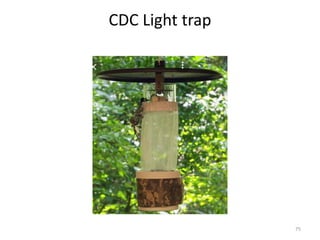
Centre for disease Control (CDC)
light trap collections
• Select a sleeping house or room where there is one or
two people sleeping together
• Set up an untreated mosquito net over the bed or
sleeping place. This net has to be used throughout the
night
• The CDC light trap at 6:00pm next to the net at the part
of the bed where the head of the sleeping person(s)
rests
• Switch on the CDC light trap at 6:00pm and leave it
burning throughout the night
• Collect the mosquitoes at around 7:00Am the following
day and take to the field laboratory for identification
• Use ether to kill the mosquitoes and identify them 74
CDC Light trap
75
Collection of mosquitoes in human
baited trap nets
• Set up trap nets for two human baits indoors and
outdoors.
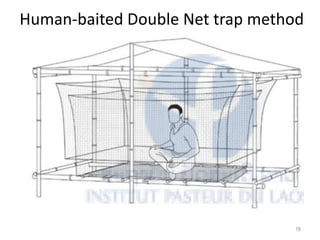
• A human baited trap net is set up such that two nets
are used, the smaller one with human bait inside
protected by larger net outside
• Set up a folding camp-bed
• Put up the inner net around the bed to protect the
person acting as a bait
• Erect the bottom of the outer net by securely tying to
poles or branches
• Stretch the bottom of the outer net tightly and tie it to
legs in the ground, leaving 15-20cm between the
ground and the cover edges of the net
76
Collection of mosquitoes in human
baited trap nets
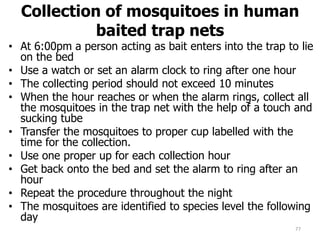
• At 6:00pm a person acting as bait enters into the trap to lie
on the bed
• Use a watch or set an alarm clock to ring after one hour
• The collecting period should not exceed 10 minutes
• When the hour reaches or when the alarm rings, collect all
the mosquitoes in the trap net with the help of a touch and
sucking tube
• Transfer the mosquitoes to proper cup labelled with the
time for the collection.
• Use one proper up for each collection hour
• Get back onto the bed and set the alarm to ring after an
hour
• Repeat the procedure throughout the night
• The mosquitoes are identified to species level the following
day
77
Human-baited Double Net trap method
78
Collecting mosquitoes from windows exit
traps
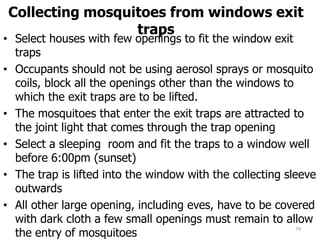
• Select houses with few openings to fit the window exit
traps
• Occupants should not be using aerosol sprays or mosquito
coils, block all the openings other than the windows to
which the exit traps are to be lifted.
• The mosquitoes that enter the exit traps are attracted to
the joint light that comes through the trap opening
• Select a sleeping room and fit the traps to a window well
before 6:00pm (sunset)
• The trap is lifted into the window with the collecting sleeve
outwards
• All other large opening, including eves, have to be covered
with dark cloth a few small openings must remain to allow
the entry of mosquitoes
79
Collecting the mosquitoes from windows
exit traps
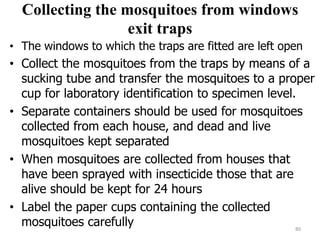
• The windows to which the traps are fitted are left open
• Collect the mosquitoes from the traps by means of a
sucking tube and transfer the mosquitoes to a proper
cup for laboratory identification to specimen level.
• Separate containers should be used for mosquitoes
collected from each house, and dead and live
mosquitoes kept separated
• When mosquitoes are collected from houses that
have been sprayed with insecticide those that are
alive should be kept for 24 hours
• Label the paper cups containing the collected
mosquitoes carefully 80
Collecting the mosquitoes from
windows exit traps
• The proportion that dies within that period should be
determined
• The first collecting of the night should be 2 or 3
hours after sunset.
• If it is raining heavily or very windy, it is necessary
either to protect the window trap or collect
mosquitoes at intervals of 2-3 hours
• A further collection should be made the next
morning, just after sunrise (7:00pm)
81
Larval sampling using scoops
Procedures
• Put a scoop/dipper into mosquito breeding sire;
allow water and mosquito larvae/pupae to flow
into the dipper
• Take a fixed number of dips per habitats, usually
10 or multiple of 10, covering as much of the
habitats as possible
• Transfer all the water sampled into trays/dishes
• Pick larvae and pupae from the water using
pipettes, and transfer into specimen bottles
• Each bottle should carry a label showing details
of the habitat, date of collect, mosquito species,
name of area where collection was done 82
Larval sampling using scoops
• Samples collected are taken to the field laboratory
where they are separated into larvae and pupae.
• Larvae are preserved in an appropriate solution for
identification later
• 4th stage larvae and pupae are reared into adults for
identification and other entomological studies
• NB: Avoid shadowing/ disturbing the habitat
unnecessarily, as Anopheline larvae are sensitive to
shadows/movements, which drives them to hide
83
Identification of adult female
Anopheline mosquitoes
• Abdomen-absence (plate 1) or presence of laterally
projecting tufts of scales on segments 2-7
• Hind leg-either speckled or not speckled
• Hind tarsal segments- last 2 or 3 tarsal segments
white while the last tarsal segment is dark
• Palps-5 segmented and marked with rings of white
scales
• Wing venation-wings have 6 veins with veins 2 and
5 with 2 branches. Note the arrangement of the
main dark and light areas on Costa and 1st vein.
84
Identification of 4th stage of
Anopheline mosquito larvae
• Inner clypeal hairs-either closed together or separated from
each other by distance  that between inner and outer
clypeals. Simple or strongly branched at apical half
• Outer clypeal hairs-either with 8 or more branches or with <
8 branches
• Saddle hair- either with least 5 branches or with simple or
2-4 branches
• Abdominal plate 5-either 3/4 or <2/3 distance between
bases of palmate hairs
• Shoulder hairs-mounted on either inconspicuous or well-
formed basal tubercles which is either joined or separated.
• Long mesopleural hairs- either both simple or 1 split into 2-
3 branches or 1 at least feathered or with > 3 branches
• Metapleural hairs-either both feathered or 1 simple and
other feathered
• Thorax and abdomen-either with or without spicules
ventrally and laterally 85
Malaria control options
• Generally classified into 4 groups:
1. Measures designed to prevent mosquitoes from
feeding on man (personal protective measures)
2. Measures designed to destroy adult mosquitoes
(chemical control methods)
3. Measures designed to prevent or reduce breeding
of mosquitoes (Environmental management
control methods)
4. Measures designed to destroy young stages-
larvae (Environmental management control
methods, larviciding, biological control, etc)
86
Personal protective measures
• Sleeping under mosquito nets-but keep them in good
repair
• Using house screening
• Using repellents e.g. DEET, repellent creams
• Using mosquito coils
• Closing doors and windows early
• Wearing long protective clothing covering most of the
body
Chemical control methods
• Using ITNs-more effective than untreated materials
• Using residual insecticide indoor spraying-ideal for control
of epidemics and for congested areas like boarding
schools, armed forces barracks, industrial housing
estates, health facilities admitting patients, prisons
• Using aerosol sprays
87
Tsetse fly vectors
• Tsetse flies, being the vector of human and animal
trypanosomosis, constitute one of the major health
constraints of sub-Saharan Africa.
• Tsetse flies are the biological vectors of two
trypanosome species, T. b. gambiense and T. b.
rhodesiense
• Important vectors for human African trypanosomosis
are:
 all subspecies of Glossina fuscipes and G. palpalis, G.
pallicera pallicera, G. swynnertoni, G. morsitans
centralis, G. morsitans morsitans and G. pallidipes.
• Morsitans ("savannah" subgenus)
• Fusca ("forest" subgenus)
• Palpalis ("riverine" subgenus)
• Both sexes are hematophagous
• Tsetse flies can detect odours by means of sensilla
situated on the antennae 88
Feeding and resting behaviours of
tsetse flies
• on forest trails
• near water collection points in forests
• in vegetation close to bathing and water collection sites
along the banks of rivers
• in vegetation surrounding villages
• sacred forests or forests on cemeteries;
• forest edges surrounding plantations (e.g. of coffee)
• savanna habitats (morsitans group).
• All tsetse flies, males as well as females, feed on blood,
but the species differ in their preferences for the source of
blood.
• Most tsetse flies feed preferentially on animals and only
accidentally on humans.
• While searching for food they are attracted by large
moving objects, by strikingly blue objects and by carbon
dioxide. 89
Life cycle
• These flies are multivoltine and long-lived, typically
producing about four generations yearly, and up to 31
generations total over their entire lifespans
• The female tsetse fly does not lay eggs but produces
larvae, one at a time.
• The larva develops in the uterus over a period of 10
days and is then deposited fully grown on moist soil or
sand in shaded places.
• It buries itself immediately and turns into a pupa.
• The fly emerges 22–60 days later, depending on the
temperature.
• Females mate only once in their life and, with optimum
availability of food and breeding habitats, can produce a
larva every 10 days.
90
Tsetse fly control methods
1. Game destruction
• This involves killing of essential hosts of tsetse
flies in the game reserves or game parks
• Sometimes the numbers have to be reduced to
lower level that cannot support tsetse populations
• Game destruction has been used as a routine
method of tsetse-fly control in many countries
including Uganda
• It has been effective against G. morsitans and G.
pallidipes
• It is disadvantageous in that it can lead to killing
of animal species that are facing extinction
• However, the status of game destruction is rapidly
declining. 91
Tsetse fly control methods
2. Clearing of vegetation
• This involve clearing of vegetation spots that
harbour tsetse flies
• It is always done to clear tsetse along the rivers
where man and animals get water
• Vegetation is also cleared along the main routes
of communication of man or animals
• Clearance of vegetation along the river has been
effective against riverine tsetse species like G.
palpalis and G. tachinoides
• Vegetation clearance may be discriminative,
partial or selective
92
Tsetse fly control methods
3. Sequential aerosol technique (SAT)
• This method involves the ultra-low volume spraying of non-
residual insecticides 10-50 m above the tree canopy by fixed
wing aircraft or helicopter
• The spraying cycles can be 5-6 separated by 16-18 days
depending on the temperature
• The optimum droplet size needs to be sufficiently small to
remain suspended long enough in air and large enough to
prevent floating upwards
• The goal is to kill all adult flies in the first spraying cycle by
direct contact and then kill all emerging flies in the
subsequent cycles before they can start reproducing
• The method is delicate (insecticide must be applied at night)
and does not tolerate any delays in timing of the cycles
• It remains effective when using GPS-guided navigation and
spray systems for area-wide tsetse suppression
93
Tsetse fly control methods
4. Stationary attractive devices
• It replaced insecticide-spraying tactics that were commonly
used in the 1990’s
• The goal is to attract female tsetse to an attractive device
(traps and targets) that either kill the flies through tarsal
contact with the insecticides embedded in the fabric or guide
and collect the flies to a non-return cage
• The method aims at exerting an additional daily mortality of
2-3% to the female segment of the population
• This bait technology requires appropriate trap/target site
selection, adequate maintenance, periodic replacement and
replenishment of the odours, appropriate reflectivity pattern
of the used cloth and degradation of insecticide deposits by
UV light
• The method is suitable for deployment by the local farmer
94
Tsetse fly control methods
5. Live bait technique
• This method is based on the insecticide treatment of
livestock and exploits the blood sucking behaviours
of both sexes of tsetse
• Tsetse flies attempting to feed on cattle or other
treated domestic livestock are killed by picking up a
lethal insecticide while feeding
• The success of the method depends on a relatively
large proportion of feeds being taken from domestic
animals and a sufficient proportion of the livestock
population being treated
• The technique is not prone to theft and does not
suffer from maintenance problems
95
Shortcomings of live bait technique
• Required cattle density must known
• The proportion of herd that requires treatment
• Host preference of different tsetse species
• High treatment frequency
• The high cost of the insecticides
• Insecticide residues in cattle dung
• Motivation and participation of farmers
• The potential development of resistance to the
insecticides in tsetse flies
96
6. Sterile insect technique (SIT
• SIT relies on the production of large numbers of the
target insect in specialised production centres
• Involves the release of large sterile males or both
sexes to compete favourably with wild male
population for wild females
• Mating of the sterile insects with virgin, native
females will result in no offspring
• With each generation, the ratio of sterile to wild
insects will increase and the technique becomes
therefore more efficient with lower population
densities
• The SIT is non-intrusive to the environment, has no
adverse effects on non-target organisms, is specific
and organisms can easily be mass reared
97
Merits of sterile insect technique
• The SIT is non-intrusive to the environment
• Has no adverse effects on non-target organisms
• It is species specific and can easily be integrated
with biological control methods such as
parasitoids, predators and pathogens
• There is no development of resistance to the
effects of the sterile males
Demerits
• The release of sterile insects is only effective when
the target population density is low
• It requires detailed knowledge on the biology and
ecology of target pest
• Insects should be available for mass rearing 98

Basic Entomology(0).pptx

  • 1.
  • 2.
    Entomology Introduction • Entomology isthe study of insects. • Insects are extremely successful animals and they affect many aspects of our lives, despite their small size. • All kinds of natural and modified ecosystems, both terrestrial and aquatic, support communities of insects. • They may be aquatic or terrestrial throughout, or during part of their lives. • They may be conspicuous or concealed and active by day or night. 2
  • 3.
    Evolution of insects •Insects first appeared by the early Devonian period (419.2 Mya). • By Carboniferous (80 million years later), they evolved into a diverse array of winged forms. • Shortly thereafter they evolved metamorphosis. • Then in Late Jurassic or Early Cretaceous (150–140 million years ago), the first complex societies evolved. • Major adaptive features of the insects developed at that time were; -terrestriality (the origin of hexapods) -flight (the origin of pterygote insects) -complete metamorphosis (the origin of the Holometabola) -eusociality (origin of sociality) 3
  • 4.
  • 5.
    Habitats of insects •The soil e.g., ants, termites, beetles, wasps, flies, crickets, cockroaches, moths, fleas, etc. • Water e.g., mosquitoes, etc. • In the ambient air (temporary fliers) e.g., Bees, beetles, mosquitoes, flies, grasshoppers, wasps, butterflies, moths, dragonflies, ants and termites. • On man e.g., lice, etc • On animals e.g., lice, fleas, mosquitoes, ox-warble fly, etc. • On plants e.g., Beetles, aphids, gall insects, scale insects, manna insects, etc. 5
  • 6.
    Classification of insects •It is divided into two sub-classes on the basis of the nature of the thorax, wing, development and type of metamorphosis 1. Sub-class: Apterygota • Primitive, wingless insects without metamorphosis Orders: Protura (Proturans), Diplura (Diplurans), Thysanura (Bristletails), Collembolla (Springtails) E.g., Proturan 6
  • 7.
    Classification of insects 2.Sub-class: Pterygota Winged insects Orders: Paleopteroid, Neopteroid (Exopterygota and Endopterygota). E.g. edible grasshopper 7
  • 8.
    Classification of insects 1.Paleopteroid orders • Odonata (Dragonflies) • Emphemeroptera (Mayflies)  These are members without a wing-flexing mechanism in the thorax.  They have simple metamorphosis 2. Neopteroid orders • Orthopteroid • Hemipteroid  Have wing-flexing mechanism in the thorax.  Metamorphosis is simple or complete 8
  • 9.
    Classification of insects •Exopterygota a) Orthopteroid orders (with biting and chewing mouthparts) Order: Orthoptera e.g, locusts, grasshoppers, crickets, cockroaches, etc Order: Isoptera e.g, termites (allates-winged termites) Order: Dermaptera e.g, earwigs Order: Plecoptera e.g, stoneflies Order: Embioptera e.g, webspinners 9
  • 10.
    Classification of insects •Exopterygota b) Hemipteroid orders (with haustellate mouthparts) Order: Hemiptera e.g, bugs Order: Homoptera e.g, aphids, leaf hoppers, scale insects Order: Mallophaga e.g, chewing lice Order: Anoplura e.g, suckling lice Order: Thysanoptera e.g, thrips 10
  • 11.
    Classification of insects •Endopterygota Order: Coleoptera e.g, beetles Order: Diptera e.g, flies Order: Siphonaptera e.g, fleas Order: Lepidoptera e.g, butterflies, moths Order: Hymenoptera e.g, bees, wasps, ants, etc 11
  • 12.
    Insect external morphology •The exoskeleton is comprised of sclerites: -Dorsal plates sternites -Ventral plates pleuron -Lateral area, often membranous. • The integument (body covering) is comprised of multiple layers • The cuticle is the outermost layer, covering the entire outer body surface. • It also lines the air tubes (tracheae, etc.), salivary glands, foregut, and hindgut. • Strength and resilience (not hardness) are provided by chitin, a nitrogen-containing polymer common to the arthropods. 12
  • 13.
    Insect external morphology Mouthparts -Labrum(1) (Upper lip) -Mandibles (2) (Jaws) -Maxillae (2) (More jaws) -Labium (1) (Lower lip) -Hypopharynx (1) (Tongue-like, bears openings of salivary ducts) -Labrum-epipharynx (1) (Fleshy inner surface of labrum - sensory) 13 The orientation of the mouthparts on the head may be: -Prognathous: projecting forward (horizontal) -Hypognathous: projecting downward -Opisthognathous: projecting obliquely or posteriorly
  • 14.
    Insect external morphology •Eyes: Compound eyes: Individual units are facets or ommatidia. • Ocellus (Ocelli), or simple eyes: small, usually a single lens • Antennae/ filaments comprise of several segment types (a) setaceous: hair-like; (b and f) filiform: thread-like; (c) moniliform: bead-like; (d) serrate: sawtoothed; (e) pectinate: comb-like; (g) capitate: headlike; (h) geniculate: elbowed; (i) lamellate: plate-like; (j) plumose: plumed or feather-like. 14
  • 15.
    Insect external morphology Theinsect thorax (3 distinct segments): -Prothorax; Bears 1 pair of legs -Mesothorax: Bears 1 pair of legs, 1 pair of wings -Metathorax: Bears 1 pair of legs, 1 pair of wings -Notum is dorsal plate or sclerite. -The pronotum is the dorsal sclerite on the prothorax. -Pleuron is the lateral plate -Sternum is ventral plate 15
  • 16.
    Insect external morphology •Wings are divided into; -mesothoracic wing (forewing) and -metathoracic wing (hindwing). • Wing veins and cells between veins are named according to the standard system. • Wing modifications: -Halteres (Halter): Knob-like reduced hind wings of Diptera -Elytra (Elytron): Hardened, protective forewings of Coleoptera -Hemelytra: Half-hardened, half- membranous forewings of Hemiptera (Heteroptera). -Fringed wings: Modified wing structure of the Thysanoptera (Thrips) -Scales and hairs: Lepidoptera, Trichoptera, some Diptera 16
  • 17.
    Insect external morphology Legs •The fore-legs are located on the prothorax, the mid-legs on the mesothorax, and the hind legs on the metathorax. • Each leg has six major components: coxa (plural coxae), trochanter, femur (plural femora), tibia (plural tibiae), tarsus (plural tarsi), pretarsus. • The femur and tibia may be modified with spines. The tarsus may be divided into tarsomeres. • Insect legs are highly modified for the following functions; • Ambulatory legs are used for walking. -Examples: Bugs (order Hemiptera), leaf beetles (order Coleoptera) beetles. • Cursorial legs are modified for running. -Examples: Cockroaches (order Blattaria), ground and tiger beetles (order Coleoptera). 17
  • 18.
    Legs cont……. • Fossorialfore legs are modified for digging. - Examples: Ground dwelling insects; mole crickets (order Orthoptera) and cicada nymphs (order Hemiptera). • Natorial legs are modified for swimming. - Examples: Aquatic beetles (order Coleoptera) and bugs (order Hemiptera). • Raptorial fore legs modified for grasping (catching prey). - Examples: Mantids (order Mantodea), ambush bugs, giant water bugs and water scorpions (order Hemiptera). • Saltatorial hind legs adapted for jumping. -Examples: Grasshoppers, crickets and katydids (order Orthoptera). 18
  • 19.
    Insect external morphology Theinsect abdomen • comprise of 6 to 10 segments. • Terminal structures include: -Cerci: Paired sensory projections from the terminal abdominal segment. -Ovipositor: Egg-laying apparatus (may be modified for other purposes). -Aedeagus: Male copulatory organ, analogous to the penis in vertebrates 19
  • 20.
    Internal anatomy ofinsects Digestive System • Divided into 3 sections: -Foregut: pharynx (throat), esophagus (gullet) crop (storage) and proventriculus (gizzard-like) -Midgut: gastric caecae (blind sacs) (food storage and enzymes) and ventriculus (most digestion and absorption food here). -Hindgut: anterior intestine (excretory organs empty in), rectum (reabsorption of water) and anus 20
  • 21.
    Internal anatomy ofinsects Excretory system: • Remove nitrogenous wastes • Maintain / regulation of salts and water balance • Primary excretory organs: malpighian tubules and the rectum. -malpighian tubules "float" in the hemolymph 21
  • 22.
    Internal anatomy ofinsects Nervous system • The brain, the supraesophageal ganglion (nerve cell mass above the esophagus) • Optic lobes (paired): the largest lobes of the brain; each protrudes from the protocerebrum • Protocerebrum (paired): innervates compound eyes and ocelli • Deutocerebrum (paired) innervates antennae • Tritocerebrum (paired) connect to the visceral nervous system • Circumesophageal connectives (paired)-from the dorsal brain to the ventral nerve cord 22
  • 23.
    Internal anatomy ofinsects Nervous system cont…… • The ventral nerve cord: connects segmental ganglia (nerve cell bundles). Thoracic and abdominal ganglia control many body operations. • The corpora cardiaca and corpora allata are neuroendocrine glands. • Chemoreceptors (taste and smell) take the form of sensory pegs on various body structures, particularly antennae, tarsi, and palpi. • Photoreceptors are located in the compound eyes and the ocelli (and also the cuticle). • Hearing organs may be located on the abdomen (grasshoppers), tibiae (crickets), or thorax (moths). 23
  • 24.
    Internal anatomy ofinsects Respiratory system (tracheal system) • Spiracles: External openings on each side of most body segments • Tracheae: large tubes that run the length of the body on each side. Smaller tubes are called tracheal branches and tracheoles. • Air sacs that store air (air, not just oxygen) may be located in the abdomen and/or the thorax. 24
  • 25.
    Internal anatomy ofinsects Circulatory system • Insects have an "open" circulatory system. • It is comprised of a dorsal vessel with a posterior "heart" and an anterior aorta. • The heart pumps blood (hemolymph) forward and empties it over the brain. • Blood percolates backwards. • Specialized pulsating organs in some insects contribute to blood flow, including flow through wing veins. 25
  • 26.
    Internal anatomy ofinsects Reproductive system • Structures are named by similar terms as those in vertebrates. Key differences: • Spermatheca: Receives and stores sperm in the female • Spermathecal gland: Supplies nutrients for maintaining the sperm (in the female) • Female accessory glands: Secrete adhesive and protective coverings for eggs • Spermatophore: A "capsule" that contains sperm (spermatophore is produced by the male) 26
  • 27.
    Economic importance ofinsects • They bite and suck blood e.g., mosquitoes • They pass infective organisms and may inject toxin to man and animals (mechanically or biologically). • They cause myiasis on man and animals. • Annoy and irritate man and animals. • They cause envenomization by their bite, sting, spines or by their secretions. • Insects parasitize man, animals and plants. • Cause accidental injury to sense organs: they enter the eyes, ears, mouth or nostrils. • They cause allergic/asthmatic reactions by their odour, secretions, and by their dead body fragments. 27
  • 28.
    • Insects adulteratecrop is another effect of arthropods due to their droppings of fecula, dead body, egg shells, urine or microorganisms. • Insects cause Entomophobia (fear of insects): nervous disorder, hysterics, hallucination etc. • One of the greatest benefits man receives through insects is the pollonization of plants. • Silk is produced by insects (Bombyx mori). • Honey and wax is the other product of insects-honey bees. • Insects attack man, domestic and wild animals 28
  • 29.
    • Insects improvethe soil fertility e.g., dung beetles • Lac insect (Kerria lacca) is a source of a commercial varnish. • Predatory insects help to reduce the number of other insects. e.g., dragon flies, preying mantis. • Some insects are parasitoids e.g., tachnid fly, wasps, etc. • Insects are valuable as food for humans and animals. • Sources for scientific knowledge and technological innovations e.g. manufacture of aeroplanes. 29
  • 30.
    Insect physiology: nutrition •Insects have adapted to all types of diets. • The mouthparts are modified in line with the method by which food is obtained. • The mandibles are heavy and capable of cutting, tearing and crushing. • Insects with biting mouthparts include primitive apterygotes, dragon flies, grasshoppers, crickets, cockroaches, beetles, etc. • The larvae of insects like moth and butterflies have chewing mouthparts, although the adult mouthparts are highly modified • The diets of chewing insects may be herbivorous or carnivorous, and some diets may be restrictive. 30
  • 31.
    Nutrition • The specialisationof insect mouthparts has been primarily in modifications for piercing and sucking. • Adaptations for the same feeding habits are not uniform, because a sucking or piercing feeding habit evolved independently in different insect orders. • The mouthparts may be adapted for more than one function; chewing and sucking, cutting and sucking, piercing and sucking, etc • The mouthparts of moths and butterflies are adapted for sucking liquid food such as nectar from flowers. • A part of each of the two greatly modified maxillae forms a long tube through which food is sucked. • When the insect is not feeding, the tube is coiled. 31
  • 32.
    Nutrition • Piercing mouthpartsare characteristics of herbivorous insects e.g, aphids and leaf hoppers which feed on plant juices. • Predacious insects (bugs and mosquitoes) which feed on animal body fluids also have piercing and sucking mouthparts. • These insect groups have the mouthparts elongated and are organised in various ways to form a beak. • They typically possess stylets (modified mandibles and maxillae) which are adapted for penetration of prey or plant tissues. • The stylets also contain a lumen for sucking in fluids; other parts of the beak do not penetrate. • Bees and wasps have mouthparts adapted for both chewing and sucking. 32
  • 33.
    Nutrition • In bees,nectar is gathered by elongated maxillae and the labium. • Pollen and wax are handled by the labrum and mandibles, which retain the chewing form. • In biting flies e.g, horseflies, the knife-like mandibles produce a wound. • Blood is collected from the wound by a spong-like labium and conveyed to the mouth by a tube formed from the hypopharynx and epipharynx. • None biting flies e.g, houseflies use sponge-like labium alone for obtaining food, the mandibles and maxillae are reduced. • Houseflies can exude saliva through the labium onto solid food material, and then suck back the fluid into the mouth. 33
  • 34.
    Nutrition • Food takeninto the mouth passes the pharynx into the digestive tract, divided into;  Foregut, midgut and hindgut. • The foregut is sub-divided into;  Oesophagous-for food passage  Crop-usually storage chamber; in blood sucking insects it absorbs most of the water and concentrate it.  Proventriculus- in insects that eat solid food, its is modified as gizzard with features for marcerating and shredding food. 34
  • 35.
    Nutrition • Salivary glandssecrete saliva which moistens the mouthparts and provides a solvent for food eaten • Salivary glands may carry digestive enzymes such as amylase and invertase, which are secreted into food mass before it is swallowed. • In some hymenopterans e.g, silk worms, the gland secretes silk used to make pupal cells. • Other special secretions of salivary glands include mucoid materials, venoms, anticoagulants, antigens e.g, mosquito bites. • The insect midgut (ventriculus or stomach), is the principal site of enzyme production, digestion and absorption. 35
  • 36.
    Nutrition • A characteristicfeature of the midgut of many insects is the present of peritrophic membrane; secreted by epithelial cells at the end of foregut. • The membrane forms the covering around the food mass moving through the midgut • The covering protects the midgut epithelium, is permeable to enzymes and digested foods. • Insects which live on liquid diet do not secrete peritrophic membrane. • The hindgut or proctodeum consists of; anterior intestine and posterior rectum. • Both of these are lined by cuticle. 36
  • 37.
    Nutrition • The functionsof hindgut is not completely understood • However, water, fats and sodium chloride are absorbed here. • Digestion of cellulose by termites and some wood-eating insects is made possible by action of enzyme produced by protozoans which inhabit the hindgut • Acetic acid, the end product from breakdown of wood is actively absorbed by the hindgut epithelium in these insects 37
  • 38.
    Circulation • The heartof insects is tubular and extends through the first 9 abdominal segments • Blood normally flows from the posterior to anterior.  reversal of blood flow occurs in few groups • Blood flow may be aided by;  accessory pulsating structures in the head, thorax, legs or wings  a contractile ventral diaphragm in the abdomen • In many rapid flying insects, there is an additional thoracic heart which draws blood through the wings and discharges it into the aorta. • Blood flow is facilitated by various body movements, such as the ventilating abdominal contractions. 38
  • 39.
    Circulation • In additionto bringing about blood transport, localised elevations of blood pressure may serve a variety of functions;  The unrolling of the proboscis in Lepidoptera  The egestion of faecal pellets  The swelling of body during moulting and hatching  Concentration of blood meal in tsetse flies. • The blood of insects is usually colourless or green • Some insects possess clotting agents in the blood 39
  • 40.
    Circulation • Insect blooddiffers from the blood of other animals in its ionic content • Most animals rely on inorganic ions such as sodium and chloride ions, as osmotic regulators of body fluid. • In insects most inorganic ions have been replaced by organic molecules, especially free amino acids • Haemolymph also contain high concentrations of dissolved uric acid, organic phosphates, non- reducing sugar, trehalose, etc. 40
  • 41.
    Gas exchange • Gasexchange in insects occurs through trachea • A pair of spiracles is usually located above the second and third pair of legs, or only on the last pair • The first 7 or 8 abdominal segments possess a spiracle on each lateral surface • Spiracle is provided with a closing mechanism (valves) • The opening and closing of the spiracles are controlled by both direct innervation and by neuro-secretions • The stimulation to open and close is apparently related to oxygen-carbondioxide tension of the blood • The smallest sub-divisions of the trachea are tracheoles- branch into a fine network over the tissue cells 41
  • 42.
    Gas exchange • Withinthe tracheal system, gas transport takes place either by;  Diffusion along a concentration gradient or  A ventilating mass flow of air down a pressure gradient or  A combination of both • Ventilating pressure gradients result from body movements (largely abdominal) which bring about compression of the air sacs and of certain elastic trachea. • Ventilation is facilitated by the sequence in which certain spiracles are opened and closed • Diffusion along concentration gradient can supply enough oxygen for small insects 42
  • 43.
    Gas exchange • Heavyinsects and those highly active require some of ventilation • At tissue-tracheole level, gases are exchanged by diffusion across a concentration gradient • Tracheoles are permeable to liquids, and in most insects their tips are filled with fluid • This fluid is believed to be involved in the final transport of oxygen • Some carbon dioxide is probably released from the tissues directly into the haemolymph, and diffuse out through the integument 43
  • 44.
    Gas exchange • Smallinsects e.g collembolans which live in moist surroundings lack tracheae  Gas exchange occurs over the general body surface • Some aquatic immature insects also lack tracheae during early stages  Nymphs and adults may possess special adaptations for gas exchange in water e.g. gills supplied with trachea.  Usually gas exchange in aquatic immature insects occurs across the general integument between tracheae and water  Larvae of mosquitoes have few functional spiracles associated with one or more breathing tubes • The adults utilise air from air bubbles or films trapped against the body surface 44
  • 45.
    Excretion and waterbalance • The chief organs of excretion insects are the malphigian tubules, which originates from mid-gut • They lie free in the haemocoel • The tubules are capable of peristalsis and can undergo some movement within the haemocoel • Uric acid formed in the tissues and passed into the haemolymph is selectively absorbed by the malpighian tubule cells along with amino acids, water and dissolved salts • These substances form a sediment-like material, which is discharged into the gut where it is eventually moulded into faecel pellets along with waste of digestion 45
  • 46.
    Excretion and waterbalance • Re-absorption of water, salts and other nutritive substances occurs in the course of elimination. • Some re-absorption of water and inorganic ions may take place in the proximal parts of the tubules themselves and returned to the haemolymph • Not all the waste products are removed by the malpighian tubules • Some excess salts and other substances are deposited in the cuticle to be disposed at ecdysis. • Some of the calcium and uric acid salts are excreted through the walls of the gut • The fat bodies may be used as storage place for uric acid. 46
  • 47.
    Excretion and waterbalance • Insects are among the best adapted for the prevention of water loss of all the arthropods. • The epicuticle is impregnated with waxy compound, which reduce water loss • The excretion of uric acid also reduces loss of water due to protein metabolism • The re-absorption of water by the rectum further conserves water that would be lost through excretion and egestion 47
  • 48.
    Nervous system andsense organs • The brain is composed of;  Protecerebrum  Deuterocerebrum  Tritocerebrum • The ventral nerve cord forms a chain of median segmental ganglia • Both thoracic and abdominal are often fused • Sense organs are scattered over the body, but are especially numerous on the wings and antennae • These sense organs evaluate substrate vibrations, air or water currents and the animal’s course or position in space • They are stimulated by even a slight vibration of the cuticle 48
  • 49.
    Nervous system andsense organs • There are chemoreceptors located in cup-like depression of the epidermis • Auditory sense organs are developed in species that have sound-producing organs e.g grasshoppers, crickets, etc • The visual receptors are the ocelli and compound • The principal function of ocelli is perception of light and dark • Compound eyes are laterally situated on the head • The number of facets is greatest in flying insects which depend on vision of feeding • Facets are reduced in parasitic and cave dwelling insects • Facets are larger in nocturnal than in diurnal insects 49
  • 50.
    Reproduction • Female reproductivesystem consists of; 2 ovaries and 2 lateral oviducts • The paired oviducts usually unite to form a common oviduct which leads into a vagina • The vagina in turn opens onto the ventral surface behind the 7th , 8th or 9th segments • Spermatheca and accessory glands open into vagina • Each ovary is made up of a group of tubules-ovarioles • Male reproductive system includes; • a pair of testes • A pair of lateral ducts • A median duct opening through a ventral penis associated with the 8th segment 50
  • 51.
    Reproduction • Each testisconsist of a group of sperm tubes containing spermatozoa in various stages of development • These tubes empty into lateral duct-vas deferens, which unite to form a common ejaculatory duct • Vas deferens enlarged into seminal vesicle where sperms are stored • Accessory glands are located at the upper end of the ejaculatory duct • In copulation, penis of male is inserted into the female genital orifice • Sperms are transferred in spermatophore-deposited directly into the female reproductive system 51
  • 52.
    Reproduction • In primitiveinsects e.g., Thysanurans, spermatophore is deposited on the ground and then taken by female. • In Odonata, copulation occurs in flight-the male clasps the thorax or head of female with his abdominal cerci • Sperms are deposited in vagina, common oviduct and end up in spermatheca where they are stored until the eggs are being laid • Fertilisation of more than one batch of eggs • Many insects mate only once in their lifetime • When eggs reach oviduct, they are surrounded by a shell-like membrane (chorion) secreted by ovarian follicle cells 52
  • 53.
    Reproduction • The chorionis perforated by minute openings, through which sperms enters • Eggs are deposited through ovipositor, derived from 8th and 9th abdominal segments • The site for egg laying varies depending on the mode of existence of adults • Eggs are attached to the substratum or to each other by adhesive materials produced by accessory glands • In aquatic species, accessory glands produce gelatinous coating which swells in water. 53
  • 54.
    Reproduction • Some hymenopteransand dipterans, deposit their eggs in plant tissues • The plant tissue surrounding the egg is induced to undergo abnormal growth and forms a gall, which has a shape characteristic of the insect producing it • The gall forms a protective chamber for the developing eggs, larvae and pupae • The larvae feed on the gall tissues 54
  • 55.
    Development • Young insectsvary in the degree of development after hatching • Young Apterygotes are like the adults, except in size and sexual maturity (Ametabolous-no metamorphosis) e.g., collembolla (small soil dwelling insects). • Newly hatched grasshoppers, cockroaches resemble adults, except that the wings and reproductive organs are undeveloped • The wings of 1st instar nymphs are merely external pads, which only begin to look like wings at pre-adult moult • The adult form is reached gradually with successive moults • This type of development is called gradual or incomplete metamorphosis (Hemimetabolous development)-all immature stages are nymphs. 55
  • 56.
    Development • In manyinsects (bees, wasps, flies, beetles) the wing rudiments develop internally-the wings appear suddenly in adults • This type of development is a complete metamorphosis (Holometabolous development) and consists of 4 distinct stages;  egg  larva  pupa  adult • The newly hatched larval stage (no wings) is the caterpillar of butterflies, maggots of flies • This is an active feeding stage-the food usually different from of adults 56
  • 57.
    Development • In somespecies, the larvae and adults have different kinds of mouthparts  caterpillar larvae have chewing mouthparts  adults have sucking mouthpart • So parasitic groups may have 2 or more different larval habit and structures (Hypermetamorphosis) • At the end of larva period, the young become non- feeding and quiescent • This stage is called pupa and is usually passed in protective locations such as ground, cocoon or plant tissues • During pupation, adult structures are developed • The number of moults required to reach adult stages ranges from about 3 to over 30 depending on the type of development • The transformation of immature insects into reproductive adults is known to be under endocrine control 57
  • 58.
    Development • A hormonalsecretion from the brain stimulates a gland in the prothorax (prothoracic gland) which produces ecdysone A and B (hormones) that stimulate growth and moulting • At larval stages, juvenile hormone is secreted by corpora allata of the brain • This hormone is responsible for maintenance of larval structures and inhibits metamorphosis • High level of this hormone allows only larva to larva moult • When the level is less, the moult is larva to pupa • In the absence of the hormone, there is pupa to adult moult 58
  • 59.
    Insect vectors Mosquitoes • About100 species are vectors of medical importance • Mosquitoes have two subfamily groups; 1. The anopheline-Anopheles which transmit malaria and filariasis. 2. The culicine subfamily-Aedes, Culex, and Mansonia belong. • Both male and female mosquitoes feed on sugary secretions such as nectar from plants. • Only the female mosquito takes blood-meals. • Female mosquitoes are attracted to odour, the carbon dioxide and the heat from animals and humans. • The blood sucked is used to provide proteins to mature batches of eggs. 59
  • 60.
    Life cycle ofthe mosquito • Four different stages of mosquito life-cycle:  the immature stages of egg, larva, and pupa require an aquatic environment. • The females are able to lay between 30 and 300 eggs at a time, according to species. • The anopheline mosquitoes lay their eggs separately over the surface of any kind of unpolluted water. • The culicine mosquitoes, Culex and Mansonia, lay their eggs on water as an egg-raft form. • The eggs of Aedes mosquitoes are laid just above the water line or in wet mud. 60
  • 61.
    Life cycle ofthe mosquito • Each species oviposit eggs that hatch in aquatic habitats where the larval-stage feeds and acquires bacteria that colonize the digestive tract. • Larvae undergo metamorphosis after the fourth instar to form pupae that float on the surface of the aquatic habitat. • Adults emerge from the pupal stage, imbibe water and persist in terrestrial habitats. • Adults of each species also feed on sugar sources. • An autogenous species oviposits a first clutch of eggs without taking a blood meal, e.g. G. atropalpus. • Adult female Ae. aegypti and An. gambiae are anautogenous and must take blood meals before laying eggs. 61
  • 62.
    Mosquito vectors inUganda 1. Anopheles spp. vectors of malaria and lymphatic filariasis  Mainly night biters  Breed mainly in clean and clear stagnant water exposed to sunlight 2. Culex spp (C. quinquefasciatus). vectors of filariasis  Mainly night biters  Breed in any type of fresh water but preferably polluted water like flooded pit latrines, septic tanks, etc. 62
  • 63.
    Mosquito vectors inUganda 3. Aedes spp. Vectors of yellow fever, denque fever, o’nyong nyong, Rift valley fever, and other arboviral diseases  Mainly night biters  Breed mainly in discarded containers (Ae. aegypti) plant axils (Ae. simpsoni) and tree holes (Ae. Africanus) 4. Mansonia spp. vectors of minor arboviral diseases in Uganda but major vector of Brugian filariasis in Asia  Both night and day biters  Breed in swamps with larvae and pupae attached to water plants like papyrus, Pistia (Nile cabbage) waters 63
  • 64.
    Anopheles mosquitoes inUganda • About 400 Anopheles mosquito species in world but only about 36 are malaria vectors • Malaria is transmitted by bites of infected female mosquitoes of the genus Anopheles • Male Anopheles do not transmit diseases • Major vectors in Uganda. An. gambiae s.s., An. arabiensis and An. funestus, An. stephensi, etc. • Minor vectors. An. moucheti, An. Bwambae, An. gibbinsi. 64
  • 65.
    Habitats of malariavectors • There are two major malaria vectors in Uganda. Anopheles gambia s.l and An. funestus • An. gambia s.l usually prefer shallow open sunlit pools, including: burrow-pits, drains, ruts, car-tracks, newly constructed fish ponds, brick/sand/mud/murrum/stone pits, new rice fields, and hoof-prints around ponds and water holes, pools left behind by receding rivers, pools in depressions, etc. • Reports of An. gambiae s.l is adapting to live in polluted environments in urban areas of Malindi and Kisumu in Kenya. Also observed on a limited scale in seawage lagoons in Tororo district. 65
  • 66.
    Habitats of malariavectors • An. funestus prefers bodies of clear water that are either large and more or less permanent e.g., swamps (near edges if deep), weedy sides of the streams, rivers, rice fields, furrows or ditches, protected portion of lake shore, ponds, etc, especially when weedy or water such as seepages fed from underground permanent sources • This diversity of breeding sites makes it very difficult to control malaria vectors through environmental management methods as not all breeding sites are not easily accessible for filing in or draining. • Malaria mosquitoes do not usually breed in dirty or polluted water or discarded containers, although 66
  • 67.
    Man-made malaria • Alot of malaria vector breeding habitats are man- made, e.g. brick/murrum/sand pits, swamps reclaimed or forests cleared for agricultural purposes, etc resulting in man-made malaria • Papyrus swamps or uncleared forests are not ideal breeding sites • However, once reclaimed they become very ideal for anopheline mosquito breeding sites resulting in increased malaria transmission • Bye-laws are necessary to deal with these man-made malaria vector breeding habitats 67
  • 68.
    Malaria adult vectorbehaviours • Feed mostly on humans (anthropophilic) • Feed indoors (endophagic), with peak of biting activity between 10.00pm -5.00am • Rest indoors (endophilic) • Knowledge of young and adult mosquitoes is very crucial when designing control measures • Knowledge of mosquito breeding sites has bearing on environmental management control measures you can use against these mosquito species, and thus the disease you can control. 68
  • 69.
    Purposes of mosquitosampling • To map out the distribution of various mosquito species in the country/district for purposes of choosing appropriate interventions • To determine the mosquito species composition and density in an area • To provide baseline data for starting a mosquito control program • For monitoring impact of mosquito control interventions • For research purposes e.g., resistance status of major vectors, blood meal analysis • For determining major mosquito breeding habitats • For teaching purposes • To study mosquito behaviour 69
  • 70.
    Mosquito sampling techniques •Man baited traps • Animal baited traps • Centre for Disease Control (CDC) light trap collections • Exit window trap collections • Pyrethrum spray collections-in house/huts • Hand collection in natural or artificial shelters using sucking tubes • Emergency traps over breeding places • Pit latrine exit traps • Mosquito net entrance trap • Larval sampling using scoop 70
  • 71.
    Most commonly usedtechniques • Larval sampling scoops • Pyrethrum spray collections-in huts/houses • Centre for Disease Control (CDC) light trap collections • Man baited traps • Animal baited traps • Exit window trap collections 71
  • 72.
    Pyrethrum spray collections(PSC) • PSC is used for sampling adult mosquito populations that rest indoor (e.g. human habitations, preferably huts) or outdoors in well defined shelters (granaries, animal shelters) • PSC catches are performed during early hours of morning between 7:00am to 10:00am to allow ample time for dealing with specimens • Huts where PSC will be performed should be small to medium size, and having been occupied by people the previous night. These developing should be identified and consent of owners sought • Take out all movable objects • Remove or properly cover food and water containers • Spread white cotton sheets (ground sheets) on the floor to cover under beds and rest of the floor 72
  • 73.
    Using PSC inhuts/houses • Cover beds and other immovable objects with sheets • Close all windows and doors • Dispense the insecticide using hand sprayers or mist blowers that have adjustable nozzles, come out of the houses/hut and close the door • Wait for 10 minutes, open the room and starting from doorway, pick up the sheets one at a time by their corners. • Carry the sheets outside and collect the mosquitoes from the sheet with fine forceps and place onto petri- dish staffed with wet cotton wool overlaid with a filter paper for later identification • Put an identification label into the petri-dish indicating householder’s name and village 73
  • 74.
    Centre for diseaseControl (CDC) light trap collections • Select a sleeping house or room where there is one or two people sleeping together • Set up an untreated mosquito net over the bed or sleeping place. This net has to be used throughout the night • The CDC light trap at 6:00pm next to the net at the part of the bed where the head of the sleeping person(s) rests • Switch on the CDC light trap at 6:00pm and leave it burning throughout the night • Collect the mosquitoes at around 7:00Am the following day and take to the field laboratory for identification • Use ether to kill the mosquitoes and identify them 74
  • 75.
  • 76.
    Collection of mosquitoesin human baited trap nets • Set up trap nets for two human baits indoors and outdoors. • A human baited trap net is set up such that two nets are used, the smaller one with human bait inside protected by larger net outside • Set up a folding camp-bed • Put up the inner net around the bed to protect the person acting as a bait • Erect the bottom of the outer net by securely tying to poles or branches • Stretch the bottom of the outer net tightly and tie it to legs in the ground, leaving 15-20cm between the ground and the cover edges of the net 76
  • 77.
    Collection of mosquitoesin human baited trap nets • At 6:00pm a person acting as bait enters into the trap to lie on the bed • Use a watch or set an alarm clock to ring after one hour • The collecting period should not exceed 10 minutes • When the hour reaches or when the alarm rings, collect all the mosquitoes in the trap net with the help of a touch and sucking tube • Transfer the mosquitoes to proper cup labelled with the time for the collection. • Use one proper up for each collection hour • Get back onto the bed and set the alarm to ring after an hour • Repeat the procedure throughout the night • The mosquitoes are identified to species level the following day 77
  • 78.
  • 79.
    Collecting mosquitoes fromwindows exit traps • Select houses with few openings to fit the window exit traps • Occupants should not be using aerosol sprays or mosquito coils, block all the openings other than the windows to which the exit traps are to be lifted. • The mosquitoes that enter the exit traps are attracted to the joint light that comes through the trap opening • Select a sleeping room and fit the traps to a window well before 6:00pm (sunset) • The trap is lifted into the window with the collecting sleeve outwards • All other large opening, including eves, have to be covered with dark cloth a few small openings must remain to allow the entry of mosquitoes 79
  • 80.
    Collecting the mosquitoesfrom windows exit traps • The windows to which the traps are fitted are left open • Collect the mosquitoes from the traps by means of a sucking tube and transfer the mosquitoes to a proper cup for laboratory identification to specimen level. • Separate containers should be used for mosquitoes collected from each house, and dead and live mosquitoes kept separated • When mosquitoes are collected from houses that have been sprayed with insecticide those that are alive should be kept for 24 hours • Label the paper cups containing the collected mosquitoes carefully 80
  • 81.
    Collecting the mosquitoesfrom windows exit traps • The proportion that dies within that period should be determined • The first collecting of the night should be 2 or 3 hours after sunset. • If it is raining heavily or very windy, it is necessary either to protect the window trap or collect mosquitoes at intervals of 2-3 hours • A further collection should be made the next morning, just after sunrise (7:00pm) 81
  • 82.
    Larval sampling usingscoops Procedures • Put a scoop/dipper into mosquito breeding sire; allow water and mosquito larvae/pupae to flow into the dipper • Take a fixed number of dips per habitats, usually 10 or multiple of 10, covering as much of the habitats as possible • Transfer all the water sampled into trays/dishes • Pick larvae and pupae from the water using pipettes, and transfer into specimen bottles • Each bottle should carry a label showing details of the habitat, date of collect, mosquito species, name of area where collection was done 82
  • 83.
    Larval sampling usingscoops • Samples collected are taken to the field laboratory where they are separated into larvae and pupae. • Larvae are preserved in an appropriate solution for identification later • 4th stage larvae and pupae are reared into adults for identification and other entomological studies • NB: Avoid shadowing/ disturbing the habitat unnecessarily, as Anopheline larvae are sensitive to shadows/movements, which drives them to hide 83
  • 84.
    Identification of adultfemale Anopheline mosquitoes • Abdomen-absence (plate 1) or presence of laterally projecting tufts of scales on segments 2-7 • Hind leg-either speckled or not speckled • Hind tarsal segments- last 2 or 3 tarsal segments white while the last tarsal segment is dark • Palps-5 segmented and marked with rings of white scales • Wing venation-wings have 6 veins with veins 2 and 5 with 2 branches. Note the arrangement of the main dark and light areas on Costa and 1st vein. 84
  • 85.
    Identification of 4thstage of Anopheline mosquito larvae • Inner clypeal hairs-either closed together or separated from each other by distance  that between inner and outer clypeals. Simple or strongly branched at apical half • Outer clypeal hairs-either with 8 or more branches or with < 8 branches • Saddle hair- either with least 5 branches or with simple or 2-4 branches • Abdominal plate 5-either 3/4 or <2/3 distance between bases of palmate hairs • Shoulder hairs-mounted on either inconspicuous or well- formed basal tubercles which is either joined or separated. • Long mesopleural hairs- either both simple or 1 split into 2- 3 branches or 1 at least feathered or with > 3 branches • Metapleural hairs-either both feathered or 1 simple and other feathered • Thorax and abdomen-either with or without spicules ventrally and laterally 85
  • 86.
    Malaria control options •Generally classified into 4 groups: 1. Measures designed to prevent mosquitoes from feeding on man (personal protective measures) 2. Measures designed to destroy adult mosquitoes (chemical control methods) 3. Measures designed to prevent or reduce breeding of mosquitoes (Environmental management control methods) 4. Measures designed to destroy young stages- larvae (Environmental management control methods, larviciding, biological control, etc) 86
  • 87.
    Personal protective measures •Sleeping under mosquito nets-but keep them in good repair • Using house screening • Using repellents e.g. DEET, repellent creams • Using mosquito coils • Closing doors and windows early • Wearing long protective clothing covering most of the body Chemical control methods • Using ITNs-more effective than untreated materials • Using residual insecticide indoor spraying-ideal for control of epidemics and for congested areas like boarding schools, armed forces barracks, industrial housing estates, health facilities admitting patients, prisons • Using aerosol sprays 87
  • 88.
    Tsetse fly vectors •Tsetse flies, being the vector of human and animal trypanosomosis, constitute one of the major health constraints of sub-Saharan Africa. • Tsetse flies are the biological vectors of two trypanosome species, T. b. gambiense and T. b. rhodesiense • Important vectors for human African trypanosomosis are:  all subspecies of Glossina fuscipes and G. palpalis, G. pallicera pallicera, G. swynnertoni, G. morsitans centralis, G. morsitans morsitans and G. pallidipes. • Morsitans ("savannah" subgenus) • Fusca ("forest" subgenus) • Palpalis ("riverine" subgenus) • Both sexes are hematophagous • Tsetse flies can detect odours by means of sensilla situated on the antennae 88
  • 89.
    Feeding and restingbehaviours of tsetse flies • on forest trails • near water collection points in forests • in vegetation close to bathing and water collection sites along the banks of rivers • in vegetation surrounding villages • sacred forests or forests on cemeteries; • forest edges surrounding plantations (e.g. of coffee) • savanna habitats (morsitans group). • All tsetse flies, males as well as females, feed on blood, but the species differ in their preferences for the source of blood. • Most tsetse flies feed preferentially on animals and only accidentally on humans. • While searching for food they are attracted by large moving objects, by strikingly blue objects and by carbon dioxide. 89
  • 90.
    Life cycle • Theseflies are multivoltine and long-lived, typically producing about four generations yearly, and up to 31 generations total over their entire lifespans • The female tsetse fly does not lay eggs but produces larvae, one at a time. • The larva develops in the uterus over a period of 10 days and is then deposited fully grown on moist soil or sand in shaded places. • It buries itself immediately and turns into a pupa. • The fly emerges 22–60 days later, depending on the temperature. • Females mate only once in their life and, with optimum availability of food and breeding habitats, can produce a larva every 10 days. 90
  • 91.
    Tsetse fly controlmethods 1. Game destruction • This involves killing of essential hosts of tsetse flies in the game reserves or game parks • Sometimes the numbers have to be reduced to lower level that cannot support tsetse populations • Game destruction has been used as a routine method of tsetse-fly control in many countries including Uganda • It has been effective against G. morsitans and G. pallidipes • It is disadvantageous in that it can lead to killing of animal species that are facing extinction • However, the status of game destruction is rapidly declining. 91
  • 92.
    Tsetse fly controlmethods 2. Clearing of vegetation • This involve clearing of vegetation spots that harbour tsetse flies • It is always done to clear tsetse along the rivers where man and animals get water • Vegetation is also cleared along the main routes of communication of man or animals • Clearance of vegetation along the river has been effective against riverine tsetse species like G. palpalis and G. tachinoides • Vegetation clearance may be discriminative, partial or selective 92
  • 93.
    Tsetse fly controlmethods 3. Sequential aerosol technique (SAT) • This method involves the ultra-low volume spraying of non- residual insecticides 10-50 m above the tree canopy by fixed wing aircraft or helicopter • The spraying cycles can be 5-6 separated by 16-18 days depending on the temperature • The optimum droplet size needs to be sufficiently small to remain suspended long enough in air and large enough to prevent floating upwards • The goal is to kill all adult flies in the first spraying cycle by direct contact and then kill all emerging flies in the subsequent cycles before they can start reproducing • The method is delicate (insecticide must be applied at night) and does not tolerate any delays in timing of the cycles • It remains effective when using GPS-guided navigation and spray systems for area-wide tsetse suppression 93
  • 94.
    Tsetse fly controlmethods 4. Stationary attractive devices • It replaced insecticide-spraying tactics that were commonly used in the 1990’s • The goal is to attract female tsetse to an attractive device (traps and targets) that either kill the flies through tarsal contact with the insecticides embedded in the fabric or guide and collect the flies to a non-return cage • The method aims at exerting an additional daily mortality of 2-3% to the female segment of the population • This bait technology requires appropriate trap/target site selection, adequate maintenance, periodic replacement and replenishment of the odours, appropriate reflectivity pattern of the used cloth and degradation of insecticide deposits by UV light • The method is suitable for deployment by the local farmer 94
  • 95.
    Tsetse fly controlmethods 5. Live bait technique • This method is based on the insecticide treatment of livestock and exploits the blood sucking behaviours of both sexes of tsetse • Tsetse flies attempting to feed on cattle or other treated domestic livestock are killed by picking up a lethal insecticide while feeding • The success of the method depends on a relatively large proportion of feeds being taken from domestic animals and a sufficient proportion of the livestock population being treated • The technique is not prone to theft and does not suffer from maintenance problems 95
  • 96.
    Shortcomings of livebait technique • Required cattle density must known • The proportion of herd that requires treatment • Host preference of different tsetse species • High treatment frequency • The high cost of the insecticides • Insecticide residues in cattle dung • Motivation and participation of farmers • The potential development of resistance to the insecticides in tsetse flies 96
  • 97.
    6. Sterile insecttechnique (SIT • SIT relies on the production of large numbers of the target insect in specialised production centres • Involves the release of large sterile males or both sexes to compete favourably with wild male population for wild females • Mating of the sterile insects with virgin, native females will result in no offspring • With each generation, the ratio of sterile to wild insects will increase and the technique becomes therefore more efficient with lower population densities • The SIT is non-intrusive to the environment, has no adverse effects on non-target organisms, is specific and organisms can easily be mass reared 97
  • 98.
    Merits of sterileinsect technique • The SIT is non-intrusive to the environment • Has no adverse effects on non-target organisms • It is species specific and can easily be integrated with biological control methods such as parasitoids, predators and pathogens • There is no development of resistance to the effects of the sterile males Demerits • The release of sterile insects is only effective when the target population density is low • It requires detailed knowledge on the biology and ecology of target pest • Insects should be available for mass rearing 98