MUNI UNIVERSITY FACULTY
OF EDUCATION
DEPARTMENT OF
CHEMISTRY CHEM2201:
INTRODUCTORY
ANALYTICAL CHEMISTRY
GROUP ASSIGNMENT: GROUP 3
GROUP MEMBERS
1. Maberi Hassani
2. Natweta Syson
3. Yanduru Milka
4. Katuhaise Sharon
5. Kyaterekera Grace
6. Kitooke Simon peter
What is gravimetric analysis?
 Gravimetric analysis is a technique through which the amount of an analyte (the
ion being analyzed) can be determined through the measurement of mass.
Gravimetric analyses depend on comparing the masses of two compounds
containing the analyte.
 The principle behind gravimetric analysis is that the mass of an ion in a pure
compound can be determined and then used to find the mass percent of the
same ion in a known quantity of an impure compound.
In order for the analysis to be accurate,
certain conditions must be met:
 The ion being analyzed must be completely precipitated..
 The precipitate must be a pure compound.
 The precipitate must be easily filtered.
After appropriate dissolution of the sample the following steps should be followed for
successful gravimetric procedure:
1.Preparation of a solution.
This may involve several steps including;
 adjustment of the pH of the solution in order for the precipitate to occur
quantitatively and get a precipitate of desired properties,
 Removing interferences,
 adjusting the volume of the sample to suit the amount of precipitating agent to
be added.
2. Precipitation
 This requires addition of a precipitating agent solution to the sample solution.
 Upon addition of the first drops of the precipitating agent, supersaturation occurs,
then nucleation starts to occur where every few molecules of precipitate
aggregate together forming a nucleus.
 At this point, addition of extra precipitating agent will either form new nuclei or
will build up on existing nuclei to give a precipitate. This can be predicted by Von
Weimarn ratio where, according to this relation the particle size is inversely
proportional to a quantity called the relative supersaturation whereRelative
supersaturation = (Q – S)/S
 The Q is the concentration of reactants before precipitation, S is the solubility of
precipitate in the medium from which it is being precipitated.
 Therefore, to get particle growth instead of further nucleation we must make the
relative supersaturation ratio as small as possible.The optimum conditions for
precipitation which make the supersaturation low are:
a) Precipitation using dilute solutions to decrease Q
b) Slow addition of precipitating agent to keep Q as low as possible
c) Stirring the solution during addition of precipitating agent to avoid concentration
sitekeep Q lowl
d) Increase solubility by precipitation from hot solution .
e). Adjust the pH to increase S, but not too much increase np as we do not want to
lose precipitate by dissolution
f) Usually add a little excess of the precipitating agent for quantitative precipitation
and check for completeness of the precipitation.
3. Digestion of the precipitate
 The precipitate is left hot (below boiling) for 30 min to one hour for the particles
to be digested. Digestion involves dissolution of small particles and reprecipitation
on larger ones resulting in particle growth and better precipitate characteristics.
Digestion of the precipitate
 This process is called Ostwald ripening.
 Digestion forces the small colloidal particles to agglomerate which decreases their
surface area and thus adsorption.
 Individual particles repel each other keeping the colloidal properties of the
precipitate. Particle coagulation can be forced by either digestion or addition of a
high concentration of a diverse ions strong electrolytic solution in order to shield
the charges on colloidal particles and force agglomeration. Usually, coagulated
particles return to the colloidal state if washed with water, a process called
peptization.
4. Washing and Filtering the Precipitate
 It is crucial to wash the precipitate thoroughly to remove all adsorbed species that
would add to the weight of the precipitate.
 One should be careful not to use too much water since part of the precipitate may
be lost.
 Also, in case of colloidal precipitates we should not use water as a washing
solution since peptization would occur. In such situations dilute nitric acid,
ammonium nitrate, or dilute acetic acid may be used. Usually, it is a good practice
to check for the presence of precipitating agent in the filtrate of the final washing
solution. The presence of precipitating agent means that extra washing is required.
Filtration should be done in appropriate sized Gooch or ignition filter paper.
5. Drying and Ignition
 The purpose of drying (heating at about 120-150 oC in an oven) or ignition in a muffle
furnace at temperatures ranging from 600-1200 oC is to get a material with exactly
known chemical structure so that the amount of analyte can be accurately determined
6. Precipitation from Homogeneous Solution:
To make Q minimum we can, in some situations, generate the precipitating agent in the
precipitation medium rather than adding it. For example, to precipitate iron as the
hydroxide, we dissolve urea in the sample. Heating of the solution generates hydroxide
ions from the hydrolysis of urea. Hydroxide ions are generated at all points in solution and
thus there are no sites of concentration. We can also adjust the rate of urea hydrolysis and
thus control the hydroxide generation rate. This type of procedure can be very
advantageous in case of colloidal precipitates.
 An example of a gravimetric analysis is the determination of chloride in a
compound. In order to do a gravimetric analysis, a cation must be found that
forms an insoluble compound with chloride. This compound must also be pure
and easily filtered. The solubility rules indicate that Ag+, Pb2+, and Hg22+ form
insoluble chlorides. Therefore silver chloride could be used to determine % Cl-,
because it is insoluble (that is, about 99.9% of the silver is converted to AgCl) and
it can be formed pure and is easily filtered.The following;
 Put enough unknown into a weighing bottle with the lid on sideways and dry in
the oven.
 Cool in a desiccator.
 Indirectly weigh some mass, determined to 0.1 mg, of unknown into
beaker.Dissolve the unknown.
 Add a precipiating agent to the solution.
 Heat the solution(the solution on a hot plate to increase the particle size for easier
filtering).
 Test for complete precipitation by adding a drop of the precipitating agent and
looking for any sign of precipitate.
 Filter the solution using vacuum filtration.
 Use a rubber policeman to make sure all the precipitate has been transferred from
the beaker to the filter. It is important that the precipitate is quantitatively
transferred to the filter.
 If any remains in the beaker, the mass obtained will be inaccurate.Dry and weigh
the precipitate.
 Use stoichiometry to determine the mass of the ion being analyzed.Find percent
by mass of analyte by dividing the mass of the anayte by the mass of the
unknown.
consider the example below
 The following calculations would be done for the gravimetric determination of
chloride:
Mass of sample of unknown chloride after drying: 0.0984 g
Mass of AgCl precipitate: 0.2290 g
One mole of AgCl contains one mole of Cl-.
Therefore:(0.2290 g AgCl) / (143.323 g/mol) = 1.598 x 10⁻³ mol AgCl
(1.598 x 10⁻³ mol AgCl) x (35.453 g/mol Cl) = 0.0566 g Cl(0.0566 g Cl) / (0.0984 g
sample) x 100% = 57.57% Cl in unknown chloride sample
 If Pb2+ had been used to precipitate the chloride, the calculuation would need to
be modified to account for the fact that each mole off PbCl2 contains two moles
of chloride. Lead would not be a good precipitating reagent, however, because
PbCl2 is moderately soluble and therefore a small amount of chloride would
remain in solution, rather than in the precipitate.
Advantages of gravimetric analysis
 It is accurate and precise when using modern analytical balance.
 Possible sources of error are readily checked since filtrates can be tested for
completeness of precipitation and precipitates may be examined for the presence
of impurities.
 It is an absolute method; it involves direct measurement without any form of
calibration being required.
 Determination can be carried out with relatively inexpensive apparatus; the most
expensive items are a muffle furnace and sometimes platinum crucibles.
Advantages
 Gravimetric analysis was used to determine the atomic masses of many elements
to six figure accuracy.
 Gravimetry provides very little room for instrumental error and does not require a
series of standards for calculation of an unknown.
Disadvantage of Gravimetric method
 The chief disadvantage is that it requires meticulous time consuming.
 The chemist often prefers modern instrumental methods when they can be used.
 Gravimetric analysis usually only provides for the analysis of a single element, or a
limited group of elements, at a time.
 Methods are often convoluted and a slight mis-step in a procedure can often mean
disaster for the analysis (colloid formation in precipitation gravimetry, for example).
 Gravimetric analysis is based on measurement of mass
Electrogravimetry
 Electrogravimetry is a method in which a metal is quantitatively electroplated on
to an electrode, usually platinum.
 This method is used to separate and quantify ions of a substance, usually a metal.
 In this process, the analyte solution is electrolyzed.
 The main principle involved in this method is the deposition of the solid on an
electrode from the analyte solution.
Electrogravimetry
 This method employs two or three electrodes;
1. Working electrode,
2. Reference electrode
3. Auxiliary electrode.
 The species to be determined undergoes oxidation or reduction at a working
electrode.
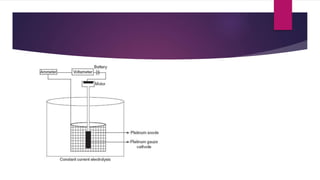
 A typical voltammetric cell shown below, has a working electrode, reference
electrode and an auxillary electrode and contains the solution to be analysed.
Electrogravimetry
 Suppose a cell has two inert, solid electrodes and a reference electrode, which dip into
an aqueous solution containing copper ions.
 The reaction that occurs is:
Cu2+ + H2O = Cu(s) + 1⁄2 O2 + 2H+
 The copper is then deposited on the cathode and oxygen is evolved at theanode.
 This is the basis for Electrogravimetry, where the copper is completely deposited from
solution and the increase in weight of the cathode determined.
 The amount of metal plated is determined by the difference in the weight of the
electrode before nd after electroplating.
Types of electrogravimetry
 There are mainly two types of Electrogravimetry methods:
1. Constant current electrolysis: By name itself it indicates that the constant current
is applied for the electrons deposition.
 The instrument is composed of a cell and direct current source.
 A 6 V battery, an ammeter and a voltammeter are used. The voltage applied is
controlled by a resistor.
Types of electrogravimetry
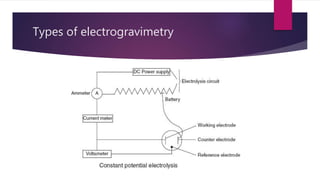
2. Constant potential electrolysis: In this method, the potential of the cathode is
controlled. It consists of two independent electrode circuits that are connected with a
common electrode.
For the better results, three electrode systems are used;
1. Working electrode: used for the deposition of the sample
2. Counter electrode: used as a current sink.
3. Reference electrode: maintains the fixed potential despite the changes in solution
components.
Types of electrogravimetry
Volatilization gravimetry
 Volatilization gravimetry is a mass analysis method that uses thermal or chemical
energy to separate substances in order to measure their masses.
 The thermal or chemical energy is used to convert some solid reactant molecules
into gaseous molecules.
 The gaseous molecules are usually liberated from the solid quite easily because
they are volatile and can be evaporated relatively easily.
 The heating or chemical decomposition separates out any volatile compounds,
which results in a change in mass that we can measure.
Volatilzation gravimetry
 The most important application of volatilization gravimetry is for the elemental
analysis of organic materials.
 During combustion with pure O2, many elements, such as carbon and hydrogen,
are released as gaseous combustion products, such as CO2(g) and H2O(g)
 Passing the combustion products through pre-weighed tubes containing selective
absorbents and measuring the increases in mass provides a direct analysis for the
mass of carbon and hydrogen in the organic material.
Volatilzation gravimetry
 In this method, the constituents are decomposed due to volatilization at a suitable
temperature.The residual product is then collected & weighed.
 The mass of the product is determined indirectly from the loss in the weight of the
sample e.g. in the determination of sodium bicarbonate NaHCO3, from a mixture
of NaHCO3 & Na2CO3, the weight sample is heated strongly to convert NaHCO3
into stable Na2CO3.
 By the loss in weight, the amount of sodium bicarbonate can be
obtained.precipitation gravimetry method
Precipitation gravimetry
 Precipitation gravimetry is an analytical technique that uses a precipitation
reaction to separate ions from a solution.
 The chemical that is added to cause the precipitation is called the precipitant or
precipitating agent eg sodiuim chloride.
 The solid precipitate eg Siliver chloride can be separated from the liquid
components using filtration, and the mass of the solid can be used along with the
balanced chemical equation to calculate the amount or concentration of ionic
compounds in solution.
 A precipitate is a solid that forms out of solution.
Precipitation gravimetry
 A common example is that of the mixing of two clear solutions:
 Silver nitrate (AgNO3)- analyte
 Sodium chloride (NaCl)- Precipitating agent
 The precipitate forms because the solid (AgCl) is insoluble in water. That is true
for all precipitates.
Thermogravimetry
 Thermogravimetric analysis or thermal gravimetric analysis (TGA) is technique
that measures the weight changes of the sample at agiven time and temperature .
 A method of thermal analysis in which changes in physical and chemical
properties of materials are being observed as a result of increase in temperature.
 It is a method of thermal analysis in which the mass of a sample is measured over
time as the temperature changes. This measurement provides information about
physical phenomena.
Thermogravimetry
 Here samples are heated and changes in the mass samples are recorded.
 Basic principle in this method technique in which the mass of the sample is monitored
against time or temperature while the temperature of the sample, in a specified
atmosphere, is programmed.
 It records over time both the weight of the specimen and the temperature of a small
oven until the specimen reaches a constant weight, i.e. from mM to mO.
 The continuous record shows anomalies in water release and the temperature at which
the anomalies had occurred (e.g. release of crystallization water or condensation
reactions), or the onset of degradation mechanisms with emission of gases (e.g.
emission of CO2, NH3).
 The TGA apparatus can be connected with a computer for special data processing
and analysis.TGA is more sophisticated than gravimetry because provides
elements to interpret the final reading, is faster, and requires smaller specimens.
Applications of gravimetric analysis
 To determine the mineral content like fluoride, mercury, calcium, etc of drinking
water and waste water.
 To determine total suspended solids in water.
 To determine the amount of fat in milk can be done by gravimetric analysis.
Applications of gravimetric analysis
 Used to calibrate other instruments because this technique can easily provide
precise and widely correct data.
 Used in the gold industry to make sure that gold content in your jewellery is true
to the jewellery shop seller's description.
 Nutritional information tables on foods printed in their package because many of
the components are analytical in the lab and percentage composition measured
by mass.
 To determine the nickel content of stainless steel.
Advantages of gravimetric analysis.
 Volatilisation gravimetry is important in determining inorganic content of an
organic material e.g. in polymers. After weighing the sample, it’s placed in a
crucible, organic material removed by combustion leaving inorganic ash.
 Electrogravimetry is applied in separation of one species in solution and
electroplating e.g. in electrochemical processes.
Factors affecting solubility of a precipitate.
Effect of acids on the solubility of the
precipitate
 Solubility of a sparingly soluble salt of a strong acid increases upon addition of a
strong acid.
 This effect is similar to salt effect. The addition of strong acid increases the ionic
strength of the solution and hence decreases the acidity coefficients of both ions
of the sparingly soluble salt.
 Solubility of the salt must increase in order that the activity product may be kept
constant.
Effect of temperature on solubility of
precipitate.
 From the solubility curves in the figure, it is seen that the solubility of a precipitate,
in general increases with rise in temperature.
 For some substances, the effect is small while for others, it is large.
 The dissociation of a solute is mostly on endothermic process, so the solubility
product constant increases as the temperature is increased.
 This also increases the solubility of the solute.For example, the solubility of in
water at is mg per litre. But the solubility of Barium sulphate at mg per
litre.Whenever possible, it is advantageous to filter while the solution is hot. The
solubility of a foreign substance is more than the solubility of the precipitate in
hot solution.
Effect of the solvent on the solubility of a
precipitate
 A solvent has a large effect upon solubility of a solute.
 Generally, polar solutes are more soluble in polar solvents and non-polar solutes
are soluble in non- polar solvents.
 Most of the inorganic salts are ionic and therefore, more soluble in polar solvents,
suchas water than in non- polar solvents such as benzene or carbon tetrachloride.
 In general, the solubility of inorganic compound is reduced when an organic
solvent like acetone, ethyl alcohol, methyl alcohol is added to water.For example,
the addition of about 20% by volume of ethyl alcohol reduces the solubility of
lead sulphate in water to a large extend. This permits the quantitative separation
of lead sulphate.
Common ion effect
 The solubility of a salt is less in a solution containing ions in common with that of the
salt in water provided the equilibrium is not disturbed by the formation of complex
ions this is known as common ion effect.
 The solubility of precipitate is decreased by the presence of other ions in the solution
common with the precipitate. E.g. during the precipitation of Ag+ ions from an
aqueous solution containing excess of Cl- ions, even small quantity of Ag+ ions in the
solution can get readily precipitated as Cl-ions are present in excess. product, Ksp of
AgCl is constant, Ksp = [Ag+] [Cl-]In some cases excess of precipitant decreases the
solubility of precipitate but in some cases it increases.
 In some gravimetric estimation, organic reagents are used as precipitant which are
prepared in non-polar organic solvents. E.g. dimethylglyoximate (DMG) for
precipitation of nckel present in solution.
Uncommon or Diverse Ion Effect
 Solubility of a sparingly soluble salt increases in presence of foreign ion, that is
ions which are not common to those of the salt. E.g. Solubility of BaSO4 is
increased by 70% in 0.01M solution of potassium nitrate than in water. Potassium
nitrate is strong electrolyte and highly soluble in water and its solution contains a
high conc. of ions.
 This results increase of ionic strength of the solution.
 The activity ‘a’ is related to the molar concentration ‘c’ by the activity coefficient ‘γ’
as a = c * γ
 e.g. solubility product Ksp for AgCl is written as Ksp = a Ag+ * a Cl- = [cAg+ * γ
Ag+] x [cCl- * γ Cl-]
Effect of PH
 Solubility of substance depends on the pH of the solution from which the salt is
precipitate.Solubility of the precipitate of salts of strong acids such as BaSO4, AgCl
is unaffected, but that of salts of weak acids is affected considerably.
 E.g. precipitate of oxalates, carbonates, phosphates dissolves in the presence of
excess of acid
References

Gravimetry.pptx

  • 1.
    MUNI UNIVERSITY FACULTY OFEDUCATION DEPARTMENT OF CHEMISTRY CHEM2201: INTRODUCTORY ANALYTICAL CHEMISTRY GROUP ASSIGNMENT: GROUP 3
  • 2.
    GROUP MEMBERS 1. MaberiHassani 2. Natweta Syson 3. Yanduru Milka 4. Katuhaise Sharon 5. Kyaterekera Grace 6. Kitooke Simon peter
  • 3.
    What is gravimetricanalysis?  Gravimetric analysis is a technique through which the amount of an analyte (the ion being analyzed) can be determined through the measurement of mass. Gravimetric analyses depend on comparing the masses of two compounds containing the analyte.  The principle behind gravimetric analysis is that the mass of an ion in a pure compound can be determined and then used to find the mass percent of the same ion in a known quantity of an impure compound.
  • 4.
    In order forthe analysis to be accurate, certain conditions must be met:  The ion being analyzed must be completely precipitated..  The precipitate must be a pure compound.  The precipitate must be easily filtered. After appropriate dissolution of the sample the following steps should be followed for successful gravimetric procedure:
  • 5.
    1.Preparation of asolution. This may involve several steps including;  adjustment of the pH of the solution in order for the precipitate to occur quantitatively and get a precipitate of desired properties,  Removing interferences,  adjusting the volume of the sample to suit the amount of precipitating agent to be added.
  • 6.
    2. Precipitation  Thisrequires addition of a precipitating agent solution to the sample solution.  Upon addition of the first drops of the precipitating agent, supersaturation occurs, then nucleation starts to occur where every few molecules of precipitate aggregate together forming a nucleus.  At this point, addition of extra precipitating agent will either form new nuclei or will build up on existing nuclei to give a precipitate. This can be predicted by Von Weimarn ratio where, according to this relation the particle size is inversely proportional to a quantity called the relative supersaturation whereRelative supersaturation = (Q – S)/S
  • 7.
     The Qis the concentration of reactants before precipitation, S is the solubility of precipitate in the medium from which it is being precipitated.  Therefore, to get particle growth instead of further nucleation we must make the relative supersaturation ratio as small as possible.The optimum conditions for precipitation which make the supersaturation low are: a) Precipitation using dilute solutions to decrease Q b) Slow addition of precipitating agent to keep Q as low as possible c) Stirring the solution during addition of precipitating agent to avoid concentration sitekeep Q lowl
  • 8.
    d) Increase solubilityby precipitation from hot solution . e). Adjust the pH to increase S, but not too much increase np as we do not want to lose precipitate by dissolution f) Usually add a little excess of the precipitating agent for quantitative precipitation and check for completeness of the precipitation. 3. Digestion of the precipitate  The precipitate is left hot (below boiling) for 30 min to one hour for the particles to be digested. Digestion involves dissolution of small particles and reprecipitation on larger ones resulting in particle growth and better precipitate characteristics.
  • 9.
    Digestion of theprecipitate  This process is called Ostwald ripening.  Digestion forces the small colloidal particles to agglomerate which decreases their surface area and thus adsorption.  Individual particles repel each other keeping the colloidal properties of the precipitate. Particle coagulation can be forced by either digestion or addition of a high concentration of a diverse ions strong electrolytic solution in order to shield the charges on colloidal particles and force agglomeration. Usually, coagulated particles return to the colloidal state if washed with water, a process called peptization.
  • 10.
    4. Washing andFiltering the Precipitate  It is crucial to wash the precipitate thoroughly to remove all adsorbed species that would add to the weight of the precipitate.  One should be careful not to use too much water since part of the precipitate may be lost.  Also, in case of colloidal precipitates we should not use water as a washing solution since peptization would occur. In such situations dilute nitric acid, ammonium nitrate, or dilute acetic acid may be used. Usually, it is a good practice to check for the presence of precipitating agent in the filtrate of the final washing solution. The presence of precipitating agent means that extra washing is required. Filtration should be done in appropriate sized Gooch or ignition filter paper.
  • 11.
    5. Drying andIgnition  The purpose of drying (heating at about 120-150 oC in an oven) or ignition in a muffle furnace at temperatures ranging from 600-1200 oC is to get a material with exactly known chemical structure so that the amount of analyte can be accurately determined 6. Precipitation from Homogeneous Solution: To make Q minimum we can, in some situations, generate the precipitating agent in the precipitation medium rather than adding it. For example, to precipitate iron as the hydroxide, we dissolve urea in the sample. Heating of the solution generates hydroxide ions from the hydrolysis of urea. Hydroxide ions are generated at all points in solution and thus there are no sites of concentration. We can also adjust the rate of urea hydrolysis and thus control the hydroxide generation rate. This type of procedure can be very advantageous in case of colloidal precipitates.
  • 12.
     An exampleof a gravimetric analysis is the determination of chloride in a compound. In order to do a gravimetric analysis, a cation must be found that forms an insoluble compound with chloride. This compound must also be pure and easily filtered. The solubility rules indicate that Ag+, Pb2+, and Hg22+ form insoluble chlorides. Therefore silver chloride could be used to determine % Cl-, because it is insoluble (that is, about 99.9% of the silver is converted to AgCl) and it can be formed pure and is easily filtered.The following;
  • 13.
     Put enoughunknown into a weighing bottle with the lid on sideways and dry in the oven.  Cool in a desiccator.  Indirectly weigh some mass, determined to 0.1 mg, of unknown into beaker.Dissolve the unknown.  Add a precipiating agent to the solution.  Heat the solution(the solution on a hot plate to increase the particle size for easier filtering).  Test for complete precipitation by adding a drop of the precipitating agent and looking for any sign of precipitate.
  • 14.
     Filter thesolution using vacuum filtration.  Use a rubber policeman to make sure all the precipitate has been transferred from the beaker to the filter. It is important that the precipitate is quantitatively transferred to the filter.  If any remains in the beaker, the mass obtained will be inaccurate.Dry and weigh the precipitate.  Use stoichiometry to determine the mass of the ion being analyzed.Find percent by mass of analyte by dividing the mass of the anayte by the mass of the unknown.
  • 15.
    consider the examplebelow  The following calculations would be done for the gravimetric determination of chloride: Mass of sample of unknown chloride after drying: 0.0984 g Mass of AgCl precipitate: 0.2290 g One mole of AgCl contains one mole of Cl-. Therefore:(0.2290 g AgCl) / (143.323 g/mol) = 1.598 x 10⁻³ mol AgCl (1.598 x 10⁻³ mol AgCl) x (35.453 g/mol Cl) = 0.0566 g Cl(0.0566 g Cl) / (0.0984 g sample) x 100% = 57.57% Cl in unknown chloride sample
  • 16.
     If Pb2+had been used to precipitate the chloride, the calculuation would need to be modified to account for the fact that each mole off PbCl2 contains two moles of chloride. Lead would not be a good precipitating reagent, however, because PbCl2 is moderately soluble and therefore a small amount of chloride would remain in solution, rather than in the precipitate.
  • 17.
    Advantages of gravimetricanalysis  It is accurate and precise when using modern analytical balance.  Possible sources of error are readily checked since filtrates can be tested for completeness of precipitation and precipitates may be examined for the presence of impurities.  It is an absolute method; it involves direct measurement without any form of calibration being required.  Determination can be carried out with relatively inexpensive apparatus; the most expensive items are a muffle furnace and sometimes platinum crucibles.
  • 18.
    Advantages  Gravimetric analysiswas used to determine the atomic masses of many elements to six figure accuracy.  Gravimetry provides very little room for instrumental error and does not require a series of standards for calculation of an unknown.
  • 19.
    Disadvantage of Gravimetricmethod  The chief disadvantage is that it requires meticulous time consuming.  The chemist often prefers modern instrumental methods when they can be used.  Gravimetric analysis usually only provides for the analysis of a single element, or a limited group of elements, at a time.  Methods are often convoluted and a slight mis-step in a procedure can often mean disaster for the analysis (colloid formation in precipitation gravimetry, for example).  Gravimetric analysis is based on measurement of mass
  • 20.
    Electrogravimetry  Electrogravimetry isa method in which a metal is quantitatively electroplated on to an electrode, usually platinum.  This method is used to separate and quantify ions of a substance, usually a metal.  In this process, the analyte solution is electrolyzed.  The main principle involved in this method is the deposition of the solid on an electrode from the analyte solution.
  • 21.
    Electrogravimetry  This methodemploys two or three electrodes; 1. Working electrode, 2. Reference electrode 3. Auxiliary electrode.  The species to be determined undergoes oxidation or reduction at a working electrode.
  • 22.
     A typicalvoltammetric cell shown below, has a working electrode, reference electrode and an auxillary electrode and contains the solution to be analysed.
  • 23.
    Electrogravimetry  Suppose acell has two inert, solid electrodes and a reference electrode, which dip into an aqueous solution containing copper ions.  The reaction that occurs is: Cu2+ + H2O = Cu(s) + 1⁄2 O2 + 2H+  The copper is then deposited on the cathode and oxygen is evolved at theanode.  This is the basis for Electrogravimetry, where the copper is completely deposited from solution and the increase in weight of the cathode determined.  The amount of metal plated is determined by the difference in the weight of the electrode before nd after electroplating.
  • 24.
    Types of electrogravimetry There are mainly two types of Electrogravimetry methods: 1. Constant current electrolysis: By name itself it indicates that the constant current is applied for the electrons deposition.  The instrument is composed of a cell and direct current source.  A 6 V battery, an ammeter and a voltammeter are used. The voltage applied is controlled by a resistor.
  • 26.
    Types of electrogravimetry 2.Constant potential electrolysis: In this method, the potential of the cathode is controlled. It consists of two independent electrode circuits that are connected with a common electrode. For the better results, three electrode systems are used; 1. Working electrode: used for the deposition of the sample 2. Counter electrode: used as a current sink. 3. Reference electrode: maintains the fixed potential despite the changes in solution components.
  • 27.
  • 28.
    Volatilization gravimetry  Volatilizationgravimetry is a mass analysis method that uses thermal or chemical energy to separate substances in order to measure their masses.  The thermal or chemical energy is used to convert some solid reactant molecules into gaseous molecules.  The gaseous molecules are usually liberated from the solid quite easily because they are volatile and can be evaporated relatively easily.  The heating or chemical decomposition separates out any volatile compounds, which results in a change in mass that we can measure.
  • 29.
    Volatilzation gravimetry  Themost important application of volatilization gravimetry is for the elemental analysis of organic materials.  During combustion with pure O2, many elements, such as carbon and hydrogen, are released as gaseous combustion products, such as CO2(g) and H2O(g)  Passing the combustion products through pre-weighed tubes containing selective absorbents and measuring the increases in mass provides a direct analysis for the mass of carbon and hydrogen in the organic material.
  • 30.
    Volatilzation gravimetry  Inthis method, the constituents are decomposed due to volatilization at a suitable temperature.The residual product is then collected & weighed.  The mass of the product is determined indirectly from the loss in the weight of the sample e.g. in the determination of sodium bicarbonate NaHCO3, from a mixture of NaHCO3 & Na2CO3, the weight sample is heated strongly to convert NaHCO3 into stable Na2CO3.  By the loss in weight, the amount of sodium bicarbonate can be obtained.precipitation gravimetry method
  • 31.
    Precipitation gravimetry  Precipitationgravimetry is an analytical technique that uses a precipitation reaction to separate ions from a solution.  The chemical that is added to cause the precipitation is called the precipitant or precipitating agent eg sodiuim chloride.  The solid precipitate eg Siliver chloride can be separated from the liquid components using filtration, and the mass of the solid can be used along with the balanced chemical equation to calculate the amount or concentration of ionic compounds in solution.  A precipitate is a solid that forms out of solution.
  • 32.
    Precipitation gravimetry  Acommon example is that of the mixing of two clear solutions:  Silver nitrate (AgNO3)- analyte  Sodium chloride (NaCl)- Precipitating agent  The precipitate forms because the solid (AgCl) is insoluble in water. That is true for all precipitates.
  • 33.
    Thermogravimetry  Thermogravimetric analysisor thermal gravimetric analysis (TGA) is technique that measures the weight changes of the sample at agiven time and temperature .  A method of thermal analysis in which changes in physical and chemical properties of materials are being observed as a result of increase in temperature.  It is a method of thermal analysis in which the mass of a sample is measured over time as the temperature changes. This measurement provides information about physical phenomena.
  • 34.
    Thermogravimetry  Here samplesare heated and changes in the mass samples are recorded.  Basic principle in this method technique in which the mass of the sample is monitored against time or temperature while the temperature of the sample, in a specified atmosphere, is programmed.  It records over time both the weight of the specimen and the temperature of a small oven until the specimen reaches a constant weight, i.e. from mM to mO.  The continuous record shows anomalies in water release and the temperature at which the anomalies had occurred (e.g. release of crystallization water or condensation reactions), or the onset of degradation mechanisms with emission of gases (e.g. emission of CO2, NH3).
  • 35.
     The TGAapparatus can be connected with a computer for special data processing and analysis.TGA is more sophisticated than gravimetry because provides elements to interpret the final reading, is faster, and requires smaller specimens. Applications of gravimetric analysis  To determine the mineral content like fluoride, mercury, calcium, etc of drinking water and waste water.  To determine total suspended solids in water.  To determine the amount of fat in milk can be done by gravimetric analysis.
  • 36.
    Applications of gravimetricanalysis  Used to calibrate other instruments because this technique can easily provide precise and widely correct data.  Used in the gold industry to make sure that gold content in your jewellery is true to the jewellery shop seller's description.  Nutritional information tables on foods printed in their package because many of the components are analytical in the lab and percentage composition measured by mass.  To determine the nickel content of stainless steel.
  • 37.
    Advantages of gravimetricanalysis.  Volatilisation gravimetry is important in determining inorganic content of an organic material e.g. in polymers. After weighing the sample, it’s placed in a crucible, organic material removed by combustion leaving inorganic ash.  Electrogravimetry is applied in separation of one species in solution and electroplating e.g. in electrochemical processes. Factors affecting solubility of a precipitate.
  • 38.
    Effect of acidson the solubility of the precipitate  Solubility of a sparingly soluble salt of a strong acid increases upon addition of a strong acid.  This effect is similar to salt effect. The addition of strong acid increases the ionic strength of the solution and hence decreases the acidity coefficients of both ions of the sparingly soluble salt.  Solubility of the salt must increase in order that the activity product may be kept constant.
  • 39.
    Effect of temperatureon solubility of precipitate.
  • 40.
     From thesolubility curves in the figure, it is seen that the solubility of a precipitate, in general increases with rise in temperature.  For some substances, the effect is small while for others, it is large.  The dissociation of a solute is mostly on endothermic process, so the solubility product constant increases as the temperature is increased.  This also increases the solubility of the solute.For example, the solubility of in water at is mg per litre. But the solubility of Barium sulphate at mg per litre.Whenever possible, it is advantageous to filter while the solution is hot. The solubility of a foreign substance is more than the solubility of the precipitate in hot solution.
  • 41.
    Effect of thesolvent on the solubility of a precipitate  A solvent has a large effect upon solubility of a solute.  Generally, polar solutes are more soluble in polar solvents and non-polar solutes are soluble in non- polar solvents.  Most of the inorganic salts are ionic and therefore, more soluble in polar solvents, suchas water than in non- polar solvents such as benzene or carbon tetrachloride.  In general, the solubility of inorganic compound is reduced when an organic solvent like acetone, ethyl alcohol, methyl alcohol is added to water.For example, the addition of about 20% by volume of ethyl alcohol reduces the solubility of lead sulphate in water to a large extend. This permits the quantitative separation of lead sulphate.
  • 42.
    Common ion effect The solubility of a salt is less in a solution containing ions in common with that of the salt in water provided the equilibrium is not disturbed by the formation of complex ions this is known as common ion effect.  The solubility of precipitate is decreased by the presence of other ions in the solution common with the precipitate. E.g. during the precipitation of Ag+ ions from an aqueous solution containing excess of Cl- ions, even small quantity of Ag+ ions in the solution can get readily precipitated as Cl-ions are present in excess. product, Ksp of AgCl is constant, Ksp = [Ag+] [Cl-]In some cases excess of precipitant decreases the solubility of precipitate but in some cases it increases.  In some gravimetric estimation, organic reagents are used as precipitant which are prepared in non-polar organic solvents. E.g. dimethylglyoximate (DMG) for precipitation of nckel present in solution.
  • 43.
    Uncommon or DiverseIon Effect  Solubility of a sparingly soluble salt increases in presence of foreign ion, that is ions which are not common to those of the salt. E.g. Solubility of BaSO4 is increased by 70% in 0.01M solution of potassium nitrate than in water. Potassium nitrate is strong electrolyte and highly soluble in water and its solution contains a high conc. of ions.  This results increase of ionic strength of the solution.  The activity ‘a’ is related to the molar concentration ‘c’ by the activity coefficient ‘γ’ as a = c * γ  e.g. solubility product Ksp for AgCl is written as Ksp = a Ag+ * a Cl- = [cAg+ * γ Ag+] x [cCl- * γ Cl-]
  • 44.
    Effect of PH Solubility of substance depends on the pH of the solution from which the salt is precipitate.Solubility of the precipitate of salts of strong acids such as BaSO4, AgCl is unaffected, but that of salts of weak acids is affected considerably.  E.g. precipitate of oxalates, carbonates, phosphates dissolves in the presence of excess of acid
  • 45.