


M r. N i t h i y a n a n d a m . T, M . S c i n P s y c h i a t r i c N u r s i n g ,
 : n i t h i y u d a y @ g m a i l . c o m
INTRODUCTION
 Viva Voce is a Latin phrase literally meaning with Living
Voice but is most often translated by Word of Mouth.
 It is also termed as an oral examination which consists of a
dialogue between the examiner and a student where the
examiner ask question and the student replies.
 The examiner may ask short open questions, multiple choice
questions or a series of other type of questions not
necessarily related to each other.
…CONTD/-
In Nursing,
 Viva voce is generally used to supplement the practical
examination where two examiners, i.e., internal & external, ask
several questions related to a particular subject matter.
 The viva voce might form a part of the validated assessment
for a course, assessed by am oral examination.
 In these situations, the viva voce is a useful tool that assists in
authenticating that the student has got enough knowledge
the subject matter.
PURPOSES OF VIVA VOCE
 To assess the students ability to communicate with another
person.
 To supplement the information obtained through other
evaluation techniques.
 To use stimulation methods like role play & telephone
conversation.
 To identify and analyse the students presence of mind.
 To evaluate the students spontaneity and mannerism.
…CONTD/-
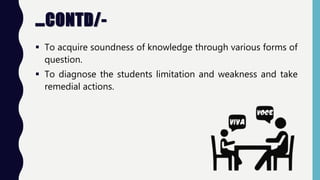
 To acquire soundness of knowledge through various forms of
question.
 To diagnose the students limitation and weakness and take
remedial actions.
PRINCIPLES TO CONDUCT VIVA VOCE
 The viva should not be limited to a single topic but should
cover a range of different issues to avoid the results of the
viva being skewed by selecting a topic which the candidate
can answer exceptionally well or about which he / she knows
nothing of.
 All questions should be strictly relevant to the purpose of
the viva.
 Do not use long introduction to questions.
 Examiners should talk as little as possible during the viva.
…CONTD/-
 The chair of the examiners must remain in-charge of the
session & must deal appropriately with any problem
candidate or difficult situation.
 When the last question is being asked, allow the student to
complete his / her answer and end the session formally.
 Viva voce examinations should not normally exceed 30
minutes.
 Candidates should be examined individually.
…CONTD/-
 Candidates should be given adequate notice of the
possibility of being called to attend the viva, and this should
normally not be less than 24 hours.
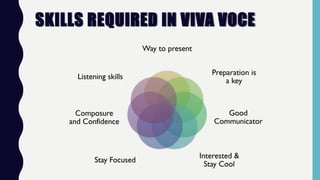
SKILLS REQUIRED IN VIVA VOCE
ADVANTAGES OF VIVA VOCE
 Provides direct contact with the candidates to assess their
communication, presentation skills & overall impression.
 Provides opportunities to mitigate circumstances into
account.
 Provides Flexibility in moving the candidates from wrong to
weak points.
 Make students formulate replies without cues and the
reaction is observed for a specific stimulus.
…CONTD/-
 Facilitates simultaneous assessment by two or more
examiners.
 Provides an opportunity for the examiner to get feedback on
on the performance of the students and the university.
DISADVANTAGES OF VIVA VOCE
 Lack of standardization, objectivity and reproducibility of the
result.
 Permits favouritism and cannot be used for future references.
 Suffers from undue influence of
irrelevant factors.
 Costly in terms of professional time.
Do you have any Queries ???
Viva voce

Viva voce

  • 1.
    M r. Ni t h i y a n a n d a m . T, M . S c i n P s y c h i a t r i c N u r s i n g ,  : n i t h i y u d a y @ g m a i l . c o m
  • 2.
    INTRODUCTION  Viva Voceis a Latin phrase literally meaning with Living Voice but is most often translated by Word of Mouth.  It is also termed as an oral examination which consists of a dialogue between the examiner and a student where the examiner ask question and the student replies.  The examiner may ask short open questions, multiple choice questions or a series of other type of questions not necessarily related to each other.
  • 3.
    …CONTD/- In Nursing,  Vivavoce is generally used to supplement the practical examination where two examiners, i.e., internal & external, ask several questions related to a particular subject matter.  The viva voce might form a part of the validated assessment for a course, assessed by am oral examination.  In these situations, the viva voce is a useful tool that assists in authenticating that the student has got enough knowledge the subject matter.
  • 4.
    PURPOSES OF VIVAVOCE  To assess the students ability to communicate with another person.  To supplement the information obtained through other evaluation techniques.  To use stimulation methods like role play & telephone conversation.  To identify and analyse the students presence of mind.  To evaluate the students spontaneity and mannerism.
  • 5.
    …CONTD/-  To acquiresoundness of knowledge through various forms of question.  To diagnose the students limitation and weakness and take remedial actions.
  • 6.
    PRINCIPLES TO CONDUCTVIVA VOCE  The viva should not be limited to a single topic but should cover a range of different issues to avoid the results of the viva being skewed by selecting a topic which the candidate can answer exceptionally well or about which he / she knows nothing of.  All questions should be strictly relevant to the purpose of the viva.  Do not use long introduction to questions.  Examiners should talk as little as possible during the viva.
  • 7.
    …CONTD/-  The chairof the examiners must remain in-charge of the session & must deal appropriately with any problem candidate or difficult situation.  When the last question is being asked, allow the student to complete his / her answer and end the session formally.  Viva voce examinations should not normally exceed 30 minutes.  Candidates should be examined individually.
  • 8.
    …CONTD/-  Candidates shouldbe given adequate notice of the possibility of being called to attend the viva, and this should normally not be less than 24 hours.
  • 9.
  • 10.
    ADVANTAGES OF VIVAVOCE  Provides direct contact with the candidates to assess their communication, presentation skills & overall impression.  Provides opportunities to mitigate circumstances into account.  Provides Flexibility in moving the candidates from wrong to weak points.  Make students formulate replies without cues and the reaction is observed for a specific stimulus.
  • 11.
    …CONTD/-  Facilitates simultaneousassessment by two or more examiners.  Provides an opportunity for the examiner to get feedback on on the performance of the students and the university.
  • 12.
    DISADVANTAGES OF VIVAVOCE  Lack of standardization, objectivity and reproducibility of the result.  Permits favouritism and cannot be used for future references.  Suffers from undue influence of irrelevant factors.  Costly in terms of professional time.
  • 13.
    Do you haveany Queries ???