 1 There are some advantages in using
translation to teach meaning, but some
disadvantages, too.
 2 I think it's really important for my learners to
keep a vocabulary notebook in which they write
the word, its meaning(s), its pronunciation, its
collocations, etc.
 3 Getting to know words is like getting to know
a friend - you learn more about them bit by bit.
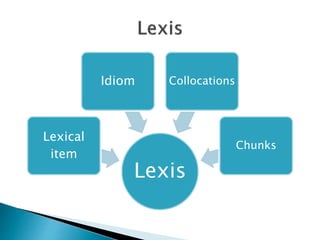
Lexis
Lexical
item
Idiom Collocations
Chunks
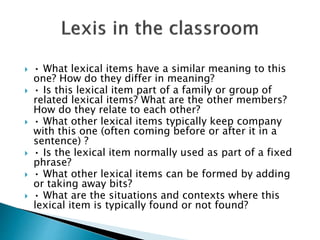
 • What lexical items have a similar meaning to this
one? How do they differ in meaning?
 • Is this lexical item part of a family or group of
related lexical items? What are the other members?
How do they relate to each other?
 • What other lexical items typically keep company
with this one (often coming before or after it in a
sentence) ?
 • Is the lexical item normally used as part of a fixed
phrase?
 • What other lexical items can be formed by adding
or taking away bits?
 • What are the situations and contexts where this
lexical item is typically found or not found?
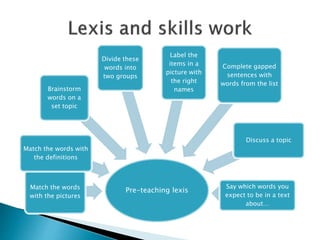
Pre-teaching lexisMatch the words
with the pictures
Match the words with
the definitions
Brainstorm
words on a
set topic
Divide these
words into
two groups
Label the
items in a
picture with
the right
names
Complete gapped
sentences with
words from the list
Discuss a topic
Say which words you
expect to be in a text
about…
Deal with an item when a student
specifically asks about it;
Give brief, to-the-point explanations or
translations, rather than detailed
presentations;
Offer help quietly to the one or two
students who ask, rather than to the
whole class;
Sometimes refuse help and tell students to
do their best without knowing some items.
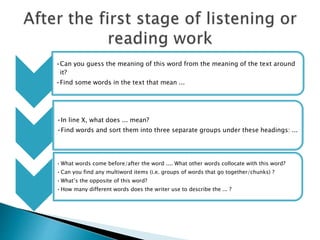
•Can you guess the meaning of this word from the meaning of the text around
it?
•Find some words in the text that mean ...
•In line X, what does ... mean?
•Find words and sort them into three separate groups under these headings: ...
•What words come before/after the word .... What other words collocate with this word?
•Can you find any multiword items (i.e. groups of words that go together/chunks) ?
•What’s the opposite of this word?
•How many different words does the writer use to describe the ... ?
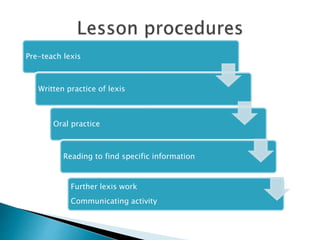
Pre-teach lexis
Written practice of lexis
Oral practice
Reading to find specific information
Further lexis work
Communicating activity
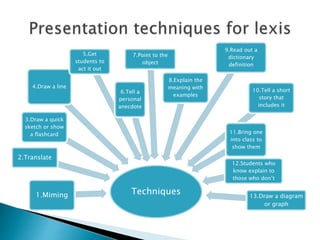
Techniques1.Miming
2.Translate
3.Draw a quick
sketch or show
a flashcard
4.Draw a line
5.Get
students to
act it out
6.Tell a
personal
anecdote
7.Point to the
object
8.Explain the
meaning with
examples
9.Read out a
dictionary
definition
10.Tell a short
story that
includes it
11.Bring one
into class to
show them
12.Students who
know explain to
those who don’t
13.Draw a diagram
or graph
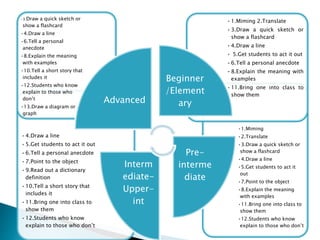
•1.Miming
•2.Translate
•3.Draw a quick sketch or
show a flashcard
•4.Draw a line
•5.Get students to act it
out
•7.Point to the object
•8.Explain the meaning
with examples
•11.Bring one into class to
show them
•12.Students who know
explain to those who don’t
•4.Draw a line
•5.Get students to act it out
•6.Tell a personal anecdote
•7.Point to the object
•9.Read out a dictionary
definition
•10.Tell a short story that
includes it
•11.Bring one into class to
show them
•12.Students who know
explain to those who don’t
•1.Miming 2.Translate
•3.Draw a quick sketch or
show a flashcard
•4.Draw a line
• 5.Get students to act it out
•6.Tell a personal anecdote
•8.Explain the meaning with
examples
•11.Bring one into class to
show them
•3.Draw a quick sketch or
show a flashcard
•4.Draw a line
•6.Tell a personal
anecdote
•8.Explain the meaning
with examples
•10.Tell a short story that
includes it
•12.Students who know
explain to those who
don’t
•13.Draw a diagram or
graph
Advanced
Beginner
/Element
ary
Pre-
interme
diate
Interm
ediate-
Upper-
int

Teaching lexis

  • 2.
     1 Thereare some advantages in using translation to teach meaning, but some disadvantages, too.  2 I think it's really important for my learners to keep a vocabulary notebook in which they write the word, its meaning(s), its pronunciation, its collocations, etc.  3 Getting to know words is like getting to know a friend - you learn more about them bit by bit.
  • 3.
  • 4.
     • Whatlexical items have a similar meaning to this one? How do they differ in meaning?  • Is this lexical item part of a family or group of related lexical items? What are the other members? How do they relate to each other?  • What other lexical items typically keep company with this one (often coming before or after it in a sentence) ?  • Is the lexical item normally used as part of a fixed phrase?  • What other lexical items can be formed by adding or taking away bits?  • What are the situations and contexts where this lexical item is typically found or not found?
  • 5.
    Pre-teaching lexisMatch thewords with the pictures Match the words with the definitions Brainstorm words on a set topic Divide these words into two groups Label the items in a picture with the right names Complete gapped sentences with words from the list Discuss a topic Say which words you expect to be in a text about…
  • 6.
    Deal with anitem when a student specifically asks about it; Give brief, to-the-point explanations or translations, rather than detailed presentations; Offer help quietly to the one or two students who ask, rather than to the whole class; Sometimes refuse help and tell students to do their best without knowing some items.
  • 7.
    •Can you guessthe meaning of this word from the meaning of the text around it? •Find some words in the text that mean ... •In line X, what does ... mean? •Find words and sort them into three separate groups under these headings: ... •What words come before/after the word .... What other words collocate with this word? •Can you find any multiword items (i.e. groups of words that go together/chunks) ? •What’s the opposite of this word? •How many different words does the writer use to describe the ... ?
  • 8.
    Pre-teach lexis Written practiceof lexis Oral practice Reading to find specific information Further lexis work Communicating activity
  • 9.
    Techniques1.Miming 2.Translate 3.Draw a quick sketchor show a flashcard 4.Draw a line 5.Get students to act it out 6.Tell a personal anecdote 7.Point to the object 8.Explain the meaning with examples 9.Read out a dictionary definition 10.Tell a short story that includes it 11.Bring one into class to show them 12.Students who know explain to those who don’t 13.Draw a diagram or graph
  • 10.
    •1.Miming •2.Translate •3.Draw a quicksketch or show a flashcard •4.Draw a line •5.Get students to act it out •7.Point to the object •8.Explain the meaning with examples •11.Bring one into class to show them •12.Students who know explain to those who don’t •4.Draw a line •5.Get students to act it out •6.Tell a personal anecdote •7.Point to the object •9.Read out a dictionary definition •10.Tell a short story that includes it •11.Bring one into class to show them •12.Students who know explain to those who don’t •1.Miming 2.Translate •3.Draw a quick sketch or show a flashcard •4.Draw a line • 5.Get students to act it out •6.Tell a personal anecdote •8.Explain the meaning with examples •11.Bring one into class to show them •3.Draw a quick sketch or show a flashcard •4.Draw a line •6.Tell a personal anecdote •8.Explain the meaning with examples •10.Tell a short story that includes it •12.Students who know explain to those who don’t •13.Draw a diagram or graph Advanced Beginner /Element ary Pre- interme diate Interm ediate- Upper- int