Aims of theunit:
•By the end of the unit, participants will have:
•Examined and discussed lexis such as types of
meaning, word formation, word groupings
and register.
•Had practice in completing tasks in which
lexis is the testing focus.
3.
What is Lexis?
acrvbauylo
Lexis, is individual words, or sets of words, that
have a specific meaning. Ex: tree
Lexis is: “All the words of a language”.
Cambridge International Dictionary of English.
Vocabulary
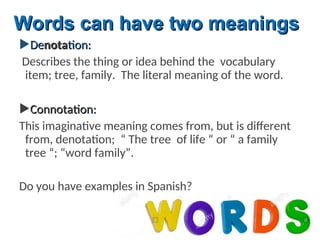
De
Denota
notation:
tion:
Describes the thingor idea behind the vocabulary
item; tree, family. The literal meaning of the word.
Connotation
Connotation:
:
This imaginative meaning comes from, but is different
from, denotation; “ The tree of life “ or “ a family
tree “; “word family”.
Do you have examples in Spanish?
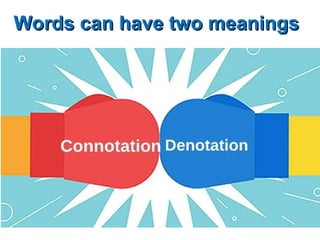
Words can have two meanings
Words can have two meanings
10.
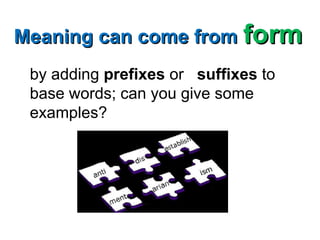
by adding prefixesor suffixes to
base words; can you give some
examples?
Meaning can come from
Meaning can come from form
form
11.
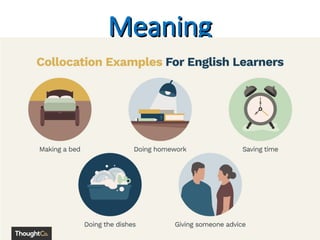
Meaning
Meaning
Colloca
Collocation
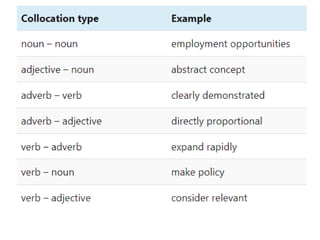
tions: are wordsthat often go together to
create a phrase in which the group of words has a
different meaning of each individual word.
Most collocations use verbs…
to take a shower
make trouble
come in
12.
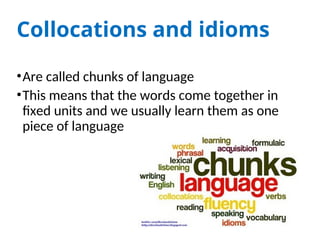
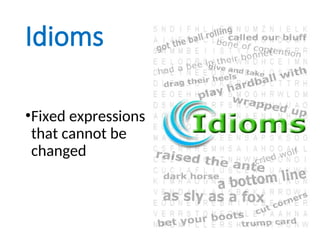
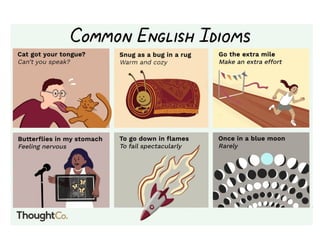
Collocations and idioms
•Arecalled chunks of language
•This means that the words come together in
fixed units and we usually learn them as one
piece of language
13.
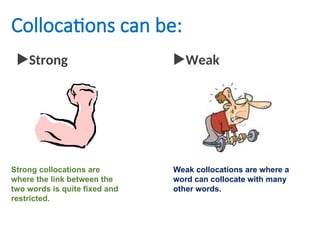
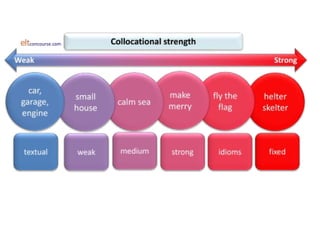
Collocations can be:
StrongWeak
Strong collocations are
where the link between the
two words is quite fixed and
restricted.
Weak collocations are where a
word can collocate with many
other words.
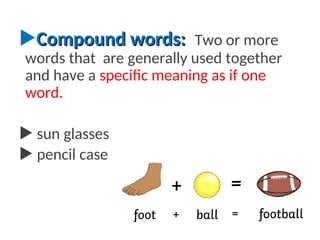
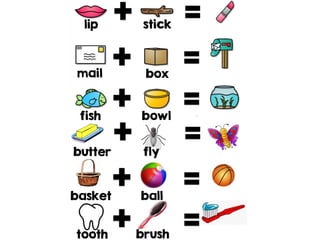
Compound words:
Compound words:Two or more
words that are generally used together
and have a specific meaning as if one
word.
sun glasses
pencil case
21.
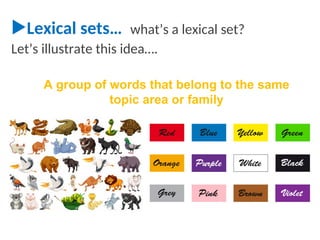
Lexical sets… what’sa lexical set?
Let’s illustrate this idea….
A group of words that belong to the same
topic area or family
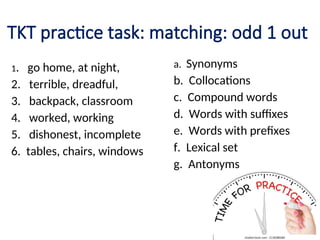
TKT practice task:matching: odd 1 out
1. go home, at night,
2. terrible, dreadful,
3. backpack, classroom
4. worked, working
5. dishonest, incomplete
6. tables, chairs, windows
a. Synonyms
b. Collocations
c. Compound words
d. Words with suffixes
e. Words with prefixes
f. Lexical set
g. Antonyms
25.
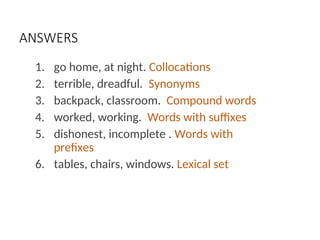
ANSWERS
1. go home,at night. Collocations
2. terrible, dreadful. Synonyms
3. backpack, classroom. Compound words
4. worked, working. Words with suffixes
5. dishonest, incomplete . Words with
prefixes
6. tables, chairs, windows. Lexical set
26.
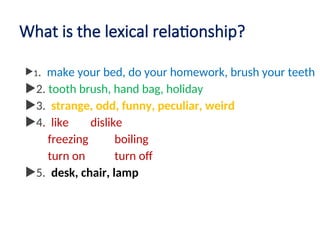
What is thelexical relationship?
1. make your bed, do your homework, brush your teeth
2. tooth brush, hand bag, holiday
3. strange, odd, funny, peculiar, weird
4. like dislike
freezing boiling
turn on turn off
5. desk, chair, lamp
27.
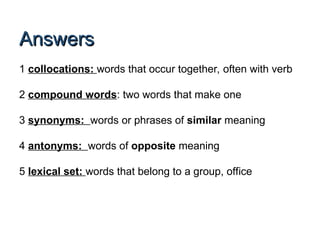
Answers
Answers
1 collocations: wordsthat occur together, often with verb
2 compound words: two words that make one
3 synonyms: words or phrases of similar meaning
4 antonyms: words of opposite meaning
5 lexical set: words that belong to a group, office
Key concepts andthe language
teaching classroom:
•Really knowing a word means knowing all its different
kinds of meanings.
•Knowing a word also involves understanding its form, i.e.
what part of speech it is, how it works gramatically, and
how it is pronounced and spelt.
•Whether we are learning our first or our second language,
it takes a long time before we fully know a word. We
often recognise a word before we can use it.
33.
Key concepts andthe language teaching
classroom
•Teachers need to introduce vocabulary items again
and again to learners, expanding gradually on their
meaning and their forms. This also increases the
chances of learners remembering the item.
REPETITION!
• We can introduce vocabulary items in reading and
listening before we ask learners to use the items.
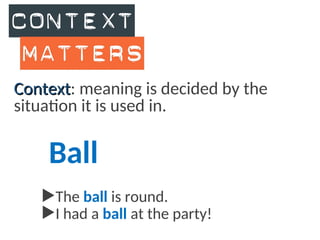
Context is important





![[RELO] Teaching Vocabulary](https://cdn.slidesharecdn.com/ss_thumbnails/vocabulary-131211134809-phpapp02-thumbnail.jpg?width=640&height=640&fit=bounds)


